Month: October 2007
India gyrates as World and his wife want in:James Saft
India gyrates as World and his wife want in:James Saft
(James Saft is a Reuters columnist. The opinions expressed are his own)
By James Saft
London, October 18 (Reuters) – Efforts by India to control massive flows of money into its markets have prompted two sharp falls and one new all-time high, all in two days. Welcome to emerging markets, the world’s new favourite asset class.
India on Wednesday shocked investors by announcing planned new curbs on investment in its equities by anonymous overseas funds, sparking a selloff in Bombay of as much as nine percent.
But after the panic selling, it was back to panic buying, followed shortly by more panic selling. India’s benchmark Sensex (.BSESN: Quote, Profile, Research) index hit another all-time high on Thursday before falling again to end the day 5 percent down.
The Sensex is now up 30 percent this year and almost 15 percent since the Federal Reserve cut rates in September.
Expect the wild ride to continue, as recent data show that the World, his wife, their milkman and the neighbourhood stray cat are all going long emerging markets at the same time.
A Merrill Lynch poll of global fund managers controlling $671 billion of assets showed a stampede into emerging markets in October. A total of 61 percent of funds were aggressively or moderately overweight emerging market equities, up 50 percent since August and the most since April 2004.
Twenty percent of funds were “aggressively overweight” emerging market stocks, compared to just 4 percent on U.S. shares and 1 percent on UK shares.
What’s more funds in all regions outside of emerging markets said they were looking for stocks with exposure to overseas demand, a strong indication that even those unable to buy emerging markets are seeking to get exposure to growth there.
Why? Investors are worried that growth in the developed world will be crimped by the bursting of the housing and credit bubbles and see emerging markets as the sole hope.
“People have become more pessimistic about the developed world and emerging markets are seen as the oasis,” said David Bowers, an independent consultant to Merrill Lynch on the survey.
“There is a cast-iron belief that emerging markets and China are bomb proof when it comes to the rest of the world slowing.”
“The bull case is that there is a shortage of organic growth anywhere else because companies have been run for cash and not for growth the past five years (in the developed world),” he said.
WORLD TO EMERGING MARKETS: MAKE MORE SECURITIES
India’s experience in the past couple of days is an object lesson in the distortions and strains this phenomenon is causing.
India is concerned about flows into its economy and share markets, partly because some of the flows are so-called hedge fund “hot money” and partly because it has driven a rise in the value of the rupee which is complicating Indian authorities’ attempts to manage the economy and monetary policy.
The Securities and Exchange Board of India said it would over 18 month wind down participatory note programmes, which are used by foreigners, often hedge funds, to invest in shares anonymously.
Foreign institutions have put more than $17 billion in Indian shares this year, as against a record $10.7 billion in 2005.
There is a lot of money that wants in, but not enough to invest in. Initial public offerings were $6.8 billion through September, a new record on even a full year basis, but you can expect that there will be much more securities issuance to come throughout emerging markets, and not just in equities.
A host of emerging market bonds have been launched to warm receptions in recent days, despite continuing difficulties in many other debt markets.
Sri Lanka, which is contending with a long-running rebellion and 17 percent inflation, found that not only was it able to make its debut issue, borrowing for a long five years, but that the $500 million deal drew commitments of $1.25 billion.
India included, it is very hard to ignore the possibility that we are seeing the latest relay in a long run of bubbles.
But, it is also true that the scope for productive and profitable investment in emerging markets is higher than in developed markets.
Look for lots of new issues, wild swings and continued outperformance.
(At the time of publication James Saft did not own any direct investments in securities mentioned in this article. He may be an owner indirectly as an investor in a fund)

How to become a courteous cell-phone user
How to become a courteous cell-phone user
19 Oct, 2007, 0503 hrs IST,
A cell-phone is a double-edged sword. While it has revolutionised our lives and made us a truly “global village”, you have to admit that it can be an irritant. Hark back to that grating ring-tone in the middle of a film or play. Like everything in life, there is a correct way to use that ubiquitous device.
Tips to make you a courteous user:
Business Meetings:
Before starting a meeting, put the phone in a silent mode or let your voice mail take the call. Generally, the person you are with takes priority over the one who is calling. If you are expecting an important call, inform your business associates ahead of time, step outside when you receive the call and keep it brief.
Ring Tones:
Although customised ring tones offer you a chance to express your personal style, they are inappropriate for business meetings.
Voice Mail:
During movies and music concerts, activate your voice mail.
Use Discretion:
Very often, one overhears intimate and confidential matters being discussed loudly on the cell phone, which is a strict no-no. Also, holding up the cashier queue while you are multi-tasking & taking your friend’s suggestion on the color to buy is rude.
Volume Control:
On the street, in the elevator, one hears people yelling into their phones. If you are unable to hear the caller, either move to a quieter area or one that offers better connectivity. In buses and trains, if people two rows away are staring at you take the hint — you are too loud.
Road Safety:
Hands-free reduces the risk but for longer conversations, pull into a parking area.
On Airplanes:
When the crew instructs to switch off the phone, resist the urge to make that one last call. Wait till the plane comes to complete halt before calling your chauffer.
Blackberry:
Suppress the urge to doodle or answer a quick email in a business meeting. Respond only if the matter is extremely urgent. Put the device in your bag, leaving it on the table is distracting when it receives a message.
Geojit Financial Services launches Mutual Funds online
Geojit Financial Services launches Mutual Funds online
16 Oct, 2007, 1813 hrs IST, PTI
KOCHI: Geojit, a leading brokerage firm, on Tuesday announced the launch of online investing in mutual funds.
The company has also entered into an agreement with SBI and Franklin Templeton Mutual funds, A P Kurian, chairman, Geojit Financial Services Ltd and Chairman of the Association of Mutual Funds in India told mediapersons here.
“The service will be available to all online customers of Geojit, except NRIs, in the first stage. In another ten months NRIs will also get the facility,” he said.
Customers can purchase, redeem and switch mutual fund schemes through Geojit’s trading portal. The new features also enable them to do non-financial transactions including updating registrars/AMCs, changing of bank accounts and changing of addresses etc, he said.
Kurian said the mutual fund (MF) industry is in a robust growth path, with Asset under Management of Rs 4.76 lakh crore at the end of September 2007, registering a 64 per cent growth over the year.
“There is a growing recognition of Mutual Funds as a suitable investment vehicle among households,” he said, adding that Geojit was promoting sale of MF schemes through its branches. Clients investing in Mutual Funds have registered a 67 per cent growth in the last one year.
C J George, Managing Director, Geojit said the initiative of selling MF’s through Internet was in line with the company’s continued focus to expand its reach through the medium.
Money Wise
Money Wise
21 Oct, 2007, 0000 hrs IST,Aman Dhall & Dheeraj Tiwari, TNN
Sunday ET spoke to industry leaders across segments to find out about their first nest eggs. ET tracks how these bosses managed their money, right from college days to the early stages of their career.
RESPECT FOR MONEY
Today, he may be managing one of the country’s largest insurance company. But for Gary R. Bennett, Managing Director & CEO, Max New York Life Insurance, success didn’t come on a silver platter. His success story is no less than a motivational book which speaks volumes on how can one survive and build a future against all odds.
“I learnt it from the book of life and life taught me some interesting financial lessons,” he says. Respect for money is what he feels is the first and the foremost lesson to be learnt when it comes to managing your finances. “I was on my own at a young age of seventeen.
I worked in a clerical position at a custom agency during the day to run my household and I doubled up as security guard in a hospital at night, to save something for future. Those were the hard times and it taught me the respect for money. I built inch-by-inch, accumulated wealth and at the age of 24, I was able to buy my first house,” he says.
According to him, one must have courage to dream, review and renew one’s goals and each one of us has the ability to make our dreams come true. “I never forget those years of struggle that laid the foundation for my financial success. And I am still building inch-by-inch for a better tomorrow,” he sums up.
MANAGE YOUR RESOURCES
Bijou Kurien, CEO, Reliance Retail, may now be spearheading the retail growth of the country but it was during the college days where he learnt to manage his resources effectively.
“I lived in Bangalore during my college life. Life as a student was an experience – dreams and aspirations, always running ahead of resources,” he recalls. Kurien feels that unlike today, in the ‘70s, diversions were few and music was the food of life. “Movies were fewer and viewing costs were reasonable. Food was limited to a few hang-outs on Brigade Road and Residency Road, which have given way to the glittery malls of today,” he says. Kurien finds a co-relation between the heady college days and the present economic jargons — “I had a frugal allowance. Personal discretionary capital expenditure had to be met out of savings in my revenue expenditure. Family could be depended on for other major capital purchases.
Financial planning was limited to a week, till the next handout. Budget allocation was driven by the head but spent by the heart. External commercial borrowings were limited to forgiving friends. But at the end, fiscal deficit was within reasonable limits.” But all in all, Kurien feels that managing your finances during the student life is an enriching experience which helps you both in your personal and professional life.
SET PRIORITIES
He handles the serious business of gaming. As COO, Zapak Digital Entertainment, Rohit Sharma feels that like a game one has to chalk out a strategy for success when it comes to financial planning. “At the early stages of the career a person generally doesn’t have a long term view of his investment plans and most investments are done with a short term gain in mind.
I feel it is important to prioritise at an early stage on both immediate and long-term return,” he says. Sharma in the early stage of his career started with investing in long term tools such as insurance. “Also being part of the booming real estate economy I invested in property, whereas most people tend to invest in property at later stages,” he reveals.
He feels that his However my decision to invest in real estate market in NCR at an early stage in his career has given him very high returns. “During my early days as a professional we did not have very successful returns on investments in Mutual funds, but I feel that in the present economy young professionals should invest in mutual funds (with 3-years window) and that get yield high returns,” he adds. Sharma emphasise that the basic thumb rule for investments should be to always stretch yourself more than you actually invest. It always pays in the long run.
ADD THE FUN ELEMENT
It’s all about enjoying life. That’s what Kajal Aijaz, CEO of DT Cinemas learned about handling finances when she was in college. Aijaz believes that managing money is not at all a difficult task if the fun element is attached to it.
The 37 year-old, daughter of an Indian Foreign Services officer, feels that today’s youngsters have wrong notion that fun without money is not possible. “During our college days, I remember we were always short of money. But there was a healthy spirit to enjoy life whatever come may,” she says. An Economics graduate from Jesus & Mary college of Delhi University, she remembers being surrounded by collegiate who used to come in cars and spend on luxuries.
“I used to walk around a lot especially if distances were a few kilometres, a virtue almost missing in today’s youngsters. I always believe that money is not important but fun part is. You should always enjoy whatever work you are doing. If you can do that, earning money won’t be a problem because it teaches you the art of enjoying life,” she says.
For her, budgeting was like learning the art of handling a business. “Majority of the money I spent was on travelling by auto rickshaw. Travelling comfortably was always important. Many a times, I compromised on my food just to make it sure that I travel safely,” she says. Kajal believes that it’s not about being satisfied — one should definitely aspire for more but shouldn’t forget to enjoy the moment.
UAE moves towards privatisation
UAE moves towards privatisation
By Saifur Rahman, Business News Editor GULF NEWS Published: October 21, 2007, 23:04
Dubai: The UAE Cabinet yesterday approved the privatisation of the country’s utility sector.
This involves privatisation of assets belonging to the Federal Electricity and Water Authority (Fewa), part of the UAE Federal Government, which supplies water and electricity to parts of the Northern Emirates.
The approval was made yesterday in a meeting chaired by His Highness Shaikh Mohammad Bin Rashid Al Maktoum, Vice-President and Prime Minister of the UAE and Ruler of Dubai.
“The Cabinet approved an amendment to Federal Law No. 31 for 1999 regarding the establishment of the Federal Electricity and Water Authority, adding an article that allows private investors to invest in the production and distribution of electricity and water in the country,” said a statement.
The move marks a major shift from the tradition of owning and managing the state’s assets towards allowing private participation. It is, however, not clear which model would the Federal Government adopt: initial public offering (IPO) or selling stakes to private partners.
Although privatisation of utilities is not new to the country, as most of the power and desalination plants in Abu Dhabi have already been privatised, the rest of the country is yet to follow. Dubai, which has one of the country’s largest utility operations, has not yet made moves to privatise services, although it has allowed some quasi-private district cooling companies to enter the market recently.
The Cabinet’s decision is in line with recent comments made by the global financial watchdog the International Monetary Fund (IMF) in its country report earlier this month.
“IMF directors encourage the listing on the equity market of large quasi-public enterprises, and promote an increased role for institutional investors in the markets,” the report said.
The Cabinet decision comes hours after DP World, the world’s third largest container terminal operator, announced its decision to offload 20 per cent stake, roughly valued at $4 billion through an IPO.
Welcoming the steps to enhance the supervision of capital markets and efforts to update the banking law and the company law, the IMF said, “These steps would, inter alia, remove barriers to foreign participation in UAE markets and help protect shareholder rights.”
The IMF called on the authorities to move ahead to enact the draft securities law.
“Such measures would strengthen investor confidence, reduce market volatility, and deepen the UAE’s capital markets,” it said.
The latest round of privatisation moves will help the country’s financial services sector and help attract larger liquidity pools, officials say.
Per E. Larsson, chief executive of Borse Dubai and Dubai International Financial Exchange (DIFX), said, “Our world-class trading platform will help DP World access the regional investment base, estimated to have $3 trillion in available liquidity, and the local retail investor base, as well as the international capital markets.”
Hamed Ali, executive officer of DIFX, said, “We have successfully built a very healthy environment for trading, including a world-class trading platform and close links with regional and international brokers. These include 19 members – 14 international and 5 regional – contractual agreements with market makers, and connections with the international central securities depositories Clear-stream and Euroclear.”
Fast facts: Demand expected to surge by 7%
– Utility demand in the UAE is expected to grow between six to seven per cent.
– Prices of electricity and water vary in the country as the UAE’s four major utility authorities
– Abu Dhabi Electricity and Water Authority (Adwea), Dubai Electricity and Water Authority (Dewa), Sharjah Electricity and Water Authority (Sewa) and Federal Electricity and Water Authority (Fewa) supply water and electricity at various rates.- To meet the demand, Fewa is investing in new capacity.
The big picture
The big picture
19 Oct, 2007, 0000 hrs IST,Jacob Cherian, TNN
At a popular party venue just outside Delhi, about 3,000 had been asked to gather one evening four years ago. They were the employees of Daksh, a business process outsourcing firm, and they were a little perplexed.
No speeches, no presentations and none of the usual gobbledygook unleashed in motivation camps. They were just being shown short clips from a range of Hollywood films: Pretty Woman, Titanic, Gone in 60 Seconds and Mighty Joe Young.
What the then-CEO, Sanjeev Aggarwal, was trying to do was to communicate with his large team what he wanted from them to build the organisation.
From Gone in 60 Seconds, he highlighted the need to set a target (steal 50 cars) and accomplish it within the allotted time (three days).
In Pretty Woman, the clip showed Julia Roberts’ character getting ill-treated by a store keeper, but later treated with respect by the manager of a hotel. By showing this, Daksh wanted its employees to treat everyone properly, irrespective of status.
A Titanic scene in which the music troupe keeps on playing even as the giant ship is sinking, demonstrated to the employees devotion to customer service comes first.
On that one evening, Aggarwal succeeded in communicating his vision across his company, without having to resort to motivational posters around the office. The unique experience also stayed in the minds of the employees, helping them constantly remember the lessons.
Very often, a startup puts together a team and people are attracted to it because of the excitement of being part of a startup, a bigger paycheck or even a stake. They hear what the target of the company is, but they are not sure what it stands for. While a vision is set for the company, the values need to be put into place as well.
A business leader needs to articulate the corporate vision clearly so that the organisation’s progress towards its goals can be effectively monitored and employees are empowered to take decisions on the move. “Someone once said that leadership is not about leading from the front. It’s like herding cats; you have to herd them from the back. If you are at the back then the ones in front have to know where they are heading. The paradigm where leaders assign tasks is gone. Sharing the vision helps people make decisions on the fly. They can take decisions in the appropriate direction without feeling lost about it,” says Alok Mittal, managing director of Canaan Partners.
Some like Laura Parkin, executive director of National Entrepreneurship Network, believes that a team wouldn’t even be formed without sharing the vision. “The only reason anyone would join a startup is if they see the same vision as the entrepreneur,” she says.
There are entrepreneurs who hesitate to share their vision with the rest of their startup team, worrying they may share too much and lose the idea to someone else. Some may simply be unable to articulate the long-term goals for the company. “Many entrepreneurs are poor communicators. Though they see the light, they are unable to share it,” says Mr Aggarwal, who is now the managing director of Helion Ventures.
For the tongue-tied entrepreneur, help is now available from industrial psychologists, corporate trainers and motivational speakers who can help her/him voice it. One such person is Uma Arora, the founder of Idam Learning. Quoting from her experience, she cited the case of a startup firm that had been growing slow and losing people.
“After examining this company closely we realised that they all (team members) hadn’t arrived at a set of values and that their visions were purely in numeric form. They goal was to gain a certain market share, but we didn’t see any vision of what the quality of the company was. There is very often an excessive focus on numbers and not on what kind of company it should be,” she says.
“What I find among today’s entrepreneurs, and there are exceptions of course, is that when we dig deep enough, we see that their vision is simply to raise the valuation and sell it off,” she points out, continuing, “If this is the case then you have to learn to speak two languages. One for your confidantes and core team, and the other for your employees.”
For the entrepreneur with the big picture dreams, the vision and values can be etched in stone. For retail chain Subhiksha, it has remained “Be the largest player in the market we operate in and give the consumer the lowest cost.”
Subhiksha is now 920 stores-strong. “Instead of sharing the vision, co-own the vision,” says R Subramanian the founder of Subhiksha. Their vision and values was set back in 1996 when the six member core team set sail.
“If you get the core team into the formulation process, then it becomes our idea and not my idea. Here the team sets the goals, the values and works backwards from there,” says Mr Aggarwal. In 2000, Daksh asked the members of the 25-member core team to make presentations on what it the values of the organisation should be. At the end of the day the funnelled it down and handed it to the human resource department to make it into posters and cards to be distributed.
Sometimes the vision and values change and entrepreneurs must be ready to face it. They can be purists and decide to stay true to their original plan. Or they could evolve with the market for higher gains. “Our initial mission statement was ‘build exceptional customer relationships by leveraging India’s high quality, cost effective intellectual capital.’ In 2000, we thought that India would be the place from where we would deploy our services. We eventually discovered we could deploy our services from Mexico and Philippines as well. So we had to modify our mission statement,” says Mr Aggarwal.
In the case of a large organisation, hitting upon the right vision could be a day-long process that involves numerous people, a clubhouse, a buffet lunch and PowerPoint presentations. For a lone entrepreneur or small team, this could happen at the coffee shop on a paper napkin. “There are a lot of personal styles involved in communicating a vision. But first of all you (the entrepreneur) have to be clear in your head. Clarity and brevity is essential. If the entrepreneur were to write down their vision, if it is longer than even a 150 words, then it is too long,” says Ms Parkin, NEN.
The vision is a mix of numerical targets, values and big picture plan. These automatically set up a monitoring system. ‘’How you do’ and ‘what you do’ is a derivative of ‘where you want to go’,” says Mr Subramanian. Ms Parkin says: “We ask people to envision what their success looks like, and then work towards that.”
Aggarwal and Subramanian had the courage to think out of the box and disseminate their vision innovatively and effectively. As a result, the companies they founded have grown beyond their peers and broke their own targets. Great companies don’t just get the big picture right, but also hang it on the wall for everyone to see.
‘Life wants us to win’

‘Life wants us to win’
Vijay Dandige (Contributor)/ KHALEEJ TIMES 21 October 2007
Renowned leadership guru Robin Sharma who is in Dubai speaks to City Times about how small daily improvements over time can lead anyone – be it a CEO or a gardener – to achieve great success in life
THE GURU wears a black trouser and a black shirt — as is his style. At 43, he has a lean athletic body, not an ounce of fat anywhere, the result probably of his love of sailing, skiing and trekking in the wilderness.
And that, coupled with a ready smile and a shining shaved head, gives him the appearance of a cool regular guy. ‘I’m just an ordinary person,’ as he says, and which, in fact, he is.
But that apparent ordinariness itself may just be the secret behind Robin Sharma’s phenomenal global popularity as an expert on leadership and personality development. He has written about 10 bestselling books, including the internationally acclaimed ‘The Monk Who Sold His Ferrari’.
His Sharma Leadership International (SLI), a globally recognised leadership development firm, has clients like GE, Nike, BP, NASA, IBM, Microsoft, FedEx, KPMG, General Motors and other big names. Even at the venues of these industry giants, Sharma, the success coach, gives his presentations and seminars, donning a plain trouser and a shirt, shunning any hint of formality or pomposity. He has worked with FORTUNE 500 executives and celebrity entrepreneurs for over 10 years with exceptional results. In an independent survey, he was ranked as one of the top 10 leadership gurus in the world. His ideas on self-mastery and organisational excellence have helped millions in over 35 countries.
Robin Sharma is currently in Dubai as the invited guest of Channel 4 Radio Network to commemorate the 10th anniversary of the radio station. ‘To mark this milestone, we always wanted to do something different, that touches the lives of our listeners and guests who are partners in our success,’ said Ravi Muni, Group Head, Finance & Audit of Channel 4 Radio Network, which belongs to Al Murad Group and was the first English radio station in the UAE. ‘We thought what could be more apt than having Robin Sharma, who is teaching millions how to be successful, to celebrate our own success.’
The famed mentor will speak on the success practices of the world’s best performers to invited guests at the Channel 4 programme on October 23 at Park Hyatt Hotel. Of Indian origin, Robin Sharma, who grew up in a small town in Canada, spoke with City Times about his success philosophy.
Just what is the secret of your boundless enthusiasm?
I love what I do. I think the secret of passion is purpose. And if you look at anyone who is successful in business and in life, they have found something that moves them. Not at an intellectual level but at an emotional level. And that’s passion.
So, you are one of the lucky ones to find work that you love…
I think we all are lucky. Even if you are a manager in a corporation or driving a taxicab, we all have the opportunity to find meaning in our work, the opportunity to make it different. Most of us are being too busy being busy that we forget about the value we could add in the contribution we can make to the work we’re doing right now.
According to your teaching, can anyone change his or her own life?
Absolutely. That’s one of my most prized values that there are no extra people on the planet. And every single one of us has greatness within us. We all can show leadership, excellence and can derive great joy and inner peace by doing the right things.
What is the most debilitating thing you have seen that holds most people back?
I’d say it is doubt and behind it one single emotion: fear. And if you fight for your excuses in life, you get to own them. And no great business and no great life has been built on a foundation of excuses. The point is: most of us are afraid to change. Most of us are afraid to realise we have amazing potential. It actually scares us, because with that great potential comes responsibility.
And does your philosophy apply to anyone, irrespective of their present position in life, whether a waiter or an executive?
Absolutely. I’ve a simple philosophy: lead without title, grow where you are planted, be great within your circle of leadership, whether you are a waiter or a taxi driver or a general manager. We all have a circle of leadership or a certain area that we can influence in, shine within, be excellent within, be enthusiastic within. And the funny thing is, the waiter who is great within his circle of leadership actually gets to expand that leadership and eventually can start living his dreams.
My books are published by Harper Collins, whose worldwide CEO started as a secretary. But she was a brilliant secretary. And that led her to the next position and the next and the next. We forget these things. What we do is say, ‘I’ll be excellent and change when I become a manager in this company.’ But that’s missing the point. The point is, be excellent as a mailroom clerk or be excellent as a secretary… whatever.
What about simple uneducated people, like labourers, can they change their lives? And what are the things they could do to achieve that?
Why not? First of all, we become who we drink coffee with. So if you drink coffee with mediocre people you’ll become mediocre. If you drink coffee with people whose life you want to live, you’ll become part of their conversation. You’ll start thinking like them. Their stardust must rub off on you, even at an invisible level.
And how do you build a great career and great life? One day at a time. There’s a very simple formula: small daily improvements over time lead to stunning results. It’s the daily improvements that most people don’t do but could do that over a time amount to greatness or mediocrity.
How crucial is goal setting in this process?
It’s mission critical. Most people spend more time planning the summer vacation than they do planning their careers and lives. Most people have what I call the ‘lottery mentality’. They think that if they do the same things every day, five years from now somehow they are going to win the jackpot, they are going to find success at work, true love, great health, a great life. How do you get to greatness professionally and personally? You plan it. Clarity precedes mastery.
Can you give a simple example of how to plan?
Take a sheet of paper and write about how you want to be remembered when you’re no longer here. In other words, your philosophy. Then write the 5 things that need to happen between now and your deathbed for you to feel your life is successful. Then bring that back. Write down your 1 year goals, 90 days goals and 30 days goals. Every morning take 40 minutes and review these goals. And pretty soon, you will start achieving your goals. Goals give you hope. Goals also give you inspiration, energy and momentum. I constantly write my goals. I take pictures and glue them into my journals, to make me see my goals vividly. That centers me.
According to you, what is the biggest challenge business people face in Dubai?
I think in Dubai one of the biggest challenges business people face is that they get caught up in the noise. And it’s easy to spend the whole life getting caught up in the noise rather than reflecting on what is most important. There are priorities. And how many people get up every morning and actually intentionally focus on these priorities. Not many.
What is your advice for people in Dubai who have no time or inclination to do these things?
I’d say we all are blessed with 24 hours in a day. The greatest leaders in business and in life actually find time to think. Even if it’s 60 minute while the rest of the world sleeps. They find time to write in their journals, to review their goals professionally and personally, to read. We all can find sixty minutes in a day. But most people get seduced into being busy being busy. And that’s where the discipline of leadership comes in. Pull back from the noise. I suggest get up at 5 o’clock in the morning and spend sixty minutes. Make that your Holy Hour. And the paradox is: that’s not a waste of time. This will make you so much more productive at work, more successful, happier and healthier. It will make you more money.
The essence of your teaching is: we all can change our lives, we can shape our destiny etc. But what about one incontrovertible element: luck. You may do everything correctly, but if you don’t have luck, success will elude you. Do you agree and what have you to say about it?
This question is so profound and exciting to me because I have spent hours and hours on this question. I’ll answer it in one line. I believe that human beings have enormous personal power, abilities and potential to create the lives they want. But that’s not everything and that’s your point.
And I summarise my life and this is just the philosophy I live by: do your best and then let life do the rest. So, just because we may not have total control over the way our lives are going to unfold, it doesn’t mean we shouldn’t do our part: being excellent, setting goals, reading, being loving people etc. But once we have done that, then wherever life leads us that’s when you say, ‘Let go, let life.’
Can you tell us about your new book, The Greatness Guide?
Most people know me for The Monk Who Sold His Ferrari. The Greatness Guide is a practical book, with 101 lessons telling people how to be more successful at work and in life. In the book my whole message is: you can create a world-class life and career and business by starting today. And anyone can get to those things by small daily improvements which over time give fantastic results.
How can normal people inject passion into whatever they are doing?
To quote Oliver Wendell Holmes, ‘Any calling can become great when greatly pursued.’ For instance, a chef in a restaurant has a choice. He can say, ‘All I am making is food,’ or he can say, ‘Through my work I get to create delicious meals which create unforgettable memories for people.’ So, it’s all how you approach your work, approach your life.
What does leadership mean to you?
Leadership is not about title. It’s not about where you sit. It’s about what you do. Leadership is a way of being, it is a philosophy. Taxi drivers can show leadership, teachers can show leadership, students can show it. Because leadership is simply an attitude and behaviour. The hallmark of leadership is lead by example. High level of integrity, finish what you start, commit to daily never-ending improvement, commit to being the best in the world in what you do, keep your promises, innovate where you are. But remember, there can be no greatness without integrity.
What has your own success taught you?
Humility. Nothing sells like success. The day I start believing our press releases, the day I fall in love with myself and what people tell at my book signings, I’m in trouble. So, success has taught me that the more successful one becomes the more humble should one become. The more I learn the more I realise I have to learn a lot more.
What you teach has been told, in essence, since millenniums, by scores of inspirational coaches and gurus. Why do you think you are so successful?
The principles of leadership, greatness and fulfilling life have been the same for five thousands years. I’m not going to set about trying to change that. As for my success, it’s probably that people see me as an ordinary person. They can relate to me. They read the books and they hear the speeches and say, ‘Well, if he can do it, I can do it.’ Secondly, I think my message is really relevant. So, people say, ‘He’s not saying I can’t have a Ferrari. He’s not saying I can’t have a nice meal and make lots of money. He’s actually saying if I can do these things, I can have that but there is another piece that needs to be attended to as well. Thirdly, my message is so simple. Fourthly, the books are entertaining, they’re full of anecdotes, stories. So people have fun while reading them. And having fun is a crucial part. It’s really important, as you build greatness in your career and in your life, to make time for fun everyday.
What give you the greatest satisfaction?
The greatest satisfaction is I was not born into this. The greatest satisfaction is I am small town kid who got lost along the way, who discovered the ideas that I now share, apply them in my whole life and get to do what I get to do. I am not different than anyone else.
How do you recharge your batteries?I am a great believer in massage. Secondly, I make time for silence every day. You sit in silence for 20 minutes and go deep, and it is very renewing. I recharge myself by reading great books, on leadership, on travel, on design, travel, art. I am very lucky I spend time with fascinating people. Their stardust rubs off on me. I exercise. What is the point of being the richest person in a graveyard? And I must journaling. I write in my journal every day. There are few things as powerful as recording your life journey, your insights, your learnings, feelings.
Barring financial problems, purely on a human level, can any business, even a small one, turn itself around? Of course. And it can start with a single person, with a single staff. How was the Taj Mahal built? One block at a time. A company that is in trouble through small daily improvements over time can end up in a whole different place. Ultimately, you can change your life with one idea. You can change your life with one meeting with a person who says something that revolutionises the way you see the world. So, if a company gets one idea, maybe it is planning, maybe it is treating people with respect, maybe creating a value for customers rather than thinking of getting their money.
Robin Sharma’s definition of success…
Success means being comfortable in your own skin, living life on your own terms, achieving balance in being successful in your career and successful in your world. There is great pride in achieving, but that is not all of it. Success is also being successful as a human being.
What Robin Sharma really wants people to know…
I’m the most ordinary man. I grew up in a town of 2000 people. I didn’t grow up with a silver spoon in my mouth. I read voraciously. I’m curious about life. I’m always learning. Sometimes I write 25 pages in my journal in one day. I’m a student of leadership and of life and, with that awareness, I can do what I do. I have many weaknesses that I am trying to improve each day. I have many doubts, many fears…
On creativity
Life wants us to win. We just have to get out of our own way. Everyone has just as much creativity as Salvadore Dali or Picasso. I truly believe that. You may think I have a special creative gift. I don’t. I have just tapped into the well spring of creativity that resides in every single one of us. And one of the ways I learnt to get to that creativity is to be silent and to go into wilderness and to make time for silence.
Want to motivate people? Read this!
Want to motivate people? Read this!
Aubrey C Daniels and James E Daniels
Leaders have the responsibility for creating a work environment that causes people to do their best every day. In theory this should be simple, since the overwhelming majority of employees are willing workers. Only an extremely small number o people take a job expecting to get paid for minimal effort.
Most people, by the act of taking a job, demonstrate that they want to do it well. WE find that many companies squander this goodwill through their leadership practices. Apparently, it is easier to lose discretionary effort than it is to build it.
If people are willing to perform at their best and they don’t, where does the problem lie? Dr Edwards Deming, the noted quality guru, attributed well over 90 per cent of the problems of quality not to front-line employees, but to management. We certainly agree and we extend this to most other performance deficiencies as well. The same leadership practices that throw away the employee’s goodwill also create the climate that suboptimizes organizational effectiveness.
Leaders create the culture, the place, and the conditions for employees and their work. This includes the physical conditions and the management process. The most effective leaders first look at those elements before looking to individuals or groups of employees for assigning blame or attempting a fix. Most failures of organizations are failure o the management process, not employees’ behavior.
Although most organisations have some form of process management, few can specify their behavior management process. Indeed, supervisors and managers are often advised to find a management style that fits their personality and the situation. Because there are so many different personality types and possible situations in an organization, there will be many different solutions to the same problem. No effective, stable leadership process is possible with this number of uncontrolled management variables.
An effective management process causes employees to do the right things at the right time in the right way. To have an effective management process, it is critical that you have an understanding of the variables that affect performance. Getting and keeping followers occupied in meaningful activity is essential to a leader.
The Basics of Follower Behavior
Much of what is common knowledge about leadership is, in fact, fallacious. Ideas extracted from our experience or that of others may not actually identify the critical variables that made that approach work in that specific situation. WE are all taught, for instance, to lead by example and to communicate, communicate, communicate! This kind of advice peddles the banal as wisdom and ignores the essentials.
While the leader’s actions and the visual images he or she paints with words are important, these are not the most powerful influences on behavior. Much more has been modeled and communicated than has been done. Simply put, the impact of your example and of your communications is get followers to do something once, perhaps twice. After that, they must see some personal benefit from their actions or the response to your example and your communications will diminish.
This relationship is clearly stated in the most basic expression of the causes of behavior presented below as the ABC Model.
This model shows that there are only two ways to change behavior: by what happens before a behavior ad what happens after it. An antecedent is simply anything that tells you what to do. It could be a memo, a meeting, company policy, this book, or a thousand things that we see, hear, touch, smell, or taste in a day. In most cases, the antecedent contains enough information for us to know exactly what to do. However, knowing what to do and doing it are two different things.
The telephone may ring, but because we are in a hurry, we ignore it; we may know a company policy and not follow it; we may know a safety rule but violate it every ay; we may know the speed limit and the consequences for speeding but exceed it every day. All of these things point to the fact that most problems that organizations face daily are not the result of not knowing what to do but are often treated by the organization as though they are. Most attempts to resolve performance issues involve emphasizing the importance of the actions, stressing the cost of failure, making our expectations clear, re-telling them, creating new policies and procedures, re-training employees, and simply nagging them to do the right things.
Is it possible to train people to do the safe thing or the quality thing and have them do what you trained them to do every time. Can you communicate priorities and have employees make decisions about their time accordingly? Can you delegate to others and know tat you will not have to worry about the cost, quality, timeliness, or appropriateness of their actions? Of course you can.
However, the determinant of whether these things will be done is not the clarity of communication and effectiveness of training, but what happens to employees when they do what has been communicated. If a person was trained to do something one way and when he applied it found that it didn’t work, would he continue? If a person is given a priority assignment and then someone comes in with an emergency request, will the priority likely be put aside? If a person is delegated responsibility for a project and the boss second-guesses every action that the person takes, will the person soon defer all decisions to the boss? You know the answer to these types of questions.
Leaders who think that people will do their best because that’s what is expected of them are prone to make errors by relying primarily on antecedents. This is especially pernicious because it leads to leadership beliefs and practices that produce suboptimal responses from the followers. You can best understand this when you consider the most important aspect of human behavior.
Behavior is a Function of Its Consequences
The closest thing we have to a behavioral law, as gravity is a physical law, is the behavior is a function of its consequences. Antecedents get their power from the consequences that are associated with them. The bottom line is that the effectiveness of most of what leaders do is determined by how they use behavioral consequences. WE believe if this simple statement was fully understood and put into practice that not a major organization exists that could not improve by 20-30 per cent per year (the government by more than 50 per cent).
This law means that every change must start with an analysis of what will happen to the performers if they do what we need and what will happened to them if they don’t. While most leaders feel that consequences in an organization are in place for those who do or don’t do what is required, the consequences that are typically used are often ineffective in either maintaining desirable action or in stopping undesirable action.
Unfortunately, not all consequences are created equal. Some are more effective than others. Most of the consequences that organizations use, such as compensation, performance appraisal, and reward and recognition practices are weak when it comes to getting behavior to occur every day. Despite the common belief that the bigger the reward, the more it impacts behavior, science tells u that the most effective con-sequences are those that are immediate and certain. The least effective are those that are delayed and uncertain.
Guess which category is the most common in the modern organization? Bonuses, profit sharing, promotions, and raises in pay are all positive, but they are future and uncertain consequences to the performers and as such they have little impact on behavior on a day-to-day basis. The size of the payoff only increase the pool of people who want to participate in the activity and has little to say about how well they will work once selected.
Things that save your followers time and effort are almost always positive, immediate, and certain. Problem solving requires a disciplined approach, for instance, because the reinforcers for most people come from soling the problem, not from analyzing the causes of the problem. Bypassing the analysis phase allows them to get into action sooner so that they experience immediate, positive consequences sooner and more often.
A common leadership issue is the execution of strategy. Every day, opportunities for positive, immediate, and certain consequences arise for less consequential behaviors which compete with the leader’s strategy. If the leader’s process for implementing his strategy doesn’t have built-in positive, immediate, and certain consequences, then such consequences must be created to keep the implementation plan on schedule.
The leader must ensure that the followers are receiving PICs on a daily basis. If they are not built into the business processes (which they rarely are), the leader must find a way to overlay them onto the process. One of the ways leaders do this is by taking work out of the process. This is a common task where the leader runs interference for the follower and removes obstacles wherever possible rather than requiring the follower to surmount each obstacle unaided. In this way the leader reduces the umber of negative, immediate, and certain consequences experienced by the followers.
While important, removing an obstacle to performance does not guarantee that the desired performance will take place. A client of Aubrey Daniels International, a Midwest bank, discovered this truism after they spent millions of dollars removing certain types of paperwork from their branches. Their consultants had convinced them that the administrative burden was suppressing sales. To increase sales, paperwork was reduced by 90 per cent, yet sales didn’t increase. They failed by not building in PICs for the new behaviors, a very common mistake. They built in bonuses, thinking that doing so would drive the correct behavior. Bonuses are positive, future, and uncertain consequences from the performers’ perspective and are weak performance drivers.
You will avoid these kinds of failures if you examine in detail the behaviors you are asking for prior to implementing your plan. What happens to the individual when she does what you expect? We find the best answers to that question when we perform what we call a PIC/NIC analysisr, which is often very revealing when planning any organizational change.
Excerpted from:
Measure of a Leader by Aubrey C Daniels and James E Daniels
Copyright 2007 by Aubrey Daniels International Inc. Price: Rs 450. Reprinted by permission of Tata McGraw Hill Publishing Company Limited. All rights reserved.
Aubrey C Daniels is the author of bestselling management classic Bringing Out the Best in People. His management consulting firm, Aubrey Daniels International, works with business leaders around the world.
James E Daniels, vice president and senior consultant with Aubrey Daniels International, has developed productivity and quality improvement systems for corporations around the globe.
Photo speaks – Passing shots
Money transferred home, Eid greetings calls made and let us relax for some time. Scene near the lawn in front of UAE Exchange Centre, Hamdan Street, Abu Dhabi. 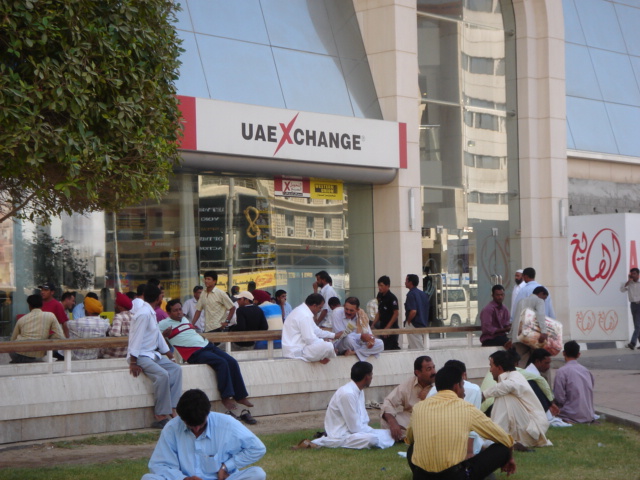
Traffic on the Hamdan Street, relatively less compared to Dubai Traffic.
Evening traffic at Abu Dhabi near Madinat Zayed Shopping Complex Abu Dhabi, near Electra Street.
Evening traffic at
 ClicksandWrites
You must be logged in to post a comment.