From sheets to pillow cases to dusters
From sheets to pillow cases to dusters
Uma Asher,TNN
Over the years, it has slowly dawned on me that I have learned many things from my parents in years past, without even noticing. They live in an apartment in the overcrowded clutter that is suburban Mumbai. Every day, they buy a handful of flowers and bel leaves for the household altar. The flower woman delivers them to our door, wrapped in a leaf and tied with a piece of string. My mother saves the string, and when it has grown to a fist-sized ball, she returns it to the flower-seller, who re-uses it.
My father would take cloth bags to the market every day, but somehow plastic bags crept into the house occasionally. My mother would collect them, and periodically hand them over to the vegetable vendor, so he could reuse them.
In the days of glass milk bottles, my mother saved the aluminum foil caps. A few caps made a new career as scrubbers for cast-iron cookware like a roti tawa; others were given to our domestic help, who sold them as metal scrap in the slum where she lived. That way she earned a spot of extra money, and the aluminium presumably got recycled somewhere. When the tough nylon fabric from folding deck chairs frayed at the edges, it was taken out and sewn into heavy-duty bags to buy our monthly supplies of grain.
Those bags lasted well over a decade. When I was a child, the fabric of my unfashionable but sturdy cotton school uniforms was ideal for making shopping bags. Our old clothes that were in wearable condition were bartered for steel pots and pans from an itinerant vendor.
My mother rescued old zippers and buttons, and stored them in an old candy box to sew on other clothes. Torn clothes were cut up and saved as wipes for kitchen spills, muddy shoes, and so on. Old cotton bedsheets got cut up, and the ends, less frayed than the centre, were sewn up into pillow cases or dishcloths. If a container broke, the lid was saved, and used when another container was missing a lid.
To this day, gifts are unwrapped very carefully, and the paper stored flat under a mattress for reuse. Resealable plastic bags are rinsed, dried, and reused when possible.
Even though my parents live in a flat, they don’t regard their hoard of old stuff as clutter; it’s well-organised so things are there when they need them. When they need string, a plastic bag, a clean jar or bottle, a lid or nail of any size, a rag to wipe a spill, they know exactly where to find it.
Only when I lived in the US did it even occur to me that stores could sell such items. I have come to recognise and be grateful for how my parents’ little habits continue to shape the way in which I use things. They never use the expression “reduce, reuse, recycle”. When they add some little item to their stash, they simply say, “This will be useful.”

Photo Speaks – Passing shots- 26102007
Burj Dubai – getting ready. 
Sheikh Zayed Road traffic towards Dubai – early morning rush
Sheikh Zayed Road traffic towards Dubai side – early morning rush
There is a street in Dubai which has a series of 2 headed coconut trees planted in the decorative median of the road. Identify it or just look for it next time you drive around. The amount of traffic block and bottlenecks, I am sure you will not miss it.
Two headed coconut tree in Dubai
Mind Speaks – Cartoon corner


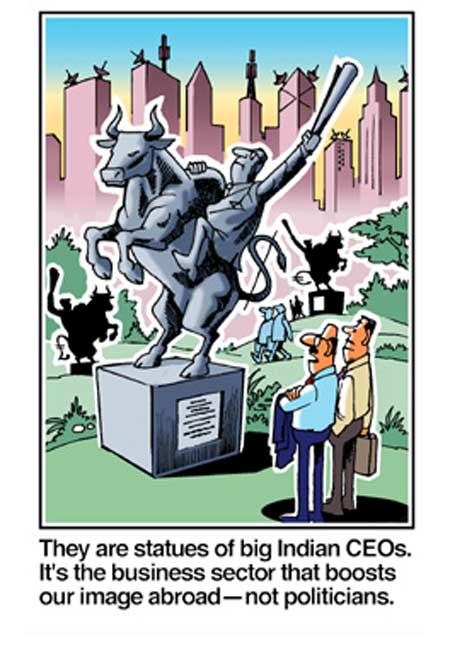


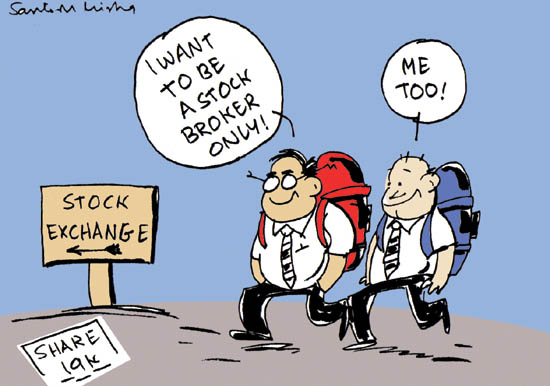
Indian Sensex going well above 19000 points during the last couple of days and this is what cartoonist had to say on it……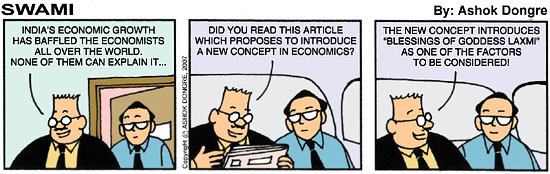
TOP 10 TRAITS of HIGHLY SUCCESSFUL PEOPLE – That You Can Learn! – by Philip Humbert
TOP 10 TRAITS of HIGHLY SUCCESSFUL PEOPLE – That You Can Learn! – by Philip Humbert
These traits work together in combination, giving repeatedly successful people a huge advantage. Because they are insatiable learners, they can respond wisely to change. Because their personal relationships are strong, they have good advisors, and a reserve of goodwill when things go bad. And finally, none of these traits are genetic! They can be learned! They are free and they are skills you can use. Start now!
1. They work hard!
Yes, they play hard, too! They get up early, they rarely complain, they expect performance from others, but they expect extraordinary performance from themselves. Repeated, high-level success starts with a recognition that hard work pays off.
2. They are incredibly curious and eager to learn
They study, ask questions and read – constantly! An interesting point, however: While most of them did well in school, the difference is that they apply or take advantage of what they learn. Repeated success is not about memorizing facts, it’s about being able to take information and create, build, or apply it in new and important ways. Successful people want to learn everything about everything!
3. They network
They know lots of people, and they know lots of different kinds of people. They listen to friends, neighbors, co-workers and bartenders. They don’t have to be “the life of the party”, in fact many are quiet, even shy, but they value people and they value relationships. Successful people have a rolodex full of people who value their friendship and return their calls.
4. They work on themselves and never quit!
While the “over-night wonders” become arrogant and quickly disappear, really successful people work on their personality, their leadership skills, management skills, and every other detail of life. When a relationship or business deal goes sour, they assume they can learn from it and they expect to do better next time. Successful people don’t tolerate flaws; they fix them!
5. They are extraordinarily creative
They go around asking, “Why not?” They see new combinations, new possibilities, new opportunities and challenges where others see problems or limitations. They wake up in the middle of the night yelling, “I’ve got it!” They ask for advice, try things out, consult experts and amateurs, always looking for a better, faster, cheaper solution. Successful people create stuff!
6. They are self-reliant and take responsibility
Incredibly successful people don’t worry about blame, and they don’t waste time complaining. They make decisions and move on. Sometimes they are criticized for taking this to extremes – Jimmy Carter carried his own briefcase and a President “shouldn’t” do that! Extremely successful people take the initiative and accept the responsibilities of success.
7. They are usually relaxed and keep their perspective
Even in times of stress or turmoil, highly successful people keep their balance, they know the value of timing, humor, and patience. They rarely panic or make decisions on impulse. Unusually successful people breath easily, ask the right questions, and make sound decisions, even in a crisis.
8. Extremely successful people live in the present moment
They know that “Now” is the only time they can control. They have a “gift” for looking people in the eye, listening to what is being said, enjoying a meal or fine wine, music or playing with a child. They never seem rushed, and they get a lot done! They take full advantage of each day. Successful people don’t waste time, they use it!
9. They “look over the horizon” to see the future
They observe trends, notice changes, see shifts, and hear the nuances that others miss. A basketball player wearing Nikes is trivial, the neighbor kid wearing them is interesting, your own teenager demanding them is an investment opportunity! Extremely successful people live in the present, with one eye on the future!
10. Repeatedly successful people respond instantly!
When an investment isn’t working out, they sell. When they see an opportunity, they make the call. If an important relationship is cooling down, they take time to renew it. When technology or a new competitor or a change in the economic situation requires an adjustment, they are the first and quickest to respond.
Vastu works wonders
Vastu works wonders
Alkesh Gupta , TNN
Vastu principles are useful for all kinds of premises – any built up area, for that matter – whether it is a home, showroom, factory, godown or even an office. The basic aim of any office is to get financial growth. Offices which are made according to vastu are helpful in generating a good financial flow. Vastu principles are made keeping in mind various energy fields emanating from different directions. These diverse energy fields affect various dimensions of our life.
But, if we make an office against vastu norms, we will find ourselves standing against natural forces. One of the basic motto of vastu is to extract maximum out of natural forces so that we can get maximum energy for each and every field of life. If we are standing in opposition to nature, some of the energy fields are obstructed and we will find ourselves lagging behind in several spheres of life.
If we talk about internal part of any office – the accounts department should be in north-east or south-east zone and the accountant should face towards east, while working. If the accounts department also has public dealing then those workers can faces north. Cashier’s cabins should be located in the northern zones of the complex.
Cash box should be kept in southern wall and its shutter should be open towards north. Best direction for reception is north-east corner, and the receptionist should face north or east while sitting. He/she should sit in such a way that he/she faces each and every person coming inside the office. Waiting area can be in northeast or north-west.
Marketing and sales department can be made in north-west corner. Cabins for field staff, peons, drivers and other can be made in this zone. The best direction for conference room is north or west direction. Conference table should not be of circular or elliptical shape. It disturbs magnetic balance of that area and all meetings end without any decisions being made.
Record room can be in south, west or southwest direction. This is the zone which should have maximum load. Store for waste material can also be made in this zone. Don’t put any table except the reception desk, exactly opposite the main entrance. It can create health problems for your staff. Sitting below a beam or a loft is prohibited as per vastu rules, as it increases tension and leads to depression. If any other alternate sitting arrangement is not possible then that loft or beam can be covered with wooden cladding.
Typically, the door of any cabin should face towards north or east. Any person who occupies that cabin should also sit facing east or north. Size of table in any room should not be too big or too small. If it is too big then that person will always feel tired and if it is too small then it reduces his confidence level. Phone, fax machine, photo copiers can be placed in south-east corner and water glass can be placed in north-east corner of the table.
Computer should be kept in south-east corner of a cabin and filing cabinet should be in south-west corner of that zone. Pamphlets, product broachers, products samples can be kept in north-west of that cabin. If you like to have an entertainment room in your office then it should be located in the north-west part of your premises.
Paint walls of your office in light pastel colours. Dark colours make us short tempered. Don’t put any painting or any sculpture depicting carnivorous animals, weeping children’s , setting sun, drowning ship, still water or any sad event. Pictures of Mahabharata battles’ are also not appropriate in an office setting. These affect the mutual harmony among office members.
Arrangement of drinking water, water cooler, boring well, water filter should be done in north-east corner of the office. This is the zone of water element. Water is related to finance as per vastu and fang-shui norms. So, keeping water in this zone increases your financial status. South-east is the direction for pantry in office. Toilet should not be below, above, adjacent or in front of the pantry.
It spoils energies of food and eatables and effects the health of the whole office staff. No staff member should sit facing towards the toilet rooms. It will be very harmful for him. If toilet is attached with any cabin, then it should not be to the north-east of that cabin.
Wipe office floor with vastu salt mixed with water daily. This removes negative energy and restrengthens positive energy flow in office. Keep the toilets as much clean as possible. Office should also not be near any hospital, cremation ground or temple – this disturbs the aura’ of the office completely and leads to low concentration power in the office staff.
FOCAL POINT
The accounts department should be in north-east or south-east zone
and the accountant should face towards east, while working
Marketing and sales department can be made in north-west corner
Best direction for reception is north-east corner. Don’t put any table except the reception desk, opposite the main entrance, since it can create health issues.
Transforming idea into a product
Transforming idea into a product
Mahul Brahma, TNN
It was a bit of ‘jealousy’ towards a classmate that made Phani N Raj a businessman. School time memory of a student who had personalised clothing and stationery continued to be etched strong in his mind till much later, making him leave his PricewaterhouseCoopers job and start the branding company eYantra. “He was from the US and his cap, pencil box, T-shirt, everything had his name on it. I yearned for such personalised stuff, but there was nothing in India then to meet my demand.”
This got him thinking until he arrived at an idea to set up virtual stores where buyers can choose personalised stuff and get them delivered at their doorsteps. Mr Raj is one of the very few with the entrepreneurial spirit who have managed to be lucky enough to convert an idea into business. But most people end up thinking and discussing their bright ideas, but stop short of converting them to prototypes. Experts say there is a set of easy steps that could help any one to nurture a thought and take it forward to see if the kernel of a viable business is contained in it.
Look for it
The first thing, of course, is to remain alert to the sights and experiences one comes across, because big ideas may be lurking in the most unlikely corners. For Shalabh Sahai, who co-founded the volunteering service MITRA, it all started at the college canteen over tea.
He had been trying to understand why there was a communication gap between individuals who wanted to volunteer for social service and the groups that were organising such efforts. “It became our favourite topic of discussion at the canteen,” he says. Thus arose an idea for setting up an online exchange for volunteers.
It also helps to jot down an idea to see if it stands the test of time. A great idea may not sound all that great, when considered a day later. An idea is just of a few words long. Only when you sit down and pen it you realise the real picture. It is crucial to go into the details.
You need to ask yourself the right questions — what is the compelling need it fulfils, who will benefit from it, is there demand for it and who will fund it? Preparing a business model answering these questions is vital, says Mr Sahai. The answers will tell you whether to pursue the idea or drop it.
Read the market
An idea from a rookie entrepreneur would be worthless if the product or service doesn’t have the prospect of demand in the market. Industry associations, websites, journals and professional agencies can all help, but an innovator needs to have well-defined ideas on whether a market exists. This is but the first step to gain confidence that an idea can work.
If the demand picture is hazy or non-existent, one should have the courage to drop the idea and move on to other things. Sometimes, ideas emerge from necessities. When you have too many projects to handle and too few people and you can’t be at the office 24×7.
Emails and phone calls may not be sufficient to handle the complexity of the work. Sahil Parikh, founder and president of Synage, came up with a solution for his office — Deskaway. A software program that helps execute projects online. “The concept was new in India, but I was sure if it is a hit in my office it will be in the market,” says Mr Parikh.
Ideas can be ahead of their time
Latent demand doesn’t immediately translate into a viable business opportunity and some ideas, attractive as they seem, might simply be ahead of their time. But there are people who have stuck to their business and made it a success in due course of time. An idea who time is yet to come need not necessarily fail, but the entrepreneur must be able to envision the trend of the future that might make it succeed.
“I thought of specialising in cyber law and starting cyberlawcollege.com, when even the concept of internet was new,” Bangalore-based consultant Naa Vijayashankar (Naavi) says. “An idea ahead of times is not accepted well,” but perseverance pays. “Now, I have become a specialist in cyber law by default. So, you need to wait for the right time to come and don’t lose faith in your idea. Believe that if not today, five years down the line, it will click,” he says.
When criminal lawyer KS Kohli wanted to start a seven-day cabin crew training for airlines, everyone thought he was crazy as all other institutes offered full-year courses. But, he knew that Indian skies were going to be opened up for competition and there would be a surge in the need for flight crew. He stuck to the idea and built a successful operation, branded Frankfinn.
Customise to market needs
The aim should be to gain a general sense of the type of customer your product or service will serve. Identify your clients well enough so that you can modify your product as per their need. If the business is designed to serve the domestic market, it should have that flavour. “People work differently in different countries. So, it is very important to give Indian touch to your product,” says Mr Parikh.
eYantra’s Mr Raj says that he moved over from personalised stuff to corporate brand recall after the internet bust and it worked. MITRA’s Mr Sahai agrees: “We start as novices so we should never be too rigid. We need to learn and adjust our ideas to changes and be open to modifications.”
It is also important to hear people out. Because sometimes your business idea may come from the person you least expect it from, just casually, even over beer. M Sanjay Kanth, CEO, founder, ESS Solutions, was originally in the medical transcription business. But, the industry was losing its sheen. He knew the president of a title company based out of Baltimore. That person told Mr Kanth that there was refinance boom in the US which has resulted into a huge backlog in terms of production.
Incidentally, his brother M Sujay Kanth, who is now the COO of ESS, happened to be in US to explore business opportunities. They took up this opportunity. This was their first break. “Initially, we had no clue of what was going on and it was very hard to grasp. We took it as a challenge and Sujay got trained in their office for about 40 days after which we started the transition to my India office from 2004,” says Mr Kanth.
Sell the idea to investors
Money is often the biggest bridge that a first-time entrepreneur has to cross. It is important to sell the concept to potential investors. The startup should also detail a proper plan of how much money needs to be raised and how it would be spent. Projecting cash flow milestones will become easier if the homework to understand the demand had been done. There are also investment bankers who help you get venture capital against a ‘success fee’ i.e they will only charge you if you get funding.
But, there is another way in which entrepreneurs get going. They first start a small establishment, may be in a garage with a bit of furniture, and ramp up as the business builds itself. Frankfinn’s Mr Kohli started his business Frankfinn Medico Infoservices by borrowing Rs 40,000 from his friend. But, when the right time came, he used his own fund for starting cabin crew training business. Remember, the customer must eventually “pay” for your business. Everybody else is waiting to get paid. Loss-making as a business virtue perished with the dotcom bust.
Start now
All the risk you have taken by giving up your cosy job or turning down a big offer has finally paid back. Well, once things are in place just get started. Your idea is now a viable business proposition and has a funding. So, what are you waiting for? “It is very important when starting out is to be mentally prepared for a different journey filled with uncertainty and excitement. This entrepreneurial journey will teach you more about yourself than you would have ever known doing anything else,” says Mr Parikh.
‘It’s vital to connect with yourself’
‘It’s vital to connect with yourself’
Viren Naidu, TNN
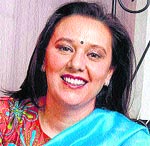
Shailja Dutt, Founder and Managing Director, Stellar Search and Selection Pvt Ltd speaks about her love for dance and the eagerness to solve crosswords!
Mantra
I think it is vital to connect with “yourself” and find the time I call ‘ME TIME’ – my time away from work, home, responsibilities, chores and duties – to do the things I enjoy and those that energise me to go back to work and my kids completely recharged. Several professionals with very hectic schedules and tenuous work-life balance will probably share the same thought. Eventually, when you have worked hard to achieve your goals, you must play hard to enjoy!
Dance
I have always loved to dance. A couple of years ago, I thought it would be fun to learn to Tango, and ended up learning Salsa, Cha Cha, etc. I attended classes with my younger brother but unfortunately, now I do not get the time. Personally, I think both business and dance are about passion and being nimble on your toes!
Art
I have been singing since I was a child and have been often complimented on having a great voice. So, after having kids and after taking my business to the next level, I thought why not train my voice? My guruji would come home to give lessons and even though I haven’t performed professionally, my friends are always being regaled by impromptu my performances.
Puzzle
Solving the crossword has become a habit. Before, I go to sleep, I have to finish the daily crossword in the newspaper. I have been doing that for years now. But in Sudoku, I am actually finding my feet and my son is better than me.
Style
To me pursuing an interest is a priority as is work and family. I also learn Spanish and do Yoga a couple of times a week. Though my days are hectic, I have never missed a single important event in the life of my children or my family.
Being successful without a degree
Being successful without a degree
Ramiya Bhas, TNN
As kids, everyone dreamt of making it big, starting with the right kind of education. One always took pride in suffixing their name with degrees like LLB, Phd, MBA, etc. But what happens when you stop studying and skip college? Does the dream of making it big in today’s corporate world, obsessed with academic qualifications, come to an end? If you are one of the many who think the answer to this question is yes, then you are wrong!
Success does not come with a degree hanging on the wall; it comes with sheer determination and hard work. And the most famous drop-out success story happens to be that of chairman of Microsoft Corporation, Bill Gates, who dropped out of college to start his own software company. Meet three individuals who dropped out of school/college and have proved with nothing but sheer dedication and persistence by their side, they too can be successful without a degree in hand.
Travelling Through
What do you expect a seventh standard dropout to do in life? If you are David Patrao, you would start a business at the age of 27. “I left school after I completed my seventh standard mainly because there was no motivation left in me to study further. Also at that time, my family was going through a crisis and the responsibility fell on us children to do something for the family,” recollects Patrao.
Once out of school, Patrao didn’t have many choices in life. So he came to Mumbai in a hope to fulfil his dreams. “I struggled a lot till I was 27. It was at that time I realised that I needed more than just a dream to make it big,” he says. He started his business with a three-wheeler tempo, which he used to transport vegetables. “In a couple of years, my business doubled because of the people I worked with,” he says.
However, right at the peak, things fell apart for Patrao. “The oil and gas industry was facing certain problems and at that time, my business got hit rather badly. There were certain government red tape issues for us and I faced certain union problems because of which I had to close down my business at that time,” he explains. But instead of losing hope, Patrao took up the challenge of doing something else. “At that time I decided to start a travel business as I had the available finance and the right kind of contacts,” he adds. Today, Patrao runs MER Travels and has a fleet of vehicles to his credit.
Does this prove that you don’t need education to be successful? “I wish I had completed my studies and got a proper degree in business or finance as I would have had better knowledge about how a business should function. I realised I had made a mistake back then by not completing my education. I hope people today aim at getting a degree in their hands,” he says.
Click ‘S’ for success
He was a run-away from Kerala, with nothing in his pocket but a few rupees and lots of hope. That’s all P Vishwanath came with when he was 16 who had just managed to pass out of tenth standard after a second attempt. “I had nothing when I came and the one thing I missed most back then was a degree behind my name. My reason for not trying harder was not that I didn’t want to but the circumstances through which we were passing were rather terrible. So I took it upon myself to do something worthwhile and I ran away from home,” he says.
When he came to Mumbai, he faced the crisis of not knowing the language and having proper education. “For four years, I had no job and I survived on nothing. Eventually, I got a small job; selling calculators, which didn’t pay enough. But I stood my ground and started working with electronic typewriters and copiers. Who knew that dealing with machines would be so profitable?” he asks.
But he didn’t stop at calculators and typewriters only, he moved to bigger things. “I realised that there were better things in manufacturing other than these two items and that’s when I started saving money to go to Germany. However, since I did not know the language, I spent a long time learning English.” Once back from Germany, he learnt about plastic cards and started a revolution. Today, his company is an “Arsenal certified contact less card manufacturing company”.
But with success, there is always wishful thinking. “I realise this now that the troubles I had faced would be nil if I had the right educational background. I still wish I could go back to school and complete what I had once left behind,” he explains.
Fastened Success Back in the ’60s, a graduate with a science background had potential. Vincent Fernandes could have been an engineer, a doctor or anything he wanted. Instead, he dropped out of college and decided to get a job. “I had completed my 11th grade in science and instead of going further with my education; I came to the city and began working at that time, as my family was going through financial and emotional crisis,” recalls Fernandes. Once here, he started his quest for employment. But initially, all in vain. “Eventually, I took up a helper’s job in a manufacturing company,” he recalls.
However, Fernandes realised that his dream was much bigger than that and he had to start looking for better options. Slowly, he started learning the tricks of the trade and bought a small company, which was going into losses. This was just the beginning for Fernandes as from there on he went to start his own company.
“For me, my hardships started when I quit my education. When I wanted to set up my own business, I faced a lot of problems from banks as they refused to give loans,” he explains. “I still regret the fact that I quit my education. But my experience has taught me what I think could not have been taught in books or management classes.” Fernandes now is the proprietor of ‘Precision Industrial Fasteners’, which has been operational for more than 15 years. As they say successful people are quick to forget about the past and the future is where ‘it’ is.
Team building strategies: You must know them all!
Team building strategies: You must know them all!
Neha Sharma, TNN
Walk the talk…
Our company founder, Mary Kay Ash, often said, “The speed of the leader is the speed of the gang.” I therefore focus on leading by example and always attempt to “walk the talk.” I make efforts to ensure that my actions are transparent, speak for themselves and that they set the pace for the rest of my team.
A leader must…
… have the ability to not only create and communicate an inspiring vision to all members of his/her organisation but also build purpose beyond the job for all of them. This should be complemented with excellent listening skills and a problem solving approach. I also believe that an effective leader must be very consistent.
My people should have…
… vision, honesty, integrity and a golden heart. I want team members who dream big, work hard and stick to their principles. I have found that when people focus on helping others achieve success, they typically achieve it themselves. The personal traits of an individual can either have an immensely positive impact in the work environment or vitiate it completely. At Mary Kay, we believe it’s impossible to separate strength of character and consistency of actions from the overall growth and success of our organisation.
Our culture is…
… built around the golden rule: “Do unto others as you would have them do unto you” . Regardless of where we operate around the world, we have found that when our people truly adopt this mantra, sky is the limit for them. A culture that is built on motivation, recognition and always doing the right thing makes for a great organisation. I firmly believe that if you will let people know that you appreciate their performance, dedication and consistency, they will respond by doing even better. Encourage them to take calculated risks in addition to this and you will have a winning organisation.
My personal space….
I am very fortunate to have a job that not only fulfils me professionally but also gives me the opportunity to meet other people who share my interest in creating opportunities for women to achieve their dreams. Apart from this, I spend a lot of time with my husband and two children. I also dabble in a number of activities, such as aerobics, yoga, playing the piano, interior decorating and reading to build new experiences.
 ClicksandWrites
You must be logged in to post a comment.