HPCL awards three naphtha cargoes to Itochu
HPCL awards three naphtha cargoes to Itochu
14 Dec, 2007, 2052 hrs IST, PTI
NEW DELHI: India’s state-run Hindustan Petroleum Corp has sold three naphtha cargoes for February to April lifting at a premium of slightly higher than $15.5 a tonne to Middle East spot quotes, a trade source said on Friday.
The three 30,000-tonne cargoes have been awarded to the Japanese trading house Itochu, the source, who did not wish to be identified, said.
Other than the term contract, HPCL has also awarded Itochu a 25,000-30,000 tonnes cargo of naphtha for loading in the first half of January at a premium of around $12.5 a tonne, he said.
Another HPCL cargo for loading in the second half of January was awarded to Glecore at a higher premium of $18-$19 per tonne, the source said. All the cargoes are scheduled for loading from Vizag port in the east coast.
Indian Oil-Oil India win 3 onshore oil blocks in Libya
Indian Oil-Oil India win 3 onshore oil blocks in Libya
NEW DELHI: The Indian Oil-Oil India combine has won three onshore oil blocks in Libya, adding to the two blocks the consortium already had in the nation that holds Africa’s largest oil reserves.
IOC-OIL teamed up with Sonatrach of Algeria to win blocks 1, 2 and 3 in contract area 95/96 in the Ghadames Basin, industry sources said.
In the previous Libyan licensing round, IOC-OIL combine had been disqualified from bidding but in the latest round, they were qualified to bid as investors. The two teamed up with Sonatrach, which will be the operator of the blocks.
IOC-OIL combine had in 2005 won 7,087 sq km Block 86 and 2,710 sq km Block 102/4. Both hold 50 per cent stake in each and OIL is operator for both.
Sources said OIL-IOC and Sonatrach will now sign an Exploration and Production Sharing Agreement (EPSA) with the National Oil Corp of Libya. The Algerian national oil company will be the operator of the blocks won in this round.
Libya auctioned exploration permits in the central, western and southern desert, in its first licensing round in potentially gas-rich areas.
Russia’s state-run natural gas exporter Gazprom joined Shell, Europe’s largest oil company, Algeria’s Sonatrach and Polskie Gornictwo Naftowe i Gazownictwo SA of Poland in winning four of 12 licenses on offer.
The winners agreed to pay a minimum bonus of 10 million dollars when they signed the contract. Libya’s National Oil Corp, which ran the auction, chose the companies that would give it the highest share of production from any field they find.
Young Achiever: Trimmed for success
Young Achiever: Trimmed for success
Malini Sen,TNN
Hair designer Sumit Israni tells how he fought social taboos to pursue his choice of profession.
“Don’t judge me by my age but my work,” says hair designer Sumit Israni. At 27, he has a long list of awards and achievements to his credit. And after successfully managing a hair salon and hair lounge, his family and friends are finally taking him seriously.
From school itself Sumit has been passionate about the business of hair. And in class XII, when he won the ‘Best Colourist Award’ sponsored by L’Oreal, he decided that he wanted to pursue a career in the same. But that was the easy part. “It was tough convincing my family. Like any other Indian family, they looked no further than an MBA or engineering degree. It was taboo for a son to be a barber! So, I struck a deal with them. I would do what they wanted and they would give me a chance to prove my mettle.”
Sumit completed his BCom through correspondence while he went to Paris for training. He also appeared for the usual ‘Indian-son pre-requisite examinations’ – CAT and MAT. After his 18-month training, he joined Toni & Guy in London following a test as a junior stylist. It took him under two years to become the style director. “When I first joined, I did everything from shampooing to laundry. My fingers itched to hold the scissors, but I waited and watched, knowing my chance would come. Eventually my perseverance paid off.”
He has also been trained by Vidal Sassoon and Guy Kremer. Sumit has bagged some of the top awards in the field, including L’Oreal People’s Award for Best Hairdresser, Asian Hairdresser of the Year, and so on. Besides having done cover pages for Elle and Cosmopolitan, Sumit is a member of the Board of Directors of CHF (Creative Hairdresser Forum) and the international Intercoiffure Mondial (ICD), a consortium of the world’s best hair dressers. Further, this brand ambassador for L’Oreal is also a guest faculty at NIFT.
Friends, who earlier had to think twice about how to introduce him, now wait to get an appointment; his diary is always booked. Today, with an increasing number of people becoming conscious of their looks, the hair industry offers lucrative career opportunities. “It is a very personalised service; you have to create a different style for every client. When I recruit my staff, my first question is whether they are passionate about hair or not,” says Sumit, who adds that a good hair stylist can make nearly Rs 70,000 per-month. There is another form of gratification as well. “When I make an 80-year-old look like a queen, the smile on her face is my biggest reward.”
And leaving no place for complacency, Sumit travels overseas every three months to upgrade his skills. He is also opening a hair academy next summer to train aspirants who share his passion. “I have faced my share of contempt so I want to pave the way for youngsters so they can enjoy their share of respect in this field.”
Wipro wins award for best software testing tool
Wipro wins award for best software testing tool
Indo-Asian News Service, Bangalore, December 14, 2007
IT major Wipro Technologies has won the best practice award for software testing, set up by the US-based International Institute for Software Testing (IIST), the company announced in Bangalore on Friday.
The company’s testing services division was given the award for innovating a statistical tool that reduces the time taken to test a product.
“As part of our proprietary tools suite code-named StORM (statistics, operations, research, matrix), the tool helps us to reduce test case development effort by about 30 per cent,” Wipro vice-president and testing services’ head CP Gangadharaiah said in a statement.
With over 10 years of experience in independent testing services, Wipro is the largest third-party offshore testing service provider worldwide.
It has also set-up the first wireless fidelity (Wi-Fi) pre-certification and certification lab at its Bangalore campus.
The IT bellwether offers software testing services to global customers in partnership with other leading vendors such as Hewlett-Packard, IBM and Microsoft.
“The award is one of the initiatives we have taken to advance the software testing profession and encourage IT firms to adopt best practices. The award also enables firms to share their best practices with the software testing community,” IIST chairman Magdy Hanna said.
Wipro was chosen for the award out of 36 technology firms worldwide that were short-listed by the institute.
No place for happiness
No place for happiness
Ajit Bishnoi, New Delhi
There was a rich man who had everything that one can materially hope for; he had his personal plane, expensive cars, a large house, a villa in Spain, a thriving business, besides being blessed with a nice family.
However, what he did not possess was peace of mind and consequently any happiness – ‘ashantasya kutah sukham’ (Bhagavad Gita 2:66).
Somehow or the other it got into his head that very soon he would contact some terminal disease, like cancer and die.
Therefore he was focused on his body seeking signs that would indicate some malfunction. A headache would scare him of brain tumour; stomach discomfort would mean an ulcer; chest discomfort would point to a heart-attack and so on. He would seek emergency medical attention and every time the doctors would assure him of his physical well-being, after conducting extensive tests on him.
This went on for quite sometime until he became a complete mental wreck. A friend advised him to meet a well-known personality, who would have a solution for his problem. The rich man sought an appointment and went there. He was ushered into that man’s study and was asked to wait.
After a while, the wise man came and listened to him. He said nothing but sent for tea. The rich man was losing his patience since he heard no solutions.
He thought of leaving but stayed to drink tea, having come thus far. The host began to pour tea. He kept on pouring tea until it spilled over into the saucer “What are you doing? The cup is already full with tea and then you are leaving no space for any milk which I would like in my tea, besides sugar!” said the visitor.
Said the wise man: “Everyone must die. But you are not sick and far from being dead. You have filled your cup with misery and left no place for peace or happiness. Instead, count the blessings the kind Lord has bestowed upon you and be happy”.
The visitor was most impressed.
Paper tole artist
Paper tole artist
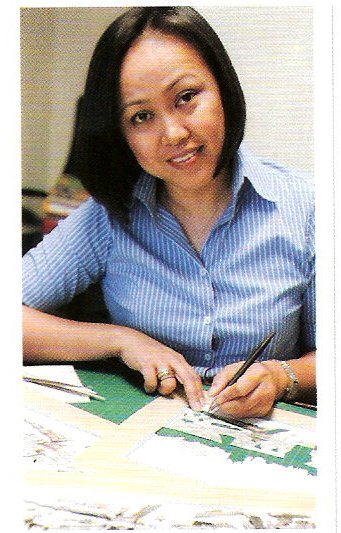
Suzan Lee, from Philippines
Lee works with paper tole, the art of creating a picture to appear in a 3-D image. “Simply stated, it is the art of creating a picture that will look lively and realistic. In paper tole, part or all of an image is raised from the surface to give a 3-D effect,” she says, adding, “It is also called 3-D decoupage.”
The most aspirational project for Lee is to work on a picture by Anton Pieck, the Dutch painter, artist and graphic artist. To her, Pieck’s work is the acme of art. “You simply have to be at your creative best. You require more imagination and resourcefulness when using his work,” she says. Pieck’s works are noted for their nostalgic or fairytale-like characters. “The reproduction of the details in his characters isn’t facile work. I find the most difficult [paper tole projects] to be ones which use of his pictures. I am inspired by his oeuvre, which includes paintings in oil and water colour, etchings, wood carvings, engravings, lithographs and textbook-illustrations,” says Lee, who is consumed by the exquisite detail of the artistic process of paper tole art.
She is also inspired by the art’s uniqueness and emphasis on detail. “I have to visualise the picture in its entirety. I then have to see which part has to be cut first. [Paper tole involves cutting and layering of various designs or prints.] The result varies depending on the project. If I work on a simple design such as fruit or kiddie stuff like a picture of a teddy bear, the result is discernible at an early stage. The more complicated the design, the harder it is to envision the outcome,” she says.
Paper tole requires the artist to make copies of each image. “These have to be cut individually, and each copy has to be reapplied directly over the original; I use four to seven copies. The method creates a sculptured and layered effect. Cutting has to be meticulous and perfect; even gluing and shaping. I have to be attentive to the most seemingly unimportant detail,” she says.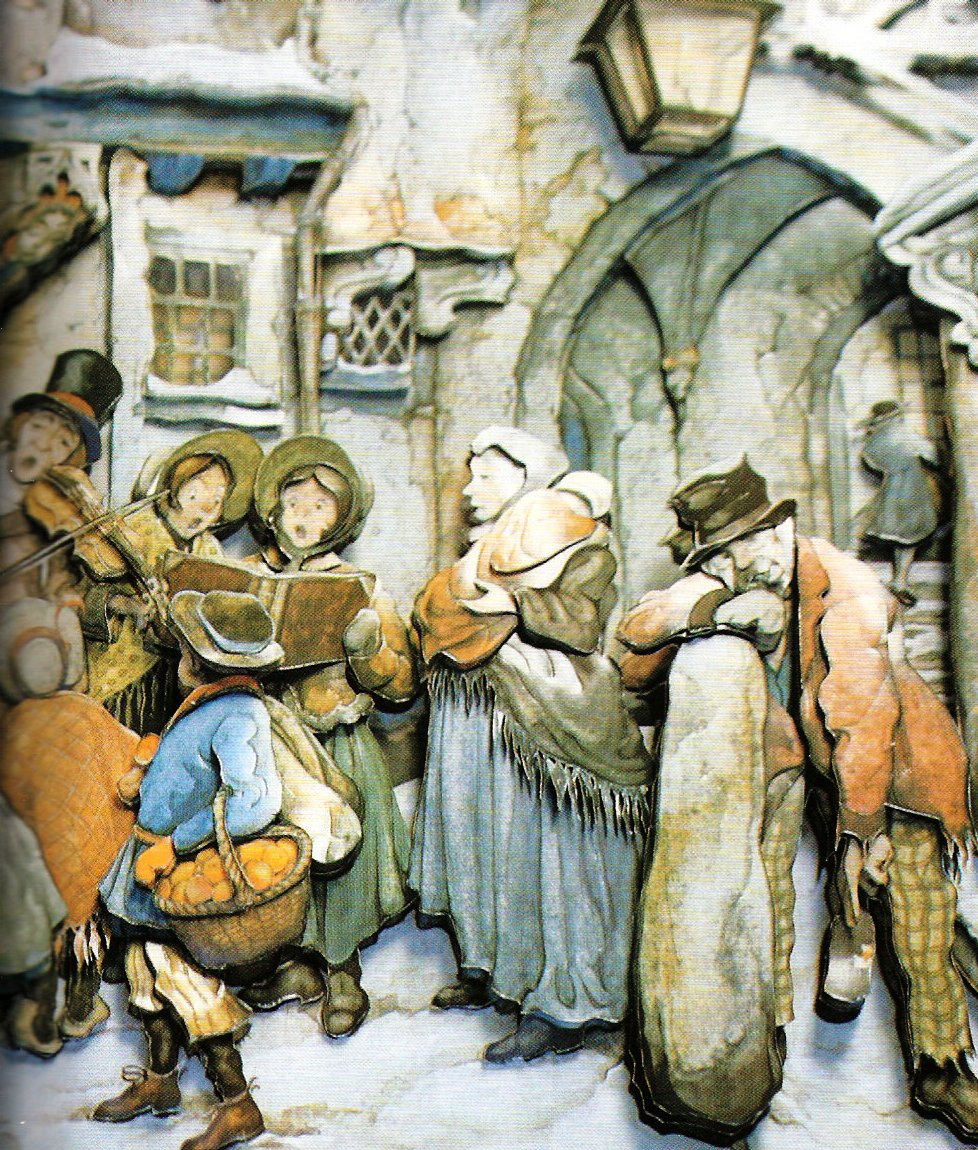
Paper tole is used to emphasise many objects from petals to buildings. And almost any image imaginable can be crafted into paper tole art. Lee loves images related to the kitchen, which is connected to her love for cooking. “I also like objects that describe happiness such as those related to weddings or a celebration. I also love pictures of children,” she says.
She can create an easy piece like a single flower in about two hours. However, designing a complicated piece like the one shown on this page (bottom left) – The Painter on the Roof by Anton Pieck – can take her six to 12 hours.
“Assembling is the most interesting part. This is where you connect your soul to the project,” she says.
Lee has been an active member at ARTE Soukh since her first participation in February this year. “At first I was hesitant. Today I am a lot more confident as many have praised my work. At every ARTE Soukh event, I conduct free demonstrations. Some of the attendees have even taken a few lessons.
“Meeting different artists and appreciating their art influences my own artistic sensibilities. The spirit among us [the art fraternity] is inspiring,” she says.
– For details, contact Lee, on mylk_007@yahoo.com
Book artist for designer book-binding and sculptural artist books
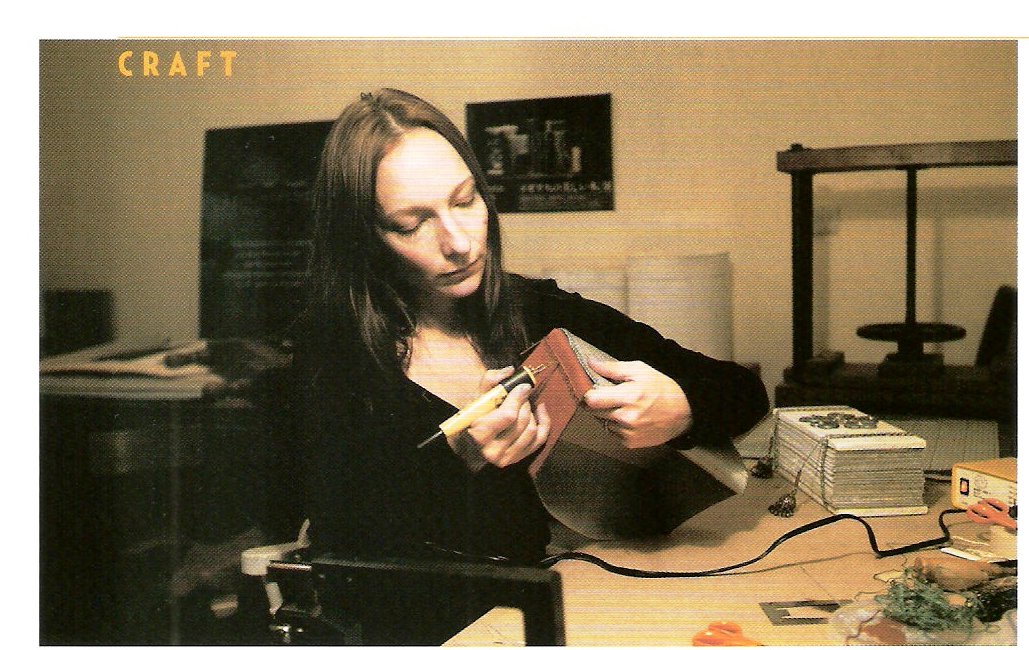
Book artist for designer book-binding and sculptural artist booksMia Leijonstedt, from Finland
Leijonstedt likes the sound of silence, and works best early morning or at night. For her, a book as a piece of art is more tactile than most other art forms. She recently bound Antony and Cleopatra by William Shakespeare for a New York-based book collector, an owner of the world’s leading miniature designer binding collection.
“I made it [binding] look like it belonged to Cleopatra. I used jewels and raw silk in purple, a colour rumoured to be her favourite. On the back of the book, I hid a lining of snakeskin in a decorative box. It is claimed she died from snakebite, where the snake was hidden in a basket. These details vivified the story,” she says.
Leijonstedt also designs sculptural artist books which are artworks in the shape of a book, where shape, material, and content express a theme; the content can be a painting or drawing. Sculptural artist books differ from designer binding in context, where the latter uses printed text.
“I make these [sculptural artist books] primarily out of paper and leather. The visual details express the theme. For example, my artist book, The Lost Spells of Merlin, creates intrigue, and draws the viewer to ‘read’ the book from all its visual and textural details,” she says.
She also designs books that combine elements of designer book-binding and sculptural artist books. “I completed one for a couple’s anniversary. It was a collection of their letters to each other from their years together,” she says.
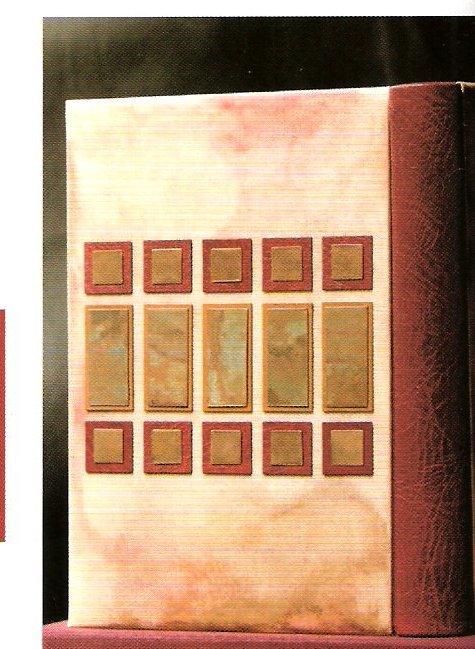
Book art has gained interest in Europe and the US as galleries host regular book art exhibitions. Leijonstedt has exhibited in more than 40 countries, including Japan, Australia, Europe and the US.
Creating art on a three-dimensional platform keeps her passionately interested more than painting, an art form she first dabbled in. “My head is full of ideas, my sketch book full of sketches … I only have time to bring a fraction into reality,” says Leijonstedt, who took part in the ARTE Soukh for the first time last month, and will exhibit this month too.
It was a fortuitous visit in the early ’90s to the British Library in London that emboldened her to take up a special university degree course in the modern and historical skills of making books by hand. At the time, she was an exchange student from the Helsinki University of Art & Design.
“It [the library] was hosting the annual competition of Designer Bookbinders. I had never seen a modern, finely-bound literary work before!” enthuses Leijonstedt, who has won six awards at the same competition between 1995 and 2005.”
Her studies covered every aspect of structural book history – from the birth of the codex to book development through medieval times. In her work, she uses the finest recherché materials like specially tanned natural grain book-binding leather, genuine 24-carat gold leaf and semi-precious stones. “It is the familiar shape of a book that allows one to enjoy the colours, textures and their combinations without worrying about identifying the art form. I deal with colour, scale, layout, symbolism, personal vision and expression.”
– For further details, contact Leijonstedt on galleriamia@gmail.com
Quilling and punch art

Quilling and punch art
Sujata Shethia, from India
The first art form Shethia learnt in 2004 was Warli, a specialised Indian tribal art, which depicts scenes of human figures engaged in everyday activities like hunting and harvesting.
She also learnt Indian Madhubani painting, an art characterised by tribal motifs and mineral pigments.
But it wasn’t till 2006 that a new art form intrigued her. It was daedal composition of quilling art used on a greeting card. “The intricacy of the designs was exquisite,” she says. So impressed was she that she asked the person who created the art to teach her. “But she wasn’t interested [in teaching]. I then spotted a brochure that listed quilling teachers,” she says.
Quilling, also known as paper filigree, is the art of rolling narrow strips of paper and then shaping them. Projects can range from simple gift tags and cards to elaborate pictures and 3-D models.
Quilling isn’t difficult to learn, but requires an eye for detail, time, patience and practice. “Quilling started with metal filigree, but scarcity of material popularised paper filigree,” says Shethia. After learning the art of quilling, which took Shethia a year, she decided to amalgamate her varied artistic knowledge to create unique artworks.
“I began to integrate painting with quilling. It doesn’t matter if it is a simple project like a card, gift box, photo frame or pencil decoration, or a large-scale project like an aquarium [pictured here]. Each creation conveys my personalised artistic message,” she says.
During one of her recent exhibitions at ARTE Soukh, a mother of two boys asked Shethia to create an aquarium for her boys. Impulsively she suggested an alien ship. “I used mixed media and quilling to create an alien world. I made use of different supplies like glitter, sequins, beads and colourful stones. I have even made earrings using the quilling technique!” she says.
Shethia, who first participated at ARTE Soukh last December, exhibits and conducts workshops for children and adults. “There is a sense of belonging, a sense of solidarity among this family of artists. The best part of the Soukh is the exclusive art pieces on offer. You will not be able to find them in regular shops or malls!” she says.
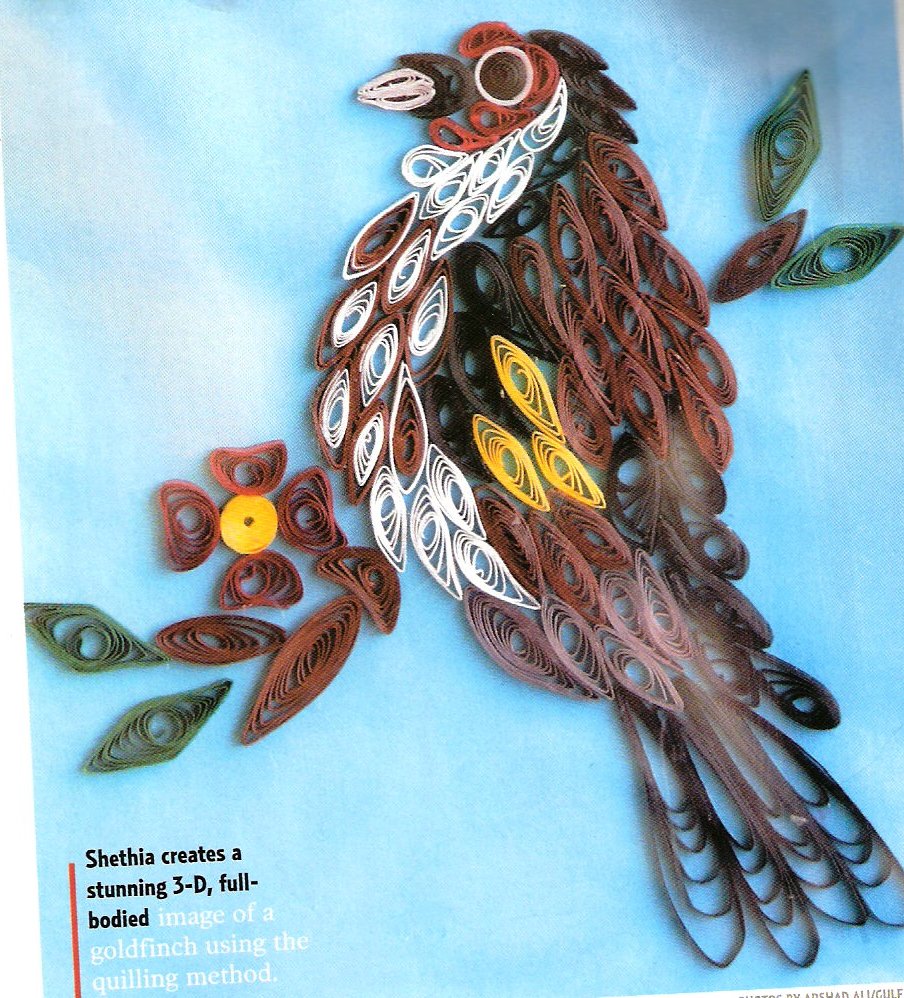
Quilling designs are made of rolled coils. Shethia says the technique needs only a few basic shapes like teardrop, rectangle, square, crescent, arrow, half circle, holly leaf, and triangle. “Once these are perfected, you can combine individual shapes to form anything.”
Interestingly, quilling can also be made to resemble other art forms like painting. “For instance, instead of a painting for a goldfinch bird, you can create the same figure by using quilling. It will give a stunning 3-D, full-bodied effect,” she says.
She enjoys the technique of combing in quilling. “It creates uniform cascading loops to make fluttering creatures or beautiful petals,” she says.
As an extension to this art form, she also learnt punch craft, and now uses both art forms. “For example, when I am making a Christmas card, I punch the Christmas tree and embellish it with beads, colourful stones and glitter. The gift boxes placed under the tree are quilled. This gives the card 3-D effect. Handmade cards express that rare sentiment not found in commercially printed ones,” she says.
– For further details contact Shethia, on sujatashethia@hotmail.com
Scrapbooking
Scrapbooking
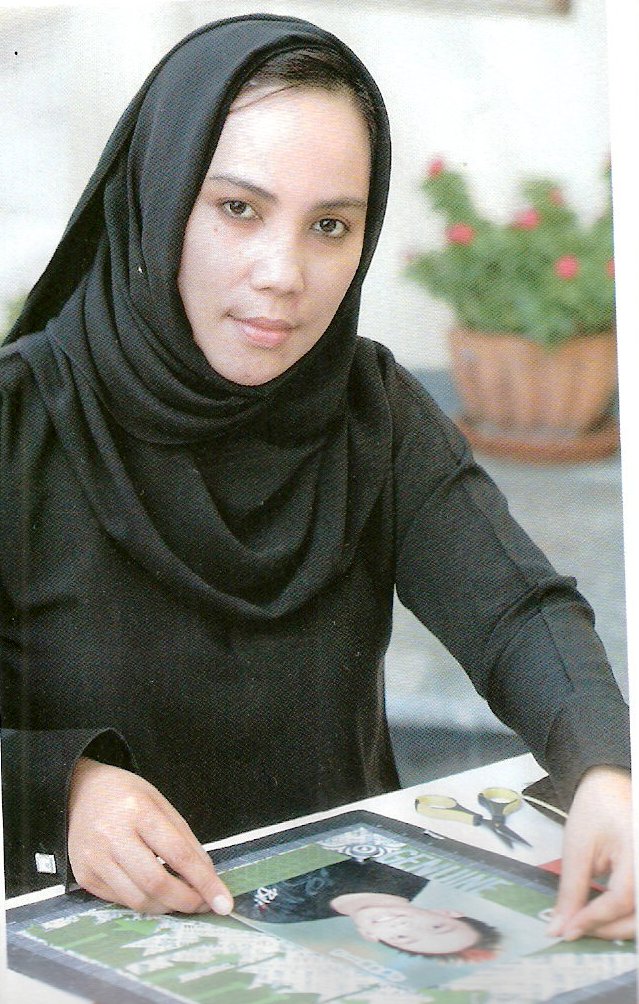
Annais Benetua Bin Haider, from United Arab Emirates
When Haider’s youngest son, Abdullah (now 10), went to grade one in 2004, she spent her mornings attending arts and crafts workshops. “I learnt decorative matting and framing of photographs. I also picked DIY craft books,” she recalls.
Her artistic potential, fuelled by an extremely creative imagination, led her to take these workshops seriously.
It also led to the online search of the use of acid-free paper in decorative matting. “I discovered its use in scrapbooking. I was hooked,” says the mother of 3 boys, Rashid, 13, and Omair, 11 and Abdullah, 10.
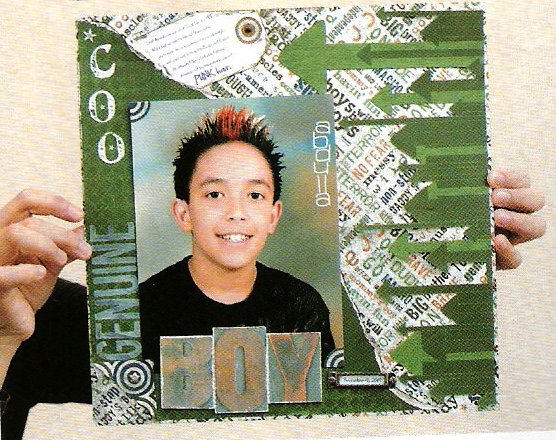
Scrapbooking is a work of art and an illustrated form of storytelling. For Haider, it is both, and an artistic expression of familial love. “A scrapbook is an interpretation of my life and my personality through art. Most importantly, it is a way to express love for my family. There is nothing more precious than the gift of a scrapbook,” she says.
Scrapbooking is often accused of being assemblage or bricolage art by artists who believe the truest form of art is creating not assembling.
“When a scrapbook artist develops his style by experimenting with different decorative techniques and a wide variety of mediums, his work becomes original. A scrapbook is an illustrated story of your life. How can somebody else have the same story or memories as you do?” reasons Haider, who has been exhibiting at ARTE Soukh since July this year, where locally made scrapbooking paper packs and Memories of UAE scrapbooking album were launched.
“All my scrapbooks are heirlooms. I use acid-free or archival quality supplies to ensure the art will not fade, yellow or turn brittle and disintegrate,” she says.
Scrapbooks can represent random, chronological or themed family life. Haider finds the entire process enjoyable. “The only tough part is choosing what to include. There are so many photographic moments I would like to record,” she says. Every stage is important, especially the layout. “The process includes the positioning of photographs, adding embellishments to support the story, and completion with written details like what, where, when, why and who. Together, these elements create the layout,” she says.
Cropping is also an important step. “It is like zooming in on your subject after the photo is taken. Through this, you can focus the viewer’s eye on a particular element of the photo or trim away the unappealing portions.”
Her fascination for scrapbooking inspired her to open her home-based scrapbook store, Creative Hands, and to offer classes tailored to support the art. “My store also deals with scrapbooking supplies because when I started out, I realised of the obvious paucity of supplies,” she says.
– For further details, log onto http://www.dubaiscrapbookingshop.com
Mind Speaks – Team 1 newsletter – Issue 485 – Born Fighters

Hello friends,
Team 1 newsletter – Issue 485 – “Born Fighters” is ready and available. Those readers who wish to obtain a personal copy of the same in pdf version, please email us at team1dubai@gmail.com.
 ClicksandWrites
You must be logged in to post a comment.