UAE
Majestic mosque gets finishing touches
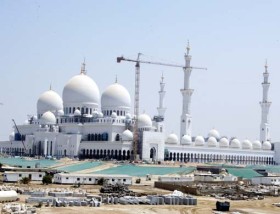
Majestic mosque gets finishing touches By Binsal Abdul Kader, Staff Reporter/GULF NEWS Published: August 18, 2007, 00:05
Abu Dhabi: More than 1,500 workers, supervisors, designers and engineers are working feverishly to put the final touches on Shaikh Zayed Mosque, which can accommodate about 40,000 worshippers.
The mosque is scheduled to open at the end of Ramadan for Eid prayers and its main prayer hall can accommodate about 5,000 worshippers, said project manager Khowla Salem Al Sulaimani.
The striking domes of the mosque are reportedly the largest ever built on any mosque.
“Two international Islamic organisations have confirmed it is the third largest in the world,” said Khowla, but notes that its main striking features are its domes, the biggest among any mosque in the world.
The General Secretariat Organisation of Islamic Countries (OIC) based in Saudi Arabia, and the Research Centre for Islamic History, Art and Culture in Turkey have confirmed the 22,412 square metre mosque to be the third-largest in the world.
Even before its completion, the Shaikh Zayed Mosque, which cost about Dh2.1 billion, has become famous around the world. A huge chandelier is installed in the main prayer hall. An Iranian carpet will also be placed in the main prayer hall and is the largest hand-woven carpet in the world.
The carpet was woven by about 1,200 Iranian women. The carpet which costs Dh30 million was delivered to Abu Dhabi last week.
The 16.5 metre chandelier was imported from Germany. The seven chandeliers in the mosque cost about Dh30 million.
The main dome which is 87 metres high with a diameter of 32.8 metres, is the largest in the world. While the other 81 domes are of traditional Moroccan design. 
Distinct features
The main door of the mosque is made completely of glass and is 12.2 metres high. The 7 metres wide door weighs about 2.2 tonnes and has beautiful floral designs.
The prayer halls are decorated with Italian white marble and are inlaid with floral designs. Various designs are used for different parts of the mosque.
The courtyard is decorated with white marble from Greece, while its 1,048 columns are being decorated by workers from India, points out Khowla, who is proud to be working on a world famous project.
The outside walls of the Shaikh Zayed Mosque are of traditional Turkish design. Worshippers entering the mosque will get a fantastic view of the entire structure, reflected in the waters surrounding it.
Artificial lakes laden with dark tiles surround the mosque.
The four minarets of the Shaikh Zayed Mosque reach a towering height of 107 metres and can be seen from far off.
“The whole structure is on an elevated position as the foundation has been laid 9.5 metres above ground level,” said the project manager.
Municipal Affairs Department of the Abu Dhabi Municipality is supervising the finishing touches on the Shaikh Zayed Mosque, one of the ten largest mosques in the world.
Director of the Shaikh Zayed mosque project Khowla Al Sulaimani said that the main prayer hall of the mosque is expected to be opened during the final days of the month of Ramadan. The carpet to be spread in the prayer hall arrived yesterday from Iran.
Different colours
The 5,000 square metre carpet is the largest of its kind in the world and is handmade with 35 tonnes of wool and cotton.
Public relations director at the Municipal Affairs Department Mubarak Saif Al Mazroui said that the Shaikh Zayed Mosque is a magnificent addition to Islamic architectural splendour, and will become a landmark in the UAE and the region as a whole.
The main prayer hall under three large domes can accommodate over forty thousand worshippers.
The main prayer hall under three large domes can accommodate over forty thousand worshippers.
Car Roll Over’ simulator will increase seat belt awareness
Car Roll Over’ simulator will increase seat belt awareness
By Joy Sengupta /KHALEEJ TIMES 26 August 2007
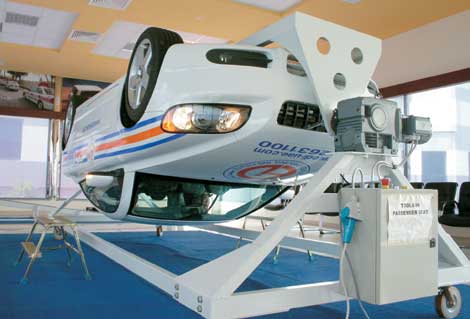
DUBAI — The Emirates Driving Institute has introduced the ‘Car Roll Over’ simulator to make drivers realise the importance of using seat belt as a safety measure.
The ‘Car Roll Over’ gives the students an actual feeling and the body movements of the driver when his car turns topsy turvy in an accident, Muhammed Arif, the Advance Driving Instructor and First Lecturer of the Institute, said yesterday.
“The apparatus would also make the people realise the fact that people inside the car have got more chances of survival if they have fastened their seats belts as it holds them tight to the seat in the case of an accident resulting in the car roll over,” he said.
“There are many organsations who have been talking about the importance of seat belts since a long time now. Fines have also been imposed on the violators. But still, there are people who don’t care. A majority of them don’t understand the importance of seat belts. We realised that a practical knowledge about how the belt works would be helpful,” he said. The system had been imported from Volvo, a popular commercial transport solutions based in Sweden.
“This is a whole car. We ask the person to sit in it and then fasten the seat belt. Then we revolve the car upside down. One can easily feel the pressure on the back and the neck when the car is turning,” Arif said.
“But then if one is fastened, the belt does not allow the person to crash out through the windscreen or get thrown in some other corner of the car. This considerably reduces the risk. Also, the air bag coming out from the front after the crash is beneficial only if you are fastened. This apparatus would indeed make people realise the importance of seat belts,” he added.
The official stated that another apparatus, called the ‘Seat Belt Convensor’ was also useful in making people aware. “In this, we try to make people know the kind of impact the car has when it hits something. It is again the seatbelt which does not let the person move out of the seat. Otherwise he can crash out of the car through the windscreen,” pointed Arif.
The official said that soon they would be opening these machines for the common people. “Anyone would be free to come down to the centre and experience this. People should know about the importance of seat belts. Seat belts are life savers,” he emphasised.
Between the signals
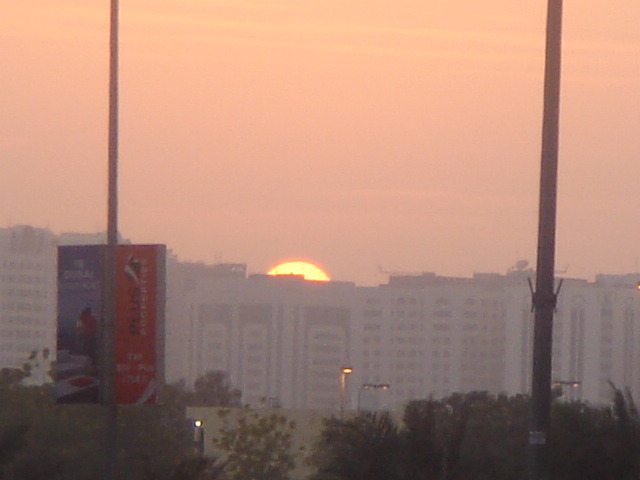
I was at the signal yesterday and managed to capture these moments. 30 seconds or may be lesser. How fast the Sun is travelling – anyone interested to calculate whether he is over speeding or not. By the feel of the hot weather even at this time of the evening, I felt he was a bit fast.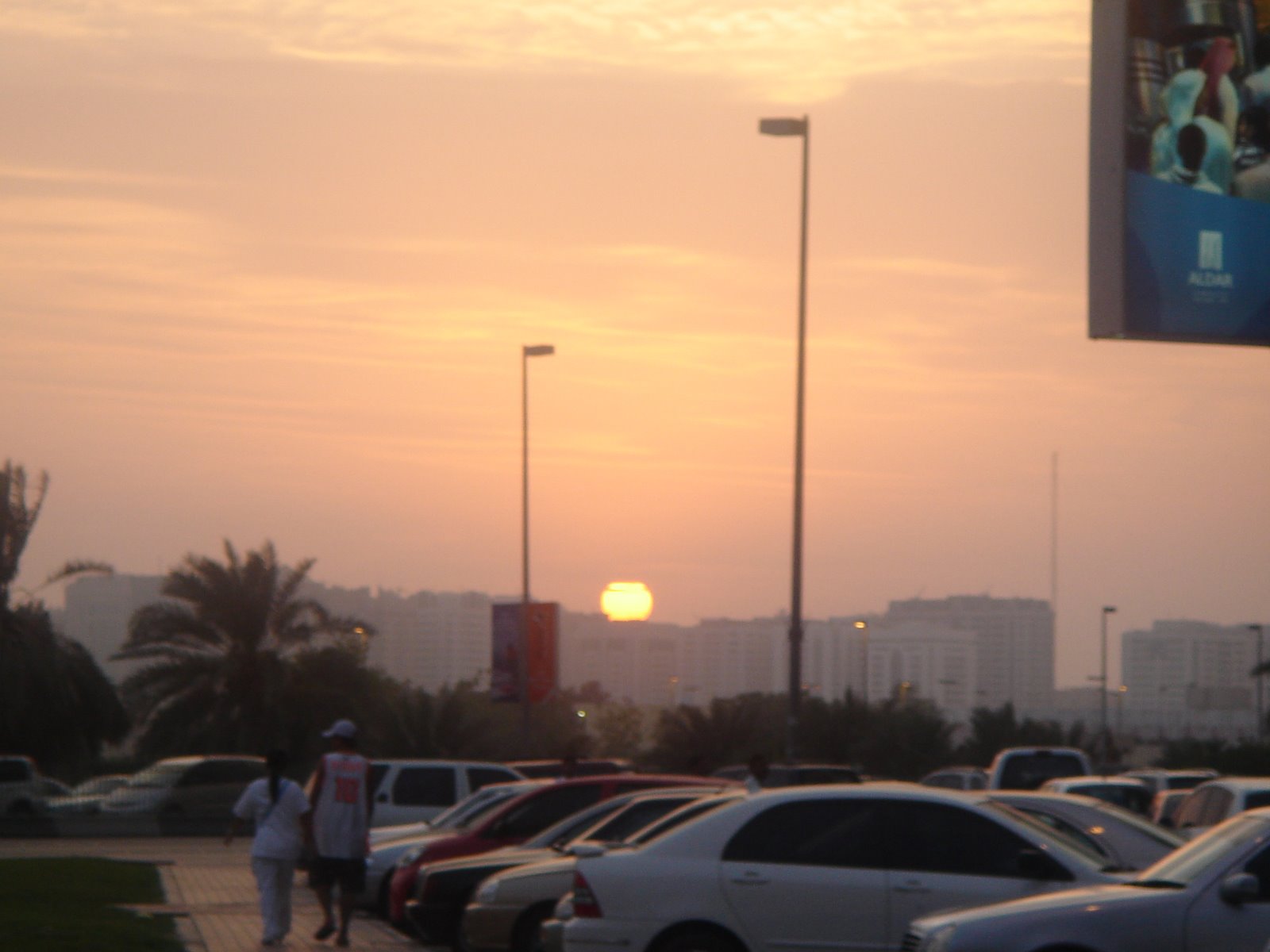



Parents hard hit by rising stationary cost
Parents hard hit by rising stationary cost
By Daniel Bardsley and Abbas Al Lawati, Staff Reporters /GULF NEWS Published: August 25, 2007, 00:24
Dubai: Many parents say they are finding it difficult to cope with the rising cost of uniforms, stationary, textbooks and all the other things they have to buy for their children every year.
Dr Elizabeth Thomas, 37, a veterinary surgeon from India with two daughters, Evana, eight, and Evita, seven, who both go to an Indian school in Sharjah, said increases in uniform prices had affected her the most.
She estimated that uniform prices had jumped about 10 to 15 per cent during the past 12 months.
“Over the year, the uniform prices have gone higher, there’s no doubt,” she told Gulf News.
“We get the uniforms from school and for the cost you pay, I certainly feel we could get better quality. Material wise, I could get a better shirt for the same price.
“The way things are now in the UAE, it’s really difficult because it’s not just the uniforms, it’s everything.”
Umm Ahmad, an Iraqi whose three children go to private Arabic schools, said uniform prices had gone up.
“Uniform prices have gone up about ten per cent, which is not bad considering that they were not expensive to start with,” she said.
She named the rising cost of tuition fees as more of a headache, saying: “The salaries of many residents of the UAE stay the same while expenses such as this are on the rise. Tuition prices go up every year.”
Armenia, an Indian whose 15-year-old daughter attends an Indian school in Sharjah, said textbook and writing book price rises had been heavy this year.
“Previously, I’ve never had to spend more than Dh200 on books, but this year it was Dh300. That is quite a big jump,” she said.
Back to school with a bang and a sigh
Back to school with a bang and a sigh
By Daniel Bardsley, Staff Reporter/GULF NEWS
Published: August 25, 2007, 00:24
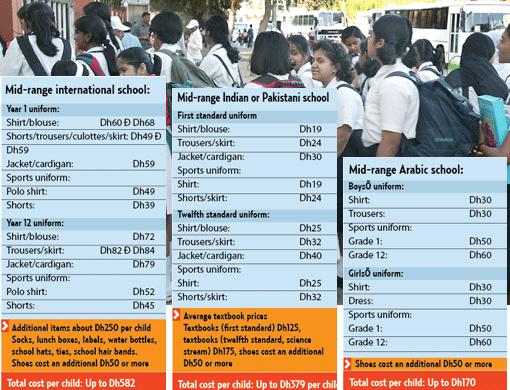
Dubai: The phrase “back to school” has struck fear into the hearts of children for decades, but increasingly, parents as well are beginning to dread the beginning of term.
The reason that mothers and fathers become concerned when the new school year looms is financial: costs of many of the essentials of school life have increased significantly this year.
It is not just the well-documented rises in tuition fees that are causing financial headaches, but also hikes in the price of books, stationery and uniforms.
As reported this month in Gulf News, stationery is now more than twice as expensive as last year for some parents, thanks to increases in the cost of paper and other inflationary pressures.
Parents who used to shell out Dh200 to equip their children with pens, pencils, exercise books and the like now have to pay Dh450.
Increases in the costs of school items are a particular headache to parents already struggling with the rising costs of rent and other major expenses.
Peter Daly, headmaster of Dubai English Speaking College, said textbooks had become much costlier, although in the case of his school, parents do not have to buy them themselves.
“Textbooks are now quite a major part of our budget. I’d say [the increase] must be 10 per cent per annum,” he said. “We get our textbooks from the UK and in the last two or three years particularly they have become expensive.”
Similarly, with regard to uniforms, Alexandra Sacher-Clynes, director of supplier Wren International, said that the cost of materials had gone up considerably, as the company sourced from the UK and exchange rates had become less favourable.
She said the firm had absorbed this cost as its contracts with schools stipulate the price of uniforms, although other firms that are not locked into contracts have been free to put up prices.
“We haven’t increased the prices – we’ve taken the headache,” she said.
Schools hike annual fees for transportation
Schools hike annual fees for transportation
By Preeti Kannan / KHALEEJ TIMES 24 August 2007
DUBAI — As students gear up for the new academic year, their parents are faced with yet another ‘extra expense’ with many schools reportedly choosing to increase transportation fees.
It is learnt that Emirates International School (EIS) has hiked the annual transportation fee from Dh3,300 to Dh5,250 and Dubai International Academy (DIA) from Dh3,300 to Dh5,200. Also, the International School of Choueifat, Dubai, has upped it from Dh3,000 to Dh3,300, while Delhi Public School (DPS) Dubai is learnt to have hiked the fees by Dh150 on some select routes.
DPS Dubai’s rates have changed from Dh 1,650 to Dh1,800 on the Deira and Ghusais routes, while the fee for Bur Dubai and Satwa routes has gone up from Dh1,500 to Dh1,650.
An official from the school, who didn’t want to be named, pointed out that the diesel costs had prompted the move.
Be that as it may, the hike in transportation fees has added to the parents’ cup of woes.
“Any change in the transport fee does pinch our pockets. Already there are so many expenses to be incurred during the course of the year. However, as parents, we have no choice but to depend on the school buses to ferry our children,” says a parent, KN, whose ward is studying in the International School of Choueifat, Dubai.
Another parent, whose child studies in DIA and who didn’t wish to be named, also echoed similar views. “It does upset our budgets when there is such an increase. Nevertheless, we would have to bear the cost if we want to use the school bus.”
Transport company Diamondlease, which provides buses to EIS, Meadows, EIS Jumeirah and DIA, confirmed that the fees have been increased. However, company officials justified the hike, claiming that it was long due because operational costs had gone up considerably.
“We had not increased our rates since DIA started a few years back. The overall operational costs like hiring of drivers, accommodation and visas for them have gone up. Also the time taken to pick up and drop children is longer now. It is financially not viable for us to run buses at a low cost,” said a senior representative of the company, who did not wish to be named.
The principals of EIS Jumeirah and Meadows, however, refused to comment.
ADCCI news
ADCCI announces second five-year strategic plan
Wam/29 July 2007
ABU DHABI — Abu Dhabi Chamber of Commerce and Industry (ADCCI) declared its second five-year strategic plan, Salah Salem Al Shamsi, chairman of the Chamber said. “The strategy comes as a result of continuing development that the Chamber has witnessed.”
In a Press conference, Eng. Salah said that the strong belief of the Chamber in the importance of setting up a strategy and implementing it, would help any institution to achieve its strategic goals. He assured that the priorities and objectives of the new strategy had been set to serve the economic and construction boom that the UAE is witnessing now.
ADCCI signs deal with Toastmasters
BY A STAFF REPORTER /KHALEEJ TIMES 25 July 2007
ABU DHABI — The Abu Dhabi Chamber of Commerce and Industry (ADCCI) has signed a cooperation agreement with the Toastmasters International, a US company, to adopt its Communication & Leadership Programme.
Ahmad Hassan Al Mansouri, ADCCI director-general, signed the agreement with Ravender Ray, the programme’s regional representative, recently.
Al Mansouri said that adopting this international programme comes in the framework of the ADCCI’s plan to support the private sector and to create special international educational and training programmes.
“The application of the internationally-known programme is expected to serve the chamber’s plans and strategies that aim at developing the services offered to its members and businessmen and linking it to their actual needs,” Al Mansouri said, adding that developing communication and leadership skills is considered to be a top priority for any leading company.
Al Mansouri said that the programme aims at supporting the society’s needs and requirements, so that it may add knowledge and experience to all those working for different government bodies, local companies, private and official institutions.
He said the Chamber will be the sponsor of more than 10 events, covering communication and leadership programmes, in addition to associated events and exhibitions.
New fees in Dubai dilute benefits of tax exemptions
New fees in Dubai dilute benefits of tax exemptions
By Ahmed A. Elewa, Staff Reporter/GULF NEWS Published: July 24, 2007, 23:05
Abu Dhabi: The advantage of tax exemptions in the UAE is being diluted by the many fees imposed on businesses, especially in Dubai, an economic expert said.
Dubai is seeking to multiply its visitors, capitalising on shopping promotions and events such as the ongoing Dubai Summer Surprises and the Dubai Shopping Festival.
However, the emirate risks major retail price hikes compared to other places in the region. The new fees have a multiplier effect not only on retail prices, but on the overall inflation rate.
“Although there are no taxes in Dubai there are many other hidden growing costs, such as the new municipality fee on property, health care, in addition to the Salik toll,” said Eckart Woertz, economist at the Gulf Research Centre.
Many other services are witnessing substantial cost increases, including education and warehousing.
“Such additional costs put more pressure on consumers, and with the possibility of a value added tax (VAT) being introduced, the situation can further deteriorate,” he added.
Expensive foodstuffs
Dubai’s high foodstuff prices could adversely affect the emirate’s endeavours to promote itself as a shopping destination.
Therefore, there must be careful consideration before introducing new fees, especially at a time when inflation is soaring as a result of robust economic growth.
“Dubai imports foodstuffs from countries like Europe, Canada and Australia, whose currencies have appreciated substantially against the dollar, hence adding the impact of imported inflation to impacts of domestic origin,” Woertz said.
House hunters weigh rent and time taken to reach office
House hunters weigh rent and time taken to reach office
By Robert Ditcham, Staff Reporter/GULF NEWS Published: August 23, 2007, 01:01
Dubai: Faced with the strenuous decision of where in the UAE to call home, most newcomers to the country factor in the rent they can afford and their travel distance to work.
It seems that, for the moment at least, the distances involved in commuting from Dubai to the northern emirates of Ras Al Khaimah (RAK), Fujairah and Umm Al Quwain (UAQ) are mostly too lengthy for people’s liking.
Real estate brokers say the main alternatives to Dubai are still Ajman, Sharjah and Abu Dhabi, where residents can enjoy lower rents and still be within touching distance of Dubai’s job scene and lifestyle options.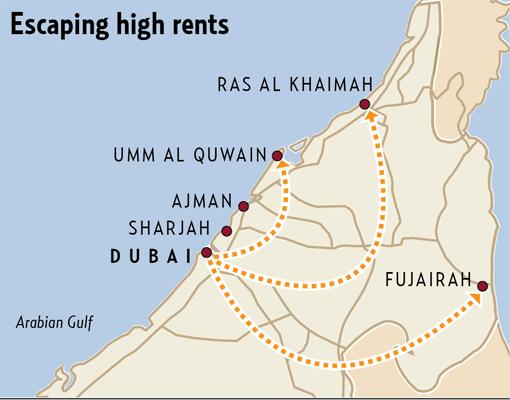
According to second quarter 2007 statistics by UAE-based property services company Asteco, rents for a one-bedroom apartment in Ajman are around the Dh22,000 mark. In RAK, Fujairah and UAQ a similarly sized apartment will set you back around Dh25,000.
Meanwhile, in Dubai, a one-bedroom apartment in Karama and Bur Dubai averages approximately Dh75,000, and in Dubai Marina will cost Dh135,000.
This price difference has put Dubai out of contention for many mid-income families, say property analysts.
“We are seeing a very strong trend of people moving out of Dubai, especially young, middle-income families, because rents are not affordable for them and schooling is cheaper elsewhere,” said Peter Penhall, CEO of property portal Gowealthy.com.
“Ajman has been the most viable alternative because of its short distance to Dubai.”
Roger Wilkinson, managing partner of Northern Emirates Property, a Sharjah-based property leasing and management company, described the residential real estate market in Fujairah and UAQ as “low key” compared to Ajman.
In terms of future rents, Penhall said Dubai will always command a premium because of the advanced state of its real estate sector, its wide array of lifestyle options and the quality of its projects.
However, he said despite rents being substantially lower in the northern emirates, the gap in the quality of apartments is moderate.

COSTS
Look carefully, you are saving a lot
Based on the assumption that petrol costs are Dh0.14 per km and the distance to Fujairah is 120km (round trip 240km).
Approximate petrol cost of daily round trip commute from Dubai to Fujairah: Dh34
Approximate annual petrol cost of round trip from Dubai to Fujairah: Dh12,380 (assuming that travel on weekends for Dubai-based activities)
Average annual rent of one-bedroom apartment in Karama and Bur Dubai (Dubai): Dh75,000
Average annual rent of one-bedroom apartment in Fujairah: Dh26,000
Overall saving for resident who has moved to Fujairah, but commutes daily to Dubai: Dh36,620
Dubai moves to calm soaring rental prices
Dubai moves to calm soaring rental prices
By Saifur Rahman, Business News Editor/GULF NEWSPublished: August 22, 2007, 00:13
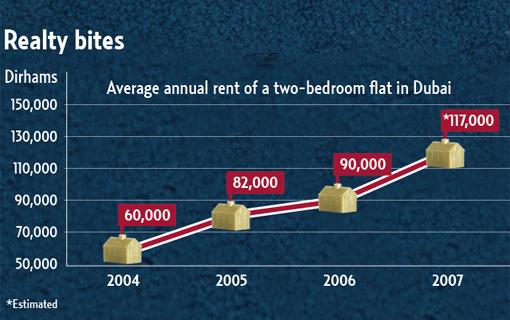
Dubai: The emirate will soon facilitate lands to develop low-cost housing for Dubai’s middle class to tackle the current housing shortage and tame rent-related inflation, a top government official said on Tuesday.
Marwan Bin Galita, chief executive of the newly formed Real Estate Regulatory Agency (Rera), told Gulf News in an interview the agency was all set to finalise a three- to five-year tenancy agreement so that the tenants can tackle the rising rental costs.
“It will be a model tenancy agreement in which all the rights and privileges of the tenants will be reserved. We will ensure that everyone strictly adhere to the contracts,” he said.
“The long term contracts will be transparent and fix the rents for that period and help the tenants in coping with rising rental costs.” 
However, these contracts may not be mandatory, but to help the consumers, he said. “We do not want to police the market, rather allow the market forces to reshape in a more professional manner. We will try to enforce this,” he said.
Experts say a big part of the problem is that the demand for housing in the emirate remains significantly larger than what is available in the market.
Project delays have deprived the market of 300,000 housing units, according to Syed Ali Anwar, chief executive officer of 3D Venture Real Estate.
“These projects have been delayed by at least one year and will only be ready by December 2009. Some are facing construction delays because of rising material costs, others never got started after being announced,” he said.
“The current demand is for 100,000 apartments but we include the number of people who will be coming to Dubai by 2009, then we will require 200,000 more units.”
The continued economic growth means demand for housing units will continue to remain strong, says Bermak Besharaty, chief executive officer of Al Mas Capital, a company advising on real estate finance deals.
“There was some overbuilding in the luxury sector. There was not enough building in the middle and lower income segments. More developers are realising this.”
To counter that, Rera is developing a comprehensive Real Estate Index to assess the market and make recommendations to the government on proposed regulations, said Bin Galita. 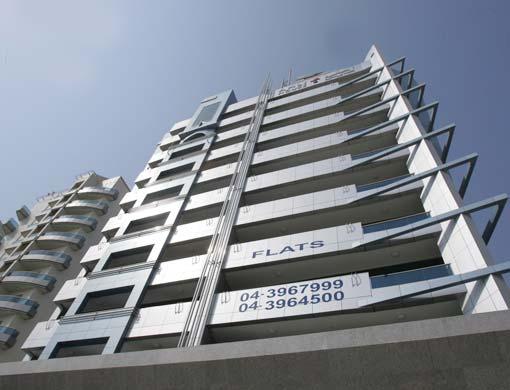
“We have began collecting data on the housing supplies and projected demand to complete the assessment which should be completed by the end of this year,” he said.
Based on data, he said, Rera will make a set of recommendations to the Dubai government in which facilitating the low-cost housing would figure prominently.
“Dubai definitely needs to facilitate low-cost housing to support the middle class like any other cities and we will definitely recommend measures to facilitate this,” he said.
“Already, a number of leading developers have come forward to launch low-cost housing schemes that will help tame the demand.” Bin Galita also stressed that Dubai was in need for a property arbitration centre, he said.
“Although the number of rent disputes will reduce drastically once the long-term tenancy comes into effect, the time is right for Dubai to set up a property arbitration centre,” he added. “The rent committee may not be enough to tackle everything.”
 ClicksandWrites
You must be logged in to post a comment.