UAE
Khalifa issues decree setting up energy firm
Khalifa issues decree setting up energy firm
WAM Last updated: September 19, 2007, 23:24
Abu Dhabi: President His Highness Shaikh Khalifa Bin Zayed Al Nahyan, in his capacity as Ruler of Abu Dhabi, issued a law setting up the Abu Dhabi Future Energy Company with a capital of Dh10 million.
Law No. 22 of 2007 sets up the Abu Dhabi Future Energy company as a private joint stock company specialised in the commercialisation of alternative energies through emissions reduction, and clean development mechanism solutions as provided by the UN agreement on climate change as explained in the Kyoto Protocol.
Research
It also sets up the Masdar Science and Technology Institute with the aim of developing and supporting scientific research and technology in the emirate.
According to the law, the company will be a corporate body that enjoys full financial and administrative independence to practice its activities and achieve its targets.
The institute, a corporate body, will also enjoy complete financial and administrative with legal capacity to practice its activities.
It will be offering specialised educational programs in renewable energy and sustainability. Based in Abu Dhabi, the energy company will have a capital of Dh10 million distributed as equity shares at a value of Dh1 per share.
Shares
The new company’s shares are wholly owned by the Mubadala Development, which has the right to restructure the capital. Mubadala is also permitted to sell its shares in the newly established company.
The company may set up, invest in or enter into partnerships with others in the areas of agriculture, industry, water and electricity abiding by the principles of sustainable energy.
It will also have wide ranging business activities in Abu Dhabi and outside the emirate.
Motorists told to drive cautiously before iftar
Motorists told to drive cautiously before iftar
Staff Report / GULF NEWS Published: September 18, 2007, 23:50
Dubai: Reckless driving of some motorists before iftar (breaking of fast) time is the main reason for traffic accidents during Ramadan, said a top police officer.
Brigadier Mohammad Saif Al Zafein, Director of Dubai Police’s Traffic Department, said Dubai Police stations recorded 42 serious traffic accidents during last year’s Ramadan (from 4pm to 5pm, before iftar time), leaving 58 people injured.
“There are two periods when traffic accidents increase: after Al Asar prayer and till iftar, and after Taraweeh prayer,” Brigadier Al Zafein said.
He said traffic offences – mainly jumping red signals at interchanges leading to deaths or serious injuries, not leaving enough space between vehicles, motorists not abiding lane discipline and lack of attention – are behind the accidents.
Pay attention
He urged motorists to pay attention while driving to avoid accidents, especially before iftar.
He said traffic patrols are present on various roads in Dubai, and during iftar time there are more patrols due to the rise in accidents.
Brigadier Al Zafein said police patrols try their best to ensure safety on the roads. Police patrols work in three shifts: 6am to 2pm (first shift), 2pm to 10pm (second shift), 10pm to 6am (third shift). Traffic policemen on motorbikes work from: 7am to 2pm, 2pm to 5pm and 5pm to 11pm. On weekends, their work extend till 1am.
Multi-million dirham education initiative launched
Multi-million dirham education initiative launched
Staff Report / GULF NEWS Published: September 19, 2007, 15:33
Dubai: His Highness Shaikh Mohammed Bin Rashid Al Maktoum, Vice President and Prime Minister of the UAE and Ruler of Dubai has launched a multi-million dirham initiative to educate more than a million children worldwide.
“Dubai Cares,” is being launched during the holy month of Ramadan, with the aim of raising money from across Dubai’s diverse community to provide children in some of the world’s poorest countries with a primary education.
The campaign is being spearheaded by Shaikh Mohammed and his children, who will be unveiling a number of initiatives to be held over the coming six weeks.
According to organisers, in addition to the aim of raising money for those less fortunate around the world, ‘Dubai Cares’ also seeks to get Dubai’s community, including individuals and the private sector, involved in the project, instilling a sense of social cohesion.
“I expect both Emiratis and expatriates to compete in charity and to participate in any way you find suitable…In our country, we added to our Arab and Islamic tradition a diversity of values represented by the diverse mixture we have here of companies, cultures and nationalities from all over the world,” Shaikh Mohammad said at the launch.
Below is the full text of Shaikh Mohammad’s speech at the launch of a multi-million dirham initiative to educate more than 1 million children worldwide.
Ladies and Gentlemen
First, let me congratulate you on the occasion of the Holy Month of Ramadan. I pray that God will give each of us the strength to fulfill our duties during the Holy Month, the desire to absorb its values to the core of our being, and the integrity to ensure these values are reflected in our deeds.
Ramadan is a blessed month for Moslems around the world. Our hearts fill with shared joy in our religion, our souls are lifted and we are swayed by the spirit of the Holy Month to offer mercy and compassion.
Let the enduring spirit of Sadaqah (Charity) be the guiding light for our actions throughout the Holy Month. Let it shape our good intentions so they become deeds whose consequences are positive, immense and far reaching.
Education offers one of the clearest and most effective ways to turn good intentions into actions that change the lives of people immeasurably and for the better. The satisfaction to be gained from a single act that helps the needy or curbs injustice can be immense. Imagine how much stronger that satisfaction must be if that act helps – as only education can – to free generation after generation from grinding poverty.
The patrons of education leave a lasting mark on history. The opening of the first school in the UAE in 1903, for example, is a defining moment in the history of the nation and continues to be regarded as one of the greatest events in the country’s modern history. Our history books record the contributions of UAE’s education pioneers such as: Mohammed bin Ahmad Dalmouk, Khalaf bin Oteiba, Ali Mahmoud, Mohammed Zeinal and a host of others.
The names of those pioneers who put their efforts into opening schools and providing the funding to support education, will be longest remembered and are an undeniable part of our history. Those who forget their responsibilities towards their community are soon forgotten.
Brothers and Sisters,
Education holds out hope for the future, enrichment for the present, and dignity for mankind. It helps us to communicate with each other. It helps nations to hurdle the barriers to understanding. It provides a solid basis from which societies can grow and flourish.
God Almighty said: “O mankind! We have created you from a male and a female, and made you into nations and tribes, that you may know one another. Verily, the most honourable of you with Allâh is that (believer) who has At-Taqwa”. (Al Hujurat – 13)
But, could the ignorant communicate with the educated? Do societies that continue to accept widespread illiteracy have any chance to bridge the gap between themselves and the educated world?
Education, through its ability to open eyes to new possibilities and extend horizons, offers a channel for communication between humans, a necessity as the Holy Quran tells us.
The importance of education has increased tremendously in the “Knowledge Age”. Promoting education and providing the support it needs to flourish are now prerequisites for global development. Those who are deprived of education will inevitably fall behind and dwell in a shadowland. They will never know the true essence of their religion, nor learn its valuable teachings. They will always be dependent on others and face the prospect of becoming burdens on themselves, their societies and the whole world.
Brothers and Sisters. Since the era of the late Sheikh Zayed and Sheikh Rashid, may God ensure their souls rest in peace, the UAE has been committed to offering support and help to our fraternal brothers and sisters in the Arab and Moslem worlds across Africa and Asia. The country’s contributions were made in many fields, and especially in the field of education.
From early on in our history pioneering UAE businessmen have appreciated the importance of education. Mr. Juma Al Majid, for example, has been an outstanding role model. His support for education has resulted in Mr. Juma being considered an outstanding figure and a celebrated patron across the Arab and Islamic Worlds.
The UAE’s remarkable successes at various local and regional levels have increased its prominence as an economic and cultural bridge between the East and the West. By accepting this crucial role we accept at the same time the duty to promote education in its entirety.
Last May, I launched the “Mohammed Bin Rashid Al Maktoum Foundation” for human development. Knowledge and Education are key components of the vision and mission of the foundation and underpin its activities. We expect the Foundation to become a showcase for the benefits of long term education initiatives for humanity in general and for our region in particular.
Today, I seize this opportunity presented by the Holy Month of Ramadan to announce the “Dubai Cares” campaign, which focuses on supporting education for children in a number of the world’s poorest countries.
I invite you to take part and support this campaign. I strongly believe that together, we can reshape the future of underdeveloped countries in the region and globally. The campaign’s mission is to help spread education in these countries by securing necessary funds.
Building new schools and classrooms, providing books, food and medical care for unprivileged children are among the campaign’s key objectives.
Brother and sisters. Eight years ago, the international community set the millennium development goals all countries pledged to fulfill. One of the main goals was to guarantee that every child will receive a basic education by the end of 2015. The realities on the ground are not promising and it looks unlikely that this goal will be met on time.
There are 120 million school-age children across the world who do not have access to education. A third of the children in developing countries cannot complete five years of education, the minimum required to achieve basic literacy.
Unfortunately, the biggest proportion of these deprived children are in Asia and Africa, especially in the Islamic world and the neighboring countries. This is in spite of the value placed on education in our holy book, as the first Aya that was sent to the world was a call for reading: IQRA’A.
Even the holy sayings of our prophet place education on the same level as worship, and even at a better place.
Brothers and Sisters. Thanks to Allah, we, in the UAE, enjoy a high standard of living. One of the secrets of our success and progress has been our ability and readiness to create opportunities and seize them in a timely fashion.
But opportunities do not grow on trees and cannot be achieved by wishing or dreaming. They are attained by taking the one clear path – the path of knowledge.
Education is the bulldozer that makes this path navigable, guiding people along its course and towards their destination. Knowledge gives people the chance to live in pride, progress and prosperity.
Expanding education in all of our emirates, and encouraging thousands upon thousands of university and higher colleges graduates, from our boys and girls, is the solid platform on which we will achieve progress and prosperity.
Advancing education remains an unquestionable priority. We have started the race against time to achieve an Emirati education that meets the highest international standards.
This Dubai Cares campaign, that I am launching today, seeks to shine the light of knowledge and dispel the darkness of ignorance. Its aim is to give the children of poor countries hope for the future and opportunities to break the cycle of poverty that threatens to entrap them and consign their families to a life with no real future.
Through education they can become positive contributors in the prosperity of their communities and countries.
Brother and sisters. Wherever ignorance reigns so does poverty, illness, misery and despair, and people start believing in fiction and illusions. The worst disease in this world is the unbreakable partnership between ignorance and poverty.
This partnership is the source of all evil from which many countries suffer and it is the root of persecution, and the main reason for divisions in the world between a wealthy North and a poor South, between advanced countries and deprived countries, between societies that know, and societies that do not know.
The only way to break this partnership between ignorance and poverty is by relentlessly attacking ignorance and by exerting every effort to spread education. We are doing our duty, regardless of the fact that many countries have resigned from playing their role in combating illiteracy worldwide and the international community is not able to fulfill its promises.
We are doing what we see as our duty by our religion, our traditions, our humanity and our deep belief that the person who turns his back on the suffering of his brothers and sisters doesn’t deserve to be called as human.
Therefore I am confident that you will participate in Dubai Care initiative for education.
I expect you, Emiratis and expatriates, to compete in charity and to participate in every way you find suitable. And I expect from the private sector a substantial contribution, including the international corporations and their offices in the UAE.
In our country, we added to our Arab and Islamic values a bright international horizon with a diverse mixture of companies, cultures and nationalities from all over the world.
This mixture offers a successful model of coexistence and collaboration. We are all invited today to develop this model and give it a humanitarian dimension through our collaborative donation to our brothers and sisters who are less fortunate than our Emirati nationals and the expat residents who have helped our country and helped themselves to achieve what they could not in their home countries.
Today, I announce the start of Dubai Cares campaign, empowered by your will and determination.
I am pleased to announce that I, together with my sons and daughters, will participate actively to ensure the success of this campaign.
I expect everyone to participate personally and that you will motivate your family members to contribute as well, so we can all fulfill our duty in what pleases our Creator and our own conscience. We need to implant the culture of donation in our society and give our children a heritage that incorporates the noble values that we inherited from our ancestors and which have now become one of the highest universal values. These values gain more territory every day.
They have new heroes every day, competing for the welfare of their brothers and sisters in humanity.
Shortage of taxis leaves residents hot under the collar in Abu Dhabi
Shortage of taxis leaves residents hot under the collar in Abu Dhabi By Binsal Abdul Kader, Staff Reporter GULF NEWS Published: September 18, 2007, 23:50
Abu Dhabi: Residents in Abu Dhabi have complained they are unable to get taxis on the city’s roads. Many say they are compelled to wait for taxis for a long time in the scorching summer heat.
Residents said even if they come across taxis, the drivers refuse to take certain routes. Manzoor Talibi, 25, an Iranian national said for a 10 minute journey he had to wait 45 minutes at Hamdan Street.
“Taxis are not available and most of the taxis refuse to drive to my destination. Besides, taxis also smell. Cleanliness has to be improved.”
Other residents complained that taxis are shuttling between the city and some suburbs to make more money. Diab Mousa, 50, an Iraqi Engineer said taxis are doing a “sharing shuttle service” to Mussafah and Baniyas, hence there is a shortage of taxis in the city.
“When the old buildings in the city were demolished, hundreds of people shifted to the suburbs and small towns. Taxi drivers are cashing in on such people who have to travel to the city for work,” said Mousa.
He suggested the introduction of an effective public bus service as a permanent solution. Moidooty, 40, an Indian X-ray technician who frequently travels between the city and Mussafah echoed the same opinion. He said shared taxis demand double the fares during the weekend.
Sajeev Mangalam, 30 an Indian salesman said, “Some taxi drivers don’t stop even when people ask them to. Their careless driving is also dangerous.”
Abdul Aziz, 47, an Indian real estate firm owner explained, “There is more demand for taxis in the city because more expatriates are coming to the emirate in the wake of a development boom. That’s why there is an acute shortage of taxis and the authorities have to take remedial steps.”
Taxi drivers refuted the allegations against them. Mohammad Hussain, 35, a Pakistani taxi driver said the number of passengers in the city has been increasing but the number of taxis is static.
His compatriot Shahid Hassan, 46, said the authorities have to give a licence to more taxis to solve the problem.
Send your comments and suggestions to letter2editor@gulfnews.com
Passenger traffic at Abu Dhabi Airport up 32 per cent
Passenger traffic at Abu Dhabi Airport up 32 per cent
BY A STAFF REPORTER KHALEEJ TIMES 17 September 2007
ABU DHABI — Abu Dhabi International Airport handled a total of 707,671 passengers in August 2007, a 32 per cent rise over the 536,201 passengers in August 2006.
The number of aircraft movements increased 10 per cent during the same period, rising from 6,156 in August 2006 to 6,785.
Cargo volume increased to 27,015 tonnes in August 2007 from 23,601 tonnes last year, a growth of 14.5 per cent. Abu Dhabi International Airport continues to achieve high levels of growth, with the passenger growth in August exceeding the 27 per cent growth seen in the first half of 2007, a particularly impressive result in the busiest time of the year for the airport.
The number of aircraft grew especially strongly in August driven by the new services added during the year by Etihad Airways, the national carrier of the
United Arab Emirates and new airlines Oman Air which commenced services in May 2007 and Ethiopian Airlines which commenced services in July 2007.
ADAC has officially taken over the operation and management of Abu Dhabi and Al Ain international Airports, as of 28 September 2006. Under its mandate will be the re-development and expansion of Abu Dhabi International Airport, which includes the new midfield terminal designed to increase the overall capacity of the airport to 20 million passengers by 2010.
Abu Dhabi economy to attract Dh1 trillion
Abu Dhabi economy to attract Dh1 trillion
BY A STAFF REPORTER KHALEEJ TIMES 18 September 2007
ABU DHABI — With fixed investment expected to double and sustained growth in the years to come, Abu Dhabi’s economy is set to attract over Dh1 trillion in local and foreign capital, according to a new report issued by Abu Dhabi Chamber of Commerce and Industry (ADCCI).
ADCCI Director General Ahmed Al Mansouri said increase in the fixed investment in the emirate during the current year outpaced figures registered for the recent year by 400 per cent with total accumulated investment reaching around Dh295 billion for the years 2001 to 2006.
“These figures stand testimony to the dynamism, vibrancy and resilience of the emirate’s economy and its capacity to lure in more local and foreign investment due to sound policies adopted by the emirate’s government,” he added.
Abu Dhabi’s business philosophy, he said, revolves around optimum utilisaition of oil revenues,forging constructive public-private partnership, creating fertile investment ground for local, regional and global investors, introducing new flexible laws and diversifying the economic base in order to achieve sustainable development.
He noted that the booming construction and building sector is projected to establish itself as the most magnetic business sector in 2007 with total inward investment growing by 346 per cent to Dh580 billion against the previous figure of Dh130 billion.
Second in line is the tourism sector whose investment is expected to see a whopping growth of 820 per cent to more than Dh230 billion.
“Manufacturing sector is set to lure Dh130 billion in the next few years and Dh12 billion in the current year, an increase of 39.5 per cent over 2005,” he indicated.
According to the ADCCI chief, Dh2.4 billion was expected to be pumped in by investors in the wholesale/retail trade sector against Dh1.4 billion in 2005.
The restaurants and hotels sectors, he continued, could see a 50 per cent growth in investment, rising to Dh3.9 billion in 2007 from Dh2.6 billion in 2005.
As for the real estate and business services, an estimated amount of Dh6.8 billion is set to be ploughed in. The figure represented an increase of 78.9 per cent over 2005.
In 2007, the social and private services sector is set to receive a total investment of Dh2.5 billion compared with Dh2 billion in 2005.
Al Mansouri put the total value of foreign investor’s portfolio in the emirate at Dh420 billion.
Staying efficient
Staying efficient
By Jyoti Kalsi, Gulf News Report GULF NEWS Published: September 15, 2007, 23:04
Fasting during Ramadan has many beneficial effects on our mind, body and spirit. But special care must be taken to ensure that the change in diet and daily routine does not affect our efficiency at work.
Those who have strenuous or outdoor jobs are particularly at risk and must take precautions against accidents due to weakness or dehydration.
Tabloid! spoke to Dr Zarqa Taimur, a specialist in Internal Medicine and Occupational Medicine. Dr Taimur is a member of the Royal Society of Occupational Medicine, the Royal College of Physicians of London, the International Organisation of Safety and Health (IOSH), the International Commission on Occupational Health (ICOH) and the American College of Occupational Environmental Medicine. She provided these tips for employers and employees to ensure a safe Ramadan at the workplace.
Workers such as those operating machines or working on construction sites can be at great risk if they ignore signs of weakness or dehydration that could lead to a collapse. It is advisable to be alert to early symptoms and take a break or seek medical advice.
Symptoms to watch out for
– Dizziness
– Headaches
– Severe weakness
– Blackout or fainting
– Drowsiness on the job
– Inability to concentrate
– Exhaustion
– If you do not feel well, say so and get help. Remember if you have a health problem or are travelling, you are exempt from fasting.
Diet
This month our diet should not differ very much from our normal diet. It should be simple and nutritious to help us maintain our normal body weight or lose weight in case we are overweight.
Recommended diet
Iftar: Up to three dates, one cup orange juice, half cup boiled chick peas with salt and pepper and one cup fruit salad preferably without added sugar or spices.
Dinner: Two slices of whole wheat bread or one cup rice or pasta. Half cup cooked vegetables like okra, spinach or potatoes, chicken, fish or mutton curry, fresh salad, yoghurt, 10 roasted, unsalted nuts and tea or coffee.
Sohour: Whole wheat bread or one cup rice, porridge or cereal. Half cup cooked vegetables or vegetable salad, one orange or half cup grapes, tea or coffee.
How to work optimally
– Reduce working hours
– If possible, work after breaking the fast
– Pace your work and take frequent breaks
– Wear loose comfortable clothes to allow air circulation
– If possible, shower during the shift and change your uniform to stay fresh
– Be extra careful if you have recently returned from vacation or are new to the job
– Rinse or brush mouth frequently as fasting causes a bad odour
After the fast
– Drink plenty of water; those who work indoors with little physical activity should drink six to eight glasses, while those with more physically demanding jobs need to have at least four litres of water.
– Avoid too much tea or coffee as it dehydrates
– Include plenty of fruits in your diet
– Reduce meat and take more porridge and soup
– Avoid excessive fatty food
– Get adequate rest and sleep; avoid heavy social agendas
– Take a stool softener or bulk forming herbal supplement to reduce constipation
Have a medical problem?
– Diabetics: Those taking insulin injections should not fast; fasting can cause loss of consciousness and death. Those who use tablets to control the disease can fast; but they must adjust the medication timings and must continue normal diet restrictions. Some diabetics report better control of sugar levels during fasting.
– Hypertension or high blood pressure: You can fast, but must continue dietary restrictions. Change the medication time from morning to after beginning the fast. Blood pressure tends to fall during fasting.
– Asthmatics, ulcer patients and people with heart disease: Fast if disease is not severe and controlled by medication. Adjust the timing for drugs and maintain dietary restrictions.
– Fasting during pregnancy, lactation or after childbirth: is optional; it can be postponed to a later time.
– Injections or intravenous medication, which is solely medical and not nutritional, is permitted during fasting. Use of eye and eardrops as well as rinsing the mouth and nose are allowed.
Common symptoms during fasting
– Energy levels drop, especially in the first three days as the body adjusts to stored glucose
-Dehydration is experienced more acutely in the first few days because the body takes some time to adjust and start conserving fluids
– Drowsiness due to changes in sleeping and eating patterns
n Headaches, constipation and irritability are other factors commonly experienced during the first few days of fasting- However, most people acclimatise within one week of fasting and energy levels improve
– In the later days of fasting, people often experience exhaustion and feeling cold
The body’s metabolism
– Our diet includes foods containing carbohydrates, fats and proteins
-The body’s main source of energy is glucose derived from the breakdown of food
– Normally the body has enough reserves of glucose in the liver to last 24 hours
– After that is uses energy reserves stored in the muscles
– Its final and maximum reserves are stored in the form of fats
– During Ramadan, when one fasts for less than 24 hours, the body uses its stores of glucose from the liver; in those with high activity jobs other reserves are used too.
Points to remember
– Cut down on coffee and tobacco a week before Ramadan to avoid headaches
– Avoid fatty food, too much coffee or tea, food containing too much sugar such as carbonated drinks
– Eat unrefined and fibre rich foods such as brown bread, barley, oats, beans and lentils to avoid constipation
– Eat leafy veggies, fruits, dry fruits and milk products
– Take adequate fluids and salt to avoid lethargy
– Eat three to four hours before bed time
Mind Speaks – Passing the baton, War is on & The Art of coming, Coming and Still Coming……
In the recent times in international news media we see an influx of advertisements coming out with yoga postures in them to promote a variety of produce from building projects to automobiles to investments schemes. One thing we can be proud of from these ads is the fact that we belong to a country of Tradition, Values and Culture. Even if we do not try to promote them, the roots planted by our ancestors have grown sufficiently enough to give the plants of their hard work to promote those values to current and future generations to come.
Welcome to read through Team 1 news’s Mind Speak column dated 15092007.
Passing the baton
The holy month of Ramadan started and it suddenly brings an air of devout feeling all around. People are more dutiful and accept their virtues and values during this auspicious month. It is at this point of time that I think about our immediate elders who live with us. It can be our grandfather, grandmother or uncles. How many of them now have the time to pass on stories or values of moral experience to our children. Not many, as they are all busy with their own scheme of things and worldly pleasures. Very few find a little extra time to sit with our children and pass on some extra special thing which they have in them. Probably most of them are busy with finding what they missed in someone and correct him or her or may be finding time to see what is happening with the sequence of the TV serial currently on. They miss a golden opportunity to groom a young generation immediately in front of them, who are waiting for a soft and gentle touch, which is extra special, and which they all are looking forward to. I hope they open their eyes and remember what they received from their own elders which made them more precious to the society.
War is On and the Expression of expressionless
The Twenty20 World Cup cricket is on in South Africa and by now we have seen some exciting cricket matches. One such match was the one where Zimbabwe beat the reigning world champions Australia. For the Australian team captain Rickey Ponting and his members, it was time to understand their ego. It was an expression of expressionless. Zimbabwe taught many lessons including one to West Indian team that if you field well and hold on to your catches, you can win matches. This format of cricket seems to be interesting at least from the Indian productivity point of view. Any cricket match anywhere in the world, will attract Indian viewers and if it happens to be a 50 over a side match, the productivity loss is that much. This shorter format saves a considerable amount of energy and resources at least in that aspect.
One more factor that interests me about this format is the combat element required while playing in this Twenty20 format. A player has to be fit, aggressive, alert, athletic and should have the urge to go for a kill while playing in. They are now in the same situation of a soldier from an infantry battalion, who has to go out in the battle field face the enemy straight away. It is here he claims his upper hand if he gets to kill one or many of his opponents before he himself succumbs to their bullets. This was proved when India batted against Pakistan yesterday. The urge to go for a kill was not there in the eyes and body gestures of players like Virendar Shewag and Yuraj Singh. And they failed miserably with their batting. India won the match with the bowl out going in favor of them. Full marks to Mahendra Singh Dhoni for his selection of bowlers for the bowl out as he did not give the pacers the initial go at the stumps and selected the slow and accurate bowlers who were right on target. Pakistan on the other hand, lost their scheme of things or I wonder where the mango trees in Pakistan gone these days. Even if do not have sufficient mango trees, we have proved by winning the bowl out that we have plenty of Public transport busses on the road to aim at and practice for a bowl out win. The pace bowlers did well within their limitations, especially Irfan Pathan. This is a killing field for bowlers, and whoever who comes out with less than 8 runs per over is a great bowler. There will be plenty of actions on this in the coming days.
The Art of Coming, coming, and still coming……….
It happens many time that we come across people who makes promises to us that they will deliver us a service within a stipulated time. They take up many things at the same time or due to the simple fact that they are not qualified enough to do the service which they are required to do, fail to deliver what they promise and keep on telling that, it is coming and on the way and will even give a time limit saying that – no sir, I will confirm it you before 12:30. Probably, he is too clever not to mention the day/date of this important 12:30 and we will sit and wait for such a 12:30 to happen. These days, we see many customer service representatives and authorities who practice this Art of Coming, coming and still coming…….. Unfortunately, I am suffering from one such group and my Team 1 news is specially dedicated to all of them who practice this art without knowing what they can or will be able to deliver. These days, a phone call, a sms, or an email stating the reason for the delay will very much avoid the wait, agony and planning disorder at the end of the valuable customer.

Taxi and transportation problem in Abu Dhabi.
Last but not the least, I cannot end my weekly round up with the support I am getting from unknown sources to express their feelings to the authorities through newspaper columns.
I remember seeing a movie Savage Harvest when I was a child. The story was on the famine situation in an African country, where by predatory animals coming out from the jungle and fighting it out to eat a whole village. The situation in the streets of Abu Dhabi is slowly getting to such a scene very soon, when you will see taxi users will fight their way in if ever they get to see a taxi coming.
I am doing my small bit of campaign to open the eyes of the authorities through newspaper columns and by other means. Suggestions have been made to introduce a Q system in all the taxi stops and also to introduce Circular public transport service within the main streets of Abu Dhabi to reduce the transportation problem of general public. If you wish to join me in this initiative, you may also forward your own thoughts and expressions to the situation to letter2editor@gulfnews.com. You may also send this to any of your friend or colleague who may be able to express it in a much better way to the authorities concerned. Finally, what we need is smooth transportation for general public to go and come back from work and to move around.
God bless and have a great week ahead.
Ramesh Menon
15092007
Nothing to Crow about
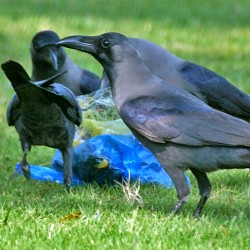
Nothing to Crow about
Nothing To Crow AboutBy Dr Reza Khan /XPRESS4ME
Recently someone suggested the local authority control the population of house crows in Dubai.
Believe it or not when I landed here in 1989 there were virtually no crows.
In 1991, the first pair built a nest in Dubai. At that time Maktoum Bridge had only two lanes on each side and it was a single bridge.
On the Deira side, by the right footpath, there was a eucalyptus tree. A pair of crows built a nest in it and raised two chicks.
My first encounter with the house crow in the UAE was in Dibba coastal area during 1986, when we used to see them resting or roosting on lamp posts and electric wire.
By 1992 we had a few more than 100 house crows in and around Dubai. Now, we possibly have more than 1,000 crows in the city.
Why are their numbers going up? Because we are careless with our waste material.
If no food is available in the streets, parks, market places and farming areas, crows cannot survive in the desert.
The only way to control their population is to manage our own domestic and city refuse in a hygienic manner. Also, the avenue and park trees should be trimmed in such a way that crows cannot build nests.
Jet gets right to fly to Gulf, Middle East from Jan 1
Jet gets right to fly to Gulf, Middle East from Jan 1
14 Sep, 2007, 1323 hrs IST, PTI
NEW DELHI: The government on Friday opened up the lucrative Gulf route to domestic private airlines, with Naresh Goyal-promoted Jet Airways becoming the first to get the nod to fly to the region from January 1 next year.
Hitherto, only Air India and Indian (now merged to form Air India) were allowed to operate on the Middle East and Gulf route.
As per the decision of the government, scheduled Indian private airlines were not permitted to operate international flights to and from Gulf till the end of 2007. The Gulf routes were served only by the Indian public carriers till then, an official statement said.
Jet Airways was granted traffic rights on the Gulf and Middle East routes at a meeting of the Directorate General of Civil Aviation last evening, it said.
Jet has been permitted to carry 3,682 passengers to Kuwait per week from three destinations in India. Of the 3,682 seats, 1,582 would be from the Delhi-Kuwait route while an equal 1,050 on Trivandrum-Kuwait and Kochi-Kuwait routes, the statement said.
Besides, Jet can also fly 3,150 passengers to Oman per week on three routes Kochi-Muscat and Trivandrum-Muscat and Calicut-Muscat.
The airliner has been given permission to connect Calicut and Mumbai to Qatar’s capital city Doha, where it can carry a maximum of 2,100 passengers per week.
Similarly, Jet can operate 2,100 seats to Bahrain, of which 1,050 can be on the Mumbai-Bahrain and 1,050 on Kochi-Bahrain route.
Jet Airways had applied for traffic rights on the India-Gulf, Middle East routes on July 18 this year.
While the government has cleared Jet’s application to operate on a majority of routes, it said the airliner’s application to fly on India-Dubai and India-Abu Dhabi route was still being considered.
“The company had asked for rights on routes to Kuwait, Oman, Qatar, Bahrain, Dubai and Abu Dhabi. Their request for grant of traffic rights on India-Dubai and India -Abu Dhabi routes is under the consideration of the Government,” the statement said.
The total entitlement for Indian carriers on the Gulf routes at present is 85,481 seats per week, of which 21,950 are for Dubai, 7,420 for Abu Dhabi, 10,206 for Sharjah, 8,000 for Kuwait, 10,892 for Qatar, 7,546 for Oman, 10,967 for Bahrain and 8,500 for Saudi Arabia.
The utilisation by Indian carriers of the available Gulf routes is 49,348 seats per week, the statement said.
 ClicksandWrites
You must be logged in to post a comment.