UAE
Savings remain nil despite better pay
Savings remain nil despite better pay
By Robert Ditcham, Staff Reporter Published: October 01, 2007, 00:41
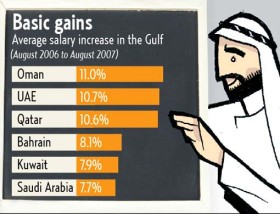
Dubai: Private sector salaries in the UAE rose by 10.7 per cent on average over the last year, just beating the nine per cent GCC average, according to figures released yesterday by online recruitment firm GulfTalent.com.
Oman registered the biggest jump, from 5.6 per cent last year to 11 per cent this year, while wages in Saudi Arabia climbed just 7.7 per cent – the lowest of the countries surveyed.
Analysts say employers have been forced to raise wages to contend with intense competition for talented workers, healthy pay rises in the public sector, the depreciating US dollar and rising salaries in India, traditionally the main supplier of expatriate workforce to Gulf countries.
But better pay is unlikely to leave more money in the bank for workers due to spiraling inflation and depreciation of dollar-pegged currencies.
The UAE’s official inflation reached 9.3 per cent in 2006, driven by soaring food prices and rent hikes, while Qatar’s inflation increased to 14.8 per cent year-on-year in the first quarter before declining to 12.8 per cent in the second quarter.
Shortage of skills
Of the UAE-based expatriates surveyed by GulfTalent.com, 41 per cent reported making no savings on their income, the highest figure in the Gulf. And nine per cent of UAE-based expats reported that their salaries did not even cover their living costs, forcing them to borrow or live off their existing savings.
For employers the trend translates into difficulty recruiting and retaining staff, which has already had serious implications for the region’s economy.
“While market demand was extremely healthy, skills shortages were limiting their companies’ ability to grow, forcing them to turn down new business or, in some cases, causing them to miss targets on their existing projects,” said Yasser Hatami, managing director of GulfTalent.com.
Abid Junaid, CEO of Dubai-based property developer ETA Star, said developers are becoming more realistic in the number of projects they launch and their delivery targets due to a lack of skilled labour among contractors, but he did not anticipate a major slowdown in the construction sector.
“It’s a very concerning situation as it impacts our ability to attract expatriate workers, especially from Europe and the Indian sub-continent,” he said.
Junaid said developers can reduce residents’ expenditure on rent by building more low-cost housing.
According to the GulfTalent survey, the GCC construction sectors enjoying the highest pay rise, along with banking and energy. Healthcare and education registered the lowest increases.
Among job categories, engineers and finance staff received the biggest pay rises, followed by human resource professionals in third place, the survey revealed.
“Historically under-represented in the region, the HR function has recently been catapulted to the front line as Gulf-based employers grapple with the challenge of attracting, developing and retaining staff,” the report stated.
In response to declining net disposable income, companies are now changing the structure of worker’s pay packages to boost staff retention, said Hatami. Pensions, stock options, training initiatives, and a reduction in working hours are all being considered, he said. 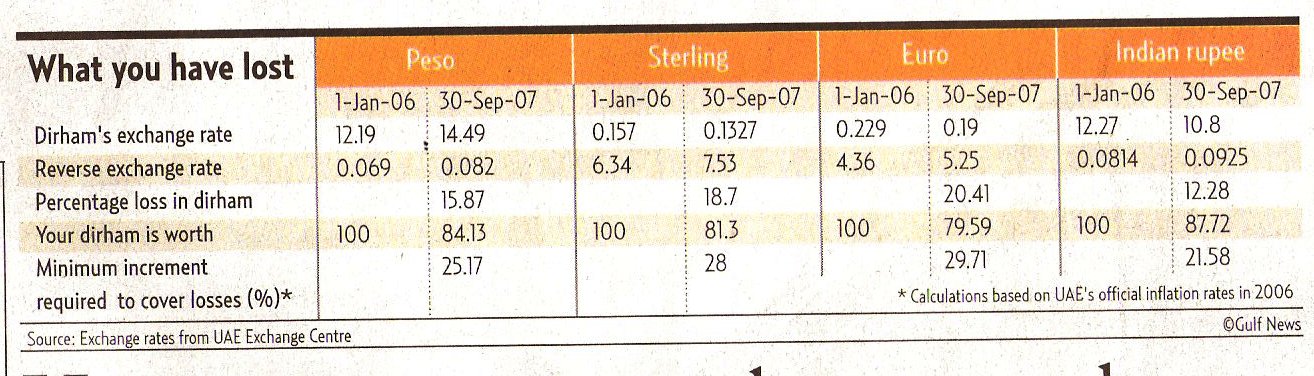
The quality of life within a country is another important factor, the survey suggested. It revealed that the UAE, and Dubai in particular, still benefit from the relative popularity of the country with expatriates, thanks to attractive career opportunities, modern infrastructure and facilities, and a relatively liberal society.
“This is allowing UAE-based employers to continue to attract and retain professionals with below-inflation pay rises, albeit with greater difficulty than previously,” the report said.
Abu Dhabi set to take giant leap forward
Abu Dhabi set to take giant leap forward
By Himendra Mohan Kumar, Staff Reporter Published: September 28, 2007, 00:00
Abu Dhabi: The imminent arrival of Hollywood entertainment giant Warner Bros in Abu Dhabi with a theme park is in line with the positioning of the emirate as a “world-class place that has it all” and over time, tourist arrivals to the UAE are expected to see strong growth, market analysts told Gulf News.
“This is yet another feather in the cap for Abu Dhabi, after the announcement of Formula One, arrival of top world-class universities, setting up of industrial zones and a museum from France, things that tourists love to see,” said one analyst.
On Wednesday in a multi-billion dollar deal, real estate developer Aldar Properties PJSC, one of the largest companies by market capitalisation in the UAE, US-based Warner Bros and the Abu Dhabi Media Company forged a long-term strategic alliance in New York aimed at Abu Dhabi’s digital transformation.
“Abu Dhabi will soon become like Dubai, a very attractive place to live in for professional people with all the goodies available in one place. This would also give a boost to the real estate projects in the UAE, particularly in Abu Dhabi,” said another analyst.
Shortly after the deal was signed, Aldar chairman Ahmad Ali Al Sayegh told Gulf News that the proposed money committed would be invested over the next five years.
Aldar and Abu Dhabi Media Company together will invest 50 per cent of it, while the remaining 50 per cent will be invested by Warner Bros.
“We are going to build an integrated entertainment and media infrastructure that will be respectful to our culture and values,” said Al Sayegh. “This is a regional partnership that will cover the entire Middle East.”
In a joint statement, Aldar, Warner Bros and Abu Dhabi Media said their alliance covers the creation of a theme park and hotel and jointly owned multiplex cinemas, as well as the formation of a joint venture fund to finance films and to develop and publish video games, heralding the growth of new media in the national capital.
Additional areas
Beyond the businesses specifically outlined in Warner Bros’ initial agreement with Aldar and Abu Dhabi Media Company, the companies will explore additional areas in which they can work together, including ventures such as production facilities, digital content distribution and retail opportunities in the Gulf.
Aldar will coordinate and oversee physical construction of both the theme park and hotel. Groundbreaking for the theme park and hotel is expected in 2009.
Warner Bros International Cinemas will develop, design and manage jointly owned multiplex cinemas in Abu Dhabi to be built by Aldar. Initial plans call for the construction of four cinemas in Al Ruwais, Al Ain, Yas Island and the Central Market in Abu Dhabi, which will be Warner Bros-branded and themed, featuring iconic characters and titles from Warner Bros’ classic and contemporary film libraries. Groundbreaking for the multiplex cinemas at the Central Market Development has taken place and they are due to open in the first quarter of 2010.
WBIC currently operates cinemas in Italy and Japan and manages the Mann Theatres chain in the United States.
The film production fund, a 50-50 venture, calls for the development and production of mutually agreed-upon, broad-appeal films, with Warner Bros retaining worldwide distribution options/rights. Separate from this arrangement, Warner Bros Pictures International will work with Abu Dhabi Media Company to develop and produce a slate of Arabic-language films for local and pan-Arabic distribution.
Educating children key to ending cycle of poverty, says Maitha
Educating children key to ending cycle of poverty, says Maitha
By Zoi Constantine, Staff Reporter Published: September 28, 2007, 00:00
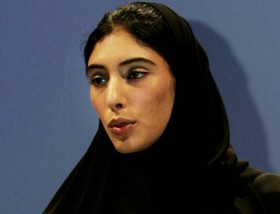
Dubai: Shaikha Maitha Bint Mohammad Bin Rashid Al Maktoum has urged Dubai’s diverse, multi-cultural communities to unite under the banner of ‘Dubai Cares’ to contribute to the goal of educating 1 million children.
The call came as the amount raised for the initiative launched on September 19 by His Highness Shaikh Mohammad Bin Rashid Al Maktoum, Vice-President and Prime Minister of the UAE and Ruler of Dubai, topped Dh300 million.
Among the latest to donate are Dubai Contracting, which yesterday pledged Dh500,000, and Ahmad Siddiqui and Sons who donated Dh1.5 million to the six-week campaign at an event hosted by Shaikha Maitha, on Wednesday night. 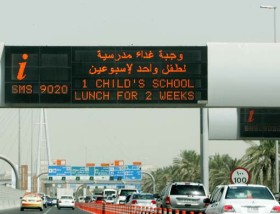
During the event she also announced that she will host the ‘Dubai Cares’ Walkathon, scheduled for October 19 to be attended by members of the public as well as sporting personalities and well-known names from the world of art and culture in the UAE.
“Dubai Cares is an opportunity for all of us – regardless of our race, religion or ethnic background – to bring together the different communities in Dubai’s multicultural landscape to support a common cause and contribute to a greater purpose,” Shaikha Maitha said during her address before the diverse crowd at the Dubai World Trade Centre on Wednesday evening.
“We recognise education as the best long-term solution to poverty alleviation in the developing world -educating children, especially girls, is the key to ending the global ‘cycle of poverty’.”
Present at the event to launch Shaikha Maitha’s participation were various sports personalities, artists and actors, including Abdullah Al Khair, who pledged their support for ‘Dubai Cares.’
Abu Dhabi congestion looms amid taxi shortage
Abu Dhabi congestion looms amid taxi shortage
By Samir Salama, Bureau Chief Published: September 28, 2007, 00:00
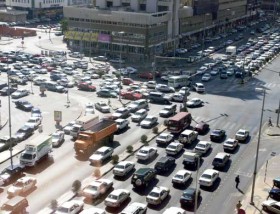
Abu Dhabi: As residents complained of an acute shortage of taxis in Abu Dhabi, a think tank has warned that the problem will worsen the traffic congestion in the city.
“A shortage in taxis will simply mean more and more people will opt to buy their own cars to rid themselves of the daily suffering of finding a cab,” said a report by the Emirates Centre for Strategic Study and Research.
The report expected that the implications of the problem will increase as time passes and that this will be reflected in worsening gridlocks.
This [predicted] increase in the numbers of cars happens at a time when the government is supposed to take measures to reduce them or at least maintain the present number, according to the report.
Statistics of the Abu Dhabi Chamber of Commerce and Industry put the increase in the number of new cars registered for the first time in Abu Dhabi at 380 per cent between 2002 and 2005, while the increase at the UAE level during the same period was 230 per cent.
A whopping 152,000 new cars were registered for the first time in Abu Dhabi in 2005 accounting for 43 per cent of the total number of cars registered across the country in the same year, compared with 40,000 cars registered in the city in 2002.
This makes the average annual growth in cars registered in Abu Dhabi around 95 per cent.
According to the ECSSR’s report, the curve of growth in the number of cars registered in the capital is ascending steeply, especially if the number of used cars registered in the city is taken into consideration.
The report expected that implications of the shortage in cabs will unfold within six months. Residents in Abu Dhabi have complained of queues being formed at bus stops, malls and in major streets everyday particularly at peak hours.
Many say they are compelled to wait for taxis for a long time in the scorching summer heat, with cars belching fumes and fraying tempers.
Refusal
Residents said even if they come across cabs, drivers refuse to take certain routes. Sahar Mohammad, 25, an Egyptian housewife, said for a 10- minute journey she had to wait for almost 60 minutes on Hamdan Street to take her children to school.
“Taxis are not available and most of the taxi drivers are very rude and arrogant and simply refuse to drive to my destination,” she said.
Varghese A., suggested that a proper public bus transport system like that in Dubai would help solve this problem. There is a lot of potential for this kind of city bus service.
Other residents complained that taxis are cashing in on people who had to move to suburbs such as Mussafah and Baniyas to escape rising rents.
Khalid Saleh Al Rashidi, general manager of the Taxi and Hire Car Regulation Centre, said there is no shortage of taxis in the city.
He told Gulf News the root cause of the problem is taxi drivers selectively taking routes which give them more revenue.
“The first batch of a new taxi fleet will hit the roads in November this year,” he said.
* 380% increase in the number of new cars registered in Abu Dhabi between 2002 and 2005.
* 230% increase in the number of new cars registered in the UAE between 2002 and 2005.
* 152,000 new cars registered in Abu Dhabi in 2005.
* 95% average annual increase in the number of cars registered in Abu Dhabi.
Abu Dhabi plans big

Abu Dhabi plans big
By Saifur Rahman, Business News Editor GULF NEWS Published: September 21, 2007, 00:17
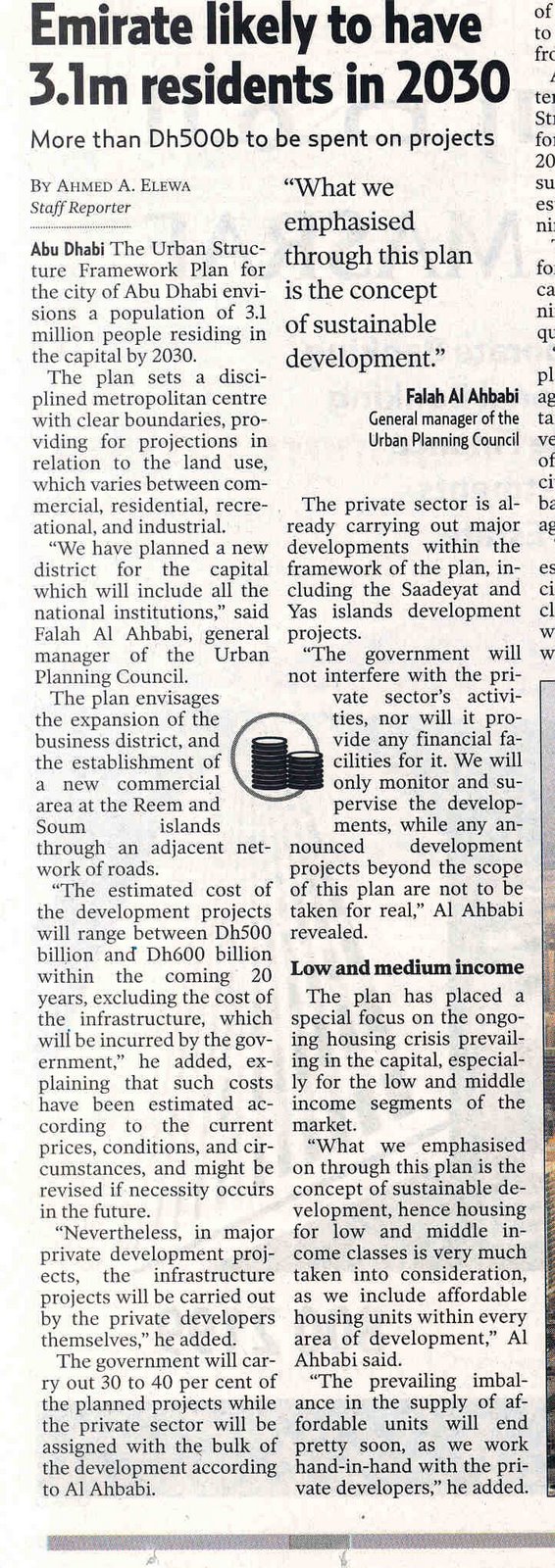
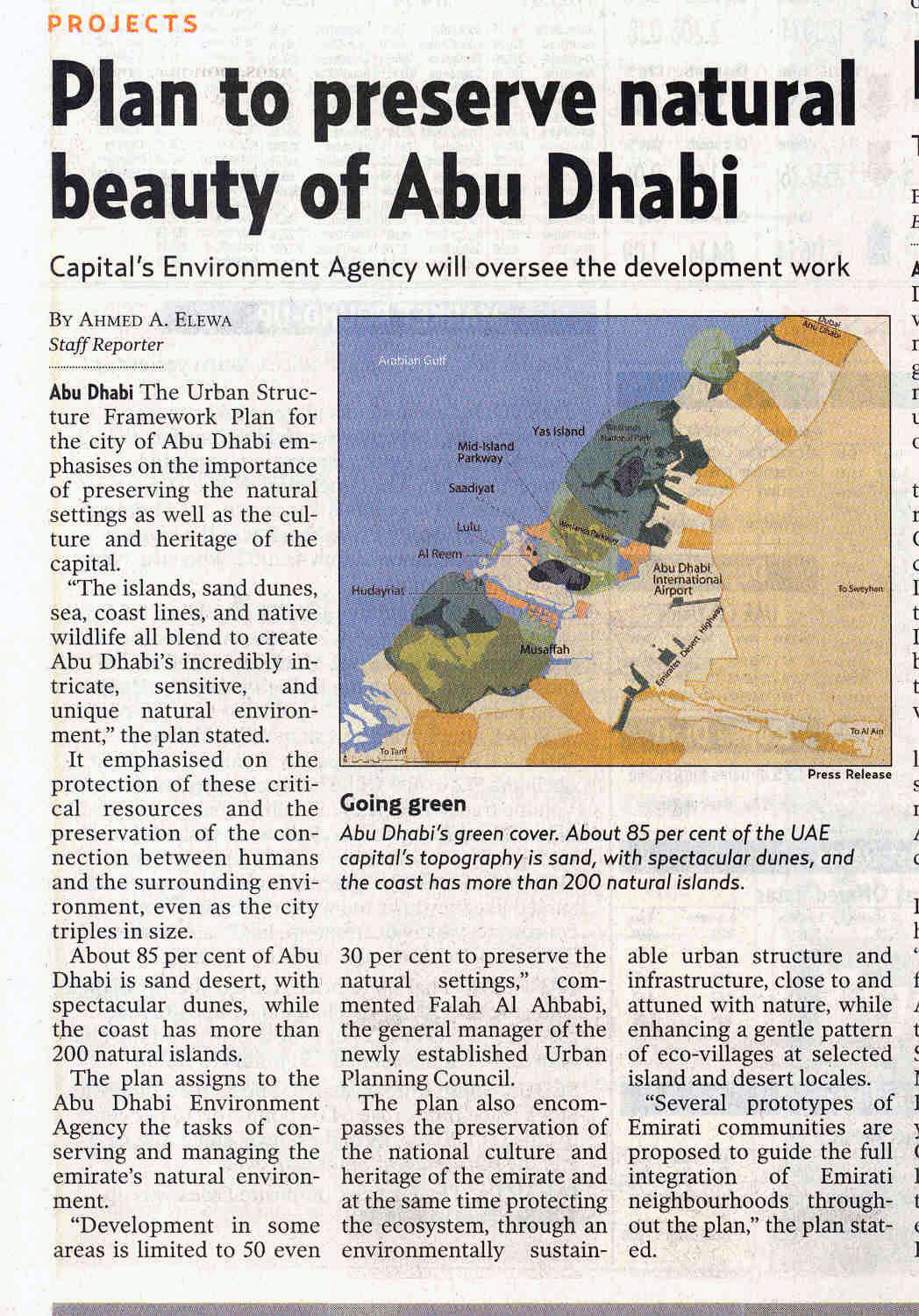
Abu Dhabi: Abu Dhabi’s urban vision for 2030, announced on Wednesday, comes at a very appropriate time when the oil-rich emirate, which occupies nearly 85 per cent of the UAE, prepares for a massive surge in economic activities as part of its diversification plan.
The Urban Structure Framework Plan 2030 has been devised to cater to the needs of a structured growth agenda for the city’s expanding urban landscape and offer a balanced diet to its economy as well as its environment. More than Dh600 billion worth of development works are already at various stages of completion in Abu Dhabi, which has 96 billion barrels of proven oil reserves – enough for a 100-year supply at current production rate. The emirate also hosts three cities.
The Dh55-billion Al Raha Beach Development, Dh100-billion Saadiyat Islands, the Dh30-billion Reem Island and the Dh40-billion Yas Island projects are some of the master developments taking shape in the emirate. Along with these, a large investment in downstream petrochemical sector, industries, aviation and tourism – Dh25 billion in redevelopment of Abu Dhabi International Airport and Dh30 billion in Etihad Airways – are all part of a larger plan to transform Abu Dhabi into an economic powerhouse in the Middle East.
The plan also envisages an additional Dh600 billion investment in projects that will more than triple the size of Abu Dhabi’s economy and quadruple some sectors.
Once ready, they will attract new residents, tourists and businesses. But the UAE capital might become a victim of its own success with heavy traffic and inflationary pressures taking their toll on the public.
Abu Dhabi residents will begin to see the fruits of the ongoing projects from around 2010, when public facilities such as transportation, housing, recreational facilities, education and healthcare, will be in high demand. Provisions for these facilities is needed to be built-in within the urban development plan.
The public facilities in Abu Dhabi could be adequate for today, but not for tomorrow. That’s why, the plan is significant. From now, all development activities will be structured in line with the broad vision that will help the UAE capital achieve a much-needed balanced growth.

Help Wanted – to sort out Taxi problem
And support from unknown sources…. As long as the objective is for the betterment of the society, we don’t mind who or from where the Help come.
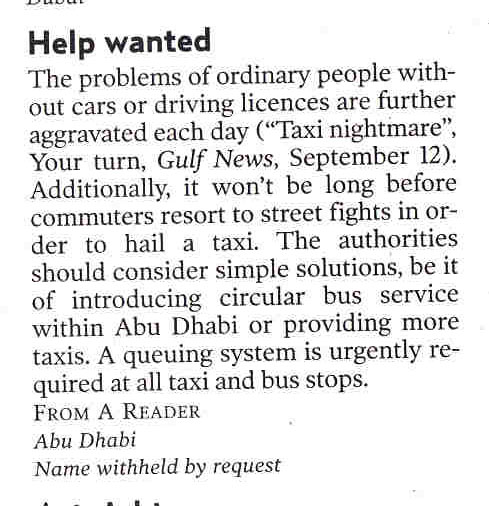
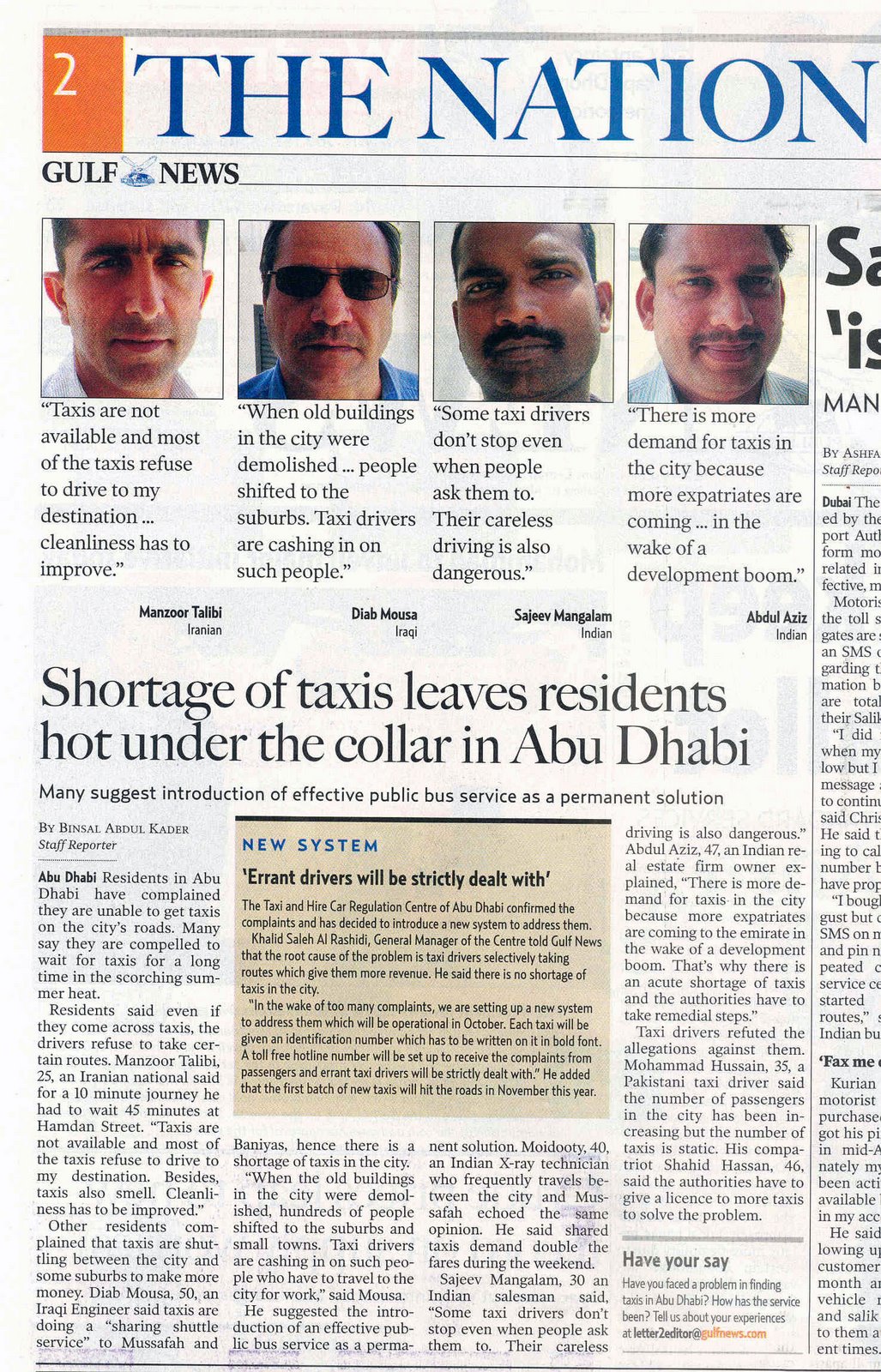
Appreciate to see more suggestions and solutions to resolve the shortage of taxis in Abu Dhabi which is making the life of people to go to work and come back home. We need solutions and we have to give solutions to the administrative authorities rather than filling them with problems.
You may write your thoughts to letter2editor@gulfnews.com.
Abu Dhabi reveals long term urban plan
Abu Dhabi reveals long term urban plan
By Samir Salama Bureau Chief and Ahmed A. ElewaStaff Reporter Published: September 19, 2007, 15:28
Abu Dhabi: A Dh600 billion master development plan for Abu Dhabi for the next quarter of a century was announced by the emirate’s Urban Development Council yesterday.
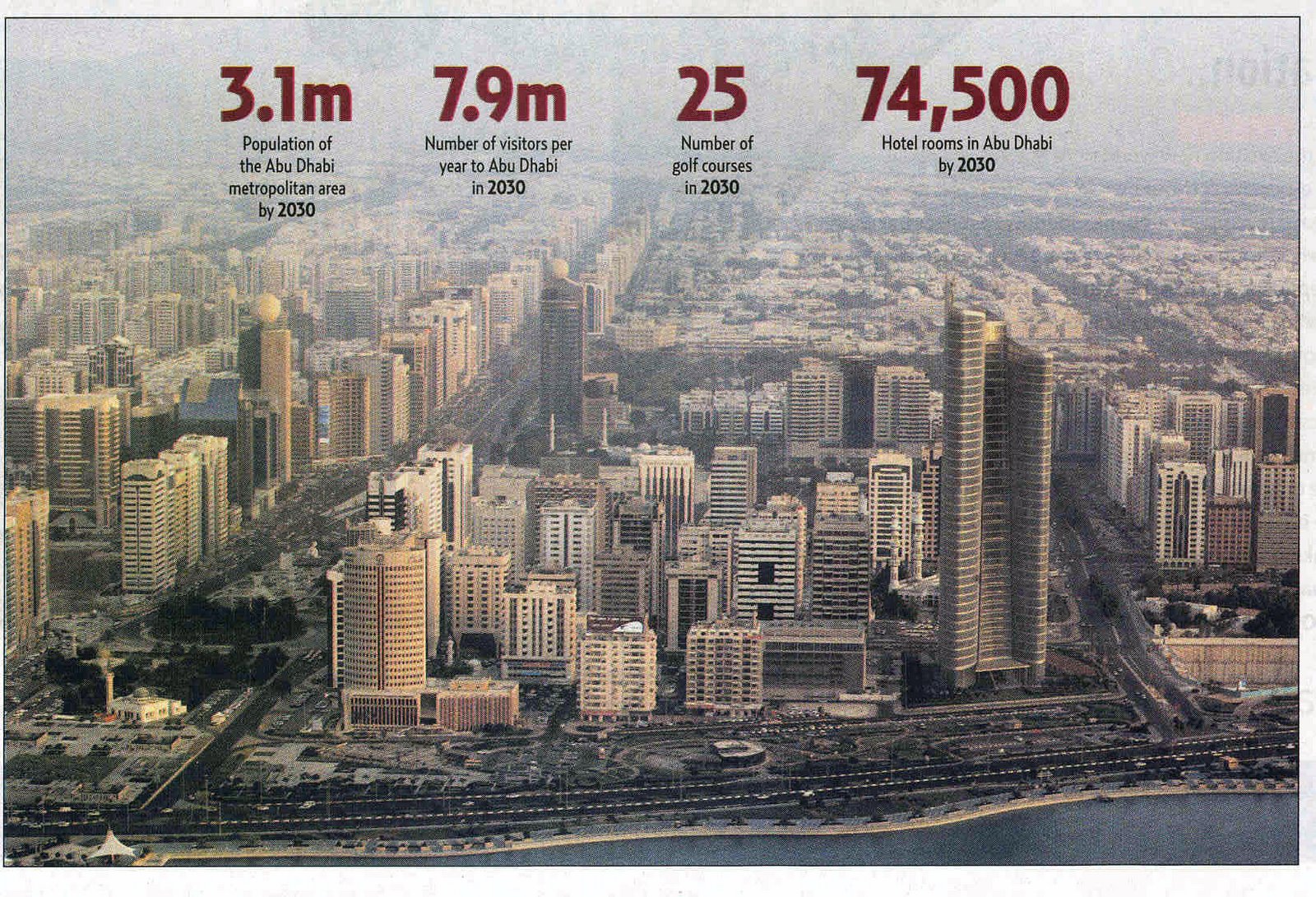
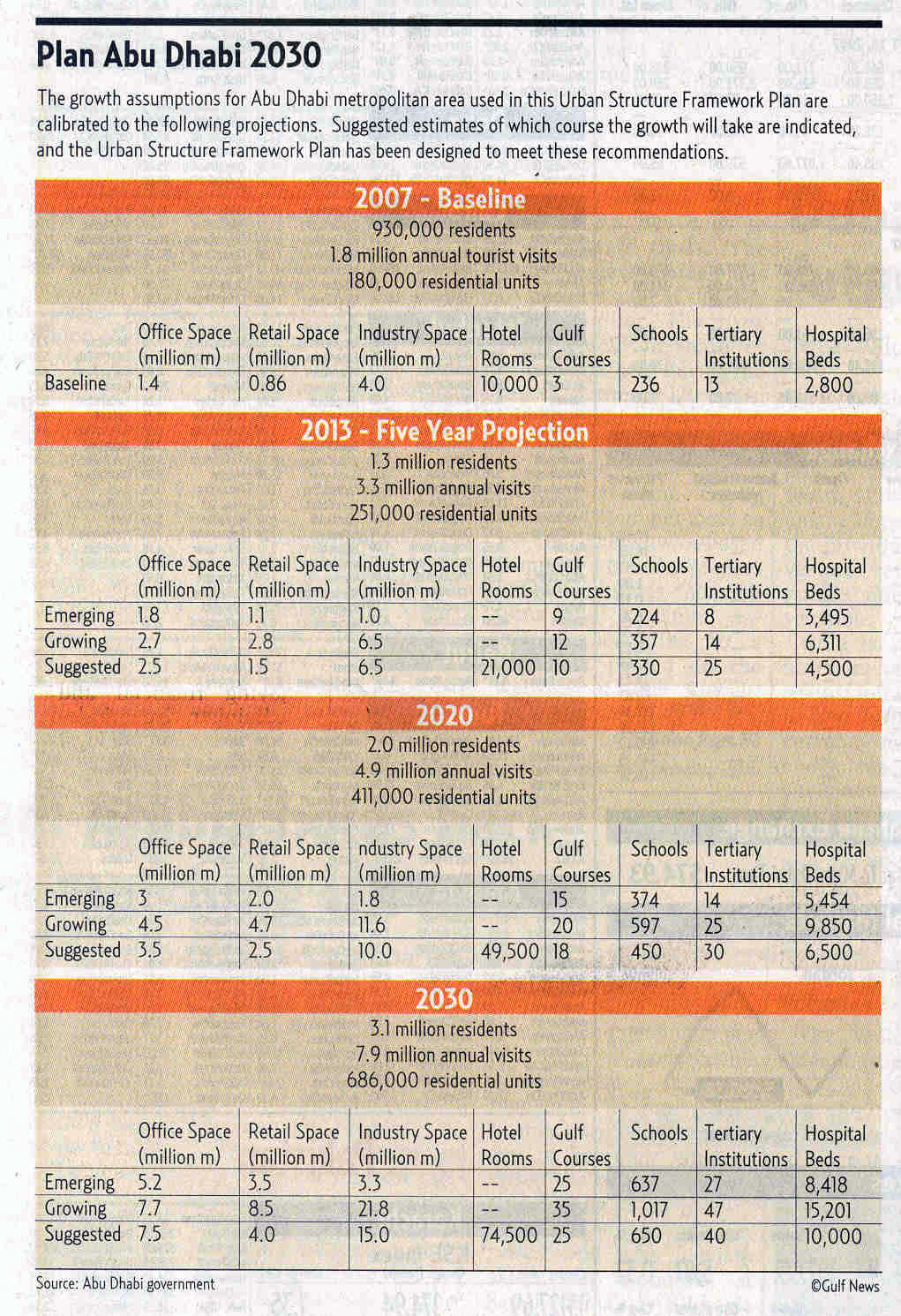
The Plan Abu Dhabi 2030: Urban Structure Framework Plan sets out a strategic approach to develop the emirate’s most dynamic economic sectors and envisages a growth of the UAE capital’s populations to over three million by that year.
General Shaikh Mohammad Bin Zayed Al Nahyan, Abu Dhabi Crown Prince and Deputy Supreme Commander of the UAE Armed Forces, said the plan provides a strong and comprehensive foundation for the development of Abu Dhabi, in a strategic and coordinated way. 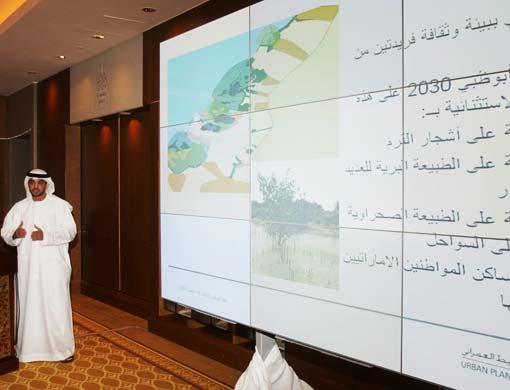
“It will ensure that future generations will continue to enjoy and be inspired by ongoing access to the desert, sea and natural assets that are integral to our national identity, while building a global capital with its own rich cultural heritage,” Shaikh Mohammad said following the release of the plan. 
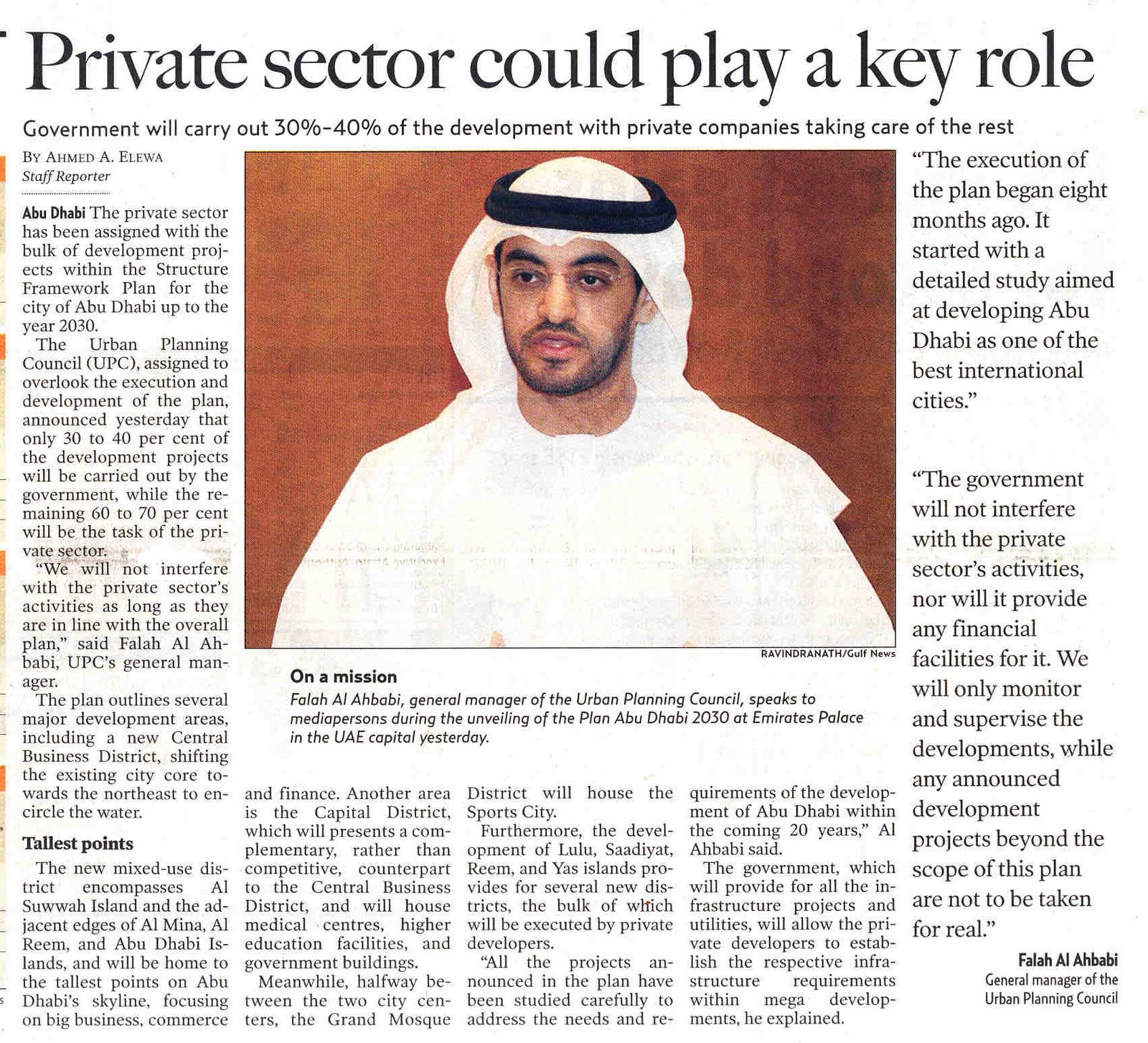
“The execution of the plan has begun already eight months ago, and it started with the detailed study aiming at developing Abu Dhabi as one of the best international cities,” commented Falah Al Ahbabi, who has been appointed general manager for UPC. The plan projects a population of three million people residing in Abu Dhabi by 2030, and sets the framework of the necessary infrastructure, housing, recreational, and business sectors to cater for such population.
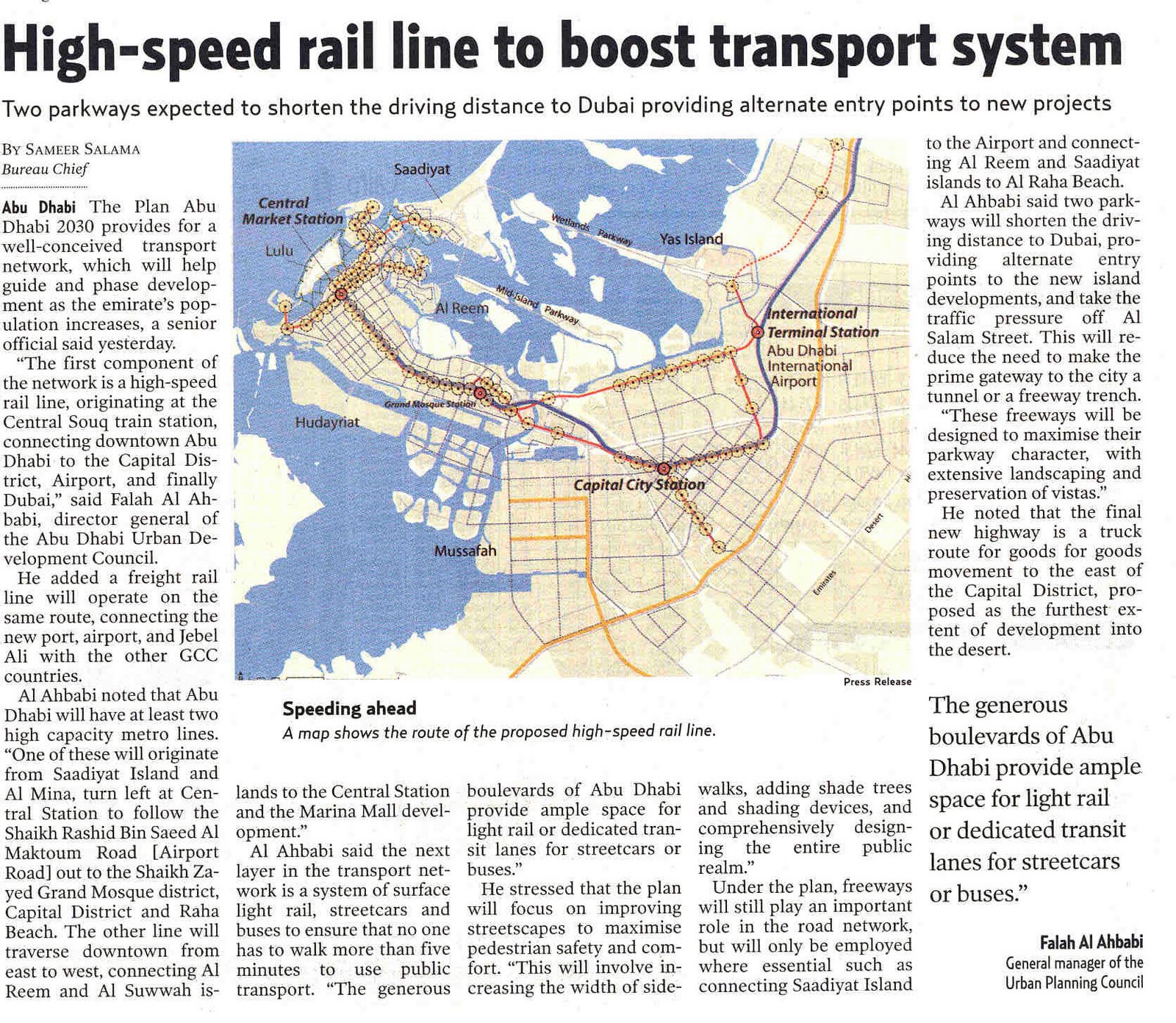
The plan includes inter-city train network and metro lines, specifies land uses, building heights and transportation plans for Abu Dhabi, said Falah Al Ahbabi, director-general of the Abu Dhabi Urban Planning Council, authorised to oversee implementation of the plan.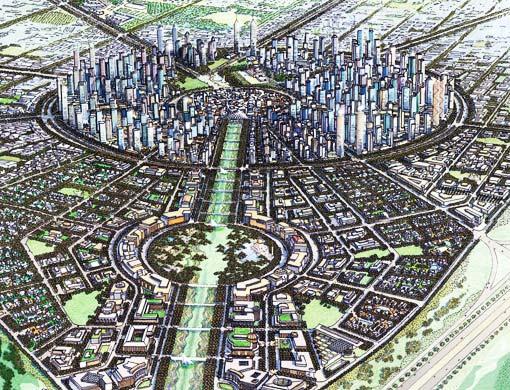
Urban Planning Council set up
President His Highness Shaikh Khalifa Bin Zayed Al Nahyan has issued in his capacity as Ruler of Abu Dhabi, a new law setting up the Abu Dhabi Urban Planning Council (UPC). As per law No. 23 for 2007, the UPC shall be an independent corporate entity enjoying financial and administrative independence and full legal status to operate. 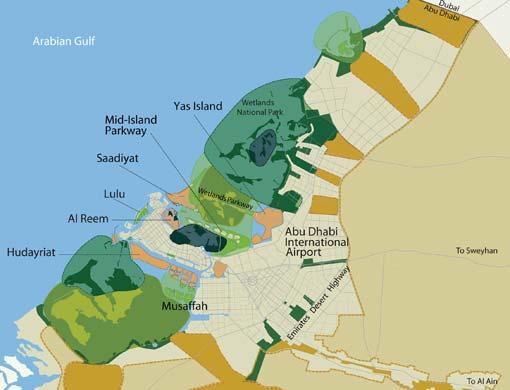
The council is to be chaired by General Shaikh Mohammad Bin Zayed Al Nahyan, Abu Dhabi Crown Prince and Deputy Supreme Commander of the UAE Armed Forces. Shaikh Khalifa also issued Decree No. 22 for 2007, setting up the Abu Dhabi Future Energy Company, a joint-stock company, and the Masdar Science and Technology Institute. The company’s shares will be completely owned by Mubadala Development, WAM reported.
Energy for sustainable growth
Energy for sustainable growth
By Francis Matthew, Editor at Large Published: September 19, 2007, 23:21
The Gulf states’ profligate use of energy will have to stop if plans for larger populations and expanded economies are going to work.
Their energy reserves are some of the largest in the world, but they are not infinite, and they will certainly not support the planned growth for ever. Even if growth eventually slows to a more stable total population, the region will be much larger than at present and will finish its reserves rapidly.
The planned scale of growth is awe inspiring. The population of the Arabian Peninsula is set to double from the present 59 million in 2007 to reach 124 million by 2050, according to the Population Reference Bureau’s June 2007 Bulletin.
This will be a combination of natural growth from the national populations, as well as continuing immigration from expatriates into the region.
This massive increase will have to be matched by very careful planning of water and power resources. Till now most Gulf Cooperation Council (GCC) states have not done well at this since growth so far has not seriously challenged their capacity to produce energy for domestic and industrial use.
All the governments have had to do is turn the taps on a bit more and they have kept pace. This cannot continue.
It is true that water has been a topic of government concern for the last decade, mainly due to the warnings sounded by the failure of traditional artesian wells which forced governments to plan alternatives and thus raised the whole question of actively planning how to allocate water resources to meet demand across the whole economy.
But this planning has remained at government level, with most solutions revolving around increased use of recycled water, and increasing desalination capacity. But wider awareness of the importance of water conservation has not happened and the population at large remains uncaring.
This is dangerous since the supply of new water depends on desalination, which uses a lot of gas to boil the sea water. All electricity in the GCC comes from generating stations which also use gas.
Both the supply of water and electricity ultimately depend on the same resource, which is gas, and as with all hydrocarbons, gas supplies are ultimately limited. They may be around for some decades or even centuries in a few areas, but they will eventually be used up.
It is startling how much the region’s future plans are linked to continued and plentiful gas supplies. There is a major long term crisis in the making unless steps are taken today to address how to conserve this large but ultimately limited resource, and the answers lie in both supply and demand.
On the demand side, it lies with all authorities to enforce more rigorous standards in all spheres of life. For example it should be mandatory that new buildings meet tough energy standards.
For example, all the glass walls we see around us require large air conditioning units on the roofs of buildings, chewing up vast amounts of energy.
On the supply side, it is important that all GCC states develop effective national power grids, and link them in a future GCC grid. This involves commitment from all governments, and it also means developing a pricing mechanism within the grid so that the power hungry parts of the GCC are able to buy power from the resource rich countries.
Any pricing mechanism will have to take into account the subsidies that most GCC governments continue to offer their populations, since very few individuals or companies are able to bear the true commercial cost of a unit a power.
Power grid
Unfortunately the GCC has not been able to implement its plans for a GCC power grid, but it is exactly the kind of project that the GCC should be able to manage. It is largely technical in nature, focusing on infrastructure, and the benefits are overwhelming. All that is required is some political commitment to achieve a solution to the pricing issue.
But there another important supply of power which the GCC states have to take more seriously. It is ridiculous that in an area which has so much sun, there is so little solar energy.
For example, all buildings should have solar panels on their flat roofs, all new projects should have their solar farms, and solar energy should become part of every planner and government official’s thinking.
The absence of solar energy in the GCC cannot remain a matter of concern to a few environmentalist lobbies. It has to become part of mainstream government thinking, otherwise the 54 million people due to be living in the region in 40 years time will not have enough power or water to keep going.
The continued success of the GCC states depends on getting this right.
 ClicksandWrites
You must be logged in to post a comment.