UAE
Ditch plastic to save cash and the environment

Ditch plastic to save cash and the environment
By Binsal Abdul Kader, Staff Reporter GULF NEWS Published: February 02, 2008, 21:30
Abu Dhabi: Prices of plastic shopping bags have increased by 200 per cent forcing retailers to look for ways to minimise their costs, Gulf News has learnt.
Several retail chains in the country said that they are looking for ways to minimise the use of plastic bags.
“Apart from environmental degradation, the price rise of plastic bags make an additional cost which could be shared with the customers if alternative arrangements can be made,” said a spokesperson for one of the largest retail chains in the region.
Some markets are even ready to reduce prices of goods for customers if they start using their own re-usable jute or cloth bags.
“There has been a 200 per cent increase in plastic bag prices in the past one-and-a-half years. The average price has increased from Dh3 per kilo to Dh9 per kilo,” said V. Nandakumar, corporate communication manager of EMKE Group, which runs Lulu hypermarkets.
He said that their 47 outlets in the country consume about 100 tonnes of plastic bags a month. “If we take the case of our about 69 outlets in the Gulf region, the consumption goes up to 150 tonnes a month.”
The millions of dirhams spent by each outlet on the environmentally damaging bags could be shared with customers, he said.
He disclosed the group’s plan to initiate such a step. “We are planning awareness campaigns against plastic bags in cooperation with various official agencies,” said Nandakumar.
Al Maya supermarkets in Dubai said they are also planning an awareness campaign against plastic bags.
Its director, Kamal Vachani, said people are more serious about pollution caused by plastic bags and their use has gone down.
Several awareness campaigns are being carried out against the use of plastic bags.
Dubai Municipality and the International Association for Human Values recently announced the Green Shopper awards, which will reward stores that take steps to reduce use of plastic bags.
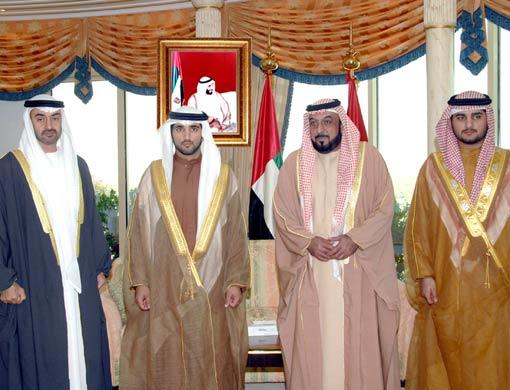
Shaikh Khalifa welcomes Hamdan, Maktoum
Shaikh Khalifa welcomes Hamdan, Maktoum
WAM Last updated: February 02, 2008, 23:47
Al Ain: President His Highness Shaikh Khalifa Bin Zayed Al Nahyan on Saturday underscored his good wishes for the decision by His Highness Shaikh Mohammad Bin Rashid Al Maktoum, Vice-President and Prime Minister of the UAE and Ruler of Dubai, to appoint Shaikh Hamdan Bin Mohammad Al Maktoum, as Crown Prince of Dubai, and Shaikh Maktoum Bin Mohammad Al Maktoum, as Deputy Ruler of Dubai.
Shaikh Khalifa expressed his appreciation while receiving Shaikh Hamdan and Shaikh Maktoum in the presence of General Shaikh Mohammad Bin Zayed Al Nahyan, Abu Dhabi Crown Prince and Deputy Supreme Commander of the UAE Armed Forces, in Al Ain on Saturday.
Shaikh Khalifa welcomed Shaikh Hamdan and Shaikh Maktoum who paid him a courtesy call on the occasion of their appointment to their new posts, and wished them success in shouldering their national responsibilities and discharging their new assignments for the sake of their country and its people.
Shaikh Hamdan pledged to put all his potential and capabilities in the service of the wise leadership of the UAE and its people.
He vowed to be loyal and faithful to Allah, the President and the Vice-President in carrying out his national duty in line with their sound directives to further achieve the hopes and aspirations of the UAE people.
Shaikh Khalifa hosted a lunch banquet in honour of Shaikh Hamdan and Shaikh Maktoum.
The meeting and the banquet were attended by a number of shaikhs and senior officials.
Meanwhile, the new appointments were unanimously welcomed by business and sports officials in the UAE.
A cross-section of business leaders who talked to Gulf News on Saturday said they were confident the new generation would take Dubai to new heights of success and prosperity. Similar sentiments were expressed by the sporting fraternity.
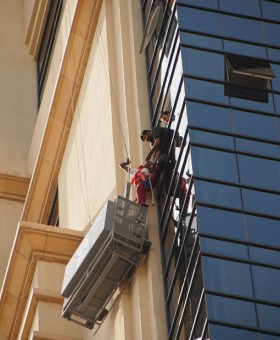
Police rescue two window cleaners stuck outside building’s 13th floor
Police rescue two window cleaners stuck outside building’s 13th floor
By Marten Youssef, Staff Reporter GULF NEWS Published: January 31, 2008, 17:20
Abu Dhabi: The Abu Dhabi police team undertook an unconventional and daring rescue on Thursday of two men who were stuck outside the 13th floor while washing the building’s windows.
The authorities blamed a power failure on the two men being stuck.
“We had four options. We could try to put electricity back to the building. We could try to reach them with our ladders, through the roof or pull them through the window,” Fabian Dyck, a member of the rescue team said.
Hundreds of people watched the rescue attempts outside the Union Bank building on Electra Street. After three failed attempts to reach the two stranded workers using the ladders of fire brigades, the rescue team decided to pull the men through the nearest window.
Third attempt
“This is the third time we tried to reach them but our ladders are just too short,” Dyck said.
Just eight metres shy of reaching the two stranded men, the rescue team changed their strategy and handed harnesses to the workers as they pulled them through the window of one of the residents.
The two men were rescued and taken by ambulance to a nearby hospital. Police said there were no physical injuries to the men.
Dubai gets new crown prince – His Highness Shaikh Hamdan Bin Mohammad Bin Rashid Al Maktoum

Dubai gets new crown prince – His Highness Shaikh Hamdan Bin Mohammad Bin Rashid Al Maktoum
DUBAI: Sheikh Hamdan bin Mohammed bin Rashid Al Maktoum, the brother of Dubai’s ruler Sheikh Mohammed bin Rashid Al Maktoum, has been appointed as Crown Prince, an official decree said in Dubai on Friday.
Vice President and Prime Minister of UAE Sheikh Mohammed bin Rashid Al Maktoum issued a decree in his capacity as the Ruler of Dubai, appointing Sheikh Hamdan bin Mohammed bin Rashid Al Maktoum as the Crown Prince of Dubai, the official Emirates news agency said.
Sheikh Mohammed also named Sheikh Maktoum bin Mohammed bin Rashid Al Maktoum and Sheikh Hamdan bin Rashid Al Maktoum as Deputy Rulers of Dubai with effect from Friday.
The new crown prince is presently Chairman of the Dubai Executive Council, which oversees Dubai Government entities.
Born on 14 November, 1982, Sheikh Hamdan studied at the Rashid Private School, Dubai. After graduation, he went to UK’s Sandhurst Royal Military Academy.
He has attended specialized courses at the London School of Economics and the Dubai School of Government.
Sheikh Hamdan is also the president of Dubai Sports Council, Dubai Autism Centre and the Sheikh Mohammed bin Rashid Establishment for Young Business Leaders.
Get ready for the big chill in UAE
Get ready for the big chill in UAE
By Adel Arafah (Our staff reporter)KHALEEJ TIMES 31 January 2008
ABU DHABI — A polar cold air mass passing by the Arabian Gulf is going to stream over the country today afternoon, the National Centre for Meteorology and Seismology predicted yesterday. The air mass would come with a moderate northwest wind.
The cold air mass would affect the Western region in the afternoon and would gradually extend to the other regions in the night.
The temperature would plummet during the night. A sharp fall in temperature would be felt tomorrow (on Friday) as well, especially in the coastal and mountainous areas.
The northwest wind would continue lashing the country tomorrow, and the sky would be hazy in the Northern and Eastern regions accompanied by rain.
The National Centre for Meteorology and Seismology advised the people to be extra careful when venturing into the sea for the next three days from today (Thursday). Waves are likely to be 3-5 feet high near the coast and 8-10 feet high in the high seas. Besides, the centre advised the people to wear warm clothes.
An expert at the centre said the country was affected yesterday by a depression forming in the south and centre of Saudi Arabia which caused the dusty winds, especially in the western region.
Winter storms and snow caused schools and shops to shut across the Middle East yesterday.
Meanwhile, many Israelis and Palestinians stayed home from work as snow piled up in Jerusalem and highland areas of the West Bank. Cars crawled through sleety streets and children, excused from school, flocked to parks to have snowball fights.
The storms also closed government ministries and universities in Jordan’s capital Amman, as many residents took the day off rather than try to negotiate the clogged roads.
In Lebanon, heavy snow disrupted traffic on the main highway to the Syrian capital, Damascus, and left villages above 600 metres (2,000 feet) largely cut off. (With agency inputs)
Customers lose up to 4% when wiring money abroad
Customers lose up to 4% when wiring money abroad
By Suzanne Fenton, Staff Reporter GULF NEWS Published: January 31, 2008, 01:28
Dubai: Expatriates in Dubai lose up to four per cent per transaction when they send or receive money from other countries, according to a recent market entrant.
As an expat magnet, the UAE sees millions of dirhams being wired to and from the country every day. And banks charge a wide variety of exchange rates and commissions, which fluctuate daily.
But, according to Lisa O’Brien, director of First Rate FX, a London-based currency specialist firm with offices in Dubai, by doing some basic research, expats can save a lot of cash when transferring money.
“Often people want to transfer money quickly, and so they get in the habit of calling their own bank,” she says.
“But we’re currency specialists. We buy large volumes of all major currencies every day. And because of this we can make a huge saving and pass this benefit on to the client.”
O’Brien says this is with no commission or any other additional charges.
Lucrative business
Mohammad Ishaq, Head of Treasury at Sharjah Islamic Bank, says: “They benefit from the customer in two ways: When a customer deposits the money, it takes a few days to arrive at the destination. In this time the money is lying in transit and the company makes the interest on that.
“Also, the company buys big amounts of money at wholesale rates, but offers it to the customer at the retail rate – about half a per cent or one per cent, depending on the transaction. This half or one per cent makes a big difference. It’s very lucrative for them.”
To highlight O’Brien’s point, using a High Street bank such as HSBC to transfer £1,000 from the UK to Dubai would convert to Dh7,175 with no extra charges or fees at an exchange rate of 7.17.
Naturally, this is only “an indication for today as prices vary from day to day”, according to a bank employee. To send £1,000 from Dubai to the UK, however, would cost Dh7,408 at an exchange rate of 7.41 with an additional charge of Dh80 for sending, amounting to a total of Dh7,488.
Sending £1,000 from the UK to Dubai with a money transfer agency like Western Union would amount to Dh7,220, with the sender paying an additional charge of Dh331 (£47). Sending £1,000 from Dubai to the UK however, would cost Dh7,510, with an additional charge of Dh400, amounting to a total of Dh7,910. Western Union also has a maximum amount of $7,500, with a $310 fee.
Using a specialist company like First Rate FX to transfer £1,000 from the UK to Dubai at a rate of 7.23 would amount to Dh7,230. To send 1,000 GBP to the UK from Dubai would be Dh7,307, at a rate of 7.31.
As foreign exchange is volume-driven, larger amounts would achieve better rates. For example, sending £25,000 from the UK to Dubai with First rate FX would amount to Dh180,957.5 at today’s exchange rate of 7.24 with no commission or extra costs. It would take Dh182,272.5 at a rate of 7.29 to get £25,000 from Dubai to the UK.
According to O’Brien, it’s a case of taking the time to research the market. “In the UK press, there’s been a lot of talk about banks charging too much. So people are becoming more educated to go to specialists instead.”
Damaged sea cable hits internet services
Damaged sea cable hits internet services
By Mariam M. Al Serkal, Staff Reporter GULF NEWS Published: January 30, 2008, 18:17
Dubai: Both the UAE’s telecom providers suffered yesterday from a break down of internet connections and international calls after a cable was cut in the Mediterranean Sea.
Officials from both network providers were unable to disclose when the issue will be resolved as the submarine cable system operators (FLAG Telecom and SEA-ME-WE 4) were responsible for repairing the damage.
In its statement, etisalat said it was able to re-route the traffic through its network partners in Asia, Europe and UAE to ensure that services remained operational in the UAE.
——————————————————————————–
——————————————————————————–
etisalat said it was working closely with the administration, partners, and concerned operators, for urgent repair work to ensure that the links with major global internet hubs are restored at the earliest. The links deployed by etisalat has meant that normal internet browsing and essential traffic will continue to work at reasonable speeds for the company’s customers.
According to a source at du, the cable is located in Egypt, 12km from the shore. The fault occurred yesterday morning and affected telecom operators globally. du confirmed that its customers were also affected by the broken cable and were likely to experience interruption in internet services and international voice calls.
Emergency: Who’s doing what
– du has transferred internet and international voice traffic through other cable systems that were not affected, although congestion is expected to occur at peak times.
– etisalat is working to ensure that links with major global internet hubs are restored at the earliest. Essential traffic continues to work at reasonable speed.
Dubai to build world’s longest arched bridge

Dubai to build world’s longest arched bridge
By Joy Sengupta (Our staff reporter)KHALEEJ TIMES 30 January 2008
DUBAI — Construction of the world’s longest arched bridge in Dubai will begin in March and the project would be completed in four years, the Roads and Transport Authority (RTA) announced yesterday.
The project, the sixth crossing over the Dubai Creek, is estimated to cost Dh3 billion.
The bridge, 1600 metres long and 64 metres wide, will comprise 12 lanes, 6 in each direction. In addition, the Green Line of Dubai Metro will run through the centre of the bridge (the dividing area between the two bridges). The giant arch will be 205 metres high and 667 metres long.
The bridge will link Al Jaddaf in Bur Dubai with the road separating The Lagoons and Dubai Festival City. The crossing would also provide entry and exit points for the Creek Island, on which Opera Building, a project of Sama Dubai, will be constructed. The Chairman of the Board and Executive Director of the RTA, Mattar Al Tayer, said the project, developed by a United States-based company, would be completed in six phases.
“The construction of the first phase would begin in March this year,” he pointed out.
The crossing would facilitate free traffic flow at all intersections and allow free navigation throughout the day as it would be15 metres above the water surface.
The 50-metre-wide navigation corridor would enable movement of large yachts.
Abu Dhabi to withdraw 500 old taxis from service
Abu Dhabi to withdraw 500 old taxis from service
By Binsal Abdul Kader, Staff Reporter GULF NEWS Published: January 29, 2008, 23:39
Abu Dhabi: About 500 taxis from the old fleet will be withdrawn from the capital’s streets this month, Trans AD, the taxi regulatory authority, told Gulf News.
“We are withdrawing the gold and white taxis [old taxis] in accordance with the increasing number of new taxis,” said Huda Al Ka’abi, Communication Officer at Trans AD.
“About 800 new taxis are on the streets now and the number is increasing day by day.”
She said more than 900 drivers have received their registration so far and some of them are undergoing training.
“About 7,600 old taxis operate in the emirate and 500 will be phased out every two months,” said Sultan Mohammad Al Shamsi, Director of Customer Services and Compliance Division at Trans AD.
“Although about 8,000 registered old taxis are in the emirate, about 400 were non-operational for a long time.” He said the compensation for old taxi owners will be distributed by next month.
The first batch of new taxis commenced operations on November 4, 2007 with 300 taxis [which gradually increased to about 800] and the phasing out of old taxis has started this month. Trans AD authorised seven national companies to operate in the emirate and over 7,000 new taxis are expected to be on the roads in the near future; over a thousand by each franchisee.
One of the franchisees said they are planning to introduce their quota of 1,021 taxis within six months.
Complaint: Knowledge
Complaints about language skills and local knowledge of drivers are also strictly dealt with, said Huda Al Ka’abi, Communication Manager.
“People have to call up the hotline number 600535353 with the taxi number and we test the language skills of the driver.” If he is unable to speak, he will be sent back for a month of training.
Hospital puts anti-abduction system in maternity ward
Hospital puts anti-abduction system in maternity wardBy Mariam M. Al Serkal, Staff Reporter GULF NEWS Published: January 29, 2008, 23:39
Dubai: Dubai’s only public maternity hospital implemented a system to prevent baby theft after some babies were abducted from their bassinet, Gulf News has learnt.
A security bracelet is attached to the babies’ ankles that have a sensory barcode which is linked to all nursery stations and security offices at Al Wasl Hospital, which implemented it last year.
Diaa Hassan, Consultant, Quality and International Accreditation, Al Wasl Hospital, told delegates at the Hospital Design and Upgrade Conference at Arab Health that the anti-abduction system is a standard procedure required by the Joint Committee International.
“The baby anti-abduction system has been implemented for the past year, and there were two to three cases of abduction in the country,” she said, but refused to elaborate.
The most publicised baby snatching case in the UAE was in December 2005, when an Indian doctor abducted a new-born Iraqi boy at Al Qasimi Hospital in Sharjah. A nurse spotted the doctor walking away with the baby and alerted the authorities. The gynaecologist served six months in jail followed by deportation.
With regard to preventing hospital-acquired infections, Hassan said that it was difficult to prevent because the maternity ward is always receiving many family members. “It is difficult to control the number of visitors at the hospital because of the culture in the region. When someone delivers all the family comes in,” she said.
She noted that it was highly unlikely for patients to receive hospital acquired infections because all infectious cases are transferred to Rashid Hospital.
 ClicksandWrites
You must be logged in to post a comment.