UAE
Abu Dhabi taxis to be fitted with tracking system
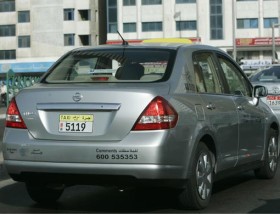 Photo by Ravindranath/Gulf News
Taxis with toll free number plying in Abu Dhabi. The Tracking and Dispatch system has been tested on about 70 new taxis.
Abu Dhabi taxis to be fitted with tracking system
By Binsal Abdul Kader, Staff Reporter GULF NEWS Published: March 03, 2008, 12:11
Abu Dhabi: Residents will soon be able to pay taxi fares through credit cards, Trans AD, the Centre for Regulation of Transport by Hire cars in the capital, announced on Monday.
This is one of the features of the Tracking and Dispatch system which has been implemented in a sample of cars, said Khalid Saleh Al Rashedi, General Manager of Trans AD at a press briefing in Abu Dhabi on Monday.
“Apart from the credit card facility, we are planning to introduce prepaid smart cards which is being studied,” he said.
The Tracking and Dispatch system has been tested on about 70 new taxis in the capital now and it will be fully implemented by the end of June 2008. “We are trying hard to complete the implementation in four phases even before the stipulated time.” It will help the people to avoid waiting for taxis. They can just call up the call centre which can track the taxis available nearby and dispatch them to the passengers.”
The officials said taxis can be booked in advance or planned future trips. The nearest available taxi to the customer’s location will be automatically dispatched using the Global Positioning System (GPS) satellite system. The system will inform the customer of the taxi number and the estimated time for arrival through the state-of -the-art Interactive Voice Response System (IVRS).
Taxis are fitted with an advanced mobile data terminal that displays fare details and progress from pick up point to destination on a map. Customers can monitor the progress and make sure that the taxi is taking an appropriate route from pick up point to drop -off point.
Transport: Fleet to be increased
Trans AD said the number of new taxis in the emirate will be increased to 1,500.
“More than 850 new taxis are on the streets now”, said an official. About 500 old taxis (Gold and White) have been phased out since January 2008. Compensation ATM cards have been given to old licensed taxi owners to receive monthly payment of Dh1,000.
Almost all 8,000 taxis have been given identification numbers to enable passengers to easily file complaints.
Khalid Al Rashedi, General Manager of Trans AD urged the public to report complaints at the call centre 600535353.
Big fall in night temperature predicted on Tuesday
Big fall in night temperature predicted on Tuesday
By Aftab Kazmi, Bureau Chief GULF NEWS Published: March 03, 2008, 10:04
Al Ain: A significant fall in night temperature is expected on Tuesday in the country due to strong shamal winds, the met office has forecast.
The wind will begin blowing in the western areas by this afternoon kicking up dust.
“It will gradually reach rest of the areas [of the UAE] by evening,” according to the forecaster of the National Centre for Meteorology and Seismology (NCMS).
The strong winds would make the sea very rough with eight to 11 feet of waves offshore. Fishermen and small boat riders have been advised to stay away from the sea.
A Met official said day time conditions would, however, remain fair and rather hot in general, but would get cold by night.
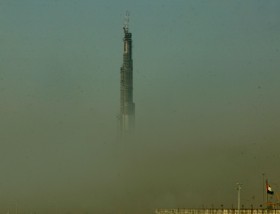
Thick fog blanketed on Monday some coastal areas such as Dubai, Sharjah and Ajman. Reduced visibility forced drivers to be extra careful in their early morning drives.
Drunk drivers face court and Dh20,000 in fines
Drunk drivers face court and Dh20,000 in fines By Alia Al Theeb and Rayeesa Absal, Staff Reporters GULF NEWS Published: March 02, 2008
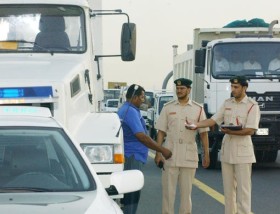
Dubai/Abu Dhabi: Starting on Saturday, police across the UAE began implementing a federal traffic law which introduces harsher penalties for traffic violations.
Lieutenant General Shaikh Saif Bin Zayed Al Nahyan, Minister of Interior, said the new law and the black point system, which were recently endorsed by the UAE’s leadership, aim to curb accidents resulting from indisciplined driving and speeding.
Brigadier Mohammad Saif Al Zafein, Director of Dubai Traffic Department, told Gulf News that the new law protects road users from motorists who violate rules and endanger lives of others.
He said the punishment for drunk driving stands revised at a Dh20,000 fine and possible jail term.
“Updating laws is normal and is also necessary so as to keep pace with the new developments in all domains for the sake of the nation’s higher interest,” Shaikh Saif was quoted as saying by WAM.
As per the new law, the black point system for traffic offences has been implemented across all the emirates aiming to cut down the number of deaths due to traffic accidents.
Last year alone, 1,056 people lost their lives in road accidents in the UAE.
As the law became effective all over the country, Dubai Police’s Traffic Department on Saturday also started implementing it in the emirate.
Dubai Police’s Traffic Department has intensified patrols and implemented strict penalties.
Brigadier Al Zafeinsaid motorists need special traffic education and called on motorists and family members who have more than one car or drivers to inform the drivers of the new law.
Fines can now be issued on the spot and in absentia.
Brigadier Al Zafein said the traffic department will send letters to the owners of offending vehicles, who will be given a month’s time to reveal the name of the person who was driving the vehicle when the offence was caused. If the owner fails to do so, the vehicle will be confiscated.
Motorists can object to the fines at the traffic department and an investigation will be launched.
The maximum number of black points a motorist can incur in a year is 24 at which point the licence is suspended. Once a person collects 24 black points, the licence will be suspended for three months.
If a motorist collects 24 points for the second time, the licence will be suspended for six months.
If it happens a third time, the licence will be taken away for a year and will not be returned until the driver passes a training course from an institute authorised by the traffic department.
The black points a person incurs will be cancelled the following year on the same date.
Senior Interior Ministry officials said if a motorist has collected many black points and feels that his licence could soon be taken away if he accumulates 24 points, then he can take a training course at an authorised driving institute. Police will then remove eight points. The option can be utilised only once a year.
Besides the black point system, another major change is that the minimum fine for serious traffic offences has been fixed at Dh20,000. Besides the fine, the penalty may or may not include a jail term.
Lieutenant Colonel Saif Al Mazroui, acting deputy director of Dubai Police Traffic Department, said the department organised lectures for traffic policemen on the new law.
On road: Charges hiked
Salah Bu Faroosha, Traffic Public Prosecutor, said the traffic public prosecution has changed the traffic charges according to the new federal law that came into effect on Saturday.
Bu Faroosha said the new punishment will be implemented for the offences that have been committed since it came into effect yesterday, while they will not be implemented on offences and accidents that took place before the changes came into effect.
He said the implication of the hard shoulder changed according to the new law, and it cannot be used on internal roads or highways, except in emergencies. Bu Faroosha said driving under the influence of alcohol or drugs now draws stricter punishment.
He said any motorist who drives under the influence of drugs, even with a doctor’s prescription, will be prosecuted in case of causing a road accident or damages to others.
Traffic law violators may face deportation
Traffic law violators may face deportationBy Adel Arafah (Our staff reporter)KHALEEJ TIMES 2 March 2008
ABU DHABI — The Minister of Interior can order deportation of expatriate violators of the new federal traffic law and the black points system that came into effect yesterday, a senior official has clarified.
The deportation as a penalty for some cases of violation has been incorporated in the amended law on the instructions of Lt-Gen. Shaikh Saif bin Zayed Al Nahyan, Minister of Interior.
Lt-Gen Saif Abdullah Al Shafar, Under-Secretary of the ministry, said at a Press conference here, “Deportation is a penalty which the minister can enforce against rash motorists who pose a danger to public safety.
“Shaikh Saif is keen about the safety of the public. His order to deport truck drivers whose vehicles dropped rocks on the roads fell within this context. The minister can enforce this penalty when it deems necessary.”
Al Shafar was replying to a question raised by this reporter about the possible enforcement of deportation on frequent violators who drive dangerously and put the lives of road users at risk. The amended traffic law aimed to restrain the rash motorists and reduce traffic accidents.
Al Shafar said a motorist had to become a self watcher now. He/she must be eager not to commit any violation due to the newly fixed tough penalties, he said, adding the ministry had launched awareness campaigns in cooperation with the traffic departments nationwide to spread awareness about the new law and the black points system.
Meanwhile, Colonel Ghaith Al Za’abi, Director of the Department of Traffic, Ministry of Interior, detailed the mechanism of implementing the new traffic law and the black points system.
He said: “The e-link between all emirates of the country is our best instrument to put the new system in place.”
Under the e-system, he explained, the traffic police would register the offence and send it to the traffic department which would, in turn, transmit it through the e-visual sender to all traffic departments. An SMS would be sent to the offender notifying him/her about the type of the violation and the number of black points.
Engineer Mohammed Al Dali of the Abu Dhabi Municipality said, “I think the black points system will make motorists more compliant with the traffic rules. The matter goes beyond paying fines to registration of black points on the motorist’s traffic record.”
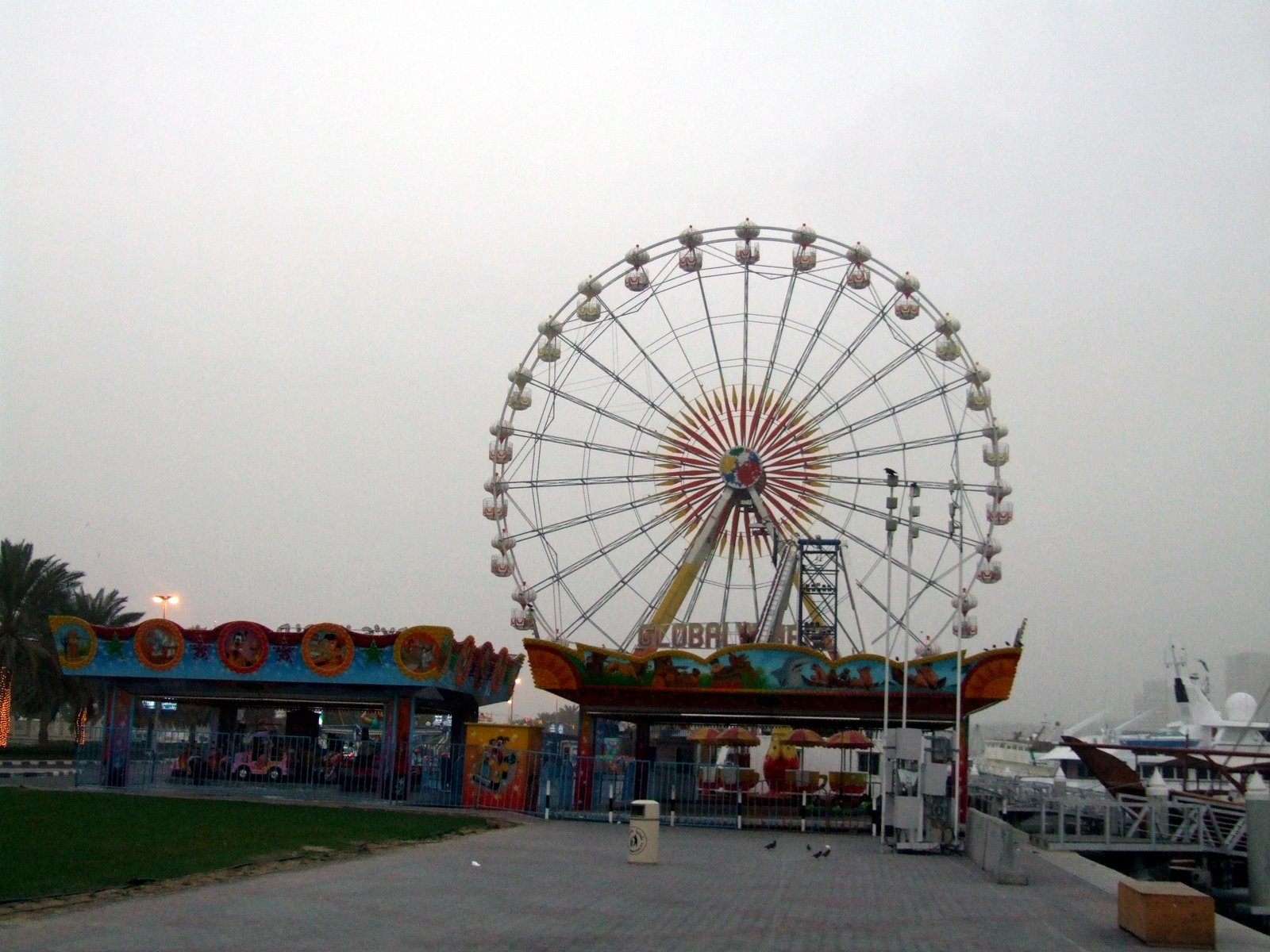
Photo Speaks – Now some rest
Photo Speaks – Now some rest
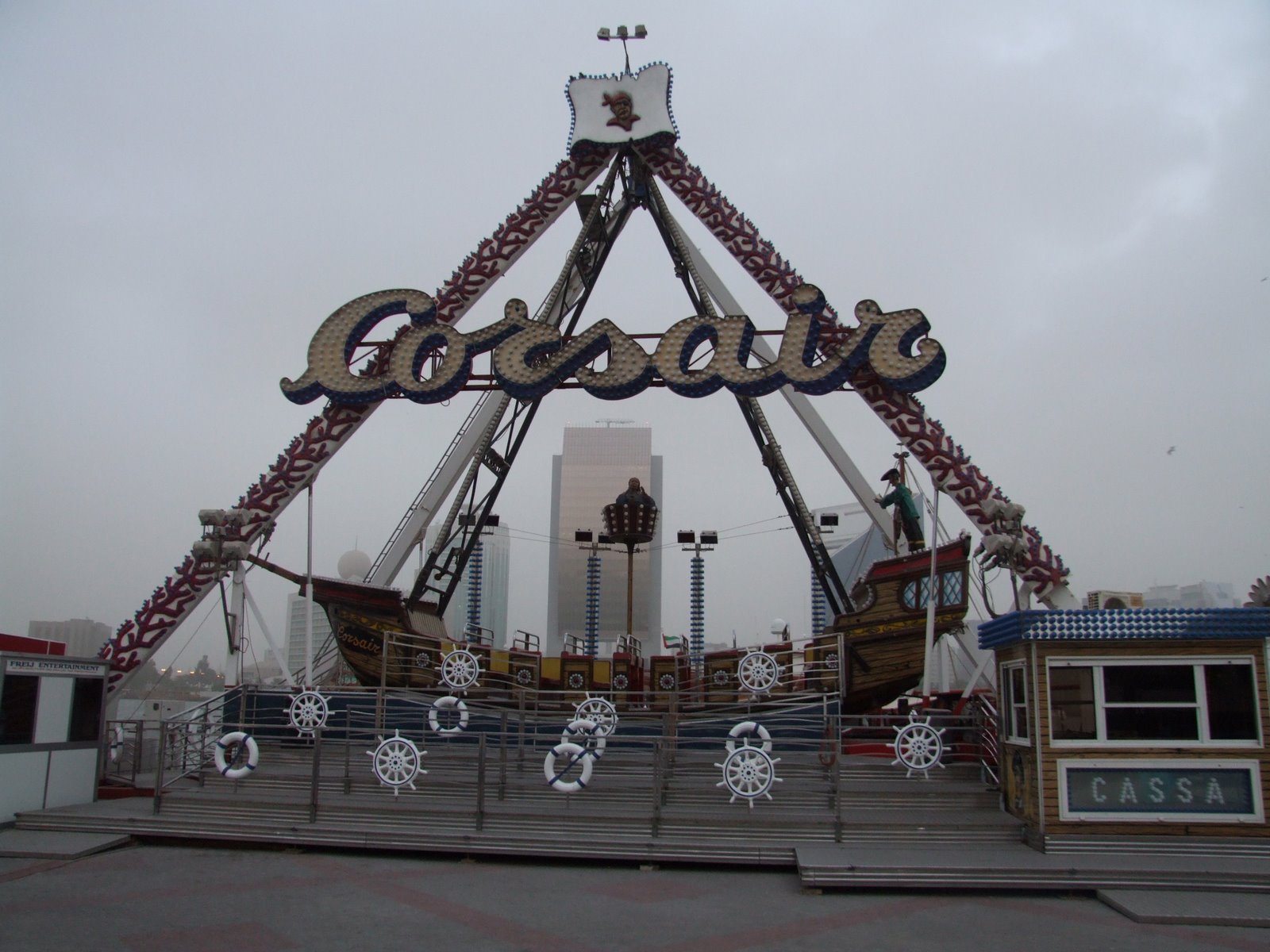
Curtain down for DSF and still the fun goes on. This was an early morning scene from the fun station at the Dubai Creek.

Prices of Selected Commodities Weekly Review dt 28 Feb 2008
Prices of Selected Commodities Weekly Review dt 28 Feb 2008
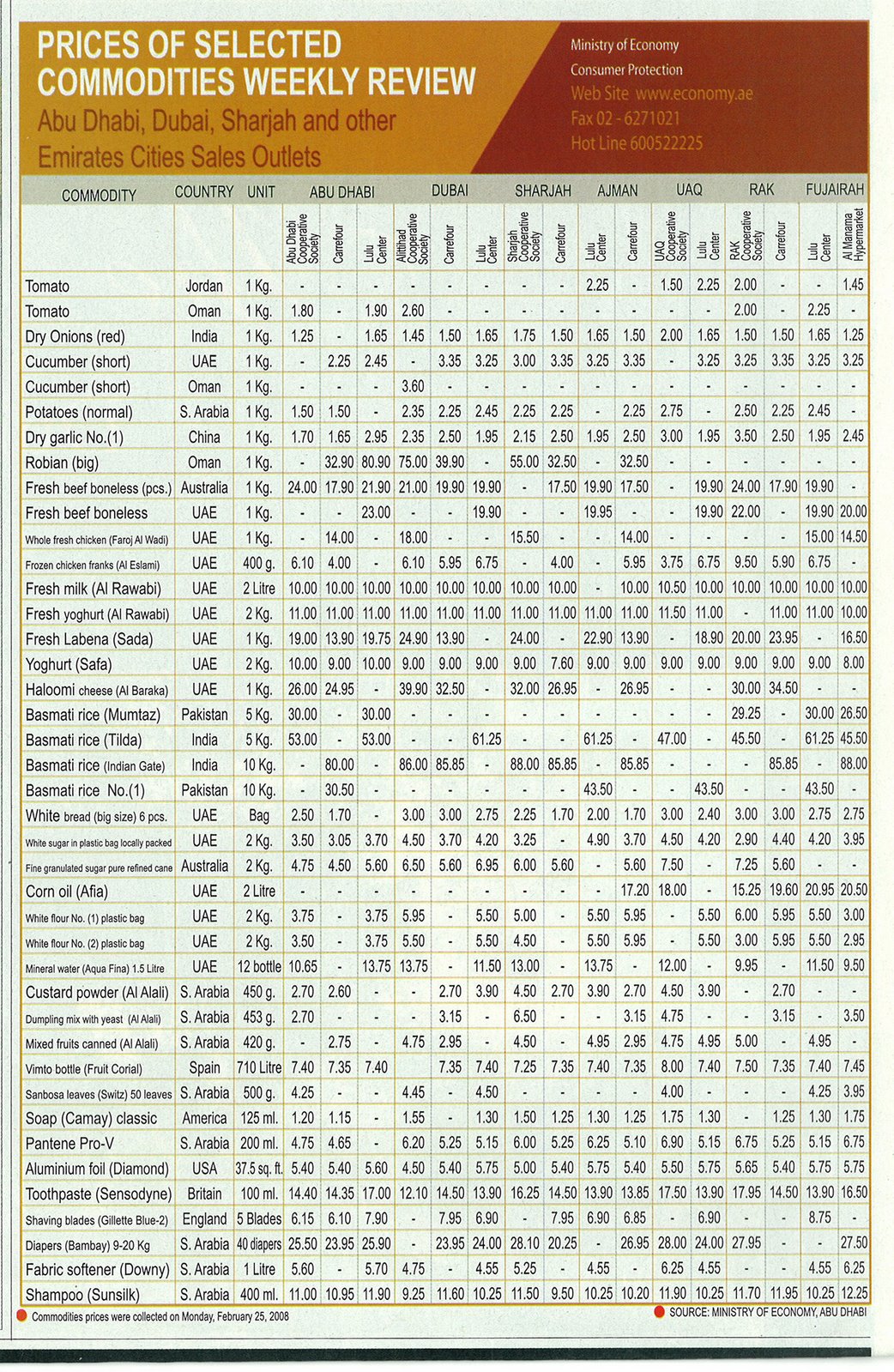
Source : Ministry of Economics, Khaleej Times
English county cricket teams pick UAE for pre-season tournament
English county cricket teams pick UAE for pre-season tournament By K.R. Nayar, Senior Reporter GULF NEWS Published: February 28, 2008, 00:40
Dubai: Top English county cricket teams have found UAE as an ideal venue for a pre-season tournament.
“UAE is close to UK and has the weather and facilities to play professional cricket before the start of their season,” said Matthew Jackson, the Chief Executive Officer Sports Arabia Ltd, the organiser of the Arch Trophy to be held in Sharjah and Abu Dhabi next month.
Top England Test stars like Andrew Flintoff, Marcus Trescothick, Ravi Bopara, Graham Gooch and Mushtaq Mohammad, representing five county teams, will play in the tournament.
“One of our companies, Arabian Cricket Ltd, a tour operator that specialises in organising cricket tours, organised a tour for Sussex and Essex last year.
“They enjoyed playing here. So we contacted the England Cricket board and International Cricket Council for approval to stage a tournament here. We are now sanctioned as an unofficial ICC event,” added Jackson.
“We are also staging an Under-19 English schools tournament from March 26 to 31 at the Zayed stadium in Abu Dhabi and a County Academy tournament in December,” he said.
Jackson is keen to expand the Arch Trophy next year. “This will be an annual event contested mainly by English teams but we will soon include pro teams from other cricketing nations too,” he said.
Elaborating on how he picked the five counties, Jackson said: “Sussex and Essex readily agreed as they played here last year. We approached Lancashire and Yorkshire because they are two of the biggest pro teams in the UK and Somerset as they are the English second division champions.
“We are also keen to develop cricket in UAE and invited the UAE team to gain from the experience of playing some of the best players in world cricket and help them in their quest to qualify for the next World Cup.”
Reviving a timeless tradition in Dubai

Reviving a timeless tradition in Dubai
By Shakir Husain, Staff Reporter GULF NEWS Published: February 28, 2008, 00:39
Dubai: The almost extinct Gulf heritage in pearl trading is set to be resurrected in Dubai. However, this revival is a far cry from the old days of pearl diving when divers spent weeks searching for the treasure hidden in oysters.
When the Pearls of Arabia project is completed in two years, creating a pearl business hub on “Antarctica” at The World manmade island cluster, the new face of the pearl trade in Dubai will reflect the progress the city has seen since the pre-oil era.
Led by the Dubai Multi Commodities Centre (DMCC), Pearls of Arabia is designed to serve as a hub for retail and wholesale pearl traders. It will also become a tourist attraction in the city, which is targeting 15 million tourists in 2015.
“This project is the first stage of Dubai’s plan to re-establish the emirate as a centre for the global pearl trade,” DMCC said.
Last year Dubai set up an exchange to provide a platform for pearl trading.
The 6,000-square-metre Pearl of Arabia features a themed cultural heritage centre, a performing arts theatre, an exhibition gallery and a seafood restaurant alongside boutiques to be run by top pearl fashion houses.
Dubai will invite leading international names in the pearl industry to set up shop in the city. Visitors will travel to the pearl destination by ferries that will serve The World archipelago of 300 islands.
Officials did not get into the specifics of the project, but made their ambitions clear.
Ahmad Bin Sulayem, executive chairman of DMCC, said Dubai is seeking “inspiration from our heritage to build a brighter tomorrow”.
He said pearling was the lifeblood of Arabia less than a century ago and accounted for some 80,000 jobs in the UAE alone. Pearling represented 95 per cent of the country’s revenues.
“Pearls of Arabia presents age-old wisdom in a modern and contemporary fashion to revive the region’s historic legacy for the benefit of future generations,” Bin Sulayem said.
DMCC did not say if pearl farming will be part of the project, which is being implemented in association with Australia’s Paspaley Pearling Company.
“Historically, Dubai served as the world’s hub in the trade of fine-quality natural pearls. Now, almost 100 years later, we are delighted to collaborate with DMCC to revitalise the region’s traditional association with pearls,” said Nicholas Paspaley, executive chairman of the Australian company.
“Together, we will resurrect Dubai’s reputation as one of the world’s premier and most important pearl destinations. Dubai will present to the world the best selection of pearls and pearl jewellery that the 21st century pearling industry has to offer, and will showcase the beautiful history and story of pearls,” he added.
The UAE had some of the best pearls at the start of the 20th century, but the diving tradition died out in the wake of the wealth generated from oil.
Globally, pearl diving is a thing of the past. Australia has one of the world’s last remaining fleets of pearl diving ships. Australian divers dive for south sea pearl oysters to be used in the cultured south sea pearl industry.
However, the Pearls of Arabia is not aimed at recreating the trade in the old style. “It will be a commercial hub with a modern facade,” said Gaiti Rabbani, executive director of coloured stones and pearls at DMCC.
Industry award
Along with developing the pearl trade, Dubai will also institute an industry award that will attract global participation.
Dubai is using its strengths in the gold and diamond trade to make pearls a big business in the city.
“We will bring all elements of the jewellery trade together. We will use the same model that has been successful for other industries by offering tax-free benefits and easy rules,” Rabbani said.
She said a set of standards will also be introduced to generate consumer confidence in the pearl trade.
DMCC is looking at introducing a uniform certification for pearls, based on globally accepted quality parameters.
The certification will be developed in conjunction with leading gem certification bodies and in consultation with local and international trade players.
History: A feature of life
Arabian pearling developed with the opening of the ancient Silk Route.
In the late 1940s and early 1950s, pearl diving was a key feature of life on the Trucial coast.
Around 80,000 men earned their living from the pearling trade, accounting for up to 95 per cent of national incomes. The Trucial States had 1,200 pearling dhows, of which 335 were from Dubai.
The pearl banks were generally some distance from the coast lying at depths of 46 to 120 feet.
The pearl banks of the Gulf provide the finest pearls in the world due to the formation of the seabed, the temperature and shallowness of the water.
Pearl diving was a hazardous business as navigation was limited to the stars, a simple compass and the captain’s knowledge and experience of the pearl banks.
In the 1830-1900 period, output was worth an average of $1.75 million a year, rising to nearly $4 million in the first decade of the 20th century.
Sources suggest that in the Mumbai market, 1gm of fine Gulf pearls may have had the same approximate value as 320 grammes of gold or 7.7kg of silver in 1917.
At the turn of the last century, the UAE had a reputation for having some of the best natural pearls in the world.
By the early 20th century the pearl industry in the Gulf was at its height but it declined during the Great Depression of the 1930s and the development of the more affordable cultured pearl in 1921.
– Source: DMCC
Dubai fuel retailers increase price of diesel to Dh12.80 per gallon
Dubai fuel retailers increase price of diesel to Dh12.80 per gallon By Nadia Saleem, Staff Reporter GULF NEWS Published: February 28, 2008, 00:39
Dubai: Dubai fuel retailers have again increased the price of diesel by 30 fils to Dh12.80 per gallon, making diesel in the emirate almost 50 per cent costlier than in Abu Dhabi.
A manager of a Dubai-based transportation company told Gulf News there had been an average 30-fils increase in the price of diesel every month and this had increased his business costs.
Last month diesel sold at Enoc, Eppco and Emarat filling stations at Dh12.50 per gallon, up from Dh11 in October.
“We have to spend time and resources informing commuters of price increases in transportation and then they become very upset and angry,” said the Dubai transport company manager, who did not wish to be quoted.
While Dubai fuel companies have been raising diesel prices for months, Abu Dhabi National Oil Company (Adnoc) has kept the price steady at Dh 8.60 per gallon.
Companies in Dubai have argued in the past that they are forced to revise their prices to match the rising crude prices in world markets.
 ClicksandWrites
You must be logged in to post a comment.