UAE
ADNRD to issue temporary permits for maids
ADNRD to issue temporary permits for maids
By Ahmed Abdul Aziz KHALEEJ TIMES 15 March 2008
ABU DHABI – The sponsors, nationals and expatriates, can be issued temporary permits to allow them to hire house maids, drivers and domestic servants for three months from the current sponsors, if they agree, in the Abu Dhabi emirate, said an informed source at the Abu Dhabi Natrualisation and Residency Department (ADNRD).
Colonel Nasir Al Awadi Al Minhali, Director of ADNRD, told Khaleej Times in an interview that the temporary permits would cost Dh 500 and valid for three months and can be renewed in case the current sponsor agreed.
“This step was taken to give the new sponsors the chance to hire maids for the three months as a probation period before transferring the sponsorship if they want that”, he said.
He elaborated that the temporary permit for maids is to avoid hiring illegals and facilitate the formalities by giving the applicants various options. “In this case, there is no violation to the residency department because the two sponsors will receive the endorsement of the ADNRD.
“The temporary permit to hire maids to another sponsor is to protect the rights of the housemaids and also to weed out the illegals from the country”, he added.
The ADNRD will tighten its inspection on the housemaid hiring agencies in the emirate of Abu Dhabi. “So far, we didn’t find erring agencies, otherwise, in case of violating the NRDs’ instructions, agencies will face closure because excuses are not acceptable, in particular, for the rights of the maids and domestic servants”, said Colonel Al Menhali.
No fees increase
Colonel Al Minhali affirmed that the decision makers have no intention to increase the fees of issuance of the visit, employment, domestic servant visas.
However, he pointed out that the ADNRD is studying the causes that created the illegals phenomenon and the survey will be completed in the end of this month [March]. The survey also includes the number and premises of the housemaids’ agencies in the emirate that will ease monitoring their activities as a step to combat the visas trading.
For decrease the fines imposed on illegal expatriates, he said that the NRDs are not authorised to decrease the imposed fines, however, in case of the applicant demand that we transfer the application to the NRD court to state whether decrease the fines or not.
Fine for jaywalkers upped by Dh150
Fine for jaywalkers upped by Dh150
By Adel Arafah (Our staff reporter) KHALEEJ TIMES 16 March 2008
ABU DHABI – The fine for crossing the street from non-designated places by pedestrians will go up from Dh50 to Dh200, Colonel Hamad Adeel Al Shamsi, Director of Traffic and Patrols Department at Abu Dhabi Police, told Khaleej Times recently.
The department had started to impose Dh50 as fine against violators from February but the amount had increased to Dh200 following the penalties stipulated by the black points system and the amended rules.
The fine would be paid by the jaywalker on the spot. In case he/she did not pay, the policeman would take away his/her identify card, which would be returned only after the offender paid the fine at the Traffic Department, he noted.
The Dh200 fine against jaywalking is being enforced throughout the country, he added.
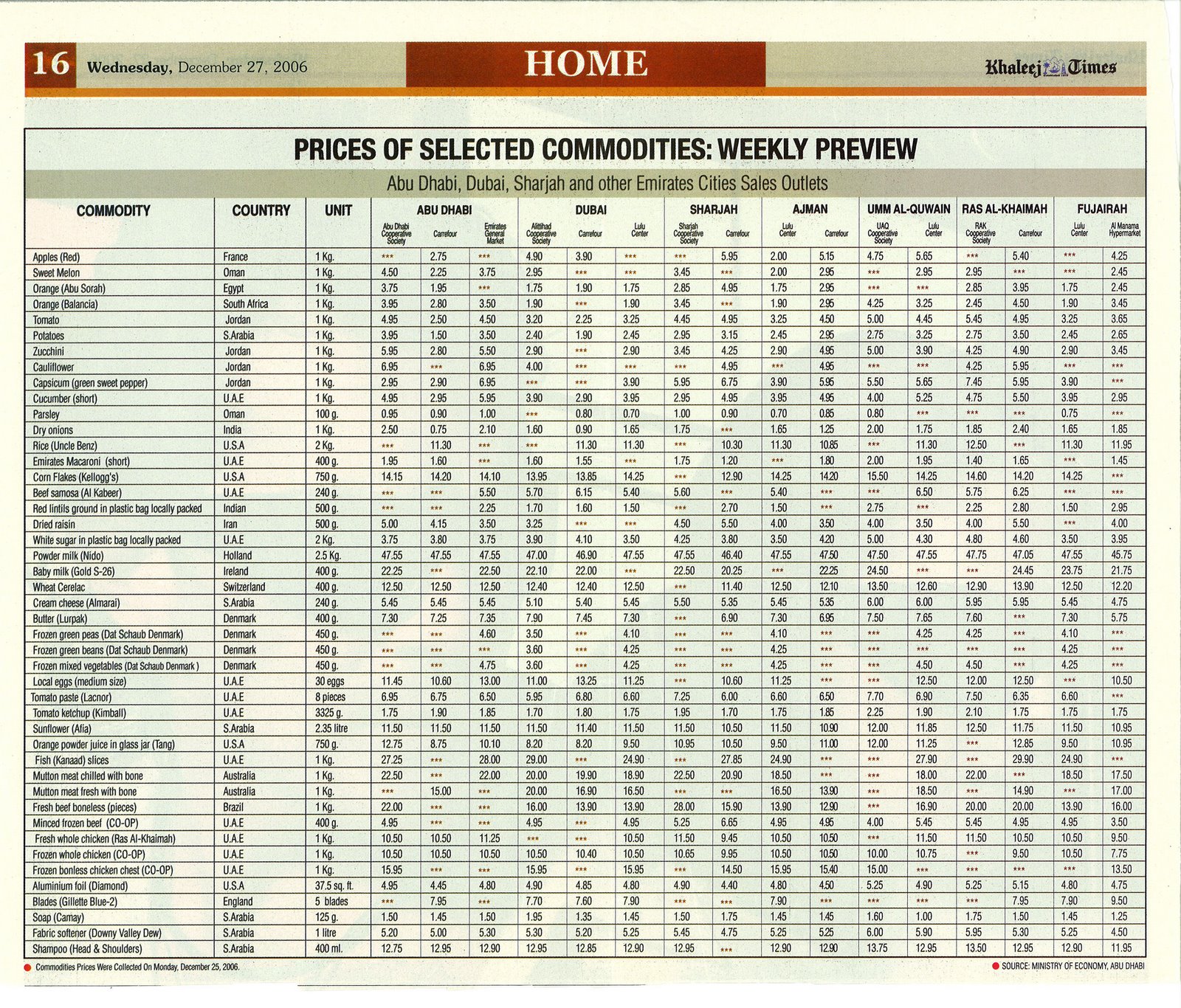
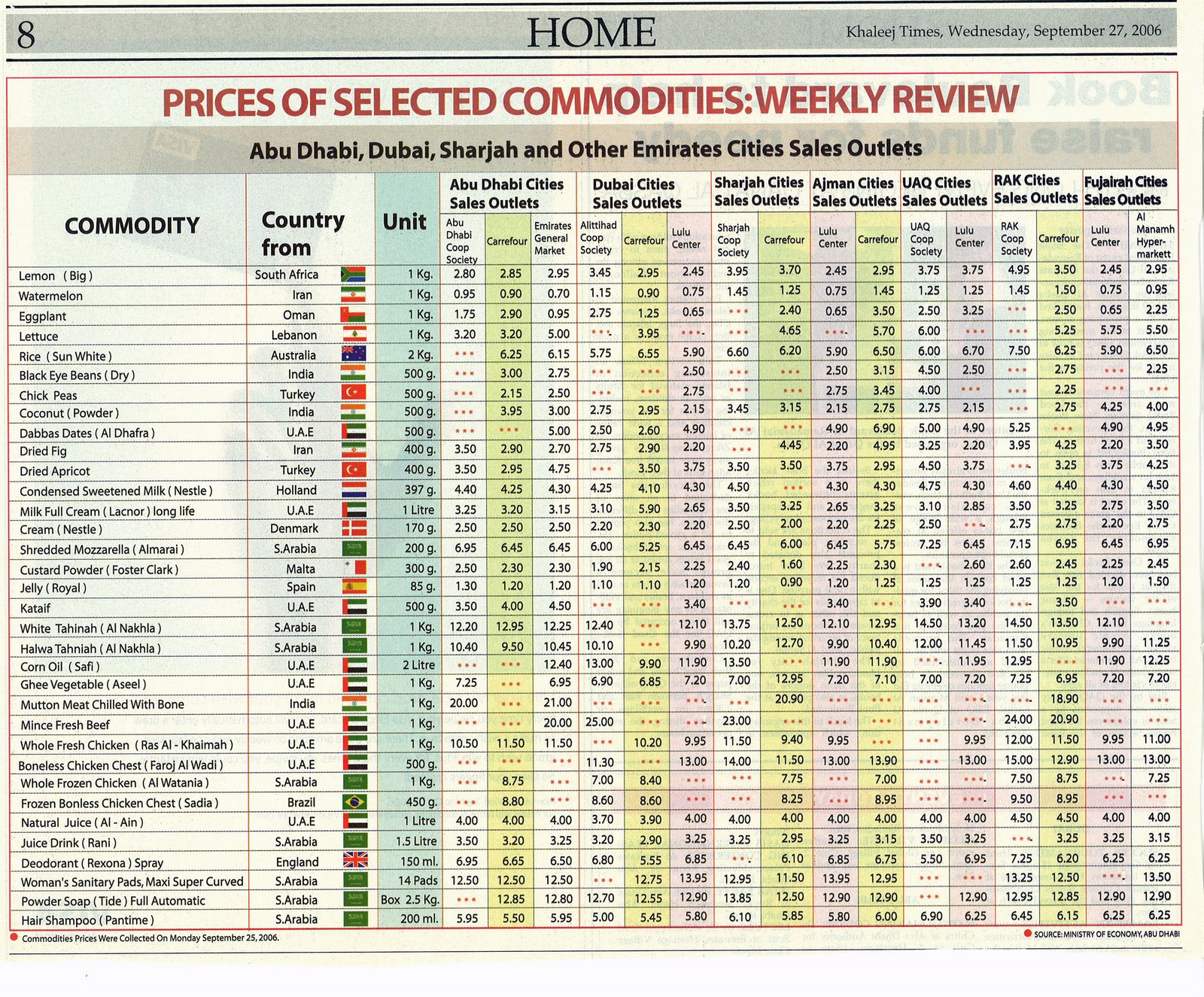
Prices of Selected Commodities – a selected review since 2006
As at 13 March 2008

As at 22 October 2007
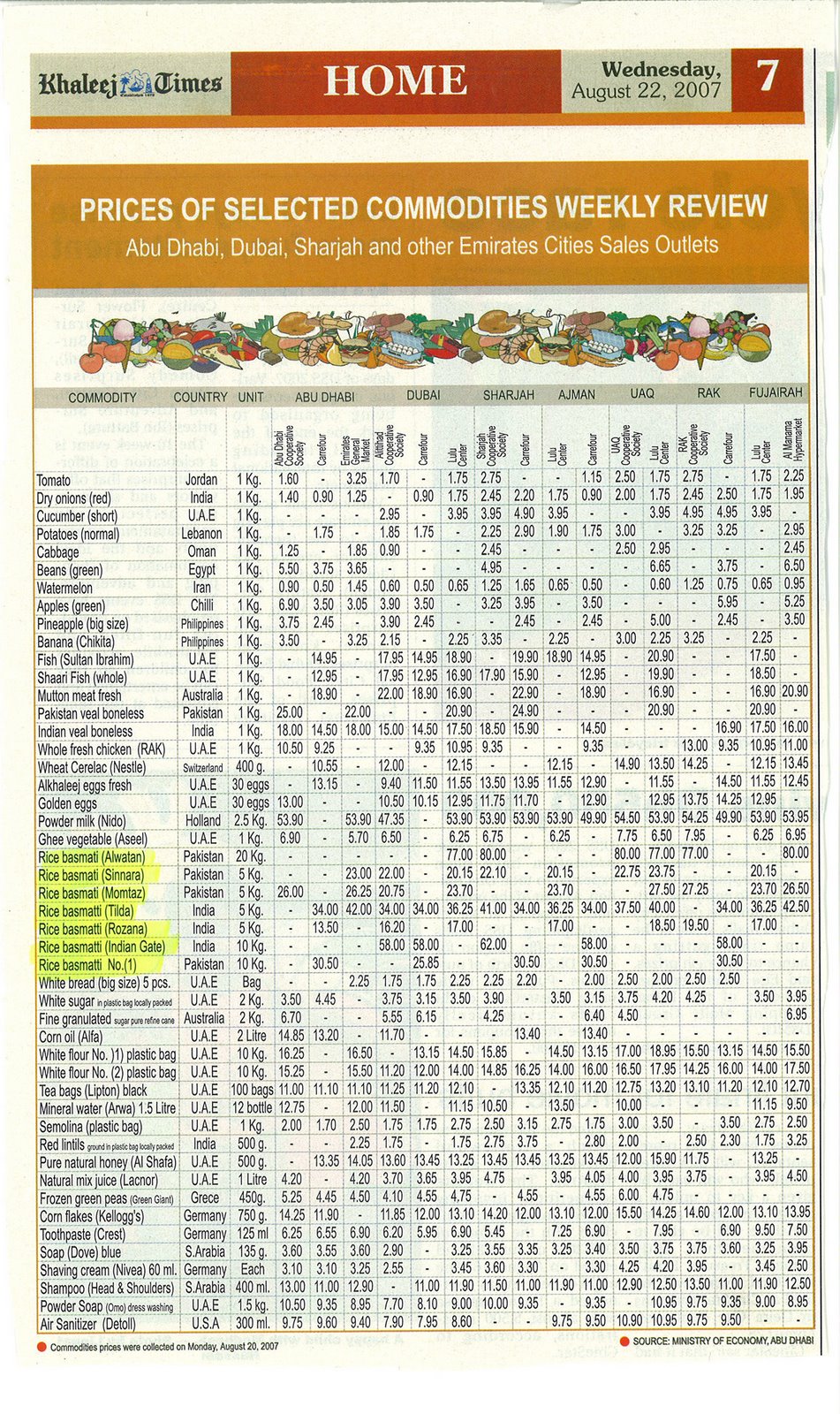
As at 27 December 2006
As at 27 September 2006
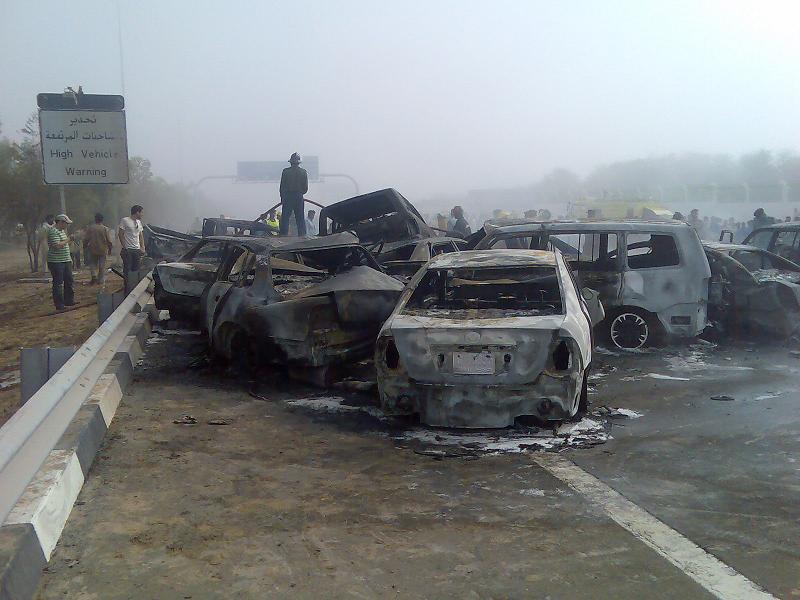
Road horror in Abu Dhabi; casualties feared
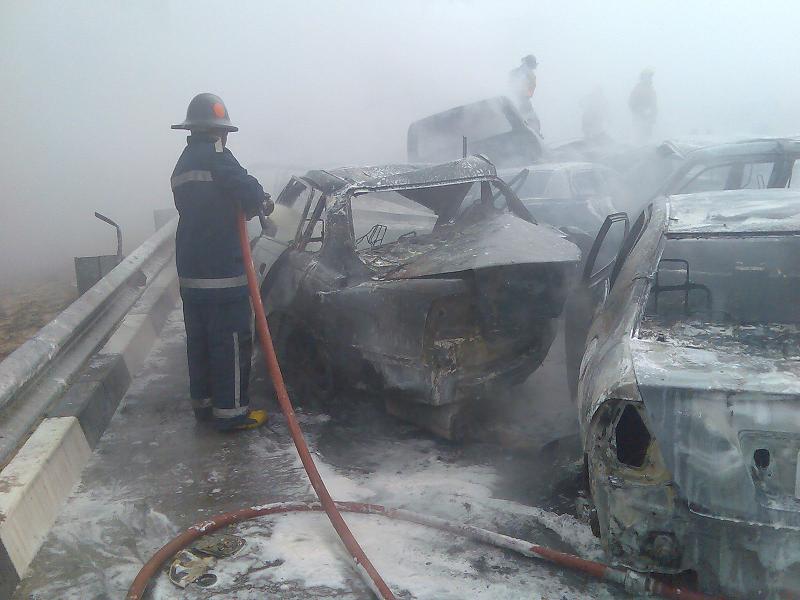
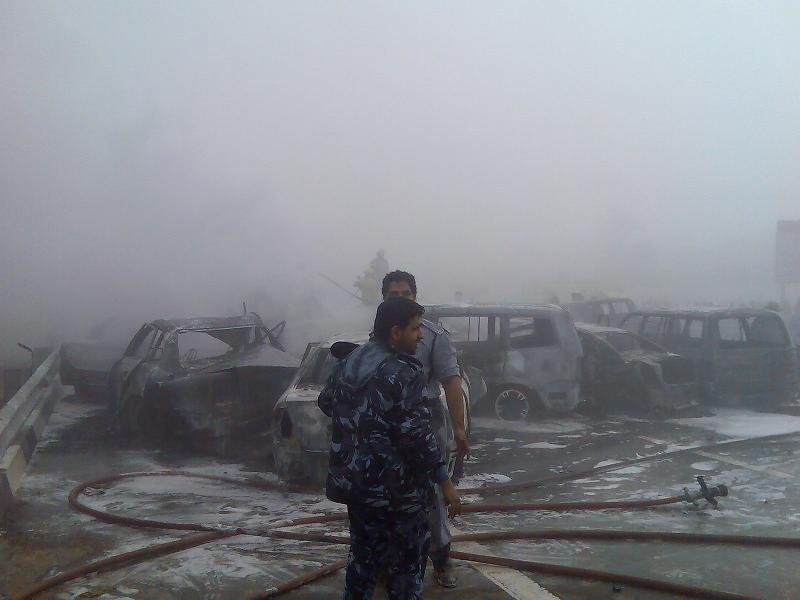
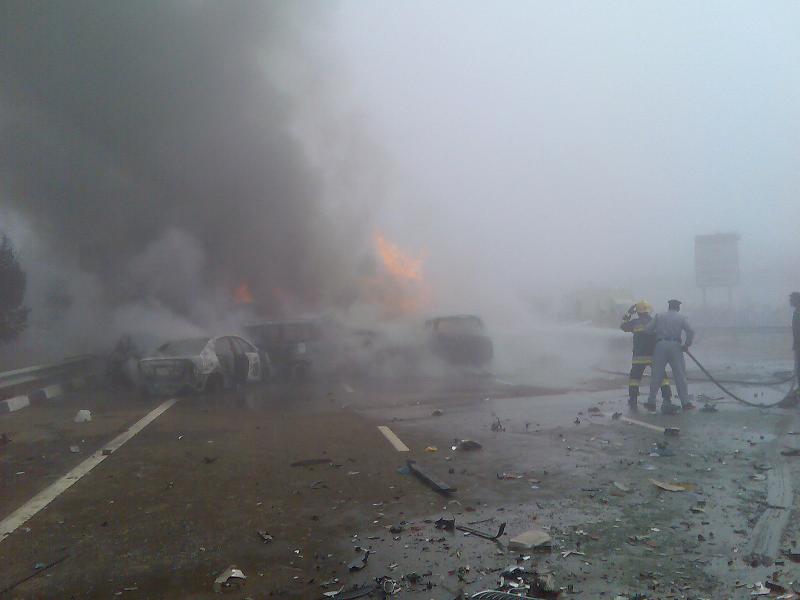

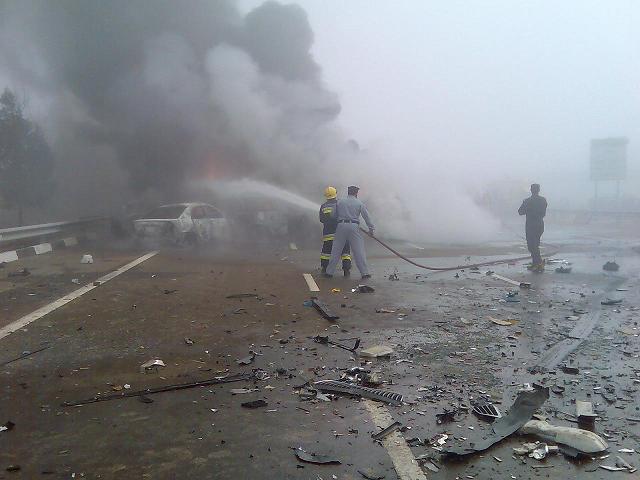
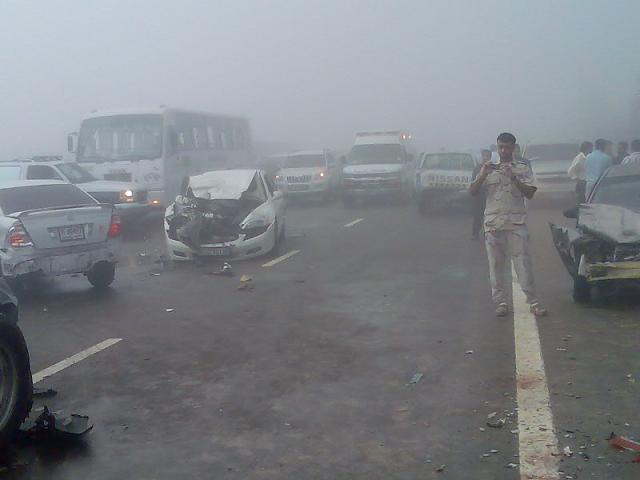
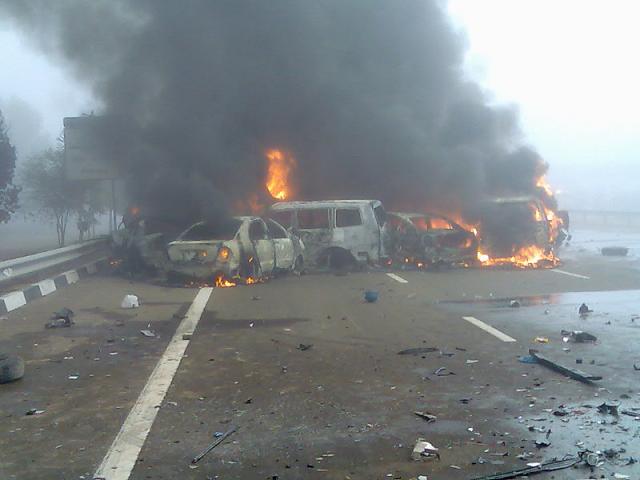
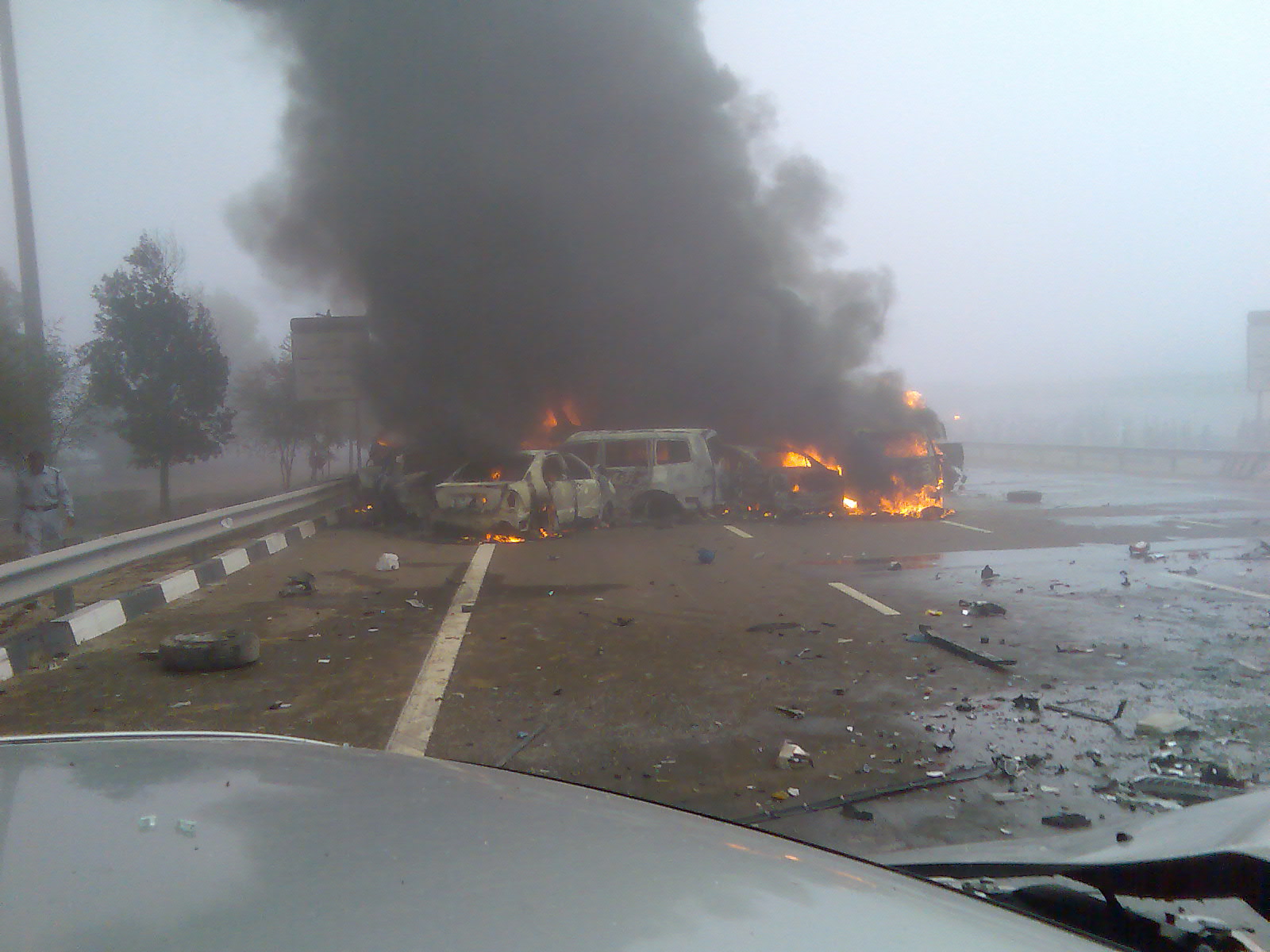
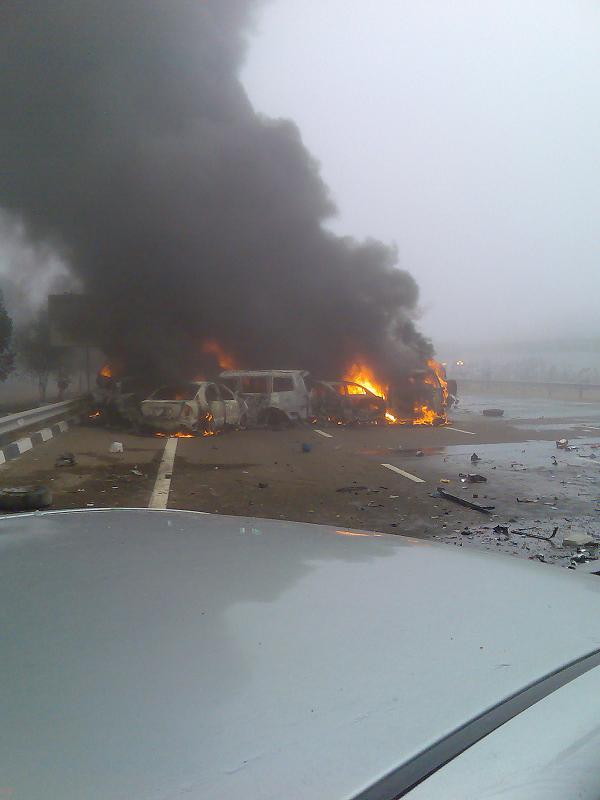


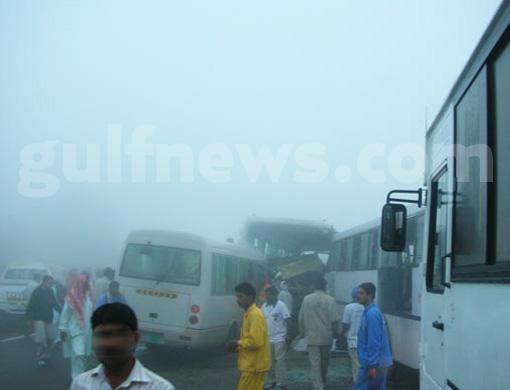
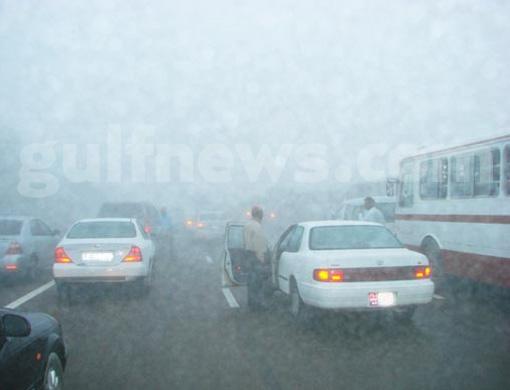
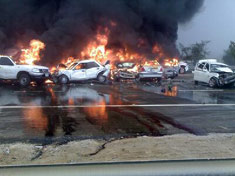
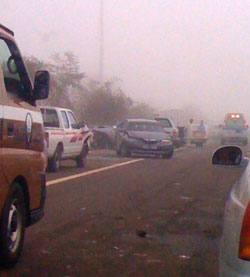


Road horror in Abu Dhabi; casualties feared
Staff Reporter KHALEEJ TIMES 11 March 2008
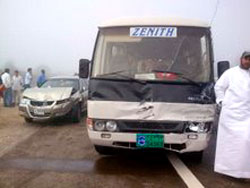
In what seems to be the worst accident to be ever recorded in the history of the United Arab Emirates, more than a 150 cars were involved in a massive pile-up on the Abu Dhabi-Dubai Road, that according to early estimates might have claimed more than ten people. About 40 were also reported injured.
The injured, some of them in critical condition have been rushed to the Khalifa Hospital. Rescue teams from Dubai and Abu Dhabi swung into action immediately as ambulances, helicopters and patrol cars were rushed to the scene.
Police sources have blamed poor visibility condition brought about by the fog for the crash.
Two eyewitnesses on the scene of the mishap recounted the tragedy as it unfolded before their eyes. Zeeshan Javed a regular commuter on the stretch says that he just escaped ‘by a whisker’ as the cars in front of smashed into each other. “It was a big pile up. I personally counted about eighty cars that had been wrecked beyond recognition. Even though emergency units were quick to respond the fact remains that there have been casualities. I have never seen an accident of this magnitude. Some cars that had caught fire were charred beyond recognition. This has to be the worst ever.”
Horrific accident on Abu Dhabi-Dubai highway near Ghantoot
Staff Report GULF NEWS Published: March 11, 2008, 10:35
Ghantoot: Many are feared dead after an horrific accident involving 31 cars blocked the Abu Dhabi to Dubai highway near Ghantoot.
Police have confirmed that there are fatalities and several injuries but have yet to say how many people were killed in the accident which happened on Tuesday morning.
Witnesses have said that three or four cars were on fire after the accident.
Special needs people must be made to feel they are part of community
Special needs people must be made to feel they are part of community
By Nada S. Mussallam (Our staff reporter)KHALEEJ TIMES 11 March 2008
ABU DHABI – The most important thing to rehabilitate people with special needs is to make them feel that they are part of the community, said Sir John Major, former British prime minister.
“It is very, very important that we should focus on making people with disabilities know that they are a part of the community and they are not different because they have a disability.
“They have the same instinct, the same souls like the rest of us and we should bring them into the society and not lock them out from the society,” said Sir John who is on a visit to the country to participate in a special needs conference.
The third Abu Dhabi International Conference for Special Needs will kick off today at the Armed Forces Club.
Speaking to Khaleej Times yesterday, he stressed: “People who have disabilities are exactly the same as the rest of us except that they have these disabilities. They are entitled to a good life as far as they could have one as anybody else.”
Sir John’s statement came shortly after ending a tour of Abu Dhabi Rehab Care Centre for Special Needs’s premises in the Mafraq region, which is an affiliate of Zayed Organisation for Humanitarian Care, Special Needs and Minor Affairs.
He praised the Centre by saying: “It is one of the most comprehensive centres I have ever seen and the facilities are of very high grade. It is wonderful to see such facilities brought together.
“This remarkable facility, I believe, would encourage disabled to become part of the community at large.”
What is wonderful about the Centre is that it has sports facilities, which are not available in most rehabilitation centres in the world, he said.
Sir John is well known for his contributions in the field of rehabilitation of people who are physically and mentally challenged in the UK.
About his opinion regarding the role of volunteers in rehabilitation of the disabled, he said: “In the UK the voluntary role is very important in supporting programmes dedicated to disabled. Volunteers can greatly help in this respect.”
UAE sets up task force to de-peg dirham
UAE sets up task force to de-peg dirham
By Issac John (Deputy Business Editor) Khaleej Times 11 March 2008
DUBAI – The Central Bank of UAE has set up a task force to help implement a possible de-pegging of the country’s currency from the US dollar.
The committee is studying the benefits of de-pegging or revaluing and will help coordinate any de-peg of the UAE dirham. It is expected to report its findings to the country’s Ruler at the end of the year, people familiar with the matter said.
The year-long timeframe for the group to report its findings will dash the hopes of many currency speculators that have increased bets on the UAE severing its ties with the dollar in the coming months. The World Bank officials said in a recent interview that the Middle East economies will be hit by an expected slowdown in global growth and the weakening greenback. Growth across the Middle East is expected to fall to as low as 5.6 per cent through 2008, down from about 6.3 per cent, senior World Bank officials said.
Self-service pumps fuel controversy in Abu Dhabi
Self-service pumps fuel controversy in Abu Dhabi
By Binsal Abdul Kader, Staff Reporter GULF NEWS Published: March 10, 2008, 00:32
Abu Dhabi: Some say it is hazardous, while others feel it is a simple task.
Residents were reacting to Abu Dhabi National Oil Company’s (Adnoc) move to install self-service pumps that allow motorists to refuel their cars.
The service has started at Adnoc filling stations on a trial basis and is expected to be eventually introduced at all stations.
Latheef A.M, an Indian, said the climate here was not conducive to such an initiative.
“It will be unbearable in the summer to get out of the car and fill gas. People are very busy here, and this will just be wasting time.”
He said as it is the stations are congested and one has to wait in a queue to get petrol and the self-service move will only add to the problem.
There are a large number of vehicles on the roads and the number is growing. The queues at the petrol stations will only become longer, he said.
Jean-Marc Suter, a Swiss businessman, said almost all petrol stations in Europe had self-service terminals.
“In the UAE, it is a very convenient service having attendants. There is also the additional service – attendants clean the windscreen. I certainly would not want the stations here to become self-service,” he said.
Shahina Ajmal, a Pakistani, who has been driving in the UAE for the past 17 years, said: “I don’t think too many women would like to leave their cars to fill petrol when the stations are crowded. Children also may decide to get out of the car, and this is an additional problem.
“I don’t think self-service petrol stations are a good idea because many people may not know how to refuel their cars. This will raise the question of safety. Only trained staff should refuel because it can be a dangerous operation.”
Hussain Al Saeedi, an Emirati IT professional, however, welcomed the idea. “I have already seen the system while travelling in England.”
He has used the service in Abu Dhabi and finds it convenient.
“But too many people may not like this. Unlike in the West, people here are not very educated and hence they may find it difficult to accept such a self-service system. If the company gives handsome discounts for self-service, people may opt for it. Otherwise it may not work,” he said.
Lalan Purnama, an Indonesian, is in favour of the service.
“I have not used it yet, but I don’t think people will have any trouble filling their cars with petrol themselves. It may be a bit inconvenient, especially during the summer, but people will cope eventually,” he said.
UAE makes Arabic official language
UAE makes Arabic official language
By Duraid Al Baik, Foreign Editor GULF NEWS Published: March 10, 2008, 00:32
Dubai: The government on Sunday decided to use Arabic as the official language in all federal authorities and establishments.
The move was hailed by UAE intellectuals who called on local governments and private institutions to follow suit.
Dr Ebtisam Al Kitbi, Professor of Political Science at the UAE University in Al Ain, said the long overdue move was a step in the right direction in emphasising the national identity. He urged the government to follow up on its implementation.
Al Kitbi said the move will enhance the presence of Arab speaking people in labour market and restore the national identity,” she said.
She said the decision is in harmony with the UAE constitution, which states that the language of the land is Arabic without exception.
“To my knowledge, there is no nation that allows an invasion of foreign languages in government institutions the way we did in the UAE. The move will correct the imbalance,” she said.
“See countries like Germany, France and Japan. People there use foreign languages, but you will never see them in the work place other than their national languages. English is widely used in the government in the UAE and this is unacceptable,” she said.
Ali Abdul Kadir Al Khalaf, secretary-general of the Sharjah-based Arabic Language Protection Association (ALPA), said that he and his colleagues in ALPA have been working working for nearly 10 years to enhance the use of Arabic in the country.
“The government decision is just one step forward. We are looking to see similar commitments by governments in the various emirates and the business sector,” Al Khalaf said.
He said ALPA is waiting for stronger moves by the government to emphasise the national identity in 2008.
“The language decision was just an implementation of President His Highness Shaikh Khalifa Bin Zayed Al Nahyan’s initiative to endorse the current year as the year of national identity,” he said.
Chaired by Shaikh Mohammad Bin Rashid Al Maktoum, Vice-President, Prime Minister of the UAE and Ruler of Dubai, the Cabinet also approved an agreement between the UAE and France to develop nuclear energy for peaceful purposes.
Jebel Hafeet – Al Ain
Jebel Hafeet – Al Ain
Jebel Hafeet (Arabic: جبل حفيت) (variously translated Jabal, Jabel and Jebal) is a mountain primarily in the United Arab Emirates on the outskirts of Al Ain. The mountain actually straddles part of the border with Oman. The mountain rises 1240 meters and offers an impressive view over the city, with what has been described as “the greatest driving road in the world”[1] extending to the summit. Jebel Hafeet was a well-known landmark through out the area’s history and is a contemporary tourist attraction. An extensive natural cave system winds through Jebel Hafeet.
At the foothills of Jabal Hafeet lies the Green Mubazarrah, a well developed tourist attraction. At the Green Mubazarrah, hot-water springs gush forth in little streams and form a lake. Swimming pools and jacuzzis are scattered all over the Green Mubazarrah. Jebel Hafeet is also home to a wide range of animals including bats, foxes, snakes, etc.
It is often incorrectly labelled U.A.E’s highest mountain (as it is certainly the most well-known); this honor actually belongs to Jabal Yibir.
The Jebel Hafeet Mountain Road extends for 7.3 mi (11.7 km) up the mountain, rising 4000 ft (1219 m). With 21 corners and three lanes (two climbing and one descending), the immaculate road was called the greatest driving road in the world by Edmunds.com. The road scales the mountain and ends at a parking lot with only a hotel and a palace belonging to the country’s rulers.
Build by Strabag International Cologne,Germany
Jebel Hafeet Road is the challenge for cyclists who frequently come over to train. The Jebel Hafeet Mercure Challenge is a yearly road cycling competition taking place somewhere in January. National & international riders take part in climbing the 8% average ascent of the mighty mountain.
Al Wathba – Camel Market
Al Wathba – Camel Market
On the Abu Dhabi – Al Ain road, Al Wathba is famous for the Camel Racing track. It has also a famous Camel market adjacent to it. And not to forget about the Al Wathba Prison.
 ClicksandWrites
You must be logged in to post a comment.