UAE
Smart Radars to Catch Errant Drivers
Smart Radars to Catch Errant Drivers
Amira Agarib for KHALEEJ TIMES 16 September 2008
dubai — New sophisticated mobile radars will be introduced on Dubai roads soon after Eid Al Fitr, according to a senior police official.
These radars will be mounted on police vehicles to monitor speed limits, Major Saif Muhair, Deputy Director of General Department of Traffic, told Khaleej Times on Monday. It is for the first time that these radars, equipped with advanced technogly, will be introduced in this region. Maj Saif said that the new ‘smart radar’ could be fixed on any vehicle and would be able to detect all speed violations.
He said that the smart radar would be on trial for one month after which it would be deployed on all Dubai roads. These new smart radars differ from other such monitoring equipment, he said.
Order Lunchboxes Online, Get Them in Classrooms
Order Lunchboxes Online, Get Them in Classrooms
Preeti Kannan for KHALEEJ TIMES 16 September 2008
Dubai — A number of parents have started ordering their children’s lunchboxes online and choosing menus that are healthy and nutritious for their wards.
Nearly 400 parents in Dubai choose from a range of sandwiches, salads, snacks and drinks from lunchboxes.ae, which delivers the meals right up to the classrooms every morning.
The online initiative, launched in December last year, provides parents and pupils over 180 menu options everyday to make their own “balanced, wholesome” meals, in a bid to combat obesity and diabetes among children in the UAE. The lunchboxes are then delivered to students’ classrooms by 8am, usually even before the child reaches school.
Sharon Ogden, whose four children have been selecting their lunch menu for nearly a year, says the service is hassle-free, cost-effective and her children like choosing their own menu. “There is so much variety and it is convenient knowing there is a good mix of food available for them everyday. My four-year-old girl loves the fresh salads and the sliced fruits they send, making it easy for her to eat them. It saves me a lot of time in the mornings and it is like a surprise for the children when they open their lunchboxes everyday,” says the mother, whose children study at the Royal Dubai School. The online service enables parents to register their details, logon once a week with their child and then create healthy lunchboxes. The child can pick a salad or a sandwich with two fillings, a drink, fresh fruits and two snacks to keep them going throughout the day. If children order foods like mini pizzas more than twice a week, parents are notified immidiately by text messages. Parents also say that children do not waste food anymore since they enjoy the meals they opt for. “They (delivery people) never fail to reach the school on time and that is very advantageous. Having three children at home and making snacks for them everyday can be very difficult. Besides, it is not very expensive,” says Patrice Thomas, a parent, whose children study at King’s College, Dubai.Lester Owencroft, Managing Director of lunchboxes.ae, notes that they launched the service after realising that parents were under constant pressure thinking how to create tasty, healthy lunches for their kids.
“We interviewed 800 parents who said they spend a lot of time thinking how to motivate their kids to eat. So we decided to launch this community initiative. Our menus are reviewed by a nutritionist and we encourage parents and pupils to tell us what they want,” says Owencroft. “We provide a fully balanced meal so that we can try to reduce the cases of obesity and diabetes among children.lunchboxes.ae also brought down its prices recently to encourage more parents to use the service.
He adds that their priorities are also to provide lunchboxes to local schools. Due to the increasing demand from parents in Dubai and Sharjah, the online culinary service plans to add another 12 schools by the end of next year and hope to cater to more than 1,000 children by the end of this academic year.

Know Safety No Pain – campaign by Dubai Municipality
Know Safety No Pain – campaign by Dubai Municipality
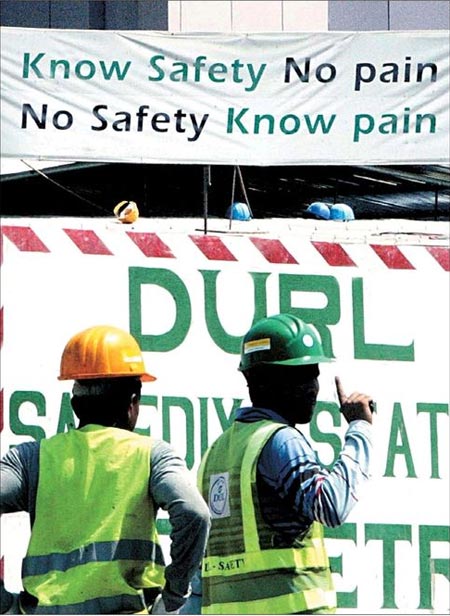 ‘Safety at work’ is being stressed currently by the Dubai Municipality and its allied departments. A slogan put up at a Dubai Metro construction site on Khalid Ibn Waleed Road highlights the theme of the campaign. – ‘Know safety, No Pain and No Safety, Know Pain. – Photo by Mukesh Kamal KHALEEJ TIMES
Energy saving tips on tap
Energy saving tips on tap
By Emmanuelle Landais, Staff Reporter GULF NES Published: August 10, 2008, 00:02
Dubai: Using water and electricity too abundantly is not in anyone’s best interest in this time of energy conservation so Dubai Electricity and Water Authority (Dewa) has launched a campaign to help residents use less of the UAE’s resources.
The campaign, Now That You Know, Don’t Let it Go, focuses on the behaviour of consumers when it comes to wasting water and electricity.
For example to meet residents’ daily demand of electricity requires 7,000 workers, 1,219 kilometres of overhead lines and 2,129 kilometres of underground cables.
There are 43 desalinating units and 769km of pipeline to get water to your house where it might be wasted and used to wash sand off your driveway or used more carefully with water saving faucets.
The campaign is a sequel to the Your Decision campaign that marked the introduction of a slab-based tariff system.
The new campaign, which will be implemented at government departments, private companies and shopping malls, aims to educate the public on avoiding wasting water and power to help save the environment and natural resources.
Watering your garden before 8am or after 6pm and avoiding doing so on windy days, and in several short sessions rather than one long one, is the best way to keep your lawn healthy.
Dewa also advises people to only water when the lawn needs it.
Overwatering promotes shallow root growth making your lawn less hardy. To determine if your lawn needs to be watered, simply walk across the grass. If you leave footprints, it’s time to water.
Amal Koshak, manager of investors services at Dewa’s Customer Relations Department, said the campaign will contribute in educating consumers on the need for the prudent use of water and electricity through highlighting best practices in the areas of saving natural resources.
The campaign also aims to highlight the huge effort and cost behind delivering water and electricity to consumers, including the maintenance and management of water and electricity lines and networks across the expanding emirate.
For instance, washing machines can use as much as 110 to 130 litres of water per cycle and dishwashers up to 35 litres per cycle. Yet a full dishwasher is more water-efficient than washing the same load by hand.
“This campaign is an integral part of the Your Decision campaign which targets all segments of society, including individuals and organisations.
“The new initiative provides practical yet simple tips to reduce water and electricity consumption and thus preserve the environment and natural resources of the emirate.
“We want to enhance consumer awareness on a very critical environmental issue that requires the involvement of both public and private sectors in Dubai.”
Tejari calls for new e-Volunteers
Tejari calls for new e-Volunteers
By a staff reporter KHALEEJ TIMES)6 August 2008
DUBAI -Tejari has invited applications for its 2008 e-Volunteer Programme, the largest internship initiative of its kind in Dubai.
Under the e-Volunteer programme, Tejari interns approach small, medium and large scale private and public sector enterprises in order to demonstrate the advantages and benefits of e-Commerce and provide advice on how to succeed in a global knowledge-based economy. These interns also help businesses through the process of registering with the online trading portal.
IA slashes UAE fares
IA slashes UAE fares
18 Jul 2008, 1745 hrs IST,PTI
DUBAI: At a time when major carriers operating in the UAE have hiked their fares, Indian Airlines has adopted a new aggressive marketing strategy by reducing fares to most Indian destinations.
IA has cut fares on the UAE to Delhi and Mumbai routes by 20 per cent. The one-way fare has been cut from Dh500 (about Rs 5,500) to Dh 400 (Rs 4,400), while the fuel surcharge remains same. The new fares came into effect from July 14.
Indian Airlines Regional Manager Abhay Pathak said the airline had introduced special fares to Delhi and Mumbai last Monday.
On May 5, fuel surcharge was hiked to Dh 390 from Dh 350. During the peak summer period, the fare would be Dh 100 cheaper although the fuel surcharge would remain the same. “We have a large number of blue-collared workers. We don’t want to distance our customers. I think we’ll maintain the fare,” he said.
He said the fares reduction was aimed at getting more volumes since the India-UAE sector was seeing over deployment of capacity. It will help us maximise our revenues, he added.
Most of the airlines, including Emirates, increased the fares citing the staggering rise in fuel prices.
Both Indian Airlines and Air India operate 19 flights daily from Dubai and Sharjah to Indian destinations. With the reduced fares, one-way ticket from Dubai to a destination in Kerala costs Dh 790, including taxes, down from Dh 900.
A single journey to New Delhi and Mumbai, too, is costing 790 against the previous Dh 1,070 and Dh 880, respectively.
Passengers flying from Sharjah to any Indian destination also stand to benefit from the reduced fares as Sharjah-Mumbai ticket price has come down to Dh690 from Dh840, while Sharjah-New Delhi ticket price is down to Dh 740 from Dh 1,070.
Masdar hires first batch of professors
Masdar hires first batch of professors
Bradley Hope
Last Updated: July 02. 2008 11:50PM UAE / July 2. 2008 7:50PM GMT
ABU DHABI // The capital’s plan to become a centre of alternative energy innovation is a step closer, with 24 professors now hired to conduct research and teach at the Masdar Institute of Science and Technology (MIST).
The institute is also jumping ahead of schedule and bringing 20 graduate students to the programme in the autumn to assist with research.
“We wanted to test the market and see what kind of interest we could get from students,” said Fred Moavenzadeh, a professor from the Massachusetts Institute of Technology (MIT), which is helping to co-ordinate the programme. “We have already received 75 applications without advertising anywhere.”
The private, non-profit MIST will be the first part of Masdar City, a zero-carbon emissions development, to be constructed in 2009 – in time for the inaugural class.
In the coming week, Masdar will begin putting advertisements in publications around the Middle East to solicit applications for another 50 faculty positions to be filled before the start of the new school year in autumn 2009.
The first hires include a cast of top engineering and environmental design experts from around the world. They have degrees in specialities such as building technology, artificial intelligence and risk management, but many have also worked in the private sector. A key goal of MIST is not just to produce valuable research, but models and technologies that can work in the marketplace and help to transform Abu Dhabi from a petroleum-based economy to a sustainable energy economy.
“These professors will be developing everything from technology to intellectual property rights to transform this economy,” Dr Moavenzadeh said. “They will be the manpower that will help enable this change.”
The idea for the institute predates the plan for Masdar City, which is perhaps the better-known project. MIT first started a partnership with Mubadala Development, the parent company of Masdar, three years ago to begin putting together the plans.
Dr Moavenzadeh – who is a professor of systems engineering and the director of MIT’s Center for Technology, Policy and Industrial Development – is leading the team at MIT that is advising on MIST’s research objectives, university structure and hiring.
In addition to the initial group of 20 students coming this autumn, he said the professors were considering offering short courses and conferences on sustainability for local industry and government organisations. The target size of the university in 10 years is 150 faculty members and about 800 graduate students, all working and some living in Masdar City. So far, 75 students have applied to MIST, despite the fact that the institute has not officially started recruiting.
“Eight of them outright qualified,” Dr Moavenzadeh said. “Another 30, we are waiting for the results of their exams.”
He said 20 applications came from universities in the UAE.
“We were very pleased that the majority were female,” he said. “The fact that there is so much interest in these technologies is rare.”
The rise of MIST is part of a wider resurgence of academia and research in the GCC countries. Universities are rising in Dubai, Qatar and Kuwait, where governments are using oil and financial services revenue to develop knowledge-based economies to ensure economic viability in the future.
bhope@thenational.ae
Cancer centre to open in UAE
Cancer centre to open in UAE
Alison McMeans and Tala al Ramahi
Last Updated: July 12. 2008 11:48PM UAE / July 12. 2008 7:48PM GMT
ABU DHABI // A research centre dedicated to fighting one of the biggest killers in the region is to be opened in the UAE, says the Ministry of Health.
The plan was outlined to health professionals at a GCC meeting last month by Dr Mona al Kawari from the ministry, but was revealed publicly only yesterday.
The health officials had come together from across the region to discuss the effects of cancer in their countries and the directives being undertaken to combat the disease.
The centre will collect information across the country in an attempt to find ways to combat the disease, and will focus on prevention as well as treatment.
“We are in the process of setting up a unified cancer centre,” said Dr Mona al Kawari from the MoH. “We will announce the final decision in October.”
The centre would be under the supervision of the health authorities of the different emirates, she added.
Between 1998 and 2002, 41,475 GCC nationals were diagnosed with cancer, according to GCC statistics. Cancer rates are on the rise in the UAE and in many cases late diagnosis and treatment lead to medical complications and death.
Breast cancer is one of the biggest killers of women in the UAE and is often diagnosed during later stages of the disease.
Dr Adel Anis Hajj, the head of oncology at Cedars Jebel Ali International Hospital said: “The idea is fantastic,” he said.
“It is not only important for the UAE, but it is important for every country. Cancer is a burden and our knowledge of treatment is developing.”
Combining information and expertise would have positive effects on the study of the disease, he said.
“The UAE, as well as any other country, especially in this part of the world, is in need of serious research projects, activities and better acknowledgement of what is going on in our country.”
He said researchers needed to find out what were the most common cancers, what the risk factors related to those cancers were and how awareness campaigns could be adapted to make more people aware of them.
The most common cancers, he said, were breast cancer and prostate cancer, and colorectal and skin cancers.
The cancer centre is likely to fall under the new National Health Council, announced last week to unify public and private health policies. Part of its mandate is to establish centres of excellence that focus on research and education.
* The National
AD Municipality, MoL to implement new safety standards
AD Municipality, MoL to implement new safety standards
By Ahmed Abdul Aziz (Staff reporter / KHALEEJ TIMES) 13 July 2008
ABU DHABI – The Abu Dhabi Municipality recently organised a one-day workshop on the occupational health and safety standards for representatives of more than 30 contracting companies in Abu Dhabi and Al Ain, according to a senior official at the municipality.
‘The workshop aimed at completing a survey on the work sites to ensure implementing the safety measures to save the workers’ lives and protect their health,’ said Ibrahim H. Baqer, Director of Safety and Quality Department at the municipality.
Baqer told Khaleej Times that the Head of Occupational Safety and Health at the Ministry of Labour (MoL) and directors from 31 leading construction and contracting companies in the emirate attended the workshop.
He added the efforts on improving the safety standards in the emirate are in line with the Abu Dhabi 2030 strategy.
Tom Banies, Senior Health and Safety Engineer (HSE) at the municipality, said, ‘The aim of the survey is to understand how you can manage the entities to ensure the safety at the companies and to create a tool to manage the work environment.’
Twenty teams, each having three HSEs, would conduct the survey at the sites. The survey’s results would be available by the end of August this year.
Meanwhile, sources at the MoL affirmed that the Abu Dhabi’s Occupational Safety and Health Office will add the new suggested evaluation items to the inspection sheets.
More than 50 items have been identified for evaluation to implement the new safety standards.
They include site offices and welfare, fire precautions and evacuation, safe working on roofs, employers’ liability insurance compensation certificate, designers’ workplace hazards and risks assessment, pre-construction information and phase plan, highway traffic management, first aid specialists and noise level at the work site.
 ClicksandWrites
You must be logged in to post a comment.