TQM
Time for change
Time for change
Shashi Ravichandran
John F. Kennedy once said, “Change is the law of life. And those who look only to the past or present are certain to miss the future.”
Everyone has heard this or a variation of this truth at some time or another. But how prepared are we to actually face and accept change? It seems that most people have a hard time acknowledging that age old ways of doing something may not work in tod ay’s demanding corporate world. The rigours of working with international teams and matrix reporting structures, both of which are common practice today, calls for certain panache in adaptability and a willingness to change with the times.
Take for instance an area where leading industry gurus are crying hoarse for change – college curriculum in the area of soft skills and business communication. How receptive are people to this suggestion? “I have been teaching this course for 23 years and you are now telling me there is a gap in the content?” His voice grew shrill. “I am a professor of English and I am good at what I teach. You are an executive in a multinational company. What do you know about teaching English?”
Mishra, Professor of English, has been teaching in the same college for over two decades. The syllabus is weighed down by the classics and Shakespeare. Mishra’s teaching style has changed little over the years and his course content and notes even less so. Shyamal, the target of the professor’s ravings, is an executive in the organisational learning department of an IT company.
Mishra does make a fair point. So where is the disconnect? And is it real?
Very. Mishra may be an experienced professor but his coursework and teaching are outdated for today’s market needs. The graduate population coming out of college needs the self-confidence to hold its own in an international arena. They have to be able to talk impressively with confidence. They have to know how to communicate effectively with impact. The syllabus, the teaching methodology, and the course content all beg to be revamped.
But because change is unsettling and ambiguous, because it robs people of confidence and challenges their beliefs and attitudes, many people like Mishra and not just those in academics, resist change. It threatens them and makes them insecure; it also intimidates them because they are unsure of whether they have the wherewithal to cope with the new situation. Generally speaking, most people are comfortable in a set routine and many get angry when confronted with change. Some even believe that if they are indifferent and ignore it, it will actually go away.
But the fact is, people who succeed in today’s changing world are those who don’t shy away from taking measured risk in trying a new approach. They embrace differences and recognise the value of diverse experiences. They have a flexible mind, they are open to change, and they possess high self-esteem and self-confidence. They meet challenges with innovative approaches and fresh thinking; they think laterally and build on each other’s ideas. They train themselves to adapt quickly to changing demands and are capable of delivering superior solutions. The future, as George Will said, has a way of arriving unannounced. Preparing oneself to win is every individual’s own responsibility and choice.
(The writer is Head, Corporate Affairs, Scope International Pvt. Ltd., the wholly-owned subsidiary of Standard Chartered Bank, UK.)
Networking matters
Networking matters
Ranjini Manian
There are no strangers in the world, only friends we haven’t yet met.
It was 8.15 am and I was at Frankfurt airport with a five-hour wait for my connection to Denver.
I walked up and down in the waiting lounge observing friends I hadn’t yet met, reading the papers, working on their laptops, drinking coffee, chatting on their cell phones or at least busy looking out of the window. Waiting is no luxury these days, and we all fill it with things to do.
As I did my people-watching, I noticed an Indian lady — the only other one in the room. She was elegantly dressed and seemed vaguely familiar. I walked by, but not before smiling and she acknowledged my greeting.
My mind was saying to me, “Naturally, she looks familiar, she is Indian… silly, but she is busy so don’t disturb her. She won’t like it.” But my sixth sense said, “Wait a minute. Why is she familiar?” So I walked right up to her with an extended hand and a sincere smile, “You look familiar, haven’t we met before?”
“Are you a doctor,” she asked after I gave her my name. “I told you so,” my mind said, “You don’t know her, now you look silly.” But I shushed it and went on to give her a 30-second elevator introduction of myself that I have learnt to deliver quickly.
“I am Ranjini Manian and I run Global Adjustments, an expatriate services company for people doing business in India.”
And then the Eureka moment arrived; over two years ago, she had attended one of our Global Indian seminars in Bangalore on international etiquette and cross-cultural communication strategy. “What a great memory you have,” Larisa Singh smiled.
The story ended with an opportunity for my company to interact with Larisa’s brilliant IT solutions business and to explore providing our services.
This potential business is the outcome of a proactive networking moment which I had seized despite my muttering mind.
What I want to share with new managers in today’s column are thoughts on how we all can seize opportunities as they present themselves to us.
Try these steps for networking the next time you are at a conference, a social occasion or any group situation. If I can do it, anyone can.
Fact 1: People won’t know who you are till you tell them.
Fact 2: People won’t know how good you are unless you tell them.
Fact 3: People are the same, mostly good; don’t let them scare you.
Steps to networking
Be proactive and use sincerity in your approach. Remember, in a previous column we had talked about how India was ranked 123rd among the nations of the world based on who smiles the most.
So we do need to consciously work on this area. Smile sincerely as you purposefully walk up to someone you want to meet, offer a firm handshake and use the moment to make a good first impression. The next two points tell you how to make a good impression.
Practice your elevator introduction piece. Here is where you need to have done your homework.
You need to write a two-line introduction about yourself and your company or your unique contribution to the world.
The introduction should be done naturally when you meet someone for the first time. For instance, “Good evening, I am Ajay Bindra and I am a systems analyst at XYZ Technologies which provides accounting solutions to firms in the US”; or “Nice to meet you, I am Shanta Raman and I am a HR professional at ABC Corporation which makes auto parts”; or “Hello, I am Suzy Fields, I am a freelance writer/ high school teacher/ homemaker supporting my entrepreneur husband.”
Take an interest in their interests. Once you have introduced yourself, then all you have to do is simply listen and absorb. Repeat information you hear, “Oh I see, how interesting. So does your job mean a lot of travel” or “Uh huh, (after she has mentioned being in New York) how was it when you were in New York last week?”
Learn when the moment is over. It may go well and the proof is when you end with an exchange of business cards. Don’t try to transact business here; keep that for later. Sometimes, the interaction may not go very well and you simply know it is time to move on.
People will tell you through body language if they want to end the interaction. Simply stay tuned to signs such as glancing at a watch, fidgeting with keys, shifting eyes or feet.
Simply leave with a polite phrase such as “nice to have met you,” but a closing comment is a must.
If there is an awkward moment, let it not bother you.
Brush-offs teach you to get even better at networking as soon as you handle your first one or two. You are simply free to go and try meeting the next friend.
Follow-up afterwards. A networking situation is not the place to try to push a business deal or get into a detailed conversation. Save that for a follow-up call or e-mail.
If the person doesn’t give you a card, it doesn’t matter; don’t insist that he does. You can always find them via the Internet or the phone book.
If the follow-up is soon enough, they will remember the recent pleasant interaction and a meeting can ensue.
(The writer is CEO of Global Adjustments, a company that offers integrated India destination services and cross-cultural education delivered through the portal http://www.globalindian.com)
Business lessons in the fast lane
Business lessons in the fast lane
M. Chandrasekaran
I first heard the whining, whizzing sound a few months ago when I happened to make one of my infrequent visits to my teenage son’s room. The TV was on and from what I could see, there were a number of colourful cars zooming around a track repetitively and endlessly. I made the rookie mistake of commenting disparagingly on this apparently mindless activity. Naturally, my son reacted as any self-respecting teenager would and gave me an earful about my ignorance of the many things that matter in life and, importantly, about my cluelessness about Formula One racing. Shamefacedly, I beat a hasty retreat.
Two weeks later, I heard that sound again and went back to my son’s room pasting on an acolyte’s eager expression of wanting to learn from his guru. My son looked up belligerently, expecting some more ‘inane’ (his words) commentary from me. What he saw made him welcome me grudgingly. He initiated me into the intricacies of the starting grid positions, pit stop strategy, tyre change strategy, fuel carrying capacity, down draft, impact of track temperature on performance, slip streams, spoilers and so on. I goggled at the many parameters in what I considered to be a mindless sport. I certainly was wrong to go by first impressions. F-1 racing seemed to have all the crucial ingredients that go into making a complex business operation.
When we look at companies, most often, we find that there is a clear divide between the so called front-end functions and the back-end functions. Unfortunately, these terminologies have also contributed to showing the so called back-end functions in a supportive but inferior light. The way that most companies are run, and the formal and informal importance given to the so-called front-end functions, serves to underline this unfortunate differentiation. Over a period of time, companies subtly develop a caste system, a most regrettable development that undermines performance. Something akin to the way the Manu Smriti’s formulations have degenerated over time to prevent social mobility and societal renewal.
The biggest lessons from F-1 racing are that there is a place for everyone on the team, each person’s contribution is equally vital and the contributions are visible to all concerned. And all this happens in real time. Strategies have to be fine tuned/revised in quick time and responses are measured in seconds. The driver and the racing company get the trophies and publicity, but it is clear to all that in a very real sense this really belongs to the entire team. The drivers say so every time and they mean it.
When we look at organisations, while there is near universal commitment on paper to all these ideals, in practical terms one or more of the tenets are never practised. If organisations have to deliver consistent high performance, it becomes imperative to see how best to assimilate the lessons from F-1 racing and apply them.
When compared to F-1, companies have the luxury of much greater time to respond; such a luxury has to be appreciated and actions must be taken in quick time. Most often between intent and action, there is a big gap which often leads to frustration in employees. There are also times when inefficiencies in the rest of the system are not addressed and persons manning the support functions become the whipping boys for sub-par performance.
This is something that needs to be driven as a concept critical to the organisation’s sustained success by the senior managers, and most important, they must live by this credo. More than a big bang announcement supported by powerful graphics, the purpose will be best served if it is observed in action — in little things and the big things, and on a daily basis. For example, the rewards and incentives programmes must reflect this thinking; the job rotation policy must also reinforce it. If this is done well, over a period of time such practices will not only get accepted, but will also get internalised at all levels in the system. In the long run, the organisation will develop into a high performance system that is open to fine tuning to meet all challenges as they emerge.
As I write this, the F-1 season is over and the new champion has been crowned. I salute my son who taught me this signal lesson in life — never trivialise anything without understanding what makes it go.
(The writer is advisor to 3i Infotech, Manipal Education & Medical Group and IDFC Pvt Equity.)
Features of leadership
Features of leadership
A look at the skills needed to stay ahead in the new economic scenario.
Kamal Kishore Jain
Leadership is in great demand, but leaders are in short supply. Leadership is in demand because it is the driving force behind the success of any individual, society, organisation or country. Leaders are in short supply because the qualities they bring to the table — of courage and character, belief in core values, compelling modesty and commitment to a cause — do not come for free and are not things that can be bought in a shopping mall.
The new parameters
Leadership is not a static phenomenon. As societies move towards a knowledge economy, there will be a paradigm shift in the skills and qualities necessary to be a successful leader. A leader has to recognise that in the knowledge economy it is knowledge that gives him a competitive advantage. Nevertheless, he also needs to recognise that the shelf life of knowledge is getting shorter. One may have a competitive advantage thanks to his or her knowledge, but this knowledge base alone may not be able to sustain his or her edge beyond a point. If you cling to old knowledge, anyone will be able to pull the carpet from under your feet no matter how firmly you keep your feet on the carpet .
Technology in the knowledge economy can make an expert of the layman. Today, anybody with a camcorder can produce a quality video. YouTube took advantage of this opportunity and became successful overnight.
It is obvious then that success in business in the future will depend on new ideas; ideas that are not just incremental but rather serendipitous.
A leader in this scenario begins by asking questions such as how do we provide a hotel room to customers at Rs 9; how do we provide cardiac care to patients at a price lesser than 30 times the cost of such procedures in the US; or how do we provide a small car to people at a price of Rs 1 lakh.
For a leader in this situation, the issue of competing with his rivals becomes extraneous, insignificant and irrelevant. He believes in being a rule maker rather than a rule taker.
People, the key drivers
As success in business depends on new ideas, people become a critical factor for such success. It then becomes a leadership issue rather than a management issue. Ross Perot rightly said that people cannot be managed; only inventories can be managed. People need to be led.
In order to make people join him on the journey towards new ideas, the leader becomes a member of the team, he engages the team, nurtures and develops it, he leads and at times is willing to be led.
As leadership takes centre-stage , it is imperative for future leaders to know what is right leadership and what is flawed leadership.
There can be no greater danger to a society or economy than that posed by flawed leadership. When you have a flawed leadership, it gives rise to people like Hitler and cases such as Enron and WorldCom. Enron, for instance, had everything in place. It had a bold, well-defined vision, the management was able to inspire its troops to rally around that vision, it was able to attract the best and the brightest people in the world and was able to create a fast-paced, highly innovative and entrepreneurial culture. But alas, it did not have the basic foundation of good leadership — values and ethics.
In this age of media activism, any compromise on values and ethics is discovered, sooner than later. Without good governance, one may end up with a fate similar to that of Paul Wolfowitz, the former president of the World Bank, who was found guilty of having skirted the rules to secure a generous compensation package for his partner and thus had to make an unceremonious exit from this prestigious position.
The business landscape is changing. Economic, political and complex social transformations demand change from business leaders, at a faster rate than ever before. The changing cultural and ethnic make-up of our societies and the changing political/social environment in the context of the new globalised economy are undeniable factors that leaders need to address.
The business world that has long been characterised by stability, autocracy and strictly bound processes, would have to embrace change in this changing landscape.
(The writer teaches at IIM-Indore)
Be happy and positive in life
Be happy and positive in life
Lina Ashar
Lina Ashar, Founder and Director, Kangaroo Kids Education Ltd, is recognised as a global pioneer in children’s education. A leading education chain, it is changing the way kids learn, by introducing innovative learning strategies, fun-filled activities and a colourful curriculum. Lina Ashar has a bachelor’s degree in education from Victoria College Melbourne. Here’s her take on four questions
Two things that my education/training taught me:
To always be happy and positive in life no matter what it offers you.
To believe that every child is born with a potential for genius.
Two things I learnt from my work/real life:
To be compassionate and be able to give love is the only way to find and connect with happiness for which one needs to have internal stillness.
Anyone or any situation that one encounters is not by chance. See ‘adversaries’ as ‘teachers’ rather than as enemies, which take one emotionally, spiritually and professionally to another level.
One quality I look for the most in a new recruit:
Passion.
A book that I read recently:
The Power of Intention, by Dr Wayne Dyer.
Spendometer to manage your budget
Spendometer to manage your budget
19 Nov 2007, 1457 hrs IST,ANI
LONDON: Young people who want to keep themselves free from debt can use the newly introduced device, Spendometer.
The device, which is available from website moneybasics.co.uk, enables mobile phone users to budget via their handsets.
For using the device, the mobile phone users need to enter their target maximum weekly spend, which can be divided into categories such as lunch, clothes and alcohol.
Any amount of money spent is then entered by category and the device sends a text message alert if the users exceed their spending limits.
“By making money management easy with mobile phones, we hope to help millions to keep better control of their money,” Scotsman quoted Malcolm Hurlston, chairman of the charity Credit Action, as saying.
Idli boy steals the show
Idli boy steals the show
– Entrepreneur holds aspiring managers in thrall
from The Telegraph, Culcutta
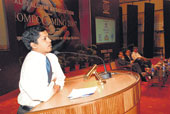
Jamshedpur, Nov. 18: A packed Tata auditorium listened with rapt attention to Sarathababu Elumalai, who was here to share his rags-to-riches story during the XLRI annual Homecoming ceremony.
The youth from Chennai, an IIM graduate who refused a brilliant job to start a catering service, said: “I was born in a family of five children in Chennai and my mother worked with the government’s mid-day meal schemes. The money was not sufficient to sustain the large family, so she set up a small idli shop near our home in one of the slum areas of Chennai.”
The founder of FoodKing Catering Services, which today serves home-made hygienic food to offices in Ahmedabad and Goa, recalled how in Class IX his teachers had to persuade him hard not to quit studies.
From selling idlis on the pavements of Chennai to binding books for students, Elumalai had done it all till he reached BITS, Pilani. “I had never heard of the institution as we never got such an exposure. Someone told me that if I study there I will get a job,” he said.
After the engineering degree and a three years’ stint in the corporate world, Elumalai moved to IIM (A).
“The kind of salary and position an IIM graduate is offered is very difficult to turn down. But if I had not taken such a decision, I would have never been able to start my business,” he said.
The business, which started with a mere Rs 5,000 and a small kiosk at Ahmedabad, has today spread to over six branches employing over 175 people whose only job is to supply nutritious home-made food to corporates.
“It was an idea that I chanced upon during my internship at Pilani when I learnt that 30 per cent of the country’s population go to bed without food,” he said.
“More than working for somebody I wanted to give jobs to people like me, who did not have other means of livelihood.”
Soon his company would venture into other cities and provide employment to at least 15, 000 people.
And while Sarathababu surprised everybody with his stories, XLRI today too put its first step in the same direction. After almost three years of negotiations, the much talked about Social Entrepreneurship Trust (SET) was formed today.
Aimed at funding and supporting innovative social entrepreneurship ideas, the trust which is the first of its kind would also work for different tribal upliftment projects in Jharkhand and would provide scholarships to tribal youths for further studies.
While B.L. Raina, managing director, Tinplate is the founder trustee and chairman of the trust, XLRI director, N Caisimir Raj will be the director of the trust. In total the trust would have about seven corporate heads as trustees from, across the country including a few XLRI faculty members.
Two amazing children
Two amazing children
CD Verma New Delhi, November 16, 2007 for The Hindustan Times
They were two youngsters, a brother and a sister. The boy aged 12 and the girl aged 15, were in school uniform. They were carrying heavy school satchels.
They behaved like children of respectable parents. Like us, they too were waiting for the bus. A state bus, bound for Chandigarh, arrived. The bus ploughed through the crowd, scattered the passengers helter-skelter and came to a screeching halt.
The commuters charged at the bus and scampered into it. In the flurry and scurry the two children patiently waited for their turn. They were the last to board. The youngsters occupied the seat in front of me. The girl handed over a 50-rupee note to me to pass it on to the conductor via other passengers, for two tickets to Ashram, New Delhi.
The note was handed over by commuters to the conductor, who in the same way dispatched the tickets and the balance amount back to the children. The gir1counted the balance returned by the conductor, looked at the value of the ticket, and counted the balance again.
Discovering that the conductor had returned Rs 1.50 in excess, she directed the younger brother to return the excess amount to the conductor The boy got up from his seat, slowly waded through the crowd of passengers, reached the conductor and returned it. The conductor nodded his head in appreciation.
All this while I watched the two in admiration. And so did the crowd. However, after some time the girl again started counting the money. On recalculation, she found that the conductor had in fact paid Rs 2.50 and not Rs 1.50 in excess.
She once again asked her brother to go to the conductor. The boy returned another rupee to the conductor. Their exemplary conduct caused a big whisper of approbation among the commuters who marveled at the conscientious youngsters. Spontaneously, I caressed their heads.
The kids responded with “Thank you.” Then they got down at Ashram, leaving us philosophising about the moral ‘sanskars’ the children might have imbibed from their parents.
Benefits of workplace rituals
Benefits of workplace rituals
13 Nov, 2007, 0657 hrs IST,
Think about your typical day: You take the same route to the office, listen to a specific radio station in the car, buy a cup of coffee or newspaper from a particular vendor, and exchange a standard joke with the receptionist or security guard. You don your favorite clothes for an important meeting, consistently choose the same mug, and reward yourself with a treat for completing a dreaded task.
For the most part we choose to think about work as rational, goal-driven , and devoid of sentiment . However, the research of psychologists, anthropologists, and sociologists increasingly shows that the modern workplace may be among the most complex ritual systems ever developed. Familiar practices and rituals support collaboration in the workplace and allow individuals to create meaning in their work.
Employees embrace workplace rituals as a way of gaining control over situations or to help them cope with daily stresses and strains. Rituals also have a positive impact on morale, making workers more confident and creating a sense of security. This sense of security may include scrawling our names on staplers, rulers, and hole-punchers . More importantly, it is a way for members of a work team to create and share bonds, ideals, and a sense of commitment to what they are doing.
Mallary Tytel
President and Founder
Healthy Workplaces,Sioux Falls, SD
Soft skill planning
Soft skill planning
13 Nov, 2007, 0658 hrs IST, TNN
Try to do your planning at the same time every day. Use this time to review past accomplishments as well. Look at your schedule for tomorrow and note your available or non-scheduled time. Use one planner to keep track of your appointments . Keeping a separate business &personal planner creates confusion. Write out a To Do list every day.
Include items that can be completed, such as “Prepare exhibits for monthly report” , rather than just “Work on report.” Separate your To Do list into A, B and C priorities . “A” items are important to your long term success, “B” may be urgent but not as important and “C” are those that would be nice to do if you get the time. Start with the A items. Don’t work on a C just because it’s easy to do.
Also, break your A items into small manageable chunks, so they’re easy to accomplish. Check off items as you complete them to give yourself a sense of accomplishment. Block off time in your planner for major activities . Schedule loosely. Leave yourself enough free time to deal with interruptions and emergencies . Make a daily appointment with yourself for at least 30 minutes (sixty minutes is better). Close your door. Work on whatever must be done.
 ClicksandWrites
You must be logged in to post a comment.