TQM
Abu Dhabi announces major road projects

Abu Dhabi announces major road projects
By Binsal Abdul Kader, Staff Reporter GULF NEWS Published: July 08, 2008, 00:09
Abu Dhabi: Major road projects, including the upgrade of the international highway and reconstruction of the Mafraq interchange, will have a huge impact on Abu Dhabi mainland, a senior official told Gulf News.
The projects will shift the focus from the city and will take development all over the emirate, in accordance with the 2030 plan of Abu Dhabi Government, said Abdullah Al Shamsi, Director of Roads and Infrastructure at Abu Dhabi Municipality, in an exclusive interview with Gulf News.
The projects will support all upcoming developmental activity on the mainland, especially in Al Gharbia (the Western Region) which will attract large numbers of people to settle there, he said.
The projects will transform Abu Dhabi into “Greater Abu Dhabi” as envisaged in Abu Dhabi government’s 2030 plan.
Al Gharbia has a population of 120,000. Abu Dhabi government has earmarked Dh98 billion for infrastructure, tourism and economic development projects in the region.
Seven cities
Al Gharbia comprises seven main cities: Madinat Zayed, Mirfa, Liwa, Ghayathi, Sila, Ruwais and Dalma Island, and is close to the borders of Saudi Arabia and Qatar.
Mafraq Interchange, about 30 kilometres from Abu Dhabi City is a gateway for motorists from Dubai and Al Ain to Al Gharbia (Western Region). When the reconstruction is completed, three levels of the project, main roads, a bridge and two flyovers will smooth traffic flow said Al Shamsi.
The existing road to Al Ain will be widened as part of the project. Traffic towards Mafraq Hospital, Baniyas, Shaikh Khalifa Bin Zayed City and Shaikh Mohammad Bin Zayed City will also be improved. A more than Dh753,767,195 project started in March 2008, will be completed in March 2010.
Upgrading the international highway from Mafraq to Al Guweifat on the Abu Dhabi-Saudi border will improve the movement of people and goods from neighbouring countries to the UAE.
About 330 kilometres of road will be upgraded in four phase at a cost of Dh9.5 billion to be completed by 2011. The road will start with three lanes from the border (Al Guwaifat to Al Ruwais ) but will be widened with four lanes (from Al Ruwais to Mafraq).
A Dh651,312,549 project will support the industrial city in Mafraq. The construction of a a 38 kilometre road will start this month and is to be completed within 300 days.
The creation of a 7.1km dual carriageway on Al Fayah Road near Al Khatim will support the Industrial Cities of Abu Dhabi (ICAD) and help attract more investment and important industrial projects.
A Dh539,103,925 project for an 18 kilometre dual carriageway between Baniyas East and Al Heelieh Road will support the new cities being developed in the area. Those cities will attract people from other congested cities.
This project will also help to distribute the population to the mainland. The project will be started soon and will be completed within 550 days.
The Ghayathi-Madinat Zayed Road Construction will link the two towns. The Dh450,340,000 project started in March 2008 and will be completed by March 2010 . It will give better connectivity between the towns of Al Gharbia.
The Al Ruwais road will link the Al Ruwais industrial area to the residential area and Al Ruwais town which will be linked to the international highway. The project was started in May 2007 and will be completed by the end of 2009.
Authority for community development
Authority for community development
(Wam)8 July 2008
DUBAI — His Highness Shaikh Mohammed bin Rashid Al Maktoum, Vice-President and Prime Minister of the UAE and Ruler of Dubai, has issued, in his capacity as Ruler of Dubai, a local law establishing Dubai Community Development Authority (DCDA) as a government entity mandated with enhancing social development and national identity, as well as strengthening citizens and residents’ role in social life.
Shaikh Mohammed also issued a decree appointing Dr Mariam Mohammed Matar as Director-General of the DCDA.
According to the law, the DCDA shall be in-charge of regulating community development in the emirate of Dubai and overseeing provision of social services with the aim of establishing an integral and efficient social development system in the emirate.
The DCDA will combine under its umbrella a number of service-oriented entities.
It will also cooperate with the Ministry of Social Affairs. The Secretary-General of Dubai Executive Council, Ahmed bin Bayat, said the establishment of the DCDA was consistent with Dubai leadership’s approach to further strengthening social bonds in the emirate which has hundreds of nationalities living together in great harmony. —
Calls for credit ‘capping’ system
Calls for credit ‘capping’ system
The National Last Updated: July 03. 2008 11:32PM UAE / July 3. 2008 7:32PM GMT ABU DHABI //
Mall of the Emirates’ expectation of a 40 per cent increase in sales during Dubai Summer Surprises has highlighted the need for a federal credit bureau to help tackle rising consumer debt.
Money owed on personal loans and credit cards in the UAE in the last three-month period alone was Dh40 billion – with 70 per cent of it owed in Dubai.
A draft law is being finalised at the Ministry of Justice, establishing a federal credit bureau to function as a national credit data-sharing structure to supervise banks’ lending policies.
The legislation was intended to be drafted last year but has been delayed. The ministry established a special committee to draft the law before passing it to the Cabinet for approval.
The proposal is being backed by Visa, the credit card provider, and has received the support of some of the UAE’s banks. However, a recent investigation by The National found one bank was still prepared to offer four credit cards with one account.
Expatriates who earn more than Dh5,000 a month are offered up to 30 times their salary.
The general manager of the UAE’s largest credit collection service, CRCQ, also supports a national capping system to prevent excessive debt and backs government plans to introduce the federal credit bureau.
“It would be very beneficial to consumers to have a capping system,” he said.
“It would need to be based on a regular source of income that an individual earns. But it’s essentially about education. People in the UAE have unprecedented access to Visa cards and loans which they would not have in other Gulf states.”
He said the reason for debt among middle and lower classes in the UAE was the same as in the rest of the world: globalisation.
“People are living beyond their means and feel social pressures to drive nice cars and wear nice clothes and so on. It’s globalisation but it is not helped by the fact that banks and financing companies make it easy for people to incur more debt.
“On the positive side, the economy here is booming and it’s a very prosperous society, but on the other, it means the consumers have no savings and high debts.”
Personal loans in the UAE increased by 39 per cent last year, reaching Dh43.6bn compared with Dh28bn in 2006.
* The National
The perfect imagemaker
The perfect imagemaker
Wednesday July 2 2008 08:42 IST Asha Prakash EXPRESS NEWS SERVICE
He is the one who coined the term ‘Image Management’. This image guru of India, economist, journalist and founder of the country’s only children’s newspaper, is the man behind the success of many a political party and politician. Founder of ‘Perfect Relations,’ he’s always in the news for his lobbying.’ And there’s more to Dilip Cherian. Describing all his achievements in a single breath would be impossible.
A Malayali by birth, Cherian was on one of his rare visits to Kerala the other day when we caught up with him. “I would prefer to call myself an entrepreneur more than anything else,” he says. “I even started a restaurant once, it was the first stand alone multi-cuisine restaurant in Delhi. But once I feel a venture is in a stage to be handed over to someone, I do it.”
Cherian, who began his career as an economist, felt that being an economist was like being the conductor of a bus. “You have no real control over it,” he says. He thus decided to switch to journalism as he felt that the industry offered space for his own views.
At that point, in the early 80s, business journalism was virtually nonexistent, says Cherian, with all market reports being done by foreign companies. But they could rarely get the correct perspective of Indian markets, he says. “You need to understand the Indian ethos and the Indian pyschology to write informed reports.” Cherian was thus part of the team which created Business India, the first business newspaper of India.
So why the switch to image management? “More than creating something new, I think it was more of a response to the great changes that were happening in the market.” In order to survive, Indian companies were desperately in need of professional and result-oriented image building. Always a step ahead of the others, Cherian founded ‘Perfect Solutions,’ an image management company in 1992.
The clients of ‘Perfect Solutions’ belong to a wide spectrum of industries from corporates to prominent political parties and bigwigs to Bollywood personalities.
Political parties are increasingly opting for professionals to do their PR and literature. “Before long the majority of voters will comprise the MTV generation. Traditional methods like long speeches will no longer win their support. So we apply the basic rules of PR here too – study the audience and give them what they want.”
Bollywood is also a field where survival depends on good image making, he says. “We try to find out what is different or unique about the brand or venture and focus on that.” For example, when a movie is about to be launched, Cherian’s team studies the scenario and the right time for the launch.
“Today, one third of the success of a movie depends on the music,” he says. “By the time a movie is launched, its music should have already created an identity.”
The future of image making lies in providing specialised services, according to Cherian. “Today clients need people who know their industry inside out, not someone who has to study it from scratch.”
So what according to him is the secret to success in the field? “The ability to communicate well, a thorough knowledge of the Indian market, environment and psychology.” But having coming so far, the image guru has no plans to rest on his laurels.
“Our next venture is to start an exclusive training centre for image management, which will match global standards,” he says. Well, one more to add to his list of first’s.
Dubai launches HR Strategy
Dubai launches HR Strategy
By a staff reporter KHALEEJ TIMES 3 July 2008
DUBAI — The government of Dubai yesterday launched a Human Resources (HR) Strategy to create a high performance culture, build the workforce capacity and capability and develop HR knowledge and expertise in order to achieve the government’s excellence objectives set out in the Dubai Strategic Plan (DSP) 2015.
The eight-year HR Strategy was unveiled under the patronage of His Highness Shaikh Mohammed bin Rashid Al Maktoum, Vice-President and Prime Minister of the UAE and Ruler of Dubai, and was attended by Shaikh Maktoum bin Mohammed bin Rashid Al Maktoum, Deputy Ruler of Dubai.
The event was organised at the Madinat Jumeirah by the General Secretariat of Dubai Executive Council.
As part of the strategy, the focus would be on requirements of Dubai’s fast paced economic and social development and hone the technical and leadership skills of nationals. From here on, reward and recognition systems will be linked to performance and subject to regular review, celebrating outstanding levels of contribution.
The thrust would also be on the availability of credible and accessible data to drive informed decision making.
Outlining the scope of the HR Strategy, Ahmad bin Byat, Secretary General of the Dubai Executive Council, said, “Some of the priority areas inbuilt into the HR Strategy will include a strategic and forward-looking policy, promoting accountability and a result-based culture, increasing efficiency, enhancing responsiveness and customer service, and empowering and motivating public sector employees.”
He added, “The strategy will provide clear, measurable indicators of progress against HR targets, and although it covers an eight-year period, it will be adapted to respond to changing factors through regular reviews, taking into account any emerging development.”
Bin Byat said the newly launched strategy would help the Dubai government attract, retain and empower a highly motivated workforce so as to become an employer of choice for high-calibre UAE nationals.
Following the launch, Shaikh Maktoum honoured the high achievers and other qualifiers of the Professional Diploma in Human Resources programme.
Hosted by the Dubai Executive Council in collaboration with the Australian Human Resources Institute (AHRI), the programme aims to build the capacity of its human capital and equip them with in-depth knowledge on international best practices.
After the launch of the HR Strategy, Shaikh Maktoum handed out diplomas to the first batch of government employees who have completed the HR Professional Diploma programme.
The graduation ceremony also acknowledged the non-executive government employees who enrolled for the HR Basic programme that sought to acquaint participants with the fundamentals of human resources management.
Foreigners visiting UAE must undergo medical check-ups for contagious diseases
Foreigners visiting UAE must undergo medical check-ups for contagious diseases WAM Published: July 01, 2008, 18:56
Dubai: Foreigners who come to the UAE to live, study or work for a period not less than six months will now have to undergo medical check-ups for some contagious diseases, like HIV/Aids, Hepatitis-b and leprosy.
Humaid Mohammad Al Qutami, Minister of Health, has issued a new ministerial decree making it compulsory for all expatriates coming to the UAE to live, study or work to undergo the medical tests.
In the case of Hepatitis-b test, the decree states that a foreigner who enters the UAE to live, study or work shall undergo the test in two phases, the first test will be conducted during the first entry into the country, but during the renewal of residence permit only six categories of expatriates will undergo the test. They include babysitters, maids, private drivers, kindergarten and nursery supervisors, barbers, beauty, health and fitness club employees and workers of all food outlets, including cooks and butchers.
The procedure for the second phase will be determined based on the result of the first phase, said the decree.
In the case of hepatitis-c test, the decree calls for more technical studies on the disease before a final decision would be taken. But the decree calls for syphilis and pulmonary tuberculosis test on foreigners during their first entry to the UAE. Those who tested positive can stay in the country, but must undergo the necessary medical treatment.
Leprosy test would be conducted on every expatriate who enters the country to live, study or work during the first entry and during renewal of residency. Those who tested positive would be deported in accordance with the rules.
Only the Preventive Medicine Department of the Ministry of Health, Abu Dhabi Health Authority and Dubai Health Authority will conduct the medical tests, said the decree.
Insurance for low-income expats
Insurance for low-income expats
By Dina El Shammaa, Staff Reporter GULF NEWS Published: July 02, 2008, 00:08
Abu Dhabi: Expatriates earning a salary of Dh5,000 or less will now be eligible to enrol for the basic health insurance plan due to high inflation rates in the UAE, said an official from the Health Authority Abu Dhabi (HAAD).
The basic health insurance plan (BHIP) is subsidised by the government of Abu Dhabi for people with low monthly salaries. Up until June 1 more than 700,000 expatriates with a salary of Dh4,000 or less have been enrolled in the plan. Daman has more than a million health insurance members to date.
Under Law 23, the executive council of Abu Dhabi and HAAD agreed with the National Health Insurance Company (Daman) to keep the premium basic product stable at Dh600 for 2008. The employer bears all costs of the employee’s basic plan.
“Individuals and their dependents with incomes not exceeding Dh4,000 with housing or Dh5,000 without housing are now eligible for the health insurance plan,” said Gulam M. Teli, Director-Technical Division in Daman.
In the past, BHIP included individuals who earned less than Dh4,000. Those who earned an exact salary of Dh4,000 were not eligible.
Beneficial
According to Dr Philipp Vetter, Head of Strategy in HAAD, Daman is technically a third party administrator whose role is to provide the product and HAAD sets the products price, as well as supervise the healthcare services through an authorised network of healthcare providers.
“Our regulations are clear on this issue. First off, salary certificates must be submitted by the employer before enrolling in the basic plan. Anyone earning more than Dh5,000 will not be eligible for the plan.”
He added that there will be no exceptions, unless the HAAD Chairman, Dr Ahmad Al Mazroui, decides that an individual can be exempt.
“This can be done on individual basis only by our chairman,” said Vetter.
According to the law, the policy includes medication costs which cover a maximum of Dh1,500 for out-patient medication expenses and 30 per cent from the transaction. In case the transaction exceeds Dh500 the insured person is required to get previous permission from the insurance company.
They may liaise with an authorised insurance company to increase the upper limit by switching to an enhanced insurance policy, provided they pay the premium difference.
“This change will be beneficial for the segment of individuals who are earning between Dh4,000 to Dh5,000. They don’t have to pay the premium difference anymore, which for many people was pretty high,” said Teli.
Global accreditation
Five hospitals in the Emirate of Abu Dhabi have been inspected and internationally accredited by the Health Authority Abu Dhabi (HAAD) in partnership with the Joint Commission International (JCI), announced HAAD.
So far a total of 14 hospitals across the UAE have been accredited by JCI. The JCI is a division of Joint Commission Resources (JCR), the not-for-profit affiliate of the Joint Commission and has been involved in the healthcare sector across the UAE since May 2006, with the mission of improving safety and quality of care.
HAAD’s partnership with JCI is an initiative to make sure licensure standards are applied in hospitals, ambulance care and continuum care.
“As the responsible authority for setting standards, inspection and licensing of health facilities in the Emirate of Abu Dhabi, we are working to ensure standards developed and implemented are best practiced, meeting the benchmark of international health care quality,” said Zaid Al Siksek, Chief Executive Officer at HAAD.
Dr Philipp Vetter, Head of Strategy at HAAD, said it was important for healthcare facilities to be accredited for two main reasons. First, the accreditation process can help improve patient safety. Second, the accreditation is an indicator of quality, which helps patients chose between healthcare facilities.
Abu Dhabi residents happy with new bus service


Abu Dhabi residents happy with new bus service
By Binsal Abdul Kader, Staff Reporter GULF NEWS Published: June 30, 2008, 23:37
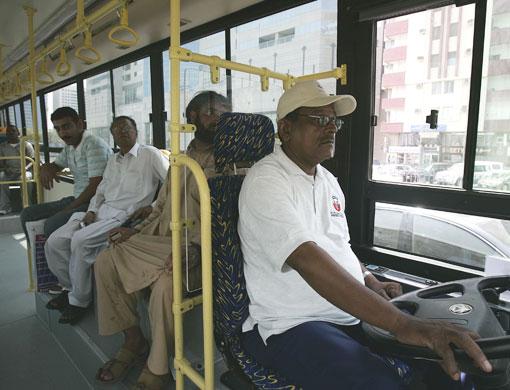
Abu Dhabi: Residents in the city enjoyed the new bus service on Monday.
Most of them said they are happy to get relief from the discomfort of long wait for taxis on the streets. Apart from the comfort, an affordable bus service is a solace to the people during increasing cost of living, others said.
About 60 buses started the service on four routes on Monday morning. Although launch of the bus service was announced last week, most of the buses were empty in the morning, as the residents were not aware of the routes. “I had to answer a lot of questions about the routes,” said Guldar Khan, a driver.
Abate Chernet, an Ethiopian working as a labour supervisor, said it is a real solution to the transportation woes. Although a free ride was announced, many passengers like Chernet boarded the bus with change to pay the fare. “Even if not free, we will appreciate it,” said his friend Boalech.
Mustafa Thottissery, an Indian working at a flower shop, said: “I used to spend Dh15 a day on taxis which can be saved now.”
Covering capital city
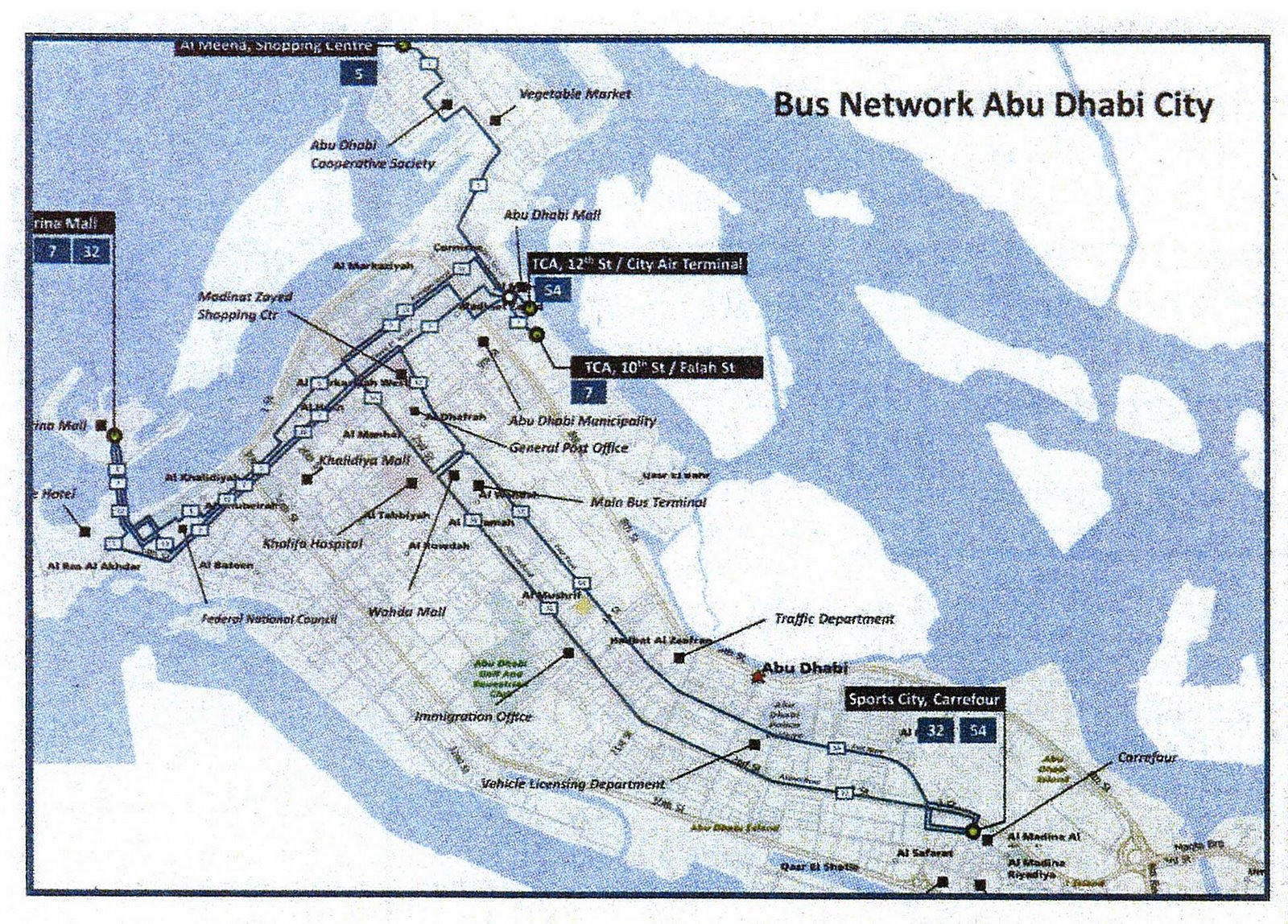
Route No 5 – Break Water, Marina Mall to Al Mina Shopping Centre via Zayed First Street, Hamdan Street, Abu Dhabi Mall and Vegetable Market.
Route No 7 -Break Water, Marina Mall to 10th Street/ Falah Street (Near Abu Dhabi Mall) via Bynuna Street and Zayed First Street.
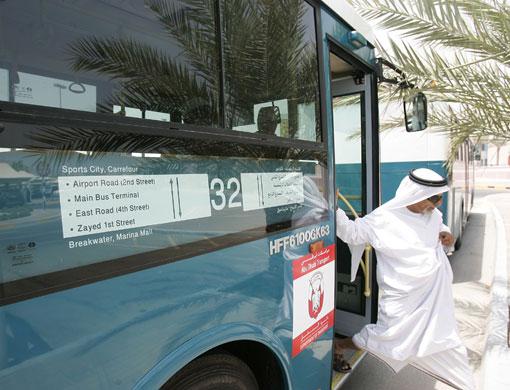
Route No 32 -Sports City, Carrefour to Break Water, Marina Mall via Airport Road, Main Bus Terminal, East Road (4th Street), Zayed First Street.
Route No 54 – Sports City, Carrefour to Abu Dhabi Mall via Muroor Road and Tourist Club.
English Matters – Helping your child speak English
English Matters – Helping your child speak English
Monday June 30 2008 22:51 IST Albert P’Rayan for EXPRESS NEWS SERVICE
Recently I attended a parents-teachers meeting at a school where my 6-year old son studies. The meeting lasted for an hour. The interaction between the class teacher and parents was lively.
The parents who were present there raised a few questions that were related to enabling their wards’ conversational English. I take the following two questions for discussion:
1. “What steps do you take to make students speak English at school?” 2. “Could you suggest ways to develop our children’s spoken English?” When the first question was asked by a parent, pat came this reply from the teacher. “My mother tongue is different from yours. I don’t speak the language your children speak at home. In this situation there are only two possibilities. I should communicate with them either in English or Hindi. If I speak in Hindi not a single child will understand what I tell them. So I speak to them in English.” The teacher’s message is very clear. Exposure to English does wonders. The teacher does not know the students’ first language and so she communicates with them in the target language. Her English is quite good. She is fluent and her utter ances are accurate. She is very interactive and it provides ample opportunities for the students to use English in the classroom. The exposure to the English language has helped students develop their listening and speaking skills to a great extent.
I had a feeling of satisfaction after the meeting and I told my son that he was lucky to have such a good teacher of English. A teacher is expected to be a role model for her students.
The second question for discussion is how we can develop our children’s spoken English.
Parents are also expected to play an important role in helping their children learn English at home.
Let me start with my own example. My son, Aldeesh, is fond of stories. He enjoys reading and listening to stories and it has become a habit for me and my wife to narrate stories to him almost every day Whenever a guest comes home, he asks .
them to tell him a story. Listening to stories has had a positive impact on him.
Here I explain how I, as a parent, helped Aldeesh develop his English language skills.
STAGE 1 I narrated a story to the child and asked him to narrate the same story back to me. At the initial stage he was a bit reluctant but later he gained confidence and became very enthusiastic. The reason is very simple. My aim was to develop his fluency in the target language. I never tried to stop him while he was narrating a story. In other words, I tolerated his grammatical errors. The teacher in me did not play any role.
As an enthusiastic listener, he listened to me actively and developed his listening skills. Then without fear or inhibition he recounted the story and it helped him develop his fluency He proved .
the saying that a good listener is a good speaker.
His range of vocabulary is also good.
Some tips:
Speak simple English. Communicate and don’t complicate.
Don’t stop your child in the middle while he/she is speaking to correct his/her gram matical errors.
If there are grammatical errors, narrate the story again using correct sentences. By lis tening to correct English, the child picks up the language naturally .
Help him/her gain confidence.
Allow them to speak naturally .
STAGE 2 I narrated a story and stopped in the middle and asked him to continue the story. The objectives were to develop his listening and speaking skills and foster his imagination and creativity As days .
went by, he could create characters and narrate new stories.
Tips Be imaginative.
Narrate a story and stop in the middle.
Ask the child to continue the story.
Ask them to create their own characters and produce new stories.
Don’t look for logic in your child’s story It is .
not important at this stage.
Appreciate your child’s imagination. A pat on the back helps your child gain confidence.
Spend 10-15 minutes every day with your child for this purpose.
Look at this sample. The transcription of a story narrated by Aldeesh is given below. Though it contains a mixture of tenses and a number of grammatical errors, it was quite comprehensible.
“There was a lion.
His name was Jangu.
The lion was going to the other side of the forest.
There he saw a monkey in a tree.
The monkey was very frightened to see the lion.
But the lion is happy to see the monkey .
Then the monkey started running.
The monkey cannot run fast.
It was thirsty .
The monkey drank so much water.
Then he started running fast to the other side of the forest and escaped.
The lion was very sad.
He drink water.
Afterwards it saw a tiger.
Then the tiger and the lion fighting.
The lion jump up and stamp on the tiger.
He killed the tiger and he was very happy .” STAGE 3 Reading is an important habit that a child should cultivate at a young age. I have bought a number of story books for Aldeesh and I read the stories to him. The stories are in simple English and they do not contain any difficult words. I ask him to read one or two stories every day The regular reading .
practice helps him improve his pronunciation and reading skills.
Tips:
Subscribe to magazines such as Champak and Magic Pot.
Don’t try to teach vocabulary as a teacher does. Let the children read stories and under stand the meanings of unfamiliar words from the context.
Ask your child to read at least 10 minutes every day .
Albert P’Rayan is an ELT resource person and editor of ELTeCS for India and Sri Lanka. He can be reached at rayanal@yahoo.co.uk
Free Public Transport Bus Service in Abu Dhabi from 30th June 2008
Free Public Transport Bus Service in Abu Dhabi from 30th June 2008



Photos – Ramesh Menon
By Adel Arafah, Staff reporter KHALEEJ TIMES.
ABU DHABI — The Transport Department of Abu Dhabi will launch free public bus service within the emirate today. Initially, 60 buses would ply on four major routes.
Saeed Al Hameli, Director-General of the public buses office at the department, told Khaleej Times yesterday that Route 5 starts from Marina Mall in the breakwater area to the shopping centre in Al Mina area, Route 7 is from Marina Mall to Abu Dhabi Mall through the Tourist Club area, Route 32 from Marina Mall to Carrefour through the Airport road, and Route 54 from Zayed Sports City to Carrefour through the Airport road.
Al Hameli said the buses would stop at the existing bus stops along the routes.
The buses would not stop at a station for passengers to board for more than 10 minutes.
The free bus service would be from 6.30am to 12.30am.
Al Hameli said the number of routes would increase to 21 in the near future, covering almost all areas of Abu Dhabi and the surrounding islands.
The public can contact the department on the toll-free number — 80055555 — for any details.
This bus service will be free of charge till the end of this year.
 ClicksandWrites
You must be logged in to post a comment.