The National

Picture of rain explained dangers – The National Dt. 30 March 2014
Posted on Updated on

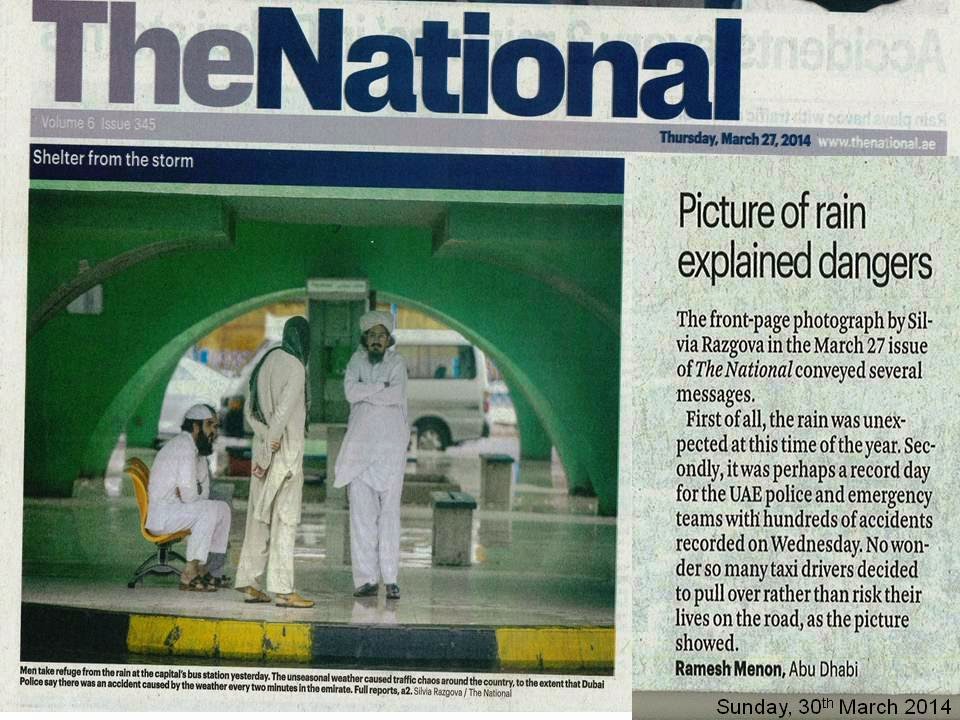
Picture of rain explained dangers

The front-page photograph by Silvia Razgova in the March 27 issue of The National conveyed several messages.
First of all, the rain was unexpected at this time of the year. Secondly, it was perhaps a record day for the UAE police and emergency teams with hundreds of accidents recorded on Wednesday. No wonder so many taxi drivers decided to pull over rather than risk their lives on the road, as the picture showed.

Ramesh Menon, Abu Dhabi

Drivers must obey rules in wet weather – The National Dt. 27-03-2014
Posted on Updated on

Drivers must obey rules in wet weather
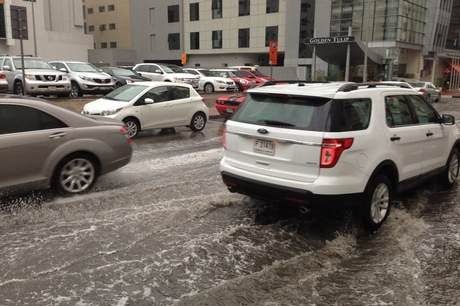
There has been bad weather once again and multiple accidents on our roads (Heavy rain causes traffic delays and flooding throughout UAE, March 26).
It looks as if some people are determined to prove that whatever the authorities do to promote road safety, they will never change.
The scenario on the Dubai to Abu Dhabi road is the same every day. Even in wet weather, I see many drivers tailgating, driving above the speed limit and reading messages or texting while at the wheel.
The authorities should encourage road users to promptly alert them using 999 or another emergency contact number if they witness dangerous driving. At the same time, maintenance teams should ensure that they place adequate warning signs when there is roadwork happening.
If there is bad weather or other dangerous driving conditions, police, road transport authorities, radio stations and both du and ¬Etisalat should alert motorists.
I strongly believe that until and unless we are able to change drivers’ attitudes, our roads will never be safe.
Ramesh Menon, Abu Dhabi
Letters to the editor, The National
online 26/03/2014

in print 27/03/2014

To read it in original, please visit THE NATIONAL online.

My comments : Decreasing overall speed should be goal of radar The National Dt. 09 March 2014

Posted on

A driver can also be pulled over and issued a fine by a traffic policeman, who use both marked and unmarked patrol cars.

“I’ve seen a heightened police presence on Saadiyat highway and the road towards Mussaffah when you drive through Salam Street last year,” said Ramesh Menon, an Abu Dhabi resident for 25 years.

“But these days many have resorted to speeding, tailgating and reckless driving since no one’s there to stop and fine them.”

To read this in original, please visit THE NATIONAL online.

Window cleaner shows need for zero tolerance on safety – The National Editorial Dt. 02 March 2014
Posted on Updated on

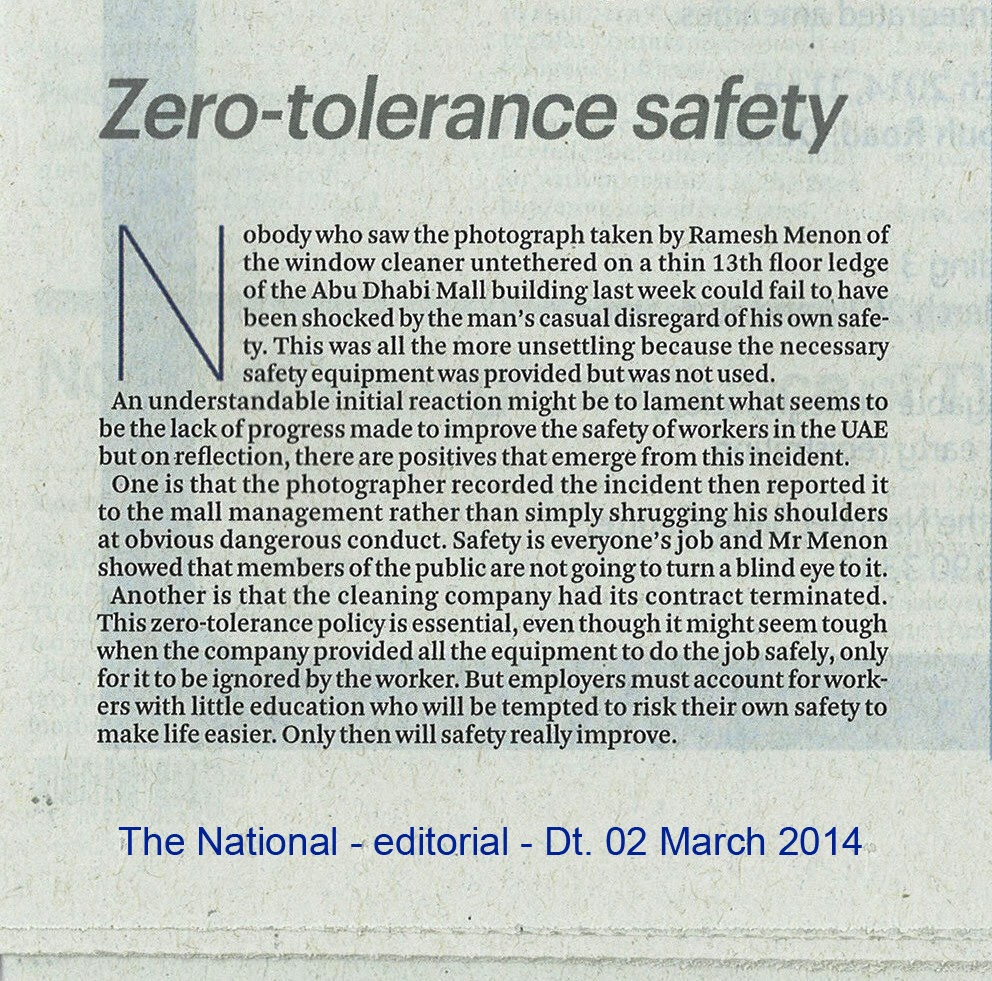
Window cleaner shows need for zero tolerance on safety
National Editorial
March 1, 2014 Updated: March 1, 2014 17:15:00
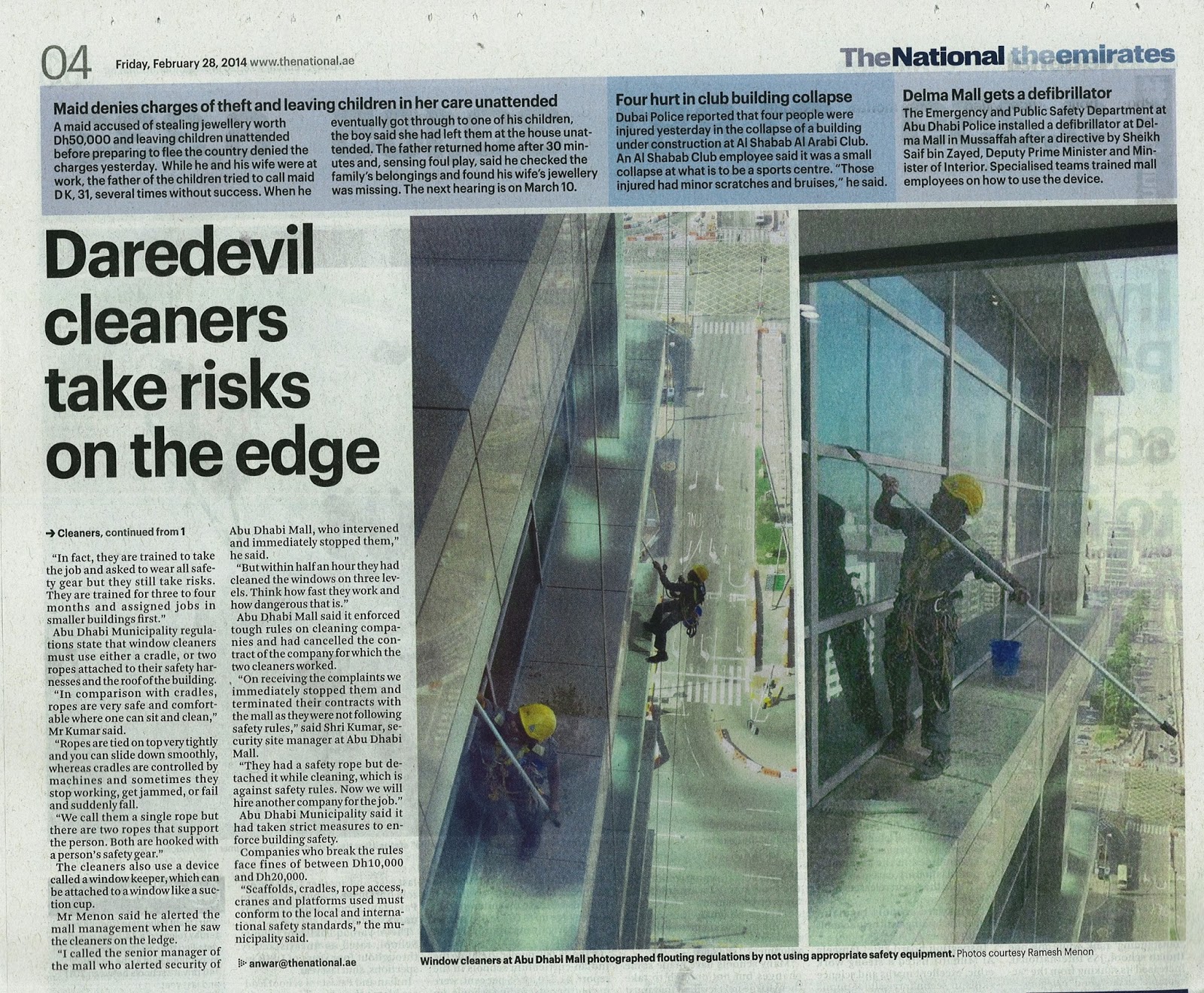
Nobody who saw the photograph taken by Ramesh Menon of the window cleaner untethered on a thin 13th floor ledge of the Abu Dhabi Mall building last week could fail to have been shocked by the man’s casual disregard of his own safety. This was all the more unsettling because the necessary safety equipment was provided but was not used.
An understandable initial reaction might be to lament what seems to be the lack of progress made to improve the safety of workers in the UAE but on reflection, there are positives that emerge from this incident.
One is that the photographer recorded the incident then reported it to the mall management rather than simply shrugging his shoulders at obvious dangerous conduct. Safety is everyone’s job and Mr Menon showed that members of the public are not going to turn a blind eye to it.
Another is that the cleaning company had its contract terminated. This zero-tolerance policy is essential, even though it might seem tough when the company provided all the equipment to do the job safely, only for it to be ignored by the worker. But employers must account for workers with little education who will be tempted to risk their own safety to make life easier. Only then will safety really improve.
To read it in original, please visit THE NATIONAL online.

Abu Dhabi window cleaners without safety harness spark concerns – The National Dt. 28 February 2014

Posted on Updated on

Abu Dhabi window cleaners without safety harness spark concerns

Anwar Ahmad

ABU DHABI //
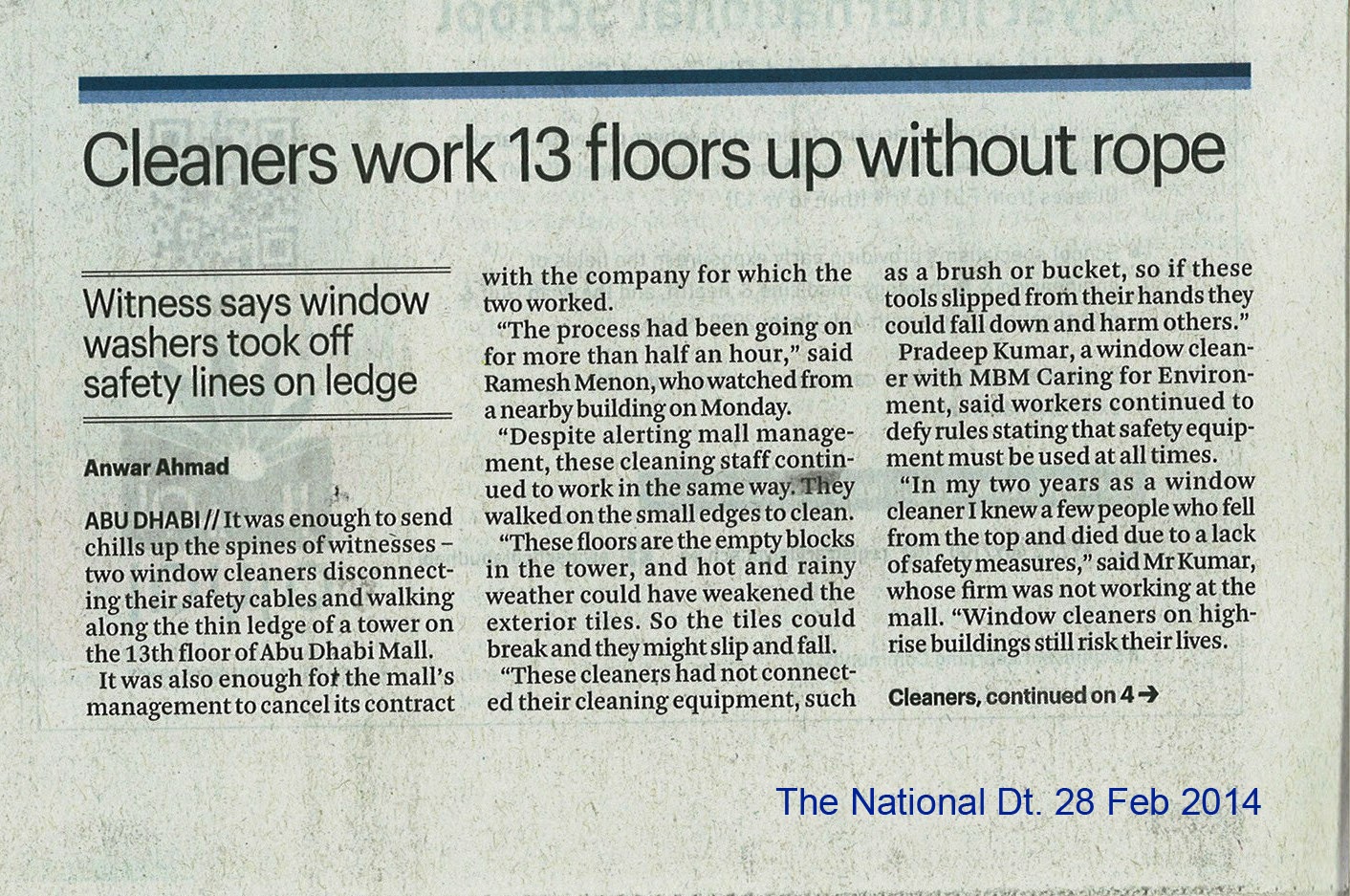
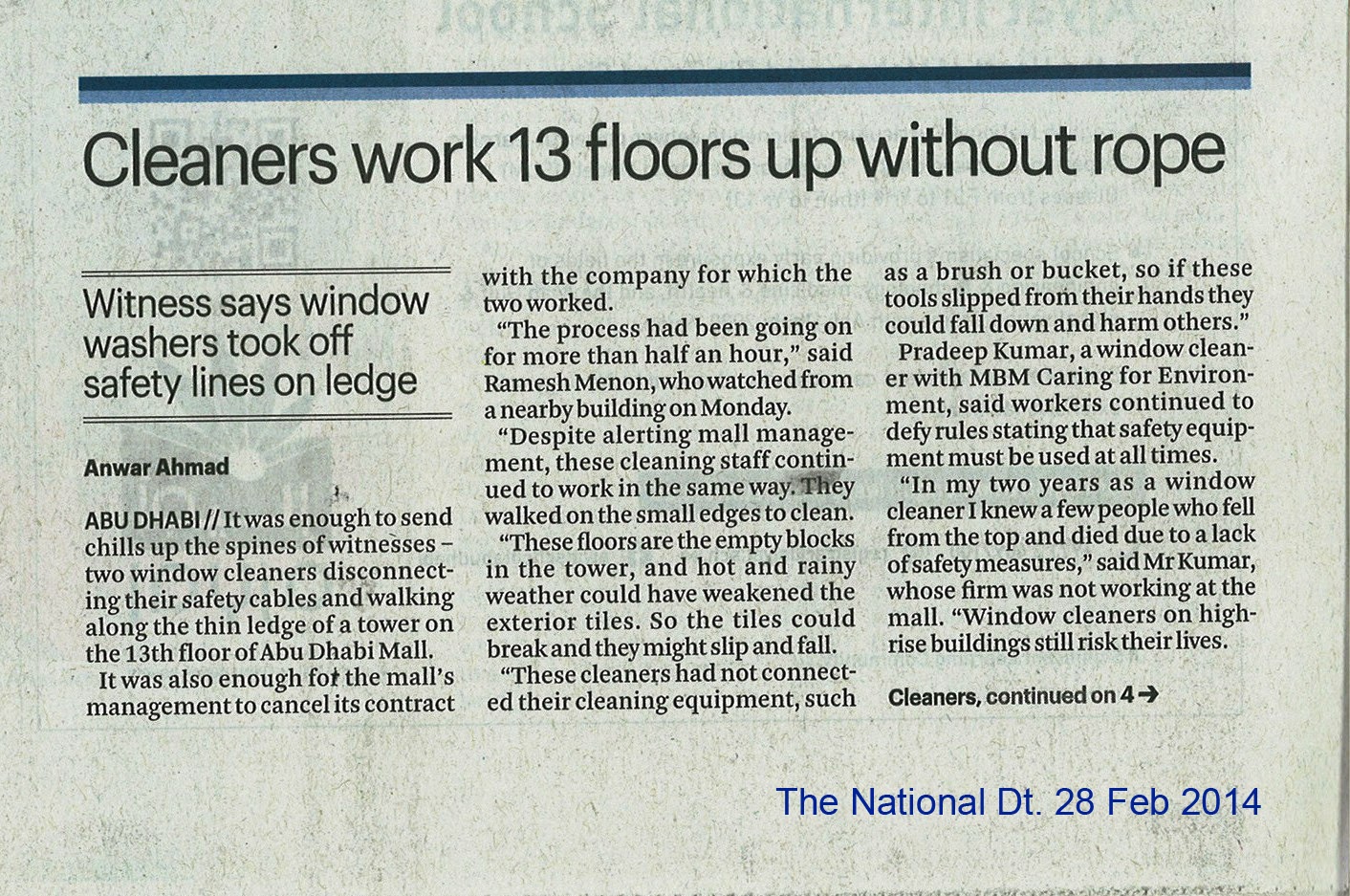
ABU DHABI // It was enough to send shivers up the spines of witnesses – two window cleaners disconnecting their safety cables and walking along the thin ledge of a tower on the 13th floor of Abu Dhabi Mall.

It was also enough for the mall’s management to cancel its contract with the cleaning company.
“The process had been going on for more than half an hour,” said Ramesh Menon, who watched from a nearby building on Monday.

“Despite our alerting the mall management, these cleaning staff continued to work in the same way. They walked on the small edges to clean.

“These floors are the empty blocks in the tower, and hot and rainy weather could have weakened the exterior tiles. So the tiles could break and they might slip and fall.

“These cleaners had not connected their cleaning equipment, such as a brush or bucket, so if these tools slipped from their hands they could fall down and harm others.”

Pradeep Kumar, a window cleaner with MBM Caring for Environment, said workers continued to defy rules stating that safety equipment must be used at all times.

“Window cleaners on high-rise buildings still risk their lives,” said Mr Kumar, whose company was not involved in the mall incident.

“In fact, they are trained to take the job and asked to wear all safety gear but they still take risks. We are trained for three to four months and assigned jobs in smaller buildings first.

“During my two years as a window cleaner I knew a few people who fell from the top and died due to a lack of safety measures.”

Abu Dhabi Municipality regulations state window cleaners must use either a cradle, or two ropes attached to their safety harnesses and the roof of the building.

“In comparison to cradles, ropes are very safe and comfortable where one can sit and clean,” Mr Kumar said.

“Ropes are tied on top very tightly and you can slide down smoothly, whereas cradles are controlled by machines and sometimes they stop working, get jammed, or fail and suddenly fall.
“We call them a single rope but there are two ropes that support the person. Both are hooked with a person’s safety gear.”

The cleaners also use a device called a window keeper, which can be attached to a window like a suction cup.

Mr Menon said he alerted the mall management when he saw the cleaners on the ledge.
“I called the senior manager of the mall who alerted security of Abu Dhabi Mall, who intervened and immediately stopped them,” he said.

 “But within half an hour they had cleaned the windows on three levels. Think how fast they work and how dangerous that is.”

Abu Dhabi Mall said it enforced tough rules on cleaning companies and had cancelled the contract of the company for which the two cleaners worked.

“On receiving the complaints we immediately stopped them and terminated their contracts with the mall as they were not following safety rules,” said Shri Kumar, security site manager at Abu Dhabi Mall.

“They had a safety rope but detached it while cleaning, which is against safety rules. Now we will hire another company for the job.”

Abu Dhabi Municipality said it had taken a number of strict measures to enforce building safety.
Companies who break the rules face fines of between Dh10,000 and Dh20,000.

“Scaffolds, cradles, rope access, cranes and platforms used must conform to the local and international safety standards,” the municipality said.


anwar@thenational.ae


Please click on the link at The National online to see a video of this activity.

To read this news in original, please visit The National online

Seeding can make the most of clouds – Letters to the editor – The National Dt. 28 February 2014

Posted on

Seeding can make the most of clouds Cloud-seeding is an interesting topic for those who value our water resources (Meet the UAE cloud-seeding captain who flies into the eye of the storm, February 26). Every time I arrive at the Abu Dhabi or Dubai airport, I get the opportunity to see that this part of the world is blessed with a great quantity and quality of water-filled clouds. By judicious use of the cloud-seeding method, the meteorology department should be able to harvest more rain. Having more water will benefit both farmers and the general community. If it is done properly, this scientific intervention should not affect the blessings given to this country by its desert climate. Ramesh Menon, Abu Dhabi Read more: http://www.thenational.ae/thenationalconversation/feedback/india-should-chase-down-all-its-criminals#ixzz2ubXkUzXo Follow us: @TheNationalUAE on Twitter | thenational.ae on Facebook

When will people learn about safety? – Letters to the editor – The National Dt. 26 February 2014
Posted on Updated on

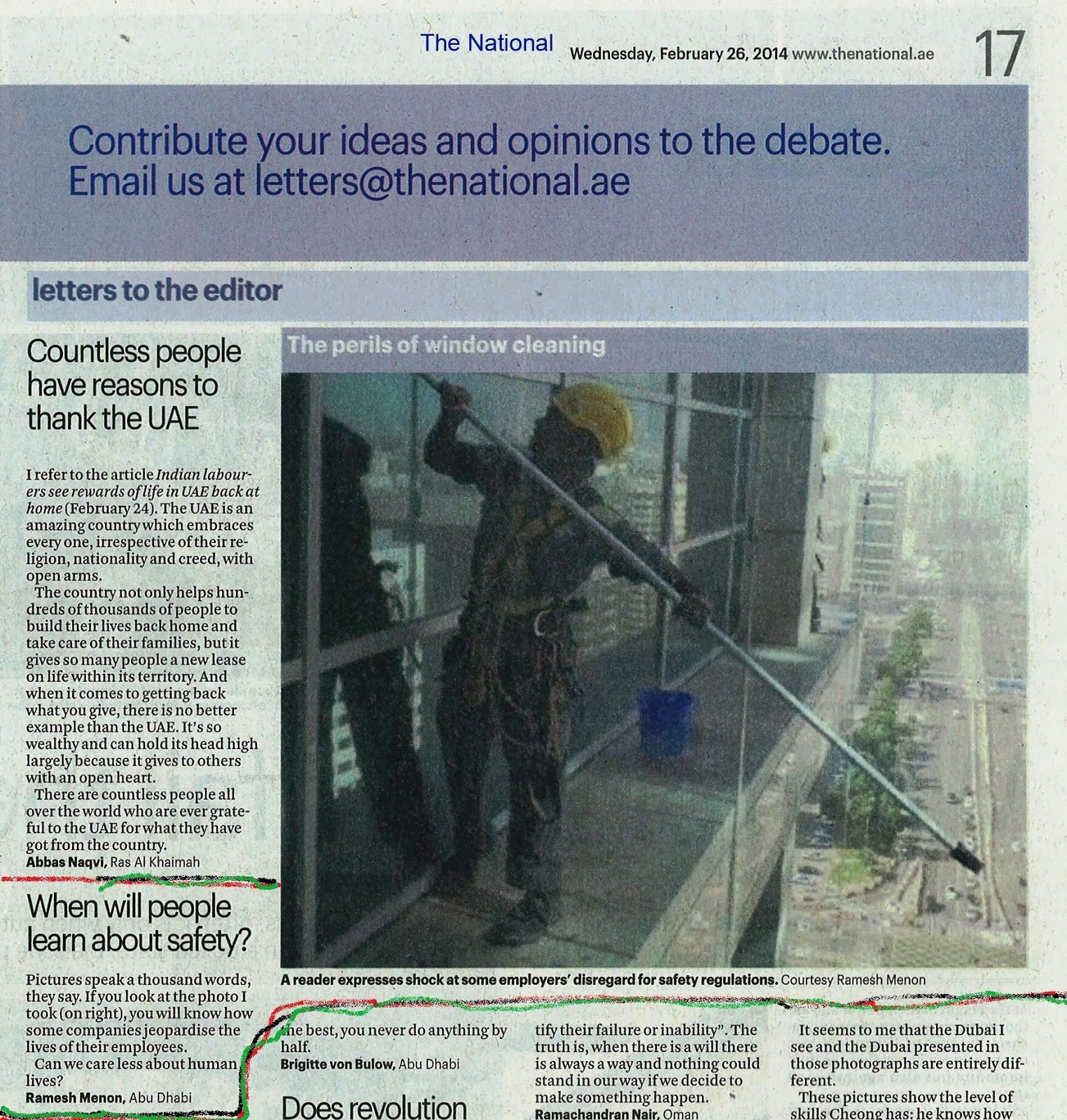
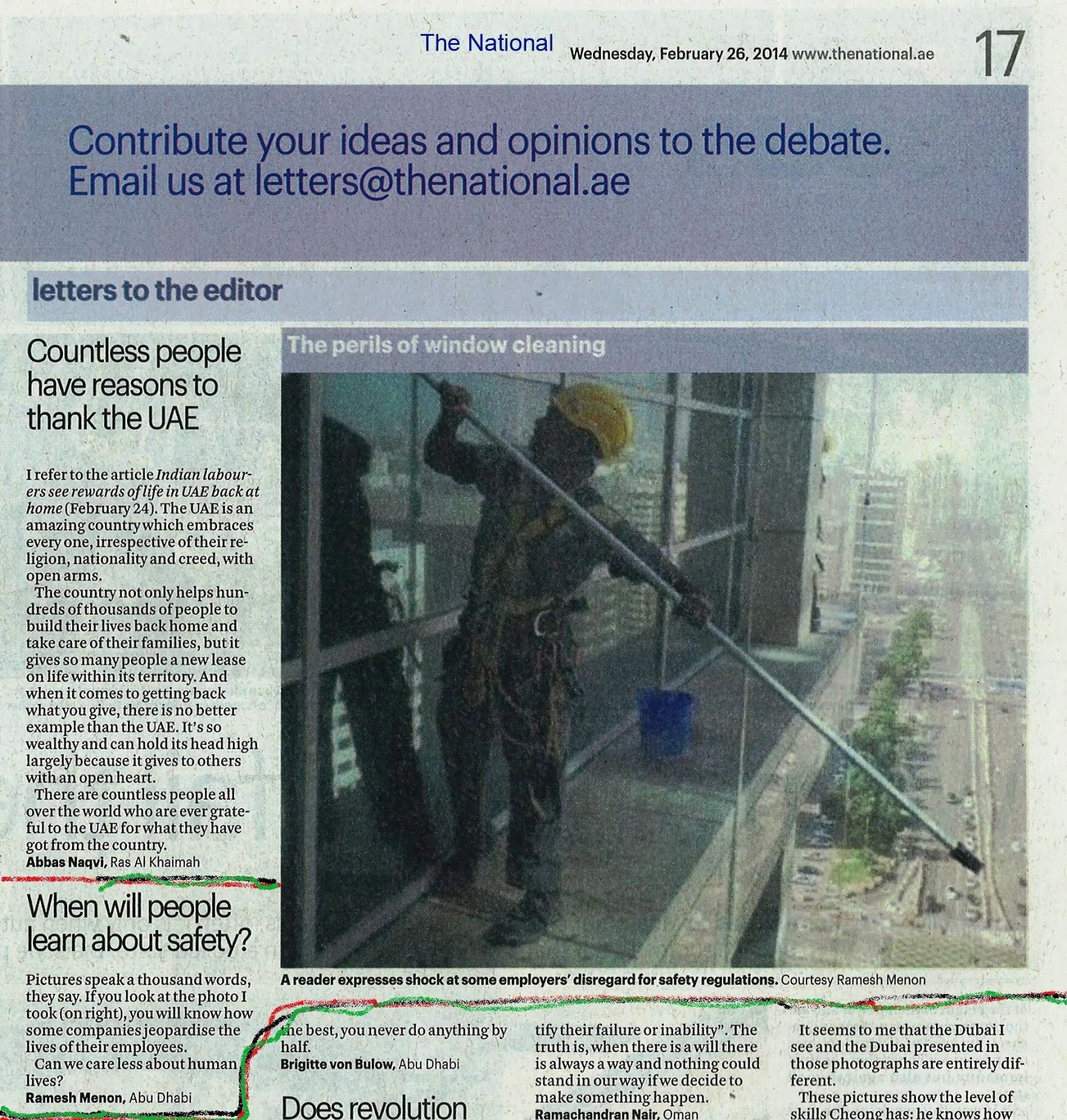
Pictures speak a thousand words, they say.

If you look at the photo I took, you will know how some companies jeopardise the lives of their employees. 

It was shocking.

Can we care less about human lives?

Ramesh Menon, Abu Dhabi 

Read more: http://www.thenational.ae/thenationalconversation/feedback/when-will-people-learn-about-safety#ixzz2uQiprmQt Follow us: @TheNationalUAE on Twitter | thenational.ae on Facebook

Lorry drivers must heed safety rules – Letter to the editor – The National Dt. 07 February 2014
Posted on Updated on

Safety is of paramount importance when it comes to the presence and behaviour of lorries on our highways (Set maximum driving hours for truck drivers, UAE transport companies told,February 3).
It is important for drivers of heavy vehicles to have periodic training about maintaining safety and discipline on the road.
It is essential for logistics controllers to allow sufficient time for vehicles to complete a journey, taking into account all anticipated traffic delays on the route.

It is also very important for other road users to report any rash driving involving heavy vehicles.
All large vehicles should be required to display a reachable contact number for other motorists to contact if they see poor driving, speeding or a faulty vehicle.
This should also be the case for lorries coming into the UAE from other countries. Often their number plates are hidden behind a road permit board.

Ramesh Menon, Abu Dhabi
To read it in original, please visit, THE NATIONAL online

Get tough with errant motorists – Letters to the editor – The National Dt. 26 January 2014

Posted on

Get tough with errant motorists

It is extremely sad to read that within a week’s gap another major multiple-car collision happened on the UAE roads (Heavy fog on Abu Dhabi to Dubai motorway causes mass vehicle pile-ups, January 24).

Obviously the weather is not the culprit, as similar conditions are experienced by people in many other countries across the world. The main culprit are the drivers themselves.

A lot has to be done in terms of driving practices and attitude of drivers, especially during such unfavourable weather conditions. I would suggest the authorities implement new rules incorporating mandatory reduction of speed limit by 40 per cent during inclement weather conditions.

At the same time, fines should be doubled or tripled with compulsory community services for errant motorists.

A strong sense of road safety should be cultivated through sustained efforts. More police presence and warning signs could also be part of the solution. Meanwhile, one could follow the simple principle: start early, drive carefully, reach safely.


Ramesh Menon, Abu Dhabi

To read it in original, please visit THE NATIONAL online

It’s drivers, not the fog, that caused 57-vehicle crash – Letters to the editor – The National – 19 January 2014

Posted on

It’s drivers, not the fog, that caused 57-vehicle crash
Letters to the editor – The National online dated 18 January 2014
in print 19 January 2014
Your news article, 57-vehicle pile-up brings traffic to a standstill on Al Ain-Abu Dhabi highway (January 16), reflects a black day in the history of road safety in the UAE, even though on this occasion it seems there were no fatalities.
The issue is, once again, drivers’ behaviour during adverse weather conditions. Some of our roads, and especially the Dubai-Abu Dhabi and Abu Dhabi-Al Ain roads, have strange weather pockets where one experiences dense fog with visibility below 50 meters.
Some drivers ignore the danger and continue to drive fast without any caution for themselves or others. When they encounter drivers ahead who have reduced their speed, the result is a multiple collision of the kind in your article.
The UAE is lucky to have both modern weather forecasting equipment and a comprehensive road-control system. The police should join forces with meteorological experts and issue alerts about dangerous weather conditions such as fog or sandstorms more promptly than they do now. This should be backed by deploying patrol cars on these roads during these foggy mornings so that they create a sense of caution among those who speed.
The speed limit ought to be temporarily lowered by 40 per cent during times of poor visibility, with speed cameras adjusted to suit. In times of fog and sandstorms, the fines for speeding ought to be doubled and those repeat offenders ought to have their licences suspended or cars impounded.

Ramesh Menon, Abu Dhabi
To read it in original, please visit THE NATIONAL online