Sports +
I love to be alone at the top – Yelena Isinbayeva

I love to be alone at the top – Yelena Isinbayeva
His Highness Shaikh Mohammed bin Rashid Al Maktoum spurs UAE
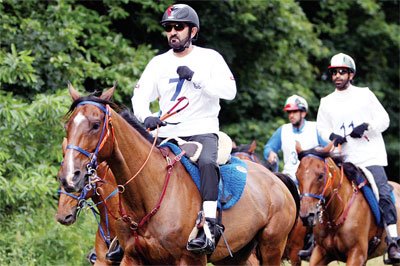
His Highness Shaikh Mohammed bin Rashid Al Maktoum, Vice-President and Prime Minister of the UAE and Ruler of Dubai, led the UAE riders to win 120-km first European Endurance championship at Houston Park district in Britain. – Wam
His Highness Shaikh Mohammed bin Rashid Al Maktoum spurs UAE
By Hisham Al Gizouli for KHALEEJ TIMES 30 June 2008
DUBAI – His Highness Shaikh Mohammed bin Rashid Al Maktoum, Vice-President and Prime Minister of the UAE and Ruler of Dubai, led the UAE riders to their first seasonal European endurance title in Britain.
The race comes as part of the preparations of the national team for the World Championship scheduled to be held in Malaysia during the month of November.
Riders from France, Britain, Australia and the UAE took part in the competition which extended over 120 kilometres in relatively favourable weather conditions.
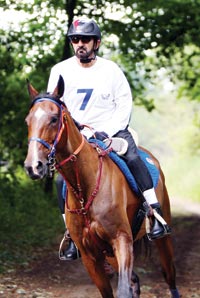
The three-member squad joined hands before they crossed the finish line ahead of the others.
Shaikh Rashid Dalmook bin Jumaa Al Maktoum and Abdullah Saeed were the other two members of the winning team.
According to the race reports, Shaikh Mohammed showed the way right from the start, followed by Shaikh Rashid Dalmook in the first 36km loop which they covered in 1:55:11 seconds at an average speed of 19,07/hr.
Shaikh Mohammed continued to set the pace in the second and third stages before the UAE riders dominated the field and went clear to cross the finish line in 3:31:28 seconds.
Sultan bin Sulayem was crowned champion of the 160km endurance ride which was held in the same venue.
Shaikh Majid bin Mohammed who started as hot favourite to win the ride, pulled out after the third loop to protect his horse.
The UAE rider and trainer Mubarak bin Shafiya said they were quite satisfied with the strong performance of the UAE riders.
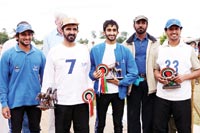
Saeed Al Tayer, vice-chairman of the Dubai Equestrian Club said it was great to see the UAE riders winning two races at the same time in one day.
“UAE riders are the true champions of the world,” he said
An inner technology for joyous living
An inner technology for joyous living
Monday June 30 2008 10:19 IST Swahilya for EXPRESS NEWS SERVICE
It was surely an ocean of joy for the participants of the Isha Yoga programmes in Chennai held every successive week this summer. The reason was their meeting with Sadhguru Jaggi Vasudev who devised a combination of Pranayama, Asanas and meditation techniques to help the individual reach to a certain inner well-being. The silent revolution of self-realisation that is the motto of the Isha Foundation is all about individual transformation.
Jananam Sukhadam he began a chant in his stentorian voice before addressing special invitees recently. “A world full of love, light and laughter, its time has come,” is what he says.
Sadhguru says that experience of life happens in every individual “You see everything within yourself. Light, darkness, sound, silence, joy, misery, agony, ecstasy – every experience happens within you and never outside of this,” he says.
When the five sense organs are turned on the moment one is born, survival process happens by nature and our mind is naturally outward bound. “Just as you have to strive to read or write or do anything, you have to strive to get the inward perception too – it won’t happen otherwise.”
Though we are physically the most comfortable generation today, we are the most neurotic people too. “A research said that 43 per cent of the American population are on anti-depressants. They have to pop a pill to just keep their mind in balance. Not just the U.S. they reached there first and all of us are following very fast,” he says.
The problem is because of fixing the outside world and not taking care of the inside which is the basis of all experience. With a practical exercise along with the audience, he explained how just the position of the palms could change one’s breathing pattern and how the pattern of one’s breath is directly related to one’s experience of joy or sorrow.
The physical body and intelligence functions at its best, only when the individual is peaceful and joyful. “If there’s no fear of suffering, your ability to explore will be greatly enhanced,” he says. Isha Yoga is not a teaching, philosophy or religion, but a technology to fix the inside. “Don’t wait for life to make its point!” Sadhguru exhorts highlighting the need for people to turn towards spirituality.
“There is something within you that does not like boundaries. It is longing to be boundless. The physical body and mind have boundaries and can never be boundless,” he says.
This is the only culture where God is described as bliss – Brahmananda. “You can make yourself blissful right now if you have access to that source,” he says.
This body is just a heap of food – comprised of breakfast, lunch and dinner. The mind is just a heap of impressions. Referring to the Blue Brain project that maps the human brain in Switzerland, he said that even science has come up with the finding that despite genetics, an individual’s brain can be rewired if willing. This re-wiring is a possibility with Yoga.
The Ananda Alai Isha Yoga programmes were conducted between May and June in Chennai, Tiruvannamalai, Pondicherry, Cuddalore and Villupuram in 200 batches. Around 12,000 individuals participated. For further details contact – http://www.ishafoundation. org or email: chennai@ishafoundation.org.
Managing the micro-seconds
Managing the micro-seconds
The other day I was watching one of the semi-finals of the Euro 2008. The digital clock was flashing the time left for a very crucial match which was extended due to scores level till the full time. Suddenly a thought came to my mind, how these players control their emotion and play out those final few minutes. The ticking clock was also visible to them as well as the viewers from all over the world. There was no display of panic or show of unwanted aggression. I wished our Sreesanth and team was watching these matches and learn a trick or two for preserving the stamina and controlling it for a final go at the goal.
We come across several situation in life similar to this scenario where we are left with the final few moments of tackling a critical action and helpless to react not knowing what to do ahead. This brings us to the summarisation that follows and criticism in plenty aftermath of such a decisive event.
All of us are good at commenting what should have / should not have done when it was happening in real. Even my grandmother who is an 80 year old lady and keen follower of cricket comments how Dhoni will play or R P Singh will bowl at a particular stage of a match. The advent of electronic media has opened up unlimited opportunities to observe and develop our skills and thinking pattern. But, going out there and performing is a different ball game. Imagine the mindset of a player at that particular situation. The external heat, the match tempo and the target requirements etc. His mind has to be really focussed on to his ultimate goal, i.e. the victory of his team. For this he has to have a concentrated effort to break his goal into short term and long term goals. First set of short term goals will be to settle down and get the feel of the ground and blend him to the tempo going on. And then work towards the larger goal of winning the game for his team. It is here his knowledge and perseverance to stay on without wasting energy for expressing unwanted emotion. This is where he wins his battle over the micro-seconds in case of a football match or the reducing no of balls to no of runs required target.
Germany will be playing Spain today and it will be a thrilling finale to end the Euro 2008. Elimination of major playing countries like England, Denmark, Italy, France, Russia etc have reduced the interest to this match. On paper Spain looks formidable and the in the run up to the finals they have a winning streak of 20 matches under their belt and have all the chances of lifting the Euro 2008. However, I have my bet on Germany for all those qualities mentioned above. Let us see tonight who will conquer those micro seconds before the final whistle blows.
Yoga classes
Yoga classes
Saturday June 21 2008 13:01 IST ENS
THIRUVANANTHAPURAM: Kerala State Jawahar Balbhavan will start the new batch of the yoga classes for elders on July 4. The classes are arranged in a way to keep the physical fitness and health and to cure various diseases like diabetis, hypertension, thyroid, hormonal imbalances, mental tension etc. The duration of the course is three months and the classes will be held on Fridays, Saturdays and Sundays.
There will be three batches and the classes will be arranged from 6.30 a m to 8 a m for the first batch, 10.30 a m to 12 noon for the second batch and 5.30 p.m to 7 p m for the third batch. The fee for the course is Rs 1200 and for those who pay in instalments Rs 500 for a month.
Volleyball Tournament – Priyadarshini Kala-Kayika Vedi’s TEN WEEKS long Volleyball Tournament in Jeddah
Priyadarshini Kala-Kayika Vedi’s TEN WEEKS long Volleyball Tournament
Dear Friends,
As part of ICC Silver Jubilee celebrations, Priyadarshini Kala-Kayika Vedi’s TEN WEEKS long Volleyball Tournament will start tomorrow (20th June 2008) at Talal International School, Baghdadiya, Jeddah @ 4:30 PM sharp.
THREE MATCHES scheduled for tomorrow (20th June 2008):
(a) : SKY STAR vs DX BOYS
(b) : KMCC PERAMBRA vs FRIENDS MAKKAH
(c) : TOWN TEAM AKKODE vs PIXEL STAR
Pls treat this message as a personal invitation for you, your friends & relatives. Since there are three matches on the first day, the tournament committee is very keen to start the game at 4:30pm sharp. As such, you are kindly requested to help us for an on-time start – preferably to be there atleast 15 minutes prior to the start of the matches. Tournament Location : Talal International School, Jeddah (West of Sharafiya; behind Egypt Air Building at Madina Road)
Note: Sun glasses/caps are recommended for those who are very sensitive to direct sun light.
Regards,
KC Abdulrahman
ChairmanPriyadarshini Kala-Kayika Vedi (Arts & Sports wing of ICC)
Orange peel extract may help enhance sporting performance
Orange peel extract may help enhance sporting performance
Tuesday June 17 2008 15:17 IST ANI
London: The next time you eat an orange, don’t forget to chew its peel because it may enhance your sporting performance.
This proposition springs from a study of plant metabolites called polymethoxylated flavones, which are found in the peel of sweet oranges such as the Valencia and Hamlin varieties.
Funded by the US Army Natick Soldier System Center in Massachusetts, the study has shown that polymethoxylated flavones can decrease post-exercise recovery time.
The researchers conducted tests on horses, and measured the time it took for post-exercise oxygen consumption levels to return to normal.
It was observed that the horses who were not administered any treatment took about 110 seconds to recover, while those treated with the flavones were ready to go again after about 85 seconds, 23 per cent quicker.
The researchers reckon that the extract could be used to delay the onset of fatigue in sporting competitions in a way that does not require banned performance enhancing drugs, reports New Scientist journal.
The magazine also reports that some researchers are studying the orange peel for their ptential anti-inflammatory and anti-tumour properties.
Exchange students
Exchange students
The IPL has given young players the opportunity to interact with their elders and betters – both from India and overseas
Siddhartha Vaidyanathan May 20, 2008
VRV Singh is among the many young Indian players who have benefited from sharing a dressing room with overseas cricketers in the IPL © AFP
It was the penultimate over of the Delhi Daredevils’ innings and Punjab’s VRV Singh, as he had done while bowling in the death through the tournament, was trying to get every ball in the blockhole. The first, which ended up a low full-toss, was turned to short fine leg by Virender Sehwag; the second, which Tillakaratne Dilshan tried to pull, was an attempted yorker that turned into a beamer down leg side; and the third, which Dilshan paddled past short fine leg, was another low full-toss.
That was when Mahela Jayawardene, fielding at deep third man, decided to run halfway across the field to have a word with the bowler and captain. As someone who captains Dilshan in the Sri Lankan team, it was obvious Jayawardene saw through his plan. Fine leg was pushed back, three full-ish balls followed, the line was controlled according to how Dilshan moved in the crease, and the remainder of the over produced just three. In a game that was decided by six runs, it was a crucial over.
There are many reasons for Punjab’s ascendancy to second spot in the IPL – balanced side, strong bowling attack, good mix of Indian and foreign talent – but tactics have played a big part.
The international players have imparted their ideas and the local players have chipped in during brainstorming sessions. Australians have helped in analysing Australian opponents, and Jayawardene and Kumar Sangakkara have been perfect allies for Yuvraj Singh.
Brett Lee, for the two weeks he was available, was a big brother to the fast bowlers. One young Indian bowler talks of the “highly emotional” atmosphere in the dressing room the day Lee left. “We became so close to him that we felt bad when he said goodbye. The amount we learnt from him in such a short time was unbelievable. He used to treat every practice session as if it was his last.”
Sangakkara has missed the last four games but that hasn’t stopped him from making a serious contribution. “Uday Kaul [the young replacement wicketkeeper] had never kept to quality fast bowling before,” says a team member, “but Sangakkara has ensured he gets adequate training.” Even during the early games, Sangakkara made sure Kaul got enough preparation in the nets.
How useful has it been brain-storming with international and local players? “It’s interesting to see how the same questions are approached by people with different perspectives,” Sangakkara told Cricinfo. “Sometimes you get two or three opinions on the same subject – or more. The debate then starts. It’s important how you bring all those into one thought process or one strategy.”
What’s been really challenging for Sangakkara and Jayawardene is coming up with strategies to counter their fellow Sri Lankans – which they haven’t quite managed against the wily Muttiah Muralitharan, who’s foxed them both at crucial moments. Sangakkara thinks there are advantages to planning against your own countrymen.
“You find yourself coming up with new ways to combat these players [like Murali],” he says, “but you then realise there are new dimensions to their game that can be exploited to Sri Lanka’s benefit later. When you analyse someone’s game, you try and find how you can get the better of them, but also find new ways in which they can be lethal. It’s nice to sit back and analyse your own team members – gives you an appreciation and new-found respect.”
If he gets a direct hit, he analyses what went right. If he misses, he analyses what went wrong. It’s the attention to detail that was mind-boggling for us
Aakash Chopra on Ricky Ponting’s approach to fielding in the IPL
The Australian way
Like Punjab, all eight franchises are experiencing the benefits of players interacting with their international peers and elders. The prolific Rohit Sharma has attributed part of his success to Adam Gilchrist. “He told me not to get swayed by the results, as my job is only to keep performing.” Delhi’s young bowlers can’t stop raving about Glenn McGrath, and over in Jaipur, Shane Warne has been inspiring a whole generation.
McGrath’s influence goes beyond his role as a fast bowler: he asked for videos of Pradeep Sangwan’s Ranji Trophy matches to analyse his action and suggest improvements. “McGrath makes it a point to stand at mid-off or mid-on when the youngsters are bowling,” says TA Sekhar, cricket operations chief of GMR Holdings, the owner of the Delhi franchise. “Now that itself is a great inspiration for young bowlers like Yo Mahesh and Sangwan. If they bowl a no-ball, he’s encouraging them, telling them how to deal with the free-hit ball. If they bowl five good balls, he makes sure they don’t get carried away with the sixth.”
Halhadar Das, the Orissa wicketkeeper who plays for the Hyderabad franchise, says he never imagined he would even see Gilchrist, let alone learn from him. Sumit Khatri, Rajasthan’s chinaman bowler, says he needs to pinch himself every time Warne says “Well bowled.” And S Badrinath, who is yet to make the national side despite years of domestic consistency, talks of the lessons learnt from Michael Hussey, who went through a similar phase (“His message was simple,” Badrinath says. “Enjoy whatever you are doing and the rest will follow”)
Ricky Ponting’s dedication to fielding was an eye-opener for everyone in the Kolkata side. “His dedication to fielding is unbelievable,” says Aakash Chopra, the former India opener who’s currently with the Knight Riders. “If he gets a direct hit, he analyses what went right. If he misses, he analyses what went wrong. It’s the attention to detail that was mind-boggling for us.”
Australians have dominated the tournament so far but it’s been their attitude to practice that has really benefited their teams. McGrath is the first to arrive at nets and the last to leave. Ponting ensured that every batting session was planned properly, and while he may not have scored many runs, his approach was inspiration enough. Warne has managed to throw in tactics even while relaxing in a swimming pool in Goa. (“It was great to sit around the pool and talk about how to construct an over,” he said.)
The approach is likely to rub off. “I always wondered how some Australians manage to score despite looking so badly out of form,” says one former India player. “Now I realise it’s because of the amount they practise. They target one area and go on striking the ball there, irrespective of the length. It’s such routines that makes them come out of slumps.”
The likes of McGrath and Lee have taken their duties as mentors seriously, and have also set good examples with their dedication to practice © Getty Images
Local flavour
It’s not all been one-way traffic. In an era of packed international schedules, the IPL has also allowed Indian superstars to interact with domestic players. “I hadn’t seen him earlier but one ball was enough to convince me that he was a talented bowler,” said Sachin Tendulkar of Dhaval Kulkarni, the 19-year-old medium-pacer who is the highest wicket-taker for Mumbai after nine games.
Ross Taylor made it a point to talk to Rahul Dravid and Shivnarine Chanderpaul about batting in England, where he was set to join New Zealand for a Test series; and Cameron White said his most satisfying experience in the IPL was discussing legspin with Anil Kumble.
India’s domestic cricketers, who could never have imagined sharing the same dressing room with legends like Tendulkar have probably benefited the most. “More than anything else, it’s given domestic cricketers a strong belief,” says a former India allrounder who is currently with one of the franchises. “There is a general perception that international cricketers are perfect, but you realise that all of them have weaknesses too. It’s because they work around these weaknesses that they play at the international level. So domestic cricketers will start to believe they can make it too, as long as they are focused and totally dedicated.”
The downside
It hasn’t been all good, though. A few foreign players have treated the tournament like a circus that offers them generous pay packets, and some have shown no restraint when it comes to late nights.
“Most of them are used to drinking late and partying hard but the worrying aspect is that some of the young Indian players are emulating this,” says an Indian player who is part of one of the franchises. “They must know their limits. Just because they see their heroes partying, it doesn’t mean they need to follow that.”
Halfway through the tournament, Bangalore’s think-tank felt the need to read the riot act to the players, listing the kind of discipline that was expected from them. Murmurs have been heard about the Deccan Chargers being distracted about the number of get-togethers and promotional events being organised. Such talk usually accompanies teams that are not doing well but it’s a warning one mustn’t ignore: revolutions have their flip side too.
Siddhartha Vaidyanathan is an assistant editor at Cricinfo
Stay young for long
Stay young for long
By Bharat Thakur Published: May 16, 2008, 23:39 GULF NEWS
Everyone would like to remain young forever. However, the laws of nature dictate that each of us gradually ages.
In today’s times, people are much concerned about how they look as they age.
Hence, we find many people turning to Botox and other cosmetic treatments such as facelifts.
Unfortunately, these invasive treatments have a detrimental effect on the individual’s health.
Before we look into ageing, we must understand what health is.
In layman’s terms, health can be defined as a feeling of wellbeing, with the individual possessing physical and mental competence. As we age, the body’s functioning deteriorates.
Spinal flexibility
Yoga, more than any other therapy in the world, helps those who practise it to “age gracefully”.
The first thing to understand is the importance of spinal flexibility. Yogic wisdom shows us that the flexibility of the spine is directly linked to the ageing process.
As one’s spine gets more rigid, the muscles of the neck also stiffen and the blood supply to the face, scalp and brain is restricted.
This speeds up the wrinkling and hair-greying process. Yoga helps loosen the muscles of the back, spine and neck so that the face and head receive regular nourishment through blood supply.
Apart from the spine, yoga helps in firming up the skin, enhancing our immune system and improving our posture and tone of the muscles. It also helps maintain regular blood pressure levels.
Those who wish to invest in their health from a young age and want to retard the ageing process must give special importance to their lifestyle.
Inverted poses beneficial
You must practise some yogic stretches for the body. Yogic inverted poses are especially beneficial as they redirect blood supply to the head and face.
Apart from slowing down greying of hair and wrinkling, these postures help enhance and maintain mental faculties such as memory and concentration.
To stay young we also need to get adequate sleep. Sleep is the time when the body’s cells rejuvenate, allowing you to cope with daily life.
Nutrition also plays a big role. Important foods that help in ageing well are apples (rich in antioxidants), berries (vitamin C), garlic (detoxfies the liver) and broccoli.
Finally, the best deterrent to ageing is to practise pranayama (breathing exercises) and meditation. It has positive effects on the physiology as well as the mental make-up.
Meditating will help you deal with ageing and understand that change is the law of nature and you cannot hold on to your youth.

Vipareet karni mudra
* Lie flat on your back.
* Raise your legs to form a 90° angle with the torso, and support your hip with your hands as you raise it off the ground.
* Maintain this posture and close your eyes.
* Hold for as long as is comfortable (not exceeding 30 seconds to one minute).
* Slowly, bring the back down to touch the floor. Lie flat on the back for about 1 minute.
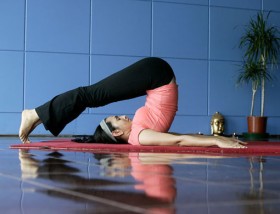
Halasana
* Lie flat on your back.
* Raise your legs to form a 90° angle with the torso, and support your hip with your hands.
* Now, begin to bend your legs further and try to touch the toes to the floor.
* Maintain this posture for as long as is comfortable and close your eyes.
* Slowly, return to the first step. Lie on your back for about one minute.
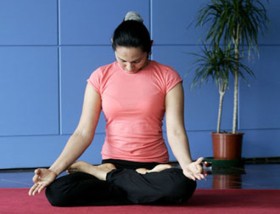
Maha bandha
* Sit comfortably in a cross-legged position on the floor, or on a chair. (If you sit on a chair, keep your legs apart).
* Place palms on your knees.l Inhale deeply. Exhale completely.
* First, contract the anal region of the body (this is called mool bandha.).
* Second, contract and pull the stomach inwards (uddiyaan bandha.).
* Third, drop and press the chin to the jugular notch on the chin (jalandhar bandha.).
* Hold for 5-10 seconds.
* Then, slowly release the chin, the stomach and finally the anal locks.
* Breathe in and slowly exhale.
* Repeat this practise. Maha bandha can only be done thrice, as further practise will cause an imbalance in the hormonal level.
Caution: People suffering from high BP should avoid holding their breath in the practise. They may hold their breath in the final step for no more than 3 seconds.

Shavasana
* Lie on your back.
* Keep your legs slightly apart and your hands beside the hips with the palms facing the ceiling.
* Begin to practise deep abdominal breathing.
* Count your breaths from 11 down, till 1.
This is a highly relaxing exercise and can be done everyday before going to sleep.
— Bharat Thakur is the founder of Bharat Thakur’s Artistic Yoga. For questions on yoga, write to dubai.artisticyoga@gmail.com. For more information, log on to http://www.bharatthakur.com
Gopumon finally got it
Gopumon asked several persons for it.
First it was Symonds, then Hayden..
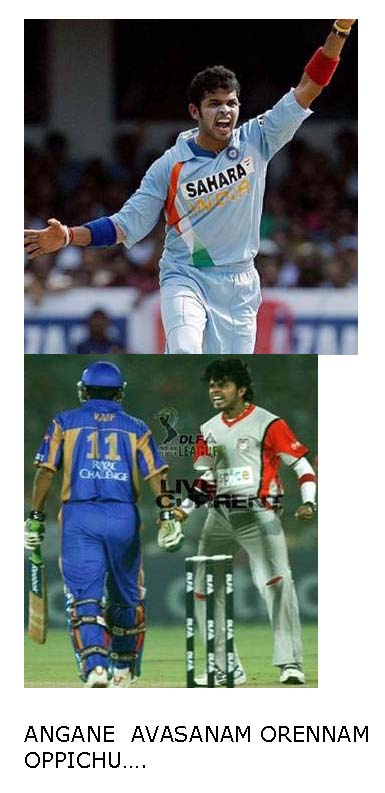
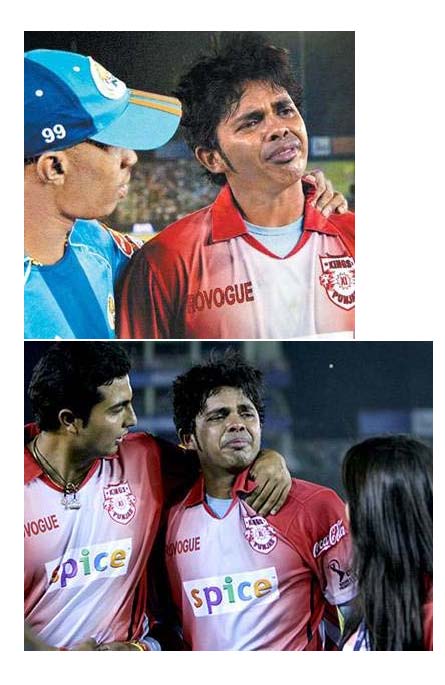
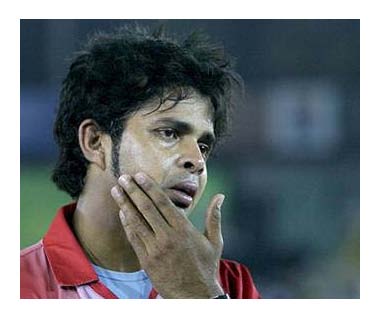
Finally, he got what he wanted. From our Bhaaji.
 ClicksandWrites

You must be logged in to post a comment.