Mind Speaks
Sarkozy: Low on dignity, high on humanity
Sarkozy: Low on dignity, high on humanity
27 Jan 2008, 0047 hrs IST,Shashi Tharoor for TIMES OF INDIA
It is curious that even in the Indian media, the build-up to the visit this week of France’s president Nicolas Sarkozy focused quite so obsessively on his personal life. Had he secretly married the Franco-Italian model-singer Carla Bruni? Was he going to bring her to New Delhi as First Lady?
Such were the questions that dominated press articles about the impending arrival in India of a major political figure – and that was odd, not merely because there were more important things worth analysing on Franco-Indian relations, but because the Indian press has traditionally drawn a discreet veil over the private lives of our politicians.
Indeed the disconnect between what our journalists and editors claim to know about politicians and what they are willing to write about is rather striking. Members of the media talk quite openly (at least in living-room gossip) about things that in other countries would be the basis for investigative exposes.
I remember a very senior editor telling me, many years ago, about the alleged habit of a certain distinguished Scheduled Caste cabinet minister, while on tour around the country, of having Brahmin girls procured in each location for his nocturnal pleasure. When I asked why, if this was common knowledge, the editor’s own paper had never reported it, he looked quite startled and said, “We don’t do that sort of thing, my boy.”
So, journalists will tell you quite cheerfully that a certain former prime minister had lived most of his adult life in a menage-a-trois with his lady love and her complaisant husband, while continuing with a straight face to describe him as a bachelor. A senior minister lives openly with a political colleague, but she is described only as his party’s president, never as his companion. This is the Indian way: the private lives of public figures are deemed to be their business, not the public’s. And perhaps that is how it should be.
After all, that was how it used to be in the West; the sexual peccadilloes of assorted American presidents were simply not discussed until the Lewinsky scandal blew the veil off the Clinton White House.
In France, too, presidents were understood to be discreetly pursuing their extra-marital interests, but the press never discussed such stories; it was only upon the death of president Francois Mitterrand, for instance, that it was revealed he had maintained a long-time mistress and had had a daughter by her, whose appearance at his funeral was the first public acknowledgement of her existence. President Sarkozy’s own relationship with a well-known journalist – who even lived with him when his wife briefly left him – was never reported. So, what has happened to change all that?
Very simply, the president himself has opened his private life to public scrutiny. He has not merely conducted a romance with a media figure; he has flaunted it, taking his lady love (a model and singer) on overseas visits and being photographed with her, visiting tourist sites, holding hands, embracing. The media, invited to indulge its prurience, has lapped it all up.
But what our press seems to have missed in reproducing foreign news agency copy about the president’s indiscretion (and its negative effect on his standing) is the simple possibility that Sarkozy’s actions fit perfectly with a deliberate strategy to transform his office. What Nicolas Sarkozy has systematically done since his election is to take the French presidency, long known for its grandeur and its distance from the people – a presidency occupied by older men who rarely deigned to give press conferences and who would never have been praised for their accessibility – and to reboot it.
And what a reboot this has been. Superficial commentary has called Sarkozy “President bling-bling” and “the People magazine President”, but what he has done is to harness the power of popular imagery to the popularisation of his office. He has personalised the presidency, hyperactively launching and announcing his own initiatives in a dizzying array of fields, but if the presidency is a person, that person must transcend the presidency, or at least its familiar rituals and trappings.
Sarkozy has humanised his office by televising his presidential and personal life; instead of adapting himself to the presidency, he has adapted the presidency to himself, individualising his political power in an increasingly individualist society. The proliferation of media in the 21st century has made voyeurs out of every citizen. Sarkozy is the first major office-holder to realise this, and to cater to it for his political purposes.
To get on the front page with Carla Bruni is as relevant as making headlines with a State visit; the presidency is no longer a symbol, it is a flesh-and-blood man. Sarkozy gives the media just enough to make them more interested than they ever were in any of his predecessors, but not so much as to devalue his office (hence the secrecy about his marriage itself). It is almost as if Princess Diana was holding Tony Blair’s job.
This has, paradoxically, strengthened the presidency in France; in the Information Age, the French president is omnipresent in the information media. In speeches, press conferences, restless trips at home and abroad, interviews and meetings, he sets the agenda, announces policies, and takes initiatives that challenge established orthodoxies; the French now talk of “hyperpresidentialisation”. Sarkozy’s self-exposure fits into the plan; by revealing so much of himself, he reduces the distance between the presidency and the people.
Democracies increasingly like citizens to believe they have control of their own destinies by placing them in the hands of leaders they can relate to. Sarkozy is no remote seigneur; he is “one of us,” with his own passions, disappointments, needs. Conducting a public romance may have reduced the dignity of the presidency, but Sarkozy is president for an era in which dignity is less important than humanity. And few presidents have shown themselves to be as human, in every sense of the term, as Nicolas Sarkozy.
Photo Speaks – Might is right

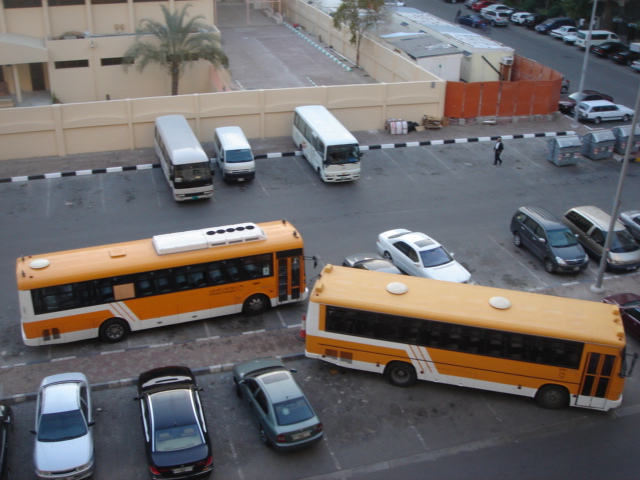
With the increase in number of vehicles and buildings, parking is difficult to find. However, there is a saying “Might is Right”. And these bus drivers knew it very well.
Photo Speaks – Balancing Act
It’s a tough world to live these days. Especially with the cost of living increasing by day. We know very well how difficult is it to do the balancing act even when we are fairly compensated. And we know how difficult and costly it can be for us with momentary lapse of concentrtion. Ever imagined how these poor workers manage thier needs under these growing economic situation?
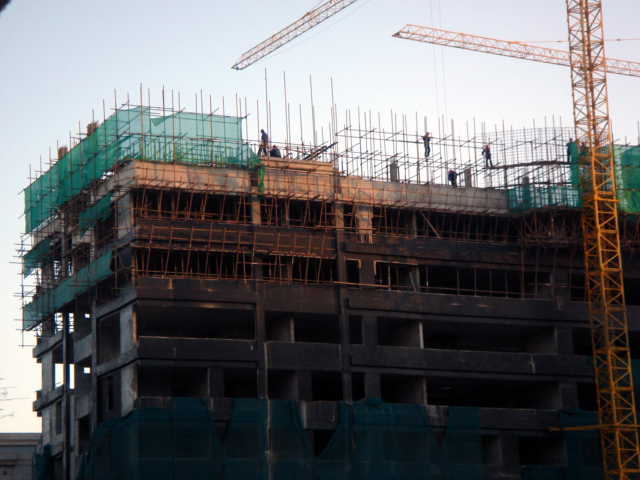
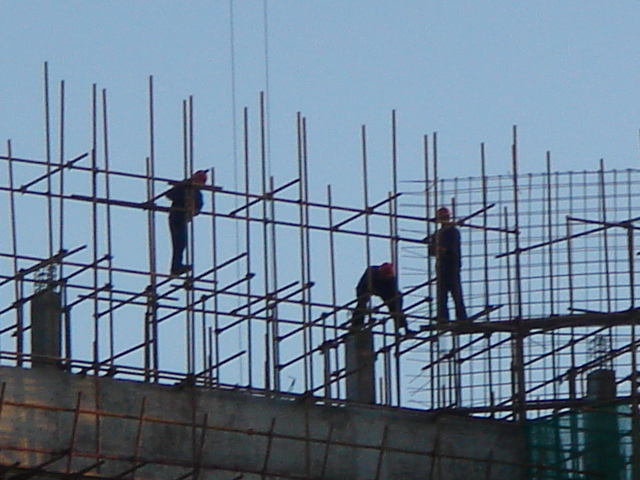
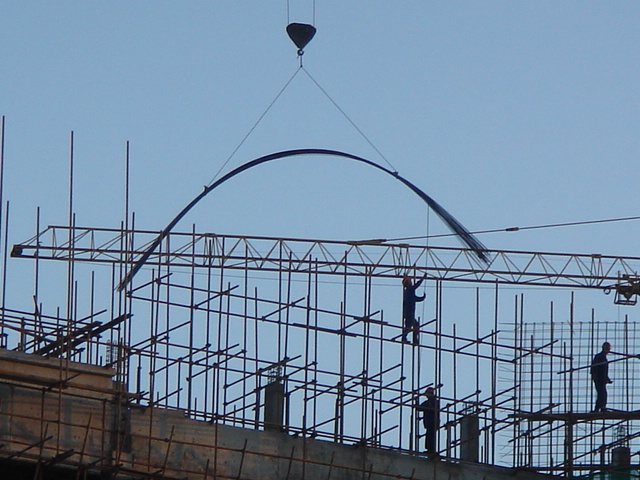
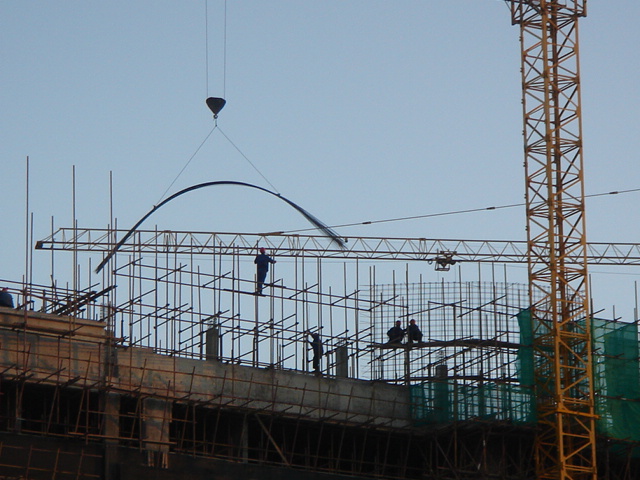
Photo Speaks – Keeping clean
We all think our job is too difficult and only we have many problems in work and life. Just have a look at these workers who are keeping the mall neat and clean. And what about them? What do they say? And to whom?

Pirates bring Ambani book out of closet
Pirates bring Ambani book out of closet
Ten years after it was effectively banned in India, photocopied versions of Hamish McDonald’s book The Polyester Prince: The Rise of Dhirubhai Ambani are now being sold freely on the city’s pavements and traffic signals for an astonishingly wide range of prices – Rs 100 to Rs 1,600. The unauthorised biography is said to be selling by the dozens.
The timing of its appearance is curious. Hawkers said they first got the book on January 13 and 14 — a couple of days before the IPO of Anil Ambani’s Reliance Power Ltd opened for subscription.
Representatives of both Mukesh Ambani’s Reliance Industries Limited and his estranged brother’s Anil Dhirubhai Ambani Group declined to comment on the underground sales.
Sanatan, a hawker selling the title for Rs 400 in Fort, had a unique marketing line. “The makers of Guru (the Bollywood film loosely based on Dhirubhai Ambani’s life) used 25 per cent of this book to make their film. The other 75 per cent that is in here was too controversial to show.” Sanatan is perhaps correct.
The book mentions how every year Dhirubhai played an April Fool’s Joke on an elderly employee, and also describes the arrest of Kirti Ambani, a general manager at Reliance, on charges of conspiring to murder Reliance rival Nusli Wadia.
On the phone, Australian author McDonald sounded bemused: “I wonder why it has suddenly appeared, 10 years after it was published. I am not even making any money out of this.”
In 1998, before the book could make it to Indian stands, the Ambanis had moved the Delhi and Ahmedabad High Courts, asking for injunctions against the book’s release on grounds of “anticipatory defamation.”
The Delhi High Court passed a verdict in favour of the Ambanis, halting the release of the book. The rights for the book’s Indian edition had then been sold to Harper Collins, which had numerous printed but unbound copies of the book in their warehouse. “After the Delhi stay order against the book, the Ambanis said they would get more such [court] orders from other states, and had threatened to sue,” said Renuka Chatterjee, who was heading Harper at the time. “Harper then decided to withdraw the book.”
McDonald recalled feeling gravely disappointed at the time. “Let a book be published and then be sued,” he said. “It getting blocked even before it can hit the stands is a serious infringement on the right to free speech.”
The Australian, though, is not one to be cowed down. “I have been keeping up-to-date with the actions of the two brothers and am thinking of an update,” he said. “I wish I find a publisher who is brave enough to publish the book in India.”
Let’s play the game, not politics
Let’s play the game, not politics
20 Jan 2008, 0414 hrs IST,Shashi Tharoor
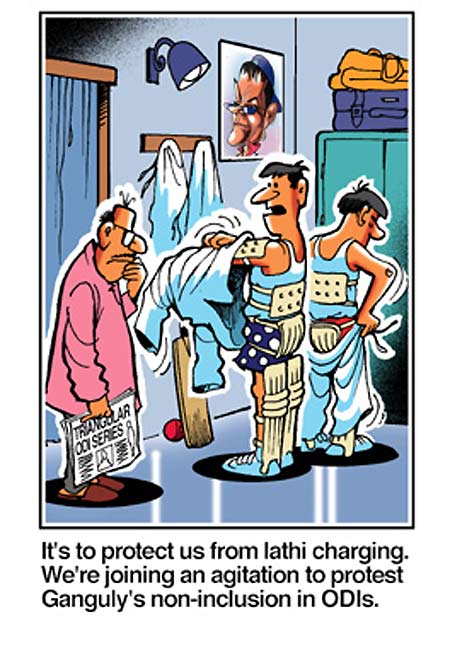
It is dangerous to act as if the undoubted financial weight of India in world cricket entitles us to our own set of rules. Despite the witty private comment to me of a senior BCCI official – “why shouldn’t we now behave in the ICC as the US has always behaved in the WTO?” – we should not destroy world cricket over a misplaced sense of national pride. Racism is as abhorrent when a bunch of under-educated young Indians in our stadiums make monkey-like gestures as Symonds comes out to bat, as it was when Mike Procter walked routinely into a dressing-room from which coloured players were barred.
With the Perth Test underway as I write, the news that the Harbhajan case is on hold till the end of the month, when his (and India’s) appeal against his three-Test ban for alleged racial abuse will be heard, offers a brief respite in which to consider some of the broader issues that have emerged from the recent cricket fracas in Australia.
The cricketing aspects of the controversy are clear enough. India suffered from umpiring that was incompetent and quite conceivably biased, and it was right to make it clear that Steve Bucknor no longer enjoyed the confidence of the touring team. What appears to have been overlooked, though, is the question of why the BCCI did not object to Mr Bucknor’s standing well before the series even began. This is hardly the first time the egregious gentleman has erred against Indian players, denied reasonable appeals, and refused to take recourse to available technology which in multiple cases would have vindicated the Indian side. Indeed I can hardly recall a Test match involving India in which Mr Bucknor has stood in the last decade which was not replete with such incidents: Tendulkar has been a repeated victim. Could the BCCI not, with all appropriate discretion, have privately indicated that Mr Bucknor was not welcome to stand in matches involving India, well before he was appointed (yet again) for a series? Did we have to wait for him to cost us a Test match before we finally declared that enough was enough?
Again, was there nothing that could have been done about the Harbhajan crisis before the dung hit the fan? Australia is the world capital of sledging in sports; the very tactic was invented by them. Australian cricketers pride themselves on their mental toughness and believe other teams are deficient in this attribute; they therefore resort to unpleasant comments, usually involving references to the opposing players’ mothers, sisters or wives, in an effort to disturb the opponents’ concentration and distract them into making errors. The approach involves crude psychology, and while it is rarely witty (“how’s your wife and my kids?” is how an Australian slip fielder once greeted a homesick English batsman arriving at the crease), it is often effective: angry players make rash mistakes. Does the BCCI provide anti-sledging counselling to our players, training them to ignore such provocations and instructing them not to offer any of their own? Was any special attention paid to the hotter-headed amongst our team members, a category into which Harbhajan clearly falls? Would a cooler head have tapped Brett Lee on the posterior with a bat, thereby prompting Andrew Symonds to unleash the diatribe that in turn allegedly provoked Harbhajan’s punishable response? Cooler heads are not just born, they can be made; but there is little evidence that our team management thought that counselling on such on-field matters was likely to be as important as net practice.
Once the complaint was lodged, how hard did we work to get it withdrawn before it came to a hearing? It is not clear that we did; instead of Kumble speaking to the insolent Ponting when the latter said it was already too late, could a higher-level approach to Cricket Australia, pointing to the likely consequences for the tour if this matter got out of hand, have prevented matters coming to a head? The nationwide outrage at the three-Test ban that followed caught our administrators by surprise. But was it wise to imply that the very charge was unacceptable? (Indians are hardly incapable of racism, despite the country’s long and honourable record of opposition to South African apartheid, a system within which Mike Procter played and flourished before discovering its evils in Sydney.)
Once we have lodged an appeal, though, we have every obligation, as a responsible and law-abiding country, to honour its findings. To imply that we would reject any guilty verdict as a slight to our national honour is to undermine the very process in which we have engaged. Once again, the best thing would be to see if the complaint can be withdrawn and the proceedings quashed. But if that is now legally impossible, we have no choice but to present our best arguments to the appeals judge — a professional who, unlike Procter, actually understands the rules of evidence and the meaning of the phrase “beyond a reasonable doubt” — and then to accept his verdict in good grace, whatever it is.
If the judge finds that Harbhajan did say what the Australians accuse him of saying, and that the intent was to disparage Symonds’ racial origins, then we must accept the punishment he imposes, without further cavil. It is dangerous to act as if the undoubted financial weight of India in world cricket entitles us to our own set of rules.
Despite the witty private comment to me of a senior BCCI official — “why shouldn’t we now behave in the ICC as the US has always behaved in the WTO?” — we should not destroy world cricket over a misplaced sense of national pride. Racism is as abhorrent when a bunch of under-educated young Indians in our stadiums make monkey-like gestures as Symonds comes out to bat, as it was when Mike Procter walked routinely into a dressing-room from which coloured players were barred.
Yet one area in which India should definitely use its financial clout is in denying the benefits of Indian corporate sponsorship to players who have violated the spirit of the game. After the appalling behaviour of young Michael Clarke in Sydney, I wouldn’t trust him to tell me the time of day, let alone buy a product he endorses. It seems to me entirely reasonable that Indian companies should rethink the value of associating with such behaviour. If Australian cricketers want to win at all costs, let them realize that there will be costs — to them. But let us always, whatever the provocation, play the game.



The end of a long, enlightening journey: Sashi Tharoor
The end of a long, enlightening journey: Sashi Tharoor
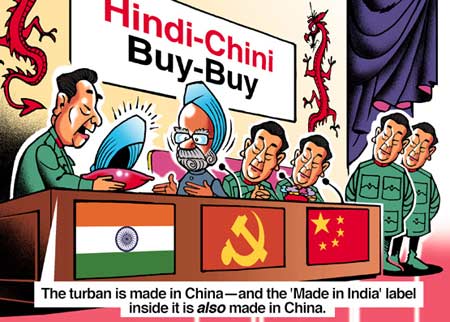
Seventeen instalments ago we embarked in this space on a quixotic scheme: to compile a glossary of things Indian, “a sense of what we have in common: the assumptions, the habits, the shared reference-points that constitute the cultural and intellectual baggage of every thinking Indian.”
We have ploughed through the alphabet, with tongue yoked firmly to cheek, and here we are at last at the final furrows on our brow (and the last letters of the alphabet).
But before we get there, as faithful readers have reminded me, there are a couple of other terms I should have defined for our glossary that I didn’t before their alphabet slipped away.
Call Centres: The quintessential symbol of India’s globalisation. While traditional India sleeps, a dynamic young cohort of highly skilled, articulate professionals works through the night, functioning on US time under made-up American aliases, pretending familiarity with a culture and climate they’ve never actually experienced, earning salaries that were undreamt of by their elders (but a fraction of what an American would make) and enjoying a lifestyle that’s a cocktail of premature affluence and ersatz westernisation transplanted to an Indian setting.
Critics argue that this is “coolie work” (see my column of April 15 this year) but it’s transforming lives, boosting our economy and altering our society. When the story of the New India is written, call centres will have to play a large part in the narrative.
IITs: Are perhaps Jawaharlal Nehru’s most consequential legacy: they epitomise his creation of an infrastructure for excellence in science and technology, which has become a source of great self-confidence and competitive advantage for India today. Nehru’s establishment of the Indian Institutes of Technology has led to India’s reputation for engineering excellence, and its effects have been felt abroad, since the IITs produced many of the finest minds in America’s Silicon Valley and Fortune-100 Corporations. Today, an IIT degree is held in the same reverence in the US as one from MIT or Caltech. There are not too many Indian institutions of which this can be said.
Back to our final entries: Villages: Are where two-thirds of Indians still live. They are, for the most part, neither the dregs of misery they are sometimes portrayed to be (living conditions in our city slums are surely far worse) nor the idealised self-sufficient communities our Gandhians wish they were (there are too many inequalities and vested interests, and too few opportunities, for that). Our villages are just as susceptible to the encroachments of change, to the influence of the nearest movie theatre, to the ideas of the loudest politician, as any of our cities. They have simply lasted longer, and changed slower, because neither the attempts nor the resources have been geared for dramatic transformation. But village India is changing — few villages can claim to be identical in every respect to the way they were even a decade ago — and the pace of change can only accelerate. As urbanisation proceeds apace, within the lifetime of many of the readers of this column, villages will no longer house a majority of India’s population. And then, to borrow from Edward Luce, if Gandhiji hadn’t been cremated, he would surely have rolled over in his grave.
Weddings: Are the classic Indian social event, glittering occasions for conspicuous consumption, outrageous overdressing and free food. In a culture where marriage is a family arrangement rather than a legal contract, the wedding is the real opportunity to proclaim a new relationship to society, and brings together friends, business contacts, relatives and spongers in orgiastic celebration of the act of union. Beneath the surface bonhomie and backslapping jollity, however, lurk the real tensions, as the bride’s father asks himself, “Are the groom’s party really happy with the dowry? Can i trust the chap who’s collecting the presents?”
Xerox: Xerox machines are a relatively new feature of Indian life. The cost of photocopying, though it has been dropping, is still prohibitive enough to dissuade all but companies, scholars and the occasional spy from resorting too freely to it. But the existence of so many roadside sheds with Xerox machines in them is, like our STD booths, a contribution of Indian democracy to the popularisation of technology.
Yes-men: Known north of the Vindhyas as chamchas, yes-men have existed throughout Indian history and will no doubt continue to do so. Their role is sanctified by the tradition of deference, the power of position, the fact of overpopulation and the alternative of unemployment. No one with money, power or position moves alone when he can be accompanied by a host of sycophants ready to echo his every nod. Yes-men are not necessarily at the bottom of the social scale; the role can be played at various levels. Thus, a peasant can be a yes-man to a contractor who is a yes-man to a landlord who is a yes-man to a party boss who is a yes-man to a chief minister who is a yes-man to a cabinet member who is a yes-man to the prime minister… At no stage in the process does anyone actually think anything other than, “What does my boss want me to think?” Fortunately for the country, somebody up there values the word no.
Zoroastrianism: See Parsis. (This is part of the typical Indian habit of observing the letter of an undertaking, while violating its spirit. It is also known as having the last laugh.)
By: Shashi Tharoor
SHASHI ON SUNDAY: Kamalesh Sharma: He’s the right choice
SHASHI ON SUNDAY: Kamalesh Sharma: He’s the right choice
TNN
The election of Kamalesh Sharma as Commonwealth secretary-general is a welcome development at various levels. First of all, because it places an able Indian at the helm of an important international institution, something we have not seen in a long while. Second, because it marks the successful culmination of a skilful and focused diplomatic electoral campaign by the government. And finally, because it demonstrates to the world that India is ready and willing to assume additional responsibilities on the global stage.
Kamalesh Sharma has not been well known to the Indian public; this will now deservingly change. I have had the pleasure of counting him as a friend for two decades, since we first met in Geneva when he arrived as a youthful Indian ambassador to the United Nations system there. Since then i have watched him at close quarters as a highly effective Permanent Representative of India to the UN in New York, as a respected and statesmanlike UN head of mission to newly-independent East Timor, and most recently as India’s High Commissioner to the United Kingdom, where he has cultivated close relations across the political spectrum with the Britons whom India needs to advance its interests. He has a first-rate intellect, an eclectic set of passions from cricket to calligraphy, a direct and disarming personal manner and a beautiful and gracious wife, Babli. India could not have found a better candidate to offer the Commonwealth, and that institution is undoubtedly fortunate to have him steering its fortunes in the years ahead.
It is also gratifying that the government did everything right. It nominated an able candidate early enough so that others could not develop momentum before him. It ensured that the key members of the Commonwealth were consulted and brought on board at the very beginning, and that London, in particular, was supportive from the start. And it worked to canvass all 53 member states diligently and repeatedly, at both the political and bureaucratic levels.
One rival, from Malaysia, was sufficiently intimidated by the quality of the Indian effort that he dropped out well before the vote. The other principal contender was no pushover: I have known Michael Frendo, the Maltese foreign minister, even longer than i have known Kamalesh Sharma, and he is a young, smart lawyer with a modest and friendly diplomatic style who was certainly a formidable contender. Victory over him could not have been assumed, and wisely, it was not taken for granted by New Delhi. Given that the last time we ran a candidate for Commonwealth secretary-general (Jagat Mehta in 1979) we came a cropper, this was a sterling effort, even a model of its kind.
It helped, undoubtedly, that the world as a whole is now looking to India to provide global leadership on the multilateral stage. Few developments across the world have received as much attention in the chanceries of influential governments as India’s rise to economic strength in the last 15 years, and with that new-found prosperity and progress has come a revised set of expectations of our country. It is assumed by many foreigners that a self-confident and resurgent India would be prepared to play an even greater role in the world: just as Indian businesses are conquering foreign markets and taking over western companies, from Arcelor to Corus, so, too, might Indians take their rightful place in charge of international institutions. For many years New Delhi had been curiously diffident about projecting its own; the fear of defeat always seemed to prompt hesitation about putting forward possible candidacies. Once upon a time no fewer than three UN agencies were simultaneously headed by Indians – C P Srivastava at the bridge of the International Maritime Organisation, S S Gill at the cockpit of the International Civil Aviation Organisation, and Arcot Ramachandran on the rooftop of the UN Centre for Human Settlements. Today, we only have the estimable Rajendra Pachauri heading the Intergovernmental Panel on Climate Change, but that is a part-time job leading a technical committee, not a full-fledged international organisation. Other possibilities had opened up since the doughty Indian trio retired, but caution usually asserted itself – ”why bother?” contending with ”what if we lose?” Many foreign diplomats used to say privately that they were waiting for India to assert itself. With Kamalesh Sharma’s successful candidacy, we have done so, and other opportunities await.
Some highly-placed people in governmental circles in New Delhi had wondered whether the Commonwealth was an institution worth risking India’s prestige for. I have no doubt that it is. It has the great merit of being a multilateral institution bringing together countries large and small, rich and poor, black and white, from the global North and South, united by a common language. It is also blissfully free of vetoes from either of the two superpowers (one established, the other emerging) of the 21st century – no minor consideration since they are two governments who, for different reasons, might hesitate to share in the general enthusiasm for Indian leadership. As such, the Commonwealth will offer an able and articulate Indian secretary-general an invaluable platform to express an alternative vision of the world. The brilliant Guyanese Sir Shridath Ramphal demonstrated in the 1970s and early 1980s what an important voice a Commonwealth secretary-general can have in world affairs, far more than the mere head of a bureaucratic secretariat. Kamalesh Sharma has the experience, the wisdom and the ability to do no less.
Every thinking Indian, therefore, has reason to be proud of the news from Kampala last weekend, and to wish Kamalesh Sharma well as he puts a firm Indian foot forward in the global march to a better world.
Shashi Tharoor for Times of India
 ClicksandWrites
You must be logged in to post a comment.