Digging for gold in waste bins — what’s our role to change this?
Letters to the editor
Akkare Ninnu – Vol 5 – exclusive NRI page for Irinjalakuda live dot com
Akkare Ninnu – Vol 5 – exclusive NRI page for Irinjalakuda live dot com
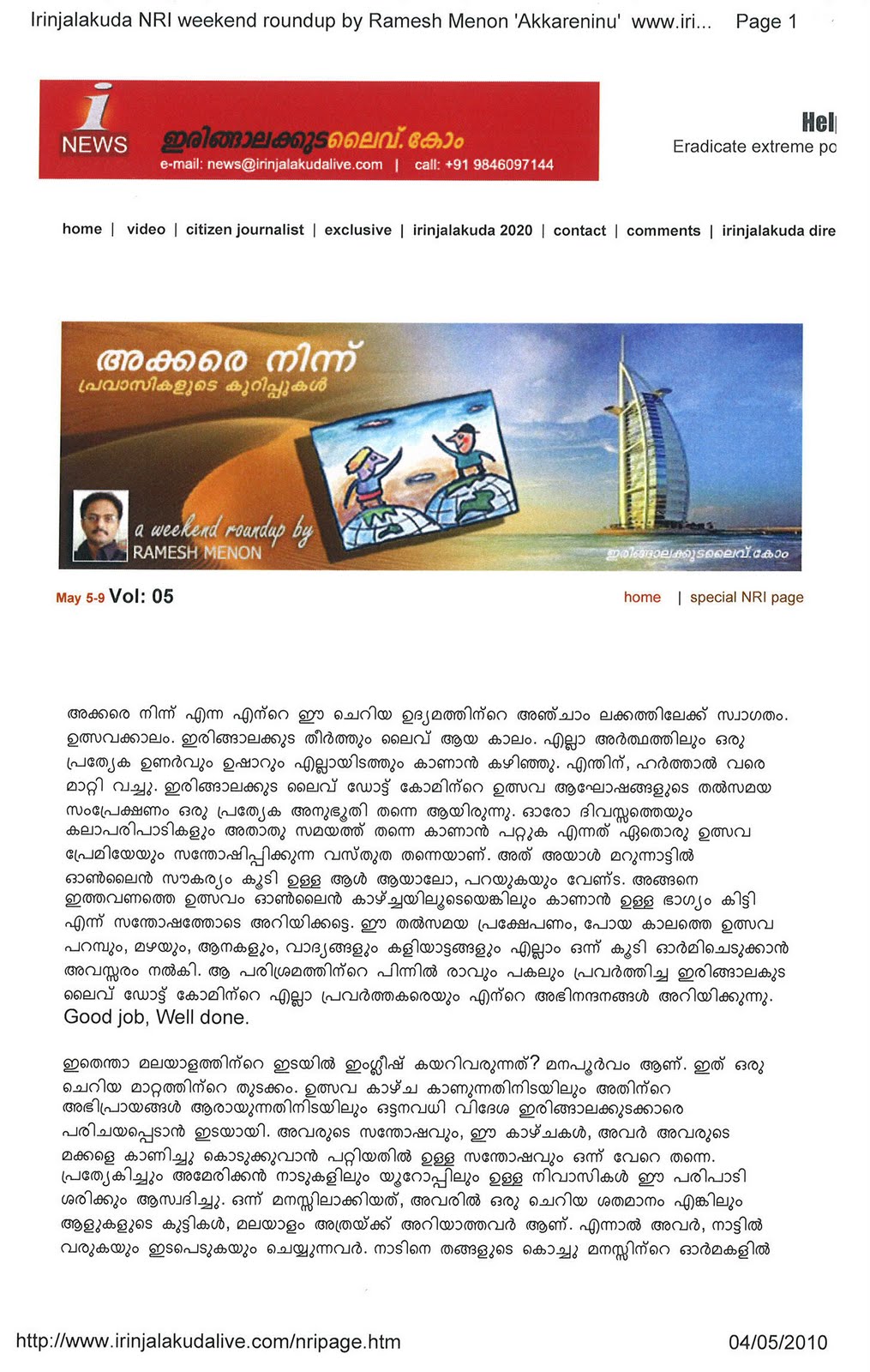
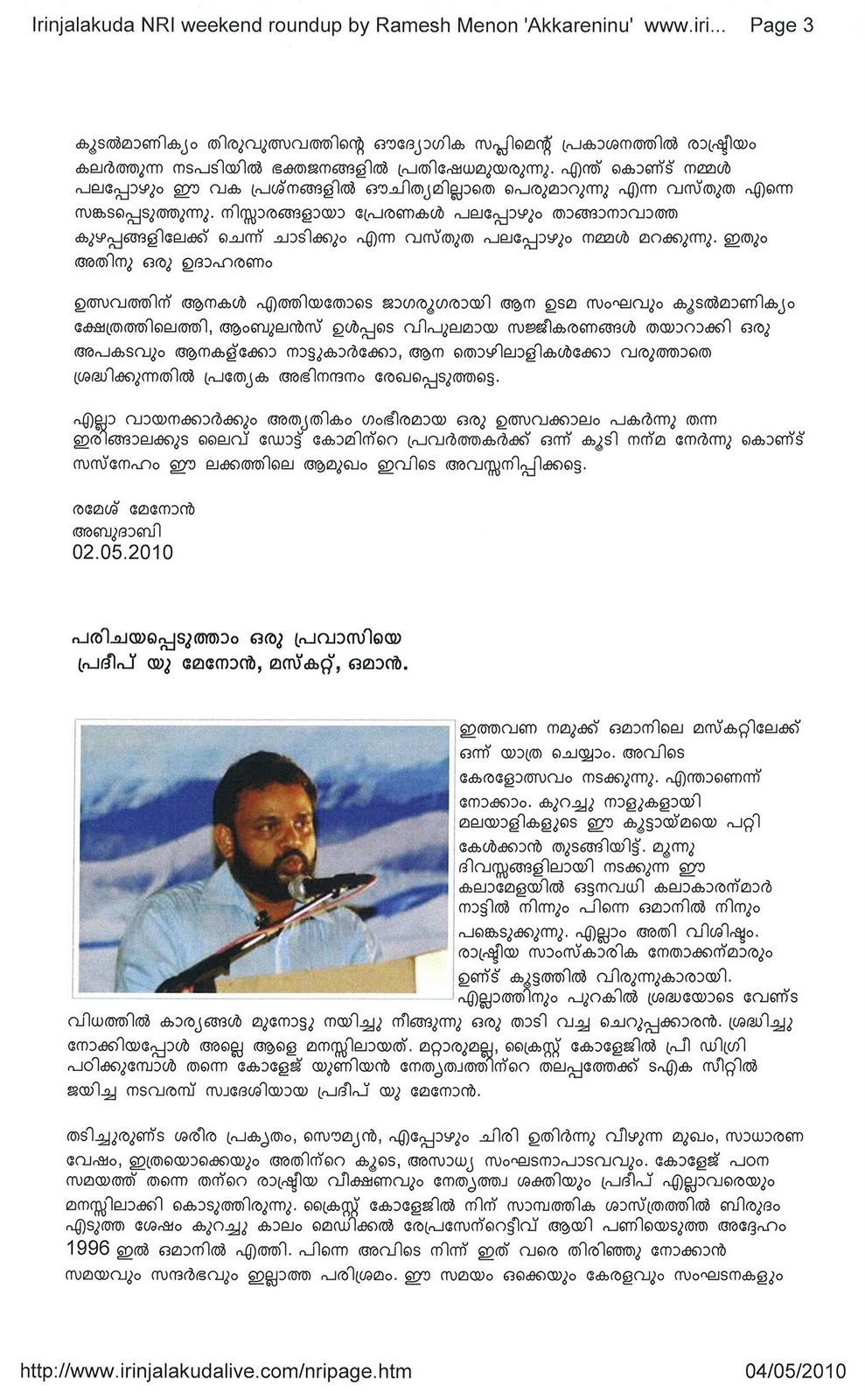


Tourists with ‘low’ jobs turned away at border – My OPinion – The National – Dt. 03.05.2010
Tourists with ‘low’ jobs turned away at border
Essam al Ghalib
Last Updated: May 02. 2010 1:21PM UAE / May 2. 2010 9:21AM GMT
Kathryn Holbrook, a teacher, was told she could cross into Oman without applying for a visa but Colin Davids, a barman in a hotel nightclub, was refused access. Pawan Singh / The National
AL AIN // Residents are being turned away from border crossings between the UAE and Oman because of the type of job they have.
Officials at crossings are enforcing a long-standing agreement between the countries that only expatriates who have what are considered professional occupations can pass into Oman from the UAE without having to apply for a visa.
According to one Omani immigration officer, teachers, doctors, lawyers anyone who has a professional occupation are free to travel into Oman. However, those who do other jobs, such as in the service industry, construction or sales, would not be allowed
The rule, which is to be implemented at all checkpoints, was previously in effect, but border officials only began enforcing it this year, said Captain Ahmad al Shamsi, an Emirati official at the Hilli checkpoint, which links Al Ain with Buraimi and is for non-GCC citizens.
One resident, Colin Davids, was turned away from the checkpoint when he attempted to cross into Buraimi for a camping trip with friends. An immigration agent refused to let him out of the UAE and into Oman.
“He wouldn’t tell me why, but referred me to the visa officer in charge, instead,” said Mr Davids, 27, who had made the crossing numerous times before. “I went inside to ask why and was shocked when he told me I had what he called a ‘low job’.”
Mr Davids works at the Al Ain Rotana hotel as a barman at Moodz nightclub. The job description on his visa says he is a waiter.
“The immigration officer told me that there was a list of occupations that were not free to travel and that mine was too low down to allow me across the border into Oman,” Mr Davids said.
An official in the consular section of the UAE Embassy in Muscat confirmed the agreement between Oman and the Emirates.
“People with certain occupations cannot leave the UAE and people with certain occupations cannot enter Oman,” she said. “There is an agreement between the two countries that is being adhered to.”
People with affected occupations who want to visit Oman need to apply for a visa at the Omani Embassy in Abu Dhabi, she said.
Khaled Hardan, an official at the Omani embassy in Abu Dhabi, confirmed that a prospective visitor’s occupation is a factor considered when issuing a visa, adding that regulations had become more stringent throughout the GCC recently, and not just in Oman.
As for Mr Davids and others like him, Mr Hardan said: “If he would like a visitor’s visa, he can come to the Omani embassy in Abu Dhabi and apply for one.”
An Omani immigration officer, who asked not to be named, said in the past many people would leave the UAE and enter Oman from Hilli. They would then stay and work illegally in Buraimi.
“In the case of the Hilli border crossing into Buraimi, there isn’t an official Omani checkpoint for 40km down the road to Muscat,” he said. “For people with professional jobs, it would be harder for them to find work illegally in Buraimi, whereas a carpenter can find odd jobs to do here and there.”
Kathryn Holbrook, a 29-year-old geography teacher at Al Ain English School, who was with Mr Davids when he tried to cross, was stunned to learn that he could not.
“My occupation is listed as a teacher so I was told I could cross into Oman, but not Colin,” she said. “I complained to people at the border who told me there was a new list that came out this year.”
Days after Mr Davids’s experience, Arianne Galez, 31, from the Philippines, stood in front of a visa officer in disbelief. After making regular trips to visit her family, who were expecting her, she was suddenly being denied.
The officer explained to Ms Galez that certain occupations, including hers – a receptionist at a dental clinic – were not considered professional.
“My cousin and sister work in Sohar,” Ms Galez said. “I don’t know when I am going to see them again.”
My Comments as follows:
Interesting news. This rule was there for some time now. But, may be they started applying it strictly from now on. The experience of the involved parties highlighted brings out an equally interesting question. Are they married couples? If not, is it an example of restrictive measures by authorities towards illegal cohabiting and fun trips across the boarder both ways during week-end. Point to ponder.
Ramesh Menon, Abu Dhabi
To read this in original, please visit THE NATIONAL online.
Road made unsafe by lack of a U-turn – My Letters – THE NATIONAL
My Letters – THE NATIONAL – Road made unsafe by lack of a U-turn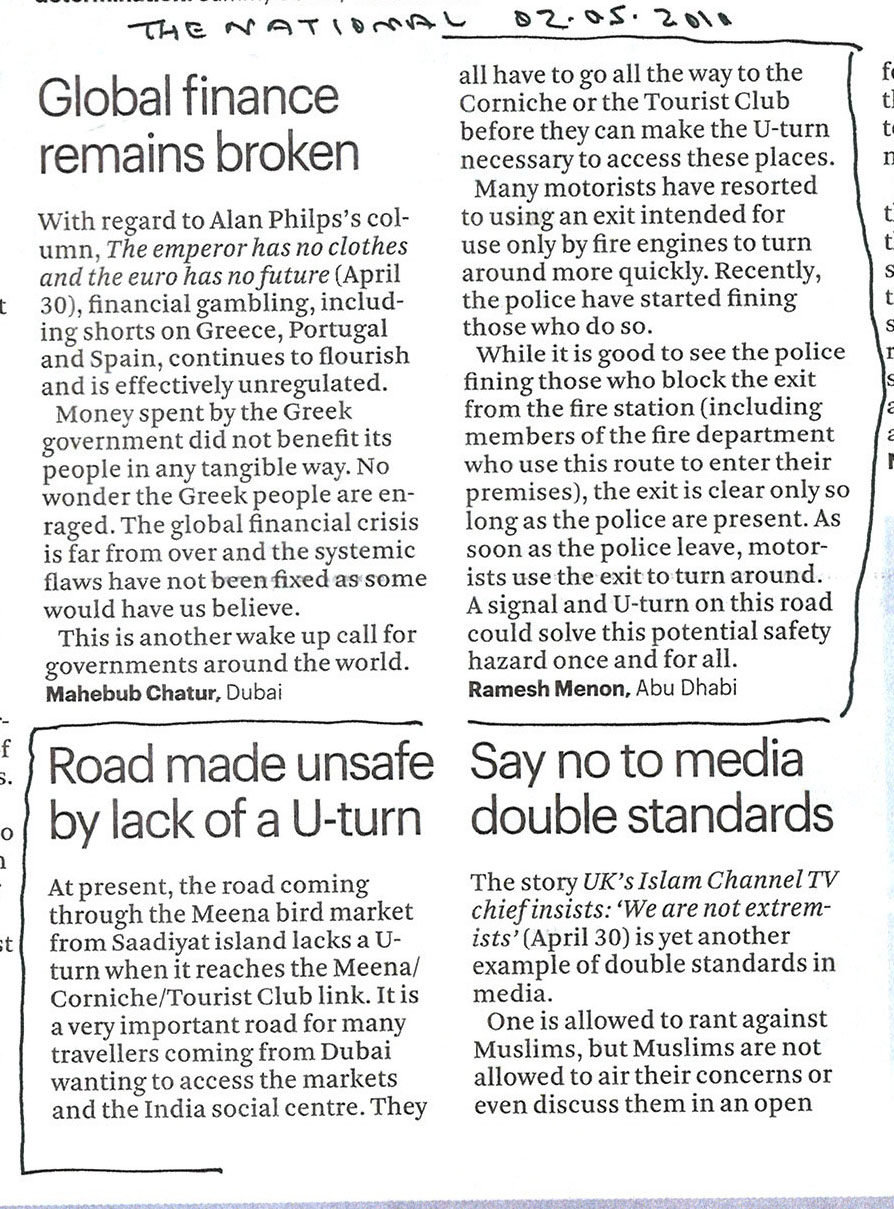 To read my letters to the news, please bookmark and visit Letters to the Editor
Short Take – Gulf Today – Dt. 01 May 2010 – View from the bus
Short Take – Gulf Today – Dt. 01 May 2010 – View from the bus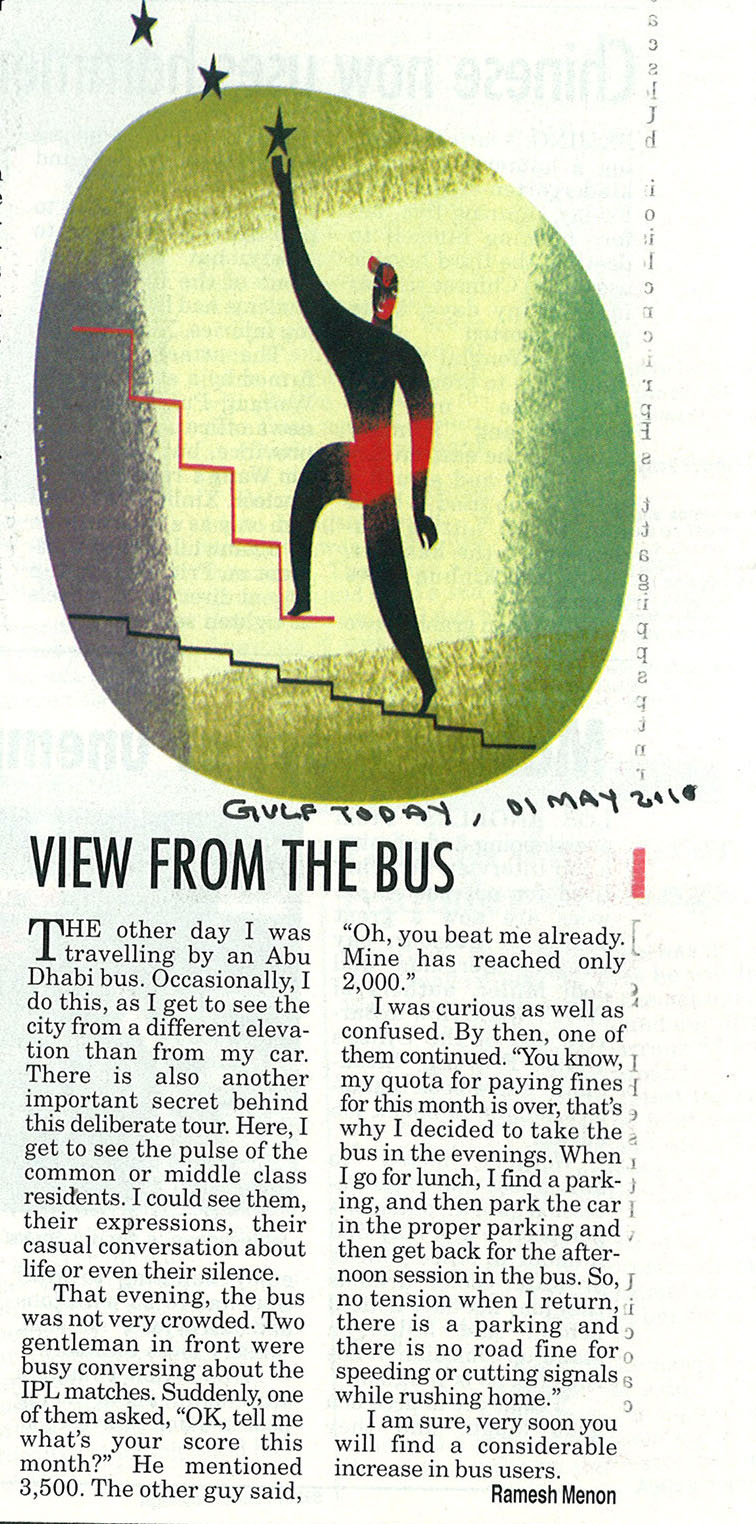
To read my letters to the news, please bookmark and visit Letters to the Editor
My Opinion : Gulf News – Dt 25.04.2010 – Recycling should replace scavenging
My Opinion : Gulf News – Dt 25.04.2010 – Recycling should replace scavenging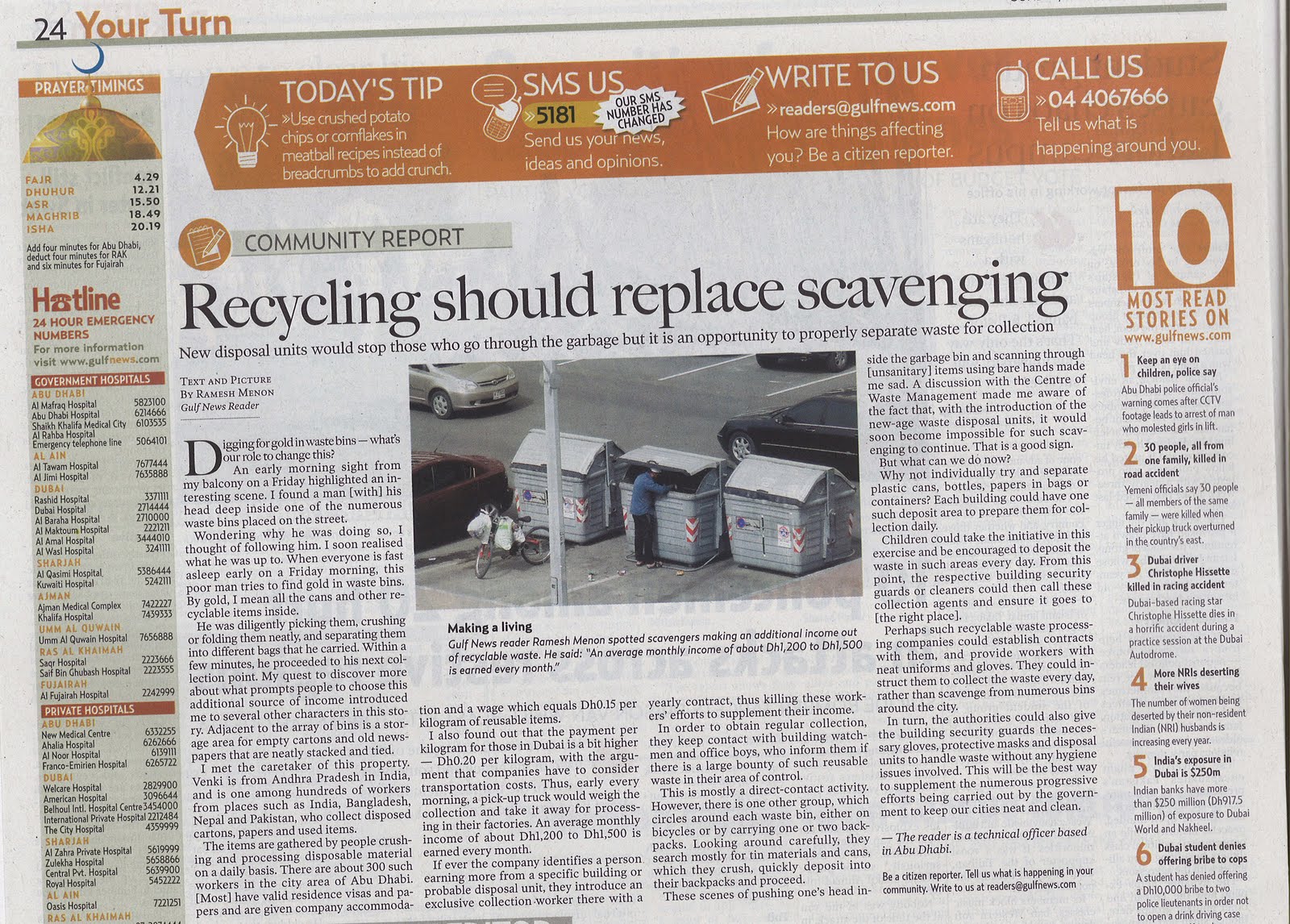
To read my letters to the news, please bookmark and visit Letters to the Editor
An early morning sight from my balcony on a Friday highlighted an interesting scene. I found a man [with] his head deep inside one of the numerous waste bins placed on the street.
Wondering why he was doing so, I thought of following him. I soon realised what he was up to. When everyone is fast asleep early on a Friday morning, this poor man tries to find gold in waste bins. By gold, I mean all the cans and other recyclable items inside.
He was diligently picking them, crushing or folding them neatly, and separating them into different bags that he carried. Within a few minutes, he proceeded to his next collection point. My quest to discover more about what prompts people to choose this additional source of income introduced me to several other characters in this story. Adjacent to the array of bins is a storage area for empty cartons and old newspapers that are neatly stacked and tied.
I met the caretaker of this property. Venki is from Andhra Pradesh in India, and is one among hundreds of workers from places such as India, Bangladesh, Nepal and Pakistan, who collect disposed cartons, papers and used items.
The items are gathered by people crushing and processing disposable material on a daily basis. There are about 300 such workers in the city area of Abu Dhabi. [Most] have valid residence visas and papers and are given company accommodation and a wage which equals Dh0.15 per kilogram of reusable items.
I also found out that the payment per kilogram for those in Dubai is a bit higher — Dh0.20 per kilogram, with the argument that companies have to consider transportation costs. Thus, early every morning, a pick-up truck would weigh the collection and take it away for processing in their factories. An average monthly income of about Dh1,200 to Dh1,500 is earned every month.
If ever the company identifies a person earning more from a specific building or probable disposal unit, they introduce an exclusive collection worker there with a yearly contract, thus killing these workers’ efforts to supplement their income.
In order to obtain regular collection, they keep contact with building watchmen and office boys, who inform them if there is a large bounty of such reusable waste in their area of control.
This is mostly a direct-contact activity. However, there is one other group, which circles around each waste bin, either on bicycles or by carrying one or two backpacks. Looking around carefully, they search mostly for tin materials and cans, which they crush, quickly deposit into their backpacks and proceed.
These scenes of pushing one’s head inside the garbage bin and scanning through [unsanitary] items using bare hands made me sad. A discussion with the Centre of Waste Management made me aware of the fact that, with the introduction of the new-age waste disposal units, it would soon become impossible for such scavenging to continue. That is a good sign.
But what can we do now?
Why not individually try and separate plastic cans, bottles, papers in bags or containers? Each building could have one such deposit area to prepare them for collection daily.
Children could take the initiative in this exercise and be encouraged to deposit the waste in such areas every day. From this point, the respective building security guards or cleaners could then call these collection agents and ensure it goes to [the right place].
Perhaps such recyclable waste processing companies could establish contracts with them, and provide workers with neat uniforms and gloves. They could instruct them to collect the waste every day, rather than scavenge from numerous bins around the city.
In turn, the authorities could also give the building security guards the necessary gloves, protective masks and disposal units to handle waste without any hygiene issues involved. This will be the best way to supplement the numerous progressive efforts being carried out by the government to keep our cities neat and clean.
— The reader is a technical officer based in Abu Dhabi.
Be a citizen reporter. Tell us what is happening in your community. Write to us at :readers@gulfnews.com
At last, the great escape – My Opinion
My Opinion : At last, the great escape
The National staff
Last Updated: April 22. 2010 12:48PM UAE / April 22. 2010 8:48AM GMT
Jaqueline Wood, left, and Tara Roe Gammon embrace after returning to Heathrow from Costa Rica via Madrid yesterday. Paul Hackett / Reuters
As European skies once again filled with planes, the UAE’s carriers flew thousands of people home yesterday from their extended, unexpected stays in the country.
Both Etihad Airways and Emirates Airline put on extra flights to clear the backlog of some 12,000 stranded passengers.
Etihad said that by evening it had flown 31 flights to and from Europe, and was on schedule to clear its backlog of 2,500 passengers stranded in the UAE by today.
Richard Hill, Etihad’s chief operating officer, said it was on course to resume its normal operations by the end of today.
Emirates, meanwhile, said it had flown 9,000 passengers back to Europe, leaving just 350 to clear. Both airlines said they were not accepting new bookings to Europe.
Other carriers were also beginning to clear their backlog of passengers. “We are investigating all possibilities to accommodate as many passengers as possible,” said Lauren Cooper, a representative for British Airways.
Meanwhile, the airline industry was counting the cost of the six-day, near-total stoppage of air traffic in Europe, the result of a massive cloud of ash spewed out by the Eyjafjallajökull volcano in Iceland.
“Lost revenues now total more than $1.7 billion for airlines alone,” said Giovanni Bisignani, the director general and chief executive of the International Air Transport Association.
“At the worst, the crisis impacted 29 per cent of global aviation and affected 1.2 million passengers a day. The scale of the crisis eclipsed 9/11, when US airspace was closed for three days.”
For Etihad alone, Mr Hill said the expense of accommodating and feeding stranded passengers, as well as all the lost revenue, had cost the airline in excess of US$5 million (Dh18m) a day.
After initial scenes of chaos in Dubai and airports across Europe, the mood turned to jubilation as stranded passengers were reunited with their friends and families.
My comments as follows:
The title of this article reflects as if UAE is the most unfriendly country ever to be with and the respective hosts of the guests who had to experience such an unexpected ordeal belong to the same breed. I am sure, every effort would have been made by the airlines, authorities and the respective contact parties to make sure this unexpected stay was made comfortable to the maximum possible by all parties involved.
Ramesh Menon
Abu Dhabi
To read it in original, please visit THE NATIONAL online
Safety experts fear city’s new digital billboards may cause car crashes – My Opinion
My Opinion : Safety experts fear city’s new digital billboards may cause car crashes
Safety experts fear city’s new digital billboards may cause car crashes
Matt Kwong
Last Updated: April 21. 2010 10:00PM UAE / April 21. 2010 6:00PM GMT
An electric sign overlooks the busy intersection at Airport Road and Al Falah Street. Galen Clarke / The National
ABU DHABI // Hi-tech distraction or sign of the times? The city’s digital billboards are eye-catching indeed, but maybe too eye-catching, say local safety experts.
Their flashing colours and rapidly changing images are a fast-growing segment of the outdoor advertising market, but safety experts say they pull motorists’ eyes away from signals and pedestrians and could lead to more accidents.
Norm Labbe, a defensive driving instructor in the capital, said: “Our senses are being bombarded by navigation equipment, bright lights, music, cell phones, and now these billboards, where it’s almost like a strobe-light effect.”
More than a dozen US cities have banned the popular electronic advertising billboards, pointing out that unlike mobile phones, drivers cannot switch them off. Several cities in Canada are also considering moratoriums on the technology. Here, however, their numbers are increasing.
Abu Dhabi’s digital signage is perched atop buildings overlooking major junctions such as Muroor Road at Electra Street and Airport Road at Al Falah Street. The newest mammoth LED screen, measuring 20 metres by eight metres, is being erected on the corner of Muroor Road at Hamdan Street.
Future Vision, the ad firm that owns those displays, rotates six images every 10 seconds, allowing as many clients to promote themselves using the same billboard.
The computer-operated billboards have been a boon for advertisers, said Rajiv Khurana, the Middle East vice-president of the advertising firm Dentsu Marcom. He predicts the number of displays will more than double in the Emirates within five years.
The problem, Mr Labbe said, is that such billboards are designed to be distracting in order to be effective. Changing colours or designs encourages drivers to keep looking for the next digital image to appear.
“It takes approximately one and a half to two seconds for you to react properly and apply your brakes and come to a stop,” he said. “A lot can happen in two seconds.”
Just as there is a growing body of research on the dangers of texting while driving, he called for local researchers to study how much of a distraction the signs pose to people at the wheel.
Results from US studies on the issue have been mixed. The Virginia Tech Transportation Institute, which is financed by the billboard industry, found that the displays posed no hazard in 2007. However, the American Association of State Highway and Transportation Officials reported last year that they “attract drivers’ eyes away from the road for extended, demonstrably unsafe periods of time”.
“That’s my concern, that this is one more added element to the mix,” Mr Labbe said.
Abu Dhabi’s preprogrammed displays draw more attention at night, and are even more hazardous at what Dr Peter Barss, an injury prevention specialist who works with UAE University, described as “complex driving environments” such as major intersections.
Dr Barss said the onus should be on companies profiting from the billboards to prove that they do not imperil drivers.
“The traffic environment here is extremely high speed at a lot of places, so it seems to me the potential [for accidents] would be high,” he said.
“When you’re trying to discern whether you go right or left, and suddenly there’s a huge flashing sign out there pulling your eyes away, well how many seconds can you afford to take your eyes off the road and not hit somebody?”
Although Future Vision’s three signs have video capabilities, Robert Awad, the company’s media executive, said Abu Dhabi Municipality was wary of allowing moving pictures to play above evening traffic. “They gave us the approval to do this latest technology on one condition, to make the billboards static, not dynamic,” Mr Awad said. “This is to avoid accidents.”
Even so, it is hard to miss Synaxis Media’s dynamic 224-square-metre Opulence, the largest outdoor LED sign in the Middle East, broadcasting “TV-quality ads” just above the Marks & Spencer on Airport Road.
The Opulence can broadcast video because it is not positioned at a major intersection, said Fahad al Absi, the founder of Synaxis.
“You can deliver six messages for the same campaign using the same space. You save six times the money,” he said of the display, which was switched on two years ago.
Adverts cost Dh300,000 (US$81,673) a month and can be viewed 600 times a day. It costs Future Vision Dh90,000 a month to operate its screens.
However, Mr al Absi supported strict regulation of electronic advertising placement.
“Having it face intersections where they think the ad might be more effective is not such a good idea,” he said. “Other LEDs might seem located in a prime location, but excuse me, it’s right behind a traffic light. That can be confusing.”
Samira Ahmed, an Emirati housewife, drives by the Opulence nearly every day and has had a few close calls in traffic while watching the screen.
“The place is wrong because this is like a highway,” said Mrs Ahmed, 46. “I almost had an accident one time because it was in the evening.”
Abu Dhabi Municipality did not respond to requests for comment, but officials with the advertising section said this month that three digital billboards have had their illumination levels decreased by 10 per cent after complaints.
My comments as follows:
I agree with the dangers of high intensity level getting beamed across the road from these sign boards. While, I also agree with the fact that such sign boards are displayed in other cities world-wide, but feel they are of low intensity and long duration. The higher the intensity and the shorter the duration, they tend to distract the reflexes of the drivers and may tend to create dangerous situation for accidents to happen. One prominent example is the sign board displayed at the Mark and Spencer building in front of the Cultural Foundations. It is too bright and many times dangerously create lighting effect which even block the colors of the changing signals a short distance from it.
In addition, I would like to take this opportunity to highlight another danger that is happening these days. There are several ads being played by FM radios, which has sound effects of cars honking horns and ambulance or police sirens, to create some advertising attraction. These ads disturbs and create driving attention and focus and authorities should curb airing of ads which carries such sounds.
Ramesh Menon, Abu Dhabi
To read it in original, please visit THE NATIONAL Online
Short Take – GULF TODAY – Dt. 24.04.2010 – Knowing the pulse
Short Take – GULF TODAY – Dt. 24.04.2010 – Knowing the pulse
My Opinion : Entire police force to watch roads for unsafe drivers
Dubai: Drivers beware. The next time you weave through lanes, be aware that chances are now greater for a police officer to flag you down for violating Dubai’s traffic rules.
A new rule implemented beginning this week gives the approximately 20,000 members of the Dubai Police force the authority to issue traffic fines and impound vehicles whose registration has expired.
Earlier, only traffic police officers totalling about 800 could issue such fines.
The new regulation is aimed at curbing the number of road violations and ensure motorists are more conscious of their driving, said Major General Mohammad Saif Al Zafein, Director of the General Department of Traffic at Dubai Police.
All access
“Any officer stopping a motorist for any road violation will have access to his/her traffic violation record and will be able to issue a fine or take action in coordination with the traffic department,” said Al Zafein.
Senior traffic officers will monitor the roads day and night. “I will personally take to the roads to monitor the driving of motorists and issue fines. This is being done to change the general perception about senior officers and that it is the duty of every officer to monitor driving habits. And I believe when motorists see that officers are present to ensure they follow the rules they will be more conscious,” Al Zafein said.
In the first quarter of 2009, the total number of traffic fines issued totalled 727,054. This year, the figures dropped to 608,776.
This drop in fines is attributed to many reasons but one of them is due to the increase in patrols monitoring the streets.
“Patrol units from police stations backed-up traffic officers to curb violations,” he said.
According to Al Zafein, the number of on-the-spot fines issued to motorists in the first quarter this year reached 278,964, compared to 251,336 in the same period last year.
Truck drivers committed 6,416 offences in the first quarter of 2010 compared to 1,852 during the same period in 2009. There were 3,884 motorists who were caught jumping red lights in the first quarter of 2010 compared to 2,612 in 2009.
“The number of accidents and injuries has decreased, and that is because a lot of people are taking more precautions now, such as fastening their seatbelts,” said Al Zafein.
800: traffic police officers in Dubai
20,000: approximate number of personnel in police force
608,776: traffic fines issued in first quarter
278,964: on-the-spot traffic fines issued
First quarter traffic violators
The three most dangerous roads with the highest number of fatalities are Emirates road, Dubai Bypass road and Dubai-Al Ain road.
In the first quarter of 2010, 62 people were killed whereas it was 69 in the first period of 2009
“The most dangerous road in the emirate so far is the Emirates road which holds the highest number of fatalities. This is for several reasons such as the existence of both trucks and cars on one road, and the reckless driving that occurs there,” according to Maj Gen Mohammad Saif Al Zafein, Director of the General Department of Traffic at Dubai Police.
The indicator of traffic fatalities that the department aims to reach is 11.8 person for every 100,000 of the population a decline to last year’s indicator which reached 12.9.
“From the statistics of the first quarter of 2010 it is idealistic to meet this indicator thus we have a range from 11.8 to 12.5,” said Maj Gen Al Zafein.
My Comments as follows:
I am happy to see this move, may be a side effect of constant effort to highlight such cases of rash driving happening around through community reports, letters and suggestion options at the Dubai Police site. Many times I have felt, life was at the mercy of some reckless driver who ignore his life as well as of the others on the road. Congratulations to sustained efforts by authorities to ensure a safe road for us.
Ramesh Menon, Abu Dhabi, United Arab Emirates
To read this in original, please visit GULF NEWS ONLINE
My Creatives – Malayala Manorama Online Dt. 21.04.2010 – Manalaaranyangalil ninnuyarunna sargatma sakthi
My Creatives – Malayala Manorama Online Dt. 21.04.2010 – Manalaaranyangalil ninnuyarunna sargatma sakthi 

 ClicksandWrites
You must be logged in to post a comment.