Information – Positive Thinking
Internal elements for personal identity
Internal elements for personal identity
Babita Narayanan for Express Buzz 21 Aug 2008 03:03:00 PM IST
WE have already initiated our process of personal branding with some of the external elements required.
I’m sure some of you who have started making certain changes in your appearance after reading the last column and must be feeling good about yourselves. I am replying to some of the queries I got on email about the internal elements that are necessary for the process of self packaging and creating your brand identity.
Every person is a sum of both internal and external factors which include several significant elements. Depending on the situation and the interaction, some of these combined elements always make an impact. It is difficult to determine which one of these has more significance or relevance.
Today let us journey into our inner selves and find out what internal elements determine a powerful personal identity.
1. SWOC analysis. Make an honest analysis of your strengths, weaknesses, opportunities and concerns. Put it on paper. Take help from people close to you and let them give you a feedback. This will give you a picture of your present position. Now you know exactly what your opportunities are and what is stopping you.
2. Open Mind. Can you accept the analysis you have made of yourself in totality and the necessity to change them? Do it. Are you open to changes, advice, suggestions? Slowly develop a mind that is open, unbiased and clear to yourself. Establish a firm sense of self- acceptance.
3. Recognizing your true purpose. What really drives you? What is your purpose in life? This can allow you to make dramatic changes in our lives. Determining what your purpose is and pursuing it with passion can lead to a true renaissance in your personal and professional endeavors.
4. Self esteem- Value yourself. What image do you have of yourself ? Are you feeling good about yourself ? List out what is about you that makes you feel good and otherwise. You have to start loving yourself completely without being blind to the aspects that you need to change.
5. Level of confidence- A high level of balanced confidence is what will give anyone an edge. What is the level of confidence do you possess especially when you meet someone with authority or a stranger? Most of the times we find our confidence wavering when we meet people who are different from us or better than us and we feel threatened. Analyze yourself and be completely of your confidence in all situations.
6. The right attitude. The way you think, day in day out, affects all aspects of your life. What is your attitude towards yourself, towards your work, towards others and towards life itself ? Are you perpetually depressed, critical, complaining or nagging? Stop and listen to your “inner voice’. What is it saying? Most of the time, we hear our inner voice all negative and unhappy. Well, its time we know that ‘inner voice’ is completely controlled by us. Start the process.
Start by converting each of the negative thought to a positive one. Start with just one positive thought at a time and start developing a right attitude.
7. Positive Reinforcements- Make this your mantra. Repeat as often as possible n I need to change to achieve my goal and I will start the process today.
* I am unique, one of a kind.
* I will treat others the way I want to be treated.
* I cannot change my family; I can only change myself. I will love them for what they are.
When I smile, I feel better. So I am going to smile all day today.
* I am alive today. Let me be kind and loving to everyone I meet.
So go ahead and live life to the fullest brimming with joy and happiness.
Small change can make big difference
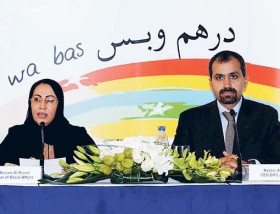
Mariam Al Roumi, UAE Minister of Social Affairs, and Nasser Al Sha’ali, CEO of the DIFC Authority, during the launch of the “Dirham Wa Bas” campaign.
Small change can make big difference
Staff Report GULF NEWS Published: August 20, 2008, 23:44
Dubai: One dirham only can go a long way towards helping others in a new campaign launched by the Ministry of Social Affairs’ Social Responsibility Fund.
The “Dirham Wa Bas” (One dirham only) campaign aims to raise funds for social care and development projects in the UAE. It is being supported by the Dubai International Financial Centre.
Mariam Al Roumi, Minister of Social Affairs, said: “The Dirham Wa Bas campaign aims to support sections of society that need our help, such as people with limited income, disabilities and the elderly. Everyone can contribute to this campaign. All financial contributions, starting from as little as one dirham, are needed and appreciated. The campaign is part of the Social Responsibility Fund’s objective of bridging the gap between the public and private sector and uniting them to address and solve social and community issues.”
The public will be encouraged to donate as little as one dirham, which can be deposited at donation boxes across the UAE. These locations include Emarat petrol stations, major shopping malls and retail stores.
“The Dirham Wa Bas campaign will tap the power of public participation to contribute towards social causes in the UAE. Small contributions can add up to make a huge difference. We seek the support of all members of the public across the UAE to make the Dirham Wa Bas campaign a success,” Al Roumi said.
The DIFC will be supporting the campaign by offering marketing expertise and developing publicity campaigns, which will target the retail industry and the public.
Nasser Al Sha’ali, CEO of the DIFC Authority, said: “The Dirham Wa Bas campaign is a wonderful example of how different sectors of society, including the Government and the private sector, can work together to involve the individual in contributing towards social issues in the UAE. DIFC’s support for the campaign is based on our strong belief that corporate organisations have an important role to play in the development and welfare of the community. We are committed to contributing to the well-being of the society we are part of.”
The Roads and Transport Authority, Dubai Municipality and Telecoms provider Du will also be offering support.
How to participate
* Donation boxes will be placed in shopping malls, Emarat petrol stations and retail stores.
* The public are being invited to donate as little as Dh1.
* The elderly, disabled and those on limited incomes are set to benefit from the donations, via the Social Responsibility Fund.
* The campaign was launched yesterday and will run until December.
I love to be alone at the top – Yelena Isinbayeva

I love to be alone at the top – Yelena Isinbayeva
Life lessons from Michael Phelps
Life lessons from Michael Phelps
August 18, 2008 , Rediff News
At 23, Michael Fred Phelps has become an international sporting sensation.
The young American swimmer has smashed seven world records and won eight gold medals at the Beijing [Images] Olympics [Images], the first athlete ever to secure first place so many times at a single Olympics Games.
Given his success, it’s easy to slot Phelps into the ‘born achievers’ category — at 23, he’s established a glorious career doing what he loves best, he’s a millionaire, a world record-holder and the pride of his nation.
But hold on a minute — is Michael Phelps [Images] really a born achiever?
He may beg to differ.
At the age of seven Phelps, the youngest of three children, was diagnosed with Attention-Deficit Hyperactivity Disorder. For those not familiar with the condition, ADHD is a childhood condition characterised by constant activity, impulsive behaviour and the inability to focus one’s attention on anything for a short span of time.
ADHD is treated with therapy and medication, but is not classified as curable — as per information on the website WebMd.com, about 60 percent of afflicted kids carry the condition into adulthood.
To help release his pent-up energy and to emulate his older sisters who were also accomplished swimmers, Phelps took up swimming, starting to outshine his peers right from the start.
At the age of nine, Michael’s parents divorced. His mother brought up all three children single-handedly, encouraging them to follow their dreams at all costs — one middle-school teacher even told Michael’s mother he would never be a success.
But successful Phelps is, and how.
Yes, there are the occasional set-backs. Like the time back in 2004 when Phelps, then 19, was arrested for driving under the influence of alcohol. He was under the legal drinking age limit of 21 in any case and to top it he was driving in an inebriated state. A repentant Phelps pleaded guilty and was sentenced to 18 months probation, saying in court, “I recognise the seriousness of this mistake. I’ve learned from this mistake and will continue learning from this mistake for the rest of my life.”
So who is Michael Phelps? He was a regular kid who struggled with an irregular condition and the divorce of his parents. He’s young, he excels at what he does and like the rest of us, slips up once in a while.
And what life lessons do his struggles and successes hold for us?
Deal with your own issues effectively — Michael certainly dealt with ADHD and his parents’ divorce that way. His mother helped him cope up with his condition and channeled his energy into what he loved.
Cut out the drama — Michael’s story is inspirational but at the same time, neither the young man nor his family have exploited their experiences to sensationalise his life. They’ve told it like it is.
Zero in on your strengths and overcome your weaknesses — He was less than an average student at school, but Michael was a passionate and dedicated student of his sport. The young swimmer is known to have studied tapes of his races over and over, zeroing in on mistakes and working towards bettering himself constantly. Excellent is still not good enough.
Remain focused on your goals — At the Athens Olympics back in 2004, Phelps was beaten by teammate Ian Crocker beat in the 100m butterfly. He put up a poster of Crocker in his room to motivate him and keeps a list of his career goals beside his bed.
Pursue what you love with passion and put in a genuine effort — Phelps’ dedication to swimming was apparent back when he was nine and began to break national records in his age group. His commitment to what he does has grown with him.
It’s not just his career and his unbelievable performance at the Olympics that classify Phelps as a winner — it’s his story of inspiration that makes him a real champion, a youth icon, somebody to look up to.
No limits to excellence
No limits to excellence
The important lesson in the Nadal-Federer match is that people who operate at high levels of excellence pull each other up the scale.
V. K. Madhav Mohan for THE HINDU
CEOs and organisations can learn important lessons from the history that unfolded on Centre Court at Wimbledon on July 6, 2008. The gentlemen’s final of 2008 was arguably the greatest tennis match of all time. Noted tennis historian Bud Collins had no hesitation in classifying it as the greatest Wimbledon final ever (also the longest at 4 hours and 48 minutes).
What Rafael Nadal and Roger Federer achieved on that rain-swept day was unimaginable. As the rest of the world looked on in disbelief, they shifted the frontiers of excellence upward by an order of magnitude.
This was not just tennis, as Vijay Amritraj said during live commentary. The match had everything anyone could hope for: drama, fortunes swinging like a pendulum, brute power laced with consummate finesse, court speed fuelled by fighting spirit and above all, mental strength beautified by sportsmanship.
What has all this got to do with CEOs and organisations? Quite simply, the classic encounter reveals finer points that are as applicable to individuals as they are to organisations. Both Nadal and Federer competed on their own respective scales and yet propelled each other to the next level. They fed on each other’s performance and so transcended from good to great. That transition points the way for the rest of us, lesser mortals!
The important lesson that stands out is that people who operate at high levels of excellence pull each other up the scale. Peter Drucker posited that the difference between the top and the average is constant and so the way to shift the average upwards is to help the top shift upwards. The common practice however is to help the bottom shift upwards.
Both in academic and corporate environments, the focus is almost always on the weaker, poorer performers. More resources are lavished on them in terms of training and counselling; if the same resources were directed at the top performers, they would move even higher. Then the average would move upwards since the difference between the top and average is constant.
This has important implications for organisational performance. If more people improved their performance and if top performers went even higher the entire organisation would migrate to new standards. This is more or less what happened during the Nadal-Federer epic. Both have been top performers consistently as their respective ATP rankings of two and one in the world respectively, denote. On July 6 both pushed the other into a new zone of performance, a zone that that is the stuff of dreams.
Their achievement is bound to raise the standard of tennis on both the men’s and the women’s circuit because Nadal and Federer have demonstrated what is possible. This is much like Roger Bannister breaching the four minute barrier for the one mile run on May 6, 1954, with a time of 3 minutes 59.4 seconds; a month after this feat another runner, an Australian named John Landy, bettered Bannister’s record with a time of 3 minutes 57.4 seconds.
New performance zones
The CEO should think about ways to move his team into these new zones of performance. By focusing his own time and the organisation’s resources on the top performers (mentoring, training, new assignments, exposure, travel, scholarships) he can create an environment in which every individual pushes others up their own scales. A collective lift ensues, thereby scaling up organisational performance, much like the flight of geese in formation generates collective lift.
Wining formula
Coming back to the Wimbledon final, I believe Nadal won this time because of the following, each of which has lessons for CEOs:
His backhand is hit with perfect balance in all situations since he is a natural right-hander converted into a lefty. So Nadal actually has two equally powerful sides, his powerful lefty forehand and his backhand beefed up by the strength and control in his natural right hand. Organisations need to learn from this by creating and innovating new strengths while augmenting the existing strengths. This more than compensates for weaknesses.
Nadal’s swinging slice serve which curves away from the opponents on either side. Even the great Federer’s perfect ground-strokes were always under pressure on the Nadal first serve because the ball was always either going away from Federer (on the deuce court) or curving into his body (on the advantage court).
The lesson here is to develop one particular weapon to specifically neutralise a competitor’s core strength. That means understanding the opponent’s strength and designing a product, service or policy to eliminate its effectiveness in the market
Unrivalled court speed and unrelenting aggression. Nadal is probably the fastest man ever on a tennis court. That allows him to retrieve even impossible winners and forces the opponent to play interminably long points, thereby sapping his stamina.
Companies need to build reserves of cash and talent that will force opponents downhill with every competitive encounter. No matter what strategy or tactics the competitor employs, the CEO must always be ready with a counter thrust. In fact, the reserves of organisational stamina must be built up with contingency plans and resources, careful husbanding of cash and constant honing of talent
Continuous adaptation and evolution in his game. Nadal has made the crossover from a clay court specialist to a complete tennis player. From being able to hit mostly heavy top spin ground strokes he’s graduated to drop shots, sliced backhands, deft angles and serve and volley tennis. Similarly organisations must adapt continuously and develop all-round capabilities much like pilots with all-weather ratings. That calls for continuous market analysis and organisation development to map the market.
Mental toughness. Nadal’s mental toughness prevented him from wilting even when he had lost several match points. That strength is evidently practised and polished with visualisation exercises. Mental rehearsals are as important as physical practice. CEOs must develop this capability for personal visioning by repeatedly visiting the scene of future physical performance mentally and “seeing” a perfect performance every time. By encouraging everyone around him to develop this skill the CEO can make a very strong impact on organisational performance.
Supreme physical fitness. No other tennis player has demonstrated Nadal’s unremitting aggression, court speed or mental toughness. The basis of all that is his almost superhuman physical fitness which gives him the balance, breath control and stamina to deploy his technique and weaponry with devastating effect.
The peerless Federer revealed fleeting glimpses of fatigue only in the last two games of the match but that, sadly, was enough to make the difference between victory and defeat.
So too must CEOs , business owners and managers be committed to physical fitness. This is the key to mental toughness and clarity. Gym workouts, sports, walking, yoga, pranayama are all de rigueur for today’s leaders. Personal discipline leads to fitness, physical and mental, and that goes with the territory of leadership.
What the world experienced during the Nadal-Federer encounter was indeed a demonstration of possibilities for personal and organisational growth. The dynamic duo proved beyond doubt that limits to growth and excellence do not exist. For that we have be eternally grateful to those two great sportsmen.
TheLonelyCEO@gmail.com
Unlocking India’s potential
Unlocking India’s potential
11 Jul, 2008, 0543 hrs IST, ET Bureau
In India, we have always been competitive as individuals, primarily because we live with the reality of too many people chasing too few resources. This competitiveness has helped us make a mark in the global business scene; but it has also led to the over-exploitation of common goods, be it in business, government or society, leading to our systems being corrupt and clogged. We refuse to understand that our mentalities are supposed to grow along with the growth of our nation. That we are supposed to graduate from individual players focusing on personal gains to team players focusing on growth and sustenance of the entire system.
So, how do we make sure that our pure selfish individual attitudes are not standing in the way of our development ? The most common solution is regulation by a leadership authority with an iron hand, where legal coercion, in the form of penalties or punishments, is imposed so that people give up their immediate individual benefits to comply with social rules. Most developed nations have done this during the initial stages of their development itself, through a benevolent dictator who gradually gives way to a democratic environment.
However , in the case of India, since this democratic machinery is already in operation, this would be almost impossible to pull off. Privatisation is another solution where governmental regulations limit the amount of a common good available for use by any individual. One example is the reduction in corruption, once license raj came to an end in India . But this route might not work or could prove to be costly in cases like traffic or environmental protection.
There is a third way, which is probably the best way, where each one of us owns up responsibility to co-operate and improve the system, though no outside agency is enforcing this. This is indeed true leadership, where each citizen realises that the next level of growth for our nation depends on each one of us behaving responsibly towards each other and towards the system. Where leaders lead responsibly by putting people at the centre of the system, where people don’t shirk r e s p o n s i b i l i t i e s though no one is directly monitoring and where citizens behave responsibly towards the environment and traffic.
Some of us who are open to this idea might think, what is the use of just me co-operating in the system ? I would still lose out thoroughly , if everyone else refused to collaborate. As leaders, as responsible citizens , let the change start with us. Once a few of us start behaving responsibly, others will follow suit, some of them out of their own responsibility, and some out of coercion. Let the unlocking of India’s potential start from each one of us.
New Mid Day break – an opportunity for educating labour class

New Mid Day break – an opportunity for educating labour class
UAE government has come out with a strict rule requiring all construction and other on-site job involving companies to allocate approximately 3 hours of rest during the time 12:00 noon to 3:00/4:00 pm. Temparature during the last few days have been going on the higher side of 50 degrees.
It is really a humanitarian move from the government for the welfare of the labourers working in this extremely hot climate. It is very refreshing to see these poor workers relaxing on the shades during noon. It has also proved as a good business opportunity for the small grocery shops nearby the huge construction areas as these workers go for snacks or cool drinks during this forced leisure time.
Looking at this scene during the last few days, I wonder why not social groups and associations or even companies utilise this leisure time to educate these poor working class about various savings methods, insurance schemes, awareness on health/welfare measures etc.
Good to see your comments and any possible implementation/assistance plans for this cause if you are in favour.
Ramesh Menon
16072008
The perfect imagemaker
The perfect imagemaker
Wednesday July 2 2008 08:42 IST Asha Prakash EXPRESS NEWS SERVICE
He is the one who coined the term ‘Image Management’. This image guru of India, economist, journalist and founder of the country’s only children’s newspaper, is the man behind the success of many a political party and politician. Founder of ‘Perfect Relations,’ he’s always in the news for his lobbying.’ And there’s more to Dilip Cherian. Describing all his achievements in a single breath would be impossible.
A Malayali by birth, Cherian was on one of his rare visits to Kerala the other day when we caught up with him. “I would prefer to call myself an entrepreneur more than anything else,” he says. “I even started a restaurant once, it was the first stand alone multi-cuisine restaurant in Delhi. But once I feel a venture is in a stage to be handed over to someone, I do it.”
Cherian, who began his career as an economist, felt that being an economist was like being the conductor of a bus. “You have no real control over it,” he says. He thus decided to switch to journalism as he felt that the industry offered space for his own views.
At that point, in the early 80s, business journalism was virtually nonexistent, says Cherian, with all market reports being done by foreign companies. But they could rarely get the correct perspective of Indian markets, he says. “You need to understand the Indian ethos and the Indian pyschology to write informed reports.” Cherian was thus part of the team which created Business India, the first business newspaper of India.
So why the switch to image management? “More than creating something new, I think it was more of a response to the great changes that were happening in the market.” In order to survive, Indian companies were desperately in need of professional and result-oriented image building. Always a step ahead of the others, Cherian founded ‘Perfect Solutions,’ an image management company in 1992.
The clients of ‘Perfect Solutions’ belong to a wide spectrum of industries from corporates to prominent political parties and bigwigs to Bollywood personalities.
Political parties are increasingly opting for professionals to do their PR and literature. “Before long the majority of voters will comprise the MTV generation. Traditional methods like long speeches will no longer win their support. So we apply the basic rules of PR here too – study the audience and give them what they want.”
Bollywood is also a field where survival depends on good image making, he says. “We try to find out what is different or unique about the brand or venture and focus on that.” For example, when a movie is about to be launched, Cherian’s team studies the scenario and the right time for the launch.
“Today, one third of the success of a movie depends on the music,” he says. “By the time a movie is launched, its music should have already created an identity.”
The future of image making lies in providing specialised services, according to Cherian. “Today clients need people who know their industry inside out, not someone who has to study it from scratch.”
So what according to him is the secret to success in the field? “The ability to communicate well, a thorough knowledge of the Indian market, environment and psychology.” But having coming so far, the image guru has no plans to rest on his laurels.
“Our next venture is to start an exclusive training centre for image management, which will match global standards,” he says. Well, one more to add to his list of first’s.
 ClicksandWrites

You must be logged in to post a comment.