Information – Positive Thinking
Want to succeed? Avoid these 9 traps

Want to succeed? Avoid these 9 traps
Robert J Herbold
Success leads to the damaging behaviors of a lack of urgency, a proud and protective attitude, and entitlement thinking. This leads to the tendency to institutionalize legacy thinking and practices. Essentially, you believe that what enabled you to become successful will enable you to be successful forever.
After reviewing this problem in many companies, I believe there are nine dangerous traps into which successful people and organizations often stumble.
Trap 1: NEGLECT
Sticking with Yesterday’s Business Model
By business model, I mean what you do and how you do it. It includes such issues as deciding what industry you will be competing in and what approaches you will use in carrying out all the processes necessary to compete in that industry. Will we manufacture something or contract it out? How will we sell our products or services?
Do we go through retail channels? How should we organize our sales force? Which segments of the industry do we want to ignore, and which do we want to compete in? What is the structure of our support staff? Which parts of the organization do we out source? What are our approaches to distribution and inventory management? What are the cost targets of the various components of the organization, like information technology costs and human resources costs? Does our model leave us satisfied with our gross margins, profit margins, and other such figures?
Organizations should be consistently reviewing all aspects of their business model, looking for areas that are weak and need to be overhauled. By weak, we mean out of date, too costly, too slow, or not flexible. In which areas of the business model are you at parity? In those areas, are there any bright ideas on how to achieve a competitive advantage?
TRAP 2: PRIDE
Allowing Your Products to Become Outdated
You may be super proud of your product or service today, but you have to assume that it is going to become inferior to the competition very soon. You need to hustle ad beat your competition to that better mousetrap, and you need to do it over and over.
The amazing thing about success is that it leads to a subconscious entitlement mentality that cause you to believe that you no longer need to do all the dirty work of getting out and studying consumer behavior in details, analyzing different sales approaches, jumping on the latest technology to generate improved products, and everything else that is required to stay ahead. The attitude is often one of believing that you have done all of that and have figured it out, and now things are going to be fine.
Until the early 1970s, typewriters were used to prepare documents. The IBM Selectric model was the standard. Then along came Wang Laboratories’ word processor in 1976, providing a completely new approach. It displayed text on a cathode ray tube (CRT) screen that was connected to a central processing unit (CPU). In fact, you could connect many such screens to that CPU in order to handle many different users. Wang’s device incorporated virtually every fundamental characteristic of word processors as we know them today, and the phrase word processor rapidly came to refer to CRT-based Wang machines. Then, in the early to mid-1980s, the personal computer emerged. Wang saw it coming but made no attempt to modify its software for a personal computer. PC-based word processors like WordPerfect and Microsoft Word became the rage, and Wang died. Wang fell into the trap of not updating its products, even though it basically invented the word processor industry.
We saw this behavior very clearly with the General Motors example. Its cars, while highly distinctive back in the 1970s, were allowed over time to look more and more alike, and the excitement factor for the customer disappeared.
TRAP 3: BOREDOM
Clinging to Your Once-Successful Branding after It Becomes Stale and Dull
Constantly achieving uniquencss and distinctiveness for a brand and also keeping it fresh and contemporary is hard work. Once a brand achieves some success, the tendency is to sit back and pat yourself on the back, allowing your brand to become dull and ordinary.
The Plymouth automobile was introduced by Chrysler for the 1928 model year as a direct competitor to Ford and Chevrolet. It was a sturdy and durable car that attracted a legion of loyal owners. Plymouth became one of the low-priced three from Detroit and was usually number three in sales, just behind Ford and Chevrolet. For almost two decades, Plymouth sold almost 750,000 cars per year and had a solid brand reputation in the low price range of being reliable but having a bit more flair than Chevrolet or Ford. Older readers may remember the 1957 Plymouth with the huge fins, as well as its Road Runner (beep beep!) model. Plymouth had a very clear brand positioning.
In the 1960s, the Plymouth brand began to lose its uniqueness. Chrysler decided to reposition the Dodge, reducing its price so that it was quite close to Plymouth’s. Chrysler came out with low-priced compact and intermediate-size models under both the Plymouth trademark and the Dodge trademark. By 1982, Dodge, was outselling Plymouth. Throughout the late 1980s and the 1990s, Plymouth offered nothing unique. Sales continued to decline, while Dodge was quite healthy. In 1999 Chrysler announced that the Plymouth brand would be discontinued. The lesson is simple: when you allow brands to get stale, they die.
TRAP 4: COMPLEXITY
Ignoring Your Business Processes as They Become Cumbersome and Complicated
Successful organizations often reward themselves by adding more and more people and allowing processes to become fragmented and nonstandardized. This is often done under banner of refining the management of the business. It is also caused by business units and subsidiaries seeking more autonomy, which leads them to develop their own processes and staff resources. Before you know it, getting any kind of change made is very complicated.
Over and over again you read stories about organizations experiencing weak financial results, then finally coming to grips with the problem, laying off thousands of people and simplifying the organization.
We saw in our Toyota case study how aggressive that company is at constantly improving each and every process. Keeping that mindset of constant improvement is very difficult. Success usually leads to a decrease in the intensity with which you tackle such challenges. Also, success leads to a belief that since we are doing so well, we probably need to reward the people in the organization who are asking for their own building and lots of extra people to get them to the next level. Importunely, all those extra costs often lead to bloated processes and further fragmentation of how work gets done.
TRAP 5: BLOAT
Rationalizing Your Loss of Speed and Agility
Successful organisations and individuals tend to crate complexity. They hire a lot of extra people, since clearly things are going well, and those people find things to do, often creating layers of bureaucracy, duplicating capabilities that already exist in the organization, and making it very hard to react quickly to change.
Getting an organization to constantly think about retaining simplicity and flexibility is not easy. The account given in the previous chapter of Toyota’s Global Body Line is a good example of doing it right. Toyota thought about agility ahead of time, and when it came time to build a brand-new car, such as the Prius, it didn’t have to build a new plant or a new line. This enabled Toyota to get to market fast and save tens of millions of dollars compared with traditional approaches.
TRAP 6: MEDIOCRITY
Condoning Poor Performance and Letting Your Star Employees Languish
When organizations are successful, they have a tendency to stop doing the hard things, and dealing with poor performance is a really hard thing. It also becomes hard to move new people into existing jobs, because there is the burden of getting the new person up to speed and the perception that you are losing valuable expertise. Also, the really strong performers and to get ignored. Consequently, what happens in many successful organizations is that people are left in their jobs too long and poor performance is not dealt with as crisply as it should be. Unfortunately, this also leads to strong players not being constantly challenged.
Successful organizations are especially vulnerable to this trap, since companies that achieve success often have high morale and pride. And who wants to spoil the fun by dealing with the tough personnel issues, which is an onerous task for most managers? Any excuse to put it aside will be embraced.
TRAP 7: LETHARGY
Getting Lulled into a Culture of Comfort, Casualness, and Confidence
Success, and the resulting tendency to become complacent, often leads organizations and individuals to believe that they are very talented, have figured things out, have the answers to all the questions, and no longer need to get their hands dirty in the trenches. They lose their sense of urgency � the feeling that trouble might be just around the corner.
Considering our case studies on GM and Toyota, the contrast between their cultures is really striking. GM seems to exude pride and an attitude of “we are the real pro in the industry,” while Toyota has a more humble personality that is all about constant improvement.
The leader of a group really sets the tone on this cultural complacency issue. The tendency is to become very proud of your success and protective of the approaches that got you there. It is those very tendencies that lead to an insular, confidence culture that makes people believe that they are on the wining team, while in reality, the world is probably passing them by.
TRAP 8: TIMIDITY
Not Confronting Turf Wars, Infighting, and Obstructionists
Success often leads to the hiring of too many people and the fragmentation of the organization. Business units and subsidiaries work hard to be as independent as possible, often creating groups that duplicate central resources. Staff groups fragment as similar groups emerge in the different business units. Before long, turf wars and infighting emerge, as who is responsible for what becomes vague.
Even worse, the culture gets very insular, with an excessive focus on things like who got promoted, why am I not getting rewarded properly, and a ton of other petty issues that sap the energy of the organization.
Another source of turf wars and infighting is lack of a clear direction for the organization and slow decision making on critical issues. When these kinds of management deficiencies occur, people are left to drift and end up pulling in different directions. That often leads to tremendous amounts of wasted time as groups argue to have it their way.
TRAP 9: CONFUSION
Unwittingly Providing Schizopherenic Communications
When an organization is success or stable, its managers often fall into the trap of not making it clear where the organization is going from there. Sometimes this is because they don’t know, but they don’t admit that, and they don’t try to get the company’s direction resolved. They do everything they can to keep all option open, with no clear effort to get decisions made and a plan developed. Such behaviors lead to speculation by the troops, based on comments that they pick up over time. Often those comments are offhand remarks that the leaders have not thought through. Or the troops hear conflicting statements coming form a variety of folks in leadership positions in the organization.
When employees receive confusing and conflicting messages and don’t have a clear picture of where the organization is gong or whether progress is being made, they feel vulnerable and get very protective of their current activities. In late 1991, IBM’s CEO,John Akes, announced that in the future, IBM would look more like a holding company and that “clearly it’s not to IBM’s advantage to be 100 per cent owners of each of IBM’s product lines.”
During the next 12 months, everybody was trying to figure out what he meant. And IBM made no attempt to start publishing separate financial information by product line in preparation for possible spin-offs. IBM also ignored Wall Street’s suggestion that it create separate financial entries, with their own stock exchange symbols, for the products that were to be spun off. Employees and investors were confused. The IBM board of directors finally ended the drama in early 1993, announcing that Akers was leaving and a new CEO would be hired quickly. From 1987 to 1993, IBM shareholders lost $77 billion of market value.
Communications from the head of the organization, be it a small group or an IBM, are critical. People want to know where they are headed and how things are going. When the words and actions don’t match, confusion reigns.
In the remaining parts of this book, I will discuss these traps in detail. In each part, I will give detailed examples of companies and individuals that in some cases have been hurt and in other cases have avoided these problems. My objective in each part is to provide specific actions that people can take to avoid the particular trap, or to rid themselves of the problem.
Excerpted from:
Seduced by Success by Robert J Herbold.
Copyright 2007 by Robert Herbold. Price: Rs 495. Reprinted by permission of Tata McGraw Hill Publishing Company Limited. All rights reserved.
Robert J Herbold was hired by Bill Gates to be chief operating officer of Microsoft Corporation. During his seven years as COO of 1994 to 2001, Microsoft experienced a four-fold increase in revenue and a seven-fold increase in profits.
Gearing up to observe end of blessed month

Gearing up to observe end of blessed month
By Samir Salama, Bureau Chief GULF NEWS Published: October 10, 2007, 00:37
Abu Dhabi : Eid Al Fitr, the Islamic celebration following the end of Ramadan, is upon us once again and the choice of activities during the public holiday is wide across the Emirates. From contemporary Arabic music concerts, international dance troupes and theatre, there is something to do for all the family.
Eid Al Fitr is a day of blessings for all fasting Muslims as they are promised great rewards by Almighty Allah for observing their fast. It is one of the two festivals of Islam and celebrated by all Muslims on the first day of Shawwal – the tenth month of the lunar Islamic calendar, which marks the completion of Ramadan.
By the end of Ramadan, Muslims express their gratitude to Allah for enabling them to fast and at the same time granted them abundant provision during the blessed month.
Eid Al Fitr, therefore, is a day of joy, acts of worship, thanksgiving to Allah, brotherhood, unity, and spiritual provision.
As Almighty Allah has put Muslims to test during Ramadan, Muslims feel a great sense of achievement at the end of the month: it is the joy of spiritual fulfilment.
Zakat Al Fitr, or the giving of alms, is offered to the poor during Eid.
The ceremony of Eid Al Fitr starts early morning with Eid prayers. This service is generally held in a large open place and is attended by thousands of Muslims.
After the prayer, the leader of the prayer or the Imam delivers a short sermon and then people greet each other. The rest of the ceremonies, generally, are held privately with families and friends.
Even though fasting is not permitted during Eid, the major part of the celebration is not to just eat and drink but to pray, and for Muslims to get together to remember Allah’s bounties and celebrate His glory and greatness.
Two festivals
Muslims have two festivals – Eid Al Fitr and Eid Al Adha, which mark the conclusion of important periods of worship like fasting and the Haj, or pilgrimage to Makkah. They also show determination to continue to obey and submit to Almighty Allah.
When Prophet Mohammad (PBUH) came to Madinah, the people of Madinah used to have two festivals. On of those two days they had carnivals and festivity. The Prophet asked the Ansar (the Muslims of Madinah) about it.
They replied that before Islam they used to have carnivals on those two joyous days. The Prophet told them: “Instead of those two days, Allah has appointed two other days which are better, the days of Eid Al Fitr and Eid Al Adha.”
For Muslims, the two Eids are an occasion to increase their good deeds.
What Muslims do during Eid
On the day of Eid, there are some Sunnah acts that Muslims should do, including:
Wake up early and have breakfast before leaving for the Eid prayer ground.
Dress in the best clothes that a Muslim can afford, that are reasonable and modest.
Apply perfume (men only).
Offer Eid prayers in congregation in an open place.
Engage in takbir prayers after the Faj, or sunrise prayer, until the imam comes out for prayers. Takbir is recommended for males, females, young and old.
It is also important to make sure to pay Zakat Al Fitr before the prayer. Ideally, it should be given in advance so that the poor can enjoy their Eid.
Wish every one the joy of Eid.
It is also a good Islamic practice to visit one another and exchange gifts. The Prophet (PBUH) said: “Exchange gifts in order to foster love.”
Remember the true spirit of Eid is reflected in extreme generosity to the poor and the needy. So, a Muslim should be charitable as best as he or she can.
Changing route on returning from the prayer ground
to exchange Eid greetings with as many Muslims.
Movies
With movie going becoming an increasingly popular Eid holiday pastime, cinemas are gearing up to release some popular English, Arabic and Hindi titles.
“The Eid season has traditionally been the busiest week of the year for cinemas in terms of admissions,” said Cameron Mitchell, General Manager of Cinestar Middle East.
“Ramadan, on the other hand, is the slowest time of the year”.
Mitchell said film distributors often wait till the Eid season to release movies if they expect them to do better then.
Some of the major releases:
The Kingdom
Resident Evil 3
Daddy Daycare
Georgia Rule
Omar wa Salma (Arabic)
– Laga Chunari me Daag (Hindi)
Bhulbulaiyaa (Hindi)
Entertainment
Abu Dhabi
October 10 – 13
Moroccan Live cooking activities
Where: Al Wadha Mall
Price: Free
October 13 – 15
Who: Story tellers will be there to entertain children under the theme of Ramadan – Zamman or Ramadan in the past, backgammon competitions
Where: Marina Mall
First day of Eid
Who: Fatoon – Emirati singer, Live Music Performance by International Dance Group
Where: Al Wahda Mall
Second day of Eid
Who: Fatoon – Emirati singer, Live Music Performance by International Dance Group
Where: Al Wahda Mall
Third day of Eid
Who: Live Music Performance by International Dance Group
Where: Al Raha Mall
October 14 – Middle East International Film Festival at the Emirates Palace in association with the Abu Dhabi Authority for Culture and Heritage (ADACH).
Who: opening night of The Atonement followed by an after party
Where: Emirates Palace
Price: Dh500
October 15 – Free screenings of films across Abu Dhabi, for listings check http://www.meiff.com
Dubai
October 10 – Dubai Ramadan Fair You can also make your way to the Airport Expo Dubai for one last night to meander amongst products from 10 countries from around the world. The fair is a unique event and attracts a large numbers of consumers from across the GCC.
Theatre every night during Eid – 9pm
“Travel Blind” by Safer Alemian performed in Arabic
Where: Rashid Auditorium, Indian School Council.
Price: Dh20 per person, with the proceeds going towards Dubai Cares.
“Shaabiyat” by Dubai Folklore Society Theatre, a comedy performed in Arabic
Where: Al Mamzar area, under the patronage of Dubai Cultural Council.
Price: Dh20 per person, with the proceeds going towards Dubai Cares.
Jumana – Secret of the Desert is a pyrotechnics show, which includes waterworks, fireworks and laser effects with hundreds of actors and acrobats who bring a stage play to life in the middle of the desert. The show takes place at the Al Sahra Desert Resort part of Dubailand.
First day of Eid
Who : Fares Karam, Aasi Al Helani and Nancy Ajram
Where: Madinat Jumeirah Arena
Price: Dh300
Second day of Eid
Who : Hussain Al Jasmi, Rashid Al Majid and Yara
Where : Madinat Jumeirah Arena
Price: Dh300
Who : Mohammad Hamaki, Myriam Fares
Where : The Aviation Club
Price: Dh150 to Dh750
Third day of Eid
Who: Elissa, Fadel Shakir and Shereen.
Where: Madinat Jumeirah Arena
Price: Dh300
Oct 15 – Disney Star Show will be staged at Dubai Creek Park between 7pm and 9pm. The Disney Symphony will feature songs from the early classics through to recent releases, including ‘The Lion King’ and ‘The Little Mermaid’, accompanied by two giant screens displaying scenes from each film. Call 04 366 22 77 for tickets.
Inputs by Emmanuelle Landais, Siham Al Najami, Zoi Constantine, Dina El Shamma, Staff Reporters
Acting in haste versus vacillation
Acting in haste versus vacillation
8 Oct, 2007, 0110 hrs IST, TNN
A king of ancient India had hung from the ceiling of his palace (as was also the practice in many houses on those days), various manuscripts with selections of pithy quotes of great writers. One night, as the king entered his queen’s chamber, he found her on the cot, embracing a young man. Enraged, the king pulled out his sword, which, as it rose up to the ceiling happened to first hit one of the manuscripts, hanging on the ceiling.
Angry at the distraction, at the same time curious as to the matter written on that particular manuscript, which had thus fallen down, the king restrained himself to read the contents therein. The leaf bore these lines from the ancient Sanskrit work, Kiratarjuniya of poet Bharavi, which, when translated ran thus, “One should not do anything in haste because confused and impulsive behaviour could be most dangerous. Prosperity naturally attends on the virtuous and those who do things after due consideration.”
The king calmed down and demanded an explanation from the queen. Pointing to the youth at her bedside, she replied, “Don’t you recognise him? He is our dear son, who, while yet a boy, had after a tiff with you, run away. He has now returned!”
This was a case, where, thanks to a chance intervention, a major tragedy didn’t come to pass. In most cases, however, problems and often misfortunes follow impetuous actions, as also ill considered and stinging words. Valluvar in his Tamil work, Kural observes that even the wound caused by burns would heal but not the scars inflicted by a harsh tongue.
Though desisting from hasty actions would be ideal, at least expressing sincerely one’s regret or asking for forgiveness could be done as damage control exercises, instead of choosing to stand on prestige. Fortunate indeed is one, possessed of that healthy ego, which often is nourished by a willingness to admit one’s mistakes and shed vain pride!
Act in haste, repent at leisure
Act in haste, repent at leisure
1 Oct, 2007, 0339 hrs IST,K VIJAYARAGHAVAN, TNN
The story of ‘Kuttathy sisters’ was often recounted by late Seetha Venkatachary, a very good narrator of didactic tales of ancient India. This story illustrates the axiom that one should think twice before acting harshly and that hasty actions would be followed by agonising repentance, which would be of no avail.
Taken from Kerala folklore, this story involves Valia (the elder) Kuttathy and the Kochu (the younger) Kuttathy, who were birds of a particular species, living in happy companionship. One day, Valia Kuttathy obtained from outside, some green gram. She entrusted the job of frying these to Kochu Kuttathy, as she went out.
On her return, she inspected the fried pulses and observed that the quantity had reduced. On being accused that she had eaten a portion of these, Kochu Kuttathy pleaded her innocence. Enraged at what she presumed was her sister’s cheating and lie, Valia Kuttathy attacked her younger sister and killed her.
Another day when Valia Kuttathy herself fried some newly obtained green gram, she found, to her dismay, that the quantity had reduced. On enquiry with others, she came to know that such pulses generally reduce in size on being fried.
In painful remorse, Valia Kuttathy spent the rest of her life, crying out to her dear sister, “Kochu Kuttathy, urr.. urr.. Kochu Kuttathy, urr.. urr..” Malayalam folklore has it that, to this day, the same painful cries can be heard at certain times, from an untraceable bird — possibly a descendant of Valia Kuttathy.
The need to be vigilant against impetuous actions is also underlined by another well known story of a lady, who once went out to fetch water, leaving her infant child to the care of her pet, a mongoose. On return, she observed that the mongoose had blood stains all over its mouth. Presuming that it had devoured her child, she threw the pot on it, instantly killing the creature. Screaming, she thereafter went to her child’s cradle, expecting to find the mangled remains. Surprised, she saw the child peacefully asleep, while a dead snake lay nearby, obviously killed by the mongoose which had intercepted this killer, while it had slithered up the cradle.
Hasty and ill considered actions and also such words, bring in their wake sufferings all over. A well known Tamil proverb observes, Kaanpathum poi, ketpathum poi, theera vicharipathe mei (even what we see and what we hear could be misleading; what is ideal is proper inquiry and analysis). Indeed these are words of great wisdom!
President His Highness Shaikh Khalifa Bin Zayed Al Nahyan grants Dh370m for endowment drive
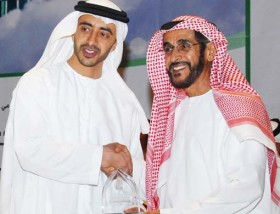
Shaikh Abdullah honoured key sponsors, philanthropists and winning students in the endowment campaign for their support and contribution to the drive.
Khalifa grants Dh370m for endowment drive WAM Published: October 03, 2007, 23:52
Abu Dhabi: President His Highness Shaikh Khalifa Bin Zayed Al Nahyan granted Dh370 million for the endowment campaign organised by the General Authority for Islamic Affairs and Awqaf.
The grant was announced during a ceremony held on Tuesday under the patronage of General Shaikh Mohammad Bin Zayed Al Nahyan, Abu Dhabi Crown Prince and Deputy Supreme Commander of the UAE Armed Forces.
Shaikh Abdullah Bin Zayed Al Nahyan, Foreign Minister, honoured key sponsors and philanthropists and the winning students in the endowment campaign for their support and contribution to the success of the campaign. He presented mementos, cash prizes and certificates of appreciation.
The campaign, launched on the first day of Ramadan, aims at reviving the Sunna Waqf and helping alleviate the burden of the poor and the needy.
It sponsors orphans and needy students and poor people. It also provides healthcare, helps to build and renovate mosques.
Dr Hamdan Musallam Al Mazroui, chairman of the authority, said: It gives me great pleasure to honour the participants in the endowment campaign.
The sponsors of the campaign will help to fulfil its maximum potential, Al Mazroui said. The ceremony began with the national anthem presented by students of the Emirates School in Abu Dhabi, followed by recitation of some verses from the Quran in the presence of Islamic scholars and preachers invited by Shaikh Khalifa to give lectures during Ramadan.
Al Mazroui hailed Shaikh Khalifa, His Highness Shaikh Mohammad Bin Rashid Al Maktoum, Vice-President and Prime Minister of the UAE and Ruler of Dubai, and Their Highnesses the Supreme Council Members and Rulers of the Emirates for their generous support to Islamic endowments.
The campaign, launched on the first day of Ramadan, aims at reviving the Sunna Waqf and helping alleviate the burden of the poor and the needy.
Upholding family values
Upholding family values
By Manal Alafrangi, Staff Writer GULF NEWS Published: October 03, 2007, 23:52
There is a certain universality when it comes to the term “family values” but because the concept itself is rooted in individual cultures, ideals and morals can come across as different. So then, what happens when people of different creeds and nationalities live in one society? Do they agree on what constitutes family values? Do they share the same ideals and principles?
According to our latest survey, there is a concern when it comes to cultural values being present in the UAE. That is, more than two thirds of our respondents feel family values are being eroded in the UAE. This opinion is particularly high amongst Arabs, excluding Emiratis (73 per cent). Moreover, 62 per cent of those surveyed feel people in the UAE are courteous and respectful to others but there is a difference of opinion amongst the various nationalities; 71 per cent of Emiratis compared to 39 per cent of Westerners.
Similarly, Arabs (excluding Emiratis) and Asians are also split on whether they think UAE residents have a community spirit. Emiratis and Westerners on the other hand are on opposite ends of the spectrum with the former saying they do and the latter saying they don’t.
That is one of the main conclusions from the latest Gulf News survey undertaken by YouGov-Siraj where by 1,191 people answered questions on family, growing old, and challenges to family time. (Of the total surveyed, 119 were Emiratis, 147 other Arabs, 168 Westerners, 669 Asians, and 88 others).
We asked our respondents who each of them considers to part of their own family. Across all nationalities, ‘parents’, ‘brothers and sisters’ and ‘spouse’ top the family member ladder. ‘Children’ and ‘grandparents’ are not far behind in the family members consideration set. Interestingly, despite no blood connection, 25 per cent believe friends are family and 16 per cent find employed household staff to also be part of family.
Who do they live with? More than half of our respondents say they currently live in the UAE with their spouse- this is clearly observed among Westerners and Asians (75 per cent and 63 per cent respectively) as compared to Arabs (42 per cent). Moreover, both Arabs and Asians seem to have more of their parents living with them in the UAE compared to Westerners. Arab scores are largely observed among Emiratis (6 in 10 Emiratis vs. nearly 3 in 10 other Arabs).
On the other hand, almost 1 in 10 lives alone in the UAE. This is primarily because their families live in different countries (numbers being highest amongst Western and Asian respondents). Some respondents simply say that they “prefer to live alone” (with 2 in 10 Emiratis saying so).
There is unanimity amongst our respondents when it comes to caring for their elderly parents. 95 percent said they would be supportive towards helping their parents as they grow older and become dependent upon others for help. What options would they seek in such a scenario? Nearly 6 out of 10 say they would nurse them at home themselves. But a closer look reveals that while 60 per cent of Arabs and 67 per cent of Asians feel this way, only 34 per cent of Westerners feel the same.
Instead, 40 per cent of Westerners say they would employ a nurse at home. Sending elderly parents to a nursing home proved the least popular option for our respondents.
Through this survey, we got an insight as to why respondents would consider helping their elderly parents. The overwhelming majority say they would do it out of love for their parents. 7 in 10 say it is because they feel a sense of gratitude to be repaid to parents and many feel it is expected of them to be with their family.
Our respondents are equally supportive of their spouse’s parents with 92 per cent saying they would care for them as the need arrives. Across all nationalities, Asians tend to be more supportive in assisting spouse’s elderly parents (95 per cent of Asians vs. 89 per cent for Arabs and 85 per cent for Westerners). Half of the respondents claimed they would be willing to nurse their spouse’s parents at home by themselves however, among Westerners, scores are directionally low.
As of now, over two thirds of our respondents prefer to live with their families than to live by themselves. This is especially the case with Asian respondents (82 per cent). What’s more, respondents aged 30-49 are more likely to want to live with family than younger respondents (aged below 30).
We asked UAE residents to peer into the future when they themselves become elderly; what then would they prefer their living arrangements to be? 48 per cent say they would like to with their own grown up children – assuming they had any. It should be noted that of the total, only 23 per cent of Westerners feel this way compared to 52 per cent of Arabs and 53 per cent of Asians..
Another option is to live in a nursing home or a retirement village. While it has proved unpopular amongst the Arab and Asian respondents, 27 per cent of Westerners choose it as their preferred option.
An extended family has its benefits. The majority of our respondents feel having them around is advantageous namely for emotional support. They also improve family bonding and help maintain a sense of belonging. But by the same token, having an extended family means a lack of privacy and lack of personal space for the majority of our respondents- irrelevant of their demographic profile.
Working life affecting private life
Our respondents are split on whether their or their partner’s working life has impacted their private life. 39 per cent said it has impacted their private life a lot, while 30 per cent say the impact has been small. A closer look at the survey shows that more females claim their partner’s working life has greatly impacted their private life. On the other hand, 16 per cent find there has been no impact whatsoever.
Fifty six per cent have at least 1 child in their household. They say that on average, they spend 3 hours and 50 minutes with their children on a typical work day. Emirati parents tend to spend fewer hours with their children as compared to other Arabs.
On average, it is likely that parents waste 5 hours and 4 minutes without being with their children due to work related issues outside of regular office hours or other commitments. Such work related issues include traffic congestion, which is by far, the most recalled factor that makes people stay away from being with their families (this is clearly observed among Asians). Shopping, socialising, and going to the gym are also reasons that feature lightly on the survey.
Importance of family values
UAE residents believe that family values are important in today’s world. Asians in particular have the highest scores when it comes to this conviction. We asked our respondents if they thought their family values are being eroded here in the UAE. Close to two thirds said yes. This opinion was particularly high amongst other Arabs (73 per cent). The three main reasons behind this are: lack of time for families to be together, economic pressure, and lack of parental guidance.
Other explanations including lack of proper role models and having too many temptations also feature prominently on the survey.
So then, how do our respondents generally feel about people in the UAE? Are they courteous and do they have a community spirit? Sixty-two per cent of those surveyed said yes but there is a difference of opinion amongst the various nationalities; 71 per cent of Emiratis compared to 39 per cent of Westerners.
Giving back to Society
Giving back to Society
By Robert Ditcham, Staff Reporter GULF NEWS Published: October 03, 2007, 23:52
Ask company employees about the importance of addressing global poverty, illiteracy, homelessness and environmental decay and most will say they care deeply.
Although they may do their bit, financial restraints and limited time may hinder their charitable efforts.
Their employer, on the other hand, has the financial muscle, brand status and human resources to tackle these issues head on. But is it actively engaging in corporate social responsibility (CSR) programmes?
In the UAE, the answer is more often than not a negative one. Brand analysts and companies say CSR in the UAE is in its infancy compared to North America, the Far East and Western Europe.
“Developed markets have been open for longer, commercial models and structures have been established, while consumers and pressure groups have grown in importance and in their ability to scrutinise and apply pressure to companies,” said Manal Shaheen, director, sales, marketing and customer service at real estate giant Nakheel.
However, she and many others say the UAE could be on the verge of embracing the global CSR phenomenon, with the recently-launched Dubai Cares campaign providing the much-needed catalyst.
At the time of going to press, nearly Dh700 million have been raised under the initiative, which will put one million children through primary education.
“Of course, there is still some way to go in this part of the world, but I believe that CSR will grow more rapidly than it did in those other regions because the momentum has built up, and lessons – both good and bad – have been learned,” Shaheen said.
As with any decision in the corporate world, there needs to be clear benefit to the firm itself. Why should companies invest in society at large when their primary concern should be their shareholders? After all, isn’t it the job of politicians to tackle society’s ills?
Obligation
According to CSR promoters, companies have a moral obligation to support society and the environment.
“We believe that CSR initiatives are a means for us to give something back to the society and the nation that has handed us everything to get us to where we are now,” said Princy Philip, manager for marketing and corporate communications at UAE property developer Memon Investments. “This fact makes it our moral responsibility to care for the unfortunate and provide for the unloved.”
Defining the business case for CSR is often more of a challenge. But, in a world where brand value and reputation are increasingly seen as a company’s most valuable assets, the pros are becoming more apparent to UAE chief executives.
According to an Ernst & Young survey in Europe, 94 per cent of company executives believe the development of a CSR strategy can deliver real business benefits.
“CSR is becoming more and more important in terms of building a strong corporate brand image, while companies are facing increasing pressure from their clients, customers and staff to be responsible corporate citizens,” said Hermann Behrens, the Dubai-based managing director of brand consultants Enterprise IG.
Behrens stressed that in the Gulf’s competitive job market, potential employees factor in a company’s CSR record when choosing their future job, selecting those that can make a positive impact on society.
According to the organisation CSR Europe, 78 per cent of employees would rather work for an ethical and reputable company than receive a higher salary.
CSR Europe argues that a “responsible attitude” towards society and the environment can make a business more competitive, more resilient to shocks, and more likely to attract and hold both consumers and the best employees.
Business sense
And in a world where socially responsible investment is growing, CSR can also attract investment and save businesses money in dealing with regulators, banks and insurers, the organisation adds. It says socially responsible investment accounts for nearly 13 per cent of the $16.3 trillion in investment assets under professional management in the US.
“The reason companies are taking the issue more seriously because it makes good business sense,” said Shaheen.
“Firstly, it has become clear recently that financial markets are factoring in some of the ‘sustainability’ issues into their valuations and decisions to invest or move their funds.
“Secondly, as customers get more savvy, it’s getting easier to compare the Good and the Bad. There is enormous value with your customers if they know you are one of the good guys and it’s no coincidence that people are prepared to pay a premium for this.”
But adopting CSR initiatives doesn’t always result in a rosy picture being painted of a company. Those that throw money at environmental causes and champion human rights, but also pollute the atmosphere and exploit their workers, will soon be found out, resulting in spectacular public relations disasters.
Behrens said good CSR is about a lot more than donating large sums to noble causes. A CSR campaign that engages the whole company in its ethos and gets its staff involved in charities or social work will have the best results, he said.
Shaheen said Nakheel is aware that CSR is much more than making “token gestures”.
“Although it’s quite normal for companies to make big statements, huge promises, or grand gestures, negative impressions can often be caused by what I’d call ‘tokenism’ – when companies obviously bolt-on campaigns or initiatives that are clearly superficial gestures and not integrated into the ethos of the company,” she said.
“I think that a lot of companies are on the journey from one to the other at the moment.”
The corporate sector’s swift response to the Dubai Cares campaign is among several examples of CSR being pursued in the UAE.
Memon Investments, a Dubai-based property developer and part of the international business conglomerate, the Memon Group of Companies, recently announced its participation in the ‘Safe & Sound’ campaign – BurJuman’s breast cancer awareness programme – as the official annual sponsor.
This will mark Memon Investments’ first CSR undertaking in the region.
Giant property developer Nakheel said it has established initiatives such as Bidaya, an educational and leadership programme aimed at discovering and nurturing the UAE’s next generation of leaders.
The programme offers university scholarships to outstanding male and female candidates from the country’s public high school system.
As one of its key CSR initiatives during 2007, Dubai Holding recently said it has pledged nearly Dh1.5 million to two organisations – the UAE Beit Al Khair and the Dubai Autism Centre.
Over the past two years, Dubai Holding has contributed more than Dh80 million in projects such as a facility for Zayed University and Dubai Education Council.
“Even as we rapidly drive our business to cross new milestones, we regard it as our duty to share the responsibility of the general welfare of the community,” said Mohammad Al Gergawi, executive chairman of Dubai Holding.
Meanwhile, a golf team from oil and gas major BP decided to use its $1,000 prize money won in a golf tournament recently to pay for a facility for autistic children at the Future Centre in Abu Dhabi.
Multinational corporation Halliburton has also made donations to The Future Centre, which provides schooling for children with special needs, through its Halliburton International Fund.
How bad can a good thing be?
How bad can a good thing be?
28 Sep, 2007, 0000 hrs IST
My bank’s relationship manager emails weekly parables – simple stories with a moral lesson – to his customers.
This week he sent this:
A father wanted to inculcate a sense of responsibility in his careless son. So he told him that for every careless act of his he would hammer a nail into a wooden pillar in their house, and for every positive act he would pull out one nail.
The boy saw that the pillar was getting crowded with nails, so he resolved to change his behaviour and soon the nails started coming out, till there were none left. The father was very proud. He said, “Son, you have done a great job, there are no more nails left on the pillar.” The boy, however, started crying and replied, “The nails are gone but the holes remain.”
The fable’s obviously been made up to teach a few pithy lessons such as that some mistakes are part of the learning process and may be unavoidable; or, mistakes even when corrected, leave marks forever. Also, that some mistakes are just not correctable and the price paid is very heavy – for example, carelessness while crossing the street can cost a life. etc.
However, if we leave out the boy’s last comment and halt the story at him just crying after there were no more nails left, we can discover an altogether different kind of message running through the story.
For instance, could he have begun crying because it might suddenly have dawned on him that there were no more mistakes left to be corrected? Because in that case he must have also realised his good behaviour and deeds were not as spontaneous as he believed they were.
Instead, the positive acts were those of redemption goaded by his earlier irresponsible behaviour that had nailed him to the wooden pillar in the first place. (The reason for crying could also have been due to the fact that once he knew his impetus for doing good arose from un-good acts, it turned out to be not a great feeling to live with.)
Something similar had happened to Emperor Ashok too, the man they used to call murderous and heartless. On the battlefield of Kalinga when he saw the scattered corpses – basically his own set of nails – he is supposed to have cried out, “What have I done?” Indeed, what had he? And so he spent the rest of his life pulling out one nail after another till there were none.
Could Ashok have been greater if he had been virtuous to begin with and had not required gutted soldiers to remind him he was doing something wrong? He could. That’s another moral of the relationship manager’s parable.
Job Hopping!!
Mr. Gopalakrishnan succeeds Mr. Ratan Tata as Chairman of Tata Sons
Ltd., the holding company for many of the Tata Bluechips like Tata
Steel, Tata Motors, Tata Power, Tata Chemicals, Voltas, etc.,
Possibly he is the first non-Tata person to head the Tata Empire.
The grass isn’t always greener on the other side!!
Move from one job to another, but only for the right reasons. It’s yet
another day at office. As I logged on to the marketing and advertising
sites for the latest updates, as usual, I found the headlines
dominated by ‘who’s moving from one company to another after a
short stint’, and I wondered, why are so many people leaving one job
for another?
Is it passé now to work with just one company for a sufficiently long
period?
Whenever I ask this question to people who leave a company, the
answers I get are: “Oh, I am getting a 200% hike in salary”; “Well, I
am jumping three levels in my designation”; “Well, they are going to
send me abroad in six months”.
Then, I look around at all the people who are considered successful
today and who have reached the top – be it a media agency, an
advertising agency or a company. I find that most of these people are
the ones who have stuck to the company, ground their heels and worked
their way to the top. And, as I look around for people who changed
their jobs constantly, I find they have stagnated at some level, in
obscurity!
In this absolutely ruthless, dynamic and competitive environment,
there are still no short-cuts to success or to making money. The only
thing that continues to pay, as earlier, is loyalty and hard work.
Yes, it pays!
Sometimes, immediately, sometimes after a lot of time. But, it does
pay.
Does this mean that one should stick to an organization and wait for
that golden moment? Of course not. After a long stint, there always
comes a time for moving in most organizations, but it is important to
move for the right reasons, rather than superficial ones, like money,
designation or an overseas trip.
Remember, no company recruits for charity.
More often than not, when you are offered an unseemly hike in salary
or designation that is disproportionate to what that company offers it
current employees, there is always unseen bait attached.
The result? You will, in the long-term, have reached exactly the same
levels or maybe lower levels than what you would have in your current
company.
A lot of people leave an organization because they are “unhappy”. What
is this so-called-unhappiness? I have been working for donkey’s years
and there has never been a day when I am not unhappy about something
in my work environment-boss, rude colleague, fussy clients etc.
Unhappiness in a workplace, to a large extent, is transient.
If you look hard enough, there is always something to be unhappy
about.
But, more importantly, do I come to work to be “happy” in the truest
sense?
If I think hard, the answer is “No”. Happiness is something you find
with family, friends, may be a close circle of colleagues who have
become friends.
What you come to work for is to earn, build a reputation, satisfy your
ambitions, be appreciated for your work ethics, face challenges and
get the job done.
So, the next time you are tempted to move, ask yourself why you moving
and what are are you moving into.
Some questions are:
* Am I ready and capable of handling the new responsibility? If yes,
what could be the possible reasons my current company has not offered
me the same responsibility?
* Who are the people who currently handle this responsibility in the
current and new company? Am I as good as the best among them?
* As the new job offer has a different profile, why have I not given
the current company the option to offer me this profile?
* Why is the new company offering me the job? Do they want me for my
skills, or is there an ulterior motive?
An honest answer to these will eventually decide where you go in your
career- to the top of the pile in the long term (at the cost of
short-term blips) or to become another average employee who gets lost
with time in the wilderness?
“DESERVE BEFORE YOU DESIRE” – Dr. Gopalkrishnan, Chairman TATA Sons.
 ClicksandWrites
You must be logged in to post a comment.