Information – Oil Gas Future Energy
Reliance plans $24 bn investment in petrochemicals
Reliance plans $24 bn investment in petrochemicals
IST, PTI
DUBAI: Reliance Industries, India’s largest company by market value, plans to spend $24 billion over the next ten years in setting up petrochemicals projects in the Middle East, company Chairman and Managing Director Mukesh Ambani is reported to have said.
“We plan to set up a number of petrochemical plants in the next decade, with each costing $4-6 billion,” the Dubai-based Gulf News quoted Ambani as saying.
Ambani had yesterday told a conference here that building five billion dollar petrochemicals plants in the Middle East will be the best way for Reliance, India’s biggest producer of chemicals, to meet India’s quadrupling demand of chemicals in the next 10 years.
Reliance wants to tap the growing demand for chemicals in Asia, especially in China and India.
“Dubai will be the gateway to our future investment in this part of the world and beyond,” Gulf News quoted Ambani as saying. “We will increase our headcount in Dubai, which will be the nerve centre of our international operations.”
Ambani, who had yesterday at the petrochemical conference said that Reliance would aggressively pursue acquisitions as part of a new strategy to grow, told Gulf News his company was not yet ready for big-ticket acquisitions.
“We will need to grow and invest in our own expansion for at least 10 more years, before entering into big-time acquisitions,” he was quoted as saying.
Adnoc to supply full term crude for February
Adnoc to supply full term crude for February
Reuters GULF NEWS Published: December 28, 2007, 00:32
Tokyo: Abu Dhabi National Oil Co (Adnoc) will supply full term volumes of crude oil to its Asian customers for February, the same as January, in line with expectations, traders said yesterday.
On top of the contracted volumes, Adnoc is expected to supply additional spot barrels to some lifters upon request for a third straight month, they added.
Adnoc occasionally sells extra crude to its term buyers in Asia, its main export market, though exact volumes to be supplied were not immediately known.
Three lifters had received written notices that they would get full term volumes for a third month in February and did not ask for extra barrels. “It was exactly at the contracted levels,” one source said. “We had been thinking that there would be no cuts.”
Traders said Adnoc was likely to supply additional volumes of light sour Murban crude for February as spot cargoes to some lifters in need, but one said the volumes will be limited.
When lifters decide to take additional spot crude from Adnoc, they buy at the grade’s official selling price without having to pay a premium in the spot market. The spot differentials for middle-distillates-rich Murban crude for February loading have stayed at a premium of around 20-25 cents a barrel to Adnoc, reflecting winter demand.
A trader said Adnoc offered additional offshore Upper Zakum crude to some lifters, but it was not clear whether any lifter accepted the offer.
Liquefied natural gas poised to surpass oil as energy source
Liquefied natural gas poised to surpass oil as energy source
By Leah Bower, Special to Gulf News Published: December 24, 2007, 22:58
Oil may be the energy source on everyone’s mind right now, but there is a good chance that liquefied natural gas (LNG) will surpass it as oil prices remain astronomical.
Once a bit of a backwater in the energy field, demand for LNG has been on a steady rise because it is relatively clean burning and because its liquefied state allows for transport to remote locations without construction of elaborate and expensive pipeline networks.
And while it can’t hold a candle to oil’s price, quite a few analysts seem to see it as the bandwagon of choice to jump on to.
Worldwide demand for LNG during the first half of 2007 was pegged at roughly 115 billion cubic metres (bcm), roughly nine per cent growth over the same period in 2006, and demand in East Asia has been growing even faster.
Calgary-based Ziff Energy says it expects demand for natural gas in North America will rise by 1.8 per cent a year through 2015, and US Energy Department data backs up that claim, reporting that they expect imported LNG to increase from three per cent of total gas consumption to 14 per cent by 2020.
Currently, Japan is the world’s largest LNG consumer, importing 81.86 bcm of natural gas as LNG in 2006. South Korea is second and the US currently ranks as the fourth-largest consumer.
LNG is natural gas, but it is reduced to a liquid state by cooling it to about minus 160° Centigrade, which reduces the volume of the gas by about 600:1 and makes transportation far simpler. Before it can be used, LNG must be returned to its gaseous state at a regasification plant. For countries like Qatar, which is sitting on the world’s largest natural gas reserves – 25 trillion cubic metres – the renewed interest in LNG is a boon, since there is no need for pesky pipelines that travel through neighbouring countries before reaching their destinations.
Just ask the Europeans, who saw their natural gas get cut off in early 2006. Russia, where the pipeline originated, and Ukraine, which hosted part of the pipeline, had a price dispute. The two countries disagreed and so did the Europe’s energy supply. The dispute even resurfaced in 2007, although the gas continued to flow this time.
So LNG, with its ability to be shipped by sea or land, is slowly building a power base. And people like Qatar’s Energy Minister, who once said it was “bad news” that the country only had gas reserves and no oil, are starting to change their tune.
The International Energy Agency (IEA) reported that by 2010 Qatar could own 20 per cent of the global LNG market.
Other countries with reserves are hopping on board as well.
The Australian government expects energy production growth down under will be led by LNG, with exports of the fuel set to grow by more than seven per cent yearly, through 2030. That would have LNG output rise from less than 16 million metric tonnes in 2007, to 24 million by 2012, and possibly reaching as high as 76 million by 2030 as new projects come online.
Without the ability to ship liquefied natural gas, this type of growth would have been almost inconceivable. Already the $16 billion) North West Shelf venture is expanding LNG capacity, while Perth-based Woodside is building the Pluto project, also in Western Australia.
Chevron is planning to expand its $10 billion liquefied natural gas project known as Gorgon, which now calls for three liquefaction production lines, instead of two. Inpex Holdings and BHP Billiton are also proposing new plants.
Get on board while the year is new.
The writer is a freelance journalist based in Alaska, USA.
UAE’s crude production falls 18% in November
UAE’s crude production falls 18% in November
By Himendra Mohan Kumar, Staff Reporter GULF NEWS Published: December 23, 2007, 00:36
Abu Dhabi: The UAE’s crude oil output fell by more than 18 per cent in November, mainly due to maintenance being conducted on some offshore fields, the Organisation of Petroleum Exporting Countries (Opec) said in its market report for December.
The UAE pumped an average of 2.12 million barrels per day of crude oil in Nov-ember, making it the seventh largest Opec producer last month, the group said.
Citing secondary sources, Opec said that oil production by Saudi Arabia, Iran, Kuwait, Venezuela, Nigeria and Iraq was higher than that of the UAE.
Offshore field maintenance in Abu Dhabi, which produces more than 90 per cent of the UAE’s oil, reduced production in Nov-ember by as much as 481,000 bpd.
The fields that were particularly affected were Umm Shaif, Upper Zakum and part of Lower Zakum.
Industry sources say full output is expected to be restored shortly.
Crude oil production by all 13 Opec members averaged 31.45 million bpd in November.
Abu Dhabi will invest $20 billion to boostoil and natural gas output.
BP to work on LNG safety programme with Qatar
BP to work on LNG safety programme with Qatar
By Himendra Mohan Kumar, Staff Reporter GULF NEWS Published: December 19, 2007, 23:54
Abu Dhabi: Global energy major BP and Qatar Petro-leum have signed a memorandum of understanding to develop and fund a world-class liquefied natural gas safety research programme in Qatar.
The MoU is in partnership with the Qatar Foundation, and Texas A&M University and its affiliates. The agreement was signed by Mohammad Bin Saleh Al Sada, Qatar’s minister of state for energy and industry affairs.
“We at Qatar Petroleum believe that this MoU represents a significant step in our quest to develop the Qatari human resources, and we are sure partnerships with leading institutions will contribute to the advancement of science, and enhance technical skills of safety in the LNG industry,” said Al Sada.
“We are proud to be a part of this programme which will certainly be a remarkable achievement for Qatar Petroleum and the oil and gas industry in Qatar,” he added.
The programme, which will extend and complement the existing BP-sponsored programme run at the Texas A&M University in College Station, Texas, will help advance the technical understanding of key safety issues impacting the worldwide LNG industry.
The research will be carried out at the Texas A&M University branch campus within the Qatar Foundation university campus in Doha and will encompass practical testing at Qatar Petroleum’s Ras Laffan Emergency and Safety College which is currently being constructed at Ras Laffan Industrial City.
“As Qatar continues to develop its leading role in the LNG world, such activities will facilitate the transfer of relevant technologies and build human capacity in LNG safety for the benefit not only of Qatar but also the LNG industry worldwide,” said Steve Peacock, president of BP’s Middle East and South Asia Exploration and Production Unit.
Qatar is the world’s largest exporter of LNG and aims to more than double its exports to 77 million tonnes per year by 2011 on the back of multibillion dollar projects.
Linde sets up joint gas venture with Adnoc
Linde sets up joint gas venture with Adnoc Reuters Published: December 19, 2007, 23:54
Frankfurt: Germany’s Linde has set up a joint venture with the Abu Dhabi National Oil Co (Adnoc) for the production and long-term supply of industrial gases to customers there, it said yesterday.
Gases and engineering group Linde said it held 49 per cent of the venture, named Elixier, and that state-run Adnoc owned the remaining 51 per cent.
“This joint venture is of major strategic importance to us and is the logical expansion of the previous collaboration of our engineering division with Adnic in the petrochemical industry,” Linde executive board member Aldo Belloni said.
Adnoc has access to about 90 per cent of Abu Dhabi’s oil and gas reserves, considered the fourth-largest in the world.
In the first phase of the joint venture, the companies will build a $65 million air-separation plant in the industrial zone of Ruwais, Abu Dhabi.
By the end of 2009, the plant will supply nitrogen to industrial customers in Ruwais and will produce liquefied nitrogen and oxygen.
Opec to raise quotas in Feb
Opec to raise quotas in Feb
(Bloomberg)17 December 2007
NEW YORK — Opec, producer of more than 40 per cent of the world’s crude oil, may increase output quotas when it meets on February 1 because stronger demand is expected during the winter season, Algerian Oil Minister Chakib Khelil said.
“The forecasts now point toward a cold winter, and the economy seems to be improving. That means stronger demand” for oil, Khelil said yesterday in an interview in Limassol, Cyprus.
“The chances that we could decide to increase output are greater than reducing output.”
The Algerian oil official will become the Organisation of Petroleum Exporting Countries president on the first of the year for a 12-month term. Venezuela’s Oil Minister Rafael Ramirez said earlier this month that the oil exporters group may decide to reduce output when it meets in February to discuss output policy at its headquarters in Vienna.
Oil prices in New York closed in New York on December 14 at $91.27 a barrel, up more than 4 per cent since Opec decided to keep production quotas unchanged at its December 5 meeting.
Opec’s production ceiling now stands at 29.673 million barrels a day for 12 of its members.
War-torn Iraq is the only member without a quota.
Khelil is in Cyprus this week to attend a conference of European and Mediterranean energy ministers which starts tomorrow.
HPCL awards three naphtha cargoes to Itochu
HPCL awards three naphtha cargoes to Itochu
14 Dec, 2007, 2052 hrs IST, PTI
NEW DELHI: India’s state-run Hindustan Petroleum Corp has sold three naphtha cargoes for February to April lifting at a premium of slightly higher than $15.5 a tonne to Middle East spot quotes, a trade source said on Friday.
The three 30,000-tonne cargoes have been awarded to the Japanese trading house Itochu, the source, who did not wish to be identified, said.
Other than the term contract, HPCL has also awarded Itochu a 25,000-30,000 tonnes cargo of naphtha for loading in the first half of January at a premium of around $12.5 a tonne, he said.
Another HPCL cargo for loading in the second half of January was awarded to Glecore at a higher premium of $18-$19 per tonne, the source said. All the cargoes are scheduled for loading from Vizag port in the east coast.
Indian Oil-Oil India win 3 onshore oil blocks in Libya
Indian Oil-Oil India win 3 onshore oil blocks in Libya
NEW DELHI: The Indian Oil-Oil India combine has won three onshore oil blocks in Libya, adding to the two blocks the consortium already had in the nation that holds Africa’s largest oil reserves.
IOC-OIL teamed up with Sonatrach of Algeria to win blocks 1, 2 and 3 in contract area 95/96 in the Ghadames Basin, industry sources said.
In the previous Libyan licensing round, IOC-OIL combine had been disqualified from bidding but in the latest round, they were qualified to bid as investors. The two teamed up with Sonatrach, which will be the operator of the blocks.
IOC-OIL combine had in 2005 won 7,087 sq km Block 86 and 2,710 sq km Block 102/4. Both hold 50 per cent stake in each and OIL is operator for both.
Sources said OIL-IOC and Sonatrach will now sign an Exploration and Production Sharing Agreement (EPSA) with the National Oil Corp of Libya. The Algerian national oil company will be the operator of the blocks won in this round.
Libya auctioned exploration permits in the central, western and southern desert, in its first licensing round in potentially gas-rich areas.
Russia’s state-run natural gas exporter Gazprom joined Shell, Europe’s largest oil company, Algeria’s Sonatrach and Polskie Gornictwo Naftowe i Gazownictwo SA of Poland in winning four of 12 licenses on offer.
The winners agreed to pay a minimum bonus of 10 million dollars when they signed the contract. Libya’s National Oil Corp, which ran the auction, chose the companies that would give it the highest share of production from any field they find.
Shaikh Khalifa reviews new building project by Adnoc
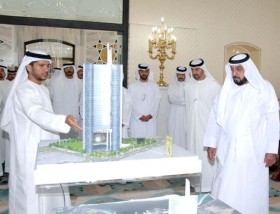
Shaikh Khalifa reviews new building project by Adnoc
(Wam)11 December 2007
ABU DHABI — The President, His Highness Shaikh Khalifa bin Zayed Al Nahyan, yesterday reviewed a model of the Abu Dhabi National Oil Company’s new headquarter project in the presence of General Shaikh Mohammed bin Zayed Al Nahyan, Crown Prince of Abu Dhabi and Deputy Supreme Commander of the UAE Armed Forces.
The project, designed by an international consultancy house, envisages construction of a 39 to 49-storey building which can accommodate over 2,000 staff and customers.
The project’s first phase involves construction of the main offices. Work on the first phase will commence in 2009. It is scheduled to be completed by 2011. The project’s second phase will be completed in early 2014. The state-of-the-art building is designed to be energy efficient. It will be located in an area adjacent to the Emirates Palace hotel and Adnoc’s old building.
The company’s old building was opened in 1979 by the late Shaikh Zayed bin Sultan Al Nahyan.
The reviewing session was attended by Shaikh Mansour bin Zayed Al Nahyan, Minister of Presidential Affairs, Shaikh Hamed bin Zayed Al Nahyan, Chief of Abu Dhabi Crown Prince’s Court, Chairman of Higher Corporation for Specialised Economic Zones (Zonecorp), Shaikh Omar bin Zayed Al Nahyan, the President’s aide de camp, Dr Shaikh Sultan bin Khalifa Al Nahyan, other Shaikhs, members of the Supreme Petroleum Council and senior officials.
 ClicksandWrites
You must be logged in to post a comment.