Information – Oil Gas Future Energy
Jet gets right to fly to Gulf, Middle East from Jan 1
Jet gets right to fly to Gulf, Middle East from Jan 1
14 Sep, 2007, 1323 hrs IST, PTI
NEW DELHI: The government on Friday opened up the lucrative Gulf route to domestic private airlines, with Naresh Goyal-promoted Jet Airways becoming the first to get the nod to fly to the region from January 1 next year.
Hitherto, only Air India and Indian (now merged to form Air India) were allowed to operate on the Middle East and Gulf route.
As per the decision of the government, scheduled Indian private airlines were not permitted to operate international flights to and from Gulf till the end of 2007. The Gulf routes were served only by the Indian public carriers till then, an official statement said.
Jet Airways was granted traffic rights on the Gulf and Middle East routes at a meeting of the Directorate General of Civil Aviation last evening, it said.
Jet has been permitted to carry 3,682 passengers to Kuwait per week from three destinations in India. Of the 3,682 seats, 1,582 would be from the Delhi-Kuwait route while an equal 1,050 on Trivandrum-Kuwait and Kochi-Kuwait routes, the statement said.
Besides, Jet can also fly 3,150 passengers to Oman per week on three routes Kochi-Muscat and Trivandrum-Muscat and Calicut-Muscat.
The airliner has been given permission to connect Calicut and Mumbai to Qatar’s capital city Doha, where it can carry a maximum of 2,100 passengers per week.
Similarly, Jet can operate 2,100 seats to Bahrain, of which 1,050 can be on the Mumbai-Bahrain and 1,050 on Kochi-Bahrain route.
Jet Airways had applied for traffic rights on the India-Gulf, Middle East routes on July 18 this year.
While the government has cleared Jet’s application to operate on a majority of routes, it said the airliner’s application to fly on India-Dubai and India-Abu Dhabi route was still being considered.
“The company had asked for rights on routes to Kuwait, Oman, Qatar, Bahrain, Dubai and Abu Dhabi. Their request for grant of traffic rights on India-Dubai and India -Abu Dhabi routes is under the consideration of the Government,” the statement said.
The total entitlement for Indian carriers on the Gulf routes at present is 85,481 seats per week, of which 21,950 are for Dubai, 7,420 for Abu Dhabi, 10,206 for Sharjah, 8,000 for Kuwait, 10,892 for Qatar, 7,546 for Oman, 10,967 for Bahrain and 8,500 for Saudi Arabia.
The utilisation by Indian carriers of the available Gulf routes is 49,348 seats per week, the statement said.
Opec extraordinary meeting to be held in Abu Dhabi on Dec 5

Abu Dhabi: The 146th extraordinary meeting of the Organisation of Petroleum Exporting Countries will be held in Abu Dhabi on December 5, the organisation said in its schedule of forthcoming events.
The third Opec summit will be held in Riyadh, Saudi Arabia, on November 17 and 18.
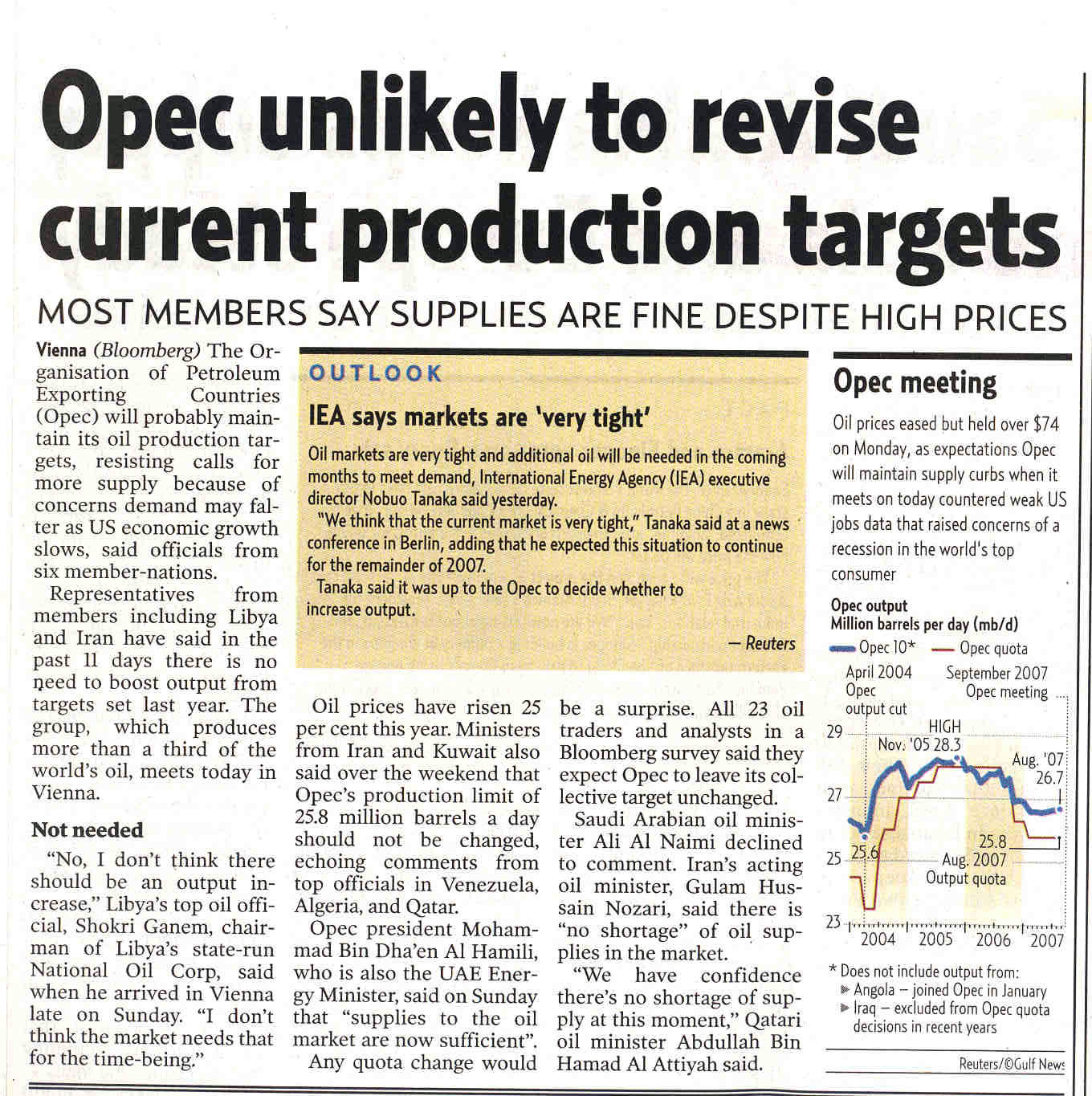
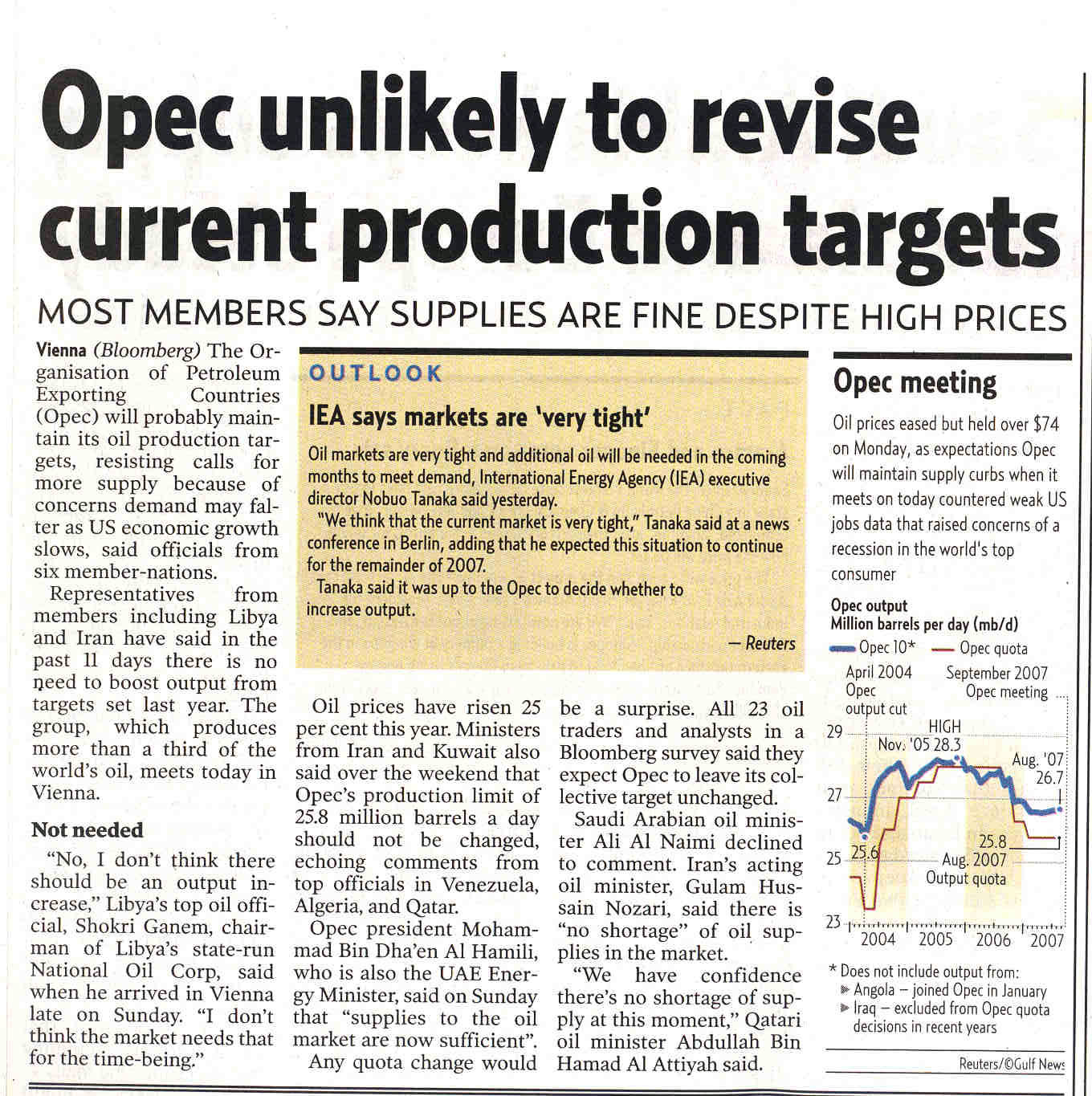
International media reports on Monday said Opec will probably maintain its oil production targets, resisting calls for more supply because of concerns that demand may falter as US economic growth slows.
Representatives from member states, including Libya and Iran, have maintained over the past fortnight that there is no need to boost output from those targets set last year.
Ministers from Iran and Kuwait also said over the weekend that the organisation’s production limit of 25.8 million barrels a day should not be changed, echoing comments from top officials in Venezuela, Algeria and Qatar.
UAE’s Minister of Energy and Opec president Mohammad Bin Dha’en Al Hamili said yesterday that “supplies to the oil market are sufficient,” state news agency WAM reported.
Oil prices have risen 24 per cent this year and touched a record $78.77 a barrel in New York on August 1 after members of the organisation curbed exports to drain inventories.
Contribution
Opec countries have made significant contributions to their reserves in recent years by adopting the best practices in the industry.
As a result, the proven reserves of the organisation currently stand well above 900 billion barrels.
Output: Group produced 30.37m bpd in August
Opec produced 30.37 million barrels per day in August, or over a third of the world’s 85 million bpd supply.
Opec countries hold more than three-quarters of the world’s oil reserves. The bulk of Opec oil reserves is located in the Middle East, with Saudi Arabia, Iran and Iraq contributing 56 per cent to the organisation’s total.


Enoc appoints new chief executive to oversee future growth strategy

Enoc appoints new chief executive to oversee future growth strategy
Staff Report GULF NEWS Published: September 10, 2007, 00:16
Dubai: Emirates National Oil Company (Enoc) yesterday announced the appointment of Saeed Khoury as group chief executive designate.
Hussain M. Sultan, Enoc group chief executive, said, “Saeed Khoury is a proven expert in the oil and gas industry with 28 years of solid experience in the UAE. I am delighted to welcome him to a new strategic role that will drive Enoc’s future growth and help us maintain our leadership position.”
Khoury joins Enoc from Abu Dhabi National Oil Company (Adnoc) where he was assistant general manager, technical. He has also served as a board member in a number of oil and gas service companies.
Established in 1993 as a wholly-owned company of the government of Dubai, Enoc aims to promote the interests of its shareholders through the development of further downstream and upstream activities in the oil and gas sector and beyond and to encourage the economic diversification of Dubai and the rest of the UAE.
Enoc’s joint ventures with major international companies allow partners to pool their technology, know-how and expertise along with resources to further commercial success.
BP ready to take opportunities in Iraq
BP ready to take opportunities in Iraq
Reuters / Published: September 04, 2007, 00:37
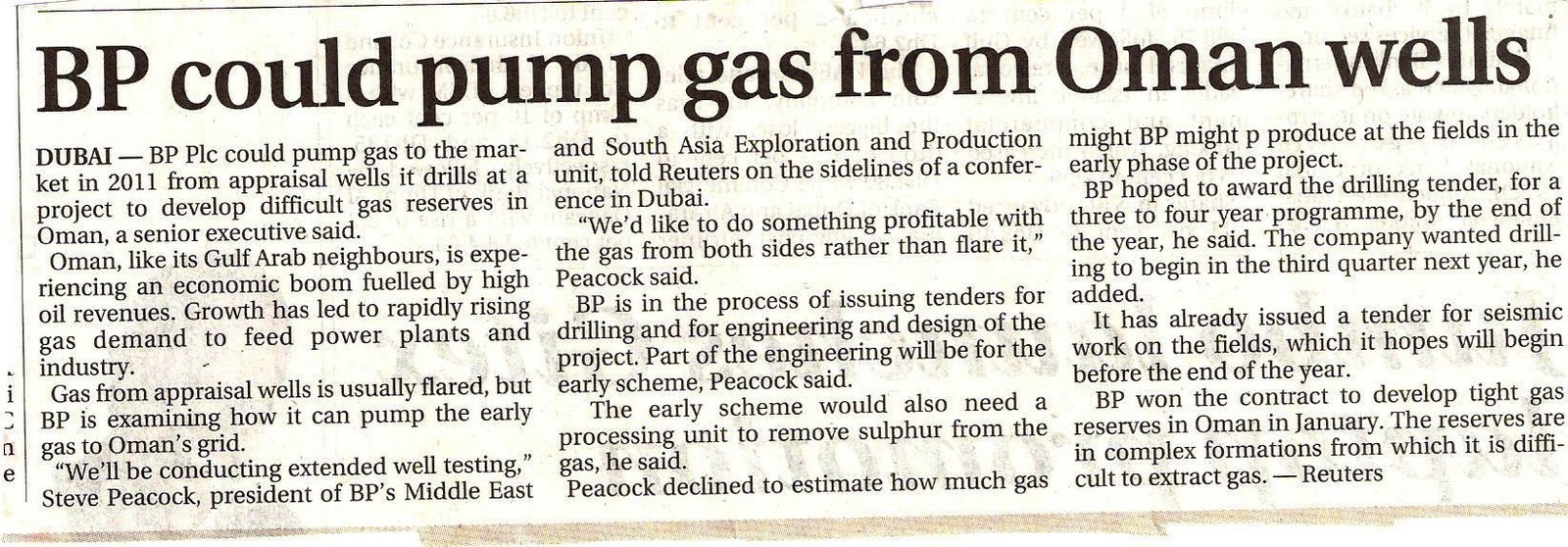
Dubai: BP is ready to compete for the opportunities that arise in Iraq’s oil and gas sector once the country passes its oil and gas law, a senior executive said on Sunday.
Iraq’s parliament has yet to debate the controversial oil law, but was expected to consider it this month. Washington has pushed Iraq for months to speed up passage of the oil law, which is among legislation it sees as pivotal to reconciling warring Iraqis and attracting foreign investment.
“We’ve studied all of Iraq and absolutely have a view on which are the relatively good looking prospects,” Steve Peacock, president of BP’s Middle East and South Asia Exploration and Production unit, told Reuters on the sidelines of a conference in Dubai. “Whether it turns out to be a licensing round or some other form of offering, we’re ready.”
Open tender
Iraq’s oil minister said last month the government hopes to call an open tender to develop its oilfields as early as this month if the law was passed. Developing the oil sector and boosting export revenues are key to reconstructing the country’s shattered economy.
The contracts and terms that Iraq may offer oil companies to work on its prized oilfields have yet to be defined.
The type of contract was much less important than ensuring the terms were attractive for both the oil company and the government, Peacock said.
“There are many forms of contract that can find that sweet spot in the middle,” Peacock said.
Oil companies tend to regard short-term service agreements as less of a lure than longer-term production sharing agreements.
Service agreements could be attractive if the terms compensate for the skills, tools and experience that international oil companies bring to the table, he said.
BP would be unable to send people to work in Iraq until the security improves, he said.
“We hope that happens soon for the sake of Iraqi people, not just so that we can go in and do business,” he said.
Recommendations that BP has made to Iraq on the southern Rumaila oilfields have had a positive effect on output there, he said.
Studies that BP carried out on Rumaila, one of Iraq’s largest oilfields, showed that production could be boosted quickly with application of modern techniques, he added. He declined to detail the potential increase.
“This ought to be encouraging for Iraq, although I can’t say if all the fields look lie Rumaila.”
Years of war and sanctions and more recently insecurity have led to chronic underinvestment in Iraq’s oil sector and led to concern of permanent damage to oil reservoirs at fields such as Rumaila.
OPEC president says no shortage of oil
OPEC president says no shortage of oil
(Reuters)6 September 2007
DALIAN, China – The oil market is well balanced and there is no shortage of crude, OPEC’s president said on Thursday, ahead of a meeting of the producer group next week that is expected to maintain supply curbs.
“I think the market is very well balanced… There is no shortage whatsoever of oil supplies,” Mohammed bin Dhaen al-Hamli, who is also oil minister of the United Arab Emirates, told Reuters.
In the run up to the Sept. 11 gathering, several members of the Organization of the Petroleum Exporting Countries (OPEC) have said they see no need to boost supply, despite calls by consumer nations for an increase that could help bring down high prices.
Hamli, in the northeastern Chinese city of Dalian for the World Economic Forum, declined to comment on what OPEC would decide at next week’s meeting.
OPEC has spare capacity ready to meet extra demand if necessary, but any additional crude it produced now would go into already high stockpiles, he said.
Although US crude traded above $76 on Thursday, near the record-high hit in August, Hamli said that adjusted for a weak dollar and inflation, prices were around 1970s levels.
Strong economic growth, despite recent concerns about the health of the US economy after a credit crunch, was also supporting oil demand, he said.
“We think the world economy is growing and that means that there is quite strong demand on the oil,” he said.
Options open
Asked if an extra harsh start to the peak winter season or other unexpected factors could cause them to call a meeting between September and the next gathering in December, to reconsider output levels, he said it was always an option.
“If there is a need to meet before the next scheduled meeting we certainly would,” he said.
An OPEC source said on Tuesday the group may need to boost crude oil output by up to 1 million barrels per day (bpd) later in 2007, perhaps in December, should demand prove robust and inventories fall.
Hamli also urged countries pushing to boost renewable energy capacity to keep OPEC updated about their plans. China aims to get 15 percent of its energy from non-fossil fuels by 2020, while the European Union is targeting 20 percent.
The producers group, which pumps around one-third of the world’s oil, is not worried appetite for crude will tail off, but needs the information to ensure they have enough spare capacity to protect consumer nations without wasting their cash on developing fields that will sit idle.
“In OPEC we encourage efficient utilisation of resources,” he said. “There will always be demand for oil, but we want to know.”
Hamli emphasised a shortage of skilled labour and bottlenecks in the refinery sector as key factors in high oil prices that were beyond producer nations’ control.
The skills shortfall is pushing up costs and causing delays, but he said the UAE is still moving ahead to boost refining capacity.
A refinery to be built in the UAE’s Fujairah would possibly have capacity of around 300,000 bpd, Hamli said.
That was down on the 500,000 bpd initially mooted by the Abu Dhabi-owned International Petroleum Investment Company (IPIC), working on a feasibility study with ConocoPhillips for the project, expected to cost between $8 billion and $10 billion.
 ClicksandWrites
You must be logged in to post a comment.