Information – Health +
Meditation can keep BP in control
Meditation can keep BP in control
15 Mar 2008, 1523 hrs IST,ANI
WASHINGTON: Meditation is not only a stress buster, it also helps in regulating high blood pressure with an added benefit of bypassing possible side effects and hazards of anti-hypertension drugs, says a new study.
In the new meta-analysis, researchers from University of Kentucky conducted nine randomized, controlled trials with Transcendental Meditation as a primary intervention for hypertensive patients.
The findings revealed that practicing Transcendental Meditation led to approximate reduction of 4.7 mm systolic blood pressure and 3.2 mm diastolic blood pressure.
Dr. James W. Anderson, lead author and professor of medicine at the University Of Kentucky College Of Medicine, insisted that reduction the blood pressure could significantly reduce the risk of atherosclerotic cardiovascular disease without the side effects of drugs.
“Adding Transcendental Medication is about equivalent to adding a second antihypertension agent to one’s current regimen only safer and less troublesome,” he said.
Education makes you live longer
Education makes you live longer
13 Mar 2008, 0039 hrs IST,AFP
WASHINGTON: If you have been contemplating going back to school to get a degree, this might convince you: a study by the Harvard School of Medicine has shown people with a better education live longer.
“Between the 1980s and 2000, life expectancy increases occurred nearly exclusively among high-education groups,” the study said.
While life expectancy for people with a high school degree or less did not change between 1990 and 2000, the better-educated gained more than 1.5 years over the same period, the study showed. “A 25-year-old with a high school degree in 1990 could expect to live another 50 years, or for about 75 years,” lead author Ellen Meara said.
“Looking at a similarly educated 25-year-old in 2000, you have the same expected life span,” said Meara, assistant professor of healthcare policy at Harvard Medical School.
“For the better educated, you have an expected life span of 80 years in 1990, but it’s 81.6 by the year 2000. So it’s quite a big gain.” The reasons for such longevity appear to be that more educated people have better access to both information about disease and medical advances.
“Quite literally, why are the better educated living longer? They’re less likely to die of diseases,” said Meara. Life expectancy grew across the board for all races and genders between 1990 and 2000, showed the study, which looked only at non-Hispanic blacks and whites to “limit the impact of immigration on estimates.”
Screen kidney, be safe
Screen kidney, be safe
13 Mar 2008, 1015 hrs IST,Risha Chitlangia,TNN
NEW DELHI: On World Kidney Day on Thursday, nephrologists want to raise awareness about Chronic Kidney Disease (CKD), incidents of which are increasing at an alarming rate.
If you have diabetes or high blood pressure, then you are at a risk of developing CKD. Unfortunately, by the time a person is diagnosed with CKD, nearly 50% of his kidneys are damaged. This happens because the blood creatinine levels, which are the indicators for kidney disease, don’t rise till 50% of the kidney functioning is affected.
During routine check-up, most doctors don’t study the creatinine levels of the patient if it is in the normal range. “But normal creatinine level doesn’t mean that the patient’s kidneys, especially those who have diabetes or high BP, are functioning properly. There is a need to study the creatinine levels seriously with respect to the patient’s weight, age, sex and history of diseases,” said Dr Vijay Kher, director, nephrology and kidney transplant unit, Fortis Healthcare.
Routine check-up doesn’t involve creatinine level assessment. “It is only in cases which have history of high BP or diabetes or any other ailment or they present with CKD symptoms, then we screen for CKD,” said Dr Mukesh Mehra, HoD, internal medicines, Max Healthcare.
Creatinine is freely filtered by the glomerular capillaries, inside the nephrons, and a small amount is also secreted in our body. But when these nephrons get damaged either due to high BP or diabetes, then the Glomerular Filtration Rate (GFR) also decreases. As a result of this, the creatinine level increases in a patient’s body.
“Unfortunately, the creatinine levels increase only after the GFR is affected nearly 50%. This means when the kidneys are nearly 50% damaged, it is then a patient is diagnosed with CKD. But by then it is too late,” said Dr Sanjeev Bagai, director and paediatric nephrologist, Rockland Hospital.
The prevalence of CKD is “one in 10 people in different stages of the disease. This varies from mild to severe form called, the End Stage Kidney Disease (ESKD),” said Dr S K Agarwal, additional professor, department of nephrology, AIIMS.
He added, “The reason for this in most cases is lifestyle related. High BP and diabetes are very common today. Most of the CKD patients have either of the two, especially in the urban population.
“If CKD is diagnosed in the early stages, it can be managed well and need for dialysis and a transplant in a patient can be delayed. A creatinine clearance test along with patient’s medical history can help a physician diagnose whether he/she is a case of CKD or not,” said Dr Kher.
CKD can happen in children too and can affect newborns as well. “A woman’s nutrition during pregnancy can affect the baby. It has been seen that newborns with low birth weight stand a chance of developing kidney diseases and also high BP when they grow up,” said Dr Agarwal. The common symptoms of CKD are: high HP, diabetes, low haamoglobin, difficulty in passing urine or blood in urine and swelling in body parts.
“If anybody has all these symptoms, then a routine ultrasound of the kidneys is a must. With this we can pick up kidney problems in the early stages,” said Dr Bagai.
Though there are no screening programme for CKD by the government, doctors say a screening test would not cost more than Rs 100 when compared with the cost of treatment of renal failure cases. So next time you go for a routine check-up, do ask the doctor for a CKD screening test, especially those who have above-mentioned symptoms and are BP or diabetes patients.
Morning sex can keep you healthy
Morning sex can keep you healthy
13 Mar 2008, 0046 hrs IST,ANI
LONDON: A steamy sex session in the morning can keep you in good health, say British researchers.
According to a research from Queen’s University in Belfast, a good morning session at least three times a week, decreases the risk of heart attack or stroke by half and a regular session improves circulation, thereby reducing blood pressure.
According to a study in New Scientist, a steamy session twice a week enhances IgA, an antibody that provides protection against microbes that multiply in body secretions, reports the ‘Sun’. Morning sex also helps in alleviating arthritis and migraine. It burns around 300 calories an hour that simultaneously diminishes the risk of developing diabetes.
Moreover, an American study involving 300 sexually active women whose partners did not use condoms revealed that they were less prone to depression.
Sex increases the production of testosterone that provides stronger bones and muscles thus helping to stave off osteoporosis.
A good morning session can make the hair shine and skin glow by raising the output of oestrogen and other hormones which are associated with it.
According to Yale School of Medicine researchers, having morning sex can aid in averting endometriosis, a condition where the tissue that normally lines the uterus, grows in other parts of the pelvis.
Special needs people must be made to feel they are part of community
Special needs people must be made to feel they are part of community
By Nada S. Mussallam (Our staff reporter)KHALEEJ TIMES 11 March 2008
ABU DHABI – The most important thing to rehabilitate people with special needs is to make them feel that they are part of the community, said Sir John Major, former British prime minister.
“It is very, very important that we should focus on making people with disabilities know that they are a part of the community and they are not different because they have a disability.
“They have the same instinct, the same souls like the rest of us and we should bring them into the society and not lock them out from the society,” said Sir John who is on a visit to the country to participate in a special needs conference.
The third Abu Dhabi International Conference for Special Needs will kick off today at the Armed Forces Club.
Speaking to Khaleej Times yesterday, he stressed: “People who have disabilities are exactly the same as the rest of us except that they have these disabilities. They are entitled to a good life as far as they could have one as anybody else.”
Sir John’s statement came shortly after ending a tour of Abu Dhabi Rehab Care Centre for Special Needs’s premises in the Mafraq region, which is an affiliate of Zayed Organisation for Humanitarian Care, Special Needs and Minor Affairs.
He praised the Centre by saying: “It is one of the most comprehensive centres I have ever seen and the facilities are of very high grade. It is wonderful to see such facilities brought together.
“This remarkable facility, I believe, would encourage disabled to become part of the community at large.”
What is wonderful about the Centre is that it has sports facilities, which are not available in most rehabilitation centres in the world, he said.
Sir John is well known for his contributions in the field of rehabilitation of people who are physically and mentally challenged in the UK.
About his opinion regarding the role of volunteers in rehabilitation of the disabled, he said: “In the UK the voluntary role is very important in supporting programmes dedicated to disabled. Volunteers can greatly help in this respect.”
Don’t fear the teen years
Don’t fear the teen years
Bharat Thakur, Columnist, GULF NEWS, Published: March 08, 2008, 01:10
This is the second part of yoga for children. It focuses on teenagers.
Teen years are a difficult time. During puberty and later teens, several hormonal and physiological changes take place in the body.
These changes often result in rebellion and mood swings.
Regular practise of yoga can help teens maintain balance in their lives. Asanas help build flexibility, strengthen muscles and keep internal organs healthy.
Trataka is a cleansing technique that helps the child to improve memory, develop concentration and a strong will power.
Bandhas help balance certain hormonal secretions.
Given below are some practices that can be made part of the teen lifestyle so that teenagers benefit all round and stay healthy.
Surya Namaskar is a combination of ten postures, which can be practised daily in rounds of 10 to 20.
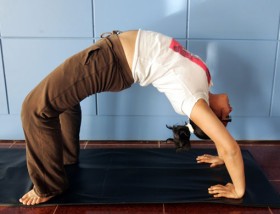
Chakrasana (The wheel pose)
Lie on the back with the knees bent and the heels touching the buttocks.
The feet and knees should be about 30cm apart.
Place the palms on the floor beside the head with the fingers pointing towards the shoulders.
Slowly, raise the body and arch the back, allowing the crown of the head to support the weight of the upper body.
Straighten the arms and legs as much as possible and lift the head and trunk from the floor.
Try to arch the back as high as possible in the final position.
Let the head hang between the straightened arms.
Hold this position for as long as is comfortable.
Slowly, lower the body so that the head rests on the floor and lower the rest of the body, too.
Practise three rounds.
Caution : Should be practised on a carpet to protect the head.
Shouldn’t be practised by teens with any illness, weak wrists or when they are feeling tired.
Sarvangasana (Shoulder stand)
Lie on the back on a mat. Make sure your body is straight.
With the support of your arms, slowly raise the legs to a vertical position, keeping them straight.
Bend the elbows and place the hands behind the rib cage, keeping them slightly away from the spine, to support the back.
Gently push the chest forward to bring it closer to the chin.
In the final position, the legs are vertical, together and in a straight line with the trunk.
Hold this position for as long as is comfortable.
To return to the starting position, bring the legs forward until the feet are above and behind the back of the head.
Slowly, release the position of the hands and bring the body down to the floor.
Relax on your back until the heart beat returns to normal.
Beginners should hold the position for a few seconds only.
Gradually increase the time to 3-5 minutes.
Should be performed once.
Caution: Shouldn’t be practised by teens suffering from enlarged thyroid, cervical spondylitis and slip disc.
Should be avoided during menstruation.
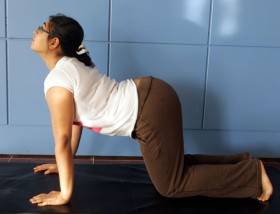
Marjariasana ( Cat-stretch pose)
Sit on your heels.
Raise the buttocks and stand on the knees.
Lean forward and place the hands flat on the floor beneath the shoulder, with the fingers facing forward.
Inhale and raise the head while depressing the spine, so that the back becomes concave.
Exhale while lowering the head and stretching the spine upwards.
At the end of each exhalation, contract the abdomen and pull in the buttocks and head between the arms and look towards the thighs.
This is one round; repeat 10 to 15 times.
Singhasana (Roaring-lion pose)
Sit on your heels with knees about 45cm apart.
Place the palms on the floor between the knees, with the fingers pointing towards the body.
Lean forward, resting the body on the straightened arms.
Arch the back and gently tilt the head back so that there is a comfortable tension in the neck.
Inhale slowly and deeply.
At the end of the inhalation, open the mouth and extend tongue as far as possible towards the chin.
While slowly exhaling, produce a clear steady “aaah” sound from the throat.
This is one round. Repeat five times.
Jalandhar bandha
Benefits: When we press the chin to the throat, the parathyroid and thyroid glands in the neck get activated and thyroxin is secreted.
This hormone helps reduce stress.
It also helps control numerous problems related to the thyroid gland.
Sit in a comfortable posture with the back straight.
Inhale deeply, fill your lungs with air, raise your chest and hold your breath.
Press your chin to the throat.
Hold your breath for 30 seconds to a minute.
When you can’t hold your breath anymore, raise your head and exhale.
Repeat three times.
Caution: People with cervical spondylosis shouldn’t attempt this bandha.
Teens with high thyroxin levels shouldn’t perform this bandha.
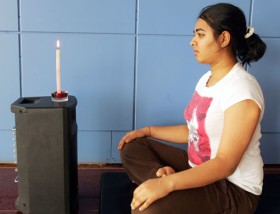
Trataka (Gazing with concentration)
Light a candle and place it on a small table. The flame should be exactly at the eye level when sitting.
Sit in a comfortable position with the head and spine erect. Be at arm’s length from the candle.
Close your eyes to relax them.
Open your eyes and gaze steadily at the end of the candlewick. The flame may flicker slightly but the end of the wick will always remain steady.
Try not to blink or move the eye balls in any way.
Don’t strain, as that will make you blink because of tension.
After a minute or two, when your eyes become tired or begin to water, close them gently.
With your eyes closed, focus mentally on the image of the flame.
If the image moves, try to stabilise it.
When the image of the flame begins to fade, try to bring it back.
When the image can no longer be retained, open your eyes and gaze at the end of the wick once more.
Repeat the practice.
Continue this way for two to three times.
After completing the final round, rub your palms and keep them on your eyes a couple of times.
Caution: Must be practised on a steady flame, so ensure that the room is not airy.
Avoid undue strain.
Bharat Thakur is the founder of Bharat Thakur’s Artistic Yoga. For questions on yoga, write to dubai.artisticyoga@gmail.com. For more information, log on to http://www.bharatthakur.com
Eat breakfast, avoid obesity
Eat breakfast, avoid obesity
IANS
WASHINGTON: Those who eat breakfast every morning are more physically active than those who skip the first meal of the day, especially during adolescence.
That’s the conclusion of a study in which researchers examined the link between breakfast frequency and five-year body weight change in more than 2,200 adolescents.
The results of the study indicate that breakfast eaters consumed a healthier diet and were more robust than those who skipped the meal.
Five years later, daily breakfast eaters also tended to gain less weight and had lower body mass index levels, an indicator of obesity risk, compared with skippers.
Mark Pereira, co-author of the University of Minnesota project EAT, points out that this study extends the literature on the topic of breakfast habits and obesity risk because of its size and duration.
“The dose-response findings between breakfast frequency and obesity risk, even after taking into account physical activity and other dietary factors, suggests that eating breakfast may have important effects on overall diet and obesity risk, but experimental studies are needed to confirm these observations,” he added.
Over the past two decades, rates of obesity have doubled in children and nearly tripled in adolescents.
It is estimated that between 12 and 24 percent of children and adolescents regularly skip breakfast. This percentage of skippers, while alarming, has been found to increase with age.
Dianne Neumark-Sztainer of project EAT said researchers have found further evidence to support the importance of encouraging youth to eat breakfast regularly.
“Although adolescents may think that skipping breakfast seems like a good way to save on calories, findings suggest the opposite,” she said.
Drinking may boost blood pressure
Drinking may boost blood pressure
REUTERS
LONDON: Drinking alcohol, even moderate amounts, may boost blood pressure more than previously thought, British researchers said on Tuesday. People with a genetic mutation that makes it difficult to consume alcohol had significantly lower blood pressure than regular or heavy drinkers, the researchers found.
People without the mutation who had about 3 drinks per day had “strikingly” higher blood pressure than people with the genetic change who tended to drink only small amounts or nothing at all. “This study shows that alcohol intake may increase blood pressure to a much greater extent, even among moderate drinkers, than previously thought,” Sarah Lewis, a researcher at the University of Bristol’s Department of Social Medicine, and colleagues wrote in their report published in the Public Library of Science journal PLoS Medicine.
The researchers said there was more than a two-fold risk for high blood pressure among drinkers and a 70 per cent increased risk for “quite modest” drinkers compared to people with the genetic mutation. High blood pressure, which affects more than a billion adults worldwide, can lead to stroke, heart failure, heart attack and kidney failure.
Previous studies have linked heavy drinking with high blood pressure while others have suggested that moderate alcohol intake provides health benefits such as lower cholesterol. The genetic mutation is common in some Asian populations and discourages drinking because alcohol triggers facial flushing, nausea, drowsiness, headache and other unpleasant symptoms. Comparing people with the mutation and volunteers without the genetic variation helped the researchers better gauge long-term effects of drinking, they said. “Reporting of alcohol (in other studies) is likely to be subject to considerable error, and this error may be differential — for example, people who have been advised to reduce alcohol intake for medical reasons may under-report alcohol intake,” the researchers wrote.
Want to test your fitness, climb 55 floors
Want to test your fitness, climb 55 floors
By a staff reporter KHALEEJ TIMES 26 February 2008
DUBAI — A high rise stair climb in Dubai’s iconic tall buildings will be held on February 29. As part of it, participants will scale 55 floors to test both their endurance and fitness.
The ‘Dynamisan High Rise Stair Climb’ was announced yesterday by Novartis Consumer Health (NCH).
The climb, to be held at the A W Rostamani 21st Century Tower in Dubai, is expected to be rolled out throughout the GCC countries over the coming months.
With the increasing incidence of lifestyle diseases such as diabetes and cardiovascular diseases in the UAE, this climb aims to showcase the benefits of taking the stairs and getting more physical exercise to combat obesity and help ensure a healthy lifestyle.
Stair climbing is an effective cardiovascular work-out and burns twice as many calories as other sporting activities; 15 minutes of stair climbing produces the same results as 30 minutes of running. Climbing up the first 20 flights will be aerobic, after which the climb will intensify becoming an intense anaerobic work-out.
Samah ElManzalawy, Dynamisan Brand Manager from Novartis Consumer Health said, “We all work long hours and tend to neglect our health, especially with regards to exercise. We are often too tired to exercise, even though it will give us an energy boost.”
The event is open to everyone.
First 3 hours after stroke crucial
First 3 hours after stroke crucial
ANI
WASHINGTON: A new study has found that the first three hours at the start of a stroke are crucial for the treatment of the victim.
The study found that rhe damage caused by stroke can be reduced by giving tPA treatment, the only approved treatment for stroke caused by blood clots in the brain, to the patient. If given intravenously within the first three hours of the start of a stroke, or injected directly into the brain within six hours, tPA can break up clots and stop or slow the damage caused by strokes. The analysis showed that delay kept many patients away from receiving tPA.
“Efforts to speed up patients’ arrival at the hospital are absolutely crucial. We have very effective treatments; we just need to get patients to the hospital as fast as possible,” said Lewis Morgenstern, professor of neurology, emergency medicine and neurosurgery at the U-M Medical School. Morgenstern added a person experiencing a stroke really needed to get to a hospital within two hours of the start of a stroke to have the best chance of receiving tPA.
 ClicksandWrites
You must be logged in to post a comment.