HSE
Lack of pumps on Saadiyat Island – My Letters – THE NATIONAL Dt. 02.07.2010
My Letters – THE NATIONAL Dt. 02.07.2010 – Lack of pumps on Saadiyat Island

Using the new Saadiyat Island road, motorists are left with the limited option to fill their cars with petrol once they leave the city.
The rush of motorists in the afternoon is on the high side as there are many daily commuters who reside in Dubai and work in Abu Dhabi. This makes refuelling an issue as there is a long queue at petrol stations in both emirates.
This is a major inconvenience as there is no petrol filling station on this stretch for about 40km and any motorists leaving the city with short of fuel has no options to refill. In addition, two of the major petrol pumps in the city are under renovation, making it all the more difficult.
Thus, a petrol station at the exit of Mina towards Dubai or somewhere on the new road after the exit from Abu Dhabi city will be welcome by all the motorists.
I humbly request the authorities to initiate necessary measures to ease the refuelling difficulties of motorists.
Ramesh Menon, Abu Dhabi
To read it in original, please visit THE NATIONAL online
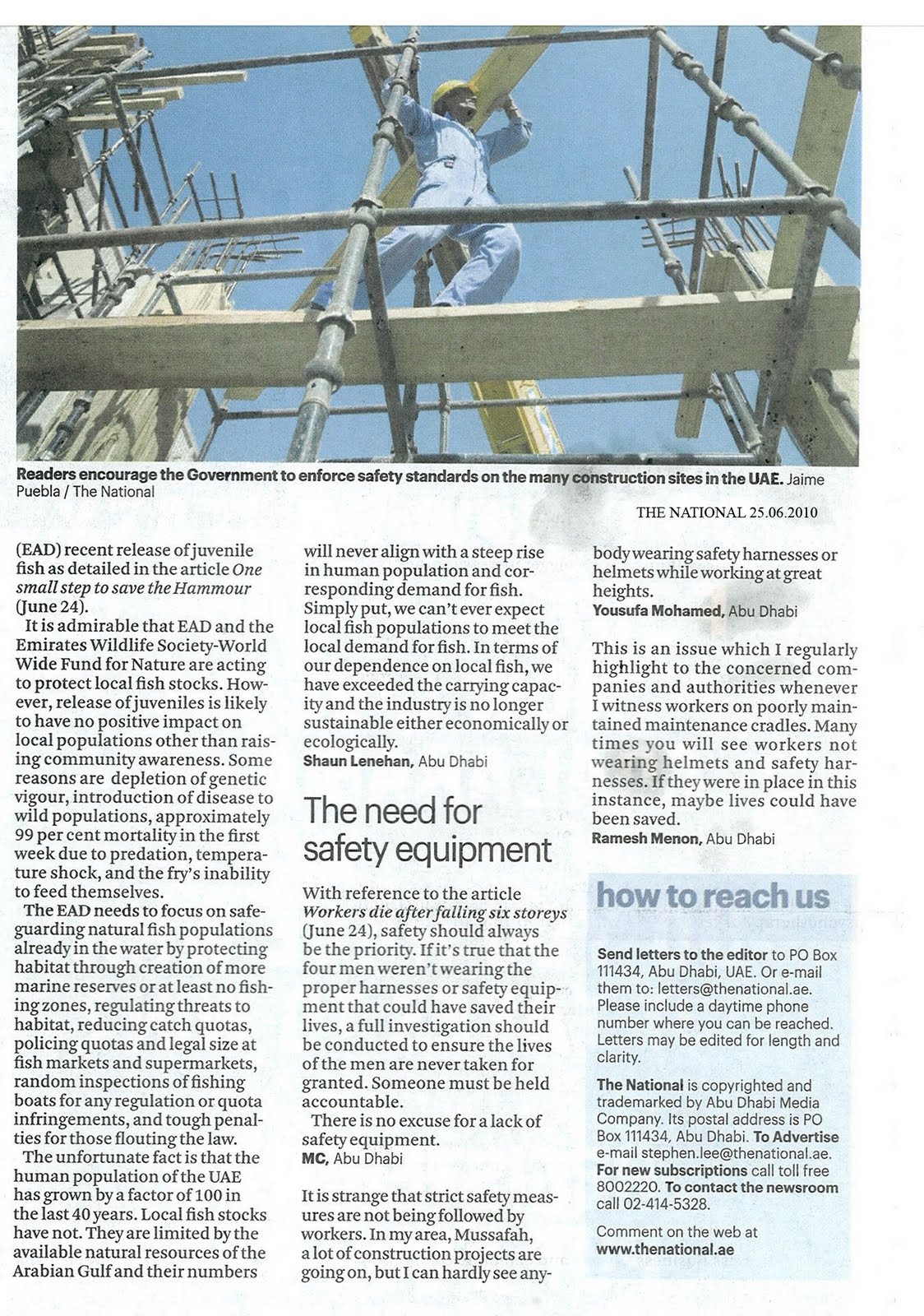
The need for Safety Equipment – My Letters – The National – Dt. 25.06.2010
My Letters – The National – Dt. 25.06.2010 – The need for Safety Equipment
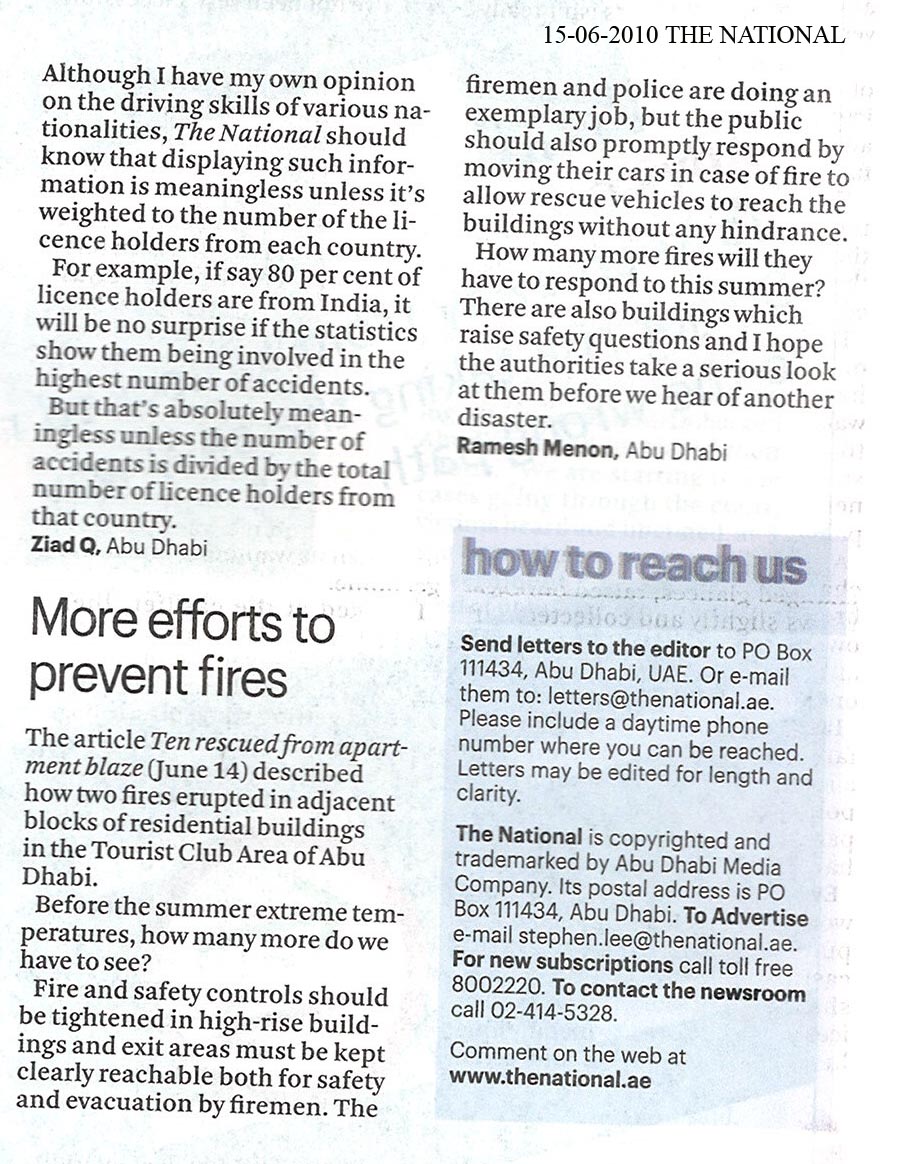
More efforts to prevent fires – My Letters – THE National – Dt. 15.06.2010
My Letters – THE National – Dt. 15.06.2010 – More efforts to prevent fires
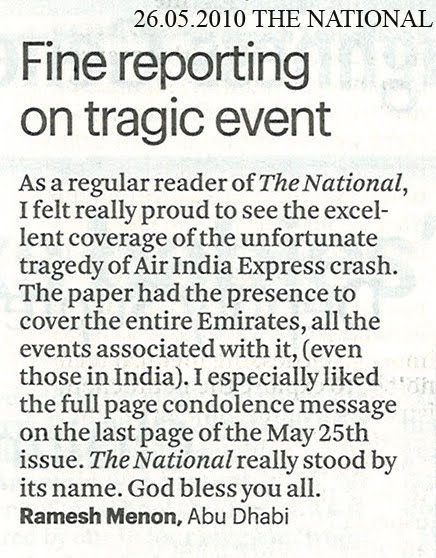
Fine reporting on tragic event – My Letters – THE NATIONAL – Dt. 26.05.2010
My Letters – THE NATIONAL – Dt. 26.05.2010 – Fine reporting on tragic event
Air India confirms 158 dead in crash – My Letters – THE NATIONAL – Dt 23.05.2010
My Letters – THE NATIONAL – Dt 23.05.2010 – Air India confirms 158 dead in crash
Air India confirms 158 dead in crash
Praveen Menon and Leah Oatway
Last Updated: May 22. 2010 11:30PM UAE / May 22. 2010 7:30PM GMT
Civilians look on as Indian firefighters and rescue personnel gather around the site of an Air India plane that crashed in Mangalore, in the southern Indian state of Karnataka, Saturday, May 22, 2010. AP Photo
An Air India Express passenger plane from Dubai crashed outside the Mangalore airport in southern India today, killing 158 people when it burst into flames after overshooting a table-top runway and plunging into forest below.
There were only eight survivors after the Boeing 737-800 appeared to have skidded off the runway in rain in Karnataka state, Air India director Anup Srivastava said.
It is believed 146 bodies had been recovered.
“We had no hope to survive, but we survived,” Pradeep, a survivor who is an Indian technician working in Dubai, told local television.
“The plane broke into two and we jumped off the plane. As soon as the plane landed, within seconds this happened.”
Investigators in India say the preliminary findings show the aircraft touched down about 2,000 feet (610 metres) too late on the 8,000-foot runway. But experts said that type of aircraft still had plenty of room to stop safely.
The national carrier of India had 163 passengers, seven crew members and four infants. As many as 19 of the passengers were children.
The flight took off from Dubai Airport Terminal 2 at around 1am this morning and was expected to land at the newly constructed Mangalore Airport.
The entire Kenjar village has turned into a crash site as rescue operators search through the wreckage for possible survivors.
The black box has been recovered from the flight.
“The black box of the aircraft has been recovered and the mandatory court of inquiry ordered by the Director General of Civil Aviation,” WAM news agency reported from India.
The Indian consulate in Dubai confirmed that they have been flooded with calls since morning as many Indians living in the UAE were on the flight.
According to Mr Pathak, the airline has been contacted by many passengers’ relatives in Dubai and is considering chartering a flight to Mangalore for relatives.
A hotline number has been set up at Terminal 2 airport and another city control room will soon be functional at the Air India office in Dubai.
Delhi: 011-25656196, 25603101
Mangalore: 0824-2220422, 2010167
Dubai: 00971-4-2165828, 00971-4-2165829
Air India Express operates flights out of Dubai, Abu Dhabi, Al Ain and Sharjah International Airports.
Flight IX 812 operates seven days a week from Dubai International Airport Terminal II to Mangalore Airport at 115 am with a flight duration of 3 hours, 45 minutes. The fare for a flight next Friday May 28 on the Boeing 737-800 is dh750.
The company also operates five flights per week from Abu Dhabi to Mangalore
My comments as follows:
I join amongst many expatriate passengers who has no other alternate option other than to use limited operational facilities of Air India Express to travel to various smaller airports in India. The fear associated always with flying in it, especially during the landing is always talked up on. God forbidden, there were no tragedy involved, but it was not the case this morning. I was one amongst the many with profound grief and sadness, who gathered for a condolence meeting held at the ISCC Abu Dhabi to pray for the departed souls. Many stories were told touching our emotions about lost friends and family, known and unknown. May be it is due a technical error or human error, or some other unknown reason. Finally, it is a national loss and a major personal loss to those who got affected in it. Let us all, pray to god, calamities of this sort never repeats due to man made errors, as fate and destiny never give choices to us to escape from the natural disasters of unknown kind.
Ramesh Menon
Abu Dhabi.
To read it in original, please visit, THE NATIONAL online
Illegal U turn tempts many motorists – My Opinion – THE NATIONAL – Dt 10.05.2010 – THE NATIONAL
My Opinion – THE NATIONAL – Dt 10.05.2010 – THE NATIONAL – Illegal U turn tempts many motorists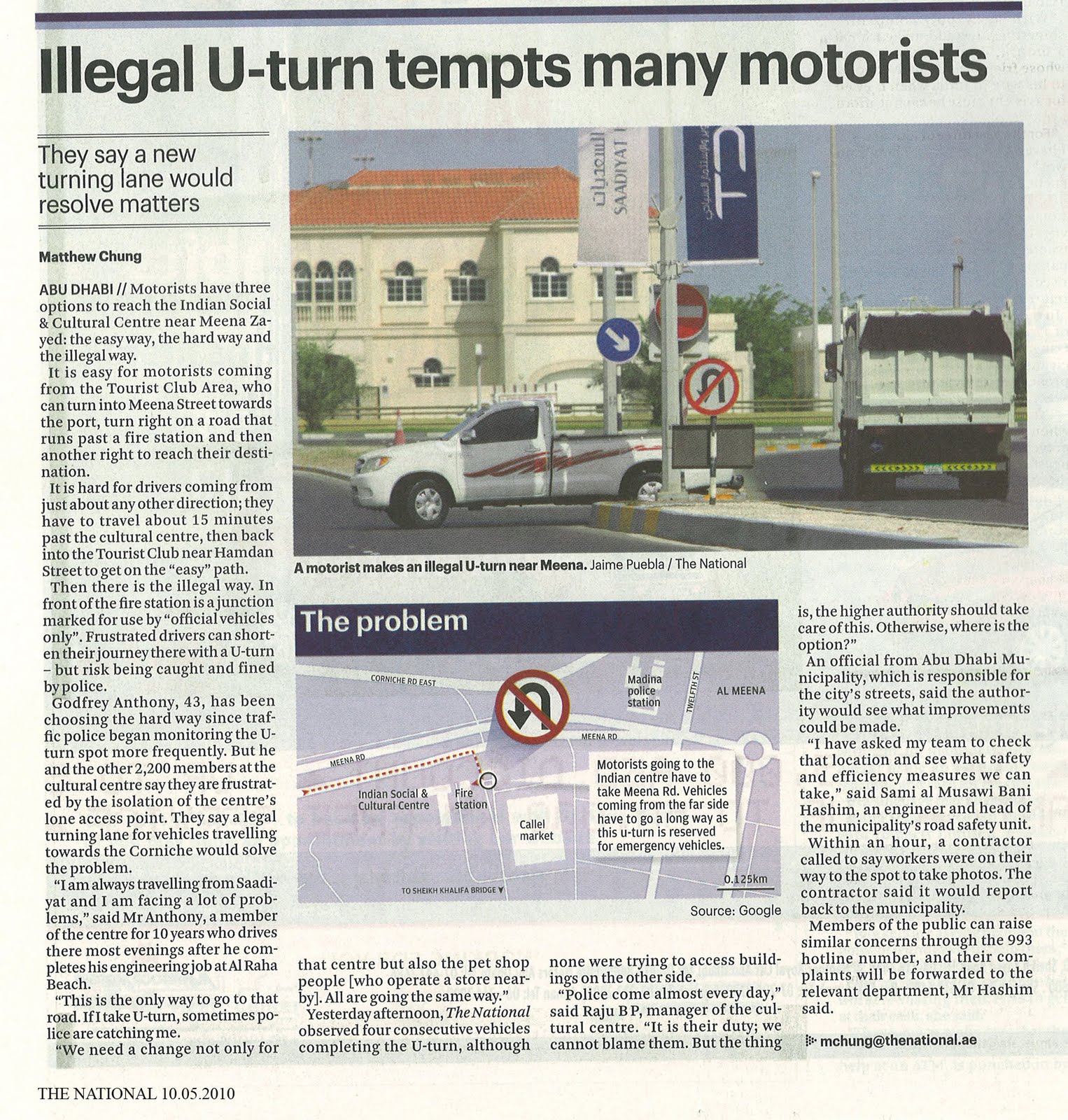
Road made unsafe by lack of a U-turn – My Letters – THE NATIONAL
My Letters – THE NATIONAL – Road made unsafe by lack of a U-turn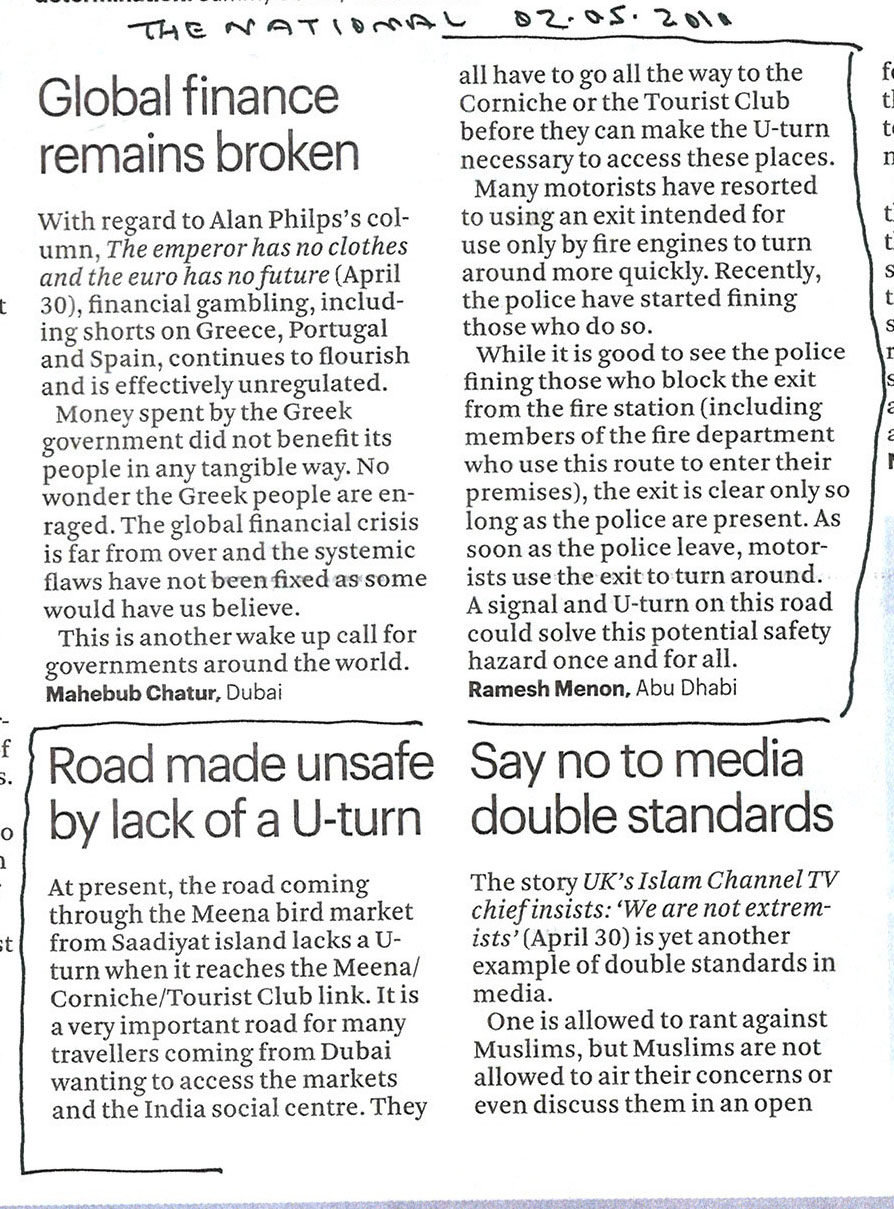 To read my letters to the news, please bookmark and visit Letters to the Editor
Safety experts fear city’s new digital billboards may cause car crashes – My Opinion
My Opinion : Safety experts fear city’s new digital billboards may cause car crashes
Safety experts fear city’s new digital billboards may cause car crashes
Matt Kwong
Last Updated: April 21. 2010 10:00PM UAE / April 21. 2010 6:00PM GMT
An electric sign overlooks the busy intersection at Airport Road and Al Falah Street. Galen Clarke / The National
ABU DHABI // Hi-tech distraction or sign of the times? The city’s digital billboards are eye-catching indeed, but maybe too eye-catching, say local safety experts.
Their flashing colours and rapidly changing images are a fast-growing segment of the outdoor advertising market, but safety experts say they pull motorists’ eyes away from signals and pedestrians and could lead to more accidents.
Norm Labbe, a defensive driving instructor in the capital, said: “Our senses are being bombarded by navigation equipment, bright lights, music, cell phones, and now these billboards, where it’s almost like a strobe-light effect.”
More than a dozen US cities have banned the popular electronic advertising billboards, pointing out that unlike mobile phones, drivers cannot switch them off. Several cities in Canada are also considering moratoriums on the technology. Here, however, their numbers are increasing.
Abu Dhabi’s digital signage is perched atop buildings overlooking major junctions such as Muroor Road at Electra Street and Airport Road at Al Falah Street. The newest mammoth LED screen, measuring 20 metres by eight metres, is being erected on the corner of Muroor Road at Hamdan Street.
Future Vision, the ad firm that owns those displays, rotates six images every 10 seconds, allowing as many clients to promote themselves using the same billboard.
The computer-operated billboards have been a boon for advertisers, said Rajiv Khurana, the Middle East vice-president of the advertising firm Dentsu Marcom. He predicts the number of displays will more than double in the Emirates within five years.
The problem, Mr Labbe said, is that such billboards are designed to be distracting in order to be effective. Changing colours or designs encourages drivers to keep looking for the next digital image to appear.
“It takes approximately one and a half to two seconds for you to react properly and apply your brakes and come to a stop,” he said. “A lot can happen in two seconds.”
Just as there is a growing body of research on the dangers of texting while driving, he called for local researchers to study how much of a distraction the signs pose to people at the wheel.
Results from US studies on the issue have been mixed. The Virginia Tech Transportation Institute, which is financed by the billboard industry, found that the displays posed no hazard in 2007. However, the American Association of State Highway and Transportation Officials reported last year that they “attract drivers’ eyes away from the road for extended, demonstrably unsafe periods of time”.
“That’s my concern, that this is one more added element to the mix,” Mr Labbe said.
Abu Dhabi’s preprogrammed displays draw more attention at night, and are even more hazardous at what Dr Peter Barss, an injury prevention specialist who works with UAE University, described as “complex driving environments” such as major intersections.
Dr Barss said the onus should be on companies profiting from the billboards to prove that they do not imperil drivers.
“The traffic environment here is extremely high speed at a lot of places, so it seems to me the potential [for accidents] would be high,” he said.
“When you’re trying to discern whether you go right or left, and suddenly there’s a huge flashing sign out there pulling your eyes away, well how many seconds can you afford to take your eyes off the road and not hit somebody?”
Although Future Vision’s three signs have video capabilities, Robert Awad, the company’s media executive, said Abu Dhabi Municipality was wary of allowing moving pictures to play above evening traffic. “They gave us the approval to do this latest technology on one condition, to make the billboards static, not dynamic,” Mr Awad said. “This is to avoid accidents.”
Even so, it is hard to miss Synaxis Media’s dynamic 224-square-metre Opulence, the largest outdoor LED sign in the Middle East, broadcasting “TV-quality ads” just above the Marks & Spencer on Airport Road.
The Opulence can broadcast video because it is not positioned at a major intersection, said Fahad al Absi, the founder of Synaxis.
“You can deliver six messages for the same campaign using the same space. You save six times the money,” he said of the display, which was switched on two years ago.
Adverts cost Dh300,000 (US$81,673) a month and can be viewed 600 times a day. It costs Future Vision Dh90,000 a month to operate its screens.
However, Mr al Absi supported strict regulation of electronic advertising placement.
“Having it face intersections where they think the ad might be more effective is not such a good idea,” he said. “Other LEDs might seem located in a prime location, but excuse me, it’s right behind a traffic light. That can be confusing.”
Samira Ahmed, an Emirati housewife, drives by the Opulence nearly every day and has had a few close calls in traffic while watching the screen.
“The place is wrong because this is like a highway,” said Mrs Ahmed, 46. “I almost had an accident one time because it was in the evening.”
Abu Dhabi Municipality did not respond to requests for comment, but officials with the advertising section said this month that three digital billboards have had their illumination levels decreased by 10 per cent after complaints.
My comments as follows:
I agree with the dangers of high intensity level getting beamed across the road from these sign boards. While, I also agree with the fact that such sign boards are displayed in other cities world-wide, but feel they are of low intensity and long duration. The higher the intensity and the shorter the duration, they tend to distract the reflexes of the drivers and may tend to create dangerous situation for accidents to happen. One prominent example is the sign board displayed at the Mark and Spencer building in front of the Cultural Foundations. It is too bright and many times dangerously create lighting effect which even block the colors of the changing signals a short distance from it.
In addition, I would like to take this opportunity to highlight another danger that is happening these days. There are several ads being played by FM radios, which has sound effects of cars honking horns and ambulance or police sirens, to create some advertising attraction. These ads disturbs and create driving attention and focus and authorities should curb airing of ads which carries such sounds.
Ramesh Menon, Abu Dhabi
To read it in original, please visit THE NATIONAL Online
My Letters – Khaleej Times – Dt. 08.04.2010 – Soft Pedal
My Letters – Khaleej Times – Dt. 08.04.2010 – Soft Pedal
 To read my letters to the news, please bookmark and visit Letters to the Editor
 ClicksandWrites
You must be logged in to post a comment.