Gulf News

Confusing crossing – GULF NEWS – Community Report Dt 25.03.2012

Posted on Updated on

Confusing crossing – GULF NEWS – Community Report Dt 25.03.2012

Confusing crossing

Steps needed at Abu Dhabi Mall for people to have easy passage without being fined
  • By Ramesh Menon, Gulf News Reader
  • Published: 00:00 March 25, 2012

  • Image Credit: Ramesh Menon/Gulf News Reader
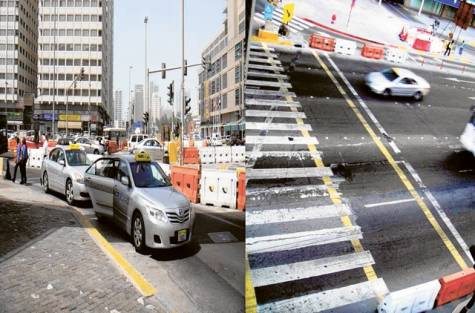
  • Left: The traffic signal in front of Abu Dhabi Mall.
    Right: The pedestrian crossing is for handicapped only but the sign escapes the attention of residents who are at risk of being fined.
  • The area around Abu Dhabi Mall is one of the busiest places in the emirate, especially during the early mornings and evenings. There is always a constant flow of visitors to the numerous embassies, shops and offices situated there.
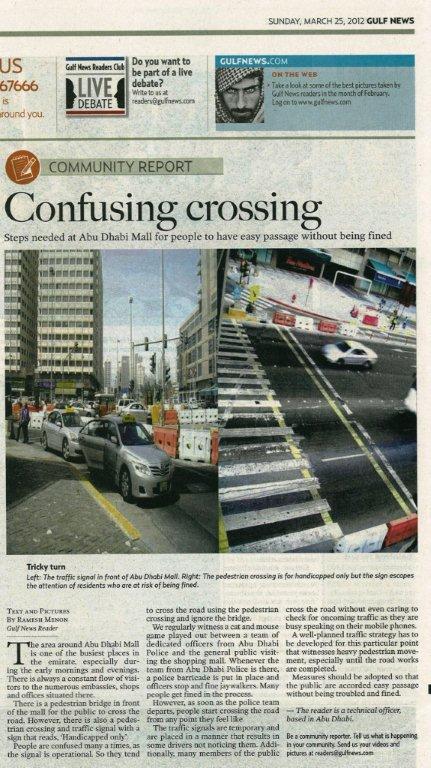
     
    There is a pedestrian bridge in front of the mall for the public to cross the road. However, there is also a pedestrian crossing and traffic signal with a sign that reads, ‘Handicapped only’.
     
    People are confused many a times, as the signal is operational. So they tend to cross the road using the pedestrian crossing and ignore the bridge.
     
    We regularly witness a cat and mouse game played out between a team of dedicated officers from Abu Dhabi Police and the general public visiting the shopping mall. Whenever the team from Abu Dhabi Police is there, a police barricade is put in place and officers stop and fine jaywalkers. Many people get fined in the process.
    However, as soon as the police team departs, people start crossing the road from any point they feel like.
    The traffic signals are temporary and are placed in a manner that results in some drivers not noticing them. Additionally, many members of the public cross the road without even caring to check for oncoming traffic as they are busy speaking on their mobile phones.
     
    A well-planned traffic strategy has to be developed for this particular point that witnesses heavy pedestrian movement, especially until the road works are completed.
     
    Measures should be adopted so that the public are accorded easy passage without being troubled and fined.

     
    — The reader is a technical officer, based in Abu Dhabi.
    To read it in original, please visit GULF NEWS online.

    Rousing start to Abu Dhabi Festival – My Letters – GULF NEWS Dt. 21 March 2012
    Posted on Updated on

    Rousing start to Abu Dhabi Festival – My Letters – GULF NEWS Dt. 21 March 2012

    Anoushka Shankar’s performance sets the tone for truly global celebration of art and culture
    • Staff Report
    • Published: 00:00 March 21, 2012

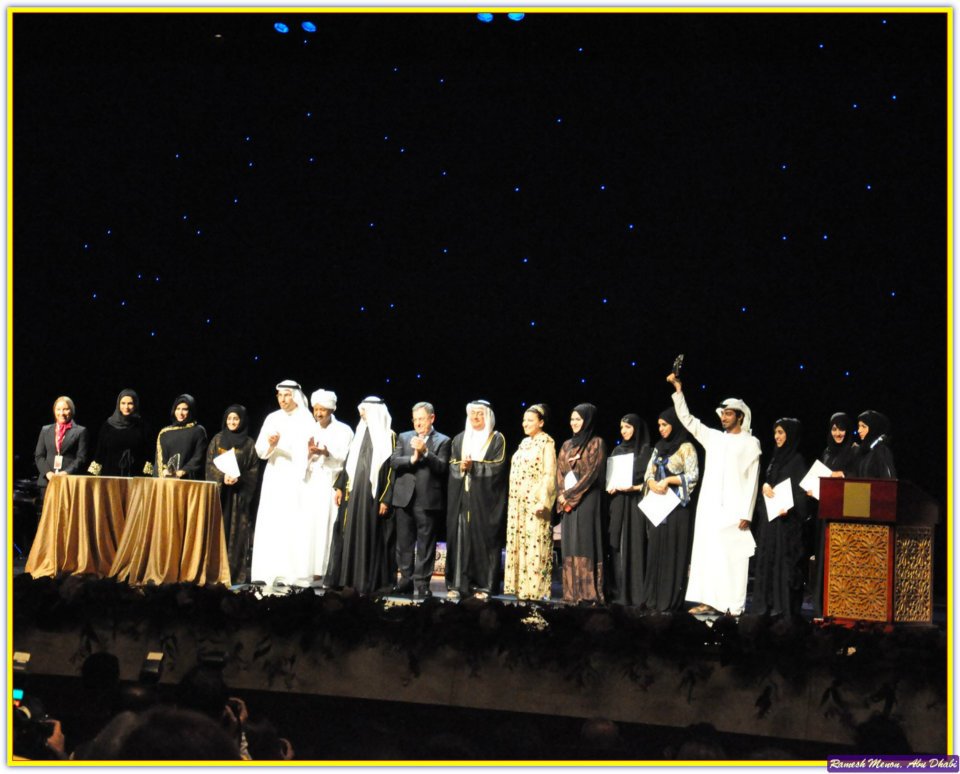
    Abu Dhabi: The seventh edition of the Abu Dhabi Festival was inaugurated at a special ceremony at the Emirates Palace Hotel attended by dignitaries, guests and members of the public, on Monday.
     
    Iraqi artist Hassan Massoudy’s specially commissioned calligraphy exhibition ‘Gestures of Light’ was the highlight of the evening’s programme along with a performance by internationally renowned musician Anoushka Shankar, who is widely regarded as one of the world’s leading sitar players, and the only artist to be trained exclusively by her father, the legendary Ravi Shankar.
     
    “Every year we aim to showcase the diversity of the world’s artists and genres by bringing a taste of global music and performances to the nation’s capital. With Anoushka’s involvement in this year’s festival, we broke new ground with her mesmerising young talent renowned the world over and set a new bar for future performances,” said Hoda Al Khamis Kanoo, founder and artistic director of the Abu Dhabi Festival.
     
    Students honoured
     
    Additionally, outstanding Emirati students from the UAE University, Zayed University and the Higher Colleges of Technology were recognised for their participation in initiatives supported by the Abu Dhabi Music and Arts Foundation.
     
    They included the Young Media Leaders programme, which provides training for careers in the media and the Theatre-in-Education (Tie) programme, a series of workshops led by the City University of New York’s creative arts team.

    The festival also presented a lifetime achievement award posthumously to Dr Walid Gholmieh, a prominent conductor, composer, scholar and activist for western classical music in the Middle East, and a defining influence in Lebanon’s classical landscape.
    The 27-day event, which will end on April 6, includes 168 cultural and artistic events across the UAE.
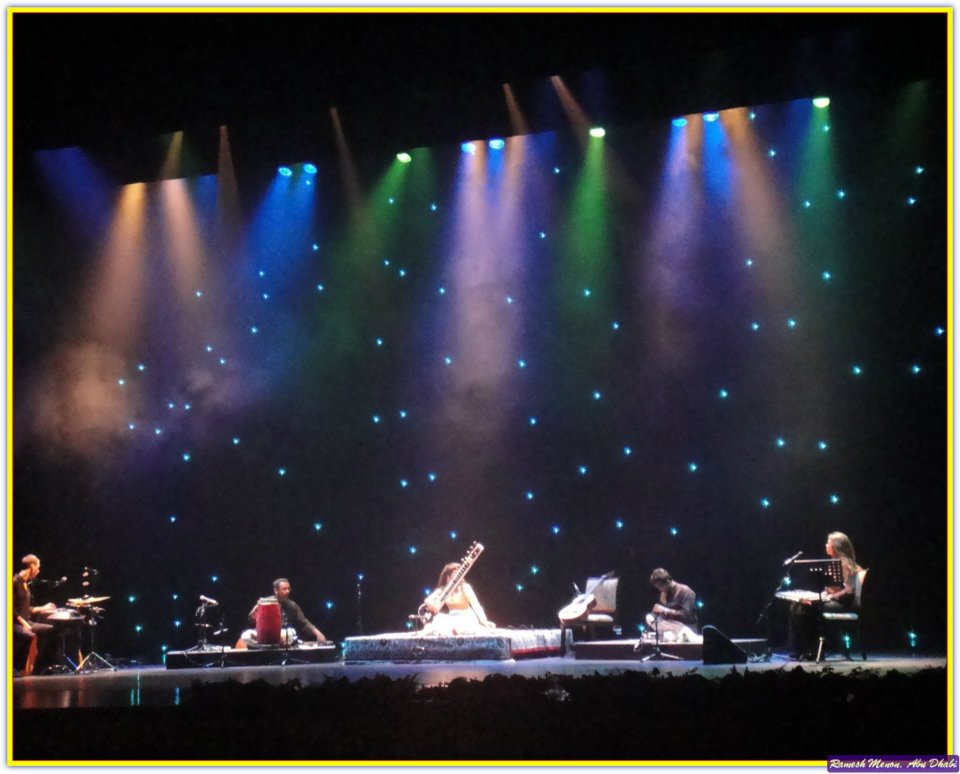
     

    My comments as follows:

    The opening ceremony of Abu Dhabi Festival along with Anoushka Shankar’s performance created an everlasting memory. An impressive array of dignitaries joining HE Shaikh Nahyan Bin Mubarak Al Nahyan were present to recognise outstanding Emirati students from the UAE University, Zayed University and the Higher Colleges of Technology for their participation in initiatives supported by the Abu Dhabi Music and Arts Foundation.

    It was a moment of joy for all those who actively involved in the Young Media Leaders programme. Lifetime achievement awarded posthumously to Dr Walid Gholmieh created the perfect platform for a scintillating two hour two session of music by Anoushka Shankar and her team of musicians.

    The performance was harmoniously blended with the artists complementing each other on traditional Indian and Spanish musical instruments and music.

    The theme Traveller turned out to be perfect as the rhythm and mood created a gypsy feelings in audience mind. I could relate the proud sense of watching her perform live at Abu Dhabi when after the programmes some of the guests leaving the auditorium mentioned, I watched her dad perform 40 years ago in New York and now her here in Abu Dhabi. Both bring the same sweet smile, calmness and ease of quality music out when they sit to perform.

    Wish the programme was made available for a wider range of audience for view outside the auditorium through giant screens placed at various points in Abu Dhabi Corniche. In addition, after each show photo session of the artists performed on stage should also be allowed.

    Hope Abu Dhabi Festival organisers will consider this aspect for the future shows. The name and fame of Abu Dhabi Festival should reach a wider section of population.
    Ramesh Menon, Abu Dhabi, United Arab Emirates

    To see a similar performance held elsewhere, please watch this video. It was almost the same or better.


    Indian federal budget fails to impress the majority – My letters – Gulf News 16 March 2012

    Posted on

    Indian federal budget fails to impress the majority – My letters – Gulf News 16 March 2012

    Indian federal budget fails to impress the majority

    Finance minister makes a weak attempt to trim deficit

  • By Babu Das Augustine, Deputy Business Editor
  • Published: 10:53 March 16, 2012
  • Dubai: Disappointing economists, business leaders and stock market, India’s finance minister Pranab Mukherjee on Friday presented the federal budget 2012-13, which made a feeble attempt, at best, in reducing India’s ballooning fiscal deficit.
     
    The budget set a fiscal deficit target of 5.1 per cent of GDP for the fiscal year, down from an expected 5.9 per cent in the current year. This year’s figure, however, ended up far above the 4.6 per cent it had originally targeted in its budget a year ago.
     
    Mukherjee said he expected the Indian economy to grow by 7.6 per cent in the next fiscal year, up from an expected 6.9 per cent in the current year but below the 8.4 per cent growth of the previous fiscal year.
     
    “We are disappointed with the budget because it assumes a relatively high, 5.1 per cent deficit in the 2012-13 fiscal year. We also think that growth target is a bit too optimistic while inflation may have hard time falling as much as they are assuming,” said Dariusz Kowalczyk, senior economist and strategist at Credit Agricole, Hong Kong.

    Analysts said the budget did not make a serious effort to rein in subsidies. The Finance Minister announced that from 2012-13 while subsidies related to food and for administering the Food Security Act will be fully provided for, all other subsidies would be funded to the extent that they can be borne by the economy without any adverse implications. He said that the government will endeavour to restrict the expenditure on central subsidies under 2 per cent of GDP in 2012-13and over the next three years, it would be further brought down to 1.75 per cent of GDP.
     
    “The market was hoping for a lower deficit for the next financial year, so disappointing from that perspective. India continues to have the largest fiscal deficit within emerging Asia, hence expect this to weigh on the rupee,” said Jonathan Cavenagh, foreign exchange strategist, Westpack, Singapore.
     
    In the budget estimates for 2012-13, the gross tax receipts are estimated at 10, 7.76 trillion which is an increase of 15.6 per cent over the Budget Estimates and 19.5 per cent over the revised estimates for 2011-12. After devolution to States, the net tax to the central government in 2012-13 is estimated at Rs 77 trillion. The Non Tax Revenue Receipts are estimated at Rs16.46 trillion and Non-debt Capital Receipts at Rs 4.16 trillion. The total expenditure for 2012-13 is budgeted at Rs149 trillion. Of this Rs52 trillion is the Plan Expenditure while Rs96.9 trillion is budgeted as Non Plan Expenditure.
     
    Tax proposals
     
    The tax proposals are guided by the need to move towards the Direct Tax Code (DTC) in the case of direct taxes and Goods & Services Tax (GST) in the case of indirect taxes. For now it appears that the DTC has been deferred from the planned implementation from April 1, 2012.
     
    Individual income upto Rs200,000 will be free from income tax; income upto Rs 180,000 was exempt in 2011-12. Income above Rs500,000 and upto Rs 1 million now carries tax at the rate of 20 per cent; the 20 per cent tax slab was from Rs500,000 to Rs800,000 in 2011-12. A deduction of up to Rs10,000 is now available for interest from savings bank accounts.
     
    The budget made an attempt to widen the service tax base. All services will now attract service tax, except those in the negative list. The negative list has 17 heads and includes specified services provided by the government or local authorities, and services in the fields of education, renting of residential dwellings, entertainment and amusement, public transportation, agriculture and animal husbandry. Service tax rate is being increased from 10 per cent to 12 per cent, with consequential change in rates for services that have individual tax rates. The standard rate of excise duty for non-petroleum goods is also being raised from 10 per cent to 12 per cent. No change is proposed in peak rate of customs duty of 10 per cent on non-agricultural goods.
     
    The direct tax proposals in the budget will result in a net revenue loss of Rs 450 billion and the raising of indirect taxes will result in a net revenue gain of Rs 4.6 trillion resulting in a net gain of Rs 4.1 trillion.
     
    “The finance minister is looking to collect large sums of money through indirect taxes, probably to mitigate the fiscal situation, but this could have an impact on consumption,” said Deven Choksey, managing director of K R Choksey shares & Securities, Mumbai.

    My comments as follows:

    The presentation of budget 2012-13 by Finance Minister Pranab Mukharjee presents a feeling of let down to middle class citizen of India. He projected India’s GDP growth in 2012-13 to be 7.6 per cent, +/- 0.25 per cent when compared to global growth is impressive.
    With increased cess on crude oil to Rs 4,500 per tonne from Rs 2,500 per tonne, Oil exploring companies will be burdened further and look for relaying it to the end users.
    Ignoring the cry of indian companies manufacturing heavy power equipment to increase the customs duty on imports of such equipments will demotivate growth in this sector.
    The budget did not give support to Indian engineering exporters like Larsen & Tubro, which accounts for about one-fourth of the country’s total merchandise exports and instead proposed to raise excise duty to 12% from 10%.
    Power utilities are likely to benefit with proposed two-year exemption on import duty for companies importing thermal coal.
    A proposal to allow external commercial borrowing to part finance rupee debt of power projects will also help growth in this sector.
    Low cost housing developers and financiers will benefit after the budget proposed allowing external commercial borrowings for low-cost housing projects below Rs 25 lakhs. Hope it brings more quality and genuine infrastructural offerings to common man.
    Private Airlines will benefit after the budget proposed to allow external commercial borrowings of up to USD 1 billion to help meet immediate funding needs.
    The proposal to allow foreign direct investment by airlines under “active consideration” may bring a smile on two on airline king Vijay Mallya.
    The above two items looks as interesting options for Indian investors from abroad to move in with financial platters to stake more presence in the forthcoming years to barter important rights to NRIs.
    Infrastructure finance companies such may tend to benefit after the proposal to double the issue of tax-free bonds for financing infrastructure projects.
    India also announced an increase in import taxes for assembled SUVs and utility vehicles costing more than USD 40,000. On one hand the proposal mentioned on will see increased prices on luxury cars, we are yet to see any reforms being done on the registration of such cars at  the point of purchase origin or rather a unified registration charges in all states, which is where the state exchequer and in turn centre being devoid of a major share on taxation. However, the move may turn out to be positive for indigenous car makers like Tata and Mahindra.
    Fertilizer makers could see a fall in expenditure after the budget fully exempted basic customs duty on import of equipment for three years which when passed on to farmers could result in smiles on ordinary citizens.
    On one hand it brought in measures to reduce the pricing on medicines for treating cancer and HIV, there was no mention on the facilitators to control the costlier trial and error methods they use to treat these patients. This therefore will remain a costlier option for common man in the year to come.
    Full exemption on branded silver jewellery from excise duty may create interest in silver as first choice.
    Duty-free allowance for eligible passengers of Indian origin from `25,000 to `35,000 and for children of up to 10 years from `12,000 to `15,000, which seems to be one among the few sugar candies thrown at NRIs in this overall exercise.


    To read it in original, please visit GULF NEWS online.

    Parents of Sharjah road crash victims seek answers – My letters – Gulf News 15 March 2012

    Posted on

    Parents of Sharjah road crash victims seek answers

    Father speaks of the last conversation he had with his daughter over the university bus service before she was killed

  • By Mariam M. Al Serkal, Staff Reporter
  • Published: 00:00 March 15, 2012
  • Sharjah: The parents of two female university students who were killed on Buhairah Corniche in a traffic accident on Monday have said the incident could have been prevented if the bus driver had dropped the students close to their home.
     
    Ahmad Farouq, the father of 19-year old Mariam who studied at Manipal University in Dubai, said the last conversation he had with his daughter was at 4:30pm after the bus driver refused to take her home after she failed to produce a transfer identification pass, which is the only possible means to be allowed on board the bus
    .
    “She was collected from home in the morning by the same bus driver who refused to drop her off later in the afternoon. She did not have her transport ID card with her for some time because she was very naive and did not know how to get it, so it was not the first time she went on the bus without one. We lived a very protected life in Saudi Arabia and Mariam was still not accustomed to living away from us,” said Farouq.

     
    So upset

    The family lived in Saudi Arabia and when Mariam was accepted at the university to study Biotechnology in the summer of 2011, her parents decided to continue living in Riyadh while she went to live with her mother’s sister and uncle in Sharjah.
     
    Her parents arrived in the UAE on Tuesday morning and were awaiting an explanation from the university as to why their daughter was not dropped off at her home.
    “Mariam called her mother in Saudi Arabia to complain how rude the bus driver was and how he embarrassed her in front of her classmates after she failed to produce a transport ID card on board the bus. She was so upset that she left the bus with her other friends, who also did not have their ID cards with them,” explained Farouq.
    Once Mariam got off the bus, another bus driver recognised her and her friends and agreed to drop them off near Al Majaz Park, which is about a 25-minute walk from her home.
    “She used to say that she wanted to live in the dormitory of the university but I kept telling her that it, would happen next year,” he remembered.
     
    ‘Running from the issue’
     
    Devendra Singh, the father of 21-year-old Mitthi who was due to graduate in June in the media studies programme, said that his daughter accompanied Mariam in the other bus as she also did not have her transport ID pass with her.
     
    “The bus dropped her far away from her home. They didn’t take a taxi but decided to walk and that is when the horrible accident happened,” he said.
     
    “I met with the transport department from the university and when I asked who was the bus driver that dropped my daughter, they did not answer and I felt as if they were running away from the issue,” said Singh.
     
    Gulf News tried to contact Manipal University via email and telephone on several occasions but was unable to receive a comment.
     
    The traffic accident occurred on Monday at 5.30pm as the two students crossed the road from an undesignated area as there was no zebra crossing close by. They were then suddenly hit by a speeding vehicle, which according to Sharjah Police, was travelling at speeds of more than 120 kilometres per hour through a road that had a 80km speed limit.
    Mitthi Singh was killed on the spot while Mariam was transferred to Kuwaiti Hospital and died later in the night due to her severe injuries.
    My comments as follows:
    It is very sad to see that life of two young students looking forward to a bright future, which was very near to them, getting cruelly perished in a man-made road tragedy here in UAE.
    The concerned transportation department of the university they studied definitely holds responsibility to answer many questions. As we can see, many times, travel of students to and back from classes are contracted to transportation companies. Some of them may not have sufficient trained resources to handle the students. Adding to it, if a temporary driver comes on board, it will create all confusion and absolutely there will be no co-ordination in this shifting. This scenario has to be controlled with strict regulations making mandatory requirements, color codes and training for all student transport irrespective of whether they are small children or university students. This is very important as we get to see several such shuttles daily between shorter routes and longer routes including Abu Dhabi and other emirates happening from these educational centres.
    Point number two is two pronged and to control speeding and jay walking, and create more awareness amongst drivers to not use mobile phones while driving and also create amongst the pedestrians an all time self cautionary approach while crossing the road to hold on to 2 extra seconds and look carefully and cross, while they too do not use mobile phones and be a careless victim of any such tragedies on our roads.
    My prayers to the peace of those two souls departed from this world in a crurel and untimely manner and words of solace to the families and friends involved.
    Ramesh Menon, Abu Dhabi

    To read it in original, please visit GULF NEWS online
    Parents urged not to drive with children on their laps

    Posted on

    Parents urged not to drive with children on their laps – My Letters – Gulf News Dt 31.01.2012

    Dubai: Traffic officials have warned parents against driving with infants on their laps, as they are risking their child’s life by doing so, engineer Maitha Obaid Bin Udai, CEO of the Traffic and Roads Agency at the Roads and Transport Authority (RTA), said yesterday.
    As many as 13 infants were injured in traffic accidents last year, but the number has dropped considerably as compared to the year before.
     
    Two fatalities
     
    According to traffic accident statistics of 2011, a 35 per cent drop in the number of infants (between the age of 0 to 2) injured in accidents was recorded.

    <!– document.write('’); //–> window.onload=initial;

    While 20 infants were injured in traffic accidents in 2010, the number dropped to 13 in 2011, she said. Two infant fatalities were recorded in 2010 as well as in 2011.
    RTA credited the drop in injuries to a Child Safety Programme, launched at Latifa Hospital and Dubai Hospital in 2009. Over 1,000 mothers are members of the programme.
    • 13: infants were hurt in road accidents in 2011
    • 20: infants were injured the previous year
    My comments as follows:
    Added15:33 January 31, 2012

    This is a common scenario. I get to see and keep a controlled silence, because, I wonder, what they think about their own safety, their child’s safety, others who are in the car, and on the road at the same time with them. I really do not know. Women are not exemption. Last week, while driving on Shaikh Zayed Road, I watched with awe a woman, with a fully tinted four wheel drive speeding with her child on her lap (between the door and the seat) and even more, talking on the phone. God, save us, and reach us back home safe, that is the only prayer, I have, when I drive each time from Abu Dhabi to Dubai and back.

    Ramesh Menon, Abu Dhabi, United Arab Emirates
    To read it in original, please visit GULF NEWS Online

    A safety culture is critical – Gulf News Community Report – Dt 24.01.2012
    Posted on Updated on

    A safety culture is critical – Gulf News Community Report – Dt 24.01.2012

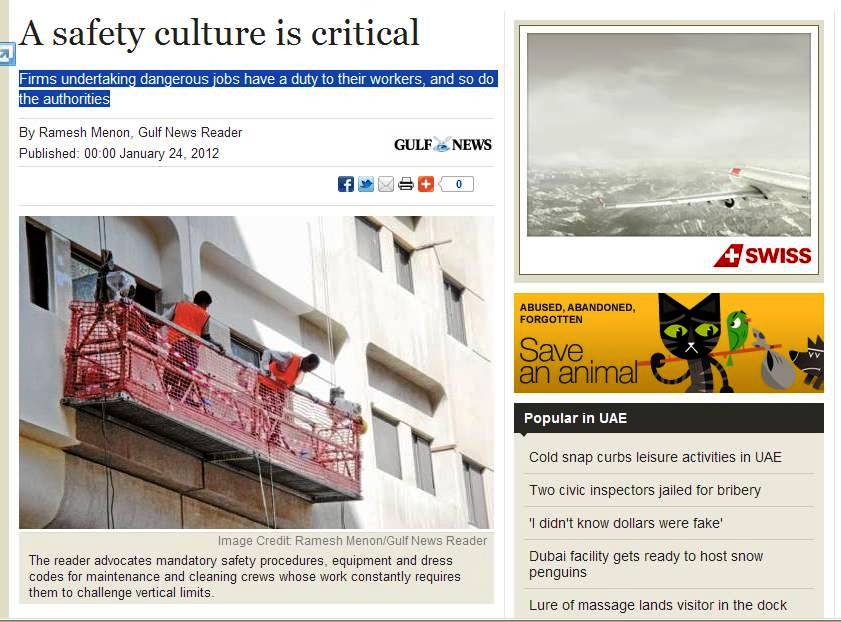
    Image Credit: Ramesh Menon/Gulf News Reader
    The reader advocates mandatory safety procedures, equipment and dress codes for maintenance and cleaning crews whose work constantly requires them to challenge vertical limits

    A safety culture is critical

    Firms undertaking dangerous jobs have a duty to their workers, and so do the authorities
    I see that many old buildings in Abu Dhabi city are being painted these days. While this beautification campaign should be appreciated, I have noticed that some safety elements are being ignored in the process.
     
    Most of the maintenance teams use poor quality suspended cradles and the painters are not properly harnessed and do not wear safety helmets. Even if they do have helmets, they often keep them aside as they probably feel the helmet-shaped plastic caps may not be much help in case of an accident.
     
    Through this community report, I request the supervisors of companies undertaking such jobs to take appropriate measures for the safety of the workers.
     
    I also urge the authorities to implement mandatory safety procedures, equipment and dress codes for all involved in such high-risk jobs. Let us be proactive and think of safety 24/7, rather than acting after an incident happens. 


    — The reader is a technical officer, based in Abu Dhabi

    To read it in original, please visit, GULF NEWS online.
    Phone-in dangers – Gulf News Dt. 27.10.2011

    Posted on

    Phone-in dangers

    Radio stations in the UAE can play an important role in educating traffic safety to road users. After listening to various radio channels in the past few days I suggest an increased voluntary participation by radio jockeys from all prominent radio stations to talk about the importance of not using mobile phones while driving — or using it diligently with appropriate hands-free equipment. Radio stations should implement a check to not entertain a caller if he or she is not using such equipment while participating in phone-in programmes. Can the radio stations, which are doing a wonderful job in passing out useful information and entertainment to listeners, include this in their daily agenda? Could the authorities also ensure that an appropriate guideline is issued to radio stations on this subject?

    From Mr Ramesh Menon
    Abu Dhabi

    To read it in original, visit GULF NEWS online.