General
Old vehicles to go off road by Jan
Old vehicles to go off road by Jan
By Ahmed Abdul Aziz (Our staff reporter/KHALEEJ TIMES)16 June 2008
ABU DHABI — By next January, 20-year-old light vehicles would go off the roads and the import of cars manufactured five years back would be banned, according to a senior official at the Ministry of Interior (MoI).
Colonel Ghaith Al Zaabi, Director-General of the Federal Traffic and Patrol Department in the MoI, told Khaleej Times yesterday that the decision of the Cabinet’s Services Committee is aimed at regulating licensing of light and heavy vehicles with the objective of reducing the rush on roads and to protect the environment from the emissions of the old cars.
He said that licences for cars manufactured in or before 1988 would not be renewed. He advised the owners of such vehicles to not apply for licence renewal from January 2009.
The licences of cars manufactured 15 years ago would not be renewed from January 2010, he added. According to Ministry of Interior’s latest statistics, the UAE has 1.8 million vehicles of different makes and manufacturing years. Import of used light vehicle would be allowed if it is not more than five years old and in the case of heavy vehicles not more than seven years old.
The decision also bans transfer of licence of vehicles aged more than 10 years. “It means that if you have a light car that was manufactured 10 years ago, you would not be able to sell it to another person,” Col Al Zaabi clarified.
However, vintage and classic cars have been exempted. “The classic and historic cars can be imported, if they fulfil the requirements of the technical check,” added Al Zaabi. Licensed taxis would be allowed to get renewal just for five years from the date of production of the car. The Ministry of Interior will coordinate with the National Transportation Authority to implement the decision.
Check-in during summer rush
Check-in during summer rush
By Zoe Sinclair (Our staff reporter/KHALEEJ TIMES) 16 June 2008
DUBAI — Airlines at Dubai International Airport are checking in passengers and closing boarding gates early to help an expected 11 million people travel smoothly during the peak summer period starting today.
More than 300 Dubai Airports staff have also volunteered to help customers make their way through the airport, coping with 20 per cent more passengers than last summer — the highest passenger numbers yet.
Emirates Airline will close its boarding gates 15 minutes before take-off time from June 22 to ensure flights leave as scheduled during the summer rush.
Mohammed H. Mattar, Emirates airport services senior vice-president, warned that anyone arriving late at the boarding gate would be left behind.
“Emirates is implementing the 15-minute before departure gate closure in consideration of our customers who arrive on time for their flights,” Mattar said. “The new policy will allow aircraft to take off as scheduled as it takes about 15 minutes to locate and off-load the baggage of missing or late customers.”
Emirates’ customers are requested to check in two hours before departure and to arrive at the boarding gate 35 minutes before their flight departs.
Passengers are reminded at various points of the new 15-minute early gate closure, including via public address system.
Help for transit passengers
Transit passengers from flights arriving late in Dubai will be escorted by airport staff through formalities to ensure they make it to their onward connection flights.
Indian Airlines Gulf regional manager Abhay Pathak said the airline had begun opening its check-in desks four hours before departure ahead of the busy summer time.
“We also will have a number of Indian Airlines staff helping passengers through the airport during summer along with Dnata staff,” Pathak said.
“Ultimately it is the physical movement of people and ground-handling staff which are important if passengers are late and bags have to be unloaded.”
Volunteers at hand
From Dubai Duty Free staff to Dubai Airports management, more than 300 staff are taking part in the volunteer programme as part of the initiatives to manage Dubai International Airport’s smooth operation during the annual peak season from June to August.
Paul Griffiths, CEO of Dubai Airports, said: “Our employees understand the challenges we face during the peak season and are going the extra mile by volunteering to improve the travellers’ experience. They are available at every step in the terminal journey, helping and assisting customers with their requirements.”
The volunteers in red shirts, present at 35 different locations from kerb-side to the gate, will help passengers move quickly through queues by distributing clear resealable bags for liquids and gels and advising them to remove metal ahead of screening machines.
After trial run last week, Majed Al Joker, Head of Operations at Dubai International Airport, said: “Our customers are able to undergo the security check in a much shorter time without any compromise to the security process.”
Other measures included more detailed signage, instruction videos, better screening machines, more check-in counters (including self and mobile check-in counters), more immigration counters, and e-gate registration facilities in both arrivals and departures.
Major revamp of visit visa norms
Major revamp of visit visa norms
By Ahmed Abdul Aziz (Our staff reporter)KHALEEJ TIMES 12 June 2008
ABU DHABI — Under the new visit visa rule which comes into effect from August 1, residents sponsoring their immediate family members, which include spouse, children and parents, are expected to pay a Dh1,000 deposit, refundable on exit, Khaleej Times has learnt.
Besides, the sponsor seeking to apply for visit visa for his immediate family or first degree relatives (brother, sister, aunt, uncle) should draw a minimum monthly salary of Dh5,000, the new rule states.
Currently, visit visa for an immediate family member does not require any refundable deposit. The deposit of Dh2,000 is paid only in case the sponsor applies for visit visa for a first degree or second degree relative. However, it is not very clear whether the new visit visa rule requires a refundable deposit to be made even for immediate family members.
A meeting of officials of the Naturalisation and Residency Departments of all emirates will be held today in Ajman to discuss and clarify all the fine points and procedural requirements of the new visit visa rule.
The amended rule, according to the by-laws, regulates issuance of visit visas and will now oblige the sponsors who want to bring their relatives to pay
Dh1,000 guarantee which is refundable when the visitor leaves the country.
Colonel Darwish Eid Ebaid Al Meheri, Director of Visas and Residency Department at the Federal Naturalisation and Residency Department (FNRD) at the Ministry of Interior, had earlier said, “The sponsors who want to bring their relatives to the country on visit visa must pay the guarantee of Dh1,000, in addition to providing the health insurance before issuing the visa”.
However, the situation will change by August 1, as the sponsors (nationals or expatriates) who want to bring first or second degree relatives must deposit a Dh1,000 refundable guarantee.
According to Article 40 of the by-law regulating the implementation of the new visit visa structure, the guarantee deposit will be refunded once the visitor leaves the country.
Expatriate residents can seek visit visas only for their relatives such as spouses, parents, children, brothers and sisters. However, in case of friends, the sponsor must be a UAE national.
Meanwhile, if the visitor arriving in the UAE is a second-degree relative such as cousins or nephews, the application must be endorsed by the Undersecretary of the Ministry of Interior (MoI) or approved by the director of naturalisation and residency of the respective emirate.
Mid-day break for labourers
Mid-day break for labourers
By Riyasbabu (Our staff reporter)KHALEEJ TIMES 11 June 2008
DUBAI — The Ministry of Labour (MoL) yesterday announced the mid-day break for labourers for this year’s summer months, banning outdoor work between 12.30pm and 3pm daily during the months of July and August.
Making the announcement, Humaid bin Deemas, Under-Secretary of MoL, stated the ban would provide respite to construction workers from the scorching sun and high humidity during the peak summer months.
Humaid bin Deemas said all preparations were in place for the implementation of the rule and violators would be penalised.
The MoL started implementing the mid-day break rule since 2005 as a part of its commitment to ensuring the health and safety of workers during the summers.
“This is the fourth year we are implementing the mid-day break. The response from companies as well as workers has been overwhelming,” said Humaid bin Deemas, while disclosing that the number of violators had been declining over the last two years.
According to the figures provided by the MoL’s Inspection Department, some 1,240 companies were found flouting the ban in 2005, 862 in 2006 and 617 in 2007.
“This shows that more companies are aware about the law. We’ll increase the number of inspectors this year,” said Humaid bin Deemas, without specifying the number of inspectors to be deployed this year.
According to the law, companies violating the rule for the first time will be fined Dh10,000 and their status will be transferred to ‘C’ category for three months and all of their new visa applications will be blocked.
If a company is found violating the law for the second time, a fine of Dh20,000 will be slapped and its status will be downgraded for six months.
If the company violates the law the third time, the fine will be Dh30,000 and its work licence will be suspended for one year.
Humaid bin Deemas added: “All the companies should provide shades for workers to rest during the mid-day break. A failure to do so will be considered a violation of law and violators will face the same penalties.”
He clarified: “Government organisations are not exempted from the law. All the government departments will be informed of the rule and they have to oblige by it.”
MY DRIVING EXPERIENCES IN CHENNAI by Mrs Usha Sridhar
MY DRIVING EXPERIENCES IN CHENNAI
by Mrs. Usha Sridhar, Chennai
Chennai road rules broadly operate within the domain of karma where you do your best, and leave the results to your insurance company. The hints are as follows: Do we drive on the left or right of road? The answer is ‘both’. Basically you start on the left of the road, unless it is occupied. In that case, go to the right, unless that is also occupied. Then proceed by occupying the next available gap, as in chess. Just trust your instincts, ascertain the direction, and proceed. Adherence to road rules leads to much misery and occasional fatality. Most drivers don’t drive, but just aim their vehicles in the generally intended direction.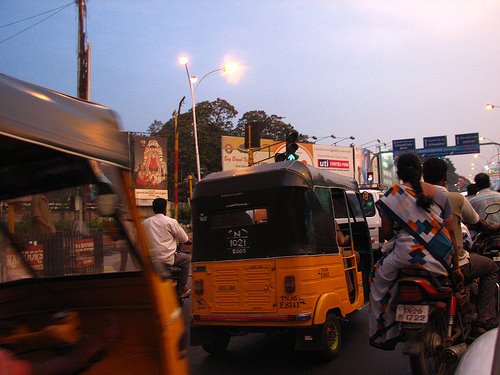
Don’t you get discouraged or underestimate yourself except for a belief in reincarnation; the other drivers are not in any better position. Don’t stop at pedestrian crossings just because some one wants to cross the road. You may do so only if you enjoy being bumped in the back. Pedestrians have been strictly instructed to cross only when traffic is moving slowly or has come to a dead stop because some minister is in town. Still some idiot may try to wade across, but then, let us not talk ill of the dead.
Blowing your horn is not a sign of protest as in most countries. We horn to express joy, resentment, frustration and romance (two brisk blasts),or just mobilize a dozing cow in the middle of the bazaar. Keep informative books in the glove compartment. You may read them during traffic jams, while awaiting the chief minister’s motorcade, or waiting for the rainwater to recede when over ground traffic meets underground drainage.
Auto Rickshaws are the main villains of the road. This triangular vehicle carries iron rods, gas cylinders or passengers three times its weight and dimension, at an unspecified fare. After careful geometric calculations, children are folded and packed into these auto rickshaws until some children in the periphery are not in contact with the vehicle at all. Then their school bags are pushed into the microscopic gaps all round so those minor collisions with other vehicles on the road cause no permanent damage. Of course, the peripheral children are charged half the fare and also learn Newton ‘s laws of motion enroute to school. Auto-rickshaw drivers follow the road rules depicted in the film Ben Hur, and are licensed to irritate.
Mopeds runs 30 miles on a teaspoon of petrol and travels at break-bottom speed. As the sides of the road are too rough for a ride, the moped drivers tend to drive in the middle of the road; they would rather drive under heavier vehicles instead of around them and are often ‘mopped’ off the tarmac. The same is opposite for other two wheelers.
Most bus passengers are hanging off other passengers, who in turn hang off the railings and the overloaded bus leans dangerously, defying laws of gravity but obeying laws of surface tension. Steer clear of these buses by a width of three passengers.
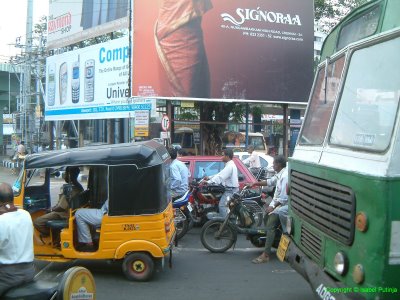
I seriously think that one-way Street are put up by traffic people to add jest in their otherwise drab lives. Don’t stick to the literal meaning and proceed in one direction. In metaphysical terms, it means that you cannot proceed in two directions at once. So drive as you like, in reverse throughout, if you are the fussy type. Least I sound hypercritical, I must add a positive point also. Rash and fast driving in residential areas has been prevented by providing a ‘speed breaker’; two for each house. This mound, incidentally, covers the water and drainage pipes for that residence and is left untarred for easy identification by the corporation authorities, should they want to recover the pipe for year-end accounting.
Night driving on Chennai roads can be an exhilarating experience for those with the mental make up of Genghis Khan. In a way, it is like playing Russian roulette, because you do not know who amongst the drivers is loaded. What looks like premature dawn on the horizon turns out to be a truck attempting a speed record. On encountering it, just pull partly into the field adjoining the road until the phenomenon passes. Do not blink your lights expecting reciprocation. The only dim thing in the truck is the driver, and with the peg of illicit alcohol he has had at the last stop, his total cerebral functions add up to little more than a naught. Truck drivers are the James Bonds of India, and are licensed to kill. Often you may encounter a single powerful beam of light about six feet above the ground. This is not a super motorbike, but a truck approaching you with a single light on, usually the left one. It could be the right one, but never get too close to investigate. You may prove your point posthumously!!!
The writer Mrs. Usha Sridhar, wife of Dr. Sridhar, is now based in Chennai. She was a long time resident of UAE and Sridhar family is enjoying their home coming to India and we hope we get regular updates of their experience and exploration of the new India they are discovering after a long stint abroad.
Visitors face Dh500 fee in visa overhaul
Visitors face Dh500 fee in visa overhaul
Haneen Dajani and Meera al Sayegh for THE NATIONAL
Last Updated: June 08. 2008 11:18PM UAE / June 8. 2008 7:18PM GMT
Miriam Najam, an immigration officer, deals with people at passport control, in the departures section of Dubai International Airport. Randi Sokoloff / The National
Many visitors will have to pay at least Dh500 (US$136) to enter the UAE under an overhaul of the visa system announced yesterday that is also intended to enable authorities to keep better track of them.
Four extra categories of visas will be added when the changes come into force on August 1, and a series of charges will be levied for some types of stays, including a Dh500 fee for a 30-day visitor’s visa.
Major Gen Mohammed al Khaili, the director general of the Naturalisation and Residence Department, also outlined several amendments to the current visa rules, following a decision by General Sheikh Saif bin Zayed, the Interior Minister.
“As the country is constantly growing and developing, there are more reasons for people to visit, therefore it is necessary to develop the current visa system to match the various types of visits,” said Major Gen Khalili.
The shake-up will create another layer of security at the country’s borders, with more detailed information sought on exactly why each visitor is here.
The new categories include a study visa, a medical visa for those obtaining treatment, an “exhibition and conference” visa and one for guests of the Government.
Other amendments include creating two types of visit visas – short-term and long-term – that will allow holders to stay for 30 days and 90 days, respectively.
At Dh1,000, the cost of the 90-day visa will be double that for a 30-day visit and the fees will apply to people visiting the country to stay with friends or relatives. The 30-day visa can be renewed for a further 30 days, at a cost of Dh500 per person.
For tourists who book into hotels or who book holidays through a registered tour operator or agency, the visit visa will not be required. Instead, they must carry a tourist visa, costing Dh100, which can be issued through the hotel or agency. The tourist company will have to pay Dh75,000 to the Government when opening the agency and a refundable Dh1,000 for every visa for tourists from certain countries.
The company must be able to provide a full itinerary for the traveller for their stay. The visa requirements, which also stipulate that an individual must have health insurance valid for the period of his stay, will apply to all nationalities.
An official, who asked not to be named, said the proposed changes followed an investigation by the Ministry of Interior into visa violations that showed that many visitors misunderstood the conditions.
“The study concluded that narrower categories would make the entry system easier to navigate,” said the official. “The new categories are also intended to curb abuse of visit visas, which are used by many job-seekers to get into the country and then search for employment.”
The need for a medical visa had been identified, he said, “because many violators were using medical treatment as an excuse for overstaying their deadline”. The new visas would make it easier for visitors, said Col Darwish al Meheri, manager of the Department of Entry and Residency Permits.
“For instance, there was no category for students who come to the UAE for short-term courses, such as summer courses,” he said. “Under the new system, such visas could be issued by accredited research and educational facilities.”
A 90-day medical treatment permit will cost Dh1,000 and could be renewed for 90 days at a cost of Dh500. A student visa for short-term courses will be valid for 60 days at a cost of Dh1,000 and could be renewed twice for the same period at a cost of Dh500.
In addition, a visa to attend a conference or exhibition for a period of 30 days from date of entry could be issued at a cost of Dh100, in co-ordination with the event organiser. Applicants will pay a refundable Dh1,000 deposit, to ensure they leave on time. The visa issued by the Government for special guests has no time limit or fee.
Under the current system, foreigners can obtain a “multiple-visit visa” valid for six months, allowing 30-day visits, at a cost of Dh1,000. Under the new system each visit will be limited to 14 days, at a cost of Dh2,000.
A 96-hour transit visa will cost Dh100, used while passing through the country’s airports. The traveller must have a valid ticket for the next flight.
Gen Sheikh Saif bin Zayed promised Federal National Council officials last March that he would submit to the Cabinet new travel regulations for different visa types.
The council has asked the Ministry of Interior to tighten the procedures for issuing visitor visas amid fears that increasing numbers of criminals and beggars are entering the country.
hdajani@thenational.ae
Four new types of visit visas
Four new types of visit visas
By Ahmed Abdul Aziz (Our staff reporter)Khaleej Times 9 June 2008
ABU DHABI — The Director-General of Federal Naturalisation and Residency Department (FNRD) in the Ministry of Interior, Lieutenant-General Mohammed Salim Al Khaili, yesterday introduced four new types of visit visas and announced the new fees structure for various types of visit visas that would be implemented from August 1.
Addressing media at the FNRD Directorate-General in the capital, Lt-Gen. Al Khaili said visa fees have been revised as per the Cabinet’s decision No.16 of 2008.
Colonel Darwish Eid Ebaid Al Meheri, Manager of Entry and Residency Department, pointed out that all visas would be issued after the sponsor or the company paid for and provided health insurance because the visitors who come to the country should have health insurance cover.
About the new types of visas, Lt-Gen. Al Khaili said, “This is to meet the developments that the UAE is witnessing as part of the economic boom and the huge contracting and tourism projects across the country.”
The new fees approved for the six-month multiple entry visa is Dh2,000. However, under this category visitors would not be allowed to stay for more than 14 days in the country on each visit. The visa can be renewed for another six months on payment of Dh2,000.
The new visit visas will be of two types: the long stay (three months) that would cost Dh1,000, and the short (one month) costing Dh500. Both are not renewable.
Lt-Gen. Al Khaili told Khaleej Times that the Ministry of Interior is keen on protecting the workers’ rights and stressed that the companies must abide by the laws when bringing workers to the UAE. The visit visas should be sought only for visitors, not workers, he clarified.
“We work in cooperation with the authorities concerned to protect the rights of workers such as wages, air tickets and health insurance that would not be available to them if they entered the country on visit visas,”, he pointed out, noting that
the firms can apply for three-month mission visas to bring in workers.
The non-renewable mission visa would allow a stay of three months and cost Dh200 and the non-renewable transit visa would allow a stay of 14 days and cost Dh100.
Visit visas for GCC residents would allow a stay of one month and cost Dh100, and could be renewed for another month for a fee of Dh500.
Visit visas for those accompanying GCC nationals would allow a stay of one month and cost Dh100 and could be renewed for another month at a fee of Dh200.
The duration of the new education visas would be fixed depending on the universities’ courses and programmes taken by the students and each authorised academic institute must apply to issue visas for that particular course. The education visa would cost Dh1,000 and could be renewed for a fee of Dh500.
For the medical treatment visas, Col. Al Meheri said they would be issued to expatriates who want to come to the country for medical treatment and would cost Dh1,000 for three months and could be renewed at a cost of Dh500 for another three months.
He added that the tourism visas would cost Dh100, and allow one-month stay and could be renewed for another month at a cost of Dh500.
Lt-Gen. Al Khaili said the travel and tourism agencies would have to pay a refundable guarantee of Dh1,000 per visa at the time of issuance.
Visit visas issued for conferences and exhibitions would cost Dh100 for a stay of one month and would be non-renewable.
Visit visa to the UAE will cost Dh500 from August
Visit visa to the UAE will cost Dh500 from August
By Rayeesa Absal, Staff Reporter GULF NEWS Last updated: June 08, 2008, 16:55
Abu Dhabi: Visit visas to the UAE will cost Dh500 from August 1 following the revamp of the structure and charges of entry documents in line with a cabinet decision, a senior official said. New types of visas have also been introduced.
“Visit visas valid for 30 days will cost Dh500. This cannot be renewed,” said Lieutenant General Mohammad Salem Al Khaili, Director-General of Federal Naturalisation and Residency Department.
“If a person wishes to stay for an extended period, he or she must obtain a visa valid for 90 days which costs Dh1,000.”
A health insurance policy is mandatory for visitors and a Dh1,000 deposit will be collected by the department before issuing visas.
Residents can apply for the visa for their spouse or blood relatives. Sponsoring other relatives will need the approval of senior officials. Only UAE nationals can sponsor friends.
Multiple entries
Some 16 types of visit visas have been defined by the FNRD specifying the reason for visit, such as education, treatment, or for participating in an exhibition or conference.
“A multiple entry visa has also been introduced. The visa [costing Dh2,000] is valid for six months, but a person can stay in the country only for 14 days at a stretch, ” said Al Khaili.
“New types of visas are introduced to keep up with the fastpaced development of the country,” he added.
Student visit visas will cost Dh1,000. To obtain this, a person must be registered in one of the universities in the UAE and must obtain health insurance. Additionally a refundable deposit of Dh1000 must be paid.
Those wishing to undergo treatment must take visit visa for treatment purpose that costs Dh1,000 for 90 day duration.
This can be renewed for a similar period at Dh500.
Those visiting to attend conferences or exhibitions can obtain a visa for this purpose at Dh100.
One-month long tourist visas will cost Dh100, as before. This may be renewed only once. Transit visas will cost Dh100 while mission visas will cost Dh200.
Apart from the 16 new types of visas, complimentary visit visas could be issued by all government departments free of cost to delegates, dignitaries and others.
VISA FEES
Type of visa Fees in Dhs
Short Entry (visit) Visa 500 (1 month)
Long Entry (visit) Visa 1,000 (3 months)
Multiple Entry Visa 2,000
Entry Visa for Study 1,000
Renewal of Study Visa 500
Entry Visa for Medical Treatment 1,000
Renewal of Medical Treatment Visa 500
Entry Visa for Expos and Conferences 100
Tourism Entry Visa 100
Renewal of Tourism Visa 500
Entry Visa for GCC State Residents 100
Renewal of GCC State Resident’s Visa 500
Entry Visa for GCC State Resident’s Companions 100
Renewal of GCC State Residents Companions’ Visa 200
Mission Entry Visa 200
Transit Entry Visa 100
Dubai address system revamp will help public locate places easily
Dubai address system revamp will help public locate places easily
By Ashfaq Ahmed, Chief Reporter GULF NEWS Published: June 08, 2008, 00:06
Dubai: Dubai will radically revamp the addressing system to help the public locate addresses easily in the fast growing city.
“The expansion of the city warrants the need to have a state-of-the-art addressing system,”said Mattar Al Tayer, Chairman of the Board and Executive Director of the Dubai Roads and Transport Authority (RTA).
He said the RTA has decided to improve the existing addressing system to make it simpler for residents and visitors.
The existing road numbering system will be abolished and the new system will be based on the street names and house or building numbers. A new Directional Signage System will be introduced to make it easier to locate an address.
“The authority wants residents to shift from the landmark-based address system to real address system, because the city is expanding. The new system will also help materialise plans to deliver mail and utility bills at doorsteps in addition to making it easier for people to locate addresses,” a senior official told Gulf News.
Committee
He said the RTA wants people to use real addresses instead of post box numbers.
A committee consisting of top officials from leading government departments, including the Dubai Road and Transport Authority, Dubai Police, Dubai Municipality, Emirates Posts Holding Group, Civil Defence Department, Dubai Ambulance Services and Emirates Telecommunications Corporation, met at the RTA office to deliberate on the new addressing system and decided to bring major changes to the existing one.
“After meetings with our strategic partners, we have decided to overhaul the existing addressing system in a way that help residents, visitors and emergency services reach the desired destinations easily,” Al Tayer said.
The project for the comprehensive address system, including the building numbers, roads and street names and numbers, and the community numbers had first started in the early 1980s in Dubai. So far, about 70 per cent of the city has so far been covered.
The decision was taken after a study conducted by a RTA consultant that revealed difficulties currently being experienced by residents and visitors of Dubai in locating their whereabouts.
The consultant also revealed that that even police and the Civil Defence vehicles found difficult in locating venues of emergency callers as they are unable to accurately describe their locations.
Also, majority of the people do not understand the existing addressing system because it is complicated.
The new addressing system, which will be implemented in phases, will use road names and sectors as a basis for the addressing system.
“The new system does not require to modify the existing building numbers and it will be easy to integrate the addressing system with the Directional Signs System,” said Al Tayer. Currently, road and street numbers are used in most of the areas for directional signs. Al Tayer revealed the change will be made only to directional signs and not the overhead support signage; a matter which will save time and effort as signage will have to be modified in accordance with the requirements at site.
The pilot project for the new addressing system will run for a three-month period after which the results of the experiment will be evaluated.
The Jumeirah-3 area has been selected for introducing the new addressing system, and a sector of Shaikh Zayed Road from the 2nd to the 4th Interchange has also been selected to implement the Directional Signs System.
Maps required for the system will be produced and intensive awareness campaigns will be carried out to educate the public on the optimum use of maps.
An intense media and promotional campaign will be launched to introduce the system to the public and how best they can benefit from it.
How it works
* Under the new system, road names will be used instead of the road numbers such as (24Abu Hurairah Road/Jumeirah, Dubai). It has also been agreed to replace road numbers with new ones.
* Areas will be divided into sectors consisting of several districts, but building numbers will remain the same.
* Names of roads and sectors will be used on the new directional signs instead of names of areas, as is the case in the applicable system.
* The project, which is modelled on the global positioning systems, includes designing and production of Traffic Control Means Guide, and preparing maps of directional sign locations using Geographical Information Systems (GIS) and other similar systems.
Teri diwani – Classical Dance – Kathak – Anushri Nair
Classical Dance – Fusion
Teri diwani – Classical Dance – Kathak
 ClicksandWrites
You must be logged in to post a comment.