General
New beach on Abu Dhabi Corniche to be opened
New beach on Abu Dhabi Corniche to be opened
opensAbu Dhabi: A new two-kilometre beach stretch along the Abu Dhabi Corniche will open to the public on Monday.
The new beach will have swimming areas, refreshment outlets, scenic gardens, walking pathways, beach volleyball pitches, children’s play areas and toilets.
Last-minute touch-ups are in full swing at various facilities at the new tourism destination, which lies on an area of 11 hectares.
At least 170 umbrellas will line the stretch to provide shade to beach goers. Four volleyball pitches will also be available for visitors throughout the day.
People will be able to use the swim area during daytime, and trained lifeguards will monitor the swimmers from seven surveillance towers.
Floating fences will ensure swimming security over 40-metres into the sea. A police post has also been built on the beach front for more security.
The landscaping and greenery are also expected to make the beach one among the most beautiful destinations in the country.
A central building, complete with a mosque, refreshment areas and changing rooms, will give facility for picnic events, get-togethers and family assemblies.
Along the landscaped area, benches have been laid out giving the people one of the most refreshing sights of the sea.
Visa runs continue despite Shaikh Mohammad’s order’s
Visa runs continue despite Shaikh Mohammad’s order’s
By Alia Al Theeb, Staff Reporter GULF NEWS Published: June 27, 2008, 00:07
On February 11, 2004, Shaikh Zayed Bin Sultan Al Nahyan abolished the law countrywide that required foreign workers to briefly exit the UAE to comply with visa regulations, a day after a Kish Air plane crashed into a residential area near Sharjah airport, killing 43 of the 46 people aboard.
Expatriates who arrive on visitors’ visas but later find jobs no longer have to exit and re-enter on new work visas.
On February 10, 2004, His Highness Shaikh Mohammad Bin Rashid Al Maktoum, Vice-President and Prime Minister of the UAE and Ruler of Dubai, who was then the Dubai Crown Prince, ordered new measures to ensure that there will no longer be any need for people on visit visas, who have been issued work permits, to leave the country to convert them into residence visas.
The new arrangement would cover all professions and nationalities and it was meant to ensure public safety and reduce their burden.
Short visa runs set to end, says UAE official
Short visa runs set to end, says UAE official
By Bassma Al Jandaly, Staff Reporter GULF NEWS Published: June 27, 2008, 00:07
Dubai: Short visa runs will be banned once new entry permit rules take effect on August 1, a senior Ministry of Interior official told Gulf News on Thursday.
Expatriates who wanted to adjust their visa status had to make quick trips to neighbouring countries and then return to the UAE.
In February 2004 a Kish Air plane crashed into a residential area near Sharjah airport, killing 43 people aboard. Most of the victims had gone to Kish Island in Iran so that they could adjust their visa status.
Immediately afterwards, the late Shaikh Zayed Bin Sultan Al Nahyan abolished the law that required foreign workers to briefly exit the country to comply with visa regulations.
His Highness Shaikh Mohammad bin Rashid Al Maktoum, Vice-President and Prime Minister of the UAE and Ruler of Dubai, who was then Crown Prince of Dubai, ordered new measures to ensure that there was no longer any need for people on visit visas, who have been issued work permits, to leave the country to convert them to residence visas. A fee could be paid instead.
However, four years later, visa runs continue. All this is set to change once the new rules come into effect. A Ministry of Interior official said short visa runs will be completely stopped.
People who have secured jobs will come here only on employment visas – they won’t be allowed to come on visit visas and then change their status to employment and residency.
The official said the complete ban on short visa runs will be made soon. “We will stop these daily runs to neighbouring countries. If required, expatriates will have to leave the country for at least a month,” he said.
Gulf News reported on Wednesday that a two-month-old baby must travel to Kish or to Oman and return so that he can get a residency visa.
Abu Dhabi bus service is route to beating traffic woes

Abu Dhabi bus service is route to beating traffic woes
By Samir Salama, Associate Editor GULF NEWS Published: June 26, 2008, 00:03
Abu Dhabi: From Monday until the end of the year residents in Abu Dhabi will enjoy free bus trips on the island to encourage car owners to leave their cars behind, it was announced on Wednesday.
“Altogether 125 brand-new, handicap-accessible, world-class, white and green buses will be deployed in Abu Dhabi between 6am and midnight to transport people, free of charge, to make public buses the preferred mode of transportation,” said Saeed Al Hameli, general manager of the bus section at the Department of Transport.
He launched a two-year plan to gradually overhaul the emirate’s public transport network and infrastructure in line with “Plan Abu Dhabi 2030”.
The project will be completed in phases, starting June 30, with the gradual deployment of 258 buses as a short-term solution. Of these 125 are new and 133 have been refurbished, Al Hameli told a press conference.
The fleet will enter service gradually with 60 buses being deployed on the first day on high-traffic routes, to immediately enhance commuter comfort and convenience and improve frequency and scheduled services.
“A further 100 new buses are due to enter service in the first quarter of 2009, with more phases to follow. All future phases will aim to increase city, suburban and inter-city capacity by 50 per cent by the end of next year.”
The new buses, Al Hameli said, will initially service four new routes, followed by six additional routes in August with the goal to operate on 21 high-frequency routes by the beginning of 2009, covering most of Abu Dhabi Island.
The department of transport plans to service Abu Dhabi with 1,360 world-class buses by the end of 2010 and has already designed Abu Dhabi’s future bus route network, which will provide comprehensive coverage within cities and link the emirate’s urban areas.
As the emirate’s population is expected to increase to 1.5 million people by 2010, the department is today sowing the seeds for a safe, sustainable, economically viable, efficient and lifestyle-enhancing transport system that will be the preferred mode of transport for the public,” said Abdullah Rashid Al Otaiba, chairman of the Department of Transport.
“This is the first step on the long road ahead that will fuel further economic growth, contribute to the reduction of CO2 emissions, enhance quality of life and establish a sustainable public transportation system for all the people of Abu Dhabi.”
He added that by 2030, Abu Dhabi will be home to 3.5 million people and the aim is to develop a comprehensive public transportation network that will appeal to all segments of society. Our biggest challenge today is to encourage car owners to utilise the new facilities and infrastructure.
“It’s going to be a gradual process but Abu Dhabi residents and tourists will start seeing the changes next week,” Al Otaiba said.
Upon completion of the project, Abu Dhabi will boast one of the world’s most modern bus fleets.
Freedom Bus lanes planned
*From June 30, free bus rides will be offered until the end of the year with the gradual deployment of 258 buses, 125 new and 133 refurbished.
* Routes: Marina Mall to Mina Zayed through Zayed The First Street and Hamdan Street; Abu Dhabi Mall to Marina Mall through Zayed The First Street; Shaikh Rashid Bin Saeed (Airport) Road to Courts Complex and Carrefour Mall and Al Muroor Road to Madinat Zayed Centre.
* Toll free telephone number 800 55555 for information on routes, complaints or suggestions
* Dedicated bus priority lanes may be deployed in key Abu Dhabi arteries that will ensure the smooth flow of buses and connectivity.
* Renovation of the existing 12 bus stations and the development of 25 new bus stations. Over the next five years, the 37 bus stations will feature an array of retail, banking, food and beverage and other facilities.
* Creation of six bus depots.
* Tariff for old buses on other routes will remain unchanged.
Abu Dhabi considers congestion charges
Abu Dhabi considers congestion charges
Ivan Gale and Matthew Chung for THE NATIONAL
Last Updated: June 22. 2008 11:45PM UAE / June 22. 2008 7:45PM GMT
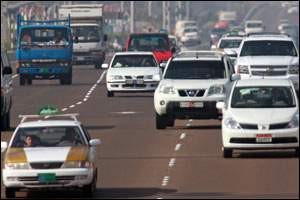
The scenario emphasises road-based public transport options such as new bus fleets, instead of rail-based metro and tram systems. The National
ABU DHABI // The Abu Dhabi Government is considering eliminating fuel subsidies, introducing congestion charges and levying new fees on motorists as part of its efforts to solve the capital’s transport woes, according to documents posted on a new Department of Transport website.
The documents, developed by the DoT and made public on its website, illustrate the dilemma the department is facing. They lay out four scenarios for improving transportation in the city.
Three of the plans call for more public transportation, while one suggests building more motorways, although it is understood that the department could also adopt elements of the different plans.
Just two days ago, the Department of Planning and Economy released a report saying that road congestion and poor public transport were inflicting a “heavy economic toll” on the city and required “urgent remedial measures”.
The DoT has been studying the emirate’s transport problems since it was created two years ago. The city currently has a dearth of buses and many people wait for long periods to catch cabs.
Over the next two decades the department is expected to spend tens of billions of dirhams to improve things, in part to support the emirate’s 2030 plan, aimed at guiding the overhaul of infrastructure over the next quarter of a century.
The developers of the 2030 initiative expect Abu Dhabi’s population to more than triple in size during the period.
The transport department has invited the public to comment on the four scenarios. Then, in February 2009, the agency is expected to issue its recommendations and a blueprint for the transport network.
Abdulla al Shamsi, the director of roads and infrastructure at Abu Dhabi Municipality, said the new website and the publication of the documents were part of a transparency drive to keep the public more informed and actively involved in government planning.
The website, he said, “is really a step forward to the future”. It can be accessed at http://www.transportabudhabi.ae and members of the public are encouraged to comment on the ideas.
The four plans are: a highways-based scenario, a public transport and car alternatives scenario, a demand management scenario and a “low carbon” based scenario.
Under the highways approach, the Government would divert funds towards developing a high capacity, high quality motorway system to cater to private vehicles and road-based public transport and freight.
Existing freeways would be widened and flyovers and underpasses would be added. A one-way street network would be introduced in the central business district to improve flow and capacity.
The scenario emphasises road-based public transport options such as new bus fleets, instead of rail-based metro and tram systems. Toll lanes would be offered for commuters seeking to avoid congestion during peak travel times.
The public transport scenario would expand the mass transit network to include regional rail, trams, metro, bus and water ferries.
The plan calls for a network of integrated services so that journeys can be “door-to-door”. Some road capacity would be allocated to public transit, with the expectation that traffic would be transferred from the road to the public transit.
A regional rail network would be created within the emirate with high-speed rail links to Dubai, Al Ain and potentially Qatar. The public transit plan also calls for air-conditioned walkways. Ferries would service commuters living on the new residential islands of Abu Dhabi and others would run to Dubai.
The demand management scenario would introduce fees for road use, impose vehicle taxes and other maintenance charges, and provide free park-and-ride sites to encourage public transport use. The charges would be introduced in stages after public transport option alternatives are in place.
Fuel subsidies would be removed and fuel taxes introduced, as well as annual vehicle registration fees and safety tests. Congestion charges would be introduced as well as “cordon pricing” for vehicles entering the metropolitan area, similar to the one used in central London. Paid parking would also be extended. Car-pooling and cycling would be encouraged and signs throughout the city would warn drivers about congested areas. Pedestrian-only zones would encourage walking.
However, the report notes that introducing charges on motorists would “most likely” meet opposition.
The low carbon based scenario would rely heavily on public transport but would include a personal rapid transit network on Lulu Island and the use of alternative fuel and low-emission buses.
Low-pollution or electric vehicles or freight trams would be used to transport freight. A low emission zone would be introduced for Abu Dhabi, Sowwah, Reem and Saadiyat Islands, as well as the Capital City development, with charges on vehicles entering the zone based on their emissions. Subsidies would be given for alternative fuels.
In another sign that transport planning is gathering momentum, the DOT last week assembled its largest ever gathering to discuss transport options with key stakeholders from the public and private sector.
More than 70 people attended the meeting. In addition to government agencies, participants included representatives from the emirate’s biggest companies such as Mubadala, Aldar, the Abu Dhabi Investment Agency, Hydra Properties, and Abu Dhabi Basic Industries Corp.
igale@thenational.ae
mchung@thenational.ae
New buses on streets of Abu Dhabi
New buses on streets of Abu Dhabi
Matthew Chung for THE NATIONAL
Last Updated: June 25. 2008 6:06PM UAE / June 25. 2008 2:06PM GMT
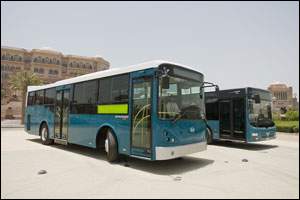
New buses are parked outside Emirates Palace. The Department of Transport has unveiled the new bus service for Abu Dhabi. Phil Cheung / The National
More than 1,300 new air-conditioned and handicap-accessible buses will be plying Abu Dhabi’s streets by 2010, the Department of Transport (DoT) said on today.
The first of the buses will start running on Monday on four routes serving Abu Dhabi Island. Six additional routes are scheduled to be added in August.
By 2009, the department plans to operate on 21 high-frequency routes.
Saeed al Hameli, the general manager for the bus office of the DoT, said the buses serving Abu Dhabi Island would be free until the end of this year to encourage residents to use them.
A further 100 buses are expected to start running by the first quarter of 2009.
The buses are among the first steps the department is taking to solve traffic congestion in the emirate, in which the population is expected to grow to 3.5 million by 2030.
A report issued on Saturday by the Department of Planning and Economy said the UAE was losing about Dh5 billion (US$1.3bn) to traffic congestion and that Abu Dhabi’s roads had outgrown their capacity.
“Our aim is to develop a comprehensive transportation network that will be appealing to all segments of society,” Mr Hameli said.
“Our biggest challenge today is to encourage car owners to utilise the new facilities and infrastructure once they come on line.”
Passengers could expect a reduction in waiting times for buses, Mr Hameli added.
As part of the project, the emirate’s 12 existing bus stations will be renovated and 25 new bus stations built. They will all feature a mix of retail, food and beverage and banking facilities.
Six depots will also be built for bus maintenance. The department is also considering creating dedicated bus lanes on some roads.
mchung@thenational.ae

Visas in the UAE
Visas in the UAE
Gulf News Report Last updated: June 08, 2008, 17:08
Regulations in the UAE are complicated and subject to change. Check with your local UAE Embassy or travel agent prior to leaving to be sure.
There are several different types of visa available. The most commonly used are Visit visas, tourist visas and residency visas for ex-pats.
Visit visa: Visit visas valid for 30 days will cost Dh500. This cannot be renewed. A person wishing to stay for an extended period must obtain a visit visa valid for 90 days that costs Dh1,000.
Citizens of the certain countries (listed in the next paragraph) can get a 30-day visit visa free of charge upon arrival, entitling them to stay for 60 days: Britain, France, Italy, Germany, the Netherlands, Belgium, Luxembourg, Switzerland, Austria, Sweden, Norway, Denmark, Portugal, Ireland, Greece, Cyprus, Finland, Malta, Spain, Monaco, Vatican, Iceland, Andorra, San Marino, Liechtenstein, United States, Canada, Australia, New Zealand, Japan, Brunei, Singapore, Malaysia and Hong Kong.
After this period a visitor can extend the visit visa by a further two months by leaving the country and returning. This can be done twice. When the third visit visa expires the person must leave the UAE for at least a month before returning.
For residents of other countries, the visa must be sponsored by an individual, such as a relative, or an establishment. The application is submitted by the sponsor with all required documents.
Tourist Visa: It is available for tourists sponsored by tour operating companies and hotels. It is issued for 30 days for a fee of Dh100 and an additional Dh10 for delivery. This may be renewed only once.
Student Visit Visa: Will cost Dh1,000. To obtain this, a person must be registered in one of the universities in the UAE and must obtain health insurance. Additionally, a refundable deposit of Dh1000 must be paid.
Special Mission Entry Visa: This is issued for a non-renewable 14 days for a fee of Dh220 and a delivery charge of Dh10. Commonly known as a transit visa, it is collected by the visitor upon arrival. It is issued to businessmen and tourists sponsored by a company or commercial establishment or a hotel licensed to operate in the UAE.
Mission Visa: The newly added type of visa, it is issued for the purpose of temporary work in the country. It is issued for a maximum of 180 days with a combined fee of Dh1,800. It is issued for three months against a fee of Dh600 and can be renewed for another three months against a fee of Dh1,200.
It has been introduced to facilitate Labour Ministry’s Temporary Work Permit. An applicant must obtain the permit from the Labour Ministry first to get the visa.
Transit Visa: It is issued to travellers transiting through UAE airports. It issued for 96 hours and must be sponsored by an airline operating in the UAE. The visitor must have a valid ticket for onward flight. There is a charge of Dh100.
Multiple Entry Visa: It is an option for businessmen who are frequent visitors to the UAE and who have a relationship with a reputable company here.
This multiple visa is valid for six months from the date of issue and costs Dh1,000. However, each visit must not exceed 30 days. The visitor must enter the UAE on a visit visa and obtain the multiple entry visa while he is here.
Residence Visa: A residence visa is required for those who intend to enter the UAE to live indefinitely with a person who is already a resident. It is issued to the immediate kin of a resident for three years for a fee of Dh300.
The residence permit becomes invalid if the resident remains more than six months at a time out of the country.
Parents of residents are issued residence visas after special approval with a renewable validity of one year for a fee of Dh100 for each year. A refundable deposit of Dh5,000 has to be paid for each parent.
Investor Visa: It is issued to an expatriate investor in partnership with a local. The foreign investor must hold a minimum stake of Dh70,000 in the share capital. Like the residence visa, it is issued for three years for a fee of Dh300.
Employment Visa: Employment Visa or Permit is issued by the Immigration Department to a foreign national who wishes to work for a company in the UAE upon the approval of the Ministry of Labour and Social Affairs.
It allows the holder to enter the UAE once for a period of 30 days and is valid for two months from the date of issue.
When the employee has entered the country on the basis of the employment visa, the sponsoring company will arrange to complete the formalities of stamping his residence.
Visit visa for medical purposes: Those wishing to undergo treatment must take visit visa for treatment purpose that costs Dh1,000 for 90 day duration. This can be renewed for a similar period at Dh500.
Visit visa for events: Those visiting to attend conferences or exhibitions can obtain a visa for this purpose at Dh100.
New fuel stations outside city areas
New fuel stations outside city areas
By Ahmed Abdul Aziz (Our staff reporter/KHALEEJ TIMES) 17 June 2008
ABU DHABI — New permanent fuel stations would be allowed only outside the city areas and mobile stations would be set up on the highways to reduce rush at the gas stations in the capital and in other emirates, according to Colonel Ghaith Al Zaabi, Director-General of the Federal Traffic and Patrol Department of the Ministry of Interior (MoI).
Colonel Al Zaabi told Khaleej Times yesterday that the meeting with ADNOC officials last week recommended to establish new stations in the remote areas, where there is a need for them, in addition to setting up mobile stations on the highways to reduce the rush at the petrol stations in Abu Dhabi, Sharjah and Northern Emirates.
Al Zaabi attributed the rush at ADNOC stations to the low prices, which are about 50 per cent less in comparison with the other companies.
He added the premises of the new stations would be decided after studying the geographic surveys. “Moreover, the department will set fixed hours for the trucks to fill diesel in case they need it when they are inside the cities.”
The MoI and ADNOC will increase the number of diesel dispensing units at the fuel stations to meet the increase in the number of trucks in the country. The MoI’s latest statistics showed that the total number of vehicles (trucks, heavy and light cars) has reached 1.8 million this year.
The decision to move fuel stations out of the city limits is due to the heavy rush at the ADNOC stations across the emirates.
Visa service to cost Dh40 at Dnata counters
Visa service to cost Dh40 at Dnata counters
By Mary Nammour and Zoe Sinclair (Our staff reporters / KHALEEJ TIMES)
DUBAI — A new service to be provided soon by Dnata for delivery of entry permits for residency and visit visas to the airports will cost Dh40, a Dubai Naturalisation and Residency Department (DNRD) official told Khaleej Times yesterday.
However a Dnata spokesperson did not confirm the fee increase and said details would be provided later.
The DNRD official said that a new task force was being formed comprising members of DNRD and Dnata to define the implementation details of the new agreement signed on Sunday. “The agreement will be implemented in phases. We’ll be elaborating on the implementation process in due course,” the official noted.
“Under the agreement, Dnata will be delivering entry permits for residency and visit visas to the airports located in Dubai thus sparing the customers the time and effort of worrying about lodging the visas at the airport,” the official noted.
He added: “Dnata is already operating at the Dubai International Airport. The new deal comes to expand Dnata services. It expands the nature of its services and areas of its operations.”
The DNRD official justified the Dh40 fees for delivery and service charge. It is to be divided between DNRD and Dnata.
A Dnata spokesperson confirmed this.
“Dnata has for several years provided a service at Terminal 1 which allows for the lodging, delivery and cancellation of visas,” a Dnata spokesperson said.
“The service is currently available at Terminal 1 of Dubai International Airport and this agreement will see the opening of new counters. The location of these new counters will be officially announced later.
“Any fee increase would be announced separately and would be line with service enhancements.”
According to the agreement, Dnata will deliver all types of entry permits at the airports in the emirate. A counter will also be opened at the DNRD for receiving visas and delivering them at its offices at the airports.
 ClicksandWrites
You must be logged in to post a comment.