Education +
Total Energy and Education Seminar
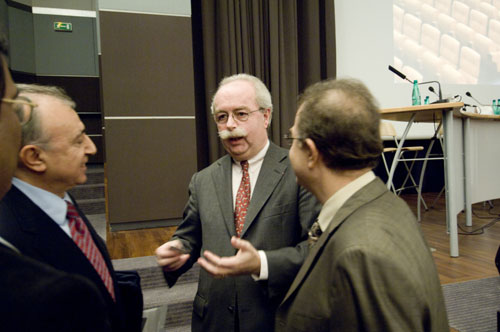
Total Energy and Education Seminar
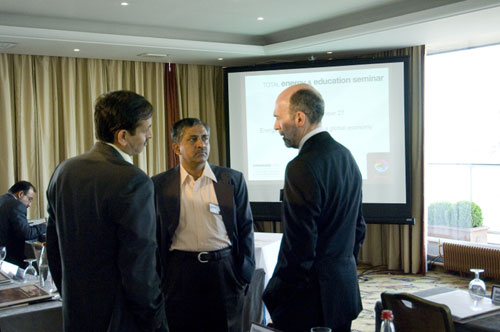
52 university professors from around the world came to Paris for the Total Energy & Education Seminar
From November 25 to 30, Université Total was welcoming for the first time in Paris 52 professors from 44 universities in 21 countries for a week of conferences and discussions on energy and education.
The attendees, most of whom specialize in scientific fields related to energy, or in economics or management, shared their views with some 20 Total senior executives and outside experts.
List of the universities
ALGERIA
University M’Hamed Bougara of Boumerdes
ANGOLA
Agostinho Neto University
ARGENTINA
Instituto Tecnológico de Buenos Aires
Universidad de Buenos Aires
Universidad Austral
CANADA
Keyano College
University of Calgary
University of Alberta
CHINA
China University of Petroleum-Beijing
Shanghai Jiao Tong University
FRANCE
Ecole Centrale Lyon
Polytech’Lille
Institut d’Etudes Politiques de Paris (cycle de Menton)
Ecoles des Mines de Nancy
GERMANY
Hochschule Merseburg (FH) University of Applied Science
Aachen University of Applied Sciences
INDIA
Indian Institute of Technology-Delhi
Indian Institute of Technology-Kharagpur
Indian Institute of Technology-Bombay
INDONESIA
Institut Teknologi Bandung
University of Indonesia
IRAN
Petroleum University of Technology
Sharif University
IRAQ
Baghdad University
University of Sulaimani
ITALY
SDA Bocconi (School of Management)
Catholic University of Milan and Insubria University
LIBYA
El Fateh University
NIGERIA
University of Port Harcourt
Rivers State University of Science and Technology
NORWAY
Institutt for kjemisk prosessteknologi/NTNU
University of Stavanger
RUSSIA
Saint-Petersburg State Mining Institute
Bauman Moscow State Technical University
SOUTH AFRICA
University of the Witwatersrand
University of Cape Town
SPAIN
Universidad Pontificia Comillas
TURKEY
Middle East Technical University
Koç University
UK
Loughborough University
University of Manchester
VENEZUELA
Instituto de Estudios Superiores de Administración
Universidad Simón Bolivar
Universidad Central de Venezuela


Questions for Nathalie Fokart
Director, Université Total
What’s the common thread between the Total Summer School, the MIT senior executive seminar and the climate change conference?
Each of those programs is inspired by a commitment to thinking about and discussing issues that are not only of great interest to Total, but are increasingly a matter of public debate. Our operations involve all sorts of human, geopolitical, technological and environmental aspects that are often closely interwoven and can’t be managed by executives all on their own.
Université Total’s multidisciplinary approach and mix of both in-house and public speakers and participants make it an ideal place to study and gain perspective on these often complex issues.
How do you make this commitment to outreach work?
Whatever the topic, we favor an approach that combines different angles and a variety of scientific, economic and sociological disciplines. We try to tailor our teaching methods—courses, lectures, internships—to the subject and target audience. This can lead to some pretty unusual situations: the Total Summer School invites students into our facilities, while the MIT seminar sends Total executives off to spend a week on a university campus. In both cases, it expands their point of view. The Climate Change Conference was another attempt to break down the walls between specialties, by asking the leading stakeholders—climatologists, companies and government representatives—to come and present their insights. Incidentally, the conference inspired additional meetings on climate change across our operations. The fact that we can repeat and tailor some Université Total events at the request of the business units helps ground our projects in the day-to-day realities of the Group.
And how do you incorporate this open approach to headline issues like ethics or the environment into your internal training programs?
The Université offers a full range of courses about our ethics, environmental, community relations and industrial safety policies. Some are general and interdisciplinary, while others, like business ethics, security and human rights, industrial safety and environmental management, delve into a specific topic in more detail. Several are held in our subsidiaries to promote local presence and dialogue. The same topics are also discussed extensively in the management training and integration programs deployed by the corporate or business training departments and are part of the Université curriculum.
Université Total deals with topics that are rich, diverse and very international. How will you be able to maintain the momentum?
Our initiatives are meant to be constantly updated, since they only make sense if they are pursued over the long term. The Total Summer School will become a regular event and the success of our first session has led us to invite more students. We will continue sponsoring conferences to encourage discussion and debate on social and community issues, such as diversity, and on environmental and technological issues. For geopolitical topics, we’re working on a two-day seminar dedicated to Africa, which will alternate between country analyses and discussions on regional or social trends.
Moreover, a number of projects are giving rise to others, that build on the original. A seminar scheduled for late 2007 on energy and education is expected to draw 50 teachers from around the world.
Curiosity and the thirst for knowledge will be powerful incentives to inspire future programs.
Have An Idea, Attend Manfest
Have An Idea, Attend Manfest
IIM-Lucknow has come up with a unique opportunity for entrepreneurs to secure funding for their venture, reports Chetna Mehra
Entrepreneurs in India will now have one more opportunity to make it big. In an endeavour to encourage entrepreneurs in India, IIM Lucknow has come up with a platform ‘Start-up Showcase’ that allows entrepreneurs to showcase their business plans before IIM-L partners and angel investors. These panelists, in turn, will judge whether the ideas are credible enough. The winners will secure funding of up to $200,000 or about Rs 80 lakh. The contest will be organised in IIM Lucknow during Manfest 2008, IIM-L’s annual fest, to be held from 11 to 13 January.
Startup-Showcase is an initiative started by Abhiyan, the entrepreneurship club of IIM Lucknow. The club, in its seventh year of inception, aims to promote an entrepreneurship culture in India. In course of time, Abhiyan has developed a network of valuable mentors across the globe, including successful entrepreneurs and venture capitalists.
“The Start-Up Showcase is open to all and this is the first time we are taking such an initiative,” says Vaibhav Agarwal a team member of Abhiyaan. Till now, Abhiyan’s ‘Business Plan’ contest was open only to students. “In fact, we have received three business plans so far,” says Aggarwal. Interested participants are expected to send in an executive summary outlining their business idea. Broadly, the feasibility and innovativeness of the idea and opportunities for growth through market expansion would be tested. The last date for submitting the executive summary is 20 December 2007.
Abhiyan is organising the event in association with Seedfund, NEA-IndoUS Ventures, GEN, The Indus Entrepreneurs and Baring Private Equity Partners, which is also a part of Nirvaan 2008, IIM-L’s entrepreneurship summit. The judging plan will include personalities such as Sanjeev Bikhchandani, CEO, Naukri.com; Anand Lunia, CFO, Seedfund and Rohit Agarwal, CEO, Techtribe, Nirvaan is an excellent opportunity for students and budding entrepreneurs to also secure mentoring on their business plans from India’s best entrepreneurs. Seedfund, the leading associate of Nirvaan 2008 is a venture capitalist fund that has evolved according to the Indian business climate.
Winner of Nirvaan 2005, Prakash Mundhra founded a successful company ‘Sacred Moments’. The company that produces a puja kit ‘ Blessingz’, with the funding provided by IIML saw sales to the tune of 34 lakhs in less than six months.
Kerala gives all its schools Internet connections
Kerala gives all its schools Internet connections
IANS
Kerala’s Education Minister M.A. Baby Sunday inaugurated the first phase of Internet broadband connections to 1,200 schools in the state.
The initiative is part of the IT@School project launched by the state government in 2003 for imparting IT education to high school children across the state.
“All the 2,800 high schools in Kerala will be connected through broadband Internet by June as part of the project,” the minister said while inaugurating the first phase from the State Secretariat.
“We are planning to extend the services to upper primary schools (between 5th-7th classes) as well. In the first phase, we will start with 38 schools in this academic secession,” said Baby.
“This is an exciting phase for the schools, since for the first time in the country schools will be connected through broadband Internet. Students from 8th, 9th & 10th classes will have the opportunity to surf Internet,” he added.
Since the launch of the project, students have been learning the theoretical aspects of Internet. Now, they will start using the technology.
The project is implemented in collaboration with Bharat Sanchar Nigam Ltd. (BSNL), which has endeavoured to give special tariff rates for the 2800 schools in the state.
“The security deposit, modem rental and installation charges has been waived. Each school has also been offered a nominal rate Rs. 5000 per year to avail the services,” said K.S. Sreenivasan, chief general manager of BSNL.
The project aims to improve the conventional learning system by equipping the teachers with computers as an educational tool.
“The project has brought computers closer to children. We will start an impact study to find out the areas for improvement,” said director of public instruction M. Sivasankar.
Currently, as part of the project, about 40,000 computers have been put into use at the high schools. More than 60,000 teachers have been trained in IT and nearly 1.6 million students have benefited.
A story of determination
A story of determination
H.S. Narasimha Kumar
DAVANGERE: He is from a barber’s family and helps his father in his profession. But helping his father did not make him slack in his studies.
B.S. Vijay Kumar scored 93 per cent in the second Pre-University Course exam held this year and stood first in his college, DRM Science College in Davangere. He secured the 3035th and 4922nd ranks respectively for medical and engineering seats in the Common Entrance Test.
Vijay, who has been performing well all through his academic life, wants to become an electronics engineer. He continues to assist his father in his profession, as he is yet to be admitted to an engineering college. Vijay does not want to pursue his studies elsewhere as he wants to continue assisting his father till he completes his education and gets a job to take care of the family. He hopes to do his engineering at the Bapuji Institute of Engineering and Technology (BIET) or at Brahamappa Devendrappa Thavannappanavar (BDT) Engineering College in Davangere.
Father proud
Despite concentrating on his studies, Vijay did never failed to attend to customers at his father’s shop. “In spite of telling him to concentrate on his studies instead of assisting me at the shop, Vijay used to continue to do both with ease. He has scored very good marks right from his childhood,” recalled Somashekarappa, his father. Despite having studied in a Kannada-medium school from the beginning, Vijay has a good vocabulary in English.
That Vijay is an extraordinary boy can be seen, and he has indeed set an example for other children.
Indian institute opens new campus
Indian institute opens new campus
By Sunita Menon, Staff Reporter GULF NEWS Published: December 05, 2007, 23:14
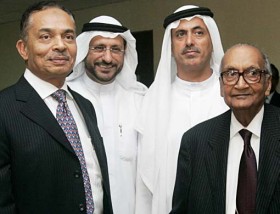
Dubai: The new campus of The Birla Institute of Technology and Science, Pilani – Dubai, at academic city was inaugurated yesterday by Dr K.K. Birla, Chancellor, of the institute.
The new campus of The Birla Institute of Technology and Science (BITS), Pilani – Dubai (BPD) at the Dubai International Academic City (DIAC) has state-of-the-art facilities and an academic block, library block, workshop block, students hostels, sports facilities and auditorium spread over 15 acres of land.
“I’m very happy that the new campus has been established in a record time, I’m sure BITS – Dubai campus will enjoy the same reputation as BITS Pilani campus, and I sincerely hope all our alumni wherever they go and whatever they do will shine in their assignment and thus bring glory to all the campuses of BITS, Pilani,” said Birla.
BPD Director Mohammad Riazuddin told Gulf News they are offering ten full tuition fees scholarship to UAE national students.
“Currently we have 1,450 Asian students, none of whom are nationals. Thus we are offering 10 scholarships to encourage Emirati students to benefit from our highly-competitive education standard.
“We expect to reach our full capacity, 2,500 students, by September 2008. Four batches of graduates have graduated so far. About 20 per cent of our students further their education in elite universities worldwide,” said Riazuddin.
Dr Ayoub Kazim, Executive Director of Dubai Knowledge Village (DKV) and DIAC, said: “BITS Pilani’s permanent campus in DIAC marks another significant milestone for DKV. It demonstrates the University’s strong commitment to meeting the needs of students, the academic sector and the entire community.
“BPD’s strategic move will lead to substantial benefits, including a significant reduction in the institution’s long term operational costs.”
IGNOU professor selected for UKIERI award
IGNOU professor selected for UKIERI award
PTI News
NEW DELHI: A professor from IGNOU has been selected for the UK-India Education and Research Initiative award this year.
Prof P R Ramanujam, Director, Inter-university Consortium, of IGNOU will share the award with Professor Ulrika Zeshan of Central Lancashire University, UK, a release issued here said.
They will be awarded for their research paper — Distance Education for Sign Language Users.
The award carries a cash prize of 50,000 Pound and other technical support for a period of three years, the release said.
Short, Flexible and Cost-effective
Short, Flexible and Cost-effective
Short-term online management programs come with three handy advantages by Anagh Pal for OUTLOOK MONEY
You might have given fulltime online MBA courses a miss thinking that they were not worth the time or the money. Short-time Management Development Programmes (MDPs), which some e-learning institutes are offering, might be worth a look.
The online advantage
First of all, these are short-term courses and cost relatively less. Second, these courses are aimed at those who don’t want a major degree but just want to brush up their knowledge in an area. If you think you could do with some more education in a particular field, these courses could be the answer. Also, since the courses are being offered in tie-up with reputed management institutes, it won’t harm your CV either. Finally, they offer the benefit of online education, that is, flexibility to learn while you are on a full-time job.
Says Shreesh Chandra, general manager eLearning, Macmillan India, a company offering online MDPs: “These courses attempt to give you an insight into a certain area.” Specialised short-term courses have been received with a lot of interest, unlike courses of longer duration. Though online courses are not something new, “the shift is in the kind of courses on offer and the institutes you partner with”, says Chandra.
How they work
Once you register and enter into the student arena with your user name and password from a broadband-enabled PC, you can download all the study material. In-built interactive vehicles like e-queries help you interact with the faculty at a predetermined time. The one drawback for these courses is that out of the several MDPs that management institutes offer, only a few are available online.
IGNOU to offer new professional courses
IGNOU to offer new professional courses
28 Oct, 2007, 1245 hrs IST, PTI
NEW DELHI: In an effort to further broadbase its educational programmes, IGNOU will soon launch post graduate and degree courses in various professional fields, including Computational Sciences, Advanced Informatics.
As per the plan, the Indira Gandhi National Open University will offer post graduate, diploma and degree courses in Computational Chemistry, Scientific Computing, Computational Sciences, Advanced Informatics and Technology Enhanced Education.
A Memorandum of Understanding was signed between IGNOU Vice Chancellor V N Rajasekharan Pillai and Indian Institute of Information Technology and Management, Kerala, to explore ways to offer open learning programmes in these areas, IGNOU’s chief PRO Ravi Mohan
The goal is to offer quality education using emerging open learning system, he said.
IGNOU is collaborating with IIITM to offer educational opportunities to the students across the country in these areas, he said.
Text the teacher
Text the teacher
Pragya Kaushika,TNN
Come November and the School of Open Learning (SOL), Delhi University (DU), will launch its welcome gift for the new batch of students enrolling in the BA programme for 2007-08 – a 24-hour query helpline via e-mail and mobiles.
One guest faculty member will be appointed as counsellor and instructor for a group of 20 students, informs H C Pokhariyal, executive director, SOL. He adds, “The basic need for any education system is the availability of teachers who can devote time to students. Distance learning is coming up as an alternative to regular classes as there are many students who do not get admission to regular courses.”
The idea emerged from the SOL’s interaction with the open universities in the UK. Admitting that distance learning in foreign countries has upgraded to a level where it can compete with the regular education system, Savita Dutta, director, SOL states, “We have invited experts from the UK to help us improve our distance education methodology.”
If the experiment with the BA programme manages to achieve the goal with which it has been started, it will be extended to other courses provided by SOL. Says Dutta, “We cannot limit the number of students enrolling in our courses, and since they need tutors just like regular students, we will enhance the teacher-student link to manage them efficiently.”
Apart from helping enrolled students find the right guidance during examinations, this new system will also provide job opportunities for fresh post-graduates. “MA/MPhil students will be invited to join us as guest faculty under the scheme, and this will simultaneously address their employability issues.”
Want to motivate people? Read this!
Want to motivate people? Read this!
Aubrey C Daniels and James E Daniels
Leaders have the responsibility for creating a work environment that causes people to do their best every day. In theory this should be simple, since the overwhelming majority of employees are willing workers. Only an extremely small number o people take a job expecting to get paid for minimal effort.
Most people, by the act of taking a job, demonstrate that they want to do it well. WE find that many companies squander this goodwill through their leadership practices. Apparently, it is easier to lose discretionary effort than it is to build it.
If people are willing to perform at their best and they don’t, where does the problem lie? Dr Edwards Deming, the noted quality guru, attributed well over 90 per cent of the problems of quality not to front-line employees, but to management. We certainly agree and we extend this to most other performance deficiencies as well. The same leadership practices that throw away the employee’s goodwill also create the climate that suboptimizes organizational effectiveness.
Leaders create the culture, the place, and the conditions for employees and their work. This includes the physical conditions and the management process. The most effective leaders first look at those elements before looking to individuals or groups of employees for assigning blame or attempting a fix. Most failures of organizations are failure o the management process, not employees’ behavior.
Although most organisations have some form of process management, few can specify their behavior management process. Indeed, supervisors and managers are often advised to find a management style that fits their personality and the situation. Because there are so many different personality types and possible situations in an organization, there will be many different solutions to the same problem. No effective, stable leadership process is possible with this number of uncontrolled management variables.
An effective management process causes employees to do the right things at the right time in the right way. To have an effective management process, it is critical that you have an understanding of the variables that affect performance. Getting and keeping followers occupied in meaningful activity is essential to a leader.
The Basics of Follower Behavior
Much of what is common knowledge about leadership is, in fact, fallacious. Ideas extracted from our experience or that of others may not actually identify the critical variables that made that approach work in that specific situation. WE are all taught, for instance, to lead by example and to communicate, communicate, communicate! This kind of advice peddles the banal as wisdom and ignores the essentials.
While the leader’s actions and the visual images he or she paints with words are important, these are not the most powerful influences on behavior. Much more has been modeled and communicated than has been done. Simply put, the impact of your example and of your communications is get followers to do something once, perhaps twice. After that, they must see some personal benefit from their actions or the response to your example and your communications will diminish.
This relationship is clearly stated in the most basic expression of the causes of behavior presented below as the ABC Model.
This model shows that there are only two ways to change behavior: by what happens before a behavior ad what happens after it. An antecedent is simply anything that tells you what to do. It could be a memo, a meeting, company policy, this book, or a thousand things that we see, hear, touch, smell, or taste in a day. In most cases, the antecedent contains enough information for us to know exactly what to do. However, knowing what to do and doing it are two different things.
The telephone may ring, but because we are in a hurry, we ignore it; we may know a company policy and not follow it; we may know a safety rule but violate it every ay; we may know the speed limit and the consequences for speeding but exceed it every day. All of these things point to the fact that most problems that organizations face daily are not the result of not knowing what to do but are often treated by the organization as though they are. Most attempts to resolve performance issues involve emphasizing the importance of the actions, stressing the cost of failure, making our expectations clear, re-telling them, creating new policies and procedures, re-training employees, and simply nagging them to do the right things.
Is it possible to train people to do the safe thing or the quality thing and have them do what you trained them to do every time. Can you communicate priorities and have employees make decisions about their time accordingly? Can you delegate to others and know tat you will not have to worry about the cost, quality, timeliness, or appropriateness of their actions? Of course you can.
However, the determinant of whether these things will be done is not the clarity of communication and effectiveness of training, but what happens to employees when they do what has been communicated. If a person was trained to do something one way and when he applied it found that it didn’t work, would he continue? If a person is given a priority assignment and then someone comes in with an emergency request, will the priority likely be put aside? If a person is delegated responsibility for a project and the boss second-guesses every action that the person takes, will the person soon defer all decisions to the boss? You know the answer to these types of questions.
Leaders who think that people will do their best because that’s what is expected of them are prone to make errors by relying primarily on antecedents. This is especially pernicious because it leads to leadership beliefs and practices that produce suboptimal responses from the followers. You can best understand this when you consider the most important aspect of human behavior.
Behavior is a Function of Its Consequences
The closest thing we have to a behavioral law, as gravity is a physical law, is the behavior is a function of its consequences. Antecedents get their power from the consequences that are associated with them. The bottom line is that the effectiveness of most of what leaders do is determined by how they use behavioral consequences. WE believe if this simple statement was fully understood and put into practice that not a major organization exists that could not improve by 20-30 per cent per year (the government by more than 50 per cent).
This law means that every change must start with an analysis of what will happen to the performers if they do what we need and what will happened to them if they don’t. While most leaders feel that consequences in an organization are in place for those who do or don’t do what is required, the consequences that are typically used are often ineffective in either maintaining desirable action or in stopping undesirable action.
Unfortunately, not all consequences are created equal. Some are more effective than others. Most of the consequences that organizations use, such as compensation, performance appraisal, and reward and recognition practices are weak when it comes to getting behavior to occur every day. Despite the common belief that the bigger the reward, the more it impacts behavior, science tells u that the most effective con-sequences are those that are immediate and certain. The least effective are those that are delayed and uncertain.
Guess which category is the most common in the modern organization? Bonuses, profit sharing, promotions, and raises in pay are all positive, but they are future and uncertain consequences to the performers and as such they have little impact on behavior on a day-to-day basis. The size of the payoff only increase the pool of people who want to participate in the activity and has little to say about how well they will work once selected.
Things that save your followers time and effort are almost always positive, immediate, and certain. Problem solving requires a disciplined approach, for instance, because the reinforcers for most people come from soling the problem, not from analyzing the causes of the problem. Bypassing the analysis phase allows them to get into action sooner so that they experience immediate, positive consequences sooner and more often.
A common leadership issue is the execution of strategy. Every day, opportunities for positive, immediate, and certain consequences arise for less consequential behaviors which compete with the leader’s strategy. If the leader’s process for implementing his strategy doesn’t have built-in positive, immediate, and certain consequences, then such consequences must be created to keep the implementation plan on schedule.
The leader must ensure that the followers are receiving PICs on a daily basis. If they are not built into the business processes (which they rarely are), the leader must find a way to overlay them onto the process. One of the ways leaders do this is by taking work out of the process. This is a common task where the leader runs interference for the follower and removes obstacles wherever possible rather than requiring the follower to surmount each obstacle unaided. In this way the leader reduces the umber of negative, immediate, and certain consequences experienced by the followers.
While important, removing an obstacle to performance does not guarantee that the desired performance will take place. A client of Aubrey Daniels International, a Midwest bank, discovered this truism after they spent millions of dollars removing certain types of paperwork from their branches. Their consultants had convinced them that the administrative burden was suppressing sales. To increase sales, paperwork was reduced by 90 per cent, yet sales didn’t increase. They failed by not building in PICs for the new behaviors, a very common mistake. They built in bonuses, thinking that doing so would drive the correct behavior. Bonuses are positive, future, and uncertain consequences from the performers’ perspective and are weak performance drivers.
You will avoid these kinds of failures if you examine in detail the behaviors you are asking for prior to implementing your plan. What happens to the individual when she does what you expect? We find the best answers to that question when we perform what we call a PIC/NIC analysisr, which is often very revealing when planning any organizational change.
Excerpted from:
Measure of a Leader by Aubrey C Daniels and James E Daniels
Copyright 2007 by Aubrey Daniels International Inc. Price: Rs 450. Reprinted by permission of Tata McGraw Hill Publishing Company Limited. All rights reserved.
Aubrey C Daniels is the author of bestselling management classic Bringing Out the Best in People. His management consulting firm, Aubrey Daniels International, works with business leaders around the world.
James E Daniels, vice president and senior consultant with Aubrey Daniels International, has developed productivity and quality improvement systems for corporations around the globe.
 ClicksandWrites
You must be logged in to post a comment.