Education +
Sharpening thinking skills
Sharpening thinking skills
9 Jun 2008, 0343 hrs IST, Sakshi Khattar for TIMES OF INDIA
Most schools agree that education is not confined to curriculum and securing marks alone, rather it is more about learning concepts that help solve real-life problems. And in the process, inculcating and exercising thinking skills plays a critical role.
Encouraged by the board results this year, CBSE now wants to introduce High Order Thinking Skills (HOTS) in classrooms and for all subjects. This is not confined to private schools as even government schools have shown a significant improvement.
HOTS, as the name suggests, focuses on thinking skills and tries to move beyond rote learning. The focus of the question paper this year was to measure students’ abilities to reason, justify, analyse, process and evaluate information. It was introduced only this year in class X and XII board examinations for mathematics, science and social science, the weightage being 20%.
According to Ashok Ganguly, chairperson, CBSE, the goal for this academic session would be to transfer HOTS to classrooms so that maximum students can benefit from it. He added that after a thorough analysis, it would be decided on which subjects and how much weightage would be given to HOTS.
It’s all about going beyond textbooks and widening the horizons of students, feels U N Singh, joint-commissioner (academics), Kendriya Vidyalaya. “HOTS is basically a concept wherein we are concentrating on application-based questions and discouraging rote-learning. The problem lies in the fact that neither coaching institutes nor guides focus on application. The aim of education is to ensure that students should know how to use the knowledge acquired to real-life situations,” he said.
“According to Bloom’s Taxonomy, education has four pillars — knowledge, understand-ing, skill and application. Our education system faulters at the last one and HOTS is an attempt to work on application skills of students. The aim is that students should be able to construct knowledge and that is what HOTS is all about,” added Singh.
Comprehension skills
Shobha Singh, head, English department, Greenfield Public School, opined: “This is not a new concept for us as we prepare our question paper in such a way that at least 20% is based on comprehension skills. It helps to judge if students have had an in-depth understanding of a particular unit. It also gives an insight into a child’s ability.” She added that students who know concepts well will sail through easily while those who have just crammed would struggle, so this discourages rote-learning.
Echoing a similar view, Veena Dhyani, counsellor, Cambridge School, Noida, said: “The objective type questions, that we prepare, are more on experimental-basis instead of direct questions. So, in a way, we are testing their thinking skills as the objective is that students should be able to use the information correctly in their lives.”
Several schools make their students take various external tests that check logical abilities of students and give them a detailed feedback. Students at the Shri Ram School, for instance, have been taking Asset tests that are more application-based than focussing on merely the curriculum. Elaborates Sonia Chib, co-ordinator, elementary classes: “Even while teaching, we try to relate concepts to what is happening around. At the end, the objective remains that students should know how to apply the knowledge gathered to real-life situations.”
Critical thinking
Critical thinking is hard, feels Vaishali Shah, communication manager, Educational Initiatives. “Although it can seem quite basic, it is actually a complicated process, and most people are not very good at it.”
She further said that one of the biggest challenge in learning new skills, particularly general skills, such as critical thinking, is the problem of transfer. The problem is that an insight or skill picked up in one situation is not, or cannot be, applied to another situation.
“For example, if someone has just learned how to calculate the per-kilogramme price for packaged nuts, they should then be able to calculate the per-kilogramme price for packaged chips; if they cannot, we would say that the learning has failed to transfer from nuts to chips. So, learning should facilitate the problem of transfer,” she stated.
Making the right choice
Making the right choice
9 Jun 2008, 0347 hrs IST, Dr Poonam Devdutt for TIMES OF INDIA
A career decision is one of the most critical decisions of one’s life. Yet it is surprising how many young people stumble into a career by chance, not choice. It is a decision which influences one’s entire future lifestyle, the kind of people one associates with, one’s prestige and status in society and the amount of money one earns. A career is important not only for earning a livelihood but also for realizing one’s ambitions and getting a feeling of self worth and self esteem.
About quarter of a century ago, the number of careers available to the educated youth was limited. The commonly sought after were law, medicine, teaching, engineering, administrative services, army, business and government jobs. Today, the scenario is drastically different. With liberalization and globalization, the job market has changed beyond recognition. Trade and commerce have expanded phenomenally. With the burgeoning of different industries, jobs in the management field have become very popular. This is accompanied by a tremendous growth in the services sector and Business Process Outsourcing. With a growing middle-class and it’s ever increasing spending capacity there is an upsurge in the area of entertainment, travel, hospitality, aviation, advertising and mass communication.
Traditionally, the choice of a career has been determined by the advice and ambitions of parents, the convenience of a family business or by the dictates of glamour, hero worship and money. Or else, simply by what was available. It was, therefore, not surprising that a large number of youth found themselves stuck in careers that were neither satisfying nor fulfilling leading to boredom, frustration and stress.
It is important to realize that a career is an integrated lifelong plan of earning a living. Therefore, career planning necessarily involves meticulous thought as well as adequate information.
So how should one go about choosing the right career? Selection of a suitable career has two aspects – self analysis and information about available job options. Self analysis includes awareness of one’s aptitudes, personality and interests as well as one’s goals and expectations from the career of one’s choice.
Aptitude may be defined as one’s inborn talents, abilities and potential. The fact is that each person possesses a range of abilities and talents. Unfortunately, most people are unaware of their gifts and therefore make limited use of them. So the first step is to ask oneself –“What am I good at? What do I do well?” Some indication can be obtained by school marks. For example, some students excel in languages, some in Math and Science, others in Art and yet others in Sports. Many children are born with a mechanical aptitude, others with an aptitude for the performing arts. An aptitude in a particular field coupled with the right kind of training can lead one to heights of success. Also, given an inborn aptitude, a moderate amount of labour can produce excellent results. Whereas, if the aptitude is low, much more labour would be required and even then the same level of success may not be achieved.
Along with aptitude one requires awareness of one’s personality. Our personality is the sum total of all our qualities and traits. As common experience shows us, every individual has a unique personality. Some are born extroverts – their energies are directed outwards, they are sociable, like to meet others and make friends. Others are introverts. Their energies are directed inwards and they are happy being alone, by themselves. Other personality traits like aggressiveness, cooperation, sociability, leadership and dominance have major implications for career choice.
Another important aspect is one’s area of interest. If one’s career fits in with one’s interest it will be more fulfilling, if not it will lead to unhappiness and stress. Imagine an electronics and computer buff, forced to become a lawyer; or a shy, home loving introvert forced to become a traveling salesman!
One’s motivation for work is also an important factor to be considered. Are you working for money, status and prestige, power or intellectual satisfaction? It is important to choose a career which will satisfy your fundamental motive.
Identification of a suitable working environment is also desirable. What is the environment in which you will be comfortable – business, government, a non-profit organization or the corporate world? Are you attracted to the high-profile, glamorous world of media and entertainment, or the more conservative field of academics or medicine? Would you like to work for the security of a regular salary or would you prefer to be self employed? Women also have the choice of either seeking full time employment or working part time.
Having analyzed oneself the next step is to obtain information about the vast range of job options available and the courses of study leading up to them. The correct matching results in the right person being in the right job, which is the formula for lifelong success and satisfaction.
Revving up on an engineering model
Revving up on an engineering model
Thursday June 12 2008 10:38 IST Siri Srinivas for Express News Service Bangalore
THE students of RV College of Engineering (RVCE) unveiled a prototype of a hybrid vehicle which uses both electric and bio-diesel mechanisms. Project Chimera is an environment friendly biodiesel-electric hybrid vehicle based on the electric car Reva.
The project, handled by the final year students of RVCE, culminated in a ceremony presided over by industry big-shots such as Mohandas Pai, member of board, Infosys, Chetan Maini, chairman of the Reva Electric Car Company, Gowrishankar Hosakere, manager R&D, National Instruments, and Friedel Pickard, MD of Bosch E&S.
The prototype, intended to bridge the gap between electric cars and gasoline-driven models, was entirely developed by the Project Chimera team; backed by RECC, Bosch, and National Instruments.
“It is an indigenously developed vehicle,” a proud Karthik Bhaskaran, team leader of Project Chimera, said.
The car runs on a Lambordini diesel engine and a motor acquired from Agni motors in Gujarat. The hybrid provides a mileage of about 40 kms per litre and can attain a maximum speed of 90 kmph.
To accommodate the diesel engine, the engineers added an additional load of 70 kgs at the front thereby making it a vehicle for two passengers from the original capacity of four of the Reva. Another interesting design aspect of the car is that it has the feature of on-board charging and does not necessarily need an external power socket.
This is due to the presence of a supplementary power source. The use of a bio-diesel blend facilitates the reduction of harmful sulphur emissions to a great degree.
The members of the project, who come from Mechanical, Electrical, Industrial and Computer Science streams, teamed up to work on the planning and development of the model.
They designed and fabricated a separate bed to house the system and programmed the motor controllers as well as the hybrid controllers which form the brain of the car.
“Chimera is a mythical creature with the head of a lion, the body of a goat and the tail of a serpent. It’s a hybrid in itself and so the name,” explain team members Arun Nedungadi and Siddhartha Saraogi.
Mohandas Pai welcomed this partnership of industry and academia and emphasised the need for innovation. Chetan Maini urged more students to think out of the box, as the enterprising team had, and spoke of the importance of nurturing engineering talent in the country.
Pickard lauded the project by saying, “Success stories don’t just happen, they’re made.”
The senior students of RVCE, who will be graduating this year to better things, were optimistic that their successors would give the project new dimensions.
“This can now be made into a fuel-solar hybrid vehicle or even further improved upon. The possibilities are endless,” says Arun.
While a certain industry big-wig not so discreetly expressed his displeasure with the new airport’s infrastructure to a fellow corporate head before the event, the buzz clearly pointed at the industry’s hope and interest in tapping young engineering talent.
Earn and learn at open school
Earn and learn at open school
Swaha Sahoo, Hindustan Times June 13,2008
Open and distance learning is no more restricted to learning from textbooks and study material. With Delhi University becoming more active in giving its students opportunities to seek work experience and upgrade their skills, SOL students can now earn while they learn.
Apart from earning some pocket money, they can also brush up their skills and qualifications with professional training and career-oriented add on courses.
“A lot of our students are from economically weaker sections of society and the university wants to give them an opportunity to earn while they are studying,” said Dinesh Gupta, deputy director, South Study Centre.
“Since BPOs require a lot of young talent, DU signed an MoU with GENPACT, wherein BA (H) English and Bcom (Pass) students of SOL would be given employment by GENPACT for three years,” Gupta said. “The selection is done by the company and students get to earn and learn,” he said.
Add on courses
DU has also introduced short-term courses to update students’ skills and prepare them for jobs in the industry and for self-employment. Some of them are medical transcription (six months, including two month internship), voice and accent training (two months) and soft skills (two months).
“Usually SOL students lack confidence and self esteem. Soft skills are important components of corporate life,” said Gupta. “The short-term courses are taught by professionals and will help our students in honing their soft skills,” Gupta said.
For instance, medical transcription involves catering to documentation requirements mainly for American Healthcare Industry, though it also caters to the healthcare sectors in the UK and Canada. The course prepares students for entry-level positions in the Physicians’ offices, clinics and hospitals.
“You don’t need any prior knowledge of biology and also get a stipend for the duration of the course,” Gupta said.
Under the professional skills project, Delhi University, in collaboration with Confederation of Indian Industry (CII), is offering six months certificate programmes in information technology, automotives and retail. Although the courses are open to all students, SOL students will get priority.
“All high growth segments of the industry — be it automobiles, retail, software development, desktop deployment and troubleshooting, media, healthcare, hospitality, and even the general services industry — are facing the skill gap challenge and the need for skilled workforce,” said HC Pokhriyal. To cater to the growing needs of these industry segments, DU has tied up with CII to enable the students to acquire usable/job-oriented skills, he said.
DU-CII is offering courses in five areas at present — software application development, desktop deployment and trouble shooting, general services skills, retail management and automobile service and management.
Presentation on higher studies in US
Presentation on higher studies in US
Wednesday June 11 2008 11:15 IST Express News Service
KOCHI: The United States of Educational Foundation in India (USEFI) is organising a presentation on “Higher Education in the United States” at the Chavara Cultural Centre at 10 a.m. on June 14.
Carly Shane, international enrolment manager, Office of International Programme and Service and Winston Erevelles, Dean, School of Engineering, Mathematics and Science, Robert Morris University, Moon Township, Pennsylvania will be the resource persons at the presentation.
The presentation will include a discussion on accreditation, financial assistance and on the opportunities at Robert Morris University.
For further information, contact: 0484-2377443/0484-4070250 or e-mail usefichennai@fulbright-india.org .
Early birds score better grades in college
Early birds score better grades in college
Tuesday June 10 2008 17:19 IST ANI
WASHINGTON: If you want to score well in college, just get out of bed earlier, for a new study suggests that morningness is a predictor of better grades in college.
The study, authored by Kendry Clay, of the University of North Texas, focused on 824 undergraduate students who were enrolled in psychology classes.
The subjects completed a health survey, which included questions regarding sleep habits and aspects of daytime functioning.
Results showed that college students who are evening types had lower GPAs, while those who are morning types had higher GPAs.
“The finding that college students who are evening types have lower GPAs is a very important finding, sure to make its way into undergraduate psychology texts in the near future, along with the research showing that memory is improved by sleep,” said Daniel J. Taylor, PhD, of the University of North Texas, Ms. Clay’s faculty mentor, a co-author, and who developed the concept for this study.
“Further, these results suggest that it might be possible to improve academic performance by using chronotherapy to help students entrain their biological clock to become more morning types,” he added.
The findings will be presented at SLEEP 2008, the 22nd Annual Meeting of the Associated Professional Sleep Societies (APSS).
A step into the future
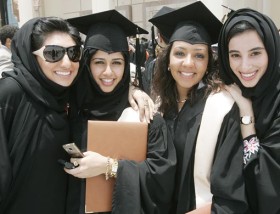
A step into the future
By Manal Ismail GULF NEWS Published: June 08, 2008, 00:06
“Today is the day we’ve all been waiting for. The day we graduate, the day we step up, the day we start upon the road leading us toward the rest of our lives.” Those were the words of Hind Hussam, mass communications graduate and Class Speaker for the 2008 graduation ceremony at the American University of Sharjah (AUS), as he addressed 463 other young graduates.
There wouldn’t be a more perfect way to describe the day than as the start of a new beginning. Parents, friends and families flocked to the Sharjah University City Hall, some in tears, others with smiles, yet all expressing the same emotion – happiness.
However there couldn’t have been anyone happier than the graduates themselves. As they proceeded into the hall, each graduate conveyed a different feeling – nervousness, anxiety, pride and anticipation.
Yet each one walked up to the stage with a sense of accomplishment knowing that this day was the culmination of years of hard work and dedication.
His Highness Dr Shaikh Sultan Bin Mohammad Al Qasimi, Supreme Council Member and Ruler of Sharjah, Founder and President of AUS, congratulated the graduates and urged them to inculcate a spirit of cultural understanding and contribute to the development of their societies.
“Education and knowledge are not limited to a nationality or a country,” he said. “Tolerance and understanding are the means to the betterment of the world.”
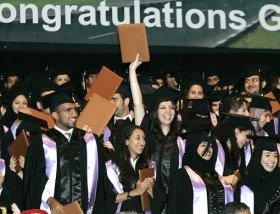
It’s time to celebrate
The clapping and stomps of eager students shook the hall every time a school or college was called to stand up prior to receiving their diplomas. Their chants of triumph echoed through the hall. “We did it! We did it!” they would shout. During intermittent periods of silence, however, you could overhear the murmur of students discussing what they were going to do after this moment was over.
“I can’t believe it has ended,” said business graduate Amar Ali. “University consumes so much of your time. You can’t help but wonder, what life has in store for us next?”
It’s true that the future is unknown, however most students said they had their lives mapped out. For international relations graduate Sidra Shahid, graduation does not mark the end of her academic life.
She hopes to pursue higher education, lead an independent life and make a difference in society. “My ultimate dream would be to get a master’s and PhD and join the United Nations,” she said. “Although this may be a farfetched dream, no matter what I do in the future I want to be an active member towards making the world a better place.”
The power of the present
In her speech, Hind Hussam advised fellow classmates that the key ingredient to true success and happiness is integrity.
“Today’s world is constantly trying to change us, trying to turn us into people who compromise their values in order to overcome life’s obstacles,” she said. “To maintain a sense of who we are and the values we hold – whether we attain the heights of success or experience the deepest defeat – is the most important challenge that we are going to face,” she said.
Hussam emphasised the importance of the power of now.
She advised students that with every decision they make comes a consequence – one that will either take them on the path to success or another that may cause them to deviate from their goals.
“Now is the time for us to prove ourselves… and to shine!” she said. “Now is the time to make choices and to show the world that we have chosen right over wrong, good over evil and truth over falsehood. We are stepping into the future, my fellow graduates. The world is waiting for us to make our choice and to take that step. And the time is now!”
And the award winners are…
Graduates Ali Yousuf Al Amouri and Murtaza Ali Abbas won the President’s Cup this year. Each year the university awards the cup to the graduates who achieved the highest grade point average. The names of the honourees are engraved on the cup, which is permanently displayed on campus. The two graduates have achieved the full grade point average of 4.0 out of 4.0.
Graduate Emmad Abu Yousuf was also awarded the Chancellor’s Cup for an outstanding combination of scholarship, character, leadership and service to the university.
Class of 2008
– 464 total number of graduating students
– 435 received undergraduate degrees
– 29 received graduate degrees
– 214 males received degrees:
– 250 females received degrees
By school/college:
– 63 students graduated from the College of Arts and Sciences
– 157 students graduated from the College of Engineering
– 84 students graduated from the School of Architecture and Design
– 160 students graduated from the School of Business and Administration.
Take a different turn
Take a different turn
B.S. WARRIER for THE HINDU
There are many study options if students choose not to go for higher secondary courses.
Hands on: ITI students at work.
Many students look for study options other than the higher secondary courses. Let us look at some of the options before them.
One is the diploma courses in engineering and technology. Jobs in the field of engineering and technology may be broadly classified into three:
•Engineers and technologists who shoulder the responsibilities of design, construction, manufacture, maintenance and so on. These professionals normally hold a degree in engineering or technology.
•Skilled craftsmen such as plumbers, electricians, welders, motor mechanics, moulders, painters, and fitters.
•Technicians who function as a dynamic link connecting the engineers and technologists and the skilled craftsmen.
Technicians play a significant role in the execution of work. They interpret and explain drawings to the skilled craftsmen, supervise their work, take charge of the maintenance of machines, prepare engineering drawings based on the designs furnished to them and so on.
The basic qualification of technicians is a diploma in engineering or technology from a polytechnic college. Candidates who have passed the 10th standard are admitted to these colleges and given theoretical and practical training for three years. Almost all the disciplines such as civil, electrical, electronics, computer science, chemical, automobile and textile engineering and technology in the B.Tech. programmes are available in the polytechnic colleges. The curriculum is similar, but there is a significant change in emphasis. Mathematical analysis and design are emphasised greatly in B.Tech. programmes. That does not happen in the diploma courses. The stress in the diploma programmes is on “what and how,” whereas B.Tech. programmes focus on “why” as well.
Diploma programmes are conceived mainly as terminal programmes. But there are opportunities for further education. Diploma holders can secure B.Tech. degrees by joining part-time evening courses in engineering colleges. Normally, those with a diploma and one or two years of experience who work in the neighbourhood of the college are admitted to the part-time B.Tech. courses.
Another option is to join the second year of the B.Tech. programmes through what is known as “lateral entry.” They complete the programme in three years instead of the four taken by regular students.
A third possibility for higher studies is securing professional memberships such as the AMIE and the AMIETE through private studies. These stand recognised as equivalent to the B.Tech. degrees. Certain State governments do not accept them as equivalent for teaching jobs in the engineering colleges; otherwise, the membership is on a par with B.Tech.
Diploma holders who start their career as technicians often become engineers by virtue of their acquired higher academic qualifications or their years of professional experience.
There may be some anxiety whether the diploma is inferior to the degree. This anxiety is misplaced. The duties of the technician are as important as those of the engineer or technologist. Every category of employee is equally important in an organisation.
An expert in education, who came across this anxiety in respect of the polytechnic diploma holders, once wrote: The society that tolerates shoddiness in philosophy because philosophy is an exalted activity and scorns excellence in plumbing because plumbing is a humble activity, will not have good philosophy or good plumbing. Neither their theories nor their pipes will hold water.
Craftsmen courses
Courses for training skilled craftsmen are being held in industrial training institutes (ITIs) under the control of the Directorate- General of Employment and Training. The institutes are affiliated to the National Council of Vocational Education (NCVT). These courses are being held in recognised private institutes known as industrial training centres (ITC). There are craft courses in engineering as well as non-engineering trades with various durations and entry qualifications. Typical samples are shown below:
•Electrician, two years, admission to those who have passed the 10th standard.
•Diesel mechanic, one year, admission to those who have passed the 10th standard.
•Painter (general), two years, admission to non-matriculates as well.
•Plumber, one year, admission to non-matriculates as well.
•Craftsman food production (General), one year, admission to those who have passed the 10th standard.
•Tool- and die-maker, three years, admission to those who have passed the 10th standard.
These courses, which aim at developing skills in the trades, are generally considered terminal courses. There are only limited opportunities for further studies. Those who are interested may go to the foremen training institutes at Bangalore or Jamshedpur, where the craftsmen can undergo training to become foremen or supervisory personnel in industries. Another option is the three-year diploma courses in polytechnic colleges.
Food craft courses
Hotel management or hospitality management is an attractive area of study that offers fine opportunities for early placement. But the course stretches over three years; admission is confined to those who have passed at least the higher secondary course.
Training in certain specific elements is being imparted in the food craft institutes. The minimum qualification for admission to some of the courses is the higher secondary certificate, whereas some others admit those who have passed the 10th standard examination.
The food craft courses which admit candidates who have passed the 10th standard:
•Food production, 15 months
•Hotel accommodation and operation, 15 months
•Bakery and confectionary, nine months
(Courses in food and beverage service, front office and canning and preservation are restricted to those who have passed the higher secondary examination.)
Other options
•Computer data-entry courses.
•Stenography (computer skills have become an essential ingredient).
•Engineering certificate examinations conducted by the State governments.
•Basic training of auxiliary nurse midwife and lady health visitor.
•Sanitary inspectors’ foundation course at various centres, under the control of the All India Institute of Local Self- Government.
•Training courses in production and quality control, pattern/cutting master, machine mechanic, garment construction in apparel training and design centres, under the Union Ministry of Textiles.
Getting ahead with CAP
Getting ahead with CAP
The online Centralised Allotment Process could prove tricky to aspirants of engineering and medical courses. G. MAHADEVAN cautions them about the pitfalls that they may come across while using the online process.
Go online: The Commissioner of Entrance Examinations will notify the list of centres where candidates can participate in CAP.
Amid continuing uncertainty about the fee and the number of seats for engineering, medical and allied courses in the State, the only constant seems to be the Centralised Allotment Process (CAP).
This year too, the Commissioner for Entrance Examination will use the software developed and maintained by the National Informatics Centre for CAP. Though the software has matured over the past two years, the online process still poses some challenges to aspirants. In some aspects of CAP, students repeatedly go wrong.
In about two weeks, the Commissioner will publish the category lists of candidates eligible for reservation. After June 12, the rank list for the architecture course will be published. By the fourth week of June, the revised category list will be published. During this period, the Commissioner will start dispatching the data sheet containing a candidate’s rank, his or her roll number and key number. The key number will be printed on a detachable portion of the sheet.
Once the category lists are out, candidates can assess their position in the rank list and by using the “last rank admitted” details for 2007, can also roughly gauge the likelihood of their getting admission to desired courses. It will be a good idea to note down the roll number, the application number and the key number on a card and keep it safe. However, candidates will be well advised not to lose the data sheet.
This is the time when candidates should gather information about colleges in which they plan to study and about the courses they wish to do. Once this is done, a candidate should sit down to fix the course and college priority.
The registration of options will begin once the Commissioner notifies CAP and specifies the window within which it should be done. There will be a designated web site for the registration. Each candidate will have a home page on this site. This page can be accessed only by keying in the roll number, the key number and the application number. An alphanumeric password of up to 15 characters has to be compulsorily set. It is vital for candidates not to lose their password. Once a candidate has reached his home page, he or she can mark preferences for courses and colleges.
Remember password
Last year, there were many instances of candidates frantically ringing up the office of the Commissioner saying they had lost or forgotten their passwords. A candidate can retrieve the password either from the Commissioner’s office at Thiruvananthapuram or at the Information Guidance and Option Facilitation Centre in each district on proving his or her identity.
The options can be registered from any computer that has a Net connection. The Commissioner will notify the list of centres where candidates can participate in CAP.
It is while marking preferences for courses and colleges that most candidates make mistakes.
Those familiar with the codes of the courses and colleges often overlook the slightest of differences in the codes while marking preferences. As a result, they may get allotted to a course or college that they never wished to study in.
A candidate who has done his homework would have a priority list of courses and colleges with the codes checked and confirmed. There is no limit to the changes a candidate can make in the priority list when the registration window is open.
Though candidates can register hundreds of course and college options, they should never mark preference for a course or college that they do not desire. Once a preference is marked against a course and college, there is every possibility of getting allotted to it. After marking each preference, the home page should be saved and a printout taken. Also, compulsorily log out is required each time.
A candidate marks his preferences using Arabic numerals (1, 2, 3 …). Do not enter separate priority lists for engineering and medical courses. In other words, a candidate can have as his first priority the electrical engineering course, second priority, the BDS programme and third, the MBBS course.
If a candidate wishes to remove a particular option from that list, all he or she has to do is to remove the given preference number, type zero in its place and update the list.
Candidates should never wait till the last minute for registering the options as that would rob them of the benefits of the trial allotments that the Commissioner makes.
After each trial allotment, the candidate can revise the option list. At a specified time and date, the web site will be frozen and no further revisions can be made.
Once the first allotment is done, the time and date for the payment of fee will be announced. At the time of the admission, the candidate will have to produce the documents listed in the prospectus (pages 37-38). Candidates should note that no eligibility or equivalency certificate is needed for the ICSE, the CBSE, the VHSE and the higher secondary courses. However, a candidate who has studied under an examination Board of another State (say, Gujarat or Rajasthan) should get such a certificate from any university in Kerala. If after the first allotment, a candidate is satisfied with the course and college he has received, he should compulsorily cancel his “higher order option” list. Otherwise, the CAP software will assume that the candidate wishes to be considered for re-allotment and will do so accordingly.
(Note: The CAP procedure described in the article was sourced from the office of the Commissioner at the time of the preparation of the article. There may be slight changes in the CAP procedure as per the discretion of the CEE.)
IGNOU’s new programmes
IGNOU’s new programmes
G. KRISHNAKUMAR, THE HINDU
A BA course in international hospitality administration and a diploma programme in retailing are among the new academic offerings.
Retailing revolution: Career prospects in retailing are good owing to the huge growth of the sector.
The Indira Gandhi National Open University (IGNOU) is ready to offer some innovative academic programmes. Come July, it will launch the BA course in international hospitality administration. The programme is being offered in association with the American Hotel and Lodging Educational Institute, U.S.
Senior university officials say the programme incorporates the flexibility of distance and continuing education with the conventional learning system and provides face-to-face interaction through its programme centres, for both theory and practical parts. Internship (industrial exposure training) is an integral part of the programme.
There will be 120 credits for the undergraduate programme. The duration of the course is three years, including six months of internship. The programme fee is Rs. 1 lakh a year. Candidates with a pass in Plus Two examination can apply.
Some of the courses to be offered by the U.S. institute include food production principles; food and beverage service; housekeeping management; front office procedures; international hotel management development; supervision in the hospitality industry; resort management; security and loss prevention management; hospitality sales and marketing; and convention management.
IGNOU will offer a foundation course in tourism, management in tourism, communication skills in English and understanding international tourists and human resources.
Candidates must complete the internship at the place deputed. It is a prerequisite for obtaining the degree and part training will not be considered.
The course is designed to ensure that students who pass out are fully employable in the hospitality industry. The classes at the programme centres are therefore mandatory for acquiring hands-on training and skills development required by a hospitality administration professional.
Retailing
Inspired by the growing Indian retail market, IGNOU has come up with a diploma programme in Retailing. The course will be offered in collaboration with the Retailers’ Association of India (RAI).
M. Shanmugham, Regional Director of IGNOU, Kochi, says that business and university relationships are perfected in the programme and all the students who join the course are guaranteed an internship of a minimum six months with an established retail company.
Each student will be paid a stipend during the period of internship. Every student is required to maintain a workbook to record his or her performance and it will be authenticated with remarks by the sponsor. A separate confidential report in a prescribed format shall be submitted by the sponsor explaining the performance of the student during the internship. There will be 36 credits for the course. Eligibility required is pass in Plus Two. Some of the courses offered as part of the programme are overview of retailing; principles of marketing; retail management perspective and communication; customer service management; merchandising; visual merchandising and store design; and retail operations and store management.
The University will establish exclusive study centres for the programme. Besides academic counsellors, experts from the retail industry will provide counselling, special lectures and discussions.
IGNOU has also proposed a Bachelor’s degree programme in retailing. The BBA programme will be developed with a modular approach incorporating diploma in retailing.
A student who takes the diploma will be eligible for admission to the BBA programme.
 ClicksandWrites
You must be logged in to post a comment.