Month: June 2008
Sharpening thinking skills
Sharpening thinking skills
9 Jun 2008, 0343 hrs IST, Sakshi Khattar for TIMES OF INDIA
Most schools agree that education is not confined to curriculum and securing marks alone, rather it is more about learning concepts that help solve real-life problems. And in the process, inculcating and exercising thinking skills plays a critical role.
Encouraged by the board results this year, CBSE now wants to introduce High Order Thinking Skills (HOTS) in classrooms and for all subjects. This is not confined to private schools as even government schools have shown a significant improvement.
HOTS, as the name suggests, focuses on thinking skills and tries to move beyond rote learning. The focus of the question paper this year was to measure students’ abilities to reason, justify, analyse, process and evaluate information. It was introduced only this year in class X and XII board examinations for mathematics, science and social science, the weightage being 20%.
According to Ashok Ganguly, chairperson, CBSE, the goal for this academic session would be to transfer HOTS to classrooms so that maximum students can benefit from it. He added that after a thorough analysis, it would be decided on which subjects and how much weightage would be given to HOTS.
It’s all about going beyond textbooks and widening the horizons of students, feels U N Singh, joint-commissioner (academics), Kendriya Vidyalaya. “HOTS is basically a concept wherein we are concentrating on application-based questions and discouraging rote-learning. The problem lies in the fact that neither coaching institutes nor guides focus on application. The aim of education is to ensure that students should know how to use the knowledge acquired to real-life situations,” he said.
“According to Bloom’s Taxonomy, education has four pillars — knowledge, understand-ing, skill and application. Our education system faulters at the last one and HOTS is an attempt to work on application skills of students. The aim is that students should be able to construct knowledge and that is what HOTS is all about,” added Singh.
Comprehension skills
Shobha Singh, head, English department, Greenfield Public School, opined: “This is not a new concept for us as we prepare our question paper in such a way that at least 20% is based on comprehension skills. It helps to judge if students have had an in-depth understanding of a particular unit. It also gives an insight into a child’s ability.” She added that students who know concepts well will sail through easily while those who have just crammed would struggle, so this discourages rote-learning.
Echoing a similar view, Veena Dhyani, counsellor, Cambridge School, Noida, said: “The objective type questions, that we prepare, are more on experimental-basis instead of direct questions. So, in a way, we are testing their thinking skills as the objective is that students should be able to use the information correctly in their lives.”
Several schools make their students take various external tests that check logical abilities of students and give them a detailed feedback. Students at the Shri Ram School, for instance, have been taking Asset tests that are more application-based than focussing on merely the curriculum. Elaborates Sonia Chib, co-ordinator, elementary classes: “Even while teaching, we try to relate concepts to what is happening around. At the end, the objective remains that students should know how to apply the knowledge gathered to real-life situations.”
Critical thinking
Critical thinking is hard, feels Vaishali Shah, communication manager, Educational Initiatives. “Although it can seem quite basic, it is actually a complicated process, and most people are not very good at it.”
She further said that one of the biggest challenge in learning new skills, particularly general skills, such as critical thinking, is the problem of transfer. The problem is that an insight or skill picked up in one situation is not, or cannot be, applied to another situation.
“For example, if someone has just learned how to calculate the per-kilogramme price for packaged nuts, they should then be able to calculate the per-kilogramme price for packaged chips; if they cannot, we would say that the learning has failed to transfer from nuts to chips. So, learning should facilitate the problem of transfer,” she stated.
Making the right choice
Making the right choice
9 Jun 2008, 0347 hrs IST, Dr Poonam Devdutt for TIMES OF INDIA
A career decision is one of the most critical decisions of one’s life. Yet it is surprising how many young people stumble into a career by chance, not choice. It is a decision which influences one’s entire future lifestyle, the kind of people one associates with, one’s prestige and status in society and the amount of money one earns. A career is important not only for earning a livelihood but also for realizing one’s ambitions and getting a feeling of self worth and self esteem.
About quarter of a century ago, the number of careers available to the educated youth was limited. The commonly sought after were law, medicine, teaching, engineering, administrative services, army, business and government jobs. Today, the scenario is drastically different. With liberalization and globalization, the job market has changed beyond recognition. Trade and commerce have expanded phenomenally. With the burgeoning of different industries, jobs in the management field have become very popular. This is accompanied by a tremendous growth in the services sector and Business Process Outsourcing. With a growing middle-class and it’s ever increasing spending capacity there is an upsurge in the area of entertainment, travel, hospitality, aviation, advertising and mass communication.
Traditionally, the choice of a career has been determined by the advice and ambitions of parents, the convenience of a family business or by the dictates of glamour, hero worship and money. Or else, simply by what was available. It was, therefore, not surprising that a large number of youth found themselves stuck in careers that were neither satisfying nor fulfilling leading to boredom, frustration and stress.
It is important to realize that a career is an integrated lifelong plan of earning a living. Therefore, career planning necessarily involves meticulous thought as well as adequate information.
So how should one go about choosing the right career? Selection of a suitable career has two aspects – self analysis and information about available job options. Self analysis includes awareness of one’s aptitudes, personality and interests as well as one’s goals and expectations from the career of one’s choice.
Aptitude may be defined as one’s inborn talents, abilities and potential. The fact is that each person possesses a range of abilities and talents. Unfortunately, most people are unaware of their gifts and therefore make limited use of them. So the first step is to ask oneself –“What am I good at? What do I do well?” Some indication can be obtained by school marks. For example, some students excel in languages, some in Math and Science, others in Art and yet others in Sports. Many children are born with a mechanical aptitude, others with an aptitude for the performing arts. An aptitude in a particular field coupled with the right kind of training can lead one to heights of success. Also, given an inborn aptitude, a moderate amount of labour can produce excellent results. Whereas, if the aptitude is low, much more labour would be required and even then the same level of success may not be achieved.
Along with aptitude one requires awareness of one’s personality. Our personality is the sum total of all our qualities and traits. As common experience shows us, every individual has a unique personality. Some are born extroverts – their energies are directed outwards, they are sociable, like to meet others and make friends. Others are introverts. Their energies are directed inwards and they are happy being alone, by themselves. Other personality traits like aggressiveness, cooperation, sociability, leadership and dominance have major implications for career choice.
Another important aspect is one’s area of interest. If one’s career fits in with one’s interest it will be more fulfilling, if not it will lead to unhappiness and stress. Imagine an electronics and computer buff, forced to become a lawyer; or a shy, home loving introvert forced to become a traveling salesman!
One’s motivation for work is also an important factor to be considered. Are you working for money, status and prestige, power or intellectual satisfaction? It is important to choose a career which will satisfy your fundamental motive.
Identification of a suitable working environment is also desirable. What is the environment in which you will be comfortable – business, government, a non-profit organization or the corporate world? Are you attracted to the high-profile, glamorous world of media and entertainment, or the more conservative field of academics or medicine? Would you like to work for the security of a regular salary or would you prefer to be self employed? Women also have the choice of either seeking full time employment or working part time.
Having analyzed oneself the next step is to obtain information about the vast range of job options available and the courses of study leading up to them. The correct matching results in the right person being in the right job, which is the formula for lifelong success and satisfaction.
Tension in cockpit on way to Bangalore
Tension in cockpit on way to Bangalore
13 Jun 2008, 0229 hrs IST, V Ayyappan,TNN
CHENNAI: Fifteen minutes after take-off from Kamaraj domestic airport and just easing into a cruising altitude at 25,000 feet, the pilot of a Chennai-Bangalore aircraft peers at the panel of his navigational aid, tuned into the 112.3 mhz VOR (Very High Frequency Omni Range) signal from Bangalore. To his surprise and shock, he finds he is just 20 nautical miles from the Bangalore international airport. Frantic checks reveal that he is still 90 nautical miles from Bangalore airport but the equipment is picking up another signal of the same frequency — from the naval air station at Arakkonam.
This is a typical scenario encountered by pilots flying the Chennai-Bangalore or Tirupati-Bangalore route ever since the airport opened at Devanahalli, near Bangalore.
When the new airport was set up, the communications division of the Airports Authority of India (AAI) selected the same frequency used by the naval air station at Arakkonam, a first in aviation history anywhere in the world.
Hence, aircraft often mistake Arakkonam for Bangalore and vice versa. While flying the 150-nautical-mile distance from Chennai to Bangalore, aircraft track the wrong VOR for seven to eight minutes while covering a distance of 30 to 40 nautical miles at cruising altitude. AAI officials have acknowledged the problem and said they would “sort it out.”
This becomes a safety hazard when the radar fails and air traffic controllers are forced to depend on the position relayed by pilots. “When the radar fails at Chennai, air traffic controllers ask for the position of the aircraft to plot the flight path. There is the risk of the pilot reading out the wrong information displayed in front of him. This could be catastrophic,” said a pilot flying in the sector.
Though there have been no near-misses so far, “this is a high risk scenario because the Chennai radar fails sometimes. If we get wrong information about the status of an aircraft, there is a possibility of flight paths crossing,” said an air traffic controller. AAI failed to check whether any other airport was using the frequency before they assigned it for Bangalore.
Now, the Magic Wheel for smooth ride to office
Now, the Magic Wheel for smooth ride to office
Saturday June 7 2008 17:44 IST ANI
LONDON: Going to work will now be made easy with the portable “Magic Wheel,” as it will not only provide relief from those long irritating hours spent in heavy traffic, but will also be eco-friendly.
This black and red wheeler is lightweight and businessmen can easily carry it on the train or into the office.
The machine consists of one large 26-inch wheel and a smaller, stabilising wheel behind, and can take riders weighing up to 19 stone. It is a sort of modified bicycle without a saddle or handlebars.
The rider has to place one foot on a platform on one side of the wheel and push himself using the other foot in a scooter-like fashion. After attaining momentum, riders can easily bring the pushing foot up with the other foot.
Created by Soma Ungar, a Hungarian inventor, the Magic Wheel is being distributed in the UK by Northamptonshire based firm Parker and Johnston. And is available online for 80 pounds.
“The Magic Wheel was originally aimed at commuters travelling to work. It’s perfect for living somewhere like London where so many people travel to work on the train. Once you have mastered it, it’s also great for weaving through crowds of people,” The Telegraph quoted Kevin Johnston, 29, of Parker and Johnston, as saying.
For a smooth ride, one has to practice on the Magic Wheel for around two hours.
Mr Johnston added that the machine was not only ideal for businessmen, but also the skateboarding fraternity.
“At first it is not that easy but once you do get the hang of it, it becomes like riding a bike – you never lose it. The average user takes a couple of hours practice before they can comfortably ride the Magic Wheel with both feet on the board.
“We have found that it’s actually much easier the faster you go. We have had plenty of interest in the wheel in the UK but I think that once it starts to be spotted on the streets it will really take off. It’s ideal for businessmen on the go but it’s also proving popular among teenagers who are into skateboarding.”
A little more sleep improves concentration, performance
A little more sleep improves concentration, performance
Thursday June 12 2008 15:54 IST PTI
NEW DELHI: An extra hour in bed not only improves performance and enhances concentration, but also helps a person get rid of daytime sleepiness.
According to a study conducted by researchers at Stanford sleep disorders clinic and research laboratory on swimmers, a considerable amount of improvement was observed in their performances after their sleep hours were extended to ten hours a day.
“These results begin to elucidate the importance of sleep on athletic performance and, more specifically, how sleep is a significant factor in achieving peak athletic performance,” lead author of the lab Cheri Mah said.
During the study, the participants were made to follow their normal sleep pattern for the first two weeks and then their sleep hours were increased.
The team noted that after getting an extended sleep athletes swam a 15-meter meter sprint 0.51 seconds faster, reacted 0.15 seconds quicker off the blocks, improved turn time by 0.10 seconds and increased kick strokes by 5.0 kicks.
They also noted a decrease in tendency of sleeping during the day hours among the performers. Also, after getting a sound and complete night sleep, the sign of tiredness in the athletes disappeared and they appeared full of vigour, energy and force.
“Typically, many athletes accumulate a large sleep debt by not obtaining their individual sleep requirement each night, which can have detrimental effects on cognitive function, mood, and reaction time.
“These negative effects can be minimised or eliminated by prioritising sleep in general and, more specifically, obtaining extra sleep to reduce one’s sleep debt,” Mah said.
Similar results were reported by Mah and her team earlier when they studied the effect of sleep on players of basketball, football, tennis, golf, cross country, and track and field teams at Stanford.
Hoping to extend her project to work with professional athletes who are seeking a unique competitive advantage, Mah said, “while these studies focuses specifically on collegiate, they suggest that athletes across all Sports can greatly benefit from extra sleep and gain the additional competitive edge to perform at their highest level.”
The study was presented on the first day of the ongoing three-and-a-half-day annual science meet, sleep 2008, a joint venture of the American academy of sleep medicine and the sleep research society, in which leading researchers and clinicians from the field of sleep medicine will present new findings and discuss clinical developments related to sleep and sleep disorders.
Revving up on an engineering model
Revving up on an engineering model
Thursday June 12 2008 10:38 IST Siri Srinivas for Express News Service Bangalore
THE students of RV College of Engineering (RVCE) unveiled a prototype of a hybrid vehicle which uses both electric and bio-diesel mechanisms. Project Chimera is an environment friendly biodiesel-electric hybrid vehicle based on the electric car Reva.
The project, handled by the final year students of RVCE, culminated in a ceremony presided over by industry big-shots such as Mohandas Pai, member of board, Infosys, Chetan Maini, chairman of the Reva Electric Car Company, Gowrishankar Hosakere, manager R&D, National Instruments, and Friedel Pickard, MD of Bosch E&S.
The prototype, intended to bridge the gap between electric cars and gasoline-driven models, was entirely developed by the Project Chimera team; backed by RECC, Bosch, and National Instruments.
“It is an indigenously developed vehicle,” a proud Karthik Bhaskaran, team leader of Project Chimera, said.
The car runs on a Lambordini diesel engine and a motor acquired from Agni motors in Gujarat. The hybrid provides a mileage of about 40 kms per litre and can attain a maximum speed of 90 kmph.
To accommodate the diesel engine, the engineers added an additional load of 70 kgs at the front thereby making it a vehicle for two passengers from the original capacity of four of the Reva. Another interesting design aspect of the car is that it has the feature of on-board charging and does not necessarily need an external power socket.
This is due to the presence of a supplementary power source. The use of a bio-diesel blend facilitates the reduction of harmful sulphur emissions to a great degree.
The members of the project, who come from Mechanical, Electrical, Industrial and Computer Science streams, teamed up to work on the planning and development of the model.
They designed and fabricated a separate bed to house the system and programmed the motor controllers as well as the hybrid controllers which form the brain of the car.
“Chimera is a mythical creature with the head of a lion, the body of a goat and the tail of a serpent. It’s a hybrid in itself and so the name,” explain team members Arun Nedungadi and Siddhartha Saraogi.
Mohandas Pai welcomed this partnership of industry and academia and emphasised the need for innovation. Chetan Maini urged more students to think out of the box, as the enterprising team had, and spoke of the importance of nurturing engineering talent in the country.
Pickard lauded the project by saying, “Success stories don’t just happen, they’re made.”
The senior students of RVCE, who will be graduating this year to better things, were optimistic that their successors would give the project new dimensions.
“This can now be made into a fuel-solar hybrid vehicle or even further improved upon. The possibilities are endless,” says Arun.
While a certain industry big-wig not so discreetly expressed his displeasure with the new airport’s infrastructure to a fellow corporate head before the event, the buzz clearly pointed at the industry’s hope and interest in tapping young engineering talent.
Notes left unsung
Notes left unsung
Thursday June 12 2008 12:57 IST Express Features Thiruvananthapuram
Every song has a story behind it. Likewise, every singer, music director and lyricist too has one; some tinged with pain, some eminently joyful.
And many of the tales are quite delectable, but regrettably – and perhaps conveniently – forgotten by the tinselworld.
Meri Aawaz Suno (Lipi Publications – Rs 75) and Engine Naam Marakkum (Olive Publications – Rs 100), two slim volumes in Malayalam by journalist and music critic Ravi Menon is about those stories. The first book deals with Hindi film music, while the other, a slightly larger one, is on its Malayalam cousin.
Christened with the opening line of a Mohammed Rafi song, Meri Aawaz Suno… is not a chronological that’s-what-happened on Hindi film music, but a compilation of musical incidents, events and histories.
It also has some interesting bits on people who almost made it big, but whose stars incredulously waned after that supreme, meteoric, moment of glory.
Ravi starts off with the legendary tiff between O.P.Nayyar and Lata Mangeshkar, sparked off by Lata’s failure to turn up for a rehearsal. It is one of numerous juicy tid-bits in the book. Here are some others.
Did you know that the guitar bits in the cultish number Dam maaro dam… from Hare Rama Hare Krishna was by singer Bhupinder? Or that Malayalam’s own P.Jayachandran got an invite from the blue from Telugu producer Pundareekakshayya to sing five numbers for a film just because he resembled Mohammed Rafi in looks?
Another readable chapter is on the happy rivalry that exists between Rafi and Kishore fans. Both represented diametrically opposite crooning styles, and tastes.
The author quotes poet Javed Akhtar who once attributed Kishore’s sudden rise to the transformation in the average Indian’s perspective, and the change from a rural point-of-view to the urban by the end of the `60s.
The touching episodes in the book are beautifully penned. How singer Shailendra Singh, who immortalised several hit numbers for Bobby never quite made it afterwards.
How ghazal maestro Jagjit Singh started off his career in tinsel world with a jingle, the tragic end of Nazia Hassan, the Pakistani beauty who gave to Indians that chic number Aap jaisa koi mere…, and many more.
You’ve tapped your feet to I’m a disco dancer… from the 1983 Mithun Chakraborthy-starrer Disco Dancer. But the singer never did become another Kishore Kumar, did he? The book also strives to bust some enduring myths.
This is best exemplified by a chapter – in fact the closing one of the book – on the number of songs Rafi sang. Rafi buffs easily roll out a stellar 26,000 songs, but whether that’s a fact is another story.
Meri Aawaz Suno can also leave you with the feeling that a lot has been left unsaid. For one, you read about Rafi (a lot about him, in fact), Kishore and even Manna Dey. But little is said about Mukesh, who made up the triumvirate with Kishore and Rafi in the `50s and `60s, and sang some of the immortal melodies of Hindi filmdom.
On the other hand, this book, as said earlier, is not a year-by-year history of Hindi film music, but a rare attempt to document a few memorable tales. In that, the author has succeeded.
ENGINE NAAM MARAKKUM This book is divided into three sections – Naadam, Gaanam and Eenam. Like Meri Aawaz Suno, this book also delves into the rare moments of Malayalam film music history, but in greater depth.
The first part is about the singers – from K.J.Yesudas to K.S.Chithra to Vani Jayaram and Brahmanandan. The second section, which is mostly about songs, relates some rare stories behind their creation. Like Yusuf Ali Kecheri’s visit to Naushad’s home to get him create music for Dhwani. ‘‘Naushad performed magic,’’ Kecheri remembers.
Most of the names in the book will be familiar to Malayali music afficionados, but one chapter in it is particularly arresting. The story behind the evergreen Ezhilam paala poothu…. It may come as a surprise to many that the music direction for this song was not by a Malayali. Like Meri Aawaz Suno, Engine Naam Marakkum also will prove a collectible for music buffs. You can contact Ravi Menon on 9447385575.
Intelligent people ‘could live 15 years longer
Intelligent people ‘could live 15 years longer’
Thursday June 12 2008 14:32 IST PTI
LONDON: It seems there may be some truth in the old cliché about being old and wise, for a new study has revealed that brainy people are likely to live 15 years longer.
Researchers at Calabria University in Italy have found that longevity is because the brains of intelligent people age more slowly — thanks to the very gene ssadh which makes them clever actually.
According to them, those with the less “smart” variant of the gene, are unlikely to live beyond 85 but those blessed with a “good” version of the same gene could expect to live up to 100 years. The Italian team came to the conclusion after analysing a research involving 500 elderly men and women.
They asked 115 people within the sample, who fell into the 65 to 85 age group, to take cognitive tests. Those with the less intelligent variant of the gene performed significantly worse confirming the earlier pattern.
The researchers also noticed that few of those with the “bad” version lived beyond 85 while those with the “good” form were likely to live to 100.
Earn and learn at open school
Earn and learn at open school
Swaha Sahoo, Hindustan Times June 13,2008
Open and distance learning is no more restricted to learning from textbooks and study material. With Delhi University becoming more active in giving its students opportunities to seek work experience and upgrade their skills, SOL students can now earn while they learn.
Apart from earning some pocket money, they can also brush up their skills and qualifications with professional training and career-oriented add on courses.
“A lot of our students are from economically weaker sections of society and the university wants to give them an opportunity to earn while they are studying,” said Dinesh Gupta, deputy director, South Study Centre.
“Since BPOs require a lot of young talent, DU signed an MoU with GENPACT, wherein BA (H) English and Bcom (Pass) students of SOL would be given employment by GENPACT for three years,” Gupta said. “The selection is done by the company and students get to earn and learn,” he said.
Add on courses
DU has also introduced short-term courses to update students’ skills and prepare them for jobs in the industry and for self-employment. Some of them are medical transcription (six months, including two month internship), voice and accent training (two months) and soft skills (two months).
“Usually SOL students lack confidence and self esteem. Soft skills are important components of corporate life,” said Gupta. “The short-term courses are taught by professionals and will help our students in honing their soft skills,” Gupta said.
For instance, medical transcription involves catering to documentation requirements mainly for American Healthcare Industry, though it also caters to the healthcare sectors in the UK and Canada. The course prepares students for entry-level positions in the Physicians’ offices, clinics and hospitals.
“You don’t need any prior knowledge of biology and also get a stipend for the duration of the course,” Gupta said.
Under the professional skills project, Delhi University, in collaboration with Confederation of Indian Industry (CII), is offering six months certificate programmes in information technology, automotives and retail. Although the courses are open to all students, SOL students will get priority.
“All high growth segments of the industry — be it automobiles, retail, software development, desktop deployment and troubleshooting, media, healthcare, hospitality, and even the general services industry — are facing the skill gap challenge and the need for skilled workforce,” said HC Pokhriyal. To cater to the growing needs of these industry segments, DU has tied up with CII to enable the students to acquire usable/job-oriented skills, he said.
DU-CII is offering courses in five areas at present — software application development, desktop deployment and trouble shooting, general services skills, retail management and automobile service and management.
Central Govt Committee to monitor Children participating in Reality Shows
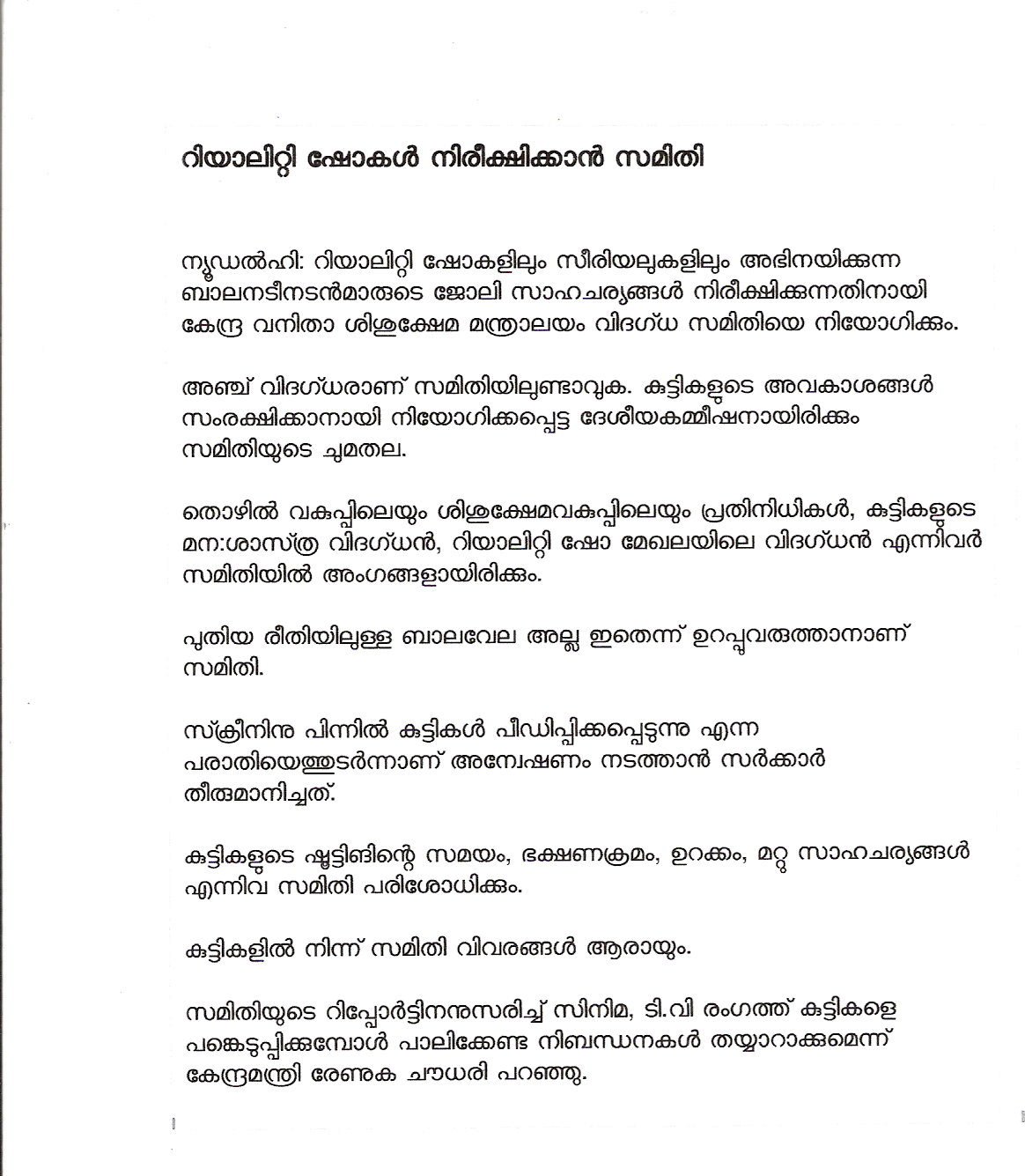
Central Govt Committee to monitor Children participating in Reality Shows
 ClicksandWrites
You must be logged in to post a comment.