Month: December 2007
A glass of wine a day delays dementia
A glass of wine a day delays dementia
16 Dec 2007, 1238 hrs IST,PTI
NEW YORK: Wine can be food for health as long as you are smart about how you drink – one goblet daily may help in preserving your memory for long.
A study has found that a glass of wine everyday delays dementia in those who are at risk from Alzheimer’s disease as they are already having memory problems.
“While many studies have assessed alcohol consumption and cognitive function in the elderly, this is the first study to look at how alcohol consumption affects rate of progression of mild cognitive impairment to dementia,” according to lead researcher Vincenzo Solfrizzi of University of Bari in Italy.
Mild cognitive impairment is a transitional stage between normal ageing and dementia used to classify people with mild memory problems and no significant disability.
The researchers came to the conclusion after they evaluated alcohol consumption and the incidence of mild cognitive impairment in a group of 1,445 people aged between 65 and 84 years.
The team then followed 121 people with mild cognitive impairment and their progression to dementia.
The researchers found that those with mild cognitive impairment who had up to one drink of alcohol a day, mostly wine, developed dementia at an 85 per cent slower rate than people with mild cognitive impairment who never drank alcohol.
“The mechanism responsible for why low alcohol consumption appears to protect against the progression to dementia isn’t known. However, it is possible that the arrangement of blood vessels in the brain may play a role in why alcohol consumption appears to protect against dementia.
“This would support other observations that drinking moderate amounts of alcohol may protect the brain from stroke and vascular dementia,” Solfrizzi said.
Success storeys – Mr. Rizwan Sajan, Chairman DANUBE Group, Dubai

Success storeys – Mr. Rizwan Sajan, Chairman DANUBE Group, Dubai
By Sandhya Rajayer GULF NEWS Published: December 13, 2007, 23:17
In 15 years, Rizwan Sajan has risen from a Dh1,500 per month job to spearhead a business that is worth $200,000. Sandhya Rajayer speaks to the chairman of Danube Group to learn of his definition of success.
A lot has changed about Dubai in the last 30 years. The vast sandy stretches have morphed into a Manhattan-like skyline, the corner grocery stores have turned into air-conditioned multi-brand format supermarkets, the city roads that once saw Cadillacs and camels crossing paths are now set to welcome the metro. But the one thing that remains unchanged is the power of this city to breathe life into dreams, to reveal to the human mind the shape and size of things to come even if at that time there is no evidence that
the dream will take shape in the way you want.
Rizwan Sajan was 28 when he came to Dubai in 1992 to take up a job in a hardware store on a salary of Dh1,500 per month. Barely 15 years from then he has propelled himself on the path to success with a speed and determination that is astonishing to record. Today he is Chairman, Danube Group, a $200,000 building material company that distributes over 10,000 products, has retail outlets in the UAE, Bahrain, Muscat and India, and three sourcing centres in China and employs 400 people. But all of this was not like a walk in the park. A part of it has been like a roller coaster ride, another stretch like a trial by fire. But through it all remained intact Rizwan’s sheer grit.
This is his story:
Rizwan’s father passed away in 1980 when he was 16 years old. As the eldest son he realised it was up to him to find ways to support his family. So he wrote to his uncle in Kuwait, who ran a building material business, saying he was looking for work and was there anything his uncle could offer him? The response was in the affirmative – but, wrote his uncle, he would have to wait for two years in order to reach the legal age to work. Rizwan interpreted the answer to be a tactic in polite evasion. So he squashed all hopes of going to Kuwait. Instead, he continued his studies and attended morning college for his commerce graduate degree at Somaiyya College in Vidyavihar (an eastern suburb of Mumbai, India) and worked part-time at Nathani Steel, a company also based in the same suburb, in the evenings.
And so it was that two years later, Rizwan was pleasantly surprised to receive a letter from his uncle in Kuwait enquiring if he was still interested in the job. Within a month, the job visa formalities were completed and he was on his way to a job in Kuwait. As he worked closely with his uncle, Rizwan began to understand the workings of the building material business inside out.
He was also sharp to build his personal assets, buy a car and over a span of 10 years, his reputation in the field turned rock solid.
He got married in 1987 and continued to work in Kuwait. But when the country was invaded by Saddam Hussain in August 1991, like several thousand other expats, Rizwan had to leave Kuwait overnight, and all that he had worked for and built up came to nought. He landed in Mumbai with about Rs150,000 in his pocket and felt as if he was back at the starting line.
Grasping at the tiniest straws of opportunity, Rizwan met up with a friend who owned a hardware business venture in Dubai. “I can still recall our meeting at the poolside restaurant (at Searock Hotel in Juhu, Mumbai) in vivid detail,” he says. “My friend asked me what kind of money I had been earning in Kuwait. About Dh15,000, inclusive of salary and commissions, I replied. ‘I can’t even think of paying you that much,’ he said. I wasn’t even dreaming of asking for that much, I responded. He offered me a job with a salary of Dh3,000 plus a 25 per cent commission on the sales. What did I have to lose? I didn’t have a job in hand anyway. I accepted the offer on the spot and he promised to send me the visa as soon as possible.”
A month later, there was no sign of the offer turning into reality. So he called his friend in Dubai only to be told that his business was lax and he could not afford to pay the salary promised earlier. “How much can you pay me?” Rizwan asked him point blank. ‘Dh1,500 plus 25 per cent commission,’ came the reply. Perhaps, Rizwan thought, it was the kind of offer that was very easy to refuse, which was why it was being offered to him. But Rizwan was desperate. He accepted the offer immediately. His only request was that he be provided accommodation and food. Fortunately for Rizwan, by the time he landed in Dubai in March 1992, the situation in Kuwait was back to normal and people had started returning to work. This meant that Rizwan’s business contacts were back in town as well and when word got round that he was in Dubai, they started placing orders with him for building material. Truckloads of cement, sanitary fittings, furniture .. all made their way from Rizwan’s new workplace to Kuwait. The friend who had offered him Dh1,500 quickly hiked his pay to the original sum of Dh3,000. With additional commissions, Rizwan began to earn about Dh8-10,000 per month.
But the whims of Lady Luck are known to none. So it was that just as he was beginning to taste success once more, his contacts in Kuwait went back to doing direct imports. Rizwan’s income stream started to dry up.
By this time Rizwan had fallen in love with Dubai. From the moment he had stepped off the plane, he had begun to feel at home. So he stood his ground in Dubai, convinced that it was worthwhile to hang in and keep trying. Eventually, it would all fall into place.
With exports to Kuwait having dried up, Rizwan was back to trading in small hardware. He realised that he had arrived at a crossroads as far as his career was concerned. He also realised that this was the moment to start thinking big. “So I suggested to my friend and employer that with my experience and contacts, we could expand the building material business and, say, trade in wood. This called for an investment of about a million dirhams. Not convinced about the returns on this risk, he refused.
“And thus it was that I parted ways with him,” Rizwan recalls.
This was barely 10 months after Rizwan had started working in Dubai and he had in his account a sum of Dh88,000 or so. His wife, Samira, was in India waiting to join him as soon as his business stabilised. “I told myself that there were two ways of looking at my situation. I could join one of the big companies that could use my expertise in the building material business or I could put my savings to good use and start my own business. Hopefully it would work, but if it didn’t, I would not have a problem getting a Dh5,000 job with a bigger company. Age was on my side, I was not even 30 at the time.”
After some hard thinking, Rizwan decided to start his own company – an indenting company – buying from a supplier, selling to a buyer and earning a commission on the transaction. However he had not reckoned with the strong resistance of big buyers. “I had a hard time for the first six months. My savings of Dh88,000 went into setting up initial capital, an office, a car and the expenses of day-to-day living even as there was no income.”
As luck would have it, Rizwan soon won the contract for supplying galvanised corrugated sheets to a company. His product was so good that it began to attract the attention of big traders who now agreed to buy from him. Things began to move slowly but steadily. To add momentum, Rizwan contacted some of his old supplier friends in Singapore and Romania. “I was frank with them. I told them that I did not have the money to pay for goods just yet but since they knew me, I hoped they would send me material on credit. I promised to pay as soon as the sale was concluded.” His good reputation was his greatest alibi. And so his business began to expand. Soon it was on a roll.
Today Danube runs the gamut of interior and exterior building material – scaffolding, steel and cement, ceramic flooring, bathroom and sanitary fittings, paints, wallpapers, glass, door fittings … He has partnered with some of the best names in the industry such as Kingplex, Halspan, Spano, Astroflame, Dorma, Nobili and many more.
Danube is now a wholesale and retail building material company with about 10 outlets within the UAE, two each in Bahrain and Muscat and in India. It has three branches also in China which act as their sourcing office. Rizwan opted for China as he found that “the (Chinese) government encourages investment and pulls out all the stops to create a conducive climate for economic development.”
(The reason for naming his company Danube Rizwan attributes to his many business trips to Romania. “I fell in love with the river Danube flowing through the country.”)
Obviously, on a journey in search of success as long as this, there are many milestones. Rizwan recalls one particular incident with a person who is now his biggest competitor. “In the initial days (of setting up my business), I had been chasing this person for an appointment, requesting for just a few minutes of his time. Finally one day he agreed to see me at 3 pm. Those days I used to work a split shift from 8 am to 2pm and 4 pm to midnight. I would go home have my lunch and take a nap before getting back to work at four.
“So the 3 o’clock appointment was a bit difficult for me and obviously I couldn’t request for a change in the time considering how difficult it had been to get an appointment in the first place! But I had dozed off in the afternoon for a bit and reached his office 10 minutes late. He just looked at his watch and said to me, ‘You are late for the appointment, you’ll have to take another one.’ I had no choice but to begin chasing him all over again for an appointment and this time I made sure I reached on time. I learned a lot of things from him but I also learnt the importance of punctuality,” Rizwan says.
Having enjoyed a ringside view of the building industry in Dubai for a long time, what does he have to say about the exponential growth of the industry? “I believe Dubai knows where it is headed. The growth is not temporary, it is here to stay.”
Obviously the building industry means more than bricks and mortar. They need to offer solutions for beautiful interiors. Danube’s House of Laminates in JAFZA, launched recently has plugged this gap. Customers usually walk in with the idea that laminates are old-fashioned and when they see the innovative designs and finishes on offer they are surprised into buying them.
“The challenge in the building industry today is to come up with innovations every day. The variety of wood, ebony, walnut, ash, for example, in place of the old staples of rose and teak are all customer driven.
“The average man does not settle for the ordinary, he wants something different even on a modest budget,” says Rizwan. “Even bathroom fittings have been subject to this demand for innovation and if earlier we talked of only a bathtub, we now have shower cubicles in different designs. The same goes for modular kitchens and different finishes for doors. The variety is truly amazing.”
The interiors of Rizwan and Samira’s home in the Dubai Marina have been totally designed by Samira. “I haven’t hammered in a single nail in my house,’ Rizwan says. Is there a glimmer of pride? Looks like it in his smiling eyes.
“Samira has always given me the freedom to focus a 100 per cent on my business. She has tackled all domestic issues with utmost ease throughout our married life of 19 years. Even when I was travelling almost six months a year in the initial stages of setting up the business, she didn’t mind it.”
Then he amends his statement. “I think I should say, there was a bit of cribbing, but not much,” he laughs.
Like all entrepreneurs who begin young did Rizwan too make a promise to himself that he would work hard and retire early? “I tell my wife this every morning,” he laughs again. “In fact I would often say to her that I would retire at 40. That was four years ago. Now I think I should change that to 50!”
Danube has been a part of almost all reputed projects in Dubai beginning with the Burj Al Arab, Media City and Knowledge Village. Among the current mega projects are the Burj Dubai, Down Town Dubai, Jumeirah Islands, International City, The Palm …
Rizwan’s definition of success in life is measured not by the savings in the bank account but the qualities that fill up an individual’s heart. A good human being is a successful human being, according to him.
“A lot of people have a lot of money but not all of them have the respect of their fellow human beings. That I think is the true mark of success. I live by the creed of live and let live – give every person the freedom to reach his goal. And this applies to my sales staff too as they don’t have to report on their daily sales calls. They have the freedom to chart their own course of action. Of course, if there is a shortfall in performance, we have to sit across the table and discuss how to change that.” Ultimately, what matters in life, he says, is whether you made a difference or not.
Total Energy and Education Seminar
Total Energy and Education Seminar
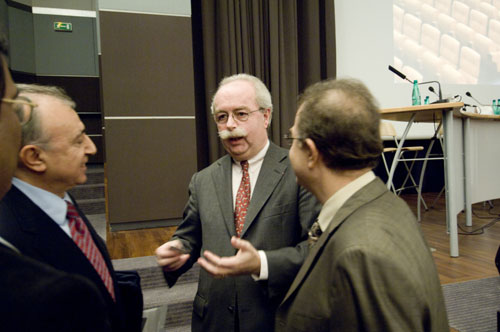
52 university professors from around the world came to Paris for the Total Energy & Education Seminar
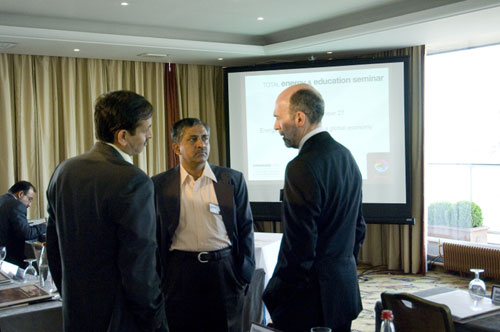
From November 25 to 30, Université Total was welcoming for the first time in Paris 52 professors from 44 universities in 21 countries for a week of conferences and discussions on energy and education.
The attendees, most of whom specialize in scientific fields related to energy, or in economics or management, shared their views with some 20 Total senior executives and outside experts.
List of the universities
ALGERIA
University M’Hamed Bougara of Boumerdes
ANGOLA
Agostinho Neto University
ARGENTINA
Instituto Tecnológico de Buenos Aires
Universidad de Buenos Aires
Universidad Austral
CANADA
Keyano College
University of Calgary
University of Alberta
CHINA
China University of Petroleum-Beijing
Shanghai Jiao Tong University
FRANCE
Ecole Centrale Lyon
Polytech’Lille
Institut d’Etudes Politiques de Paris (cycle de Menton)
Ecoles des Mines de Nancy
GERMANY
Hochschule Merseburg (FH) University of Applied Science
Aachen University of Applied Sciences
INDIA
Indian Institute of Technology-Delhi
Indian Institute of Technology-Kharagpur
Indian Institute of Technology-Bombay
INDONESIA
Institut Teknologi Bandung
University of Indonesia
IRAN
Petroleum University of Technology
Sharif University
IRAQ
Baghdad University
University of Sulaimani
ITALY
SDA Bocconi (School of Management)
Catholic University of Milan and Insubria University
LIBYA
El Fateh University
NIGERIA
University of Port Harcourt
Rivers State University of Science and Technology
NORWAY
Institutt for kjemisk prosessteknologi/NTNU
University of Stavanger
RUSSIA
Saint-Petersburg State Mining Institute
Bauman Moscow State Technical University
SOUTH AFRICA
University of the Witwatersrand
University of Cape Town
SPAIN
Universidad Pontificia Comillas
TURKEY
Middle East Technical University
Koç University
UK
Loughborough University
University of Manchester
VENEZUELA
Instituto de Estudios Superiores de Administración
Universidad Simón Bolivar
Universidad Central de Venezuela


Questions for Nathalie Fokart
Director, Université Total
What’s the common thread between the Total Summer School, the MIT senior executive seminar and the climate change conference?
Each of those programs is inspired by a commitment to thinking about and discussing issues that are not only of great interest to Total, but are increasingly a matter of public debate. Our operations involve all sorts of human, geopolitical, technological and environmental aspects that are often closely interwoven and can’t be managed by executives all on their own.
Université Total’s multidisciplinary approach and mix of both in-house and public speakers and participants make it an ideal place to study and gain perspective on these often complex issues.
How do you make this commitment to outreach work?
Whatever the topic, we favor an approach that combines different angles and a variety of scientific, economic and sociological disciplines. We try to tailor our teaching methods—courses, lectures, internships—to the subject and target audience. This can lead to some pretty unusual situations: the Total Summer School invites students into our facilities, while the MIT seminar sends Total executives off to spend a week on a university campus. In both cases, it expands their point of view. The Climate Change Conference was another attempt to break down the walls between specialties, by asking the leading stakeholders—climatologists, companies and government representatives—to come and present their insights. Incidentally, the conference inspired additional meetings on climate change across our operations. The fact that we can repeat and tailor some Université Total events at the request of the business units helps ground our projects in the day-to-day realities of the Group.
And how do you incorporate this open approach to headline issues like ethics or the environment into your internal training programs?
The Université offers a full range of courses about our ethics, environmental, community relations and industrial safety policies. Some are general and interdisciplinary, while others, like business ethics, security and human rights, industrial safety and environmental management, delve into a specific topic in more detail. Several are held in our subsidiaries to promote local presence and dialogue. The same topics are also discussed extensively in the management training and integration programs deployed by the corporate or business training departments and are part of the Université curriculum.
Université Total deals with topics that are rich, diverse and very international. How will you be able to maintain the momentum?
Our initiatives are meant to be constantly updated, since they only make sense if they are pursued over the long term. The Total Summer School will become a regular event and the success of our first session has led us to invite more students. We will continue sponsoring conferences to encourage discussion and debate on social and community issues, such as diversity, and on environmental and technological issues. For geopolitical topics, we’re working on a two-day seminar dedicated to Africa, which will alternate between country analyses and discussions on regional or social trends.
Moreover, a number of projects are giving rise to others, that build on the original. A seminar scheduled for late 2007 on energy and education is expected to draw 50 teachers from around the world.
Curiosity and the thirst for knowledge will be powerful incentives to inspire future programs.
HPCL awards three naphtha cargoes to Itochu
HPCL awards three naphtha cargoes to Itochu
14 Dec, 2007, 2052 hrs IST, PTI
NEW DELHI: India’s state-run Hindustan Petroleum Corp has sold three naphtha cargoes for February to April lifting at a premium of slightly higher than $15.5 a tonne to Middle East spot quotes, a trade source said on Friday.
The three 30,000-tonne cargoes have been awarded to the Japanese trading house Itochu, the source, who did not wish to be identified, said.
Other than the term contract, HPCL has also awarded Itochu a 25,000-30,000 tonnes cargo of naphtha for loading in the first half of January at a premium of around $12.5 a tonne, he said.
Another HPCL cargo for loading in the second half of January was awarded to Glecore at a higher premium of $18-$19 per tonne, the source said. All the cargoes are scheduled for loading from Vizag port in the east coast.
Indian Oil-Oil India win 3 onshore oil blocks in Libya
Indian Oil-Oil India win 3 onshore oil blocks in Libya
NEW DELHI: The Indian Oil-Oil India combine has won three onshore oil blocks in Libya, adding to the two blocks the consortium already had in the nation that holds Africa’s largest oil reserves.
IOC-OIL teamed up with Sonatrach of Algeria to win blocks 1, 2 and 3 in contract area 95/96 in the Ghadames Basin, industry sources said.
In the previous Libyan licensing round, IOC-OIL combine had been disqualified from bidding but in the latest round, they were qualified to bid as investors. The two teamed up with Sonatrach, which will be the operator of the blocks.
IOC-OIL combine had in 2005 won 7,087 sq km Block 86 and 2,710 sq km Block 102/4. Both hold 50 per cent stake in each and OIL is operator for both.
Sources said OIL-IOC and Sonatrach will now sign an Exploration and Production Sharing Agreement (EPSA) with the National Oil Corp of Libya. The Algerian national oil company will be the operator of the blocks won in this round.
Libya auctioned exploration permits in the central, western and southern desert, in its first licensing round in potentially gas-rich areas.
Russia’s state-run natural gas exporter Gazprom joined Shell, Europe’s largest oil company, Algeria’s Sonatrach and Polskie Gornictwo Naftowe i Gazownictwo SA of Poland in winning four of 12 licenses on offer.
The winners agreed to pay a minimum bonus of 10 million dollars when they signed the contract. Libya’s National Oil Corp, which ran the auction, chose the companies that would give it the highest share of production from any field they find.
Young Achiever: Trimmed for success
Young Achiever: Trimmed for success
Malini Sen,TNN
Hair designer Sumit Israni tells how he fought social taboos to pursue his choice of profession.
“Don’t judge me by my age but my work,” says hair designer Sumit Israni. At 27, he has a long list of awards and achievements to his credit. And after successfully managing a hair salon and hair lounge, his family and friends are finally taking him seriously.
From school itself Sumit has been passionate about the business of hair. And in class XII, when he won the ‘Best Colourist Award’ sponsored by L’Oreal, he decided that he wanted to pursue a career in the same. But that was the easy part. “It was tough convincing my family. Like any other Indian family, they looked no further than an MBA or engineering degree. It was taboo for a son to be a barber! So, I struck a deal with them. I would do what they wanted and they would give me a chance to prove my mettle.”
Sumit completed his BCom through correspondence while he went to Paris for training. He also appeared for the usual ‘Indian-son pre-requisite examinations’ – CAT and MAT. After his 18-month training, he joined Toni & Guy in London following a test as a junior stylist. It took him under two years to become the style director. “When I first joined, I did everything from shampooing to laundry. My fingers itched to hold the scissors, but I waited and watched, knowing my chance would come. Eventually my perseverance paid off.”
He has also been trained by Vidal Sassoon and Guy Kremer. Sumit has bagged some of the top awards in the field, including L’Oreal People’s Award for Best Hairdresser, Asian Hairdresser of the Year, and so on. Besides having done cover pages for Elle and Cosmopolitan, Sumit is a member of the Board of Directors of CHF (Creative Hairdresser Forum) and the international Intercoiffure Mondial (ICD), a consortium of the world’s best hair dressers. Further, this brand ambassador for L’Oreal is also a guest faculty at NIFT.
Friends, who earlier had to think twice about how to introduce him, now wait to get an appointment; his diary is always booked. Today, with an increasing number of people becoming conscious of their looks, the hair industry offers lucrative career opportunities. “It is a very personalised service; you have to create a different style for every client. When I recruit my staff, my first question is whether they are passionate about hair or not,” says Sumit, who adds that a good hair stylist can make nearly Rs 70,000 per-month. There is another form of gratification as well. “When I make an 80-year-old look like a queen, the smile on her face is my biggest reward.”
And leaving no place for complacency, Sumit travels overseas every three months to upgrade his skills. He is also opening a hair academy next summer to train aspirants who share his passion. “I have faced my share of contempt so I want to pave the way for youngsters so they can enjoy their share of respect in this field.”
Wipro wins award for best software testing tool
Wipro wins award for best software testing tool
Indo-Asian News Service, Bangalore, December 14, 2007
IT major Wipro Technologies has won the best practice award for software testing, set up by the US-based International Institute for Software Testing (IIST), the company announced in Bangalore on Friday.
The company’s testing services division was given the award for innovating a statistical tool that reduces the time taken to test a product.
“As part of our proprietary tools suite code-named StORM (statistics, operations, research, matrix), the tool helps us to reduce test case development effort by about 30 per cent,” Wipro vice-president and testing services’ head CP Gangadharaiah said in a statement.
With over 10 years of experience in independent testing services, Wipro is the largest third-party offshore testing service provider worldwide.
It has also set-up the first wireless fidelity (Wi-Fi) pre-certification and certification lab at its Bangalore campus.
The IT bellwether offers software testing services to global customers in partnership with other leading vendors such as Hewlett-Packard, IBM and Microsoft.
“The award is one of the initiatives we have taken to advance the software testing profession and encourage IT firms to adopt best practices. The award also enables firms to share their best practices with the software testing community,” IIST chairman Magdy Hanna said.
Wipro was chosen for the award out of 36 technology firms worldwide that were short-listed by the institute.
No place for happiness
No place for happiness
Ajit Bishnoi, New Delhi
There was a rich man who had everything that one can materially hope for; he had his personal plane, expensive cars, a large house, a villa in Spain, a thriving business, besides being blessed with a nice family.
However, what he did not possess was peace of mind and consequently any happiness – ‘ashantasya kutah sukham’ (Bhagavad Gita 2:66).
Somehow or the other it got into his head that very soon he would contact some terminal disease, like cancer and die.
Therefore he was focused on his body seeking signs that would indicate some malfunction. A headache would scare him of brain tumour; stomach discomfort would mean an ulcer; chest discomfort would point to a heart-attack and so on. He would seek emergency medical attention and every time the doctors would assure him of his physical well-being, after conducting extensive tests on him.
This went on for quite sometime until he became a complete mental wreck. A friend advised him to meet a well-known personality, who would have a solution for his problem. The rich man sought an appointment and went there. He was ushered into that man’s study and was asked to wait.
After a while, the wise man came and listened to him. He said nothing but sent for tea. The rich man was losing his patience since he heard no solutions.
He thought of leaving but stayed to drink tea, having come thus far. The host began to pour tea. He kept on pouring tea until it spilled over into the saucer “What are you doing? The cup is already full with tea and then you are leaving no space for any milk which I would like in my tea, besides sugar!” said the visitor.
Said the wise man: “Everyone must die. But you are not sick and far from being dead. You have filled your cup with misery and left no place for peace or happiness. Instead, count the blessings the kind Lord has bestowed upon you and be happy”.
The visitor was most impressed.
Paper tole artist
Paper tole artist
Suzan Lee, from Philippines
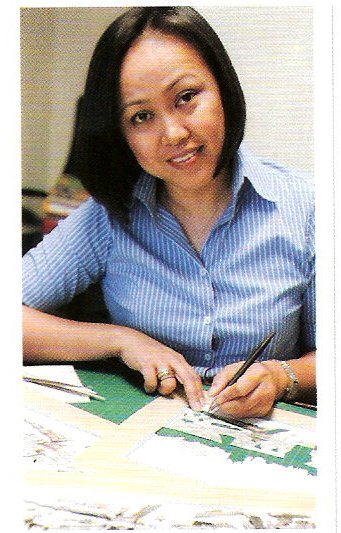
Lee works with paper tole, the art of creating a picture to appear in a 3-D image. “Simply stated, it is the art of creating a picture that will look lively and realistic. In paper tole, part or all of an image is raised from the surface to give a 3-D effect,” she says, adding, “It is also called 3-D decoupage.”
The most aspirational project for Lee is to work on a picture by Anton Pieck, the Dutch painter, artist and graphic artist. To her, Pieck’s work is the acme of art. “You simply have to be at your creative best. You require more imagination and resourcefulness when using his work,” she says. Pieck’s works are noted for their nostalgic or fairytale-like characters. “The reproduction of the details in his characters isn’t facile work. I find the most difficult [paper tole projects] to be ones which use of his pictures. I am inspired by his oeuvre, which includes paintings in oil and water colour, etchings, wood carvings, engravings, lithographs and textbook-illustrations,” says Lee, who is consumed by the exquisite detail of the artistic process of paper tole art.
She is also inspired by the art’s uniqueness and emphasis on detail. “I have to visualise the picture in its entirety. I then have to see which part has to be cut first. [Paper tole involves cutting and layering of various designs or prints.] The result varies depending on the project. If I work on a simple design such as fruit or kiddie stuff like a picture of a teddy bear, the result is discernible at an early stage. The more complicated the design, the harder it is to envision the outcome,” she says.
Paper tole requires the artist to make copies of each image. “These have to be cut individually, and each copy has to be reapplied directly over the original; I use four to seven copies. The method creates a sculptured and layered effect. Cutting has to be meticulous and perfect; even gluing and shaping. I have to be attentive to the most seemingly unimportant detail,” she says.
Paper tole is used to emphasise many objects from petals to buildings. And almost any image imaginable can be crafted into paper tole art. Lee loves images related to the kitchen, which is connected to her love for cooking. “I also like objects that describe happiness such as those related to weddings or a celebration. I also love pictures of children,” she says.
She can create an easy piece like a single flower in about two hours. However, designing a complicated piece like the one shown on this page (bottom left) – The Painter on the Roof by Anton Pieck – can take her six to 12 hours.
“Assembling is the most interesting part. This is where you connect your soul to the project,” she says.
Lee has been an active member at ARTE Soukh since her first participation in February this year. “At first I was hesitant. Today I am a lot more confident as many have praised my work. At every ARTE Soukh event, I conduct free demonstrations. Some of the attendees have even taken a few lessons.
“Meeting different artists and appreciating their art influences my own artistic sensibilities. The spirit among us [the art fraternity] is inspiring,” she says.
– For details, contact Lee, on mylk_007@yahoo.com
Book artist for designer book-binding and sculptural artist books
Book artist for designer book-binding and sculptural artist booksMia Leijonstedt, from Finland
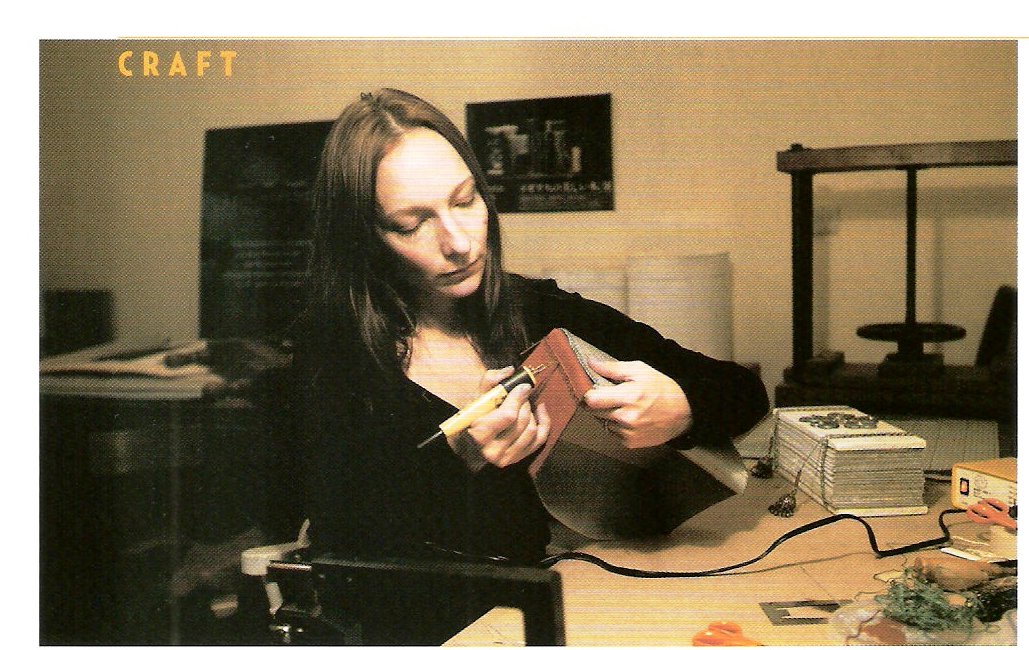
Leijonstedt likes the sound of silence, and works best early morning or at night. For her, a book as a piece of art is more tactile than most other art forms. She recently bound Antony and Cleopatra by William Shakespeare for a New York-based book collector, an owner of the world’s leading miniature designer binding collection.
“I made it [binding] look like it belonged to Cleopatra. I used jewels and raw silk in purple, a colour rumoured to be her favourite. On the back of the book, I hid a lining of snakeskin in a decorative box. It is claimed she died from snakebite, where the snake was hidden in a basket. These details vivified the story,” she says.
Leijonstedt also designs sculptural artist books which are artworks in the shape of a book, where shape, material, and content express a theme; the content can be a painting or drawing. Sculptural artist books differ from designer binding in context, where the latter uses printed text.
“I make these [sculptural artist books] primarily out of paper and leather. The visual details express the theme. For example, my artist book, The Lost Spells of Merlin, creates intrigue, and draws the viewer to ‘read’ the book from all its visual and textural details,” she says.
She also designs books that combine elements of designer book-binding and sculptural artist books. “I completed one for a couple’s anniversary. It was a collection of their letters to each other from their years together,” she says.
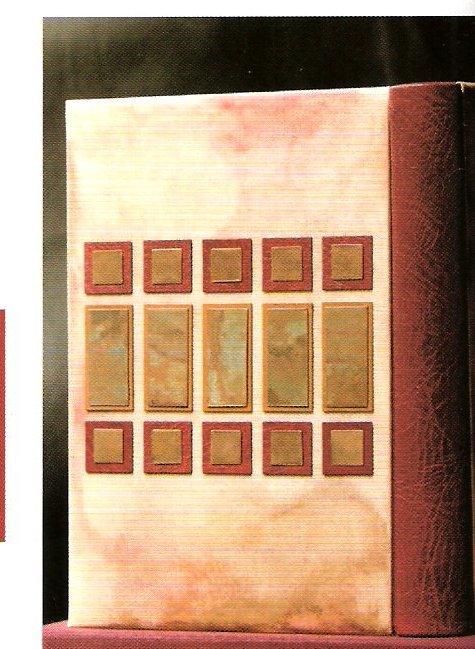
Book art has gained interest in Europe and the US as galleries host regular book art exhibitions. Leijonstedt has exhibited in more than 40 countries, including Japan, Australia, Europe and the US.
Creating art on a three-dimensional platform keeps her passionately interested more than painting, an art form she first dabbled in. “My head is full of ideas, my sketch book full of sketches … I only have time to bring a fraction into reality,” says Leijonstedt, who took part in the ARTE Soukh for the first time last month, and will exhibit this month too.
It was a fortuitous visit in the early ’90s to the British Library in London that emboldened her to take up a special university degree course in the modern and historical skills of making books by hand. At the time, she was an exchange student from the Helsinki University of Art & Design.
“It [the library] was hosting the annual competition of Designer Bookbinders. I had never seen a modern, finely-bound literary work before!” enthuses Leijonstedt, who has won six awards at the same competition between 1995 and 2005.”
Her studies covered every aspect of structural book history – from the birth of the codex to book development through medieval times. In her work, she uses the finest recherché materials like specially tanned natural grain book-binding leather, genuine 24-carat gold leaf and semi-precious stones. “It is the familiar shape of a book that allows one to enjoy the colours, textures and their combinations without worrying about identifying the art form. I deal with colour, scale, layout, symbolism, personal vision and expression.”
– For further details, contact Leijonstedt on galleriamia@gmail.com
 ClicksandWrites
You must be logged in to post a comment.