Month: November 2007
Curry may help stave off cancers
Curry may help stave off cancers
WASHINGTON: Eating curry really may be good for your health, for a new study has found two new molecular analogues of curcumin, the yellowish component of turmeric that gives curry its flavour, which have powerful tumour suppressive properties that may help fight colorectal cancers.
The study was conducted on a mouse model by researchers from Tohoku University in Sendai, Japan, and will be presented at the American Association for Cancer Research Centennial Conference on Translational Cancer Medicine.
Research has associated curcumin with several distinct actions, including the suppression of genes that promote cell growth, and induction of programmed cell death (apoptosis) in colorectal cancer.
However, the downside is that natural curcumin has “low bioavailability” i.e. the molecule quickly loses its anti-cancer attributes when ingested.
With the aim of improving the therapeutic potential of curcumin lead researcher Hiroyuki Shibata, M.D, and his colleagues synthesized and tested 90 variations of the molecule’s structure.
They found that two variations, namely GO-Y030 and GO-Y031, proved to be more potent and bioavailable, than natural curcumin.
“Our new analogues have enhanced growth suppressive abilities against colorectal cancer cell lines, up to 30 times greater than natural curcumin,” said Shibata, associate professor in the Department of Clinical Oncology at the Institute of Development, Aging and Cancer at Tohoku University.
On the study they conducted on mice with colorectal cancer, they found that when fed with the variations, the rodents fared better than those in a control group.
“In a mouse model for colorectal cancer, mice fed with five milligrams of GO-Y030 or GO-Y031 fared 42 and 51 percent better, respectively, than did mice in the control group.”
Like curcumin, the researchers believe the new analogues have clinical potential that extends beyond colorectal cancer.
“In addition to colorectal cancer, the â catenin-degrading abilities of these molecules could apply to other forms of cancer, such as gastric cancer,” said Shibata.
“Like curcumin, these analogues also down-regulate a number of gene products, such as NF-kappa B, ErbB2, K-ras, that are also implicated in breast, pancreas and lung cancers among other diseases.
“In addition to their chemopreventative abilities, these molecules might also form the basis of a potent chemotherapy, either alone or in combination with other modes of therapy.”
The next step, the researchers state, is to further examine the drug delivery mechanisms, toxicology and pharmacokinetics of these analogues, before extending the research to clinical trials.
The study was funded by the Japanese Society for the Promotion of Science and the Miyagi Health Service Association.
Breastfed babies have higher IQ
Breastfed babies have higher IQ
AFP news
CHICAGO: Scientists have identified a gene which leads children to have higher IQs if they are breastfed, a study said.
The study, released on Monday, took a bite out of the nature versus nurture debate by showing that intellectual development is influenced by both environmental and genetic factors.
“There has been some criticism of earlier studies about breastfeeding and IQ that they didn’t control for socioeconomic status, or the mother’s IQ or other factors,” said study co-author Terrie Moffitt, a professor of psychological and brain sciences at Duke University and King’s College in London.
“Our findings take an end-run around those arguments by showing the physiological mechanism that accounts for the difference.”
Researchers examined more than 3,000 breast-fed infants in Britain and New Zealand and found that the child’s IQ was an average of 6.8 points higher if the child had a particular version of a gene called FADS2.
This difference remained after researchers were able to rule out the influence of socioeconomic status, the IQ scores of the mother, birth weight and gestational age as factors.
“The argument about intelligence has been about nature versus nurture for at least a century,” Moffitt said. “We’re finding that nature and nurture work together.”
Ninety per cent of the children had at least one copy of version of the gene which yielded higher IQ if they were breast-fed.
Floating best stress and pain buster
Floating best stress and pain buster
ANI news
WASHINGTON: A recent study has found that relaxing in large, sound –and –light proof tank with salt water-floating is an effective way of easing long-term stress-related pain.
The study was conducted at the Human Performance Laboratory at Karlstad University and was carried out in collaboration with the health authorities under the Varmland County Council.
It was authored by Sven-Ake Bood, who recently completed his doctorate in psychology, with a dissertation from Karlstad University in Sweden.
The research project took under four years for concluding and included 140 individuals, all with some form of diagnosis involving stress-related long-term pain.
The recent research also agrees with an earlier thesis that improved sleep patients feels more optimistic, and the content of the vitalizing hormone prolactin increases. Anxiety, stress, depression and perception of pain declines.
The research comprised four studies that involved the treatment of pain and stress-related disorders with the aid of a floating tank. A control group that was not treated in a floating tank experienced no improvement in their health. After a period of treatment lasting a total of seven weeks, 22 percent of the participants in the floating group were entirely free of pain, and 56 experienced a clear improvement. Nineteen percent felt no change and 3 percent felt worse. And the effect persists after the treatment is completed.
“Through relaxing in floating tanks, people with long-term fibromyalgia, for instance, or depression and anxiety felt substantially better after only twelve treatments. Relaxing in a weightless state in the silent, warm floating tank activates the body’s own system for recuperation and healing,” said Sven-Ake Bood.
“The stress hormone decreases, as does blood pressure. The findings confirm and reinforce our earlier studies on the effects of relaxing in a floating tank
“The treatment method can be used for several groups, such as people with whiplash injuries, fibromyalgia, depression, and long-term stress-related pain.
“We can also see that a combination of treatment in a floating tank and traditional therapy can be effective. We are now moving on in our research and will be monitoring blood circulation in the capillaries, the oxygen uptake of the blood, and how the body’s reflexes are affected,” he added.
The study has been published in the prestigious American publication International Journal of Stress Management .
French health report smokes out shisha’s deadly secret

French health report smokes out shisha’s deadly secret
By Nina Muslim, Staff Reporter GULF NEWS
Dubai: Efforts to ban shisha-smoking in public, included in the UAE draft anti-smoking law, have got a boost from a French report which found one shisha was equivalent to smoking 70 cigarettes.
The French anti-tobacco agency (OFT), citing a national laboratory report, said one session with shisha produced 70 litres of smoke, which had 27 to 102 times the carbon tar of a cigarette, and 15 to 52 times more carbon monoxide, depending on the type of shisha smoked.
Dr Wedad Al Maidoor, head of the Anti-Smoking Committee responsible for drafting the law, told Gulf News that the study confirmed their suspicions.
“It gives a boost to our efforts. We always knew that shisha was dangerous, but we did not know by how much,” she said.
“Shisha is a very new field so there have been very few studies done on it,” other than studies done in Saudi Arabia and Egypt, she added.
Claims rubbished
Shisha, deeply associated with Arabic culture, is popular in the UAE and a draw with tourists. Shisha cafe operators have protested the proposed ban, which will only allow shisha-smoking at home.
They said the ban would adversely affect their business, the tourism industry and the economy. The proposal drew a mixed response from the public.
Dr Wedad said pooh-poohed businesses’ claims, saying the public shisha ban in Sharjah and GCC countries have shown no adverse impact on their economy. “Their economy is growing despite the ban. [In fact] we are behind them in implementing the ban,” she said.
She said the committee was working on an in-depth study on the draft law, requested by the Cabinet, addressed the possible effects of the ban on businesses, tourism industry and economy.
It also addresses increasing taxes and displaying bigger warning signs on tobacco products, limiting advertisements of tobacco products and reducing exposure to tobacco smoke.
Dr Layla Al Marzouqi, cardiologist at Dubai Hospital, hoped the findings would finally nail the health myths surrounding shisha.
“People think it is less dangerous to smoke shisha, because the water is supposed to filter the smoke. But that’s not true,” she said.
Anti-smoking: Draft law nears ratification
The draft law is close to becoming law, with only one step left. It is currently at the Cabinet level, which has to endorse it before going to President His Highness Shaikh Khalifa bin Zayed Al Nahyan for ratification.
“After that, the law will pass,” said Dr. Wedad Al Maidoor, head of the Anti-Smoking Committee.
As a signatory to the World Health Organisation Framework Convention of Tobacco Control (WHO-FCTC), the UAE is required to pass legislation and implement the minimum requirements agreed upon to reduce access and limit exposure.
IGNOU professor selected for UKIERI award
IGNOU professor selected for UKIERI award
PTI News
NEW DELHI: A professor from IGNOU has been selected for the UK-India Education and Research Initiative award this year.
Prof P R Ramanujam, Director, Inter-university Consortium, of IGNOU will share the award with Professor Ulrika Zeshan of Central Lancashire University, UK, a release issued here said.
They will be awarded for their research paper — Distance Education for Sign Language Users.
The award carries a cash prize of 50,000 Pound and other technical support for a period of three years, the release said.
Beat cancer with onions, garlic
Beat cancer with onions, garlic
PTI News
NEW YORK: Better load up on the breath mints – a new study has found that eating lots of onions and garlic may help prevent cancers.
International researchers have carried out a study and found that people whose diets are rich in onions, garlic, and other alliums have a lower risk of several types of cancer than those who avoid the pungent herbs, ‘WebMD’ reported.
According to lead researcher Carlotta Galeone of the Istituto di Ricerche Farmocologiche in Milan, “The health benefits of onions and garlic have been touted for centuries, but few studies have been able to prove the benefits.
“Onion and garlic consumption could simply be a marker for a healthier lifestyle and a diet high in a variety of potentially cancer-fighting herbs and vegetables.”
In fact, in their study, the researchers used data from several Italian and Swiss cancer studies to look at the relationship between onions and garlic consumption and cancer at several body sites, including mouth, larynx, esophagus, colon, breast, ovary, and kidneys.
Overall, consumption of onions ranged from 0-14 portions per week among cancer patients and 0-22 portions per week among those without cancer. Garlic use was also lower among people with cancer, except for those with cancer of the breast, ovary, or prostate. The researchers found moderate consumption of onions appeared to reduce the risk of colorectal, laryngeal, and ovarian cancers.
The protective effect was even greater among those who ate the most onions compared to those who ate the least. People who ate the most onions also had a lower risk of oral and esophageal cancers than those who ate the least.
Again, the anticancer effect increased with the more garlic they ate. People who ate the most garlic had a lower risk of all cancers except breast and prostate cancers, which are mainly associated with hormonal and reproductive issues, the researchers found.
300 new taxis to ease Abu Dhabi shortage

300 new taxis to ease Abu Dhabi shortage
By Binsal Abdul Kader, Staff Reporter GULF NEWS
Abu Dhabi: Residents will not face a shortage of taxis anywhere in the emirate at any particular time as a high-tech monitoring system to ensure the availability of taxis everywhere will be introduced soon, a senior official said.
“If any passenger informs the call centre about the non-availability of taxis at any particular area, the system can despatch more taxis there,” Khalid Saleh Al Rashedi, General Manager of Trans AD, which was previously known as Centre for Regulation of Transport by Hire Cars.
“A device installed in the cars, called ‘MDT’ developed by CERT technology will make it possible.”
He spoke to Gulf News yesterday after launching new taxis at a ceremony at Emirates Palace Hotel auditorium.
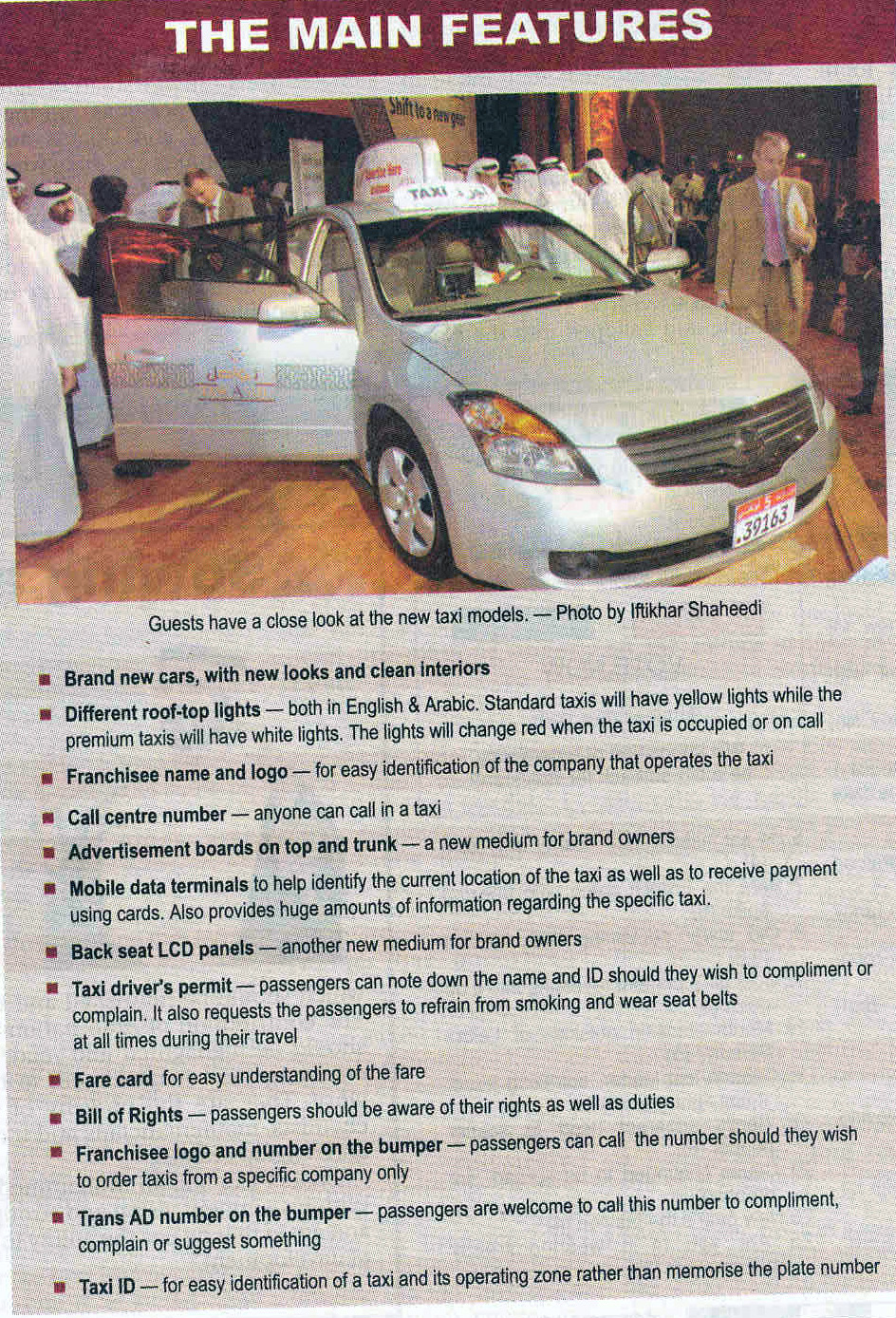
About 300 sleek new silver taxis hit the city roads today. The basic fare will be raised from the current Dh2 to Dh2.6 for standard cars and Dh3 for premium cars (which will be clearly marked).
“The monitoring system and some other facilities like credit card payments will be introduced with the launch of a second batch of about 800 taxis at the end of December. We launched the taxis without such advanced facilities to solve the shortage of taxis in the city,” he added.
Replying to a question he said an online system for the public to track their complaints against taxis will be considered. “Residents can register their complaints with the present system by calling 600535353 and we will surprise the public with immediate solutions,” said Rashedi.
By the end of 2008, Trans AD, the single regulatory authority in the hire car sector, will replace the majority of existing taxis.
Seven companies have been authorised to run 7,147 taxis in the emirate out of which 70 per cent (about 5,005) will be in Abu Dhabi city, 29 per cent (about 2,072) in Al Ain and one per cent (70) in Western region,” said Sultan Mohammad Al Shamisi, Director, Customer Services and Compliance Division.
The companies which successfully applied to run a taxi franchise operation are: Tawasul Transport; Arabia Taxi; Cars Taxi; Emirates Taxi; National Taxi; Q-Link Transport, and Al Ghazal Transport. They will be regulated by the Centre for Regulation of Transport by Hire Cars, which today also announced its name change to Trans AD and revealed its new corporate logo.
Taxi drivers also benefit from the new scheme. All taxi drivers will now be registered as private company employees, with an agreed optimum wage and additional benefits.
It’s silver for Abu Dhabi!
It’s silver for Abu Dhabi!By M. A. Qudoos / KHALEEJ TIMES
ABU DHABI — Silver will be the iconic colour of Abu Dhabi from today.
The Centre for Regulation of Transport by Hire Cars (Trans AD) yesterday unveiled the design of the new taxi fleet, signalling the dawn of a new era of modernisation in Abu Dhabi.
Over 300 of the sleek new silver taxis will commence operation today, with another 800 on the capital’s streets and in Al Ain city and western region by the year end.
By the end of 2008, the majority of the 7,000 vehicles would be on the roads.
Speaking at the official launch at the Emirates Palace, Khaled Saleh Al Rashedi, General Manager of Trans AD, said: “It is only right that Abu Dhabi, as a dynamically developing global hotspot, should have a taxi fleet to match. The new fleet will have high standards in passenger comfort, safety and style, and we are confident that they will be immediately popular with both residents and visitors.”
The minimum fare will be raised from the current minimum Dh2 to Dh 2.60 for standard cars, and Dh3 for premium cars which will be clearly marked.
The fare per additional kilometre will be 65 fils for standard and 75 fils for premium class cars.
Al Rashedi also revealed details of the new taxi scheme: “Today is the result of a lengthy consultation process with key government stakeholders, operating franchisees, licence-holders and the public.
“The new fleet will be run by selected private franchisees, which will encourage high standards and give customers more choice. We are communicating with existing national taxi licence owners to educate what this means for them and what financial compensation they are going to receive.”
The selected operators are: Tawasul Transport; Arabia Taxi; Cars Taxi; Emirates Taxi; National Taxi; Q-Link Transport, and Al Ghazal Transport.
They will be regulated by the Centre for Regulation of Transport by Hire Cars, which also announced yesterday the change of its name to Trans AD and revealed its new corporate logo.
By the end of 2008, Trans AD will replace the majority of the existing public taxis.
The licence owners will be compensated on a monthly basis according to a scientifically endorsed rate.
Licence cancellation will only be applicable if the vehicle has been in operation for more than five years.
Taxi drivers also benefit from the new scheme, said Al Rashedi.
All taxi drivers will now be registered as private company employees, with an agreed optimum wage and additional benefits.
To qualify under the new scheme, drivers are required to hold a valid taxi driver permit upon successful completion of the certification process conducted by Emirates Driving Company which has been appointed by Trans AD.
To mark the historic occasion, a convoy of the new fleet paraded the city’s streets yesterday to showcase the emirate’s new icon.
A checklist for property buyers
A checklist for property buyers
LEGAL VIEW by K.K Sarachandra Bose / KHALEEJ TIMES
K.K Sarachandra Bose is a Partner/ Corporate, Commercial and Contract Lawyer at Dar Al Adalah Advocates and Legal Consultants. Readers may e-mail their questions to: ktedit@emirates.net.ae or send them to Khaleej Times, Dubai P.O Box 11243.
Q: I am writing from Shanghai, China. I have purchased two flats in Dubai from a developer by an agreement signed between the agent and me. The construction is still going on. The title deed of the flats has not yet been transferred to my name and my lawyer in Dubai informed me that it is taking time. Now I want to buy more flats in Dubai as an investment. Can you please advise how I should make payments and how safe it is as an investment?
A: In order to protect the payments made by purchasers of real estate properties in Dubai, the Government of Dubai has promulgated three important laws, which are applicable in the emirate — law No. 7/2006 which streamlines land registration; bylaw No. 85/2006 which regulates real estate brokers’ register; and law No. 8/2007 which governs trust accounts of real estate developments.
The land registration law is applicable to real estate properties situated in the emirate of Dubai. Foreigners may, subject to the approval of the ruler, be granted the rights to acquire absolute ownership of land without time restrictions in certain areas, and usufruct or leasehold of properties for a period not exceeding 99 years. Land means any plot of land and all that are located thereon such as buildings, plants etc.
As per the said law, all transactions that create, transfer, change or cancel rights over land shall be recorded in the Land Register and no transaction shall have any effect unless registered in the register.
As per the bylaw on real estate brokerage in Dubai, every person carrying on brokerage activities must be registered at the Electronic or Documentary Register of the Real Estate Brokers at the Land Department.
As per the law on trust accounts of real estate developments in Dubai, every developer selling units of the project is bound to open a trust account in the name of the property developer in a bank or financial institution approved by the Dubai Land Department and deposit the amounts paid by the buyers of the units or the financing parties.
In short, to buy a property in Dubai, the buyer should see whether the following three points have been adhered to:
(i) that the developer has registered in the developers’ registry at the Dubai Land Department — ask for the Developer’s Registration Number;
(ii) that the developer has opened a trust account with one of the approved financial institutions by the Land Department — issue all payments to the project’s trust account number; and
(iii) that the broker has registered in the brokers’ registry at the Dubai Land Department — ask for the broker’s ID card.
For the property that you have already purchased, you will have to follow up with the developer till such time the property is registered in your name at the Dubai Land Department. Your investments will be safe as per the laws if you follow the above guidelines. — Compiled by Ahmed Shaaban
 ClicksandWrites
You must be logged in to post a comment.