Month: November 2007
WINNERS VERSUS LOSERS
WINNERS VERSUS LOSERS from CITEHR – contribution by Vennila Natarajan
The Winner is always part of the answer;
The Loser is always part of the problem.
*********
The Winner always has a program;
The Loser always has an excuse.
*********
The Winner says, “Let me do it for you”;
The Loser says, “That is not my job.”
*********
The Winner sees an answer for every problem;
The Loser sees a problem for every answer.
*********
The Winner says, ” It may be difficult but it is possible”;
The Loser says, “It may be possible but i t is too difficult.”
*********
When a Winner makes a mistake, he says, “I was wrong”;
When a Loser makes a mistake, he says, “It wasn’t my fault.”
*********
A Winner makes commitments;
A Loser makes promises.
*********
Winners have dreams;
Losers have schemes.
*********
Winners say, ” I must do something”;
Losers say, “Something must be done.”
*********
Winners are a part of the team;
Losers are apart from the team.
*********
Winners see the gain;
Losers see the pain.
*********
Winners see possibilities;
Losers see problems.
*********
Winners believe in win-win;
Losers believe for them to win someone has to lose.
*********
Winners see the potential;
Losers see the past.
*********
Winners are like a thermostat;
Losers are like thermometers.
*********
Winners choose what they say;
Losers say what they choose.
*********
Winners use hard arguments but soft words;
Losers use soft arguments but hard words.
*********
Winners stand firm on values but compromise on petty things;
Losers stand firm on petty things but compromise on values.
*********
Winners follow the philosophy of empathy: “Don’t do to others what you would not want them to do to you”;
Losers follow the philosophy, ” Do it to others before they do it to you .”
*********
Winners make it happen;
Losers let it happen.
*********
Winners plan and prepare to win.
The key word is preparation.
You are what you think!
You are what you think!
15 Nov, 2007, 0000 hrs IST,PARAMAHAMSA SRI NITHYANANDA for The Economic Times
We become what we think. Yad bhaavam tat bhavati, is what our scriptures say. Whatever we think and feel again and again is what we become. What we think we verbalise, what we verbalise we visualise and what we visualise happens.
Wisconsin University carried out an interesting research.
There are societies and cultures in our world where the language spoken is very refined and without negativities. For instance, if you notice, people from the Lucknow area, whether Hindu or Muslim, would use the respectful term for ‘you’, even to their children. Politeness and etiquette are bred into them.
On such communities Wisconsin University carried out research and found that people in such communities rarely suffered from depression and such similar ailments. They found that if the words people use are refined and without negativity, mind is not adversely affected. They do not get stressed, they do not get worried and they do not get depressed. They lead a relatively happier life.
Worry is nothing but the constant inner chatter within us, the constant negative inner chatter. I am asked again and gain, ‘To what extent are we responsible for our thoughts?’
If we are not responsible for our thoughts, who else can then be responsible for them? Our thoughts arise from within us, not from or through someone else! Is it possible for someone to come between us and our minds? Certainly not!
Brahma havit brahmaiva bhavati, say our scriptures. He who focuses on the Brahman, the Ultimate, becomes the Brahman, the Ultimate himself. What we focus our mind on, what we think, what we feel is what we become. There is no doubt about this.
How can we stop worrying? How can we streamline our thoughts without negativity? This is what everyone wants to know.
The solution is simple. You need to be aware of what you think. Constantly be aware of what your thoughts are and straighten them out. You need not stop doing anything you are engaged in to do this.
You can be driving, you can be in conversation, you can be cooking and still you are thinking. Constantly thoughts arise. Most of the time, you do not even watch your thoughts. You let your thoughts guide you into fantasies.
For a change, watch your thoughts. As soon as there is a negative thought, change it into a more positive thought. You may say it is too simple. Yes, it is that simple.
Cooking gas prices rise in most parts of UAE
Cooking gas prices rise in most parts of UAE
By Binsal Abdul Kader, Staff Reporter GULF NEWS
Published: November 20, 2007, 00:28
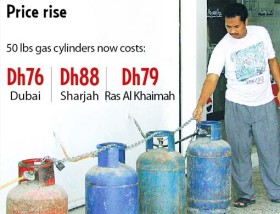
Abu Dhabi: The price of cooking gas has gone up in most emirates by 5 to 18 per cent recently, with Sharjah residents paying Dh90 for a 50 lbs cylinder, residents said.
The price has not gone up in Abu Dhabi.
A standard gas cylinder of 50lbs now costs Dh88 (without delivery charges) since the beginning of this month, compared to Dh75, said a sales agent.
“The price was increased to Dh75 from Dh69 just six months ago,” said P. Jayaraj of Al Maliha Gas Agency.
Dubai residents have to pay a 10 per cent increase for cooking gas. “The price of the standard gas cylinder was increased to Dh76 from Dh69 recently,” said a staffer from Oasis Gas and Binsuloom Gas.
A Dubai resident said she never expected the price rise will affect cooking gas prices in the country
“I thought cooking gas at least will be spared from unbearable price rise of all commodities,” said Alice Gomez, 26, from the Philippines who is working as a clerk at an insurance company.
Ras Al Khaimah residents now pay Dh79 for a 50lbs cylinder as compared to Dh75 two weeks ago. The Department of Economic Development in Ras Al Khaimah fixed the price of a standard cooking gas cylinder as Dh79 earlier this month. The department announced a price list for different sized gas cylinders, after prices soared.
The same standard gas cylinder costs Dh75 in Ajman and Fujairah, said a sales agents and residents. “The price was increased four to five months back and there was no increase recently”, they said.
In Fujairah it was increased from Dh65 to Dh75 three months back, said Zubair a sales agent of Al Ghuraih Gas in Fujairah.
GCC countries should revalue currencies
GCC countries should revalue currencies
By Saifur Rahman, Business News Editor GULF NEWS
Published: November 18, 2007, 15:27
Dubai: The six oil-rich Gulf countries should carry out a one-time big revaluation to adjust their currencies, Steve Forbes, US entrepreneur, told Leaders in Dubai conference.
Gulf consumers have lost between 25 to 35 per cent in purchasing power during the last two years as the falling value of dollars coupled with the strong economic growth has added inflationary pressures on the economy that has reflected in higher cost of living.
Forbes, however, is a strong advocate of the currency peg.
“The Gulf countries should carry out a one-time big revaluation by 10 to 15 per cent of their currencies to the dollar,” he said. “Don’t let your currency float, keep the peg, but revalue it and revisit the peg from time to time,” he said.
According to the International Monetary Fund, inflation in the UAE has reached 9.3 per cent last year on higher economic growth and partly due to the weakening value of the dirham pegged to the US dollar.
He blamed the US Federal Reserve for inflating the global economy.
“The US Federal Reserve has been printing too many dollars, causing global inflation,” he said.
“The major currencies, the euro, pound and others are in a way adding to the global inflation, with the Federal Reserve being the biggest sinner. The UAE and other Gulf countries should revalue their currencies to adjust.”
In an exclusing interview with the Gulf News, Forbes said, the Gulf states should tell the US Federal Reserve chairman to “put its act together”.
Dubaisation
Forbes said Dubai has created a model for economic growth, and others should follow what he fondly referred to as ‘Dubaisation’.
“Saudi Arabia is undergoing a reform process and developing its midedle class, which will create a healthy balance for growth. However they should look at Dubai and other economies should follow the Dubaisation example,” he said.
Forbes, a strong critic of the International Monetary Fund, said that the institution is good for nothing.
“The IMF loves to pay money to the countries and enjoy when they suffer. The IMF should be sent to Bolivia or some other places,” he said.
Abu Dhabi airport in chaos again
Abu Dhabi airport in chaos again
By Daniel Bardsley, Staff Reporter GULF NEWS
Published: November 19, 2007, 15:47
Dubai/Abu Dhabi: Fog played havoc with flight schedules at Abu Dhabi International Airport for another day yesterday.
The runways at the UAE capital’s airport were shut down from midnight to 10am due to a blanket of fog that cut visibility to 100 metres.
It was the seventh day in a row with fog at the airport and the eighth day of fog there this month, but Dubai and Sharjah International Airports escaped.
Yesterday morning 11 inbound flights to Abu Dhabi were diverted to Al Ain while 43 outbound services were delayed and at least four were cancelled.
The morning disruption caused a build-up of delayed flights that put schedules out of kilter for the rest of the day.
Abu Dhabi-based Etihad Airways announced yesterday it was rescheduling all flights due to arrive at or depart from the capital’s airport between midnight and 8am today.
The airline did this as a precautionary measure in case there was more thick fog at the airport this morning – as forecasters were predicting. Seven Etihad flights were rescheduled to ensure that no aircraft was timetabled to arrive or leave between midnight and 8am this morning. For example, services from Toronto and New York due to arrive at 2am were brought forward and were due to land before midnight.
Flights from Geneva and Munich originally set to land in Abu Dhabi before 8am were put back so they would not land during the time when fog was most likely.
In addition, eight Etihad flights due to leave this morning to destinations including Kuwait, Karachi, Jakarta, Muscat and Johannesburg were cancelled, the airline announced yesterday.
A spokesman for Etihad said the company was contacting passengers to inform them of the changes.
“We are not leaving the passengers stranded. The key is to get everything back to order,” he said.
Dubai and Sharjah International Airports remained open throughout yesterday as visibility never fell below 2,000 metres.
Dubai-based Emirates said its operations returned to normal on Sunday following the severe fog at its hub airport on Saturday morning. A spokesperson said the airline offered free meals and hotel accommodation to passengers affected by disruption.
Clive Stevens, duty forecaster at Dubai International Airport, said there was a possibility of fog this morning.
“It’s very humid at the moment so I don’t see why we shouldn’t have a high risk of fog. It’s gone on for such a long time,” he said.
– With inputs from Binsal Abdul Kader, Staff Reporter
Smoking can make you impotent
Smoking can make you impotent
18 Nov 2007, 1628 hrs IST,PTI
NEW YORK: It’s important that you give a second thought before lighting your next fag — if researchers are to be believed, smoking can ruin your sex life.
According to a study carried out by the researchers, men who smoke cigarettes run an increased risk of experiencing erectile dysfunction, and the more cigarettes smoked, the greater the risk, the ScienceDaily has reported.
“Although erectile dysfunction is not a life threatening condition, it compromises well-being and quality of life. Smoking prevention should be an important approach for reducing the risk,” lead researcher Prof Jiang He was quoted as saying.
In fact, Prof Jiang and his colleagues at the Tulane University School of Public Health and Tropical Medicine came to the conclusion after examining the link between smoking and impotency in a study in China involving 7,684 men.
The researchers used questionnaires to assess the status of cigarette smoking and erectile dysfunction. Those surveyed were men between the ages of 35-74 who did not have vascular disease.
The team found that there was a significant link between the number of cigarettes that men smoked and the likelihood they would experience erectile dysfunction. The association was found to be stronger in those with diabetes.
“An estimated 22.7 per cent of erectile dysfunction cases among Chinese men might be attributable to cigarette smoking,” Prof Jiang said.
The findings have been published in the ‘American Journal of Epidemiology’.
Spendometer to manage your budget
Spendometer to manage your budget
19 Nov 2007, 1457 hrs IST,ANI
LONDON: Young people who want to keep themselves free from debt can use the newly introduced device, Spendometer.
The device, which is available from website moneybasics.co.uk, enables mobile phone users to budget via their handsets.
For using the device, the mobile phone users need to enter their target maximum weekly spend, which can be divided into categories such as lunch, clothes and alcohol.
Any amount of money spent is then entered by category and the device sends a text message alert if the users exceed their spending limits.
“By making money management easy with mobile phones, we hope to help millions to keep better control of their money,” Scotsman quoted Malcolm Hurlston, chairman of the charity Credit Action, as saying.
Dubai Motor Show 2007
Dubai Motor Show 2007
Al fresco motoring at its finest: Maybach’s latest Landaulet, unveiled for the first time in the world.




Red hot: Rolls Royce’s jaw-droppingly spectacular Phantom Drophead Coupé.
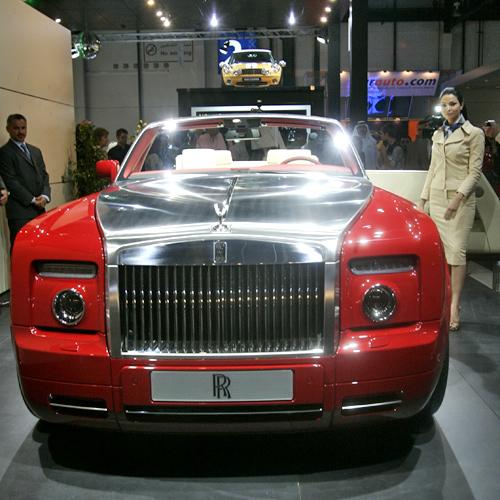
A Rolls Royce black model 1975, Shaikh Hamdan Bin Hamdan Al Nahyan collection, on display at the Dubai Motor Show.

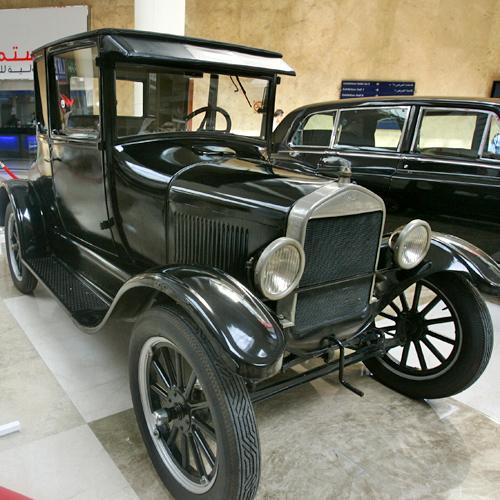
Ford A model 1928, Shaikh Hamdan Bin Hamdan Al Nahyan collection, on display at the Dubai Motor Show.
Shouja, Shaikh Hamdan Bin Hamdan Al Nahyan collection, on display at the Dubai Motor Show.

Trains of thought
Trains of thought
Trains of thought
November 17, 2007 Posted by Sanjay Bangar at 12:57 AM in Offbeat
Being a Railwayman people often ask me several questions about train travel. How much time have you spent travelling in trains? Which is the longest journey? And so on.
I’ve travelled an estimated 200,000 km by train in 15 years of first-class cricket. Nowadays, because of the BCCI’s tie-up with airlines companies, most teams travel by air. It takes away the charm of the journey because in a flight everyone is only keen to get to the destination. The whole pleasure of a journey is lost. Railways is probably the only team to still use trains throughout the season.
The Indian Railways is the largest mass transport system operating in the world in terms of travellers per day and every Indian has memories of train journeys. For us cricketers, it’s no different.
During journeys there’s a lot of interaction between players, a fact crucial in a sport like cricket. Long-term friendships are formed when one interacts with colleagues, understanding each other’s background, education, siblings and family. These journeys made team bonding much easier. One understands there is more to life than just cricket.
Our experience of trains usually corresponds with the progress made in our careers. Earlier when a player used to get picked for Under-15, Under-17 or his University team, he used to travel in second class compartments. When he progressed to the Ranji Trophy almost all players travelled second AC.
If one made it to the zonal team (for the Duleep or Deodhar Trophy) the tickets are given by organisers but with no guarantee of berth confirmations. I remember vividly a journey in 2000 when ten players of a Central Zone team were booked in an AC compartment from Kanpur to Delhi after a Duleep Trophy match. But only one ticket was confirmed. It was on that one ticket, with some help from co-passengers that we managed to spend the night in the most awkward conditions. It caused a lot of discomfort to all concerned.
You also need to endure some really long journeys. My longest journey has been for 52 hours from Guwahati to Mumbai in 1999. It was after a Duleep Trophy game and I was all by myself, going back home. I spent close to three nights in the train and it passed through so many unknown stations. It was a very lonely experience.
Another problem relates to the massive kit-bag and luggage we need to carry to games. The trains usually tend to be jam-packed and there isn’t much place to store our belongings. In hindsight one acknowledges the tolerance, humility and acceptance of co-passengers, which made it possible for us to travel. People usually used to grant us special status by making adjustments once they realised we were cricketers.
Teamwork also came to our rescue on many occasions. If we had to alight at a station where a train stops for a very short period, we used to form a queue from the seats to the exit and pass on the luggage from one guy to the other. It not only saved us paying exorbitant amounts of money to the porters but also had another big advantage. You could very easily separate a selfish character from a selfless character during these journeys. A selfish character was one who would turn a blind eye once his luggage alighted on the platform.
A related aspect is the allotment of room partners when teams are put up in hotels. Most coaches and managers try and work it out on the following basis – either it’s a senior with a junior to enhance the learning process, or it’s openers sharing a room, fast bowlers being put together, or (in Railways’ case) players being grouped according to their zones. It produces some interesting situations when one member of the room has had a great day and the other a bad one. It’s tough to party when you’ve score a big hundred but seen your room-mate failing on the day. It’s those times when you understand what a great leveller cricket can be and how failure isn’t too far away if you lose focus.
ONGC Mittal under scanner in Nigeria
ONGC Mittal under scanner in Nigeria
17 Nov, 2007, 0128 hrs IST,Rajeev Jayaswal, TNN
RIYADH: ONGC Mittal Energy (OMEL) — a joint venture between ONGC and LN Mittal group — seems to be have run into trouble in Nigeria. The new government in that country has decided to review oil block contracts awarded by the previous regime following allegations of irregularities.
According to top Nigerian officials, there are apprehensions over licences won by OMEL.
Based on the apprehensions, the company’s deals in the country are under scanner. According to official sources, the deals under review include two blocks — 285 and 279 — awarded to OMEL.
Confirming the move to ET, Nigeria’s minister of state for energy (petroleum) Odein Ajumogobia said, “We are reviewing award of blocks by the previous government. There were complaints about the procedure used in awarding some of the blocks, and we are now investigating that.”
He, however, did not specify the identity of the blocks. Official sources, however, said that the two blocks awarded to OMEL are also under review, he said.
While there was no formal confirmation about the identity of the blocks and the companies involved, industry sources said some domestic and foreign entities that obtained licences to explore oil in the energy-rich African nation through ‘back door’ may end up losing them.
OMEL had won rights to explore in OPL 279 and OPL 285 in 2005 after committing investment of $6 billion in an 1,80,000-barrels-per-day greenfield refinery, a 2,000 mw power plant and a railway line running from east to the west of Nigeria. OMEL paid a signature bonus of $50 million for OPL 285 and $75 million for OPL 279.
OMEL was given preferential bidding rights for another block (OPL 250) in another licensing round that happened just before the change in the government. The company, however, did not submit a bid for the block.
Preferential bidding rights are like the first right of refusal where the company has the right to match the highest bid for the block and bag the exploration acreage. It is understood from the sources that OMEL did calculate the political risk and opted out of the deal.
 ClicksandWrites
You must be logged in to post a comment.