Month: October 2007
Reliance Innovation Leadership Centre opened in Pune
Reliance Innovation Leadership Centre opened in Pune
5 Oct, 2007, 2240 hrs IST, PTI
MUMBAI: Reliance Industries (RIL) on Friday inaugurated an innovation centre in Pune which would drive the company’s “innovation agenda”.
Reliance Innovation Leadership Centre, inaugurated by RIL’s Chairman and Managing Director Mukesh Ambani, would be guided by an innovation council chaired by RIL board member R A Mashelkar.
The council would have global thinkers in the field of sicence, technology and innovation practioners as its members, RIL said in a statement.
The company also plans to set up a corporate research and technology centre in Navi Mumbai that would act as a hub for research centres operating at various manufacturing locations, it said.
Photo Speaks – City Image Monitoring

Abu Dhabi Municipality gives a lot of emphasise on keeping the city clean. As part of their new initiatives they have introduced several teams to monitor the environment. Here is one such unit in motion on the roads of Abu Dhabi.Keep a watch, spitting or throwing garbage on the road – a good amount of fine will be your call.
Act in haste, repent at leisure
Act in haste, repent at leisure
1 Oct, 2007, 0339 hrs IST,K VIJAYARAGHAVAN, TNN
The story of ‘Kuttathy sisters’ was often recounted by late Seetha Venkatachary, a very good narrator of didactic tales of ancient India. This story illustrates the axiom that one should think twice before acting harshly and that hasty actions would be followed by agonising repentance, which would be of no avail.
Taken from Kerala folklore, this story involves Valia (the elder) Kuttathy and the Kochu (the younger) Kuttathy, who were birds of a particular species, living in happy companionship. One day, Valia Kuttathy obtained from outside, some green gram. She entrusted the job of frying these to Kochu Kuttathy, as she went out.
On her return, she inspected the fried pulses and observed that the quantity had reduced. On being accused that she had eaten a portion of these, Kochu Kuttathy pleaded her innocence. Enraged at what she presumed was her sister’s cheating and lie, Valia Kuttathy attacked her younger sister and killed her.
Another day when Valia Kuttathy herself fried some newly obtained green gram, she found, to her dismay, that the quantity had reduced. On enquiry with others, she came to know that such pulses generally reduce in size on being fried.
In painful remorse, Valia Kuttathy spent the rest of her life, crying out to her dear sister, “Kochu Kuttathy, urr.. urr.. Kochu Kuttathy, urr.. urr..” Malayalam folklore has it that, to this day, the same painful cries can be heard at certain times, from an untraceable bird — possibly a descendant of Valia Kuttathy.
The need to be vigilant against impetuous actions is also underlined by another well known story of a lady, who once went out to fetch water, leaving her infant child to the care of her pet, a mongoose. On return, she observed that the mongoose had blood stains all over its mouth. Presuming that it had devoured her child, she threw the pot on it, instantly killing the creature. Screaming, she thereafter went to her child’s cradle, expecting to find the mangled remains. Surprised, she saw the child peacefully asleep, while a dead snake lay nearby, obviously killed by the mongoose which had intercepted this killer, while it had slithered up the cradle.
Hasty and ill considered actions and also such words, bring in their wake sufferings all over. A well known Tamil proverb observes, Kaanpathum poi, ketpathum poi, theera vicharipathe mei (even what we see and what we hear could be misleading; what is ideal is proper inquiry and analysis). Indeed these are words of great wisdom!
Dirham needs 35pc surge against dollar: experts
Dirham needs 35pc surge against dollar: experts
By Isaac John (Deputy Business Editor)KHALEEJ TIMES 6 October 2007
DUBAI — Predicting a 30 per cent possibility for an imminent revaluation of the UAE dirham, monetary experts said the UAE currency needed a significant appreciation of 35 per cent against dollar to regain its intrinsic strength in relation to other currencies.
Gary Dugan, Chief Investment Officer, Global Wealth Management, Merrill Lynch, told Khaleej Times that the GCC currencies needed to appreciate by around 35 per cent to reduce excessive savings. “In the shorter term, we expect the UAE or Qatar will move to peg versus a basket of currencies this year.”
According to Pradeep Unni from Vision Commodities Services, the UAE currency has lost 55.09 per cent against euro since 2001 — from Dh3.34, the euro is now selling at Dh5.18. Against, the British pound, dirham has lost 38 per cent in the same period, with the exchange rate surging from Dh5.41 in 2001 to Dh7.48, while against the Indian rupee, dirham has lost 24 per cent since May 2002 — dropping from Rs13.32 to Rs10.73 per dirham at present.
Despite UAE Central Bank’s insistence that it would neither opt for a revaluation of dirham nor move away from the US dollar peg, currency experts and economists believe that the likelihood of an imminent revaluation of the UAE dirham is 30 per cent.
Currency strategists said a revaluation of the dirham, which is currently estimated to 30 to 35 per cent undervalued against the US currency, could also provide investors a nice bonus on a property purchased in the UAE compared to parking that investment in a US dollar deposit account.
While affirming that an upward adjustment of dirham to the US dollar will be increasingly likely unless inflation begins to slow more noticeably next year, economists are of the view that there is increasing pressure on the UAE monetary authorities to drop dollar peg and switch to a basket of currencies as Kuwait and Syria have done. “Such a move will ward off any further inflationary trends by strengthening the dirham against other currencies,” they contend.
However, experts warn that the UAE has to undertake a series of currency realignments to ensure the true value of its currency. “While most of the UAE’s exports (oil and gas) are priced in dollars, the country’s biggest share of imports comes from non-dollar zone. A steadily falling US dollar is thus aggravating inflation which last year hovered above 10 per cent due to higher cost of imported goods, a steep surge in rents and other living expenses.”
Dugan said the dollar looked set for further weakness. “We believe that dollar weakness comes from both cyclical and structural factors. Cyclically the US economy is set to be one of the weakest in 2008. Structurally the US economy is still facing the twin deficits of a current account and fiscal deficit. Also the weakness of the dollar has gained some momentum that may extend through the fourth quarter of 2007.”
Danger on the roads

Gulf News conveys readers thoughts and fears on Road Safety
Politics hurts Kuwait’s progress to 2020 output goal
Politics hurts Kuwait’s progress to 2020 output goal
Reuters Published: October 05, 2007, 00:21
Kuwait City: A political standoff in Kuwait has delayed progress on projects to boost oil output and left the world’s seventh-largest oil exporter struggling to meet its 2020 output target of 4 million barrels per day (bpd).
The Opec member’s oil production capacity now stands at around 2.8 million bpd and is unlikely to be much more by the end of the next decade, analysts said.
“We are very pessimistic about their chances of hitting the 4 million bpd target – largely because political issues that have long dogged projects are going to continue to be major factors,” said David Kirsch, manager of market intelligence at Washington-based consultancy PFC Energy.
Kirsch expects Kuwait’s capacity to be just shy of 3 million bpd by 2017.
A key obstacle to expansion plans is winning approval from parliament for international oil companies to take a role in an $8.5 billion scheme to boost output from the country’s northern oilfields, known as Project Kuwait.
Despite having debated the plan for more than a decade, Project Kuwait has never gone beyond the committee stage to the floor of the house as some parliamentarians oppose the involvement of foreign companies.
Even with Project Kuwait, the 2020 target looks out of reach, said Colin Lothian, senior analyst for the Middle East at global consultancy Wood Mackenzie.
“They’d struggle even if the project went ahead,” he said. “To get to 4 million bpd from where they are now is an awfully big jump.”
Political standoff
Kuwait’s parliament has a history of challenging the government.
One of the latest victims of the political standoff between parliament and the government was Oil Minister Shaikh Ali Al Jarrah al-Sabah, who resigned in June and has yet to be replaced. He held the position for less than a year.
Lack of continuity in the post was impeding expansion plans, an official at a state oil firm said. “We need stability at the top of the oil sector,” the official said. “Nothing moves forward, a new minister always has to go back to the start. And the government fears any confrontation with parliament.”
Acting Oil Minister Mohammad Al Olaim, who is also in charge of the water and electricity ministry, has made few public comments about Kuwait’s oil policy.
During the summer, Olaim was kept busy averting blackouts as Kuwait’s power system ran close to maximum capacity.
Kuwaiti newspapers have reported that Finance Minister Badr Al Humadhi is most likely to become the new oil minister. No decision is expected until after Ramadan.
More trouble may lie ahead in parliament for a new minister as some deputies have submitted a motion to tie oil production to the country’s reserves in a bid to force the government to disclose reserves on a regular basis.
Doubts about the size of Kuwait’s proven oil reserves have persisted since industry newsletter Petro-leum Intelligence Weekly reported last year that it had seen internal records showing reserves were about 48 billion barrels, about half what was officially stated.
Olaim said in July the reserves stood at 100 billion barrels but did not say if these were proven or unproven reserves.
Both Kirsch and Lothian believe reserves are closer to the level that PIW reported.
Lower reserves would reduce how long Kuwait could sustain future output boosts.
Lothian forecast Kuwait’s output capacity at 2.8 million bpd in 2016, and to decline thereafter.
Pumping more of the country’s heavy oil was also key to boosting capacity, but for that, as for Project Kuwait, it would need the experience and technology of international oil firms, said Karmel Al Harmi, an independent Kuwaiti oil analyst.
Kuwait has said it wants to boost heavy oil output to 700,000 bpd by 2020.
Tehran to shut Bandar Abbas crude units
Tehran to shut Bandar Abbas crude units
Reuters Published: October 05, 2007, 00:21
Tehran: Iran will shut a crude unit at its Bandar Abbas refinery in January and a second in May to boost capacity by 40 per cent, part of its multi-billion dollar move to cut dependence on gasoline imports, a National Iranian Oil Co source said yesterday.
The source said the shutdowns at the 110,000 barrels per day (bpd) units, set to last for about 30 days each, would allow the state-run firm to boost the refinery’s capacity to 320,000 bpd.
“In January we will shut down one CDU to raise the capacity to 160,000 barrels per day, this one will last about a month and the refinery will be in full operation after,” the source said.
A second crude unit, of similar size, will be shut in May for the same operation, the source added.
Crescent completes drilling programme in Mubarak field
Crescent completes drilling programme in Mubarak field
Staff Report GULF NEWS Published: October 05, 2007, 00:21
Dubai: Crescent Petroleum, the region’s oldest private upstream company and the operator of the Mubarak field, has announced the successful conclusion of its recent drilling programme in the Mubarak field, offshore Sharjah, with completion of the K2 well.
The well was drilled to a depth of 13,528 feet in the Ilam reservoir.
After initial tests, the well is flowing at 742 barrels per day, similar to the initial flow rate of the first well, H2, in this two-well programme.
These wells were the first to be drilled by the company in the Ilam reservoir since 1997 and were appraising the remaining potential of the reservoir which has been in production since 1974.
The two wells successfully tested the potential for bypassed oil in both the northern and southern flanks of the reservoir and will therefore aid the company in selecting further drilling locations.
Crescent also set a regional operational record in completing the K2 well, with a highly challenging programme involving horizontal drilling combined with coiled tubing technology and a complex completion matrix at great depths.
With the drilling of previous wells in these deep reservoirs, Crescent established a number of world records including the deepest short radius horizontal section drilled, and the deepest slim hole to be cased by expandable casing.
As a result of these encouraging well results, further development potential for the Mubarak field will be evaluated by the company in 2008, with a particular focus on the Ilam-Mishrif oil reservoir and the deeper Thamama gas condensate reservoir.
Food for thought about exchange-rate controversies
Food for thought about exchange-rate controversies
Jul 5th 2007 From The Economist print edition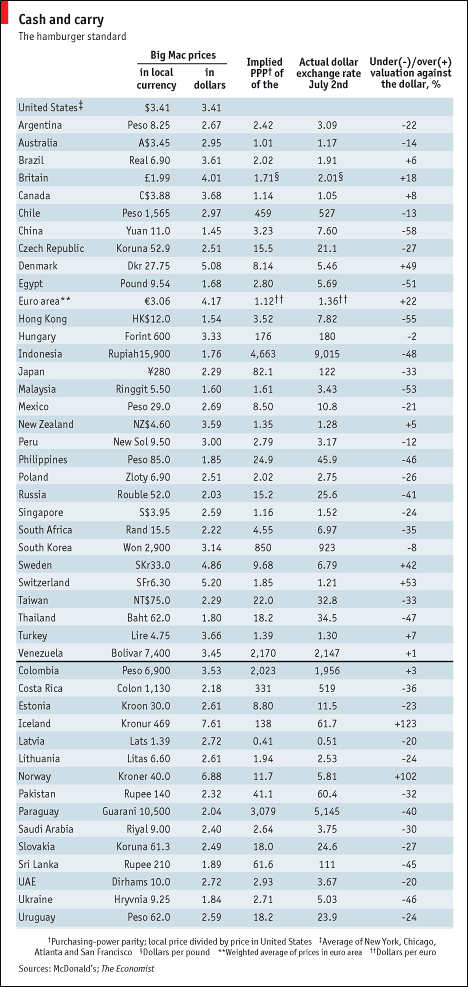
AMERICAN politicians bash China for its policy of keeping the yuan weak. France blames a strong euro for its sluggish economy. The Swiss are worried about a falling franc. New Zealanders fret that their currency has risen too far.
All these anxieties rest on a belief that exchange rates are out of whack. Is this justified? The Economist’s Big Mac Index, a light-hearted guide to how far currencies are from fair value, provides some answers. It is based on the theory of purchasing-power parity (PPP), which says that exchange rates should equalise the price of a basket of goods in any two countries. Our basket contains just a single representative purchase, but one that is available in 120 countries: a Big Mac hamburger. The implied PPP, our hamburger standard, is the exchange rate that makes the dollar price of a burger the same in each country.
Most currencies are trading a long way from that yardstick. China’s currency is the cheapest. A Big Mac in China costs 11 yuan, equivalent to just $1.45 at today’s exchange rate, which means China’s currency is undervalued by 58%. But before China’s critics start warming up for a fight, they should bear in mind that PPP points to where currencies ought to go in the long run. The price of a burger depends heavily on local inputs such as rent and wages, which are not easily arbitraged across borders and tend to be lower in poorer countries. For this reason PPP is a better guide to currency misalignments between countries at a similar stage of development.
The most overvalued currencies are found on the rich fringes of the European Union: in Iceland, Norway and Switzerland. Indeed, nearly all rich-world currencies are expensive compared with the dollar. The exception is the yen, undervalued by 33%. This anomaly seems to justify fears that speculative carry trades, where funds from low-interest countries such as Japan are used to buy high-yield currencies, have pushed the yen too low. But broader measures of PPP suggest the yen is close to fair value. A New Yorker visiting Tokyo would find that although Big Macs were cheap, other goods and services seemed pricey. A trip to Europe would certainly pinch the pocket of an American tourist: the euro is 22% above its fair value.
The Swiss franc, like the yen a source of low-yielding funds for foreign-exchange punters, is 53% overvalued. The franc’s recent fall is a rare example of carry traders moving a currency towards its burger standard. That is because it is borrowed and sold to buy high-yielding investments in rich countries such as New Zealand and Britain, whose currencies look dear against their burger benchmarks. Brazil and Turkey, two emerging economies favoured by speculators, have also been pushed around. Burgernomics hints that their currencies are a little overcooked.
Mkts still attractive for long-term FIIs: BNP Paribas
Mkts still attractive for long-term FIIs: BNP Paribas
2007-10-04 17:12:45 Source : Moneycontrol.com
Chin Loo, Currency Strategist of BNP Paribas said, the underlying sentiment was still quite bullish. She said the reverberation in the markets was more because of backup positions ahead of non-farm payrolls on Friday.
Speaking on volatility, she said it was symptomatic of markets having a split opinion. She added, “There is a fair amount of bulls as well as bears in the markets and interplay of these two leads to intraday volatility.”
She said the year-end target for the rupee was 38.50 and there was still some more downside left.
Excerpts from CNBC-TV18’s exclusive interview with Chin Loo:
Q: What’s the call on what is happening in the Hang Seng and the reverberation that we have had domestically?
A: Well it is still quite selective. The Hang Seng was quite bullish but now it’s under some pressure from profit taking, but underlying sentiment is very bullish. I think I will subscribe this more to scaling backup positions ahead of the non-farm payrolls tomorrow.
Q: How are you reading into the kind of volatility that we are seeing in Hang Seng particularly?
A: Volatility is a result of huge inflows that is coming in and therefore as an exit; there is some chipping off the table. You can expect the decline to be fairly quick as well. I think it’s symptomatic of markets having a split opinion at this stage. There is a fair amount of bulls as well as bears in the markets and interplay of these two leads to intraday volatility.
Q: How are you viewing India amidst this volatility?
A: We remain very positive on India as well as the Indian rupee. We have had calls for some time on the dollar-rupee falling below 40. So, this comes as no surprise to us. What is quite interesting is that the trend in the rupee in the very short-term has been quite separate from the dollar-Asian trends. I think it shows that Indian rupee is marching to its own drumbeat and the appreciation path in the rupee is very much dependent on intraday liquidity and how the RBI managed it.
Q: How much more appreciation do you see in the rupee because we are already at 39.50 right now?
A: Our year-end target is 38.50; I think there is more downside. What is interesting to watch obviously is other risks brewing in the US economy and for the US dollar. And as we head into the G-8 meeting, that should be a non-event because the G-7 leaders had warned for some time about global imbalances and the need for the US dollar to weaken. So, that should not come as a surprise therefore.
Q: A fair amount of liquidity has come our way this week, aside of the deep cut that we saw yesterday and today, the profit booking that we have seen. Would you say that equity markets were looking expensive?
A: I wouldn’t want to comment on equity markets, but in terms of the flows that we are seeing, certainly a lot of flows are still quite positively geared towards Asia because we feel that is a high growth story, and that in terms of drivers behind the growth remains very much intact even into next year.
So, the opportunities that present themselves are still very attractive to long-term foreign investors and that is one of the key drivers for the shift in the Indian rupee sentiment.
Q: How are you viewing the FII appetite across the region at this point in time?
A: It is good. I think the survey is that people have been very much positive across mostly all quarters coming from interest rates, credits as well as equities; most investors do have a positive reading for Asia next year. So if markets do trade the way that people think, then I think there are more advantages to be had for Asia as well as the rupee.
 ClicksandWrites
You must be logged in to post a comment.