Month: August 2007
Photo Journalism
I always believe that a good photo portrays much more than a one full page article.
Here are some inteestig ones, taken from Khaleej Times dt05082007.




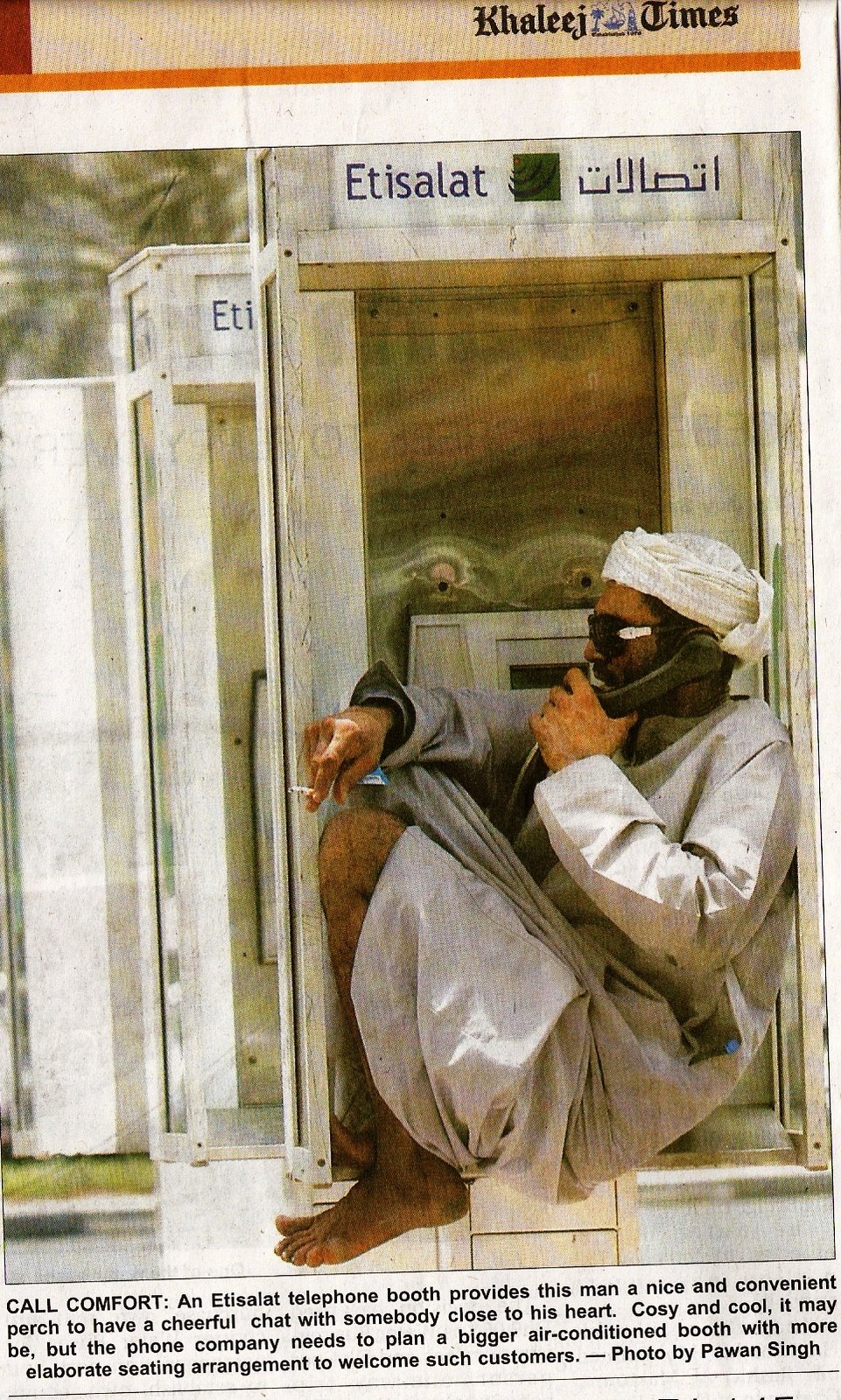
If you have a good picture from your region or which come across your way, do send it to me for posting.
Dubai to introduce water buses – 2m passengers to use annually

The Roads and Transport Authority (RTA) on Saturday announced that it would operate 10 water buses from August 16.
2m passengers to use water buses annually
By Ashfaq Ahmed, Staff Reporter/GULF NEWS Published: August 05, 2007, 00:00
Dubai: A luxury water bus service to commute across Dubai Creek will start on August 16 as part of the first phase of the Roads and Transport Authority’s marine public transport project.
Shaikh Hamdan Bin Mohammad Bin Rashid Al Maktoum, Chairman of the Dubai Executive Council, has approved the decision to operate the water bus. The decision authorised the RTA to supervise the operation.
The air-conditioned water bus will have a capacity of 36 passengers and the fare will be Dh4 per trip per passenger.
“We will spend Dh1.5 billion to have an integrated water transport service as part of our marine transport strategic plan 2020,” said Mattar Al Tayer, Chairman of the Board and Executive Director of the RTA.
He said the 10 water buses will complement the existing traditional abra service on the creek.
Around two million passengers are expected to use the water bus service annually to commute in Dubai Creek, said a senior official.
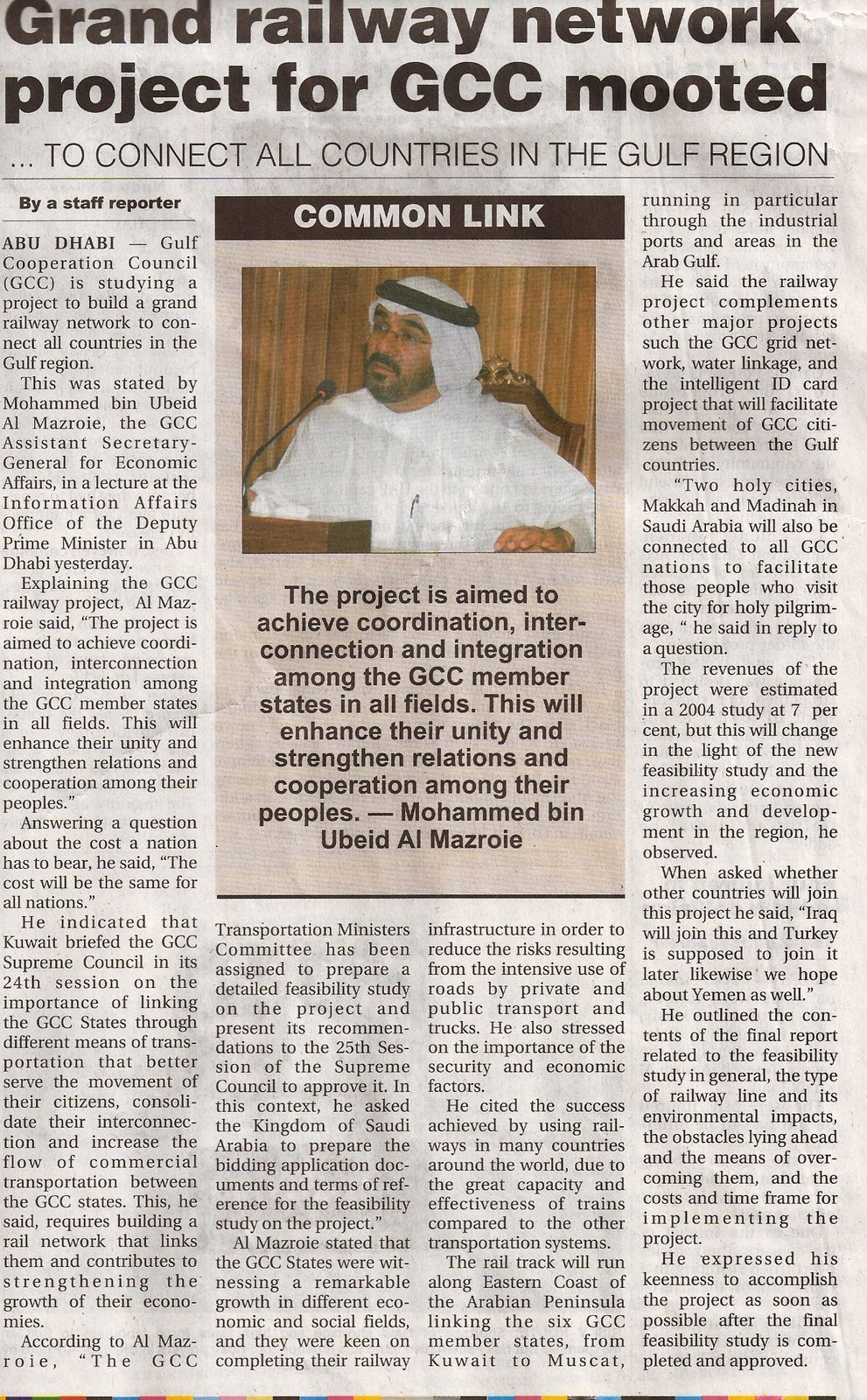
The water buses will be operated on four routes serving five stations on both sides of the Dubai Creek.
It will operate from five stations including: Sabka and Baniyas on Deira side of the creek and Al Ghubaiba, Dubai Old Souk and Al Seef Street stations on Bur Dubai side.
The first route of the water bus linking Al Sabkha Station Deira with Al Ghubaiba Station in Dubai will start on August 16 whereas other three routes will be operational from September.
Curbing congestion
Eight out of 10 buses will be used for passengers to cross the creek while two water buses will be reserved for tourists. The water bus for tourists will be available from Al Seef Station every 30 minutes.
The operation will be seven days a week for 18 hours every day from 6am to 12 midnight with 15 minutes headway time between trips.
“The water transport is part of integrated public transport plan to curb traffic congestion on roads. It will serve the congested central business districts of Deira and Bur Dubai,” said Mattar Al Tayer, Chairman of the Board and Executive Director of the RTA.
Around two million passenger are expected to use the water bus service every year. “The number is expected to grow to six million in future with the introduction of more buses,” he said.
He said the RTA has tasked the operation and maintenance of the Water Bus to the Singaporean Penguin Company.
Al Tayer said the RTA is working on its marine transport strategic plan 2020 to serve the existing and upcoming on and off shore residential and commercial developments with modern water transport system.
“The RTA will spend Dh1.5 billion to launch 210 km water transport routes as part plan by the year 2020.”
According to the RTA’s studies, Dubai’s coastline has increased from 70 km to 360 km due to new off shore developments such as Palm Jumeirah, Palm Jebel Ali, The World, The Business Bay and the Dubai Water Front.
The studies project that around 62 million people are expected to use the public water transport by 2020.
“Marine strategic plan will be implemented in stages. The first stage is the water bus, the second stage is the ferry service within the creek, the third stage is the ferry service along the coast line linking all the new on and off shore developments and the final phase is to introduce a ferry service linking Dubai with other emirates especially Sharjah,” said Al Tayer.
Specifications: It will sail at a speed of 12 knots
Hull: Aluminium, catamaran low wash boat
Length: 12 metres
Width: 4.2 metres
Speed: 10-12 knots
Passenger capacity: 30-35
Ceiling: Moveable panoramic
Engines: Two diesel engines with 185 horse power each
Centrally air-conditioned
Cost: Dh700,000 each
Fare: Dh4 per passenger one way
Fare for tourist bus: Dh25 roundtrip
Transferring sponsorship

Approval of the previous sponsor is needed in most cases of shifting jobs.
Transferring sponsorship
By Bassma Al Jandaly, Staff Reporter / GULF NEWS Published: August 03, 2007, 23:12
Dubai: In order to control the labour market in the country and to avoid confusion, the Ministries of Interior and Labour, have set up specific rules regarding transfer of sponsorship for expatriates.
A woman who wishes to transfer her sponsorship from a company to her husband, has to apply for a new entry visa.
If an employee wishes to change his or her job, the person needs to change sponsorship and follow the requirements of the Ministry of Labour. If approved, then the naturalisation and residency department will issue a new residency visa for the applicant.
A No Objection Certificate (NOC) to transfer sponsorship is necessary with the former sponsor’s approval and including the recent sponsor’s signature.
Expatriates who receive a ban from the Labour Ministry will automatically get a ban stamped on their passports by the residency department.
Transfer of sponsorship is subject to Article No 68 Residency Law of the Interior Ministry.
1) Government to government: If the application for transfer is from a government authority, establishment or government company, to a similar firm in the government sector, the following conditions shall be applicable:
Approval of the previous sponsor and the new sponsor and also the approval of the residency department for the application.
2) Private to public sector: If the application for transfer is from the private sector to the public sector, the same conditions as above shall be applicable.
A fee set by the Ministry of Labour and the Ministry of Interior, has to be paid. The applicant will also need the attestation of the Residency Department to the application.
3) Public to private sector: If the application is for transfer of sponsorship from the public sector to the private sector, the following conditions apply: Approval of the previous sponsor and the new sponsor. Attestation by the Ministry of Labour is required if the sponsored person is among categories subject to the Labour Law. Approval of residency department to the application is a must.
4) Private to private sector: If the transfer is between private sector companies, the following conditions apply: Approval of the previous sponsor, the new sponsor and the Ministry of Labour, if the job is among the categories subject to Labour Law. The sponsored person must hold a valid residency visa and must have spent at least a year working in his job.
5) Family to private sector: In case the application for transfer is from an expatriate sponsored by his or her parents or family to the private sector, the following conditions shall be applicable: Approval of the previous sponsor and the new sponsor. Attestation by the Ministry of Labour is required if the person is among the categories subject to the Labour Law. Approval of the residency department is also needed.
500 plane tickets donated to help amnesty seekers
500 plane tickets donated to help amnesty seekers
By Binsal Abdul Kader, Staff Reporter / GULF NEWS Published: August 03, 2007, 23:12
Abu Dhabi: An organisation from the Indian state of Kerala has donated 500 plane tickets for amnesty seekers who cannot afford to pay for their way home, a senior state official said here.
The decision to give the donation was taken by a meeting at Malayali Samajam here and convened by Non Resident Keralite Affairs Department (NORKA-Roots), said general manager S. Mohammad Najeeb, who was deputed by Kerala Chief Minister to the UAE. “It was decided to provide various facilities for needy amnesty seekers including at least 500 free air tickets initially,” he said.
M.A.Yousuf Ali, a prominent businessman who chaired the meeting, as Director of NORKA-Roots, offered to donate 100 plane tickets. “The rest of the tickets will be arranged by a special committee formed at the meeting,” said Najeeb, who has also been elected as the ex-officio chairman of the committee.
About 25 Keralite community organisations which participated in the meeting will work together to arrange the rest of the 400 tickets, said Ansar Chirayinkeezh, Chairman of the committee and also the president of the Samajam.
Food and water
Transportation for all amnesty seekers from the Indian Embassy to Al Watbha which is about 40 kilometres away from the city, has been arranged by Ali’s EMKE group. He has also offered to provide 2,400 bottles of water everyday until the end of grace period.
Several other Indian organisations and individuals are providing food for more than 1,000 amnesty seekers everyday, said Ansar.
Ali said the community has to ensure that a maximum number of illegal workers are taking advantage of the opportunity given by the UAE government. “There might not be an amnesty after this. We have to educate people about the risk and hardship of being illegals in a foreign land.”
Najeeb said he will convene similar meetings of Keralite organisations in Dubai and Sharjah and take measures to help the needy amnesty seekers.
So far more than 100,000 illegal residents have got their status legalised or have been issued outpasses by residency departments across the country.
Officials had said the number of amnesty seekers would increase at the end of the deadline which is September 3, but the figures have been disappointing, according to officials.
After the amnesty, police will set up checkpoints across the country to arrest the illegals.
Seeing a world with sound
My dreams are usually shapeless and colourless, says bin daher.
Seeing a world with sound
By Siham Al Najami, Staff Reporter/GULF NEWS Published: August 03, 2007, 23:12
Dubai: Imagine a world with no colour, a personal world with no boundaries, a world without any visual inputs.
One such world belongs to Dana Nashwati, a 20- year-old who lost her sight at the age of 13 after a severe bout of flu, which affected the nerves around her eyes. She can still see a blur of colours and shapes in her dreams, although it is now gradually turning into only shades and sounds.
She can still visualise things by learning to identify the characteristics of an object. “I still use colours to identify people I haven’t seen before losing my eyesight. I visualise individuals by giving them a colour by the sound of their voice,” said Nashwati. 
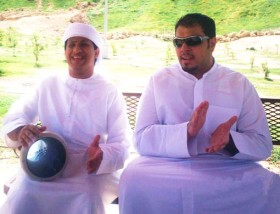
Khalfan Bin Dhaher (left), Ahmad Al Jafli (right) and members of the Blind Association.
She tries to help visually-impaired people to learn how to match colours to sounds. She is surrounded by her friends from the Blind Association, who occasionally escape busy schedules to enjoy a day with nature and good company.
Among the group is Khalfan Bin Daher, who was demonstrating his knowledge of guessing people’s age and skin colour by feeling their hands. In a few minutes he was able to correctly guess the age of the person next to him. “I don’t know how people look like, but through the sense of touch I can find out about the person’s age and skin colour,” said the 18-year-old.
“I can see light when it directly hits my eyes. That’s the only thing I can ‘see’, but I would love to learn how to match colours. I would like to know if red goes well with blue,” he said.
He explained that he sees things the way his imagination visualises it. “My dreams are usually shapeless and colourless. But then reality will always be defined by perception,” he said.
Composing music
Ahmad Al Jafli, 20, enjoys listening and composing music. The media communications student and radio presenter said he can recognise the mood of a person by carefully listening to every unconscious movement and sound.
“People can control their expressions, but they are usually unconscious of certain movements due to discomfort, happiness,” he said.
Nashwati points out that people are increasingly taught to be visually-driven. “This undermines the significance of their other senses,” she said.
Mona and Sharifa Al Hashemi, they visualise objects by the sound they make. “I identify objects by listening to the sound they create. I dream with sounds,” said Mona.
All the group members were born visually impaired except for Nashwati.
“Losing your eyesight is obviously difficult, but your visual impairment is not always a restriction. The visual element can be deceptive at times. I learned to understand matters and people better because I take the time to listen to their views … you learn the art of listening,” she said.
The groups of friends feel the country needs more awareness about the needs and wants of visually impaired people. Most shopping malls and buildings are not accessible for the visually impaired, they said.
“We still have to depend on someone to get from one place to another. We all want our independence. We always try to challenge ourselves … but we need the resources and means,” Bin Daher said.
Have your say:
Do you know someone who is visually-impaired? What is it like to spend a day with them? Tell us your experiences.
Great-great Grandma get Masters Degree

I always believe that education is a continuous process which should go on and on. And here is a news article about a grandma to support my belief.
Taken from Khaleej Times 04082007
Abu Dhabi in $3b Borouge expansion
Abu Dhabi in $3b Borouge expansion
By Himendra mohan kumar, Staff Reporter GULF NEWS / Published: August 02, 2007, 23:15
Abu Dhabi: Abu Dhabi will invest Dh11 billion ($3 billion) to expand the capacity of the Borouge petrochemicals facility to two million tonnes per year.
Abu Dhabi, which has 98 billion barrels of proven crude oil reserves, has targeted an increase in its production capacity to four million barrels of oil per day, as well as raising its natural gas supplies through the development of sour gas reserves and optimisation of existing sweet gas production.
Earlier this week, The Executive Council of Abu Dhabi in its policy agenda for 2007-08 said: “Current targets are to expand oil and gas production capacity significantly. Abu Dhabi is adding oil and gas and natural gas liquids production capacity each year through the application of better processes, products and technology. The phased approach is a deliberate strategy to ensure that the Emirate continues to provide the highest quality while steadily raising capacity.”
With its hydrocarbon reserves and relatively low production costs, Abu Dhabi has a natural advantage in a range of downstream industries.
“Opportunities in base oil and petrochemicals will be leveraged to enhance the value of energy exports and support diversification of growth across the economy,” it added.
“A key priority in Abu Dhabi’s capacity expansion will be the timely development and delivery of energy resources to meet growing domestic demand,” said the policy agenda document.”
Additionally, it said “investment entities affiliated with the Abu Dhabi government will also continue to pursue geographical diverification of Abu Dhabi’s energy interests via strategic investments in upstream and downstream hydrocarbon assets outside of Abu Dhabi and the UAE”.
The Executive Council also said the energy sector will be expected to continue increasing its contibution to an even more diverse Abu Dhabi economy, “not only via increased production capacity, but also via efficiency and productivity realised through continuous technological and managerial innovation.”
IPIC and Shell target Turkmenistan projects
IPIC and Shell target Turkmenistan projects
Reuters Published: August 02, 2007, 23:15
Dubai: The UAE’s IPIC and Royal Dutch Shell are considering joint exploration for oil and gas in Turkmenistan, the UAE’s news agency WAM reported.
The International Petro-leum Investment Co (IPIC) invests in oil-related projects for the government of Abu Dhabi, which controls more than 90 per cent of the UAE’s oil reserves. The UAE is the world’s sixth-largest oil exporter.
The three companies also plan to build a $500 million urea plant with capacity to produce one million tonnes per year, WAM reported late on Wednesday.
Both the oil and gas exploration and the urea plant were pending government approval, WAM said.
“Working with IPIC to enter oil and gas sectors in Turkmenistan is an ideal opportunity to reinforce Shell’s position in the region, which is growing,” WAM quoted Gavin Graham, Shell’s vice president of new business in the region, as saying.
IPIC’s Managing Director Khadem Al Qubaisi met with Turkmen President Kurbanguly Berdymukh-amedov, WAM said.
IPIC told Reuters last month it planned an aggressive move into oil and gas exploration and production and was eyeing deals in the Caspian. IPIC aims to double its investment portfolio to $20 billion in the next five years.
Total profits slip despite output rebound
Total profits slip despite output rebound
Reuters/ Published: August 02, 2007, 23:15
Paris: French energy group Total posted a drop in second-quarter profits yesterday as a dip in gas prices and unfavourable exchange rates outweighed a rebound in its hydrocarbon production.
The world’s sixth-largest oil major by market capitalisation reported a net income of 3.10 billion euros ($4.24 billion) – adjusted to strip out gains from changes in the value of fuel inventories and one-off items – down from 3.36 billion a year ago but slightly above a 3.05 billion average analyst forecast.
Total bucked an industry-wide trend of falling oil and gas output as its new 220,000 barrel-per-day Dalia field in offshore Angola came on stream, helping to lift quarterly production by 1.4 per cent to 2.322 million barrels of oil equivalent.
Total said underlying production growth, excluding changes to its portfolio and Opec output cuts, was 3.5 per cent.
——————————————————————————–
——————————————————————————–
The Paris-based group declined to comment on the outlook for full-year volumes until a strategy update on September 5. Although output was higher in the first half it was capped by Opec cuts, disruptions in Nigeria and a halt in production at its Congo Republic’s 60,000-bpd NKossa offshore oilfield.
“I cannot confirm any target now,” Chief Financial Officer Robert Castaigne said.
Total said in February output should grow less than 6 per cent in 2007, trimming a previous target of 7 per cent.
“We are very successful in our new projects but on the other hand there is the impact of the Opec quotas plus NKossa and the situation in Nigeria. I prefer to wait a little more to have a better view on every area before giving more information.”
- ← Previous
- 1
- …
- 9
- 10
- 11
- Next →
 ClicksandWrites
You must be logged in to post a comment.