Adnoc set to resume production at Lower Zakum West next week
Adnoc set to resume production at Lower Zakum West next week
Bloomberg Published: November 28, 2007, 00:31
Abu Dhabi: Abu Dhabi National Oil Co (Adnoc), the biggest oil-producer in the UAE, will resume production from its 280,000 barrel-a-day Lower Zakum West field on December 6, a company official said.
The field, which produces more than 10 per cent of the UAE’s daily oil output, has been completely shut since the end of October for the installation of a gas facility.
The new facility will inject gas into the oil wells to exert pressure in the reservoir so more oil can be pumped out.
Adnoc, the second-larg-est Arab oil company by production, reduced its output this month by a quarter, or about 600,000 barrels a day, because of planned maintenance at the Upper Zakum, Lower Zakum West and Umm Shaif oilfields.
Umm Shaif has resumed production, the official, who declined to be identified because of company policy, said. Lower Zakum includes Lower Zakum West and Lower Zakum Central.
Zakum Central continues to produce about 60,000 barrels a day while the rest of the field undergoes maintenance, the official said.
Lower Zakum and Umm Shaif are operated by Abu Dhabi Marine Operating Co, also a unit of Adnoc.
An Adnoc official responsible for maintenance at the Upper Zakum field declined to confirm output at that field had resumed. Upper Zakum, which contributes about 200,000 barrels a day to UAE daily oil production, is operated by Adnoc unit Zakum Development Co.
The UAE, the third-largest oil exporter in the Organisation of Petroleum Exporting Countries, is planning to raise oil output to four million barrels a day from about 2.6 million barrels a day at present.
Enoc gets new chief executive officer

Enoc gets new chief executive officer
Staff Report GULF NEWS Published: November 28, 2007, 00:31
Dubai: Emirates National Oil Company (Enoc) Board yesterday appointed Saeed Abdullah Khoury as its chief executive officer effective from December 1.
Khoury takes over from Hussain Sultan, who retires as group chief executive of Enoc, a position he held for 35 years since the group’s start-up.
Ahmad Humaid Al Tayer, Enoc’s vice-chairman, said: “With 28 years’ experience in Adnoc, Khoury is an expert in both upstream and downstream activities in the Emirates and is well placed to be a strategic implementer for Enoc’s growth.”
Khoury said: “We will continue to focus our activities to remain an important player in the local and international energy industry.” He added: “Enoc already operates many international businesses, which will be a major focus of our growth in the future, and will help to extend our excellent brand vision across the world.”
With a strong industry background, Khoury has been responsible for several industry achievements and is set to spearhead the future growth of the leading oil and gas company.
Abu Dhabi is biggest stakeholder in Citigroup
Abu Dhabi is biggest stakeholder in Citigroup
Gulf News Report Published: November 28, 2007, 00:31
Dubai: The Abu Dhabi Investment Authority yesterday became the biggest shareholder in the Citigroup following an acquisition of 4.9 per cent shares worth $7.5 billion in America’s largest bank.
Through this deal Abu Dhabi displaces Saudi Prince Alwaleed Bin Talal as Citi’s largest shareholder. Prince Alwaleed acquired his Citi stake in 1991 when the bank struggled with Latin American loan. Currently, Alwaleed holds 3.97 per cent stakes worth an estimated $6 billion.
The fresh capital injection by Adia will shore up Citi’s balance sheet, which has been hurt by some $6.8 billion of writedowns and losses in the third quarter, and the potential for another $11 billion in the fourth quarter.
Growth opportunities
Following the deal Citigroup shares gained 1.3 per cent to reach $30.18 by noon yesterday. On Monday, Citi shares closed at $29.80 on the New York Stock Exchange. Citi’s market value has fallen by more than $100 billion this year. “We see in Citi a highly respected company with a premier brand and with tremendous opportunities for growth,” said Shaikh Ahmad Bin Zayed Al Nahyan, Managing Director of ADIA.
Analysts said yesterday that the share sale might also signal an end to the freefall in US financial stocks following this summer’s credit crisis.
“There will be more such investments,” said Giyas Gokkent, head of research at the National Bank of Abu Dhabi. “The other [Gulf] buyers will likely play the same white-knight role,” he said.
The Abu Dhabi Investment Authority is buying equity units, which will be convertible into Citi shares at a price of up to $37.24 a share between March 15, 2010 and September 15, 2011.
15 financial problems at a glance!
15 financial problems at a glance!
When it comes to psychology and financial behaviour, India does not have too much of research papers. Hence we are forced to turn to the US or UK for such research work.
US studies have summarised financial problems and have found the following to be the most common of financial problems:
~ Not planning: The single biggest problem for most people is that they just do not plan their finances. It just keeps coming and going. Even if they are not happy about the results of what they have done so far, they do not change the way things are done.
~ Overspending: Many people with not very high incomes have very high ambitions. This is likely to get them to grief. Most of this problem is because the salesmen in most shops do not tell you the price of a product, they only tell you the EMI — so anything from a plasma TV to a luxury home on the outskirts of the city are made to look cheap! After all at Rs 2,899 a month does a plasma TV not look cheap?
~ Not talking finance at home: Children are kept away from the finance topics at the dining table. Finance is perhaps the second most taboo topic at home! So many children grow up without knowing how much of sacrifice their parents have gone through to educate them.
~ Parents spending on education and marriage: There are just too many kids out there who believe that they need to worry about savings, investment and life insurance only at the age of 32 plus. This means your father, father�in-law or a bank loan has funded your education and marriage. Kids should take on financial responsibility at a much younger age than what is happening currently.
~ Marriage between financially incompatible people: Most marriages under stress are actually under financial stress. Either the husband or the wife is from a rich background and the other partner cannot understand or cope with the spending pattern. It is necessary to match people financially before marriage.
~ Delaying saving for retirement: “I am only 27 years old why should I think of retirement” seems to be a very valid refrain for many 32 year olds! Every year that you delay in investing the greater the amount that you will have to save later in your life. Till the age of 32 it might be feasible for you to catch up, but after some time the amount that you need to save for retirement just flies away.
~ Very little life insurance: With all the risks of life styles, travel, etc. illness and premature death are common. We all have classmates who had heart attack at the age of 32 but still pretend that we do not need life or medical insurance. We buy car insurance because it is forced upon us, but we ignore life insurance! Imagine insuring a Rs 10 lakhs car, but not insuring (or under insuring) the person who is using the car — and paying for it, that is, you!
~ Not prepared for medical emergencies: Normally big emergencies — financially speaking — are medical emergencies. Being unprepared for them — by not having an emergency fund is quite common. Emergency fund has now come to mean the credit card — which is good news for the bank, not for the borrower.
~ Lack of asset allocation: Risk is not a new concept. However, it is a difficult concept to understand. For example when the Sensex was 3k there was much less risk in the equity markets than there is today. However at 3k index people were afraid of the market. Now everybody and his aunt wants to be in the equity market — and there are enough advisors who keep saying, “Equity returns are superior to debt returns.” This is true with a rider — in the long run. It is convenient for the relationship manager to forget the rider. So there could be a much larger allocation to equity at higher prices — to make for the time missed out earlier.
~ Falling prey to financial pitches: The quality of pitches has improved! Aggressive young kids are recruited by brokerage houses, banks, mutual funds, life insurance companies, etc. and all these kids are selling mutual funds, life insurance, portfolio management schemes, structured products, et al. Selling to their kith and kin helps these kids keep their jobs, and there is happiness all around! These kids, themselves prey to financial pitches, have now made it an art when they are selling to their own natural ‘circle of friends’ and relatives.
~ Buying financial products from ‘obligated persons’: This is perhaps one of the worst things you can do in your financial life. A friend, relative, neighbor, colleague who has been doing something else suddenly becomes a financial guru because they have become an agent! They, in great enthusiasm, sell you a financial product and promptly in 2 years time give up this ‘business’ because it is too difficult. You are saddled with a dud product for life! What a pity. Charity begins at home, not financial planning.
~ Financial illiteracy: Most people do not wish to know or learn about financial products. They simply ask, “Where do I have to sign” — so buying a mutual fund is easier than buying life insurance! Selecting products based on the ease and simplicity of buying is a shocking but true real life experience in the financial behaviour of the rational human being!
~ Ignoring small numbers for too long: What difference will it make if I save Rs 1,000 a month? Well over a long period it could make you a millionaire! So start early and invest wisely. It will make you rich. That is the power of compounding.
~ Urgent vs important: Most expenses, which look urgent, are perhaps not so important — the shirt or shoe at a sale. That luxury item which was being offered at 30 per cent discount is such an example. These small leakages are all reducing the amount of money you will have for the bigger things like education or retirement.
~ Focusing too much on money: Money is no longer a commodity to buy things. It is a scorecard of one’s life. That will cause stress, and yoga might help. However if you will seek a branded yoga teacher — so that your friends think you have arrived, yoga it self could cause financial stress!
Dubai Police 50th anniversary
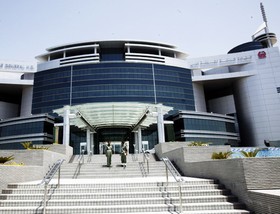
Dubai Police 50th anniversary
By Alia Al Theeb, Staff Reporter GULF NEWS
From a one-station police force with 29 members to a 15,000-strong organisation, Dubai Police has grown into one of the most successful forces in the region.
And today marks its 50th anniversary, with celebrations that will continue for 50 days.
Cultural, educational, sports and recreational activities will be held during this period.
Brigadier Jamal Mohammad Khalifa Saqr Al Merri, Deputy Commandant General of Dubai Police, says, “The celebrations include an introduction which will be conveyed through audio, video and written materials.
“A book detailing the establishment of Dubai Police, and the phases it went through, will be released. Dubai Police began operations with just 29 officers in 1956. One of them was Khalifa Bin Daen, who is still in service.”
The book comprises, among other topics, a timeline, the achievements of Dubai Police, and developments it witnessed through the years.
The celebrations will be promoted on television and through distribution of print material encouraging the public to participate.
“Today there will be a special military parade in which all the sections of the police, such as cavalry, air wing, anti-riot, explosive materials section, police dogs and various forces will participate,” says Brigadier Al Merri.
The parade begins in the morning along Shaikh Zayed Road and everyone is invited to participate. The Dubai Police Air Wing will also be participating – carrying banners promoting the Golden Jubilee.
“This celebration is a way of us saying a ‘thank you’ to all those who helped and supported Dubai Police and positively participated with it,” says Brigadier Al Merri.
During the celebration period, former police officers, including expatriates, who served Dubai Police for 25 years or more, will be honoured. They will receive the Golden Jubilee medal.
As part of the celebrations, Dubai Police will unveil a coin as well as a stamp.
“There will also be congratulatory messages sent via SMS to the public. Etisalat prepaid cards will have sentences such as ’50 years of excellence’,” he says.
Congratulation cards and gifts will be distributed in places such as petrol stations and shopping malls.
“Bluetooth technology will also be used in sending messages to people in shopping malls, while the new building of the General Headquarter will be illuminated,” says Brigadier Al Merri.
Police patrols will tour areas under their jurisdictions in their new uniforms.
Three children among five killed in Abu Dhabi crash
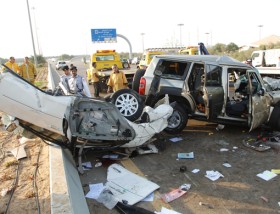
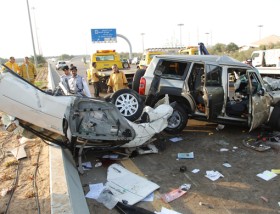
Three children among five killed in Abu Dhabi crash
By Rayeesa Absal, Staff Reporter GULF NEWS Published: November 27, 2007, 00:11
Abu Dhabi: Five members of a family, including three young children, were killed in a traffic accident on Sunday afternoon on the Musaffah Bridge.
Those killed included a 26-year-old UAE national A.M, the driver of the car, his 18-year-old sister S.M and his three nieces S.A., F.A., M.M. aged 11, 10 and 8 respectively. The accident involving four Abu Dhabi-registered vehicles happened at 3.45 pm.
“A 24-year-old Asian driver hit the car in front of him, probably due to speeding. This car with an Arab family hit the barrier and swerved to the next lane on the right hitting a third car with the five victims.
“The impact of the hit was so high that the third car was thrown on to the other side of the road, where traffic was flowing in the opposite direction. A four-wheel drive hit this car killing all five of its passengers on the spot,” said Colonel Hamad Adil Al Shamsi, the Director of the Department of Traffic and patrol police.
Hospitalised
The driver of the 4WD, H.S, a 26-year-old UAE national, has been admitted to Shaikh Zayed Military Hospital. The vehicle he was travelling was entering Abu Dhabi while the rest of the vehicles involved in the accident were leaving the city.
“All the vehicles involved have been badly damaged,” he said. Paramedics and ambulances rushed to the scene and in some cases extrication was necessary to take the victims out of the cars.
Saying that preliminary investigations to determine the cause of the accident are going on, Col Hamad added that most accidents are caused due to speeding. He urged motorists to be cautious while on the road.
‘Smoking turns men bald’
‘Smoking turns men bald’
26 Nov 2007, 1154 hrs IST,ANI
WASHINGTON: Asian men should kick the butt if they don’t want their locks to fall off, for a new study has stated that smoking might be the cause of age-related hair loss among them.
According to doctors in Taipei, the risk for the condition is largely genetic, however some environmental factors may also play a role.
“Androgenetic Alopecia, a hereditary androgen-dependent disorder, is characterized by progressive thinning of the scalp hair defined by various patterns,” the authors wrote as background information in the article.
“It is the most common type of hair loss in men”, they added.
A survey was conducted among 740 Taiwanese men of age 40 to 91 (average age 65) in 2005, where at an in-person interview, information was gathered from the men regarding their smoking habits.
They were also asked about other risk factors for their hair loss and if they were suffering from Alopecia, and if so, at what age they began losing their hair.
Using clinical classifications, their degree of hair loss was assessed, height and weight were measured and blood samples were taken for analysis.
It was found that men increased their risk of hair loss with advancing age, but still had lower risk than the average white men.
“After controlling for age and family history, statistically significant positive associations were noted between moderate or severe Androgenetic Alopecia and smoking status, current cigarette smoking of 20 cigarettes or more per day and smoking intensity,” the authors wrote.
They noted that the relationship between the two could be caused by a number of means. Smoking may destroy hair follicles, damage the papilla that circulate blood and hormones to stimulate hair growth or increase production of the hormone estrogen, which may counter the effects of androgen.
“Patients with early-onset Androgenetic Alopecia should receive advice early to prevent more advanced progression,” the authors conclude.
Wholemeal bread checks cancer risk
Wholemeal bread checks cancer risk
26 Nov 2007, 1324 hrs IST,ANI
LONDON: A new research has revealed that having two portions of whole grains such as wholemeal bread and brown rice on a daily basis may almost halve the risk of developing pancreatic cancer.
According to the research, carried out by the University of California, San Francisco, a diet rich in these ingredients and other whole grain foods could bring about a substantial reduction in the risk of developing this form of cancer.
In the study of more than 2,000 men and women, a clear link between the amount of whole grains eaten and the chance of developing pancreatic cancer was revealed.
It was found that those who ate at least two helpings of whole grains a day – the equivalent of a cup of brown rice or porridge, or two slices of wholemeal bread – were 40 per cent less likely to develop the disease than those who ate less than one portion.
It was also found that those who ate more than 0.9oz (26.5g) of fibre a day were 35 per cent less likely to develop pancreatic cancer than those who ate less than 0.6oz (15.6g).
“There is a possibility that diet can affect one’s risk of pancreatic, as well as other cancers,” maintain researchers.
“Eating a diet rich in a wide variety of grains is likely not only to help in the prevention of diabetes and heart disease, but also this very deadly cancer,” they added.
In fact, during the study, it was found that eating more refined and sweetened grains – such as two or more servings of doughnuts a week – was found to raise the risk of pancreatic cancer.
Dr June Chan, lead author of the study, said, “The risk reductions associated with some whole grain foods and fibre provide general support for the hypothesis that eating whole grains is much better than eating more refined and sweetened grains for pancreatic cancer prevention.”
The study looked at grain intake among 532 people with pancreatic cancer and 1,701 people without the disease among the San Francisco Bay area population. The two groups were similar in age, gender, and body weight, and had a similar history of diabetes.It was found that those with pancreatic cancer were also more likely to be current smokers.
The life and times of Shaikh Khalifa Bin Zayed Al Nahyan
The life and times of Shaikh Khalifa Bin Zayed Al Nahyan
Excellent & Precious photographs by Mr. Noor Ali

Shaikh Khalifa watching army manoeuvers at Al Ain with the Chief of Staff, Abu Dhabi Defence Force, Shaikh Faisal Bin Sultan Al Qasimi.

There was always plenty for the young Shaikh to do and paperwork was never far away. Here we see Shaikh Khalifa Bin Zayed Al Nayhan in his office in Al Ain.
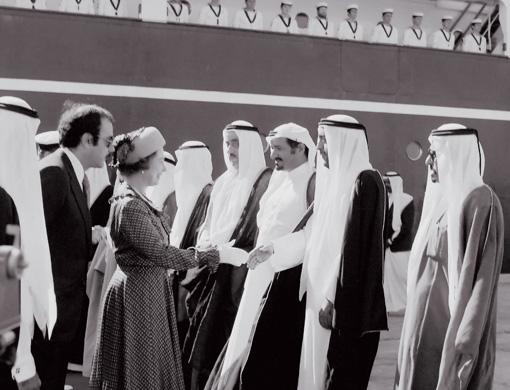
Shaikh Khalifa receives Queen Elizabeth II alongside the royal yacht Britannia, during an official visit by the British monarch to the United Arab Emirates in 1979. Also present are the Ruler of Ajman, Shaikh Humaid Bin Rashid Al Nuaimi, standing in line next to Shaikh Khalifa and and the Ruler of Um Al Quwain, Shaikh Rashid Bin Ahmad Al Mu’alla, standing next to Shaikh Humaid.
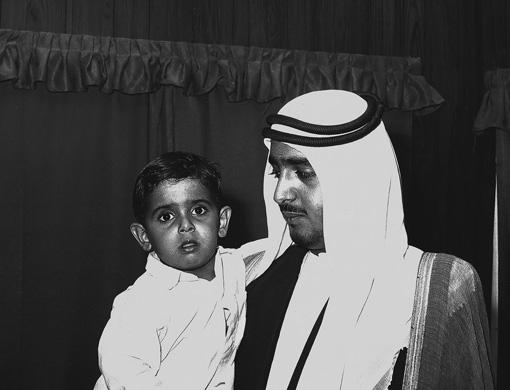
Shaikh Khalifa with his first born son, Shaikh Sultan.
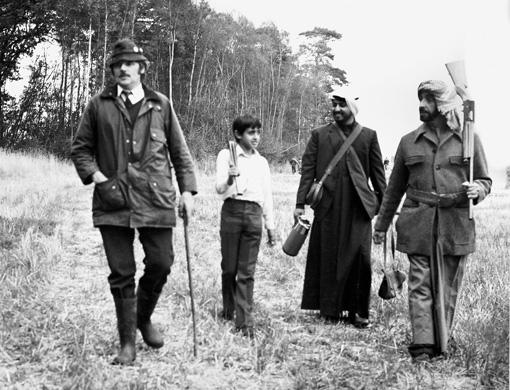
Shaikh Zayed, accompanied by his son, Shaikh Mohammad, and companions on a bird shoot during a private visit to England.
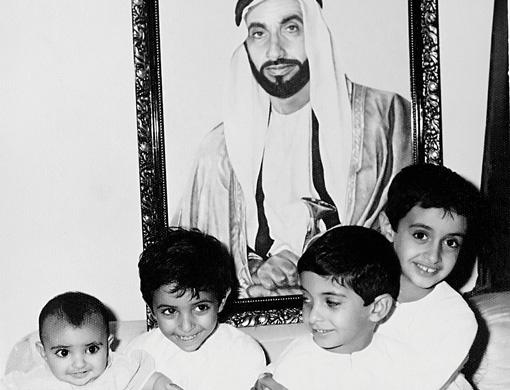
Seen from right to left, Shaikh Mohammad Bin Zayed, Shaikh Hamdan Bin Zayed and Shaikh Hazza Bin Zayed with their sister.
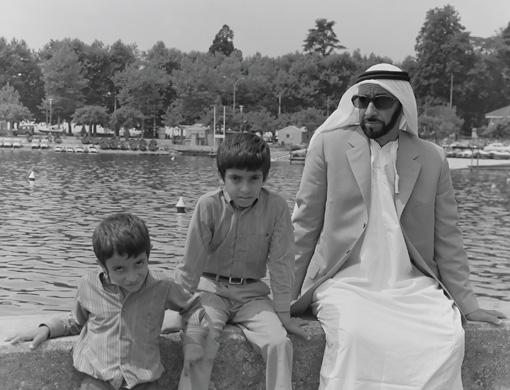
Shaikh Zayed on holiday in Lausanne, Switzerland, with his sons, Shaikh Hamdan Bin Zayed and Shaikh Hazza Bin Zayed.
Shaikha Maitha bint Mohammad bin Rashid Al Maktoum won the gold medal in the women 60kg karate final
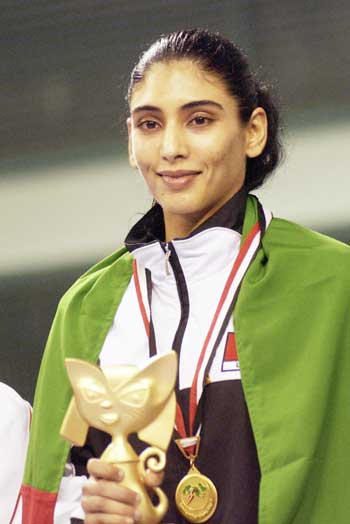
Shaikha Maitha bint Mohammad bin Rashid Al Maktoum, the daughter of His Highness Shaikh Mohammed bin Rashid Al Maktoum, Vice-President and Prime Minister of the UAE and Ruler of Dubai, poses on the podium after she won the gold medal in the women 60kg karate final during the 11th Pan Arab Games in Cairo on Thursday, November 22.
 ClicksandWrites
You must be logged in to post a comment.