The National
Bring universities to India – My Letters – THE NATIONAL – Dt 10.05.2010
My Letters – THE NATIONAL – Dt 10.05.2010 – Bring universities to India
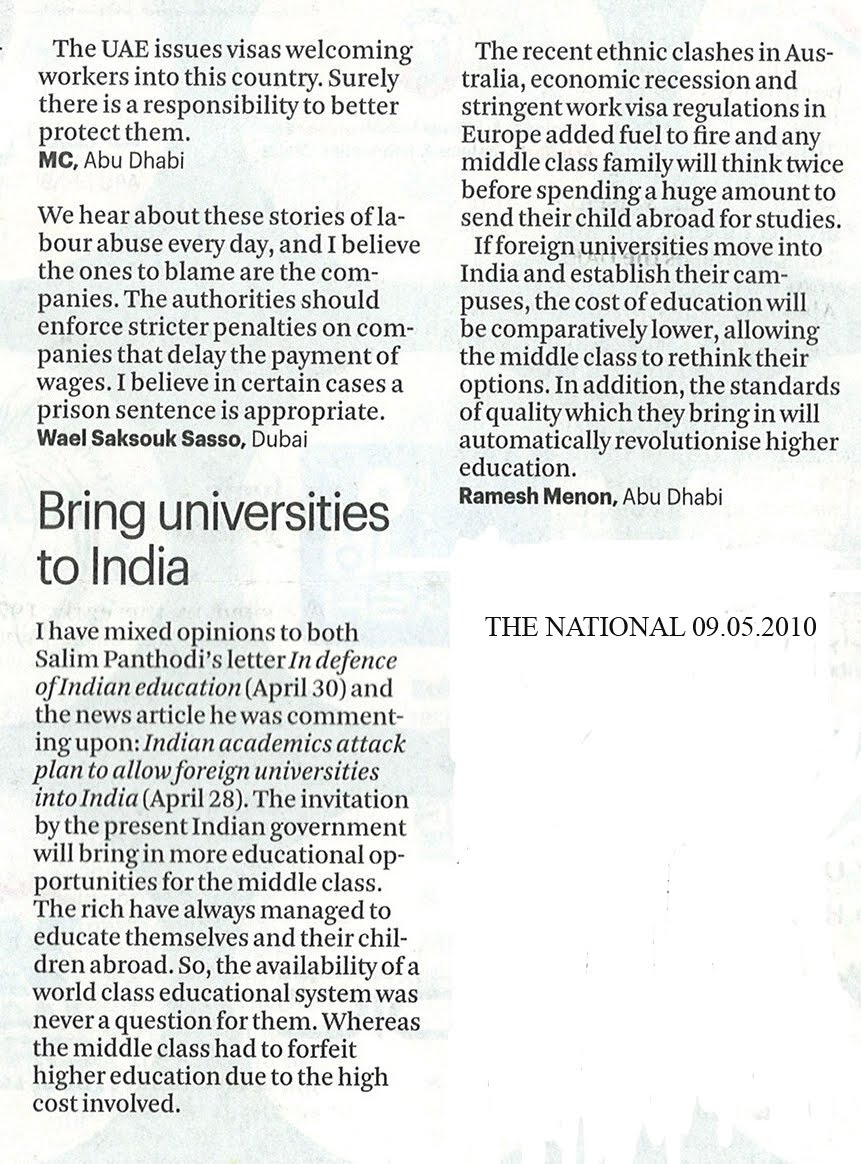
To read the original news, please visit THE NATIONAL ONLINE or read here below:
Indian academics attack plan to allow foreign universities into India
Shaikh Azizur Rahman, Foreign Correspondent
Last Updated: April 28. 2010 12:12AM UAE / April 27. 2010 8:12PM GMT
A student group protests against the plan to allow foreign universities to operate in India. Amit Dave / Reuters
NEW DELHI // A proposed law that would allow foreign universities to set up campuses in India has been condemned as a threat to India’s education system by teaching experts and academics, in a country where tens of thousands of students travel overseas to study every year.
The cabinet approved the controversial bill on March 15 and it is likely to be introduced in parliament within the next few weeks.
The government of the prime minister, Manmohan Singh, and others argue that foreign campuses will bring a much-needed boost to the standards of higher education.
But “the privileges proposed to be given to foreign education providers in the bill will kill our own educational system,” said Pushpa M Bhargava, a scientist and former vice chairman of the National Knowledge Commission.
“Knowing the lure of a foreign label for most Indians – especially the rich and the powerful – our own universities will become like today’s government schools, where only the children of the poor and the deprived go to receive no education.”
Mr Bhargava said foreign universities will come to India “not for any altruistic reasons” but for business.
The vice chancellor at the University of Madras, G Thiruvasagam, said the arrival of foreign universities would be “very dangerous for the nation” and that “social justice would become a casualty” in the country’s higher education sector.
“Those foreign universities will not … admit students from economically backward backgrounds – which is quite contrary to the purpose of inviting the foreign universities to India,” Mr Thiruvasagam said. “Should we give our land and resources to foreign institutions to take care of the interests of the rich alone?”
For decades, the brightest and most privileged Indian students have sought higher education in different developed countries. This has accelerated in recent years as increasing numbers of Indians seek jobs with international companies both in India and abroad.
According to the National Knowledge Commission, which advises the prime minister, about 160,000 students leave India every year to study in foreign universities, spending US$4 billion (Dh15bn).
In a report, the global investment banking and securities firm Goldman Sachs recently counted the lack of quality education as one of the 10 factors that could hold India back from reaching its economic potential.
International employers have long complained that in the absence of quality higher education, India is suffering from a massive shortage of skilled professionals and, according to various industry estimates, up to 75 per cent of all Indian university graduates are not employable.
Some in the information technology industry say that only one in 10 graduates are worth hiring, according to press reports.
Kapil Sibal, a minister at the human resource development ministry, which is behind the bill, described it as a “milestone which will enhance choices, increase competition and benchmark quality”.
The government hopes to push the number of students going on to higher education to 30 per cent by the year 2020 from the current level of 12.4 per cent. To meet the target, foreign university campuses in India would extend crucial help by providing infrastructure, Mr Sibal said.
“Nearly one among three Indians is under 14. Over the next 10 years we are going to have more than 40 million children going to college [for bachelor’s degrees] and to meet this demand, we would need up to 40,000 colleges and 1,000 new universities during this period.
“India has about 480 universities and around 22,000 colleges … but we are still 40 per cent less than the required numbers, which I think is critical.”
Mr Sibal said the government alone could not build the planned infrastructure of universities and colleges, so it decided to open up the sector to overseas institutions.
“No foreign investor can repatriate money abroad but has to put it back into the educational sector in India. We have already discussed the issue with foreign investors and they have agreed to it,” Mr Sibal said.
Many foreign universities already have links with Indian business schools or engineering colleges. Analysts estimate that recruiters will hire at least 13.8 million Indian graduates over the next five years to meet the demand of the employers.
Karan Khemka, an education consultant with Parthenon Group in Mumbai said foreign universities could also help raise the standard of Indian universities.
“Just as deregulation of health care or telecom has given Indian consumers choice and quality, the same applies to education. Today the Indian student must struggle to get into what by western standards are shoddy and sub-par colleges because they have no choice. Competition will clean up the industry,” he said.
But D Revathi, a student at the University of Madras said the bill had no provision for quotas for the poor or disadvantaged students. “Quality higher education will become the exclusive privilege of the rich in the new scenario,” he said. “What purpose will the new universities serve if they aren’t socially inclusive?”
Abhishek Gupta, a student in Kolkata’s South Point School, said he would consider himself lucky if he got a chance to study in a good foreign university campus in India.
“I always thought that my father would never be able to pay as much as $70,000 to $100,000 to send me to the US, UK, Canada or Australia for higher studies and I would have to settle for a degree in an Indian university. But now paying as [little] as $20,000 I can get to study in a foreign university and it is within my reach,” he said.
“Previously children only from upper-class family could flaunt a foreign degree. Now students from many middle class families will also be able to hold a foreign degree.”
Mumbai gunman to hang – My Opinion – THE NATIONAL – Dt. 07.05.2010
My Opinion – THE NATIONAL – Dt. 07.05.2010 – Mumbai gunman to hang
Mumbai gunman to hang
Anuj Chopra, Foreign Correspondent
Last Updated: May 07. 2010 4:22PM UAE / May 7. 2010 12:22PM GMT MUMBAI // After a year-long trial, Ajmal Kasab, the sole survivor out of the 10 gunmen who carried out the 2008 terrorist assault on India’s commercial capital, was sentenced to death.
“Kasab is a lingering danger to society,” Judge ML Tahaliyani said, as he announced the sentence. “He is to be hanged by the neck till death.”
Rejecting the plea for life imprisonment by Kasab’s defence lawyer, KP Pawar, who argued that his client was young and “blinded by religion”, Judge Tahaliyani said: “Words cannot express the brutality of his crime … There is no chance for reform or rehabilitation for this man. He has no right to live.”
Kasab, the Pakistani who was convicted on Monday of 82 charges, including that of waging war against India, sobbed on hearing the judgment, but was wordless. After it was over, he was hauled back to his prison cell, looking ashen.
But it is not clear when the death penalty will be implemented. Yesterday’s judgment will now lead to a long process of appeals before higher courts. If rejected, Kasab can file a petition for clemency before the president of India. It is not clear when Mr Pawar will avail these legal options on behalf of Kasab, if at all.
However, the judgment marked the end of a lengthy trial, in one of the deadliest terrorist attacks on Indian soil which claimed 166 lives, including that of 23 foreigners.
“The verdict sends a message to all terrorists: you land in India and you will meet the same fate,” said V Moily, India’s justice minister.
Kasab, dubbed “the baby-faced killer”, emerged as the poster boy for terror after he was photographed marching through Mumbai in November 2008 with his gun bared.
The attack was carried out on two luxury hotels, a cafe, a train station, and a Jewish community centre. Kasab, along with Abu Ismail, another gunman who was later killed, was involved in spraying a hail of bullets on the crowded Chhatrapati Shivaji train station, killing 70, the deadliest part of the siege.
Kasab represented a unique catch for Indian authorities. He is the first Lashkar-i-Taiba (LiT) operative to be caught alive during a terrorist operation.
His co-operation helped lead investigators to the militants who planned the attack, investigators have said.
During his trial, Kasab named two Pakistani militants, Zakiur Rehman Lakhvi and “Saeed Bhai” – or brother Saeed, believed to be Hafiz Muhammed Saeed, the founder of LiT – as the mastermind of the attack. Both men were also convicted in absentia by Judge Tahaliyani on Monday, part of 20 “fugitives” guilty of planning the attack.
“[Ajmal Kasab] was captured alive and lived to tell the tale,” wrote K Subrahmanyam, the director of the Institute for Defence Studies and Analyses in New Delhi, wrote in a recent column in the Indian Express newspaper. “This left Pakistani officials no room to dodge and they had to accept that the terrorist conspiracy was hatched on Pakistani soil by their nationals belonging to the Lashkar-i-Taiba.”
When his trial began last May, Kasab was unco-operative with the prosecution, unruly and overly talkative on some occasions, and cold and indifferent on many others. When some witnesses testified against him, he burst into giggles. But as weeks passed, he became quieter.
Then suddenly, in July, he stood up in court and confessed.
“I do not want punishment from God,” he said in a near-theatrical confession. “Whatever I have done in this world I should get punished for it by this world itself.”
Just days later, he recanted his confession, claiming that he had arrived in Mumbai to be a Bollywood actor, and was picked up by the police from a beach in Mumbai to be framed in a larger conspiracy.
Ujjwal Nikam, the chief prosecutor, said Kasab was a well-trained terrorist who underwent crash courses in dealing with interrogation by investigators. “Kasab is worse than an animal,” he said.
“He was anxious to attack India,” Judge Tahaliyani said, revealing that Kasab was “restless” when he and his nine accomplices were delayed in Karachi before heading to Mumbai in 2008.
Some observers say Kasab’s execution will not bring closure as he is but a cog in the wheel, not the brain behind the attack.
“Kasab was only the delivery boy of terror,” said YP Singh, the former joint commissioner of the Mumbai police. “All those who planned the terror plot are still beyond reach.”
SM Krishna, India’s external affairs minister, said yesterday that his focus now is on finding the men who masterminded the attack in Pakistan.
“A number of others who acted as co-conspirators will also have to be extradited and they should be brought to justice,” he said.
Residents of Kasab’s hometown, Farid Kot, in Punjab province, condemned his sentence yesterday.
“He is Pakistani, that’s why he is going to be hanged,” said Mohammad Ramazan, a retired schoolteacher, told Reuters.
“It’s a conspiracy.”
My Comments as follows:
The verdict, although highlighted as victory for fight against terrorism, does not really make any practical impact on terror plotters. Every one knows that, a series of legal procedure awaits, if every he will get a chance to walk to the gallows. But, even that seems a distant reality as there are 51 others ahead of him waiting for it. Even if all this happens within a improbably short time, on the other side of the fence, there are people who are charged with almost similar cases and a bargain could always happen. Let this case be an eye opener to all the ordinary citizen, irrespective of whether he is in India or abroad. Prevention, is better than cure. Let the ordinary citizen be alert. If any un warranted movement or suspected activity is noticed, alert the authorities well before a man made calamity happens again. Safety and Security first, let that be the mantra for all.
Ramesh Menon
Abu Dhabi
To read it in original, please visit THE NATIONAL online.
Praise for May Day worker festivities – My Letters – THE NATIONAL
My Letters – THE NATIONAL – Praise for May Day worker festivities

Labourers in dash for cash on Yas Island
Suryatapa Bhattacharya
Last Updated: May 02. 2010 1:12AM UAE / May 1. 2010 9:12PM GMT
Workers at the start of the 4 kilometre run in celebration of Labor Day and organised by the Ministry of Labor at the Yas Marina track in Abu Dhabi. Paulo Vecina / The National
ABU DHABI // The track at the Yas Marina Circuit came alive yesterday, not with the screeching tyres of racing cars but with the cheers of thousands of workers.
As an estimated 1,500 men, most of them from construction firms, prepared to run a four-kilometre race, their supporters cheered from the stands, shouting the names of the companies that the workers were representing.
The winners
Ifran Ahmed, 23, Pakistan, steel fixer with ACC.
Omar Mohammed Saad, 25, Egypt, mason with Nurol.
Issam Adnan Hamad, 27, Lebanese-Canadian, procurement department of Algeco.
To commemorate International Workers Day, the Ministry of Labour organised a “marathon” for workers from more than 30 companies.
This is the second year of the event. Last year, the workers ran along the Corniche.
Humaid bin Deemas, acting director-general of the Ministry of Labour, arrived to watch the race and stood by the track to see the runners complete the circuit.
“There is a message today for the community, firms and society,” he said.
“It is to respect the workers, protect them, protect their rights that will enhance the relationship between the workers and the owners of the companies.”
Before the start of the 5.30pm race, workers lined up, and while some chatted and looked for familiar faces, others did stretching exercises.
Dressed in blue caps and white T-shirts that said, “International Labour Day: Our workers are our partners in development”, a number of the runners helped themselves to water bottles stacked at the starting line on the hot but cloudy and windy afternoon.
Asim Ghafoor, 23, a driver from Pakistan with the Al Jaber company, heard about the race from his friend, Kulchander Singh, who works as a clerk.
Mr Singh said that workers from their company believed Mr Ghafoor was the favourite to win the race.
“After two hours of eating dinner he would run for two hours,” Mr Singh said of Mr Ghafoor, who was an athletics standout at his school in Rawalpindi.
Meanwhile, workers from Al Habtoor Group said they had conducted eliminations over the past month to ensure that only the fittest runners were sent to the competition.
Larry Caracas, 42, a shift manager from the Philippines, said 100 runners came from the company’s engineering division alone.
“We did endurance and strength training for two months,” he said. “I am confident. The training was enough.”
The prize money for the winners was increased this year. The winner was awarded Dh7,000 (US$1,360) followed by Dh6,000 for second place, Dh5,000 for third, Dh4,000 for fourth, Dh3,000 for fifth and Dh1,000 each for sixth through 10th place.
Omar Mohammed Saad, a 25-year-old Egyptian, finished second and said he would spend his prize money on jewellery for his fiancé in Egypt ahead of their wedding.
Farooq Ali, 23, a Bangladeshi who works for the Arabian Construction Company (ACC), was last year’s winner. Soon after, he was promoted to the position of security guard.
Yesterday, he placed seventh and said he was disappointed with his performance. “I was just thinking about it too much,” he said.
But the largest group of cheerleaders in the stands – from ACC – were not disappointed. They whistled and shouted as the top runner of the day was one of their co-workers, Ifran Ahmed, 23, from Pakistan.
He won by about five metres, and fell to the track after crossing the finish line. He was both tired and exhilarated.
Mr Ahmed, who works as a steel fixer for ACC, finished sixth last year. To improve his endurance, he trained for a month by running 16km back and forth between the labour camp and his worksite near the Mena port area in the capital.
He said he would send home his winnings. “One does not run for money,” he said. “One runs to earn respect.”
To read this news in original, please visit THE NATIONAL online.
Tourists with ‘low’ jobs turned away at border – My OPinion – The National – Dt. 03.05.2010
Tourists with ‘low’ jobs turned away at border
Essam al Ghalib
Last Updated: May 02. 2010 1:21PM UAE / May 2. 2010 9:21AM GMT
Kathryn Holbrook, a teacher, was told she could cross into Oman without applying for a visa but Colin Davids, a barman in a hotel nightclub, was refused access. Pawan Singh / The National
AL AIN // Residents are being turned away from border crossings between the UAE and Oman because of the type of job they have.
Officials at crossings are enforcing a long-standing agreement between the countries that only expatriates who have what are considered professional occupations can pass into Oman from the UAE without having to apply for a visa.
According to one Omani immigration officer, teachers, doctors, lawyers anyone who has a professional occupation are free to travel into Oman. However, those who do other jobs, such as in the service industry, construction or sales, would not be allowed
The rule, which is to be implemented at all checkpoints, was previously in effect, but border officials only began enforcing it this year, said Captain Ahmad al Shamsi, an Emirati official at the Hilli checkpoint, which links Al Ain with Buraimi and is for non-GCC citizens.
One resident, Colin Davids, was turned away from the checkpoint when he attempted to cross into Buraimi for a camping trip with friends. An immigration agent refused to let him out of the UAE and into Oman.
“He wouldn’t tell me why, but referred me to the visa officer in charge, instead,” said Mr Davids, 27, who had made the crossing numerous times before. “I went inside to ask why and was shocked when he told me I had what he called a ‘low job’.”
Mr Davids works at the Al Ain Rotana hotel as a barman at Moodz nightclub. The job description on his visa says he is a waiter.
“The immigration officer told me that there was a list of occupations that were not free to travel and that mine was too low down to allow me across the border into Oman,” Mr Davids said.
An official in the consular section of the UAE Embassy in Muscat confirmed the agreement between Oman and the Emirates.
“People with certain occupations cannot leave the UAE and people with certain occupations cannot enter Oman,” she said. “There is an agreement between the two countries that is being adhered to.”
People with affected occupations who want to visit Oman need to apply for a visa at the Omani Embassy in Abu Dhabi, she said.
Khaled Hardan, an official at the Omani embassy in Abu Dhabi, confirmed that a prospective visitor’s occupation is a factor considered when issuing a visa, adding that regulations had become more stringent throughout the GCC recently, and not just in Oman.
As for Mr Davids and others like him, Mr Hardan said: “If he would like a visitor’s visa, he can come to the Omani embassy in Abu Dhabi and apply for one.”
An Omani immigration officer, who asked not to be named, said in the past many people would leave the UAE and enter Oman from Hilli. They would then stay and work illegally in Buraimi.
“In the case of the Hilli border crossing into Buraimi, there isn’t an official Omani checkpoint for 40km down the road to Muscat,” he said. “For people with professional jobs, it would be harder for them to find work illegally in Buraimi, whereas a carpenter can find odd jobs to do here and there.”
Kathryn Holbrook, a 29-year-old geography teacher at Al Ain English School, who was with Mr Davids when he tried to cross, was stunned to learn that he could not.
“My occupation is listed as a teacher so I was told I could cross into Oman, but not Colin,” she said. “I complained to people at the border who told me there was a new list that came out this year.”
Days after Mr Davids’s experience, Arianne Galez, 31, from the Philippines, stood in front of a visa officer in disbelief. After making regular trips to visit her family, who were expecting her, she was suddenly being denied.
The officer explained to Ms Galez that certain occupations, including hers – a receptionist at a dental clinic – were not considered professional.
“My cousin and sister work in Sohar,” Ms Galez said. “I don’t know when I am going to see them again.”
My Comments as follows:
Interesting news. This rule was there for some time now. But, may be they started applying it strictly from now on. The experience of the involved parties highlighted brings out an equally interesting question. Are they married couples? If not, is it an example of restrictive measures by authorities towards illegal cohabiting and fun trips across the boarder both ways during week-end. Point to ponder.
Ramesh Menon, Abu Dhabi
To read this in original, please visit THE NATIONAL online.
Road made unsafe by lack of a U-turn – My Letters – THE NATIONAL
My Letters – THE NATIONAL – Road made unsafe by lack of a U-turn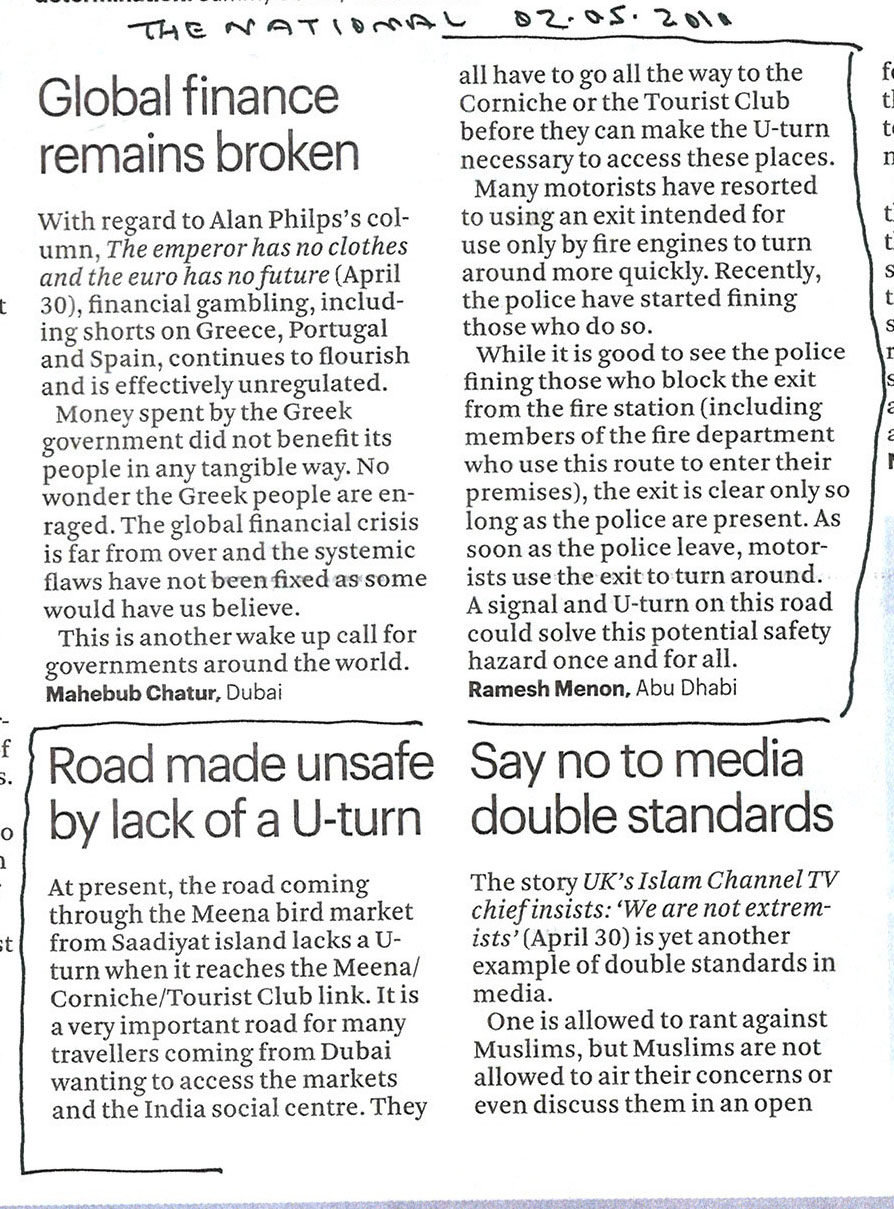 To read my letters to the news, please bookmark and visit Letters to the Editor
At last, the great escape – My Opinion
My Opinion : At last, the great escape
The National staff
Last Updated: April 22. 2010 12:48PM UAE / April 22. 2010 8:48AM GMT
Jaqueline Wood, left, and Tara Roe Gammon embrace after returning to Heathrow from Costa Rica via Madrid yesterday. Paul Hackett / Reuters
As European skies once again filled with planes, the UAE’s carriers flew thousands of people home yesterday from their extended, unexpected stays in the country.
Both Etihad Airways and Emirates Airline put on extra flights to clear the backlog of some 12,000 stranded passengers.
Etihad said that by evening it had flown 31 flights to and from Europe, and was on schedule to clear its backlog of 2,500 passengers stranded in the UAE by today.
Richard Hill, Etihad’s chief operating officer, said it was on course to resume its normal operations by the end of today.
Emirates, meanwhile, said it had flown 9,000 passengers back to Europe, leaving just 350 to clear. Both airlines said they were not accepting new bookings to Europe.
Other carriers were also beginning to clear their backlog of passengers. “We are investigating all possibilities to accommodate as many passengers as possible,” said Lauren Cooper, a representative for British Airways.
Meanwhile, the airline industry was counting the cost of the six-day, near-total stoppage of air traffic in Europe, the result of a massive cloud of ash spewed out by the Eyjafjallajökull volcano in Iceland.
“Lost revenues now total more than $1.7 billion for airlines alone,” said Giovanni Bisignani, the director general and chief executive of the International Air Transport Association.
“At the worst, the crisis impacted 29 per cent of global aviation and affected 1.2 million passengers a day. The scale of the crisis eclipsed 9/11, when US airspace was closed for three days.”
For Etihad alone, Mr Hill said the expense of accommodating and feeding stranded passengers, as well as all the lost revenue, had cost the airline in excess of US$5 million (Dh18m) a day.
After initial scenes of chaos in Dubai and airports across Europe, the mood turned to jubilation as stranded passengers were reunited with their friends and families.
My comments as follows:
The title of this article reflects as if UAE is the most unfriendly country ever to be with and the respective hosts of the guests who had to experience such an unexpected ordeal belong to the same breed. I am sure, every effort would have been made by the airlines, authorities and the respective contact parties to make sure this unexpected stay was made comfortable to the maximum possible by all parties involved.
Ramesh Menon
Abu Dhabi
To read it in original, please visit THE NATIONAL online
Safety experts fear city’s new digital billboards may cause car crashes – My Opinion
My Opinion : Safety experts fear city’s new digital billboards may cause car crashes
Safety experts fear city’s new digital billboards may cause car crashes
Matt Kwong
Last Updated: April 21. 2010 10:00PM UAE / April 21. 2010 6:00PM GMT
An electric sign overlooks the busy intersection at Airport Road and Al Falah Street. Galen Clarke / The National
ABU DHABI // Hi-tech distraction or sign of the times? The city’s digital billboards are eye-catching indeed, but maybe too eye-catching, say local safety experts.
Their flashing colours and rapidly changing images are a fast-growing segment of the outdoor advertising market, but safety experts say they pull motorists’ eyes away from signals and pedestrians and could lead to more accidents.
Norm Labbe, a defensive driving instructor in the capital, said: “Our senses are being bombarded by navigation equipment, bright lights, music, cell phones, and now these billboards, where it’s almost like a strobe-light effect.”
More than a dozen US cities have banned the popular electronic advertising billboards, pointing out that unlike mobile phones, drivers cannot switch them off. Several cities in Canada are also considering moratoriums on the technology. Here, however, their numbers are increasing.
Abu Dhabi’s digital signage is perched atop buildings overlooking major junctions such as Muroor Road at Electra Street and Airport Road at Al Falah Street. The newest mammoth LED screen, measuring 20 metres by eight metres, is being erected on the corner of Muroor Road at Hamdan Street.
Future Vision, the ad firm that owns those displays, rotates six images every 10 seconds, allowing as many clients to promote themselves using the same billboard.
The computer-operated billboards have been a boon for advertisers, said Rajiv Khurana, the Middle East vice-president of the advertising firm Dentsu Marcom. He predicts the number of displays will more than double in the Emirates within five years.
The problem, Mr Labbe said, is that such billboards are designed to be distracting in order to be effective. Changing colours or designs encourages drivers to keep looking for the next digital image to appear.
“It takes approximately one and a half to two seconds for you to react properly and apply your brakes and come to a stop,” he said. “A lot can happen in two seconds.”
Just as there is a growing body of research on the dangers of texting while driving, he called for local researchers to study how much of a distraction the signs pose to people at the wheel.
Results from US studies on the issue have been mixed. The Virginia Tech Transportation Institute, which is financed by the billboard industry, found that the displays posed no hazard in 2007. However, the American Association of State Highway and Transportation Officials reported last year that they “attract drivers’ eyes away from the road for extended, demonstrably unsafe periods of time”.
“That’s my concern, that this is one more added element to the mix,” Mr Labbe said.
Abu Dhabi’s preprogrammed displays draw more attention at night, and are even more hazardous at what Dr Peter Barss, an injury prevention specialist who works with UAE University, described as “complex driving environments” such as major intersections.
Dr Barss said the onus should be on companies profiting from the billboards to prove that they do not imperil drivers.
“The traffic environment here is extremely high speed at a lot of places, so it seems to me the potential [for accidents] would be high,” he said.
“When you’re trying to discern whether you go right or left, and suddenly there’s a huge flashing sign out there pulling your eyes away, well how many seconds can you afford to take your eyes off the road and not hit somebody?”
Although Future Vision’s three signs have video capabilities, Robert Awad, the company’s media executive, said Abu Dhabi Municipality was wary of allowing moving pictures to play above evening traffic. “They gave us the approval to do this latest technology on one condition, to make the billboards static, not dynamic,” Mr Awad said. “This is to avoid accidents.”
Even so, it is hard to miss Synaxis Media’s dynamic 224-square-metre Opulence, the largest outdoor LED sign in the Middle East, broadcasting “TV-quality ads” just above the Marks & Spencer on Airport Road.
The Opulence can broadcast video because it is not positioned at a major intersection, said Fahad al Absi, the founder of Synaxis.
“You can deliver six messages for the same campaign using the same space. You save six times the money,” he said of the display, which was switched on two years ago.
Adverts cost Dh300,000 (US$81,673) a month and can be viewed 600 times a day. It costs Future Vision Dh90,000 a month to operate its screens.
However, Mr al Absi supported strict regulation of electronic advertising placement.
“Having it face intersections where they think the ad might be more effective is not such a good idea,” he said. “Other LEDs might seem located in a prime location, but excuse me, it’s right behind a traffic light. That can be confusing.”
Samira Ahmed, an Emirati housewife, drives by the Opulence nearly every day and has had a few close calls in traffic while watching the screen.
“The place is wrong because this is like a highway,” said Mrs Ahmed, 46. “I almost had an accident one time because it was in the evening.”
Abu Dhabi Municipality did not respond to requests for comment, but officials with the advertising section said this month that three digital billboards have had their illumination levels decreased by 10 per cent after complaints.
My comments as follows:
I agree with the dangers of high intensity level getting beamed across the road from these sign boards. While, I also agree with the fact that such sign boards are displayed in other cities world-wide, but feel they are of low intensity and long duration. The higher the intensity and the shorter the duration, they tend to distract the reflexes of the drivers and may tend to create dangerous situation for accidents to happen. One prominent example is the sign board displayed at the Mark and Spencer building in front of the Cultural Foundations. It is too bright and many times dangerously create lighting effect which even block the colors of the changing signals a short distance from it.
In addition, I would like to take this opportunity to highlight another danger that is happening these days. There are several ads being played by FM radios, which has sound effects of cars honking horns and ambulance or police sirens, to create some advertising attraction. These ads disturbs and create driving attention and focus and authorities should curb airing of ads which carries such sounds.
Ramesh Menon, Abu Dhabi
To read it in original, please visit THE NATIONAL Online
Efficient service at Empost centre – My Letters – THE NATIONAL – Dt. 13.04.2010
My Letters – THE NATIONAL – Dt. 13.04.2010 – Efficient service at Empost centre
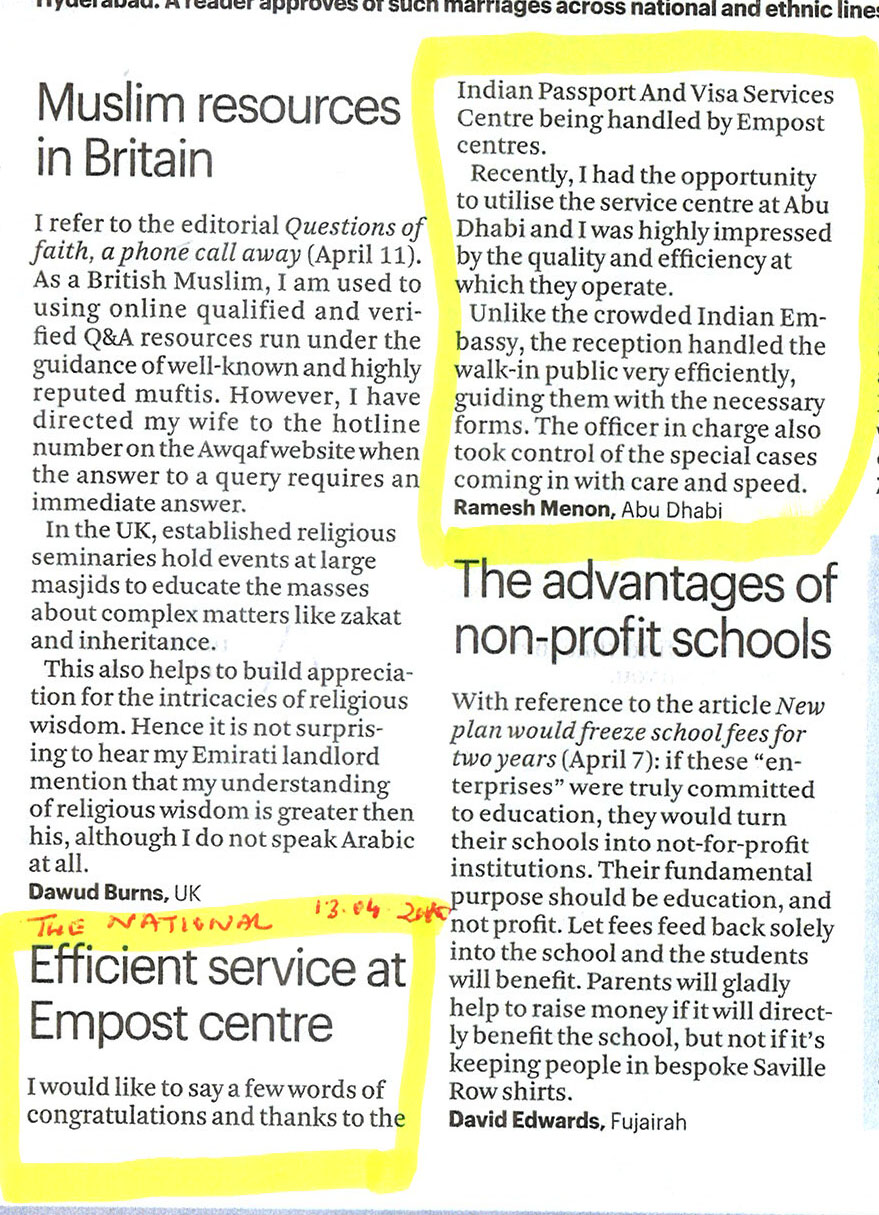
To read my letters to the news, please bookmark and visit Letters to the Editor
Indians face stark choice for education – My Letters – THE NATIONAL – Dt 15 March 2010
My Letters – THE NATIONAL – Dt 15 March 2010 – Indians face stark choice for education
 To read my letters to the news, please bookmark and visit Letters to the Editor
Free land on offer to build new Indian schools in capital – My Letters – THE NATIONAL – DT 12 March 2010
My Letters – THE NATIONAL – DT 12 March 2010 – Free land on offer to build new Indian schools in capital
Free land on offer to build new Indian schools in capital
Kathryn Lewis and Hala Khalaf
Last Updated: March 12. 2010 2:46PM UAE / March 12. 2010 10:46AM GMT
Pupils at the Abu Dhabi Indian School, where there is fierce competition for places. Andrew Henderson / The National
ABU DHABI // Anyone with the money and vision to invest in building a new Indian school will be encouraged by the offer of free land from the education authority.
For parents, however, the news does not bring any relief from the immediate problem of finding a school place for their child.
They are battling with too many families for too few places, with the new academic year for Indian schools in this country due to begin next month.
Along with the free land offer, Abu Dhabi Education Council (Adec) announced yesterday that it would allow one school to increase capacity, but it did not name the school nor say by how much.
It is considering other requests to increase enrolment from schools that meet “acceptable quality standards”.
But there may not be many such schools; only five Indian schools in Abu Dhabi occupy purpose-built school facilities, while the 12 Indian schools housed in converted villas are already slated for closure by Adec in 2012.
The council says that it is in “advanced discussions” with one Indian businessman to open a new school which would create 11,000 new places. It did not disclose his name.
It is also in discussion with others to operate schools under a not-for-profit model.
Other measures intended to grow the number of school places in the long term include opening a new Indian school in an unused government-school building in Al Gharbia with room for 800 pupils.
“Adec is extremely concerned about the current lack of capacity of Indian-curriculum schools and would like to assure the community that it is actively looking into both long- and short-term solutions for this issue,” the council said.
“We need to work in partnership with the community to make this a reality.”
But parents without a place to send their children say long-term solutions will not provide school places next month. They called for the education council to take more drastic action before the school year starts.
More than 3,500 children are on the waiting list at one school alone, Our Own English High School, Abu Dhabi.
Dr Vibha Misri-Ganjoo has been searching for a place for her five-year old daughter, Vanskika, for the past five months, after learning that Vanskika did not have a place at the Abu Dhabi Indian School as expected.
“The long-term solutions proposed by the council are important, because numbers of students are always increasing, so more schools and spots are needed. But where are the immediate, short-term solutions?” said Dr Misri-Ganjoo.
“The problem is time. The new semester starts in a few weeks so the solutions by the education council of building new schools and such are not feasible.
“We need a practical solution. It is a universal problem everybody is facing right now and no immediate solution is available.”
Dr Misri-Ganjoo, who lives in Manasir, said her daughter was on the waiting list at three schools but all were full.
“We don’t know what to do,” said Dr Misri-Ganjoo. “We think we should start looking for admission in schools in Mussafah, but that is really too far to send a little girl and would be a big problem and last resort for us.
“If there are no other options, parents will be forced to look outside the Indian community and consider other schools, as we cannot just keep our children at home. Something is better than nothing and we do not want this situation to drive us away from the UAE, which has become our home. Our children were born here.”
Adec said it had recently met the Indian ambassador to discuss the issue after officials at the Indian Embassy called on the Government to intervene.
It said it had “extended the offer to provide free land for investors who present business plans to build schools that provide low-cost education” that comply with its standards and guidelines.
Adec said it was “engaging” with companies experienced in operating not-for-profit education models in other countries to establish schools in the emirate.
Indian school owners and administrators have protested that the council’s new building standards make it difficult for investors to open more schools.
However, Dr Misri-Ganjoo said that it was important to demand higher standards at Indian curriculum institutions.
“The key is to have both good schools and good solutions,” she said.
“It is important for children to have good schools so, of course, villa schools have to be done with. But solutions also have to be found for the students in these schools. Kids have to go to school.
“The problem is how to tackle this problem right now. Younger students have time to wait for good schools to be built for them, but older students need to be in school immediately.”
Nirmalan Damodaran, a long-time Abu Dhabi resident who works in construction, said the council must act quickly. “Next week is the closing of the schools,” he said. “They have to increase the number of seats.”
Mr Damodaran agreed that there was a need for more quality schools. “They have to create more facilities, like swimming and more outside activities,” he said.
“I think they need to do much more,” said Noble Jose, an Abu Dhabi-based businessman. Mr Jose is moving his family to Dubai because he could not find a school place for his son, Aarnav, who is going into the first grade this year.
“One announcement is not enough, still there is going to be a serious shortage,” said Mr Jose. “It’s a first step – much more could be done.”
Mr Jose said he would stay in Abu Dhabi if he could find a school place for Aarnav. “If I get something immediately I will take it,” he said. “It’s going to be very difficult for me to move,” he said, explaining that his business was in the capital.
“It will be difficult but still we can manage. It’s more important to send your children to a good school. Of course, it would be better if we were still here but we are forced to move because of the circumstances.”
Mr Jose said Abu Dhabi needed more quality Indian schools. “Some parents have admitted their kids to schools, but they are not happy with the quality,” he said.
“Parents have been forced to send their children to these schools because they don’t have any other option.”
My comments as follows:
The news about Free land on offer to build new Indian schools in capital does not bring about any immediate solutions to the problems faced by ordinary and middle class Indian families looking for school admission for their children. Every year-end news and information of this sort arrive bringing hope to the community to find an end to this problem, but these die down a natural death as the school re-opens and season progress. Most of the school operators are interested in opening high end institutions which obviously brings out more operating economy for them. Thus the demand for middle income Indians to seek a standard educational institution within their means remains an oasis yet to be discovered. The news about the villa schools operating within the city and improved facilities are all a repetition of requests and requirements and an immediate solution to this will continue to remain as a dream.
Ramesh Menon
Abu Dhabi
To read this in original, please visit THE NATIONAL online.
 ClicksandWrites
You must be logged in to post a comment.