Information – Technology +
Plastic turns eco-friendly!
Plastic turns eco-friendly!
Thursday June 5 2008 00:00 IST Express Features
Even as another World Environment Day approaches, the global concerns of most environmentalists remain the same-growing pollution, global warming and that old villain that refuses to die or degrade, plastic.
The Government of Kerala banned plastics below 30 microns and encouraged the use of alternatives to plastic like paper, cloth and even jute. But none of them could replicate the sturdy utility of plastic.
Given the scenario, an alternative which has all the advantages of plastic and is also biodegradable, seemed the best answer and this is exactly what Kochi-based Biomate Enterprises is trying to market in Kerala.
OXO-biodegradable plastics are plastics with a very small amount of pro-degradant additive added during the manufacturing process.
This additive helps degradation, initially by oxidation and then enables the microorganisms to access the carbon and hydrogen in plastic, making it biodegradable.
While the process can take from a few months to a few years, it is accelerated by sunlight and continues as long as there is air.
The benefits of oxo-biodegradable plastic are many. Apart from being completely degradable, it can also be recycled.
It does not require to be segregated during waste collection and disposal. Since it releases carbon slowly, it also produces high quality compost.
Most alternatives to plastic are about 300 to 400 times more expensive to produce; the only extra cost to consider here is the cost of the additive.
When one adds the fact that pollution caused during production is negligible compared to the production of paPlastic turns eco-friendly!
Thursday June 5 2008 00:00 IST
Express Features
Even as another World Environment Day approaches, the global concerns of most environmentalists remain the same-growing pollution, global warming and that old villain that refuses to die or degrade, plastic.
The Government of Kerala banned plastics below 30 microns and encouraged the use of alternatives to plastic like paper, cloth and even jute. But none of them could replicate the sturdy utility of plastic.
Given the scenario, an alternative which has all the advantages of plastic and is also biodegradable, seemed the best answer and this is exactly what Kochi-based Biomate Enterprises is trying to market in Kerala.
OXO-biodegradable plastics are plastics with a very small amount of pro-degradant additive added during the manufacturing process.
This additive helps degradation, initially by oxidation and then enables the microorganisms to access the carbon and hydrogen in plastic, making it biodegradable.
While the process can take from a few months to a few years, it is accelerated by sunlight and continues as long as there is air.
The benefits of oxo-biodegradable plastic are many. Apart from being completely degradable, it can also be recycled.
It does not require to be segregated during waste collection and disposal. Since it releases carbon slowly, it also produces high quality compost.
Most alternatives to plastic are about 300 to 400 times more expensive to produce; the only extra cost to consider here is the cost of the additive.
When one adds the fact that pollution caused during production is negligible compared to the production of paper and cloth bags, biodegradable plastic clearly wins over other alternatives.
This kind of biodegradable plastic has already been used with some success in supermarkets in countries like the UK and Portugal. Major users include leading food chains like Pizza Hut and KFC.
Biomate Enterprises has sent a proposal to the State Pollution Control Board, but they have not yet received an official response. Biomate is planning to market its product with the help of big hotels, hospitals and supermarkets in the state. In fact, Best Bakers in the city is one of the first to start using OXO biodegradable plastics.
Hopefully others will follow the lead. For details, contact 6492728, 9249582728.
per and cloth bags, biodegradable plastic clearly wins over other alternatives.
This kind of biodegradable plastic has already been used with some success in supermarkets in countries like the UK and Portugal. Major users include leading food chains like Pizza Hut and KFC.
Biomate Enterprises has sent a proposal to the State Pollution Control Board, but they have not yet received an official response. Biomate is planning to market its product with the help of big hotels, hospitals and supermarkets in the state. In fact, Best Bakers in the city is one of the first to start using OXO biodegradable plastics.
Hopefully others will follow the lead. For details, contact 6492728, 9249582728.
Plastic fantastic
Plastic fantastic
Last Updated: May 10. 2008 9:48PM UAE / May 10. 2008 5:48PM GMT
The process by which Abu Dhabi’s natural gas is transformed into a Chinese car bumper more than 6,000km away is an unknown method to most people.
But governments in the Gulf are betting that by the end of the next decade, many consumers around the world will drive cars made, in part, from plastics manufactured in the region. The UAE and Saudi Arabia, in particular, are hoping that massive investments in chemical infrastructure and technology will diversify the revenue base for their oil-dependent treasuries.
Abu Dhabi’s plans to produce plastics for the Chinese car market illustrates how complex that wager will be.
First, natural gas must be harvested from wells in the Western Region and piped to Ruwais, where ethane is separated from the mix of compounds that occurs in natural gas.
The ethane gas is “cracked” with blasts of steam at high temperatures for short periods, producing ethylene. That is converted to propylene, then a catalyst is introduced to create polypropylene.
The little pellets of tough plastic that emerge will eventually be shipped to a planned compounding plant in Shanghai, where reinforcements, other modifiers and colouring will be added. Next, they are trucked to a factory, where they will be moulded into the bumpers and interior panelling of a Chinese-made car.
Car bumpers are but one piece of a strategy to develop a sophisticated, multi-step chemicals industry.
Last month, Borouge, the Abu Dhabi-based plastics maker, announced it would consider building a third plant at Ruwais that would more than double the company’s annual output of plastics. With its new plant in Shanghai and hefty stakes in two European chemical companies, Borouge wants to go global and grab a piece of the huge profits that come with selling more sophisticated products that require a highly skilled workforce.
The company’s expansion is one small piece of a global shift in the petrochemical industry from established bases in North America and Europe to the Middle East and Asia, where they gain a cost advantage in hydrocarbon feedstock at a time of rising energy prices.
Jean-François Seznec, a professor at Georgetown University in Washington DC and an expert on Gulf chemicals, said governments had realised they could employ more people and make more money by selling sophisticated products derived from crude oil and natural gas. So-called “downstream” operations enable producers to sell each part of their precious resource at a premium.
“Everybody in the region realises – at least the leadership in the region realises – they cannot just keep producing oil or just gas in Qatar,” Dr Seznec said. “Sooner or later, it’s going to run out.”
Abdulaziz Alhajri, the chief executive of Borouge, said regional petrochemicals producers were bringing advanced stages of plastics and chemicals production to the Gulf that were traditionally undertaken overseas.
“Today, the compounding and the downstream and some of the ingredients that we use in our industry are imported from outside,” he said.
But he noted that the model was steadily changing. “I see the future as very bright for the UAE, the overall Middle East,” he said.
In addition to the Borouge expansion, the International Petroleum Investment Company (Ipic), a Government investment fund, and Borealis, one of Borouge’s parent companies, announced plans earlier this year to build the largest integrated chemicals and plastics complex in the world at Taweelah, near the border between Abu Dhabi and Dubai.
The plant will use naphtha, a derivative of crude oil, as a feedstock and produce plastics, petrol and basic chemicals.
The UAE is not the only one working on such a plan. In Saudi Arabia, the government plans to make the kingdom the largest producer of chemicals in the world in less than five years.
But building a sophisticated chemicals industry takes more than new plants, as companies have to either acquire or develop the catalysts and specialised equipment that allow them to compete in a market that is well established in the West.
Saudi Arabia’s drive to reach the top is being put into action by the twin behemoths Saudi Aramco and Saudi Arabia Basic Industries, or Sabic, which began laying the groundwork for its rise in the 1990s. Aramco has focused its downstream operations on refining and petrochemicals based on crude oil, while Sabic has steadily moved towards higher-end chemical products derived mainly from natural gas.
Sabic’s petrochemicals growth has been driven and sustained by access to cheap ethane feedstock, according to John Vautrain, a senior vice president at the petrochemical research firm Purvin and Gertz. He noted that Sabic pays US$0.75 for a million BTUs of ethane, 15 times cheaper than some competitors. The historic average price for ethane in the United States has hovered just above US$4.50 per million BTUs.
“They have a powerful platform for growth. Cheap ethane gives them an enormous cash flow,” he said. “They have such an enormous advantage, no one else can touch them.”
Sabic’s ambitions are well known. In 2006, the chief executive, Mohamed al Mady, announced that Sabic wanted to “be the preferred world leader in chemicals” by 2020.
Mr Seznec said the company had steadily moved into more and more sophisticated chemicals in the past 10 years, with a two-pronged strategy of signing joint ventures with Western companies and also buying up the companies themselves, along with the patented technology and skilled workers.
The strategy required a large cash reserve and a disciplined company leadership that had been able to set its sights on the long-term horizon, Mr Seznec said.
“This is really due to the vision of people. Money by itself is important, but it is not a sufficient variable to really create this growth,” he said. “I mean, Iran has the money, but they don’t do anything with it.”
The company’s headline-grabbing move came last summer, when it bought GE Plastics, a US-based company, to give itself more exposure to advanced chemicals technology.
Abu Dhabi has made its own moves to acquire sophisticated technology. The Abu Dhabi National Oil Company (Adnoc) created Borouge from a joint venture with the European chemical company Borealis. Ipic then bought a 65 per cent stake in Borealis itself and a 19.6 per cent share in OMV, the largest refiner and petrochemicals company in Austria.
Even with these investments, however, Mr Seznec noted that Saudi Arabia’s technology remained far ahead of the curve.
“I think the Saudi products will be a lot more downstream because, as they go into fine chemicals, they’ll be way beyond the more basic chemicals that are going to be produced by Kuwait, Abu Dhabi and Qatar,” he said.
Mr Vautrain, the Purvin and Gertz analyst, noted the industry was entering a down cycle in terms of profit margins due to a glut of petrochemical products coming on to market, and the low-cost producers in the Middle East would increase their advantage.
“Overseas assets may become cheaper,” he said. “This is the time to do deals.”
Mr Seznec said the drive to develop a chemicals industry was not merely fuelled by a need to diversify the region’s economies, nor simply about making more money. It is also an effective strategy for conserving the region’s vast hydrocarbon reserves.
“At the end of the day, instead of having Saudi Arabia sell US$200 billion [Dh734.6bn] of oil, for instance, they will be selling maybe US$100 billion of oil, but then they’ll start selling US$100 billion worth of petrochemicals,” he said. “In the process, they will need to produce only one-fifth as much oil because there’s so much value into this business.”
Unfortunately, other GCC states face more challenges in entering the chemicals market. Bahrain, for instance, already has diversified industries, with several large refineries and the largest aluminium smelter in the world, but now has perhaps only eight years of natural gas left.
Dr Seznec said Kuwait half-heartedly moved downstream in a venture with Dow Chemical. But he said it lacked large natural gas reserves and had not moved towards using crude oil as a feedstock. It is now experiencing political infighting that could upend any attempts at large-scale economic reform. And despite recent announcements, Qatar was more concerned with managing lucrative LNG exports than committing to a large-scale petrochemicals expansion, he said.
But in Saudi Arabia and the UAE, Mr Seznec has been following events closely and is hopeful, almost gleeful, about the future.
“What they’re trying to do is go into value-added productions, knowledge-based industries, basically, and that’s going to make them able, first of all to use a lot less of their resources to make a lot more money,” he said. “And in the process create employment for the locals, and in the long term make these countries major industrial producers in the world by 2020.”
@Email:cstanton@thenational.ae
Gadgets review
Gadgets review – The Etisalat 3.5G Wireless Router for Technology Product Review.
Ryan Carter / The National
Etisalat 3.5G Wireless Router, Dh1000, plus mobile data plan
As a concept, the 3.5G wireless router is brilliant: a little white box with a SIM card that beams wireless internet throughout the home or office, with no phone line or DSL connection required.
You can take it anywhere in the UAE and, as long as there is a power supply, you have a wireless high-speed internet connection for up to 32 computers. Even if you do not have a power supply, you can plug it straight into your computer through the USB port and get a single connection.
As an extra feature you can plug a regular landline telephone into the box and the phone will work as normal, on the mobile plan and phone number of the SIM card being used by the router. This is an interesting feature — not hugely useful, but a welcome add-on.
In our experience, Etisalat’s product, manufactured by Huawei of China, comes close to living up to its potential. It is easy to use, well designed and worked well both as a network hub for computer-to-computer sharing as well as a wireless internet router.
But we would still not trust this thing to be the primary source of internet for a small office or a household that takes its net connection seriously.
Reliability was an issue. We found the internet connection dropping out on more than one occasion and, because the minimal design of the box features only one button — the on/off button — you need to physically restart the device to force a reconnection. We have heard the same problem from people using 3.5G USB modems, which apparently are also prone to dropping out and needing resetting.
Regardless, there is no doubt that this is a promising product. If you have the money to spare — Dh1000 for the router and Dh450 per month for a 10 gigabyte data connection — it is a useful, fun device to have.
If you regularly use the internet in public places that price becomes a lot less intimidating. Hotels and their price-gouging business centres often charge Dh20 per hour (and up to ten times that at some places) and Etisalat’s public Wi-Fi service charges Dh10.
We wouldn’t trust this as our primary connection. But if you can afford it, long for freedom from overpriced public Wi-Fi or regularly spend time in a place far from a regular connection, this product will make a welcome addition to your gadget bag.
E-pet could soon replace passwords
E-pet could soon replace passwords
3 May 2008, 0016 hrs IST,PTI
LONDON: If scientists are to be believed, portable electronic pets able to recognise their owner’s voice and walking style could soon replace passwords and PINs as a way to keep personal details and accounts secure.
A British team, led by Pamela Briggs of Northumbria University, is developing a gadget called biometric daemons which will match the security of biometric security systems and avoid the privacy fears these systems raise.
According to Briggs, instead of a person’s biometric signature being stored on a distant database, they will reside only in the daemon carried around by its owner.
Like a real pet, that daemon would learn to imprint itself on its owner. After that it would thrive on their unique biometric signals, such as voiceprint, fingerprints or walking style.
The human-daemon bond would be further cemented by games and interaction between the two. “Think how people bond with babies. You would do the same things with your daemon – cuddle it, stroke it, play verbal games,” Briggs said.
In the presence of its owner, those nourishing signals make the daemon “happy” and able to verify the owner’s identity, just like a PIN or password. However, separated from its owner, a daemon would no longer receive nourishment in this way and would pine away and die.
The researchers are reluctant to discuss exactly what form that the daemons would take. “The key thing is not the daemon’s physical form, but the way one interacts with it,” Briggs was quoted by the media as saying.
According to her, the daemon could be made in any form, she says, depending on what people relate to best – for example, a toy animal. “If a person lost their daemon, their access to their online life would be lost too, so a way to get a new one would be needed.”
Reaction to the idea from security experts is mixed. “Work on agents and daemons do not tend to be very rigorous,” says John Daugman at the University of Cambridge, UK. “It is difficult to find very much scientific or mathematical content to sink one’s teeth into.”
Alec Yasinsac at Florida State University, Tallahassee, US, says the idea is interesting, but so far immature. “It is hard to predict its potential,” says Yasinsac.
What to do when you receive spam
What to do when you receive spam
By Scott Shuey, Chief Business Reporter GULF NEWS Published: April 26, 2008, 00:35
Q: Last month I received some messages from a Yahoo mail saying you are the winner of “YAHOO MSN DONATION AWARD 2008 One Million Great Britain Pound Sterling”. But when I contacted them, they advised me that I have to pay $1,000 for service and transaction charges. Again they are sending messages. Can I believe them?
A: To put it simply, you cannot believe them. This is spam, and the person who sent it would like nothing more than to steal your money. No company gives money at random. There are no free lunches.
1The people who send these mails are thieves, and often of the organised variety. It’s estimated that spammers and cyber thieves, as an industry, make more money than the illegal drug trade.
2If you receive such an email again, delete it immediately. These thieves have developed many strategies over the years to take your money. Even clicking on a link within the email could cause problems. You will likely be directed to a site that will employ software devised to steal personal information in the hope that it will unlock your bank account.
3Don’t let greed or misplaced hope override your common sense. Despite what resent emails have promised, no one ever received an unsolicited corporate donation, no one has even won a lottery they didn’t enter, and the odds of you having a rich and recently deceased relative giving you the cash is zero. I was going to say slim and none, but I don’t want anyone to mistakenly get a glimmer of hope.
– Send your questions to : advice@gulfnews.com
World’s smallest transistor created
World’s smallest transistor created
21Apr 2008, 0001 hrs IST,PTI
LONDON: Scientists have created the world’s smallest transistor, measuring a little bigger than a molecule, a feat which they claim could spark the development of super-fast computer chips in the future.
Using the world’s thinnest material called graphene, a team at University of Manchester has produced the transistor which is one atom thick and ten atoms wide, marking the first true electronic nanocomponent, the ‘Science’ journal reported.
Four years ago, they discovered graphene, the first known one-atom-thick material which can be viewed as a plane of atoms pulled out from graphite. Now, the researchers led by Prof Andre Geim and Kostya Novoselov have shown that it’s possible to carve out nanometre scale transistors from a single graphene crystal. Unlike other known materials, graphene remains highly stable and conductive even when it is cut into devices one nanometre wide.
The smaller the size of the transistors, the better they perform, according to them.
Transistors made of graphene start showing advantages at sizes below ten nanometres, the miniaturisation limit at which traditional silicon-based technology is predicted to actually fail.
However, Geim does not expect graphene-based circuits to come of age before 2025 but argues this technology will probably be the only way to shrink microelectronics after the silicon era comes to an end.
“It is too early to promise graphene supercomputers. (In fact) in our work, we relied on chance when making such small transistors. Unfortunately, no existing technology allows the cutting of materials with true nanometre precision. “But this is exactly the same challenge that all post-silicon electronics has to face. At least, we now have a material that can meet such a challenge,” Prof Geim said.
“Now one can think of designer molecules acting as transistors connected into designer computer architecture on the basis of the same material (graphene),” added Novoselov.
etisalat gears up to offer mobile remittance services
etisalat gears up to offer mobile remittance services By Nadia Saleem, Staff Reporter GULF NEWS Published: April 02, 2008, 00:01
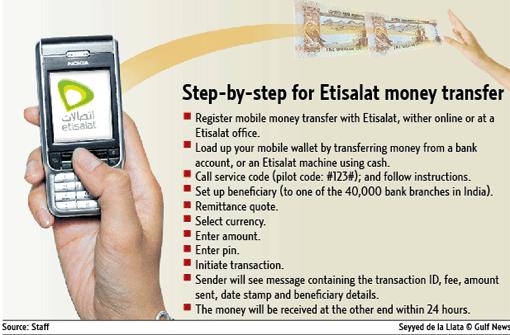
Dubai: etisalat is poised to start offering mobile remittance services in June this year, a move that promises to help millions of expatriates send money in seconds instead of queueing at the exchange houses every month.
etisalat officials on Tuesday said it has started the mobile remittance pilot project to India in partnership with mashreq, Tata Communications, Idea Cellular and HSBC India.
It expects 350,000 users to avail the services next three years. Nearly 80 per cent of the UAE’s more than five million population are expatriates, the majority of whom remit money regularly.
Formal remittance flow in 2005 crossed $7 billion (Dh25 billion), making the UAE the second-largest remittance source in the Gulf after Saudi Arabia.
The company emphasised on micro transactions, which usually take place through unofficial channels. “Mobile money transfer will be a viable service for low-value transactions,” said Abdullah Hashim, vice-president, marketing, enterprise solutions, etisalat. “This service is modelled over existing remittance flows,” he added.
Registered users of the mobile money transfer service will be able to access it abroad through etisalat roaming service.
Officials, however, could not give any indication of the cost of this services. Electronic remittance service charges starts from Dh3 onwards.
The company said on Tuesday that it has no plans to compete with money exchanges but rather will complement them. In addition, the company intends to partner with such organisations in the future.
The new service designed to be cost-effective, convenient and secure will have low transaction costs. The pilot project will allow for feedback to develop the service features and pricing.
“In the current phase, selected participants of the pilot project will be able to transfer funds to over 40,000 bank branches in India,” said Hashim.
etisalat is working closely with leading banks, financial institutions and telecom operators in other countries to offer a comprehensive network of partners for the service. It is expected that etisalat customers in the UAE will have the first opportunity to use this service to send money to various countries including India, Pakistan, Bangladesh, Philippines Egypt, Jordan, Sri-Lanka, and Nepal.
Extension
The telecom operator plans to extend the service three more countries by the end of the year. In addition, the company is in the process of launching mobile banking, parking, ticketing, government payments and purchases in the UAE.
A mobile wallet (mwallet) will be provided when users register with the mobile money transfer service. The mwallet will act like a traditional wallet.
“The service enables to add value [credit] in the mwallet which can then be used for remittance,” said Amol Natu, manager, product marketing ebusiness. The company said yesterday that it is also working on salary transfer option based on mobile wallet offering.
No ban on YouTube in UAE
No ban on YouTube in UAE
By Asma Ali Zain (Our staff reporter) KHALEEJ TIMES 26 February 2008
DUBAI — Internet users can be rest assured that YouTube, an active video sharing web site, will not be completely banned in the UAE as its content is already being regulated by the Telecommunication Regulatory Authority (TRA).
Users were concerned after Pakistan on Sunday asked its Internet service providers (ISPs) to completely ban the web site until further orders for posting blasphemous material.
A spokesperson for the TRA told Khaleej Times yesterday, “We have given choice to the Internet users in the country and not blocked the web site entirely. Adult content on the web site that is clearly against the religious, cultural, political and moral values of the UAE will automatically be blocked.
“Our ISPs (Etisalat and du) have an understanding with YouTube in this regard. Nearly two years ago, YouTube was blocked in the country. However, the TRA wants to provide flexibility to its subscribers. Therefore, the web site can be accessed in the country though objectionable content will remain blocked,” said the spokesperson.
“Following reports from Pakistan banning the site for blasphemous material, we were concerned that the UAE might follow suit since this is an Islamic country. Thankfully, the site is still accessible. Despite its drawbacks, it remains a rich source of information. It is fair though that the content is monitored and blocked if that is the rule in the country,” said Linda Brehick, a user.
“I think that the web site should be banned completely in the country because even though it is being monitored closely, there are certain objectionable materials that I would not like my children to see. It is practically impossible to monitor your children all the time. If the ban is in place, we can be assured that they will not have access to the site,” said Farida Mohammed.
According to Wikipedia, YouTube is the third most visited web site (as per statistics from Alexa Internet). It has been censored several times in some countries since its launch and it is banned in several countries including Brazil, Iran, Morocco, Pakistan, Syria, Thailand and Turkey. Saudi Arabia and the United Arab Emirates only block content that is not in line with their policies.
Virgin Atlantic jumbo jet is first airliner to fly partially on biofuel
Virgin Atlantic jumbo jet is first airliner to fly partially on biofuel
By Juliana LazarusPages Editor GULF NEWS Published: February 24, 2008, 23:07
London: Sir Richard Branson was one happy man yesterday when Virgin Atlantic became the first airline in the world to fly a commercial aircraft on biofuel.
The passengerless Boeing 747 jumbo jet made the journey from London to Amsterdam with one of its engines powered partially by biofuel made from babassu nuts and coconut oil, ingredients that are commonly found in products like shaving cream and lip balm.
The ratio of the blend was 20 per cent biofuel and 80 per cent standard fuel, Sir Richard said at Heathrow Airport before the launch, the result of a venture between Boeing, GE Aviation and Imperium Renewables.
“There were several reasons why Virgin chose babassu nuts and coconut oil over other energy sources,” Branson said.
First, unlike ethanol it did not freeze at altitudes above 30,000 feet. Second, both fuel sources did not compete with staple food crops and did not mean deforestation – they were in fact harvested from existing plantations. Third, there was no need to modify either the aircraft or the engines for the flight.
Sir Richard conceded that the biofuel was still several years away from certification, but he was confident that when that happened, it would not only mean smaller carbon footprints in the aviation industry but also cheaper airfares.
 ClicksandWrites
You must be logged in to post a comment.