Information – Positive Thinking

Never Take things for Granted

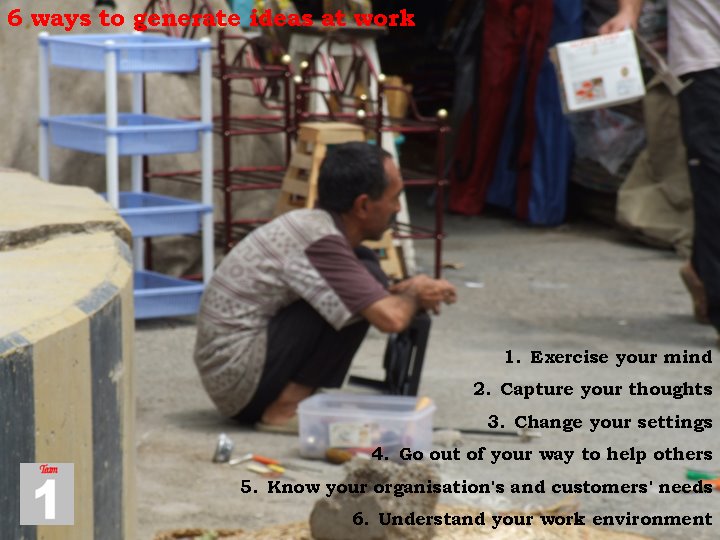
A photo provided by friend from Oman – disasters takes place unexpectedly. It is up to us to recover from it and how fast we get going towards our set path and goals.

Inspirational story – Unconditional Love
Inspirational story – Unconditional Love
A story is told about a soldier who was finally coming home after having fought in Vietnam . He called his parents from San Francisco .
“Mom and Dad, I’m coming home, but I’ve a favor to ask. I have a friend I’d like to bring home with me.”
“Sure,” they replied, “we’d love to meet him.”
“There’s something you should know the son continued, “he was hurt pretty badly in the fighting. He stepped on a land mind and lost an arm and a leg. He has nowhere else to go, and I want him to come live with us.”
“I’m sorry to hear that, son. Maybe we can help him find somewhere to live.”
“No, Mom and Dad, I want him to live with us.”
“Son,” said the father, “you don’t know what you’re asking. Someone with such a handicap would be a terrible burden on us. We have our own lives to live, and we can’t let something like this interfere with our lives. I think you should just come home and forget about this guy. He’ll find a way to live on his own.”
At that point, the son hung up the phone. The parents heard nothing more from him. A few days later, however, they received a call from the San Francisco police. Their son had died after falling from a building, they were told. The police believed it was suicide. The grief-stricken parents flew to San Francisco and were taken to the city morgue to identify the body of their son. They recognized him, but to their horror they also discovered something they didn’t know, their son had only one arm and one leg.
The parents in this story are like many of us. We find it easy to love those who are good-looking or fun to have around, but we don’t like people who inconvenience us or make us feel uncomfortable. We would rather stay away from people who aren’t as healthy, beautiful, or smart as we are. Thankfully, there’s someone who won’t treat us that way. Someone who loves us with an unconditional love that welcomes us into the forever family, regardless of how messed up we are.
Tonight, before you tuck yourself in for the night, say a little prayer that God will give you the strength you need to accept people as they are, and to help us all be more understanding of those who are different from us!!!
There’s a miracle called Friendship That dwells in the heart You don’t know how it happens Or when it gets started But you know the special lift It always brings And you realize that Friendship Is God’s most precious gift!
Friends are a very rare jewel, indeed. They make you smile and encourage you to succeed They lend an ear, they share a word of praise, and they always want to open their hearts to us.
My Dog Can Walk On Water
My Dog Can Walk On Water
There was a hunter who came into the possession of a special bird dog. The dog was the only one of its kind, because it can walk on water. One day he invited a friend to go hunting with him so that he could show off his prized possession. After some time, they shot a few ducks, which fell into the river. The man ordered his dog to run and fetch the birds. The dog ran on water to fetch the birds. The man was expecting a compliment about the amazing dog, but did not receive it. Being curious, he asked his friend if the friend had noticed anything unusual about the dog. The friend replied, “Yes, I did see something unusual about your dog. Your dog can’t swim!”
Success Principles
More than 90% of the people that we face everyday are negative. They choose to look at the hole in the middle rather than the doughnut. Do not expect compliments or encouragement from them. These are the people who cannot pull you out of your present situation. They can only push you down. So be aware of them, spend less time with them, and do not let them steal your dreams away from you.
It is a son’s world
It is a son’s world by Seema Burman HT New Delhi, June 22, 2007
When my maternal uncle was alive his only son quietly made plans to settle in Germany with his wife. Without informing his father or sister he bought tickets and sold all movable things at home.
A week before he left, everyone was informed of his plans. People criticised him for abandoning his father. The married daughter who was settled in Bhopal, shifted to Delhi to look after her father.
A year later the father was admitted to a private hospital and died. The son came from Germany, paid the bills and performed all the death ceremomes. People now said that after all, he had come all the way, so he was not a bad son.
No word about how he had neglected his father or how his sister had to disrupt her personal life to take care of old Dad. This is what life teaches every daughter. That our society values a son more because he has the religious sanction to perform death ceremonies and grant them liberation (mukti).
A daughter may have given them love, care, sensitivity, time, service, but the son gets preference because he carries forward the family name and performs shraadh. He may be uncaring, arrogant and indifferent but for parents a son is their treasure.
Two years back in our neighbourhood a man died without leaving a will. His only son sold the bungalow and took away his sick mother without informing his three sisters who then approached the courts for a share of the property.
Is this the family structure we boast of to the world? Where does love and laughter vanish when siblings become adults? Are we right in blaming a newly wed for poisoning a son’s brain? Love for a daughter has to come from within.
Saints repeatedly clarify that death ceremonies need not be performed only by one’s own son.
And what guarantee is there that a son will perfOrm the shraadh? If parents do not reciprocate a daughter’s love, won’t Heaven, which claims to be just and fair, reproach them for their insensitivity?





Creating a safer online environment for children
Creating a safer online environment for children
– By Katharine Bostick
Picture this scenario, working parents leave behind their ten-year-old son with instructions to finish his homework and keep the doors of the house locked while they are away. Once they are out the door, the boy rushes to his PC-his only other companion at home-and his window to an infinite world of games, movies, and cartoons. Neither his mom or dad nor his school has provided him with any guidance regarding his use of the computer and the Internet; he has only learned from his online and offline friends. For the next four hours, the ten-year-old is online, chatting with friends, surfing cool sites, playing online games, listening to music downloads, and researching key facts for his science project. He races through layers of fast-paced information while interacting with many people online-both familiar and anonymous Internet friends. His newest online anonymous friend is, in fact, a 40-year-old sexual predator who targets children by pretending to be another child, chatting with kids, playing online games, and “sharing” a photo of “himself”-a kid playing football. The predator convinces the ten-year-old to log on to an animated chat room where the two can “play” together in virtual space. He asks the boy to send a photo, too; so the boy sends a recent picture of himself in his school football uniform. With this information (the boys’ name and the school name), a savvy researcher can, in a matter of minutes, learn where the child lives-a mere two hour car ride away. The predator also learns that the boy is home alone four hours a day, from 4pm to 8pm, five days a week. Continuing his online chat, the predator is confident that it will be easy for him to meet this boy in the real world in a short period of time….
Although the above story is fictitious, the reality is that the online world harbors some alarming threats to young Internet users today. There is no question of the educational opportunities and benefits the Internet provides for our children. Everyday, children use the Internet to learn, explore, innovate, and communicate in healthy ways. Unfortunately, however, the Internet is also being used by predators and cyber offenders who prey upon the isolation and the innocence of naive Internet users. Online crime targeted at children requires our full attention.
The exponential growth of the Internet is largely driven by children and young people. Yet though our children may be technologically adept, they may not be fully aware of the dangers they may face-or have the maturity to address them. Meanwhile, some parents are largely unfamiliar with the Internet, feeling intimidated by the technology. That lack of familiarity means that they may not fully appreciate the dangers that their children encounter online. You may recall that in my fictitious story, the boy’s parents cautioned him about keeping the doors locked, but did not provide any advice related to online threats. Some guidance from parents on Internet safety will remind kids to think about safety online, just as they think about it when they play outside or cross the street. It is important that parents make an effort to learn to use the technology used at home to ensure that their families stay safe online-every time any household member logs on.
According to NCRB reports, the proportion of cyber crimes is increasing. In India in 2005 alone, cyber crimes increased 38.6 percent over 2004. These figures include cyber crimes against adults as well as children, and do not include unreported cyber crime offenses; nevertheless, the numbers suggest the extent of the threats we face. Data shows that children using the Internet are potential targets of pedophiles and stalkers; are exposed to age-inappropriate, illegal, and harmful materials, such as child sexual abuse images, pornography, and unwanted software (spam); are subject to harassment, intimidation, and cyber-bullying; and may be tricked into downloading viruses and spyware. Thus it is important that we reflect on ways to create safe online computing environments.
Four components-public awareness, effective legislation, international co-operation, and technology solutions-are essential for maintaining a safe online environment for children.
At Microsoft, we recognize Internet safety is a priority, and since we launched the Trustworthy Computing initiative in 2002, we have been working to build in as many safeguards as possible to create a safe online computing environment for young people to explore. While there is no substitute for parental guidance, technology tools can provide parents with guidance to provide a safer online experience for children.
Our commitment towards providing a secure online environment for children and our support for parents can be found in the new built-in parental controls in the Windows Vista operating system and Microsoft Xbox video game systems. These parental controls enable parents to easily and confidentially manage access to content, regulate when and how long children can use the computer, limit Web sites and programs that can be accessed by children, restrict PC games based on title, content, or Entertainment Software Rating Board (ESRB) ratings, and get daily reports that detail their children’s online activities and other computer use.
Technology must be part of the solution, but there remains an ongoing need for governments and the tech industry to work together to raise public awareness, enact appropriate legislation, build capacity for law enforcement, and secure international cooperation to protect children. At Microsoft, our initiatives are focused on partnering with global agencies to ensure a collaborative approach to security issues. We work with governments, industry, law enforcement agencies, and consumers to build partnerships focused on public policy, education, and enforcement. These efforts are aimed at delivering a safer virtual journey for our users, especially children, to support them in using technology more effectively for education, empowerment, and entertainment.
Ensuring Internet safety for children is a responsibility that must be shared broadly among parents, industry, government, community stakeholders, and youth. Given the magnitude of the potential harm, we must work together to effectively protect children-and in this case there is no single solution. But informed parents and teachers who communicate with children, using available technology tools, and providing adequate supervision, are clearly keys to any solution.
(The writer is head of Internet Safety Enforcement in Asia, Microsoft Corporation)
HR Lessons – A Small Story
During my second month of college, our professor
gave us a pop quiz. I was a conscientious student
and had breezed through the questions until I read the last one:
“What is the first name of the woman who cleans the school?”
Surely this was some kind of joke. I had seen the
cleaning woman several times. She was tall,
dark-haired and in her 50s, but how would I know her name?
I handed in my paper, leaving the last question
blank. Just before class ended, one student asked if
the last question would count toward our quiz grade.
“Absolutely,” said the professor. “In your careers,
you will meet many people. All are significant. They
deserve your attention and care, even if all you do
is smile and say “hello.”
I’ve never forgotten that lesson. I also learned her name was Dorothy.
 ClicksandWrites
You must be logged in to post a comment.