Information – Oil Gas Future Energy
Crescent completes drilling programme in Mubarak field
Crescent completes drilling programme in Mubarak field
Staff Report GULF NEWS Published: October 05, 2007, 00:21
Dubai: Crescent Petroleum, the region’s oldest private upstream company and the operator of the Mubarak field, has announced the successful conclusion of its recent drilling programme in the Mubarak field, offshore Sharjah, with completion of the K2 well.
The well was drilled to a depth of 13,528 feet in the Ilam reservoir.
After initial tests, the well is flowing at 742 barrels per day, similar to the initial flow rate of the first well, H2, in this two-well programme.
These wells were the first to be drilled by the company in the Ilam reservoir since 1997 and were appraising the remaining potential of the reservoir which has been in production since 1974.
The two wells successfully tested the potential for bypassed oil in both the northern and southern flanks of the reservoir and will therefore aid the company in selecting further drilling locations.
Crescent also set a regional operational record in completing the K2 well, with a highly challenging programme involving horizontal drilling combined with coiled tubing technology and a complex completion matrix at great depths.
With the drilling of previous wells in these deep reservoirs, Crescent established a number of world records including the deepest short radius horizontal section drilled, and the deepest slim hole to be cased by expandable casing.
As a result of these encouraging well results, further development potential for the Mubarak field will be evaluated by the company in 2008, with a particular focus on the Ilam-Mishrif oil reservoir and the deeper Thamama gas condensate reservoir.
Reliance plans facility to convert petroleum coke into synthetic fuel
Reliance plans facility to convert petroleum coke into synthetic fuel
Rahul Wadke Mumbai, Oct. 3
Reliance Industries Ltd is planning to convert petroleum coke, a low-value residual output of refining crude petroleum, into synthetic fuel such as diesel and naphtha.
Given the differential in prices between the two products, the acquisition of the relevant technology for conversion opens up a new revenue stream for the company.
Petroleum coke or petcoke is a residue produced while refining crude oil. Reliance annually produces 2.5 million tonnes of this residue.
Fuel plant
Sources familiar with the development said Reliance plans to set up a plant having a daily processing capacity of 4,000 tonnes of petcoke for producing the fuels. These sources also said that the company would soon be placing an order with Larsen & Toubro for six such units. The technology partner of Reliance for this venture is Lurgi AG of Germany, global major in coal conversion technologies.
Fertiliser Feedstock
Rashtriya Chemicals & Fertilizers Ltd reported that it is contemplating using gas from coal gasification as feedstock for its fertiliser plants. Sources in Tata Chemicals also indicated that Reliance had evinced interest in supplying synthetic gas as feedstock for its fertiliser units. However, it may be noted that the technology for converting coal into synthetic fuels has been around for last 80 years. In the post World War II period, due to major oil discoveries and cheap oil, synthetic fuels became economically unviable.
Today, with Brent crude prices prevailing in the $80 range per barrel, coal liquefaction and gasification has caught the attention of global oil companies as they see it as a cheaper alternative to crude oil.
Oil prices fall as investors cash in on profits
Oil prices fall as investors cash in on profits
Reuters Published: October 02, 2007, 00:12
London: Oil fell below $81 a barrel yesterdayas investors took profits from near-record highs of last week. But a weak dollar helped check losses sparked by worries of an economic slowdown in top consumer the US.
US crude fell 83 cents to $80.83 by 1441 GMT, having sunk more than $1 to $80.59 in earlier trade. London Brent crude dropped $1.10 to $78.07.
Oil has surged more than 30 per cent this year to an all-time high of $83.90 in late September on expectations of a supply shortfall in the fourth quarter as heating demand peaks.
A weaker dollar has also propped up oil and other commodities as they become cheaper for holders of other currencies. Gold hit a 28-year high on Monday, while platinum neared a record peak.
“The weaker dollar, for now, is the most consistent bullish theme that explains the incredible bullish momentum we are seeing in a variety of commodity complexes,” said Edward Meir at broker MF Global.
The dollar sank to a new low against the euro and a basket of currencies early yesterday, then rebounded as investors cashed in.
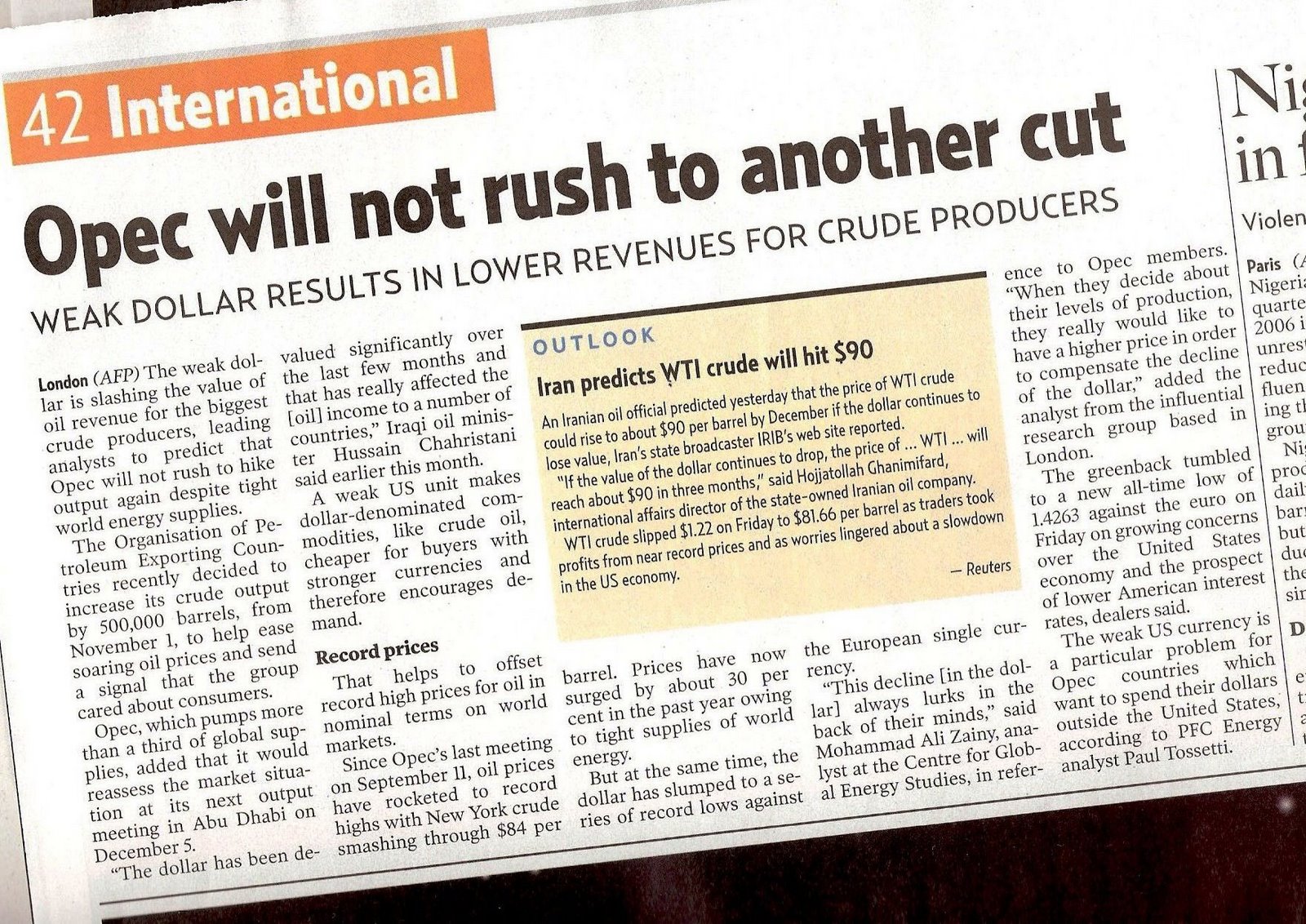
An Iranian oil official said on Sunday the price of US crude could gain $10 from current levels by December if the dollar continued to weaken.
Apart from a weak dollar, analysts said expectations of tightening fuel supplies heading into winter and the threat of supply disruptions due to hurricanes would also support prices in the near term.
The Organisation of the Petroleum Exporting Countries agreed last month to boost production by 500,000 bpd to soothe consumer concerns over high prices and tight supplies.
No need for Opec to boost output – Qatar
No need for Opec to boost output – Qatar
Reuters Published: October 02, 2007, 00:12
Dubai: More crude supply from Opec would do little to ease $80 oil as speculative investment flowing into the market from other assets is boosting the price, Qatar’s oil minister said yesterday.
US crude was trading at $81.43 a barrel yesterday. The price has been above $80 for much of the last three weeks, despite Opec’s agreement on September 11 to boost output by 500,000 barrels per day from November 1.
“I am confident that the price is not related to supply,” Qatar’s Oil Minister Abdullah Al Attiyah told Reuters by telephone.
“We increased at the last Opec meeting and were confident that it would help the market, but unfortunately the market is moving in a different direction. More oil won’t help at all.”
Members of the Organisation of Petroleum Exporting Countries (Opec) were not in consultations at the moment about boosting oil supply, he said.
Two weeks ago, an Opec source told Reuters the producer group would hold talks about a further supply boost if the price stayed above $80 for several weeks.
Al Attiyah said he did not know if Opec would consult on output before the heads of state of its 12 members gather at a summit in Riyadh in November. Oil ministers were due to meet ahead of the summit.
The global credit crunch had encouraged investors to switch to oil from other assets, Al Attiyah said.
“Our increase in output could not overcome the investment flow switch,” he said. “Investors believe oil is safer than some others [assets].”
The weak dollar was not making Opec more resistant to an output change, Al Attiyah said. The higher price has helped insulate oil producers from the erosion of their spending power due to dollar weakness. The US greenback hit a new record low against the euro yesterday.
“The weak dollar and Opec’s supply are not related,” he said. “But it has affected us. A lot of our imports are in euros.”
Qatar had no plans to change its policy to price and receive payment for all of its oil in dollars, Al Attiyah said.
Neighbouring Gulf Arab Opec members Saudi Arabia, the UAE and Kuwait also receive all their oil revenues in dollars.
Iran, locked in a row with Washington over its nuclear work, is aiming to boost oil export earnings in non-dollar currencies to 80 percent by the end of October.
It already receives more than 70 per cent in other currencies.
Qatar is Opec’s smallest oil producer, with output of around 800,000 barrels per day.
Indo-French nuclear business meets from Oct 15
Indo-French nuclear business meets from Oct 15
28 Sep, 2007, 1630 hrs IST, PTI
MUMBAI: In the backdrop of Nuclear Power Corporation of India Limited (NPCIL) planning to buy six nuclear power reactors from France, an Indo-French nuclear business meet will begin here from October 15.
The meeting is organised by the French embassy in collaboration with NPCIL, a top scientist said.
“The two-day meet is to strengthen the bilateral cooperation in the nuclear power sector and also to improve the relationship between the industries of both India and France,” S K Agrawal, Director, Projects of NPCIL told media today.
“We are expecting the participation of over 20 French nuclear companies including AREVA and an equal number from India,” he said.
NPCIL plans to buy six nuclear power reactors from France, Agrawal said.
AREVA could be one of the biggest suppliers for its Jaitapur site in the Ratnagiri district of Maharashtra which is one of the four coastal sites selected by NPCIL for imported reactors, he said.
Also, NPCIL can enter into business with the French only after the completion of the Indo-US deal, he said.
On that front, US has a timeframe for the entire process including India’s discussion with the International Atomic Energy Agency on safeguards and US’ negotiations with the NSG countries.
Asked whether other members of Nuclear Suppliers Group were also in touch with NPCIL officials, Agrawal said, the Japanese were interested and Mitsuibishi had held talks with the NPCIL officials.
Oil industry safety awards presented
Oil industry safety awards presented
30 Sep, 2007, 1500 hrs IST, PTI
MUMBAI: Recognising the efforts of oil and gas industry in enhancing safety performance, the ‘Oil Industry Safety Awards 2006-07’ were presented to five oil companies here.
The awards were given to the companies by the Secretary, Petroleum & Natural Gas, M S Srinivasan, at a function held in the city, a release said here today.
Indian Oil, ONGC and GAIL, won two awards each while Hindustan Petroleum and Bharat Petroleum won one award each.
Indian Oil’s Mathura refinery won the award for the best safety performance among refineries and ONGC’s Ahmedabad operation was adjudged the best managed oil and gas asset, the release said.
Bharat Petroleum won the award for its lube oil blending plant while GAIL won accolades for managing its Hazira-Vijaipur-Jagdishpur pipeline and the processing plant at Vijaipur.
Hindustan Petroleum won the safety award in the petroleum products marketing category and Indian Oil in the LPG marketing category.
The criteria for selection of winners was based on various parameters like complexity of facility, volumes handled, safety management system with minimum fires, accidents and losses.
The Oil Industry Safety awards were instituted in 1986-87 by the Government to promote safety performance in the industry.
They are administered by the Oil Industry Safety Director, New Delhi, which co-ordinates a series of self-regulatory measures relating to safety in the oil and gas industry in the country.
Iran and Pakistan agree to gas accord without India
Iran and Pakistan agree to gas accord without India Reuters Published: September 30, 2007, 00:33
Tehran: Pakistan has agreed to details of a deal for buying gas from Iran, officials from both sides said on Friday, adding that the proposed tri-nation pipeline would be viable even if India, the third party, walked out.
India stayed away from last week’s talks in Tehran on the proposed $7 billion pipeline, saying it wanted to agree transit costs through Pakistan on a bilateral basis first, an Iranian official said. But he said India had not said it was quitting.
“The economics of the project will improve with Indian participation but … the project is economically viable as a bilateral project also,” Mukhtar Ahmad, the energy adviser to Pakistan’s prime minister, told reporters in Tehran.
Hojjatollah Ghanimifard, international affairs director of the National Iranian Oil Company (NIOC), said the three sides had previously planned for gas sales and purchase agreements (GSPAs) to be negotiated separately by India and Pakistan.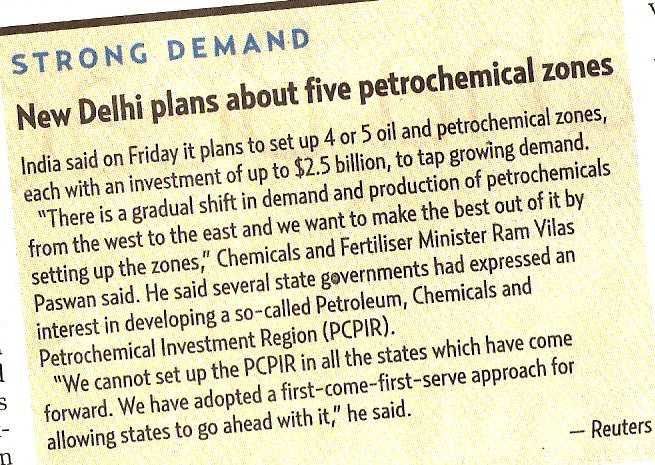
“So far, the information formally we have from the authorities of India is that they are willing to join us. They have just their internal problems, including that they need to finalise the transit fee with our good Pakistani friends,” Ghanimifard said after talks late on Friday.
Iran’s oil minister said on Wednesday his country would still sign a deal with Pakistan if India decided not to join.
Mukhtar said Pakistan and India had agreed in principle how to tackle issues like transportation tariffs and transit fees.
“We don’t see transit through Pakistan as a problem. We’ve had bilateral discussions with India on this subject,” he said, although he said more talks were be needed.
Speaking of Pakistan’s talks with Iran, Mukhtar said: “We have agreed upon everything that we needed to agree on with regard to the gas sales and purchase agreement and the inter-governmental framework agreement.”
He said the details would be drawn up in final documents to be examined at bilateral talks in Islamabad on October 15-19.
Mukhtar did not give details for the price of the gas agreed but said it would be linked to the price of oil. He also they also agreed on a price review clause – an issue that had been pending – but he did not elaborate.
In July, Ghanimifard said India and Pakistan had accepted Iran’s demand for gas price reviews based on market changes.
He denied reports by some Indian newspapers that the pipeline talks had failed after Iran demanded a review every three years.
The pipeline would initially carry 60 million cubic metres of gas daily to Pakistan and India, half for each country.
The pipeline’s capacity would later rise to 150 million cubic metres. Pakistan says it could want 60 million cubic metres for itself in the future.
Iran says it has completed 18 per cent of the work for the pipeline to bring gas from its South Pars field up to Iran-Pakistan border. Pakistan has yet to begin work on a 1,000 km stretch of the pipeline to link Iran with India.
Strong demand: New Delhi plans about five petrochemical zones
India said on Friday it plans to set up 4 or 5 oil and petrochemical zones, each with an investment of up to $2.5 billion, to tap growing demand.
“There is a gradual shift in demand and production of petrochemicals from the west to the east and we want to make the best out of it by setting up the zones,” Chemicals and Fertiliser Minister Ram Vilas Paswan said. He said several state governments had expressed an interest in developing a so-called Petroleum, Chemicals and Petrochemical Investment Region (PCPIR).
“We cannot set up the PCPIR in all the states which have come forward. We have adopted a first-come-first-serve approach for allowing states to go ahead with it,” he said.
China bets on Myanmar status quo for gas deals
China bets on Myanmar status quo for gas deals
Reuters Published: September 30, 2007, 00:33
Hong Kong: China struck an energy coup with a pipeline deal in Myanmar earlier this year but its cosy relationship with the ruling generals could come back to haunt it if the investment environment opens up, analysts say.
The military government of the impoverished southeast Asian state gets most of its export earnings from selling gas to Thailand and it has stepped up a drive to attract more foreign investment in the last three years.
But a week of unrest, in which at least 9 people died when troops broke up the biggest anti-government demonstrations in nearly 20 years, has raised the question of what might happen if the military government loses its grip on power.
“If the junta is overthrown -and that’s a very big if – clearly that might have an impact on China because it has invested a lot over the last 20 years,” said Ian Storey, a fellow at the Institute of Southeast Asian Studies in Singapore.
“We’re well into the grounds of speculation but if a more pro-Western government came into power they might seek to limit China’s involvement. China is an important ally of Burma and it won’t want to lose that.”

Myanmar is wedged between China and India, making it a small but juicy prize in a furious battle for energy between the world’s two most populous nations.
Its proven gas reserves amount to only 0.3 per cent of the world’s total, but a lack of exploration means the true figure could be much higher.
Chinese oil giant Petro-China appears to have won the last round by snatching a gas pipeline agreement from under India’s nose. It has sweetened the deal by talking to Myanmar about running an oil pipeline along the same route.
Such a pipeline would ease the passage of Saudi crude bound for China by cutting out the congested Malacca Straits, but would be dependent on the goodwill of the regime in Myanmar.
While China has been quietly trying to build ties with democratic and ethnic groups in Myanmar in recent years, Beijing has remained a steady friend to the ruling generals.
“If there was a change in government, there could be a rethink of the gas pipeline to China,” said Sanjeev Prasad at Kotak Securities.
Observers are not predicting an imminent change of government in Myanmar, but many other countries have experienced unexpectedly rapid changes of leadership in the last 20 years.
For the moment, the country’s biggest investors like Total and Thailand’s PTTET as well as South Korea’s Daewoo International Corp, operator of a multi-billion-dollar gas project under way, say it’s business as usual.
Kuwait shortlists firms for new refinery
Kuwait shortlists firms for new refinery
Reuters Published: September 30, 2007, 00:33
Kuwait: State refiner Kuwait National Petroleum Co (KNPC) yesterday announced firms pre-qualifying for the construction of the state’s planned 615,000 barrels per day (bpd) Al Zour refinery.
KNPC said last week Kuwait had approved a budget of about $14 billion for the construction of the refinery, the Middle East’s biggest, more than twice an initial cost estimate.
The tender was split into several construction packages for which the following firms pre-qualified, according to a KNPC statement published in local daily Al Qabas.
Tender details
A consortium of Italy’s Snamprogetti and Korea’s Hyundai Engineering & Construction, consortium of Japan’s JGC and Korea’s GS Engineering & Construction and consortium of Technip Italy, Foster Wheeler and Korea’s SK Engineering & Construction qualified for crude distillation units, sulphur removal and units to treat naphtha, kerosene and diesel.
For hydrogen production and recovery, sulphur industrialisation, units to treat diesel, etc, those qualified include a consortium of Technip Italy and Foster Wheeler Energy and Snamprogetti, consortium of Hyundai Engineering & Construction and Daelim Industrial Co, GS Engineering & Construction, WGI Middle East, SK Engineering & Construction and Petrofac International.
For tank storages, those qualified include consortium of CB & I and CBI Eastern Anstalt, Daelim Industrial, GS Engineering & Construction, SK Engineering & Construction and Petrofac International.
 ClicksandWrites
You must be logged in to post a comment.