Information – Oil Gas Future Energy
Saudi to raise oil output 2 per cent in July
Saudi to raise oil output 2 per cent in July
Bloomberg Published: June 21, 2008, 14:06
Jeddah: Saudi Arabia, which convenes a meeting of government and business leaders on Sunday to discuss world energy markets, will raise its oil output by 2 per cent in July, the country’s oil minister said.
The kingdom will add 200,000 barrels of oil to its daily production next month, taking its total to 9.7 million barrels a day, Ali Al Naimi told reporters in Jeddah, Saudi Arabia on Saturday. State-owned Saudi Aramco will soon add 500,000 barrels, or 4.6 percent, to the kingdom’s total production capacity with its Khursaniyah field.
The International Energy Agency estimates that world oil use this year will climb 800,000 barrels a day, or 1 per cent, as demand increases in emerging markets. Stagnating production from Russia and the North Sea are also contributing to higher prices, which have touched off strikes, riots and accelerating inflation in nations around the world.
Oil doubled in the past year, touching a record $139.89 a barrel on June 16, as investors bought commodities to hedge against a weakening US dollar and concern mounted that demand is growing faster than supply. At least 24 airlines failed this year because of rising costs, while $4 gasoline in the US sparked concern the economy may slip into recession.
A Saudi proposal, to be discussed at the meeting in Jeddah on Sunday, will seek measures against market speculators, Prince Abdulaziz Bin Salman, the kingdom’s deputy oil minister, said in an interview in the Saudi newspaper Asharq Al Awsat.
“The governments have a role to play in regulating and restructuring the markets so that the speculators are forbidden from actions that caused oil prices to reach the current level,” bin Salman said.
“We want stable prices on the long term, not high and not low, so that oil demand can grow, Saudi Arabia can increase its production and preserves its revenue on the long run,” the Saudi deputy oil minister said.
Saudi Arabia will present at the meeting a work document that outlines the reasons for the surge in oil prices, prepared in cooperation with the Organization of Petroleum Exporting Countries and the International Energy Agency, the Saudi official said. “It will be the only document that will be discussed.”
Adnoc finds elixir for its oil fields
Adnoc finds elixir for its oil fields
Tamsin Carlisle, THE NATIONAL
Last Updated: May 08. 2008 10:11PM UAE / May 8. 2008 6:11PM GMT
Abu Dhabi’s quest to become a global hub for energy technology took a step forward yesterday when Linde Group, the German technology company, announced an US$800 million (Dh2.9 billion) joint venture with Abu Dhabi National Oil Company (Adnoc) to extract nitrogen from air and pump it into ageing oil fields.
The initial project of the companies’ “Elixier” joint venture would be among the largest in the world to use nitrogen on an industrial scale to boost oil production.
It calls for the construction of a US$65 million air-separation plant at the Ruwais industrial complex on Abu Dhabi’s coast, which would produce nearly 600,000 cubic feet of nitrogen gas a day for injection into oil fields from late 2009. The plant would also supply liquefied nitrogen and oxygen to industrial customers at Ruwais.
Nitrogen, an inert gas, is the major constituent of air, comprising nearly 80 per cent of the earth’s atmosphere. It is also one of several gases that oil producers around the world are increasingly employing to coax more crude from big deposits with falling production.
Nitrogen’s big advantage for enhanced oil recovery (EOR) projects is its ready availability: air is everywhere. That means the gas can be produced close to big oil fields, avoiding high transportation costs.
The drawback is the cost of the technology used to separate air into its constituent parts, a complex engineering process that involves passing gases through “molecular sieves” as they are cooled, reheated and compressed.
But Adnoc hopes to recoup that cost by pumping more of the natural gas found in oil reservoirs. Without the injection of another gas, such as nitrogen, the natural gas would have to be left underground to maintain the pressure required to push oil into producing wells.
The commercial use of nitrogen for EOR is not new, and in the US dates back to the 1980s.
Still, the economics of such projects were often shaky. Now, soaring oil prices accompanied by rising natural gas prices on international markets are making the technology more economically viable, and much more in demand.
For Linde, the Abu Dhabi project could open the possibility of supplying other customers in the Middle East, said Stefan Metz, a company spokesman.
Indeed, Linde is already building eight air-separation plants at Ras Laffen in Qatar to supply oxygen to the Pearl project, a joint venture between Qatar Petroleum and the Anglo-Dutch energy company Royal Dutch Shell to make petroleum fuel products from natural gas.
In that project, scheduled for completion in 2010, nitrogen from the air-separation process is considered a by-product.
That is not the case with the world’s biggest air-separation plant, located in Mexico. At the end of the last millennium, output from Mexico’s Cantarell oilfield complex, site of one of the planet’s biggest crude deposits, had begun to falter.
In 2000, the country’s national oil company, Petroleos Mexicanos (Pemex), built an air-separation plant to pump out 1.2 billion cubic feet a day of high-pressure nitrogen for injection into the big offshore fields.
Oil production from Cantarell shot up 75 per cent over the next four years, peaking at 2.1 million barrels a day in 2004, when it accounted for nearly half of Pemex’s total output.
Although Cantarell crude production is again declining, billions of barrels of oil were pumped from the fields that otherwise would have stayed trapped below the seabed. Mexico, which had been slow to develop its large gas reserves as it expanded its industrial base, also reaped substantial economic benefits from producing Cantarell’s gas. The parallels between the UAE’s current circumstances and Mexico’s a few years back are striking: both countries are among the biggest oil producers in their respective hemispheres and, indeed, in the world.
The UAE today, like Mexico earlier this decade, is in the midst of an unforeseen industrial and population boom that has increased domestic gas demand faster than supply.
Other GCC countries have similar problems. Mr Metz said Linde was in negotiations to supply nitrogen to several potential new customers in the region, either from the Abu Dhabi plant or from additional air-separation plants that the firm hopes to build.
The German company’s clients already include Borouge, an Adnoc petrochemicals venture with the Austrian chemicals producer Borealis. In 2006, Linde was awarded a contract to build a large ethylene plant at Ruwais. Borouge may soon begin using oxygen supplied by Elixier.
tcarlisle@thenational.ae
Plastic fantastic
Plastic fantastic
Last Updated: May 10. 2008 9:48PM UAE / May 10. 2008 5:48PM GMT
The process by which Abu Dhabi’s natural gas is transformed into a Chinese car bumper more than 6,000km away is an unknown method to most people.
But governments in the Gulf are betting that by the end of the next decade, many consumers around the world will drive cars made, in part, from plastics manufactured in the region. The UAE and Saudi Arabia, in particular, are hoping that massive investments in chemical infrastructure and technology will diversify the revenue base for their oil-dependent treasuries.
Abu Dhabi’s plans to produce plastics for the Chinese car market illustrates how complex that wager will be.
First, natural gas must be harvested from wells in the Western Region and piped to Ruwais, where ethane is separated from the mix of compounds that occurs in natural gas.
The ethane gas is “cracked” with blasts of steam at high temperatures for short periods, producing ethylene. That is converted to propylene, then a catalyst is introduced to create polypropylene.
The little pellets of tough plastic that emerge will eventually be shipped to a planned compounding plant in Shanghai, where reinforcements, other modifiers and colouring will be added. Next, they are trucked to a factory, where they will be moulded into the bumpers and interior panelling of a Chinese-made car.
Car bumpers are but one piece of a strategy to develop a sophisticated, multi-step chemicals industry.
Last month, Borouge, the Abu Dhabi-based plastics maker, announced it would consider building a third plant at Ruwais that would more than double the company’s annual output of plastics. With its new plant in Shanghai and hefty stakes in two European chemical companies, Borouge wants to go global and grab a piece of the huge profits that come with selling more sophisticated products that require a highly skilled workforce.
The company’s expansion is one small piece of a global shift in the petrochemical industry from established bases in North America and Europe to the Middle East and Asia, where they gain a cost advantage in hydrocarbon feedstock at a time of rising energy prices.
Jean-François Seznec, a professor at Georgetown University in Washington DC and an expert on Gulf chemicals, said governments had realised they could employ more people and make more money by selling sophisticated products derived from crude oil and natural gas. So-called “downstream” operations enable producers to sell each part of their precious resource at a premium.
“Everybody in the region realises – at least the leadership in the region realises – they cannot just keep producing oil or just gas in Qatar,” Dr Seznec said. “Sooner or later, it’s going to run out.”
Abdulaziz Alhajri, the chief executive of Borouge, said regional petrochemicals producers were bringing advanced stages of plastics and chemicals production to the Gulf that were traditionally undertaken overseas.
“Today, the compounding and the downstream and some of the ingredients that we use in our industry are imported from outside,” he said.
But he noted that the model was steadily changing. “I see the future as very bright for the UAE, the overall Middle East,” he said.
In addition to the Borouge expansion, the International Petroleum Investment Company (Ipic), a Government investment fund, and Borealis, one of Borouge’s parent companies, announced plans earlier this year to build the largest integrated chemicals and plastics complex in the world at Taweelah, near the border between Abu Dhabi and Dubai.
The plant will use naphtha, a derivative of crude oil, as a feedstock and produce plastics, petrol and basic chemicals.
The UAE is not the only one working on such a plan. In Saudi Arabia, the government plans to make the kingdom the largest producer of chemicals in the world in less than five years.
But building a sophisticated chemicals industry takes more than new plants, as companies have to either acquire or develop the catalysts and specialised equipment that allow them to compete in a market that is well established in the West.
Saudi Arabia’s drive to reach the top is being put into action by the twin behemoths Saudi Aramco and Saudi Arabia Basic Industries, or Sabic, which began laying the groundwork for its rise in the 1990s. Aramco has focused its downstream operations on refining and petrochemicals based on crude oil, while Sabic has steadily moved towards higher-end chemical products derived mainly from natural gas.
Sabic’s petrochemicals growth has been driven and sustained by access to cheap ethane feedstock, according to John Vautrain, a senior vice president at the petrochemical research firm Purvin and Gertz. He noted that Sabic pays US$0.75 for a million BTUs of ethane, 15 times cheaper than some competitors. The historic average price for ethane in the United States has hovered just above US$4.50 per million BTUs.
“They have a powerful platform for growth. Cheap ethane gives them an enormous cash flow,” he said. “They have such an enormous advantage, no one else can touch them.”
Sabic’s ambitions are well known. In 2006, the chief executive, Mohamed al Mady, announced that Sabic wanted to “be the preferred world leader in chemicals” by 2020.
Mr Seznec said the company had steadily moved into more and more sophisticated chemicals in the past 10 years, with a two-pronged strategy of signing joint ventures with Western companies and also buying up the companies themselves, along with the patented technology and skilled workers.
The strategy required a large cash reserve and a disciplined company leadership that had been able to set its sights on the long-term horizon, Mr Seznec said.
“This is really due to the vision of people. Money by itself is important, but it is not a sufficient variable to really create this growth,” he said. “I mean, Iran has the money, but they don’t do anything with it.”
The company’s headline-grabbing move came last summer, when it bought GE Plastics, a US-based company, to give itself more exposure to advanced chemicals technology.
Abu Dhabi has made its own moves to acquire sophisticated technology. The Abu Dhabi National Oil Company (Adnoc) created Borouge from a joint venture with the European chemical company Borealis. Ipic then bought a 65 per cent stake in Borealis itself and a 19.6 per cent share in OMV, the largest refiner and petrochemicals company in Austria.
Even with these investments, however, Mr Seznec noted that Saudi Arabia’s technology remained far ahead of the curve.
“I think the Saudi products will be a lot more downstream because, as they go into fine chemicals, they’ll be way beyond the more basic chemicals that are going to be produced by Kuwait, Abu Dhabi and Qatar,” he said.
Mr Vautrain, the Purvin and Gertz analyst, noted the industry was entering a down cycle in terms of profit margins due to a glut of petrochemical products coming on to market, and the low-cost producers in the Middle East would increase their advantage.
“Overseas assets may become cheaper,” he said. “This is the time to do deals.”
Mr Seznec said the drive to develop a chemicals industry was not merely fuelled by a need to diversify the region’s economies, nor simply about making more money. It is also an effective strategy for conserving the region’s vast hydrocarbon reserves.
“At the end of the day, instead of having Saudi Arabia sell US$200 billion [Dh734.6bn] of oil, for instance, they will be selling maybe US$100 billion of oil, but then they’ll start selling US$100 billion worth of petrochemicals,” he said. “In the process, they will need to produce only one-fifth as much oil because there’s so much value into this business.”
Unfortunately, other GCC states face more challenges in entering the chemicals market. Bahrain, for instance, already has diversified industries, with several large refineries and the largest aluminium smelter in the world, but now has perhaps only eight years of natural gas left.
Dr Seznec said Kuwait half-heartedly moved downstream in a venture with Dow Chemical. But he said it lacked large natural gas reserves and had not moved towards using crude oil as a feedstock. It is now experiencing political infighting that could upend any attempts at large-scale economic reform. And despite recent announcements, Qatar was more concerned with managing lucrative LNG exports than committing to a large-scale petrochemicals expansion, he said.
But in Saudi Arabia and the UAE, Mr Seznec has been following events closely and is hopeful, almost gleeful, about the future.
“What they’re trying to do is go into value-added productions, knowledge-based industries, basically, and that’s going to make them able, first of all to use a lot less of their resources to make a lot more money,” he said. “And in the process create employment for the locals, and in the long term make these countries major industrial producers in the world by 2020.”
@Email:cstanton@thenational.ae
Shell out of Iran gas deal
Shell out of Iran gas deal
Tom Bergin, THE NATIONAL
Last Updated: May 10. 2008 8:50PM UAE / May 10. 2008 4:50PM GMT
Royal Dutch Shell has pulled out of a planned US$10 billion (Dh36.7bn) gas project in Iran, after coming under pressure not to participate from US lawmakers who were concerned about the country’s nuclear programme.
A spokesman said yesterday that the world’s second-largest oil company by market capitalisation was pulling out of Phase 13 of the giant South Pars gas field, but may yet join later stages of the field’s development.
Shell, Spain’s Repsol and the National Iranian Oil Company (NIOC) signed a memorandum of understanding in January 2002 to develop Phase 13 in a project known as Persian LNG.
At the time, Shell said deliveries of liquefied natural gas – gas cooled to liquid under pressure for transportation in special tankers – could begin in 2007.
However, United Nations sanctions on Iran related to its nuclear programme, which it claims is for power generation, but which the US and European states believe is aimed at developing weapons, and criticisms of the deal from US politicians and investors, slowed progress.
Meanwhile, Iran grew impatient and threatened Shell with eviction from the project if it did not commit formally. The spokesman for the Anglo-Dutch company said: “We have agreed the principal of substitution of alternative later phases for the PLNG project so that NIOC can proceed with the immediate development of Phase 13.”
She would not give a reason for the decision. Repsol was not available for comment.
Iran will now need to find new partners for the project. Media reports have suggested Russia’s Gazprom, Indian Oil Corporation and Chinese companies could join, as they were expected to be less susceptible to US political pressure, but the companies have limited experience of LNG.
Shell and Repsol began negotiating with the Iranian government to pull out of the natural gas project at the beginning of this month. The companies wanted Iran to agree to drop their current development plans for block 14 of the South Pars field, but to allow them to bid for other parts of the field in the future if the international political climate improved.
On May 3, a Repsol spokesman declined to comment on the report. Shell and Repsol had planned to export South Pars gas via ship in liquefied form as part of the Persian LNG project. Now, it is more likely the gas will supply the Iranian market or be exported by pipeline.
The US discourages Western companies from investing in Iran, which it accuses of trying to develop nuclear weapons. Iran denies the accusation.
* Reuters
UAE to sign $10bn gas deal
UAE to sign $10bn gas deal
Tamsin Carlisle, THE NATIONAL
Last Updated: April 30. 2008 3:51AM UAE / April 29. 2008 11:51PM GMT
Conoco was among the four bidders on the Shah project. Tim Johnson / Bloomberg News
ConocoPhillips rumored to be partner
A long delayed contract to develop big new natural gas reserves will be signed within a week, according to a senior official from the Abu Dhabi National Oil Company (Adnoc).
The US$10bn (Dh37bn) Shah gas project, which is key to providing new fuel needed for power plants to meet soaring domestic electricity demand, has been in limbo for eight months.
“There are no delays, no problems,” said Omair Suwaina, a senior Adnoc official, who was speaking yesterday while attending an industry conference in Abu Dhabi. “We expect to sign within a week,” he told the Reuters news agency.
Mr Suwaina declined to confirm the identity of the contract winner, widely expected to be ConocoPhillips, the US energy company.
Once under way, the project will produce up to one billion cubic feet a day of gas at the Shah field near Abu Dhabi’s southern border with Saudi Arabia. This will be the first of a series of similar projects that the Government wants to undertake.
The Shah project is scheduled to start in 2012. It was first tendered in April 2007 as part of a larger project, but no winning bidder was selected. Adnoc invited four foreign companies including ConocoPhillips to bid again on the Shah development in July of that year. It has since been evaluating the bids.
Deborah Algosaibi, a ConocoPhillips external affairs co-ordinator said Adnoc’s long delay in formally announcing the development could be related to smoothing out contract details. “Perhaps they are dotting an ‘i’,” she said.
Craig McMahon, an analyst with Wood Mackenzie, a British research and consulting company, suggested the delay could be related to the size and complexity of the project, which could involve the parties crafting a detailed commercial agreement. “The devil is always in the details,” he said.
The Shah project is the largest Abu Dhabi upstream development in the past year open to bids by international companies. The gas involved is known as “sour gas” because it contains high levels of acidic and toxic hydrogen sulphide, which makes the project costly and dangerous. Cost projections by analysts have doubled within a year in line with global inflation in the industry. Last April, when Adnoc was proposing the simultaneous development of Shah and Bab, another sour gas field, they pegged the cost for both developments at US$10bn.
Mr Suwaina, who declined to disclose Adnoc’s cost projection for Shah, told the conference that rising costs for energy development worldwide had pushed up the investment required for sour gas projects. He said the UAE would go ahead with plans to develop several sour gas fields to supply its power needs.
“There will be more developments. It is necessary and we have to do it,” he said.
However, sensitivities surround the proposed Bab field and are more pronounced than that of Shah because the toxic gas deposit is close to residential settlements. Bab, and the offshore Hail sour gas field, are next in line for development.
While costs for Abu Dhabi’s technically challenging sour gas projects could be four or five times higher than the emirate has traditionally paid for gas, the rising price of sulphur could sweeten the deal. Hydrogen sulphide stripped out of the gas stream can either be pumped back into the ground for storage or, with favourable economics, processed to yield sulphur. This month, the price of sulphur exported from Abu Dhabi surpassed US$600 a tonne, a stunning increase from about US$20 a tonne just a few years ago. Mr Suwaina said estimates for sulphur contracts were based on spot prices of $700 to $800 a tonne.
The UAE holds the world’s fifth-largest gas reserves at nearly 214 trillion cubic feet., much of it “ultra-sour” with a hydrogen sulphide content of 30 per cent or higher. Although deposits with a similar composition have been developed in other countries, safety concerns, technical challenges and rising costs have held back exploitation here.
tcarlisle@thenational.ae
BP hopes to sign oil deal with Iraq
BP hopes to sign oil deal with Iraq
Simon Webb for The National
Contract terms could set the pace of development. Bloomberg
DOHA // BP hopes to sign a service contract designed to boost output in Iraq by 100,000 barrels per day (bpd), a senior executive said.
The deal is one of five that Iraq is negotiating with major oil companies to boost output by 500,000 bpd, or nearly a quarter, from its largest oil fields.
“I’d say we might sign around the middle of the year,” said Steve Peacock, the president of BP’s Middle East and South Asia exploration and production unit. “These are active discussions with serious intent, there is no sense that they’ve stalled or reconsidered, it’s just taking longer than anticipated.”
Payment terms for the service contracts were yet to be concluded, he said. Iraq has indicated each contract could be worth up to $500 million.
Iraq wants to sign two-year technical service contracts with major firms as part of stopgap measures to boost oil production in the absence of a vital oil law. Legislation to set the terms and extent of foreign investment in the country has been stalled in parliament for more than a year.
“In this politically sensitive and difficult situation, service contacts are a pragmatic step forward for Iraq,” Mr Peacock said.
Oil firms would prefer contracts that offer long-term involvement in Iraq and were looking for a link in the service contracts to future development of Iraq’s giant oilfields.
“Whether it gets linked into the contract or not – it’s a natural question that’s on the table. These contracts are valid for a couple of years; how does that link with what comes afterwards?” Mr Peacock said.
The longer-term link would help ensure that work undertaken under the two-year contracts would be in line with future field development plans, he added.
Mr Peacock said he was confident that the companies concerned and Iraqi negotiators would come up with a contract that gave an incentive for firms to use all their skills and expertise, while at the same time respecting political opposition to deals that gave companies a share in production.
The terms of the contracts could set the pace of oil field development for years to come, he said.
“I think it’s important acknowledging the political sensitivity of using barrels as a form of reward,” Mr Peacock said.
“That shouldn’t be confused with giving up national sovereignty over the ownership – that’s never in question. The question is, do you want to use barrels or cash as a form of reward? Whichever it is, I think, is going to be key for the long term. It will determine how fast production can be realised and how fast new developments can be brought on stream.”
The service contract Iraq is negotiating centres on the giant Rumaila oil field in the south of the country.
The target to boost output by 100,000 bpd from the field was possible, although to do so in two years would require an aggressive development plan, Mr Peacock said.
The contracts call for larger project management roles in the fields. Aside from boosting production and long-term planning, the oil firms would be required to bring in supplies to Iraq.
Companies will supervise the work from outside the country as security concerns will prevent them from sending in ground staff, at least initially.
The companies have studied the same fields and have provided training and technical assistance for years as they look to position themselves for any future contracts.
“We’ve studied the whole of the rest of the country, so we’re waiting for what comes next after the service agreements. And we have an opinion on which bits we’d be more interested in,” Mr Peacock said.
BP was in similar discussions in Kuwait, he said.
Kuwait aims to include a performance-related clause in its service contracts that would increase the attraction for signing up for international oil companies.
Discussions currently revolved around the details of that clause. Mr Peacock said: “If Kuwait were to pay more for that expertise, how could that be justified? One way to justify it is to link it for achievement of output. The devil is in the details – how aggressive are the targets and how much do you get paid if targets are met?”
The contracts would likely be concluded over a period of months, he added. In Oman, drilling would start on BP’s project to develop tight gas reserves by the end of the fourth quarter.
The company is evaluating different ways of commercialising gas output from early appraisal wells. BP won a contract to develop tight gas reserves in Oman in early 2007. The reserves are in complex formations from which it is difficult to extract the gas.
* Reuters
UAE and US sign agreement on peaceful uses of nuclear energy
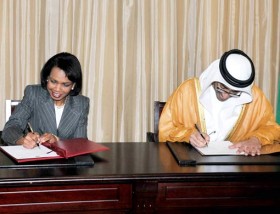
UAE and US sign agreement on peaceful uses of nuclear energy
By Samir Salama, Associate Editor, and Abbas Al Lawati, Staff Reporter
Published: April 21, 2008, 12:33
Manama/Abu Dhabi: The United States became the second country with which the UAE signed an agreement on peaceful nuclear energy cooperation yesterday, as the top US diplomat praised the UAE as a “responsible power”.
Foreign Minister Shaikh Abdullah Bin Zayed Al Nahyan and Condoleezza Rice, US Secretary of State, met on the sidelines of the GCC summit in Manama, where a memorandum of understanding on cooperation in the peaceful use of nuclear energy was signed. A similar agreement was signed with France in January.
“The UAE-US MoU represents an excellent example of cooperation the UAE hopes to forge with responsible nuclear supplier states. There are potential mutual benefits to both parties from deepening cooperation in the development of the UAE’s domestic nuclear energy sector,” said Shaikh Abdullah.
The Foreign Minister welcomed the prospect of negotiating a more extensive bilateral agreement with the US, which would establish the necessary legal basis for trade in significant nuclear commodities between the two countries.
“We are very supportive of what you are trying to do. As you know we think access to nuclear energy is very important. The UAE is a responsible partner and a responsible power,” Rice said at the signing ceremony.
Hamad Al Ka’abi, the Special Representative of the Ministry of Foreign Affairs for International Nuclear Cooperation, told Gulf News the agreement entails cooperation in developing nuclear infrastructure, training human resources and safeguarding of nuclear materials and facilities.
Al Ka’abi said the MoU does not provide for commercial contracts for American companies to build or operate nuclear plants.
Global initiative
He said the UAE will seek nuclear know-how from all responsible suppliers worldwide.
The government has also said it plans to establish a $100 million agency to look into developing nuclear energy to satisfy rising electricity demand.
GCC countries, the US, Egypt and Jordan said that they supported “the responsible and transparent development of civilian nuclear energy” in a statement.
Shaikh Abdullah also presented to his US counterpart a diplomatic note endorsing the Global Initiative to Combat Nuclear Terrorism.
– With additional inputs from Habib Toumi, Bahrain Bureau Chief, WAM and agencies
Adnoc’s unit eyes 1m bpd output by 2019
Adnoc’s unit eyes 1m bpd output by 2019
(Bloomberg) 5 April 2008
ABU DHABI — Abu Dhabi National Oil Co.’s offshore unit will raise output by two-thirds to 1 million barrels a day by 2019, said Ali Al Jarwan, general manager of the state-owned company known as Adnoc.
Abu Dhabi Marine Operating Co., in which Total SA, BP Plc and Inpex Corp. subsidiary Japan Oil Development Co. are shareholders, will raise output by 50 per cent within the next few years,” Al Jarwan said in an interview in the latest issue of the company’s Adnoc News magazine.
Adnoc plans to double gas production to supply the domestic
network, Al Jarwan said, without saying what current output is.
The United Arab Emirates produced 2.56 million barrels a day of oil in February according to Bloomberg data.
Total confirms partial stake by Chinese state-owned fund
Total confirms partial stake by Chinese state-owned fund
Bloomberg Published: April 04, 2008, 21:06
Paris: Total SA, Europe’s third-largest oil company, said a Chinese state-owned fund acquired a stake.
“A Chinese state-owned fund has built up a stake gradually over the past few months,” Total spokes-woman Patricia Marie said by phone on Friday from Paris. She declined to identify the fund or provide the size of the holding.
The Financial Times reported China’s State Administration of Foreign Exchange built up 1.6 per cent in Total, citing an unidentified person close to the Paris-based company.
Marie said Total welcomes the Chinese investment as a way to “diversify our shareholding and open up to China”.
“A stake in a multinational oil company like Total would give a reasonable return to the Chinese and is a good long-term investment,” Victor Shum, senior principal at Purvin & Gertz Inc. in Singapore, said on Friday.
There seems to be a good chance oil prices are going to stay hot
There seems to be a good chance oil prices are going to stay hot By Leah Bower, Special to Gulf News Published: April 01, 2008, 00:41
Summer is just around the corner, along with that seasonal hike in energy prices.
And since the traditional lull in oil prices that comes between winter’s cold and summer’s heat failed to, er, lull this year – we’ve seen record highs throughout the last month when the price per barrel should be at its lowest. And there seems to be a good chance that prices are going to stay hot, hot, hot.
We’ve heard it all before, but Opec and analysts are continuing to beat the “weak fundamentals” drum while prices shoot through the stratosphere.
For now, we can thank the unwelcome combination of the weak dollar and institutional investors searching for a safe haven as stock markets around the world fluctuate.
Commodities have become increasingly attractive as the United States economy officially slips closer to recession and the dollar continues to lose steam.
Witness gold spiking to an all-time high of $1,030.80 an ounce on March 17, and oil following suit with a record high of $111.80 a barrel at about the same time.
Even corn is seeing some record numbers. And with every price dip, talk surfaces that the bubble is bursting and prices will once again stabilise at reasonable levels.
However, if you watch the dips carefully they never go very low and are pretty short-lived.
Sure, oil is down a little at the start of the week. It has dipped a couple of times this year, but never very low and it has always shot back up.
Those investors who’ve been crowding into commodities also decided to shift gears a little on speculation that the US Federal Reserve might crack down on inflationary pressures, which could subdue the growth in commodity prices.
But all it took was a damaged pipeline in Iraq to send prices soaring last week, despite the fact that an insignificant – compared to overall Opec output – of black gold flows out of the war-torn nation.
There is no question that oil’s price is confounding, and even angering, everyone from Opec oil ministers to analysts who keep revising price projections downward, only to see their predictions pushed aside by what many are seeing as irrational investors.
Ali Al Yabhouni, the UAE Opec governor, pointed the finger at speculators earlier this week, telling an energy conference in Dubai that the market has sufficient supply of crude oil, and that Opec is not in the habit of catering to the appetites of investors.
Regardless of how you feel about Opec, and its current policy of keeping oil production at current levels, Al Yabhouni has a pretty strong point.
Why should Opec pump more oil when every indicator points to lower demand in the near future?
Reserves are rising and despite US President George W. Bush’s push for more crude on the market, the general consensus is that there is enough oil to go around despite strong demand from India and China.
Every indicator is also pointing to a recession in the United States. Studies show that American consumers are increasingly choosing to spend less as the housing market continues to head downwards, and eventually that will mean spending less at the pump.
Despite these factors, we’ve already seen the market climb towards and maintain what most analysts have considered an unreasonable price level, ignoring traditional fundamentals in the process.
Energy analyst Stephen Schork even vented to the Wall Street Journal that oil’s rise proves “once again that markets can remain illogical far longer than you or we can remain solvent.”
– The writer is a freelance journalist based in Alaska, USA.
- ← Previous
- 1
- 2
- 3
- …
- 13
- Next →
 ClicksandWrites
You must be logged in to post a comment.