HSE
Fine for jaywalkers upped by Dh150
Fine for jaywalkers upped by Dh150
By Adel Arafah (Our staff reporter) KHALEEJ TIMES 16 March 2008
ABU DHABI – The fine for crossing the street from non-designated places by pedestrians will go up from Dh50 to Dh200, Colonel Hamad Adeel Al Shamsi, Director of Traffic and Patrols Department at Abu Dhabi Police, told Khaleej Times recently.
The department had started to impose Dh50 as fine against violators from February but the amount had increased to Dh200 following the penalties stipulated by the black points system and the amended rules.
The fine would be paid by the jaywalker on the spot. In case he/she did not pay, the policeman would take away his/her identify card, which would be returned only after the offender paid the fine at the Traffic Department, he noted.
The Dh200 fine against jaywalking is being enforced throughout the country, he added.
Road horror in Abu Dhabi; casualties feared
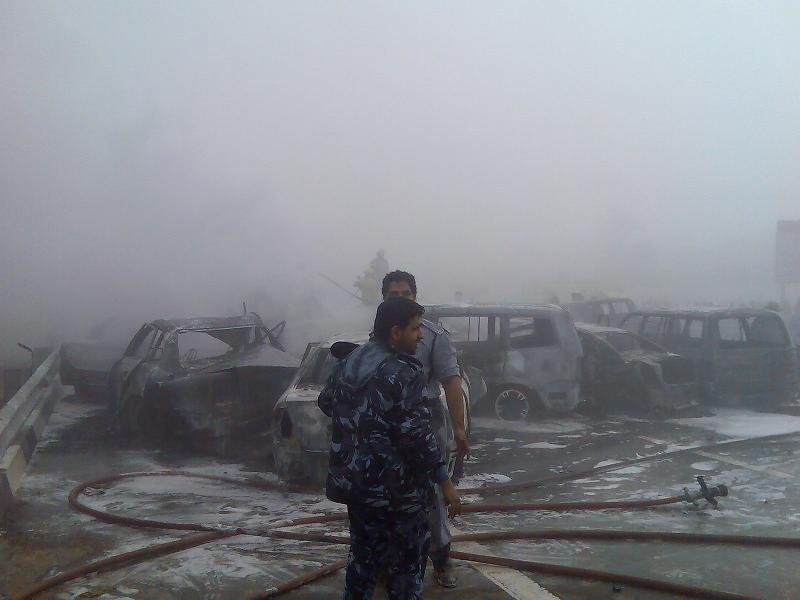
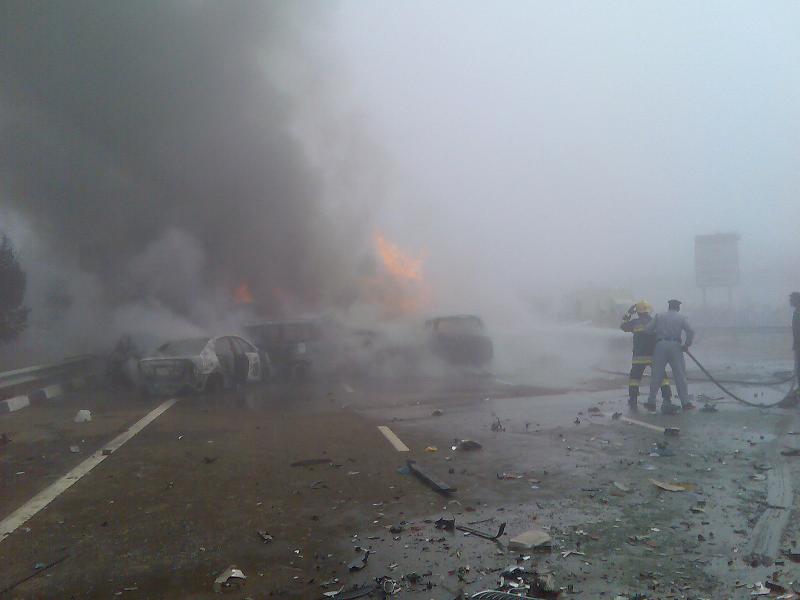

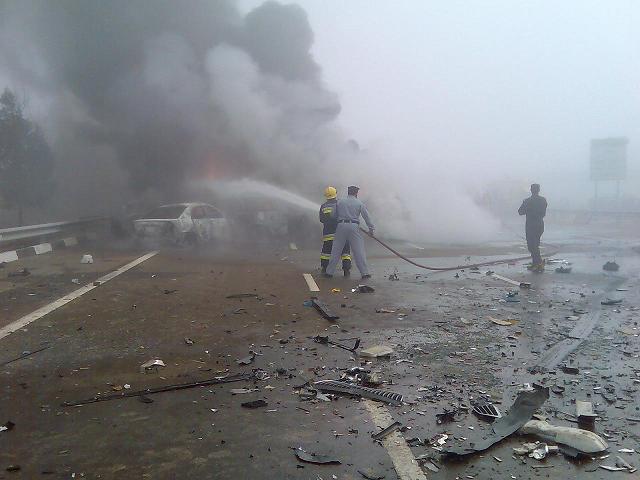
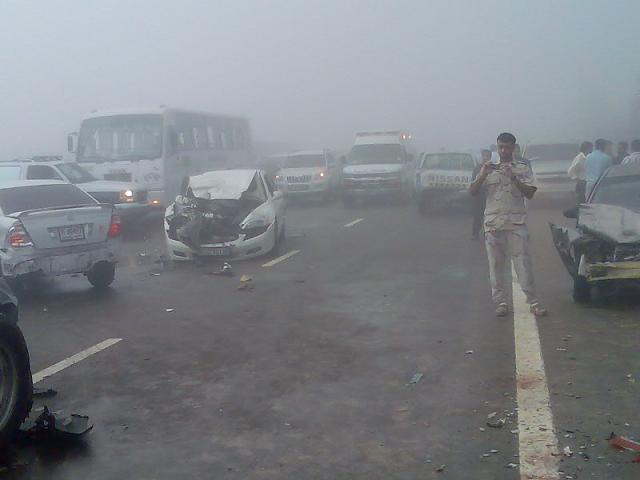



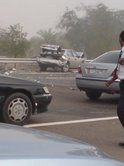
Road horror in Abu Dhabi; casualties feared
Staff Reporter KHALEEJ TIMES 11 March 2008
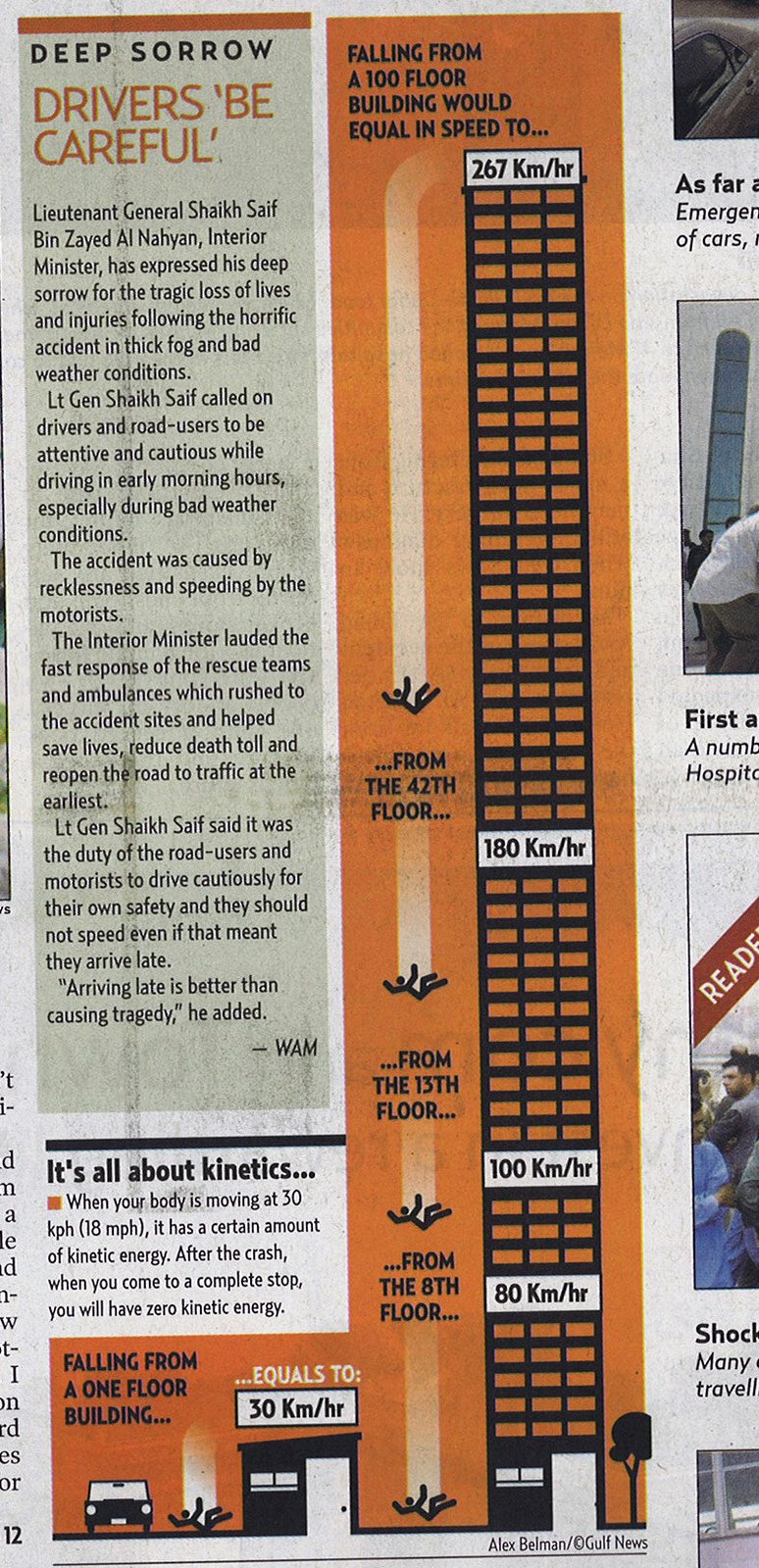
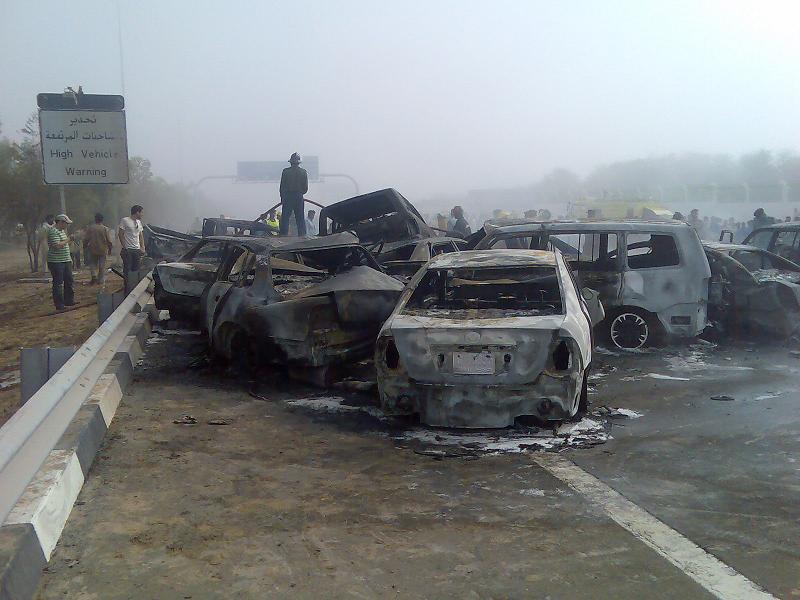
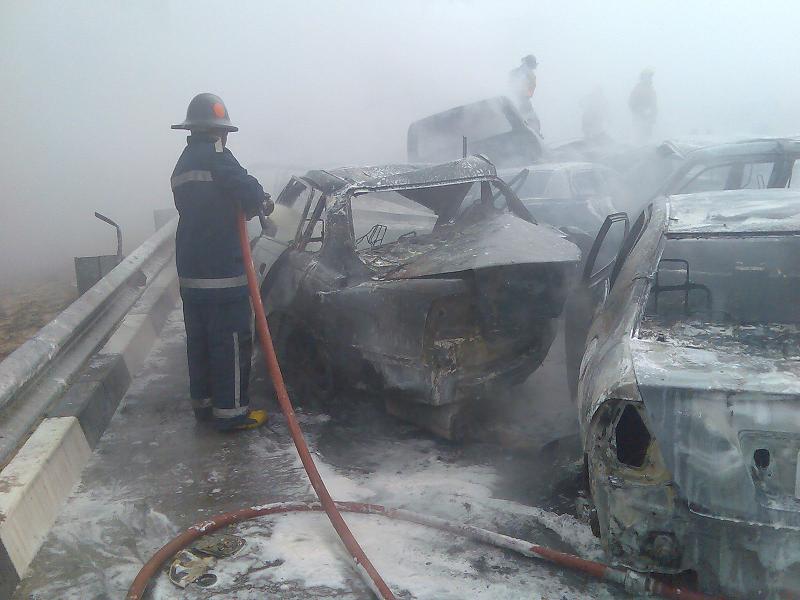
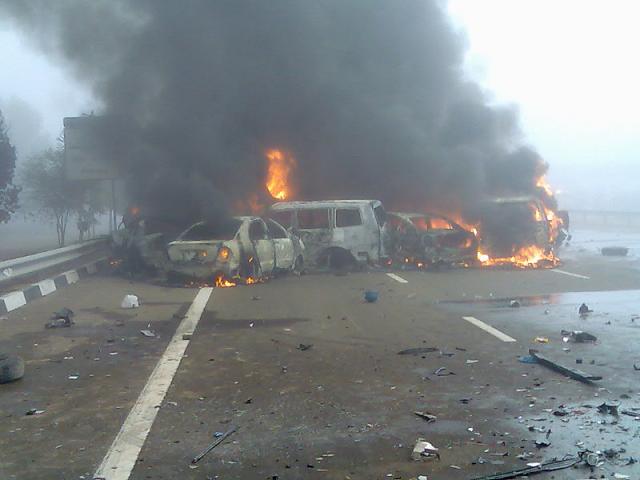
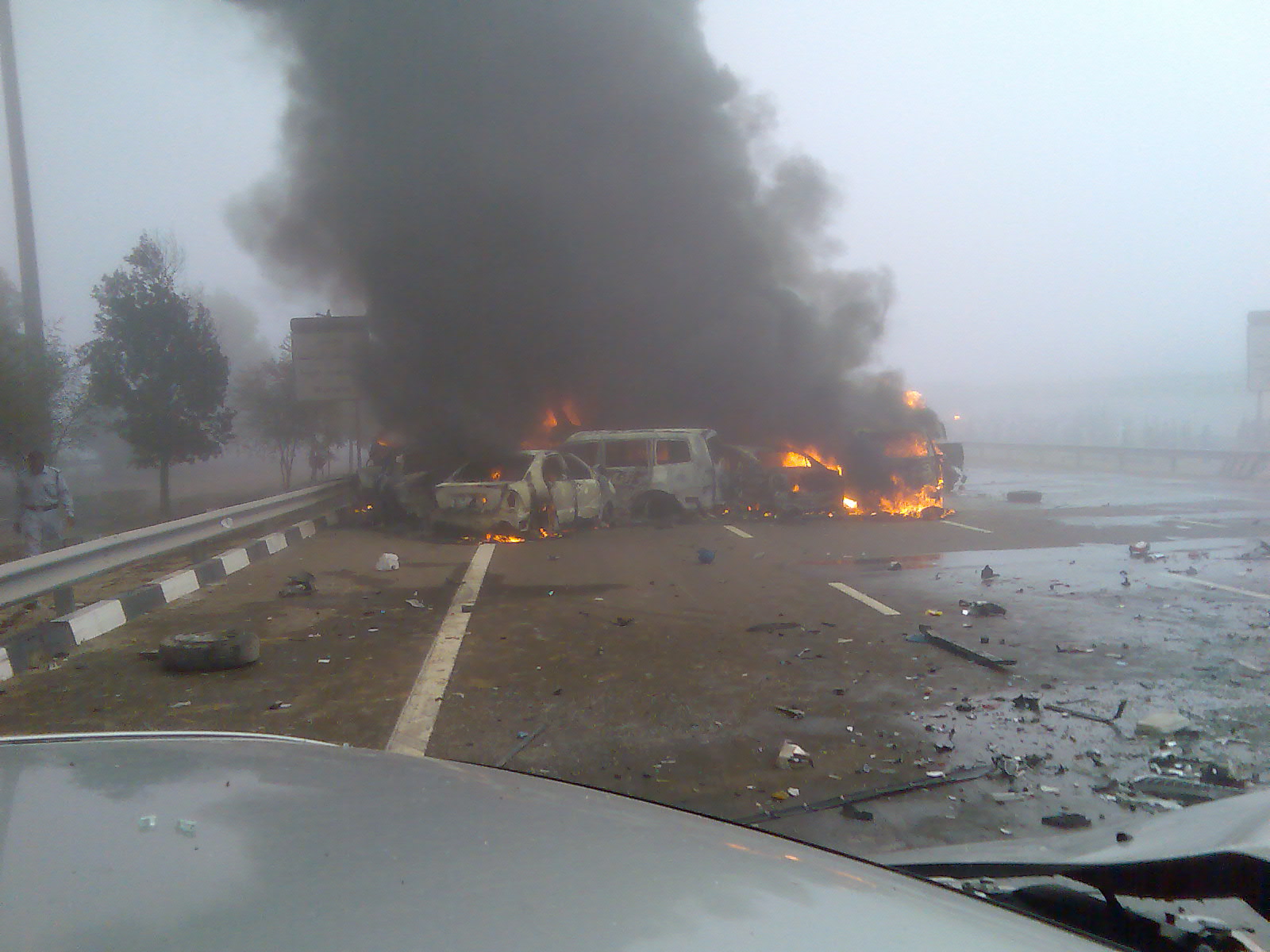
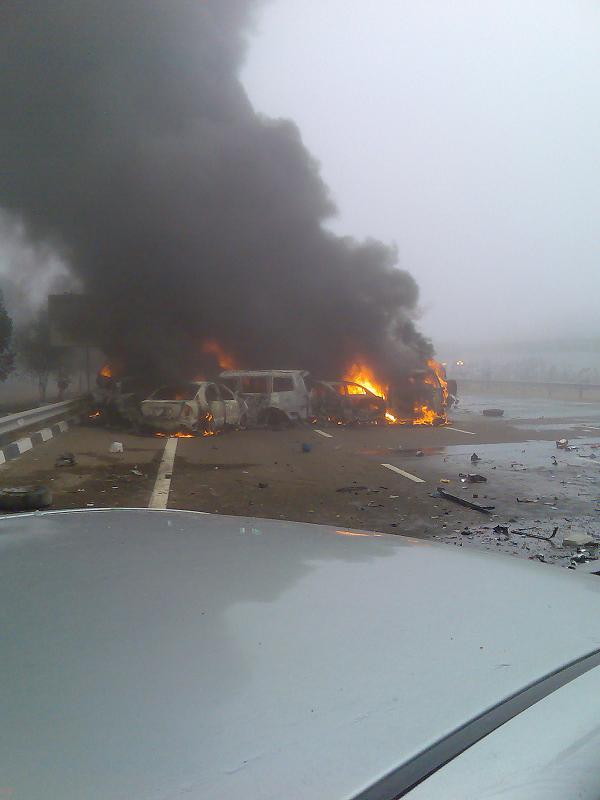
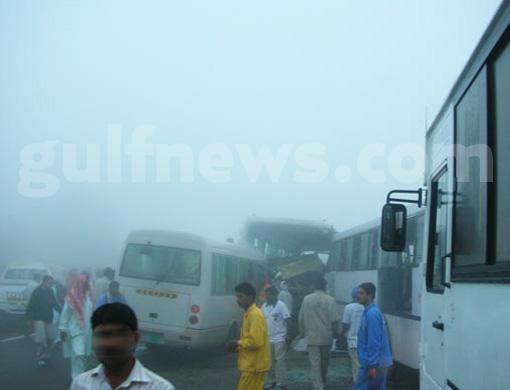
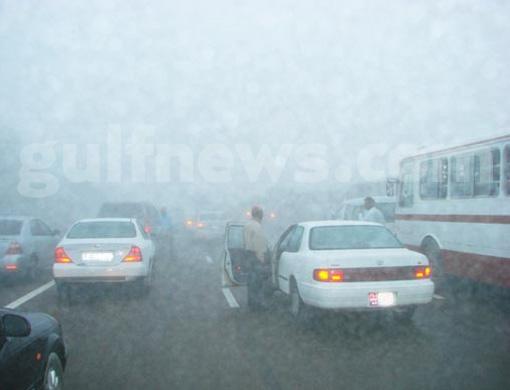
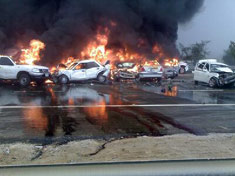
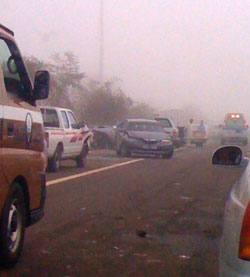
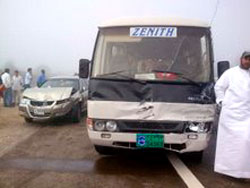
In what seems to be the worst accident to be ever recorded in the history of the United Arab Emirates, more than a 150 cars were involved in a massive pile-up on the Abu Dhabi-Dubai Road, that according to early estimates might have claimed more than ten people. About 40 were also reported injured.
The injured, some of them in critical condition have been rushed to the Khalifa Hospital. Rescue teams from Dubai and Abu Dhabi swung into action immediately as ambulances, helicopters and patrol cars were rushed to the scene.
Police sources have blamed poor visibility condition brought about by the fog for the crash.
Two eyewitnesses on the scene of the mishap recounted the tragedy as it unfolded before their eyes. Zeeshan Javed a regular commuter on the stretch says that he just escaped ‘by a whisker’ as the cars in front of smashed into each other. “It was a big pile up. I personally counted about eighty cars that had been wrecked beyond recognition. Even though emergency units were quick to respond the fact remains that there have been casualities. I have never seen an accident of this magnitude. Some cars that had caught fire were charred beyond recognition. This has to be the worst ever.”
Horrific accident on Abu Dhabi-Dubai highway near Ghantoot
Staff Report GULF NEWS Published: March 11, 2008, 10:35
Ghantoot: Many are feared dead after an horrific accident involving 31 cars blocked the Abu Dhabi to Dubai highway near Ghantoot.
Police have confirmed that there are fatalities and several injuries but have yet to say how many people were killed in the accident which happened on Tuesday morning.
Witnesses have said that three or four cars were on fire after the accident.
HSE Alert – Geyser – a home equipment to be handled with caution

HSE Alert – Geyser – a home equipment to be handled with caution
HSE Alert – Geyser – a home equipment to be handled with caution
A geyser provides a ready-to-use stock of hot water that can be set thermostatically to give a constant temperature, normally between 60-65°C, regardless of the outside temperature. Geysers are hard-working appliances – think of how much hot water you and your family use in a day. Geyser bursts can be dangerous and many times Geyser burst will be so powerful that all doors and windows along with door frames would be broken. It is also likely to cause cracks in the walls of the house.
The typical geyser installation is on the roof (preferably above the ceiling). In the event of a burst, water can pour down the ceilings, affecting light fittings, walls and furniture and furnishings in the room below.
In general, Geysers burst for a number of reasons – most often because of human error, that is, either due to:
– poor installation,
– the use of the incorrect valves,
– incorrect setting of thermostat
– wear and tear
– or the absence or plugging of safety and pressure-reducing valves
The burst usually happens because of an incorrect setting of the thermostat, which is an instrument used to control the heating temperature and the steaming pressure of the geyser. If the thermostat is badly regulated, it will incorrectly control the heating levels of hot water in the geyser, subsequently causing an explosion due to the amount of steam accumulated in the geyser.
Insurers all over the world has experienced many claims over the decades as a result of a burst geyser. Over the past few years, several people have been killed as a result of burst geysers and other accidents caused by poor plumbing installations.
In order to reduce these types of accidents due to lack of awareness, here are some handy tips to make sure your geyser won’t burst:
– Make sure you call a good plumber either to fix the old geyser, or to install a new one. The emphasis here is on the word ‘good’.
– It is always important to have a specialist to install your geyser to avoid a household disaster.
– Always take a proactive approach, if possible, by consulting a good plumber and instituting a preventative maintenance programme to protect the geyser and geyser valve. Timely anode replacement and a regular geyser-valve clean-up can save countless problems.
– If you use an unqualified plumber to install your geyser and it bursts, you are putting your life and the lives of others at risk.
– Have your geyser and pipes insulated, as well as the ceiling.
– Urgent action is needed if you hear a rumbling from the ceiling. This could be a signal that water in the geyser has begun to boil. Alternatively, steam may gush out when you open your hot-water taps.
– If these danger signals occur, switch off the geyser electrical isolator on the main distribution board.
– Now turn off the water at the main meter box. Most homes have a stopcock fitted to the inlet side of the geyser.
– If possible, look to see whether the geyser, the pressure-reducing valve or the pipes are leaking. This helps the plumber identify the problem.
– If a replacement geyser has to be fitted, it may also be advisable to fit a drip tray beneath the geyser. The tray’s outlet pipe will carry away a lot of the water in the event of a geyser burst at some stage in the future.
– If your geyser bursts, you should switch off the electricity mains immediately.
The reasons for this are twofold:
– Firstly, if the geyser element continues to heat up even if there is no water in the geyser, you could burn the house down. This is like switching on a huge, empty kettle.
– Secondly, water leaking from the geyser could get into electrical systems and cause a short circuit, and possible a fire.
– Find the water mains and switch it off. This will stop new water from running into the geyser and leaking all over your house. If you don’t know where your water mains are, make a point of finding it out today. You can phone the water department of the local municipality, but by the time they arrive, you might all be floating out the front door. So, do this check once you move in to a new apartment or house.
– If you are living in a flat, contact your neighbours, as water may be cascading into their flat. They don’t want to find that out when they step into three inches of water when they get up in the morning.
– If the area where the geyser burst is sopping wet, try and mop it all up with towels, mops or anything that is absorbent. You want to minimise damage to your floors and your furniture, or whatever else is close by.
– Buckets and plastic containers will also help to catch up some of the falling water.
– Although out of sight, the home’s plumbing system should never be out of mind, because when something goes wrong, the problem can take on nightmarish proportions. Consider the geyser, for example.
The shock of a workplace suicide
The shock of a workplace suicide
By Carole Spiers, Special to Gulf News Published: March 11, 2008, 00:41
A suicide in the workplace is fortunately a very rare occurrence. But when it does happen, it sets up uncomfortable guilt-feelings among the suicide’s colleagues, employers, friends and family, who all may wonder whether they could have done more, or anything, to prevent it.
This kind of agonising is a reaction that is very usual in such sad circumstances – but such guilty feelings are certainly inappropriate.
The ‘final straw’ that led to the irrevocable decision to take his or her own life, in most cases is never known. The suicide may have been triggered by events unconnected with work.
In all organisations, the most constructive course is to make a formal study of suicide intervention as part of routine stress-management training. Managers can be taught how to identify possible signs of a potential suicide; how to arrange counselling for any such vulnerable person; know what to say to the rest of the workforce in the event of such an incident; train your HR personnel to be aware and source specialist expertise from outside, when necessary.
An individual at risk of suicide may be depressed and withdrawn, unable to relate to those around them and increasingly liable to be absent from work. The risk is obviously greater in the wake of a traumatic event such as illness, bereavement, redundancy or when diagnosed as clinically depressed.
Unfortunately, a confusing factor is that a suicidal person can sometimes appear to be recovering from a desperate and depressed state of mind, when completely unexpectedly, they suddenly take their own life.
What, then, is the best kind of intervention? In principle, an acutely depressed and/or suicidal person, needs someone to be there for them, ready to listen patiently to what may or may not be a complex story, and to accept them as someone who is normal but who needs to be helped over what seems, to them, to be an unlivable-with position.
What they don’t need is a brisk pep-talk, a sermon, an appeal to ‘snap out of it’, or equally the too-easy reassurance that everything will be all right.
Sympathetic and attentive listening is essential – making the person feel they are being taken seriously. Experience shows that, in many instances, it is important to have access to the best professional back-up you can source.
The other day I was presented with the case of a van-driver who had tried to hang himself in his van – which, had he succeeded, would have involved his employers in a full inquest. By moving immediately into our emergency procedure, we were able to minimise the chance of another attempt. We provided immediate crisis intervention support, including access to a 24-hour counselling hotline. We also briefed his line-manager on how best to handle this particular situation, which had, in fact, been sparked by the recent suicide of the driver’s own son, for which he blamed himself.
Key points: Caring for lives
Identifying suicidal symptoms in advance can be formally taught.
Sympathetic and attentive listening is essential.
Expert professional backup should be ready to deploy, without delay, when necessary.
– The writer is a BBC broadcaster and motivational speaker, with 20 years’ experience as CEO of Carole Spiers Group, an international stress consultancy based in London.
Driving tips for foggy weather
Driving tips for foggy weather
By Alia Al Theeb, Staff Reporter, GULF NEWS Published: March 11, 2008, 16:35
Here are a few driving tips that everyone should follow to avoid accidents in this foggy weather:
* Ask yourself if your journey is really necessary before driving in thick fog.
* Avoid travelling in a car if you can.
* Make sure the headlights and the front windows of the car are clean before starting the journey.
* Reduce speed, leave enough space between vehicles and avoid overtaking.
* Do not change lanes unless necessary.
* Turn on headlights (but low beams only).
* Avoid turning on hazard lights, except in emergency cases. Using hazard lights all the time prevents a motorist from alerting other motorists to an emergency.
* Turn on the appropriate fog lights when driving.
* Make sure the window wipers work properly to constantly clean the window and have clear visibility.
* Be aware at all times for danger such as a vehicle suddenly braking in the front or another vehicle entering from a side entrance. This means not using mobile phones when driving, for example.
* Allow more time to complete a journey, especially during low visibility.
Drunk drivers face court and Dh20,000 in fines
Drunk drivers face court and Dh20,000 in fines By Alia Al Theeb and Rayeesa Absal, Staff Reporters GULF NEWS Published: March 02, 2008
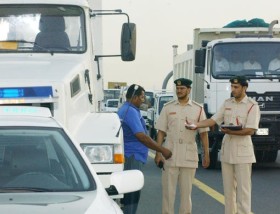
Dubai/Abu Dhabi: Starting on Saturday, police across the UAE began implementing a federal traffic law which introduces harsher penalties for traffic violations.
Lieutenant General Shaikh Saif Bin Zayed Al Nahyan, Minister of Interior, said the new law and the black point system, which were recently endorsed by the UAE’s leadership, aim to curb accidents resulting from indisciplined driving and speeding.
Brigadier Mohammad Saif Al Zafein, Director of Dubai Traffic Department, told Gulf News that the new law protects road users from motorists who violate rules and endanger lives of others.
He said the punishment for drunk driving stands revised at a Dh20,000 fine and possible jail term.
“Updating laws is normal and is also necessary so as to keep pace with the new developments in all domains for the sake of the nation’s higher interest,” Shaikh Saif was quoted as saying by WAM.
As per the new law, the black point system for traffic offences has been implemented across all the emirates aiming to cut down the number of deaths due to traffic accidents.
Last year alone, 1,056 people lost their lives in road accidents in the UAE.
As the law became effective all over the country, Dubai Police’s Traffic Department on Saturday also started implementing it in the emirate.
Dubai Police’s Traffic Department has intensified patrols and implemented strict penalties.
Brigadier Al Zafeinsaid motorists need special traffic education and called on motorists and family members who have more than one car or drivers to inform the drivers of the new law.
Fines can now be issued on the spot and in absentia.
Brigadier Al Zafein said the traffic department will send letters to the owners of offending vehicles, who will be given a month’s time to reveal the name of the person who was driving the vehicle when the offence was caused. If the owner fails to do so, the vehicle will be confiscated.
Motorists can object to the fines at the traffic department and an investigation will be launched.
The maximum number of black points a motorist can incur in a year is 24 at which point the licence is suspended. Once a person collects 24 black points, the licence will be suspended for three months.
If a motorist collects 24 points for the second time, the licence will be suspended for six months.
If it happens a third time, the licence will be taken away for a year and will not be returned until the driver passes a training course from an institute authorised by the traffic department.
The black points a person incurs will be cancelled the following year on the same date.
Senior Interior Ministry officials said if a motorist has collected many black points and feels that his licence could soon be taken away if he accumulates 24 points, then he can take a training course at an authorised driving institute. Police will then remove eight points. The option can be utilised only once a year.
Besides the black point system, another major change is that the minimum fine for serious traffic offences has been fixed at Dh20,000. Besides the fine, the penalty may or may not include a jail term.
Lieutenant Colonel Saif Al Mazroui, acting deputy director of Dubai Police Traffic Department, said the department organised lectures for traffic policemen on the new law.
On road: Charges hiked
Salah Bu Faroosha, Traffic Public Prosecutor, said the traffic public prosecution has changed the traffic charges according to the new federal law that came into effect on Saturday.
Bu Faroosha said the new punishment will be implemented for the offences that have been committed since it came into effect yesterday, while they will not be implemented on offences and accidents that took place before the changes came into effect.
He said the implication of the hard shoulder changed according to the new law, and it cannot be used on internal roads or highways, except in emergencies. Bu Faroosha said driving under the influence of alcohol or drugs now draws stricter punishment.
He said any motorist who drives under the influence of drugs, even with a doctor’s prescription, will be prosecuted in case of causing a road accident or damages to others.
Traffic law violators may face deportation
Traffic law violators may face deportationBy Adel Arafah (Our staff reporter)KHALEEJ TIMES 2 March 2008
ABU DHABI — The Minister of Interior can order deportation of expatriate violators of the new federal traffic law and the black points system that came into effect yesterday, a senior official has clarified.
The deportation as a penalty for some cases of violation has been incorporated in the amended law on the instructions of Lt-Gen. Shaikh Saif bin Zayed Al Nahyan, Minister of Interior.
Lt-Gen Saif Abdullah Al Shafar, Under-Secretary of the ministry, said at a Press conference here, “Deportation is a penalty which the minister can enforce against rash motorists who pose a danger to public safety.
“Shaikh Saif is keen about the safety of the public. His order to deport truck drivers whose vehicles dropped rocks on the roads fell within this context. The minister can enforce this penalty when it deems necessary.”
Al Shafar was replying to a question raised by this reporter about the possible enforcement of deportation on frequent violators who drive dangerously and put the lives of road users at risk. The amended traffic law aimed to restrain the rash motorists and reduce traffic accidents.
Al Shafar said a motorist had to become a self watcher now. He/she must be eager not to commit any violation due to the newly fixed tough penalties, he said, adding the ministry had launched awareness campaigns in cooperation with the traffic departments nationwide to spread awareness about the new law and the black points system.
Meanwhile, Colonel Ghaith Al Za’abi, Director of the Department of Traffic, Ministry of Interior, detailed the mechanism of implementing the new traffic law and the black points system.
He said: “The e-link between all emirates of the country is our best instrument to put the new system in place.”
Under the e-system, he explained, the traffic police would register the offence and send it to the traffic department which would, in turn, transmit it through the e-visual sender to all traffic departments. An SMS would be sent to the offender notifying him/her about the type of the violation and the number of black points.
Engineer Mohammed Al Dali of the Abu Dhabi Municipality said, “I think the black points system will make motorists more compliant with the traffic rules. The matter goes beyond paying fines to registration of black points on the motorist’s traffic record.”
Use of seatbelts in back seats may be made compulsory
Use of seatbelts in back seats may be made compulsory
By Alia Al Theeb, Staff Reporter GULF NEWS Published: February 24, 2008, 23:29
Dubai: Police are working with the Interior Ministry to issue a law that considers making not wearing seatbelts in the back of a car an offence, a senior police official announced on Sunday.
Brigadier Mohammad Saif Al Zafein, Director of Dubai Police’s Traffic Department, did not elaborate on the issue, but stressed the importance of wearing seatbelts at all times. Currently, only front seat passengers need to wear seatbelts by law.
Police issued around 25,520 offences for not wearing seatbelts in 2007 with an average of 2,126 offences monthly. Brigadier Al Zafein announced the launch of a two-week awareness campaign on wearing seatbelts which began yesterday.
Awareness
He said awareness regarding wearing seatbelts had started going down and the number of motorists who now wore seatbelts was only 50 per cent. Brigadier Al Zafein revealed that 332 people were killed in traffic accidents last year and it is estimated that 40 per cent of those victims in collisions were not wearing seatbelts.
He pointed out that 16 per cent of people who were killed in accidents where cars flipped over in 2007 were not wearing seatbelts. The fine for not wearing seatbelts is Dh100 and three black points. The law fines the motorist and the passenger sitting next to the motorist.
“We are coordinating with the Interior Ministry to issue a law that considers not wearing seatbelts in the back seat a punishable offence,” Brigadier Al Zafein said.
He said the first week of the campaign would focus on spreading awareness on the importance of wearing seatbelts and the importance of using child car safety seats.
The second week will focus on road control and issuing fines to offenders.
“Seatbelts do not prevent accidents but they do reduce the damage to the lowest levels,” Brigadier Al Zafein said.
He pointed out that traffic police issued 14 fines to motorists who allowed children under 10 to sit in the front of cars.
Lieutenant Colonel Dr Jasim Mirza, Director of Dubai Police’s Security Awareness Department, said the focus of the campaign would be on educating schoolchildren.
Dubai Police’s Traffic Department launched the campaign in coordination with the Santis HSE Group, a Global Health, Safety and Environment Consultancy and Gargash Enterprises.
Santis HSE Group and Gargash Enterprises officials will take the campaign to schools, streets and shopping malls in Dubai to promote safety and give out complimentary child car seats and car safety packages.
 ClicksandWrites
You must be logged in to post a comment.