HSE


India third biggest CO2 emitter
India third biggest CO2 emitter Mathrubhumi English edition
Miami:India is the third biggest emitter of carbon dioxide in the world, with state-owned NTPC topping the list of companies belching the deadly gas, according to new data released by a Washington-based think tank which has advocated an ‘energy revolution’ in the country based on solar power.
The Center for Global Development (CGD) said that India figures at the third position in the list of biggest CO2 emitters through power generation after China and the United States. When contacted, NTPC officials said in Delhi, ‘We are among the most efficient producers of power using fossil fuels. NTPC is the second best in the world, emitting only 800 grams of CO2 per kwh of electricity generation.’
Out of 638,000,000 tons of CO2 emission by India every year, NTPC alone contributes for 186,000,000 tons which constitutes about 30 per cent of the total gas release, the data revealed and Talcher power plant in Orissa operated by the company has the notoriety of emitting the biggest quantity of CO2.
As many as 16 power plants, operated by NTPC, one of the Navratna companies of India, are in CGD’s ‘Red Alert’ category for spewing out the deadly gas in the country. The findings, part of a recent report by CGD on ‘China surpassing the US as the world’s biggest emitter of CO2 from power generation’, also name Russia, Germany, Japan, UK, Australia, South Africa, and South Korea among the world’s top-ten power sector emitter in absolute terms.
Describing the recent data as a ’cause of serious concern’, CGD said the climate scientists warn that the amount of CO2 and other greenhouse gasses in the atmosphere must be quickly stabilised to avert climate catastrophe, which will hit first and worst in the developing world, with declining agricultural productivity, droughts, floods and rapid sea level rise hitting densely populated, low-lying regions.
‘A number of power companies have expressed desire for national policies to limit emissions and promote alternative energy,’ Kevin Ummel, who manages CGD’s Carbon Monitoring for Action (CARMA) database, told. ‘But without financial incentives for big emitters to change their behaviour, they will continue operating and building carbon-intensive plants – and Earth’s climate moves closer to the breaking point,’ Ummel said.
The new data shows that emissions from power generation are racing in the wrong direction, says CGD senior fellow David Wheeler. ‘We urgently need to cut power related CO2 emissions and to very rapidly bring down the price of proven, zero-carbon renewable power sources, such as wind and solar’.
The NTPC official also said that coal is being used as a main fuel, so CO2 emission is natural ‘but our effort is that it is produced in an efficient manner to produce minimum CO2’.
Pointing out that India and other developing countries have not presented any specific emission targets or timetable in last month’s climate-themed G-8 Summit, Ummel said Prime Minister Manmohan Singh in his speech had assured of pooling all scientific, technical and managerial talents in the country, with financial sources, to develop solar energy as a source of abundant energy to power India’s economy and to transform the lives of people there
Khaleej Times bags award for Ad Series on Traffic Safety

Know Safety No Pain – campaign by Dubai Municipality
Know Safety No Pain – campaign by Dubai Municipality
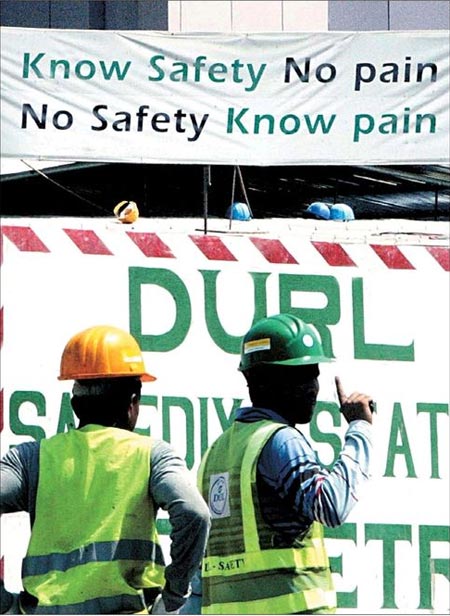 ‘Safety at work’ is being stressed currently by the Dubai Municipality and its allied departments. A slogan put up at a Dubai Metro construction site on Khalid Ibn Waleed Road highlights the theme of the campaign. – ‘Know safety, No Pain and No Safety, Know Pain. – Photo by Mukesh Kamal KHALEEJ TIMES
‘enYironmend’ tomorrow
‘enYironmend’ tomorrow
Monday August 11 2008 02:23 IST Express News Service KOCHI
KOCHI: The Young Indians (Yi) Kochi Chapter will launch their ‘enYironmend’ with a day-long mega event on August 12 at Rajiv Gandhi Indoor Stadium. The programme includes competition for the school students from standard 3 to 9.
There will be four categories of competitions including Poster Making, Public Speaking, Jungle Making, and Innovation. Around 3,000 students from various schools in the Cochin Corporation limits will participate.
The initiative website http://www.enyironmend. com carries details regarding the competitions and rules and regulation to be followed. There is no registration fee. Interested participants can register online by sending mail to enyironmend @gmail.com or contact Young Indians office at 0484-4012300.
Minibuses will have their speeds limited, say Dubai police
Minibuses will have their speeds limited, say Dubai police
By Alia Al Theeb, Staff Reporter GULF NEWS Published: July 29, 2008, 00:05
Dubai: Minibuses will soon be fitted with speed limiting devices, a senior police official said on Monday.
Brigadier Mohammad Saif Al Zafein, Director of Dubai Police’s Traffic Department, on Monday held a meeting with representatives of more than 50 companies that own or rent minibuses. The open discussion aimed at pinpointing the problems and the reasons behind the increasing number of traffic offences and accidents involving minibuses.
Check at 100km/hr
Brigadier Al Zafein said there is a plan to install speed limiters in minibuses which will prevent drivers from exceeding the speed of 100km an hour.
He said there is coordination between the traffic department and the Roads and Transport Authority (RTA) regarding this plan which will contribute in reducing fatal accidents.
“Most minibuses which were involved in fatal accidents and resulted in high number of victims were speeding excessively which does not suit the vehicle’s nature,” he said.
He pointed out to the minibus accident which took place on Shaikh Rashid Road two weeks ago and claimed five lives.
“The driver of that minibus was speeding at 140km/hr to 160km/hr,” he said. He said in the next phase, they will meet with drivers of minibuses.
Brigadier Al Zafein said the traffic department confiscated 65 minibuses as part of a campaign launched to crack down on offences committed by minibus drivers. The vehicles were confiscated for 30 days for reckless driving and overloading with passengers.
Offence: ‘Most are reckless’
Brigadier Mohammad Saif Al Zafein, Director of Dubai Police’s Traffic Department, said according to him 99.9 per cent of minibus drivers are reckless drivers and they commit four common offences which are, excessive speeding, changing lanes without indications and not abiding by lane lines, overloading of passengers and tailgating.
Temperature shoots up to 52 degree Celsius in Al Ain and other parts of UAE
Temperature shoots up to 52 degree Celsius in Al Ain and other parts of UAE By Aftab Kazmi, Bureau Chief GULF NEWS Published: July 14, 2008, 15:02
Al Ain: Ground temperatures have shot up beyond 52C in Al Ain and other inland desert cities as south-easterly winds pump in scorching air from the Empty Quarter, said weathermen.
Dry and extremely hot conditions, particularly in the open, are unbearable, said residents as doctors advised people to take precautions to avoid heat related illnesses.
The Dubai Met Office yesterday reported a maximum temperature of 47C in some parts of the city. The conditions are much worse in Al Ain, Jebel Ali, Minhad, and some interior cities where the mercury has jumped to 49C. The dry south-easterly winds have also reduced humidity level.
The National Centre of Meteorology and Seismology (NCMS) has warned of extremely hot weather that may continue up to Friday.
The temperature is above the normal usually during this month and weathermen see no respite in heat for the next few days.
With the difference in the atmospheric and ground temperatures, rumours are rife that the Met Office is deliberately showing a lesser temperature in the official reports.
People also believe that the World Health Organisation (WHO) recommends suspension of work once the temperature goes above 50C.
“This is an allegation as we are neither hiding the actual temperature nor have the authorities instructed us to hide it,” said Dr S.K. Gupta, a duty forecaster at Dubai Met Office.
He said the reports are of the atmospheric temperature and that is always different from ground level temperature.
Dr Gupta said ground temperature is always misleading since it depends on the type of the surface. “It varies on wooden, cement, metallic, sandy and rocky surfaces,” he said.
Explaining the phenomenon, Dr Gupta said: “[Yesterday] the general temperature in Dubai is 45C at 12pm but the ground level is showing two to three degree higher reading at two runways of the Dubai airport.”
‘No WHO restrictions’
Dr Jean-Luc Vaillant, a consultant in family medicine at a government hospital in Al Ain, has denied any UN or WHO restriction on work in extremely hot temperatures.
“It is the responsibility of individual countries and local authorities to take occupational safety measures,” he said. The UAE government has already introduced suspension of construction work during the hottest hours of the summer days.
There are, however, recommendations of a WHO scientific group on health factors involved in working under conditions of heat stress.
It said: “It is inadvisable for deep body temperature to exceed 38C [100F] in prolonged daily exposure to heavy work. In closely controlled conditions the deep body temperature may be allowed to rise to 39C [102.2F].”
Dr Vaillant said body temperature increases sharply when a person continuously involves in strenuous work in hot temperature.
“During temperatures as high as 50C, workers should avoid direct sun exposure, especially during warmer period [10:00 to 15:00],” he said.
“Yet all these measures are insufficient if workers are constantly exposed to heat. With a body temperature above 39C the patient is at risk of multiple organ failure and may die if not promptly treated. So regular cooling period [during which workers can also have fluids] is mandatory. This off course must happen in a shaded and if possible ventilated area,” said Dr Vaillant.
How to beat the summer heat
– Drink 3 litres of water or fruit juices every day to avoid dehydration.
– Avoid soft drinks and alcohol.
– Use plenty of sun creams for protection from the sunshine. Check the sun protection factor of the sun block cream.
– Wear a vest inside to absorb the sweat.
– Get a good pair of sunglasses to protect your eyes.
– Get a good chap stick for the cracked and dry lips.
– Cut down on meats and eat salads.
– Weakness, mental confusion, and nausea are signs of heat stress.
First aid
– If someone is unconscious and has very high body temperature, he must be brought to hospital quickly.
– Meanwhile, bring down the body temperature by spraying cold water on the affected person.
AD Municipality, MoL to implement new safety standards
AD Municipality, MoL to implement new safety standards
By Ahmed Abdul Aziz (Staff reporter / KHALEEJ TIMES) 13 July 2008
ABU DHABI – The Abu Dhabi Municipality recently organised a one-day workshop on the occupational health and safety standards for representatives of more than 30 contracting companies in Abu Dhabi and Al Ain, according to a senior official at the municipality.
‘The workshop aimed at completing a survey on the work sites to ensure implementing the safety measures to save the workers’ lives and protect their health,’ said Ibrahim H. Baqer, Director of Safety and Quality Department at the municipality.
Baqer told Khaleej Times that the Head of Occupational Safety and Health at the Ministry of Labour (MoL) and directors from 31 leading construction and contracting companies in the emirate attended the workshop.
He added the efforts on improving the safety standards in the emirate are in line with the Abu Dhabi 2030 strategy.
Tom Banies, Senior Health and Safety Engineer (HSE) at the municipality, said, ‘The aim of the survey is to understand how you can manage the entities to ensure the safety at the companies and to create a tool to manage the work environment.’
Twenty teams, each having three HSEs, would conduct the survey at the sites. The survey’s results would be available by the end of August this year.
Meanwhile, sources at the MoL affirmed that the Abu Dhabi’s Occupational Safety and Health Office will add the new suggested evaluation items to the inspection sheets.
More than 50 items have been identified for evaluation to implement the new safety standards.
They include site offices and welfare, fire precautions and evacuation, safe working on roofs, employers’ liability insurance compensation certificate, designers’ workplace hazards and risks assessment, pre-construction information and phase plan, highway traffic management, first aid specialists and noise level at the work site.
Police call for compulsory fog lights
Police call for compulsory fog lights
Matt Kwong for THE NATIONAL
ABU DHABI // Fog lights capable of penetrating dense early-morning haze should be mandatory for all vehicles to reduce the high accident rate, a new police report suggests.
“All cars in the UAE must have fog lights because we have this exceptional weather here,” said Yousif al Katheeri, a warrant officer who drafted the report. “Front fog lights should be in all cars, even Japanese ones. It doesn’t take much to install them and it could save so many lives and reduce so many accidents.” A 200-car pileup on the motorway between Abu Dhabi and Dubai on March 11 claimed four lives and left dozens of others injured.
Mr Katheeri said the scale of that accident – blamed on reckless driving and early-morning fog – convinced him that better headlights on cars could have saved lives that day.
“European cars are all already using fog lights,” he said. “Making them compulsory in the UAE could be very useful, so I’m ready to submit it [the report] to the traffic unit.”
Regular headlights dazzle other motorists in foggy conditions, but fog lights, which are mounted lower, increase visibility by projecting concentrated beams of light closer to the ground. Fog usually hovers between 30 and 45 centimetres above the surface.
Rear fog lights also increase the visibility of cars to traffic approaching from behind, and are considered to be better than four-way hazard lights.
Currently, all cars in the GCC are required to have a warning buzzer that sounds when the driver exceeds 120km/h, said Alan D’Souza, a business development manager for the Hertz rental car company in Dubai.
“But there is no mention of fog lights in the GCC specs – nothing at all yet,” said Mr D’Souza. “They might save lives when they’re used at the right time and at a safe distance. Still, there are a lot of factors to consider.”
Newer European cars all have the safety feature, he said, and both front and rear fog lights are mandatory in many parts of the continent.
“But it is a cost element for Japanese carmakers,” he added.
Drivers also have to know when to use the special headlights, he said. “Some people have fog lights but don’t even know where the switch is, or some don’t even know they have them.”
One motorist, Clive Mantell, from London, said putting fog lights on cars already in the UAE would be a “pain in the neck”, but also a welcome move.
“I think it’s to be applauded,” he said.
“It’s a bit surprising it’s taken this long [for a report] because the weather isn’t a new thing. I hope drivers get assistance from the manufacturers because this is an excellent idea.”
He added: “I used to live in Germany during the 1970s, when we had to have fog lights. You just weren’t licensed to drive unless you had those lights, so we just installed them.”
He called the thick fog “one of the most extraordinary aspects” of his experiences living in the UAE. “I’ve seen more foggy days than in my last four years living in London and The Hague, [which are] reputedly foggy cities.”
However, the main cause of most accidents seems to be reckless driving, Mr Mantell said. “Let’s be clear. The rear fog light isn’t going to stop all accidents. When the fog comes down, a good proportion of people just put on their four-way lights, continue speeding along and keep their fingers crossed. That needs to change first.”
mkwong@thenational.ae
 ClicksandWrites
You must be logged in to post a comment.