Digging for gold in waste bins — what’s our role to change this?
Gulf News
My Letters – GULF NEWS – Dt. 28.0.50.2010 – Pray for the departed
My Letters – GULF NEWS – Dt. 28.0.50.2010 – Pray for the departed

Speak your mind – GULF NEWS – Be Heard – Dt. 14.05.2010 – Fixing the problems in schools
Speak your mind – GULF NEWS – Be Heard – Dt. 14.05.2010 – Fixing the problems in schools
country’s future lies with the youth and their development
By Ramesh Menon, Gulf News reader Published: 19:38 May 13, 2010
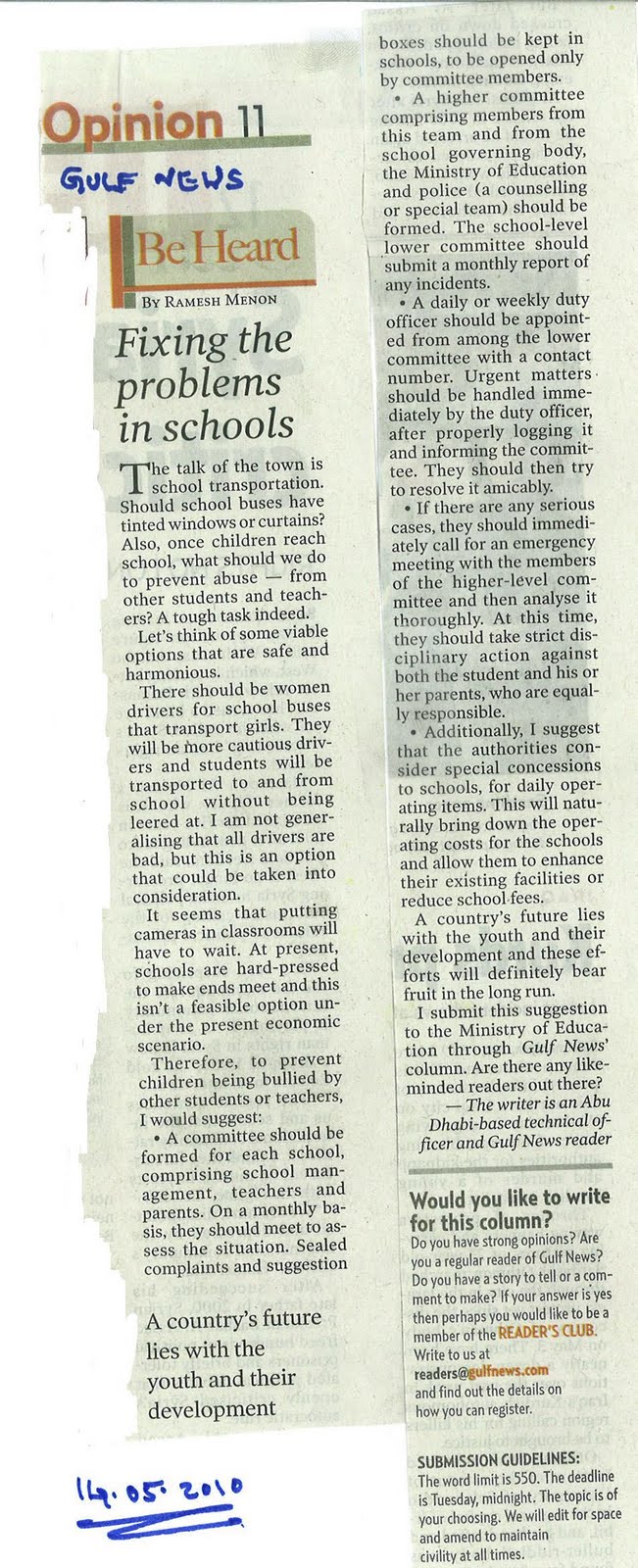
The talk of the town is school transportation. Should school buses have tinted windows or curtains? Also, once children reach school, what should we do to prevent abuse — from other students and teachers? A tough task indeed.
Let’s think of some viable options that are safe and harmonious.
There should be women drivers for school buses that transport girls. They will be more cautious drivers and students will be transported to and from school without being leered at. I am not generalising that all drivers are bad, but this is an option that could be taken into consideration.
It seems that putting cameras in classrooms will have to wait. At present, schools are hard-pressed to make ends meet and this isn’t a feasible option under the present economic scenario.
Therefore, to prevent children being bullied by other students or teachers, I would suggest:
• A committee should be formed for each school, comprising school management, teachers and parents. On a monthly basis, they should meet to assess the situation. Sealed complaints and suggestion boxes should be kept in schools, to be opened only by committee members.
• A higher committee comprising members from this team and from the school governing body, the Ministry of Education and police (a counselling or special team) should be formed. The school-level lower committee should submit a monthly report of any incidents.
• A daily or weekly duty officer should be appointed from among the lower committee with a contact number. Urgent matters should be handled immediately by the duty officer, after properly logging it and informing the committee. They should then try to resolve it amicably.
• If there are any serious cases, they should immediately call for an emergency meeting with the members of the higher-level committee and then analyse it thoroughly. At this time, they should take strict disciplinary action against both the student and his or her parents, who are equally responsible.
• Additionally, I suggest that the authorities consider special concessions to schools, for daily operating items. This will naturally bring down the operating costs for the schools and allow them to enhance their existing facilities or reduce school fees.
A country’s future lies with the youth and their development and these efforts will definitely bear fruit in the long run.
I submit this suggestion to the Ministry of Education through Gulf News’ column. Are there any like-minded readers out there?
— The writer is an Abu Dhabi-based technical officer and Gulf News reader
To read it in original, please visit GULF NEWS online.
My Letters – GULF NEWS – Increase in prices
My Letters – GULF NEWS – Increase in prices
 To read my letters to the news, please bookmark and visit Letters to the Editor
My Opinion : Gulf News – Dt 25.04.2010 – Recycling should replace scavenging
My Opinion : Gulf News – Dt 25.04.2010 – Recycling should replace scavenging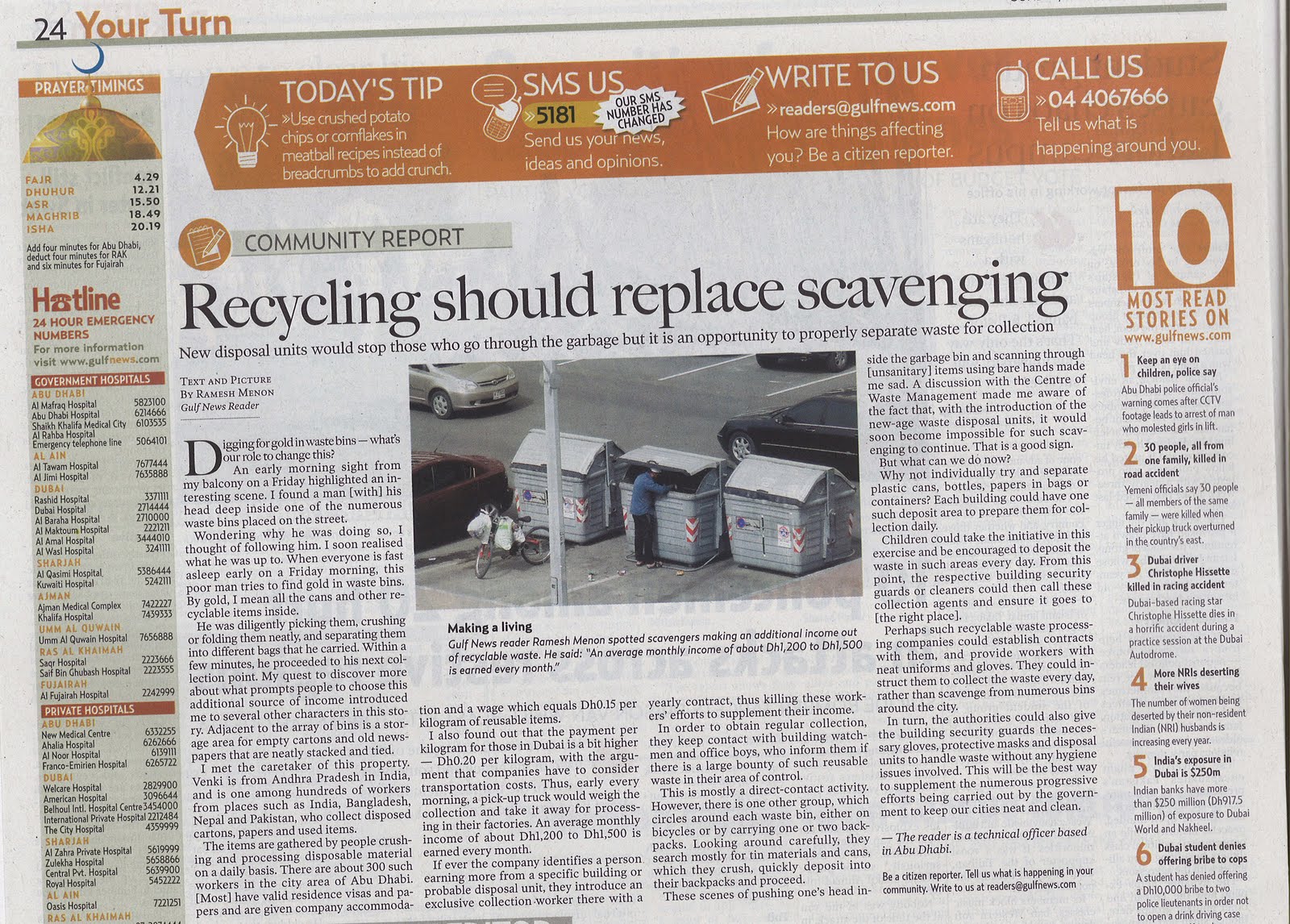
To read my letters to the news, please bookmark and visit Letters to the Editor
An early morning sight from my balcony on a Friday highlighted an interesting scene. I found a man [with] his head deep inside one of the numerous waste bins placed on the street.
Wondering why he was doing so, I thought of following him. I soon realised what he was up to. When everyone is fast asleep early on a Friday morning, this poor man tries to find gold in waste bins. By gold, I mean all the cans and other recyclable items inside.
He was diligently picking them, crushing or folding them neatly, and separating them into different bags that he carried. Within a few minutes, he proceeded to his next collection point. My quest to discover more about what prompts people to choose this additional source of income introduced me to several other characters in this story. Adjacent to the array of bins is a storage area for empty cartons and old newspapers that are neatly stacked and tied.
I met the caretaker of this property. Venki is from Andhra Pradesh in India, and is one among hundreds of workers from places such as India, Bangladesh, Nepal and Pakistan, who collect disposed cartons, papers and used items.
The items are gathered by people crushing and processing disposable material on a daily basis. There are about 300 such workers in the city area of Abu Dhabi. [Most] have valid residence visas and papers and are given company accommodation and a wage which equals Dh0.15 per kilogram of reusable items.
I also found out that the payment per kilogram for those in Dubai is a bit higher — Dh0.20 per kilogram, with the argument that companies have to consider transportation costs. Thus, early every morning, a pick-up truck would weigh the collection and take it away for processing in their factories. An average monthly income of about Dh1,200 to Dh1,500 is earned every month.
If ever the company identifies a person earning more from a specific building or probable disposal unit, they introduce an exclusive collection worker there with a yearly contract, thus killing these workers’ efforts to supplement their income.
In order to obtain regular collection, they keep contact with building watchmen and office boys, who inform them if there is a large bounty of such reusable waste in their area of control.
This is mostly a direct-contact activity. However, there is one other group, which circles around each waste bin, either on bicycles or by carrying one or two backpacks. Looking around carefully, they search mostly for tin materials and cans, which they crush, quickly deposit into their backpacks and proceed.
These scenes of pushing one’s head inside the garbage bin and scanning through [unsanitary] items using bare hands made me sad. A discussion with the Centre of Waste Management made me aware of the fact that, with the introduction of the new-age waste disposal units, it would soon become impossible for such scavenging to continue. That is a good sign.
But what can we do now?
Why not individually try and separate plastic cans, bottles, papers in bags or containers? Each building could have one such deposit area to prepare them for collection daily.
Children could take the initiative in this exercise and be encouraged to deposit the waste in such areas every day. From this point, the respective building security guards or cleaners could then call these collection agents and ensure it goes to [the right place].
Perhaps such recyclable waste processing companies could establish contracts with them, and provide workers with neat uniforms and gloves. They could instruct them to collect the waste every day, rather than scavenge from numerous bins around the city.
In turn, the authorities could also give the building security guards the necessary gloves, protective masks and disposal units to handle waste without any hygiene issues involved. This will be the best way to supplement the numerous progressive efforts being carried out by the government to keep our cities neat and clean.
— The reader is a technical officer based in Abu Dhabi.
Be a citizen reporter. Tell us what is happening in your community. Write to us at :readers@gulfnews.com
My Opinion : Entire police force to watch roads for unsafe drivers
Dubai: Drivers beware. The next time you weave through lanes, be aware that chances are now greater for a police officer to flag you down for violating Dubai’s traffic rules.
A new rule implemented beginning this week gives the approximately 20,000 members of the Dubai Police force the authority to issue traffic fines and impound vehicles whose registration has expired.
Earlier, only traffic police officers totalling about 800 could issue such fines.
The new regulation is aimed at curbing the number of road violations and ensure motorists are more conscious of their driving, said Major General Mohammad Saif Al Zafein, Director of the General Department of Traffic at Dubai Police.
All access
“Any officer stopping a motorist for any road violation will have access to his/her traffic violation record and will be able to issue a fine or take action in coordination with the traffic department,” said Al Zafein.
Senior traffic officers will monitor the roads day and night. “I will personally take to the roads to monitor the driving of motorists and issue fines. This is being done to change the general perception about senior officers and that it is the duty of every officer to monitor driving habits. And I believe when motorists see that officers are present to ensure they follow the rules they will be more conscious,” Al Zafein said.
In the first quarter of 2009, the total number of traffic fines issued totalled 727,054. This year, the figures dropped to 608,776.
This drop in fines is attributed to many reasons but one of them is due to the increase in patrols monitoring the streets.
“Patrol units from police stations backed-up traffic officers to curb violations,” he said.
According to Al Zafein, the number of on-the-spot fines issued to motorists in the first quarter this year reached 278,964, compared to 251,336 in the same period last year.
Truck drivers committed 6,416 offences in the first quarter of 2010 compared to 1,852 during the same period in 2009. There were 3,884 motorists who were caught jumping red lights in the first quarter of 2010 compared to 2,612 in 2009.
“The number of accidents and injuries has decreased, and that is because a lot of people are taking more precautions now, such as fastening their seatbelts,” said Al Zafein.
800: traffic police officers in Dubai
20,000: approximate number of personnel in police force
608,776: traffic fines issued in first quarter
278,964: on-the-spot traffic fines issued
First quarter traffic violators
The three most dangerous roads with the highest number of fatalities are Emirates road, Dubai Bypass road and Dubai-Al Ain road.
In the first quarter of 2010, 62 people were killed whereas it was 69 in the first period of 2009
“The most dangerous road in the emirate so far is the Emirates road which holds the highest number of fatalities. This is for several reasons such as the existence of both trucks and cars on one road, and the reckless driving that occurs there,” according to Maj Gen Mohammad Saif Al Zafein, Director of the General Department of Traffic at Dubai Police.
The indicator of traffic fatalities that the department aims to reach is 11.8 person for every 100,000 of the population a decline to last year’s indicator which reached 12.9.
“From the statistics of the first quarter of 2010 it is idealistic to meet this indicator thus we have a range from 11.8 to 12.5,” said Maj Gen Al Zafein.
My Comments as follows:
I am happy to see this move, may be a side effect of constant effort to highlight such cases of rash driving happening around through community reports, letters and suggestion options at the Dubai Police site. Many times I have felt, life was at the mercy of some reckless driver who ignore his life as well as of the others on the road. Congratulations to sustained efforts by authorities to ensure a safe road for us.
Ramesh Menon, Abu Dhabi, United Arab Emirates
To read this in original, please visit GULF NEWS ONLINE
My Opinion – Gulf News – Dt. 16.04.2010 – Focus : Civic Sense
My Opinion – Gulf News – Dt. 16.04.2010 – Focus : Civic Sense
To read my letters to the news, please bookmark and visit Letters to the Editor
My Letters – Gulf News Dt. 12.04.2010 – Take away the temptation
My Letters – Gulf News Dt. 12.04.2010 – Take away the temptation
 To read my letters to the news, please bookmark and visit Letters to the Editor
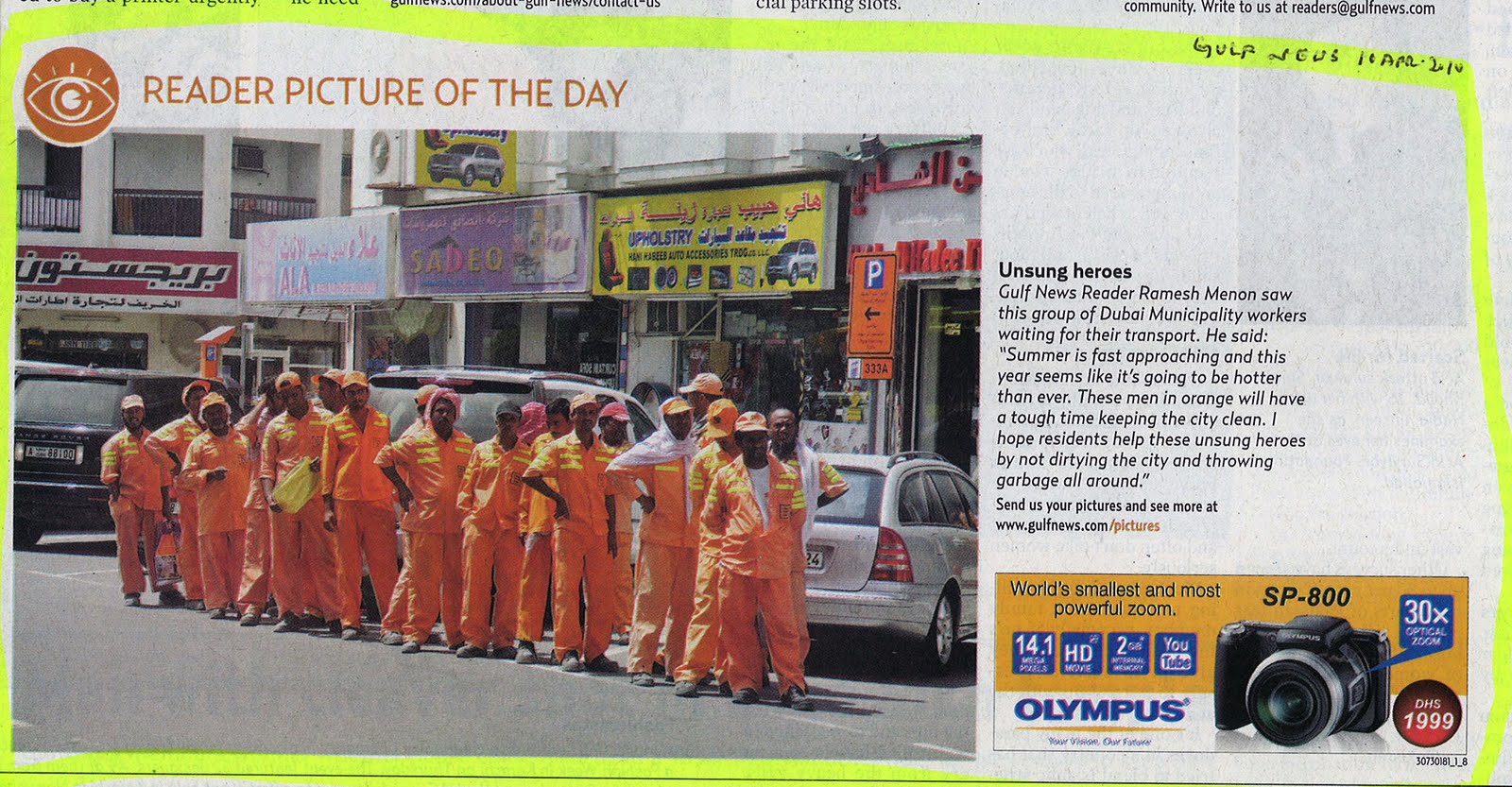
My Letters & Photo Speaks – Gulf News – Dt. 10.04.2010 – Unsung heroes
My Letters & Photo Speaks – Gulf News – Dt. 10.04.2010 – Unsung heroes
 To read my letters to the news, please bookmark and visit Letters to the Editor
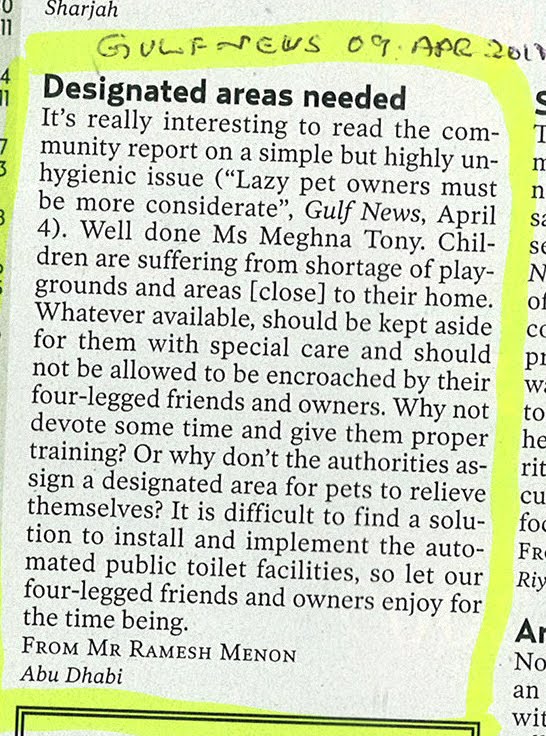
My Letters – Gulf News – Dt. 09.04.2010 – Designated areas needed
My Letters – Gulf News – Dt. 09.04.2010 – Designated areas needed
To read my letters to the news, please bookmark and visit Letters to the Editor
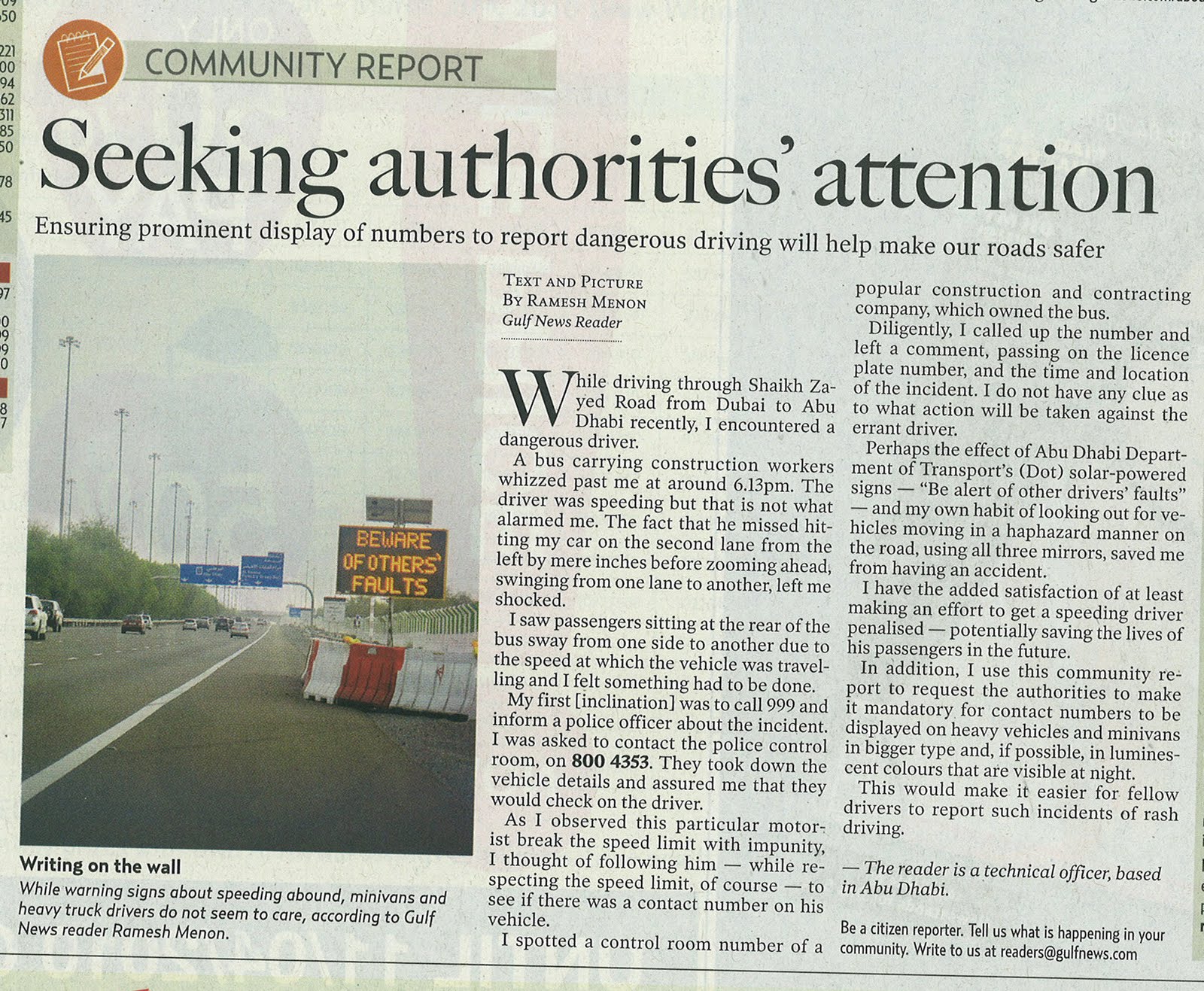
My Lettes – GULF NEWS – Dt. 08.04.2010 – Seeking authorities’ attention
My Lettes – GULF NEWS – Dt. 08.04.2010 – Seeking authorities’ attention
 To read my letters to the news, please bookmark and visit Letters to the Editor
 ClicksandWrites

You must be logged in to post a comment.