Gulf News
Community Report – GULF NEWS – Dt. 06.12.2010 – A solution to the poster menace around Abu Dhabi
Community Report – GULF NEWS – Dt. 06.12.2010 – A solution to the poster menace around Abu Dhabi
-
A solution to the poster menace around Abu Dhabi
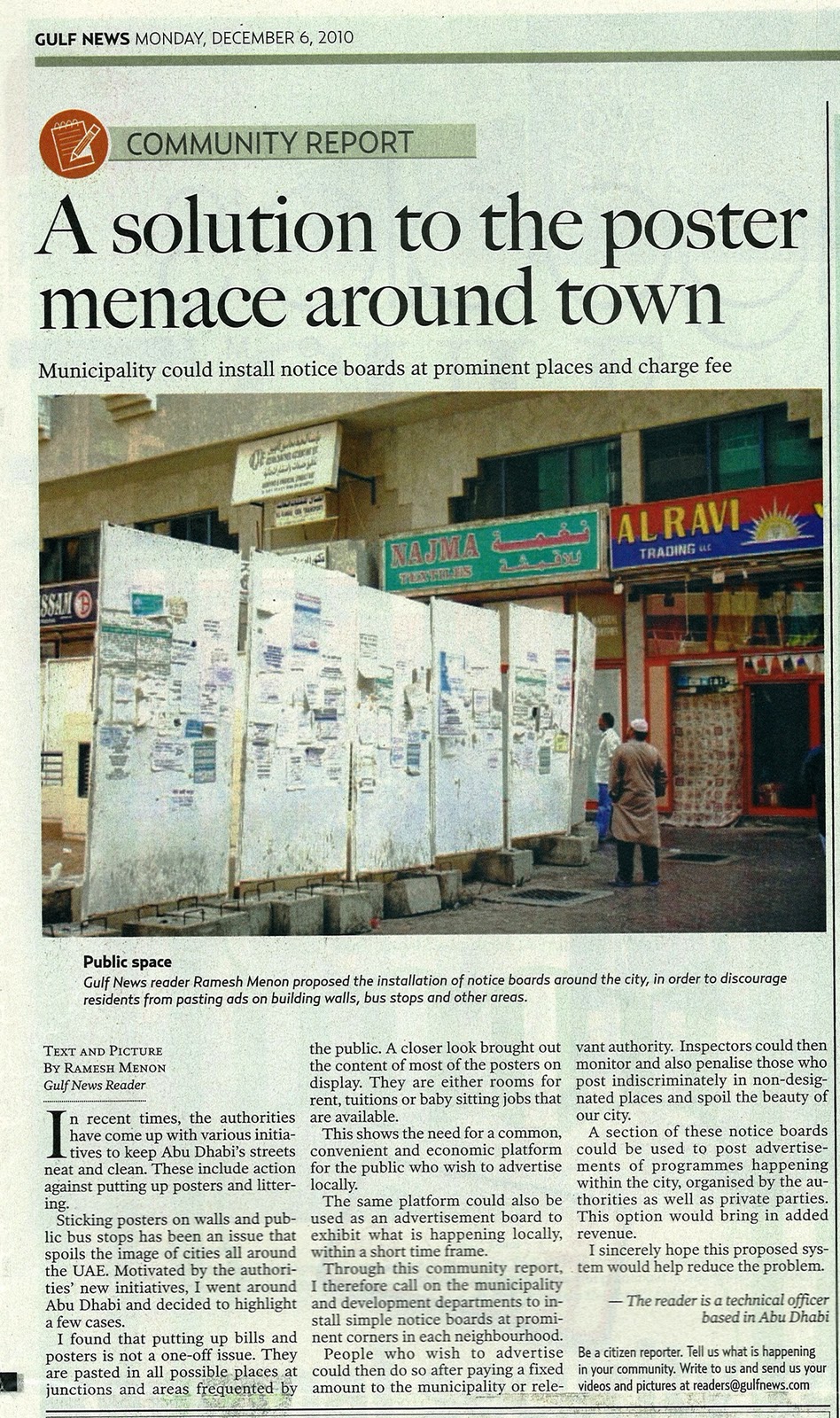
Municipality could install notice boards at prominent places and charge fee
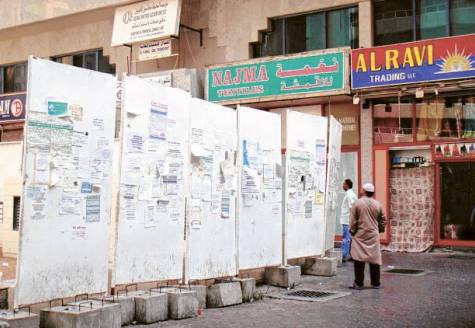
Sticking posters on walls and public bus stops has been an issue that spoils the image of cities all around the UAE. Motivated by the authorities’ new initiatives, I went around Abu Dhabi and decided to highlight a few cases.
I found that putting up bills and posters is not a one-off issue. They are pasted in all possible places at junctions and areas frequented by the public. A closer look brought out the content of most of the posters on display. They are either rooms for rent, tuitions or baby sitting jobs that are available.
This shows the need for a common, convenient and economic platform for the public who wish to advertise locally.
The same platform could also be used as an advertisement board to exhibit what is happening locally, within a short time frame.
Through this community report, I therefore call on the municipality and development departments to install simple notice boards at prominent corners in each neighbourhood.
People who wish to advertise could then do so after paying a fixed amount to the municipality or relevant authority. Inspectors could then monitor and also penalise those who post indiscriminately in non-designated places and spoil the beauty of our city.
A section of these notice boards could be used to post advertisements of programmes happening within the city, organised by the authorities as well as private parties. This option would bring in added revenue.
I sincerely hope this proposed system would help reduce the problem.
The reader is a technical officer based in Abu Dhabi
Be a citizen reporter. Tell us what is happening in your community. Write to us and send us your videos and pictures at readers@gulfnews.com
To read it in original, please visit GULF NEWS online
My Letters – GULF NEWS Dt. 11.11.2010 – Plan in Advance
My Letters – GULF NEWS Dt. 11.11.2010 – Plan in Advance
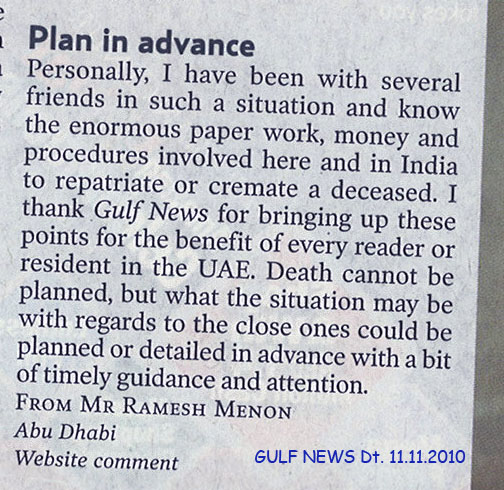
Plan in advance
From Mr Ramesh Menon
Abu Dhabi
To read it in original, please visit GULF NEWS online.
My Letters – GULF NEWS – The cost of dying: What to expect when it’s not expected

The cost of dying: What to expect when it’s not expected
Death comes to us all — but careful planning can take the pain out of dying for your family and friends
By Deena Kamel Yousef, Staff Reporter
Published: 00:00 November 6, 2010
Reader comments (2)
Dying in Dubai is expensive: families must start saving money and preparing for the death of a loved one to avoid financial and legal problems after the event.
Image Credit: Supplied
We are confronted with images of death and dying on television everyday, yet it is an uncomfortable topic that many families are unwilling to talk or think about. Often a cultural taboo, discussing the death of a family member and how to deal with the body and the estate is considered offensive to the elders.
PDF: Grave charges
Every day four people die in Dubai and every three out of those four will be expatriates, according to statistics.
It’s a sobering fact that does not usually occur to Dubai’s young population, here to pursue a better living standard and higher income.
Why open a can of worms, you say?
Consider the facts: The costs that a family must bear if a relative dies on the other side of the world from home can run into thousands of dirhams. Families are usually unprepared for the bureaucracy and red tape of getting the paperwork, organising the embalming, or sending the body home—all in the middle of grieving for a loved one.
The person’s accounts are frozen and visa is cancelled—leaving the dependants without enough money for survival and forced to leave the country. Life insurance may not be paid out immediately and the court may take months, if not years, to distribute the person’s estate. Those that do not set aside a lump sum of money behind for the family leave behind a knot of financial problems for their family to sort.
Dying in Dubai is expensive: families must start saving money and preparing for the death of a loved one to avoid financial and legal problems after the event.
The Valley of Love, a non-government organization, last year reported 100 cases of families facing financial problems following the death of a relative.
Gulf News takes you through the paper trail and cost of death in Dubai, providing experts’ advice on how to prepare for the event.
Additional specifics on Repatriation costs:
– Calculated by kilo of body and coffin weight. Varies by destination, airlines and total weight. Saving tip: repatriate the body in a cheaper and lighter coffin and transfer to a more elaborate one at home.
– Repatriation to India: Air India transports human remains to any Indian city for free. Other airlines will ship to India with a 50 per cent discount on IATA rates. Charge is approximately Dh20 per kilo. Total cargo cost is Dh1,500.
– Repatriation to Pakistan: Pakistan International Airlines (PIA) ships human remains and provides the accompanying person’s ticket for free
– Repatriation to the UK, Dh65-Dh70 per kilo.
– Repatriation to Africa, Dh95-Dh100 per kilo. It is the most expensive destination.
– Repatriation to Egypt or Lebanon, Dh20-Dh30 per kilo
– Total cost to Europe, Dh20,000 (includes documentation, fees, repatriation).
– Total cost to the Middle East, Dh10,000
– Total cost to Africa, Dh25,000- Dh30,000
– Shipping surcharges: Security surcharge (Dh0.20 to 0.80 per kilo), Fuel surcharges (Dh1 to Dh3 per kilo, depending on fuel prices), screening charge (Dh0.11 per kilo)
– Help line: Call Emirates Sky Cargo services for further details on 04-2184218
Sources:
Abhay Pathak, Regional Manager, Gulf, Middle East and Africa, Air India
Craig Holding, financial adviser and associate director of Acuma Wealth Management.
Helen Williams, Bereavement counsellor, Keith Nicholl Medical Centre, Dubai
Joseph Bobby, Vice President of the Valley of Love, a non-profit organization
Mohammed Marria, senior estate planner for Just Wills, a firm specializing in succession planning
Roy Gaunt, Chartered insurance broker, Nexus Insurance Brokers
Vivian Albertyn, Managing Partner of Middle East Funeral Services, Dubai
DNATA Cargo
Have you experienced financial trouble after the death of a loved on? Have you taken steps to avoid similar issues in the future?
My Comments:
Two excellent and must read articles for expats in UAE. Could be be termed as “Thoughts before we die” in UAE. Personally, I have been with several friends in such situation and and know the enormous paper work money and procedures involved here and India to repatriate or cremate a deceased. Thanks for bringing up these for the benefit of every reader or resident in UAE. Death cannot be planned, but what the situation may be with regards to the close ones could some what be planned or detailed in advance with a bit of timely guidance and attention by such articles.
Ramesh Menon, Abu Dhabi, United Arab Emirates
To read it in original, please visit GULF NEWS Online.
Please also read:
How to save and prepare for death
- By Deena Kamel Yousef, Staff Reporter
- Published: 13:25 November 6, 2010

- Dying in Dubai is expensive: families must start saving money and preparing for the death of a loved one to avoid financial and legal problems after the event.
- Image Credit: Supplied
2. Put some money in a bank account under a family member or loved one’s name.
3. Set aside emergency funds overseas.
PDF: Grave charges
4. Have an honest and open discussion with your spouse or family about your finances.
5. Draw up a will detailing how to split your assets among inheritors. Will cost, Dh3,000; legal costs, Dh1,500-Dh2,000; execution of will in court, Dh45,000-Dh50,000.
6. Buy life insurance: Check the benefits, clauses and time period between the death and the payment. Choose between term insurance and whole of life insurance. You can opt for Islamic life insurance (Takaful) or term insurance which does not rely on investments and is Sharia compliant. Men, older people, and those with risky hobbies have higher premiums. Suicide within the first two years of buying a policy is not covered.
7. Get free advice. Some lawyers and funeral service providers give free advice on steps to take after the person’s death.
8. Approach local non-government organizations or your embassy for financial assistance.
9. Death is the ultimate abandonment. Bereavement counselling is available in Dubai for those unable to deal with loss of a loved one. A 90-minute session costs Dh450.
10. Check your work package if you have funeral and repatriation coverage. Check medical insurance for repatriation costs.
11. Save about 25 per cent of your salary, not just for your death but for your family’s life.
12. Before the deceased’s account is unfrozen, debts must be paid out first from those accounts. Pay your debts regularly to avoid from piling up.
13. Make a list of your assets, liabilities, insurance, stock or investments here and abroad, so the will executor knows where to locate the money.
14. Get off your partner’s visa and onto your employer’s sponsorship if you are working. The deceased’s visa gets cancelled and you will have to leave the country.
15. Don’t rely on your company for death and services benefits.
16. Nominate beneficiaries for your life insurance so they can receive the money.
17. Draft a will and email it to your relatives. Keep the original at home or with a lawyer for records.
18. Write how you would like your body dealt with after death.
19. Write a list of emergency contacts.
20. It is cheaper to be cremated in the UAE than repatriated. Budget airlines do not provide a repatriation service.
http://gulfnews.com/business/your-money/how-to-save-and-prepare-for-death-1.707169
My letters – GULF NEWS – Dt. 26.10.2010 – Give them attention
My letters – GULF NEWS – Dt. 26.10.2010 – Give them attention

Give them attention
From Mr Ramesh Menon
Abu Dhabi
To read it in original, please visit GULF NEWS online.
My Letters – GULF NEWS – Dt. 19.10.2010 – Community reporting
My Letters – GULF NEWS – Dt. 19.10.2010 – Community reporting

Community reporting
From Mr Ramesh Menon
Abu Dhabi
Additional note:
My Letters – GULF NEWS – Dt. 03.10.2010 – Dedicated area
My Letters – GULF NEWS – Dt. 03.10.2010 – Dedicated area

Dedicated area
This is in reference to a recent community report about jet skis at public beaches. It was an eye-opener regarding the danger it can cause to swimmers who use the beach. Frequent accidents caused due to deliberate and inadvertent attempts to drive powerful vehicles have resulted in their restriction at public beaches in Abu Dhabi. This calls for uniform implementation of such rules in all emirates whenever a life-threatening situation is identified in one of them, as rules are implemented to control it. There should be separate options that are exclusive to water sports and those who indulge in it should limit themselves within their allotted area.
From Mr Ramesh Menon
Abu Dhabi
To read it in original, please visit GULF NEWS Online.
Community report – GULF NEWS – Dt. 21.09.2010 – Coping with fog
Community report – GULF NEWS – Dt. 21.09.2010 – Coping with fog
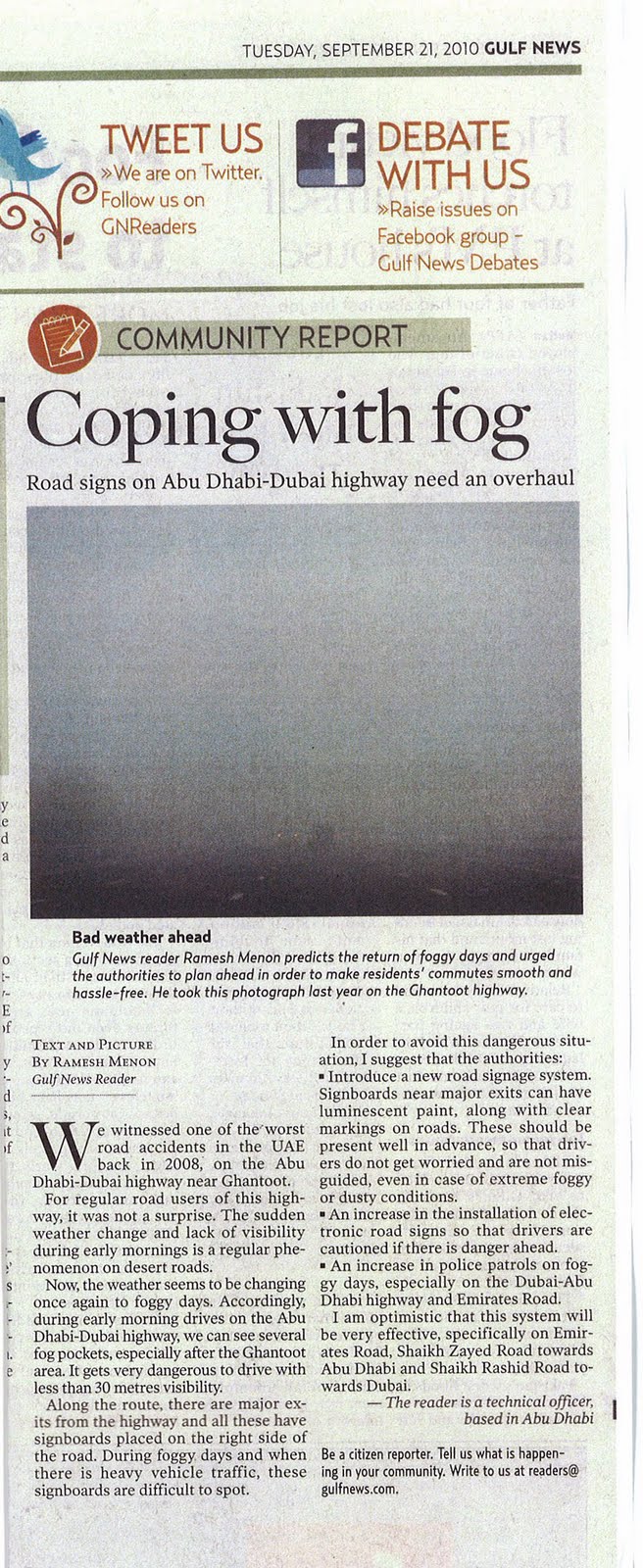
Road signs on Abu Dhabi-Dubai highway need an overhaul
Text and picture by Ramesh Menon, Gulf News Reader Published: 00:00 September 21, 2010
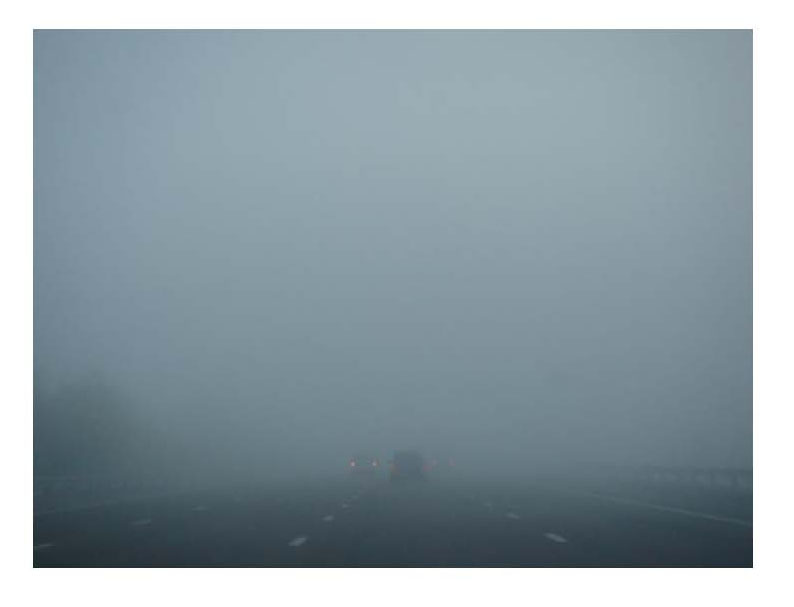
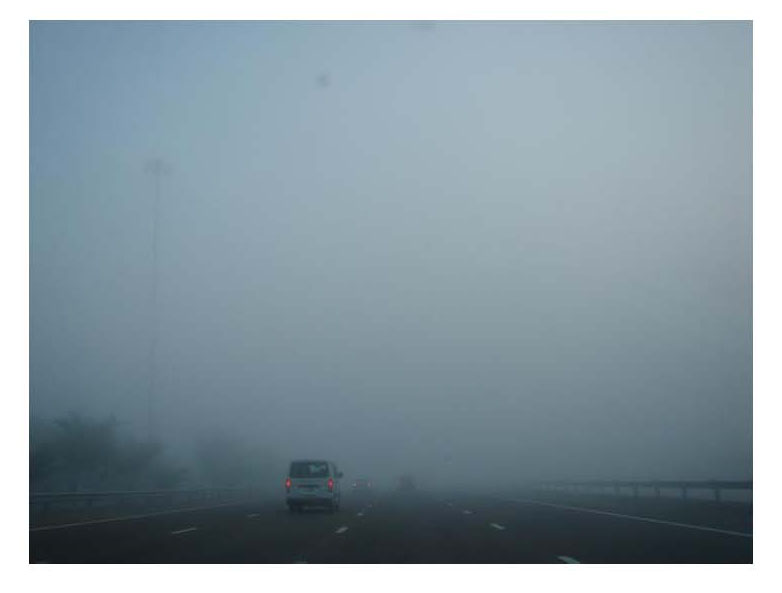
Gulf News reader Ramesh Menon predicts the return of foggy days and urged the authorities to plan ahead in order to make residents’ commutes smooth and hassle-free. He took this photograph last year on the Ghantoot highway. Image Credit: Ramesh Menon/Gulf News reader We witnessed one of the worst road accidents in the UAE back in 2008, on the Abu Dhabi-Dubai highway near Ghantoot.
For regular road users of this highway, it was not a surprise. The sudden weather change and lack of visibility during early mornings is a regular phenomenon on desert roads.
Now, the weather seems to be changing once again to foggy days. Accordingly, during early morning drives on the Abu Dhabi-Dubai highway, we can see several fog pockets, especially after the Ghantoot area. It gets very dangerous to drive with less than 30 metres visibility.
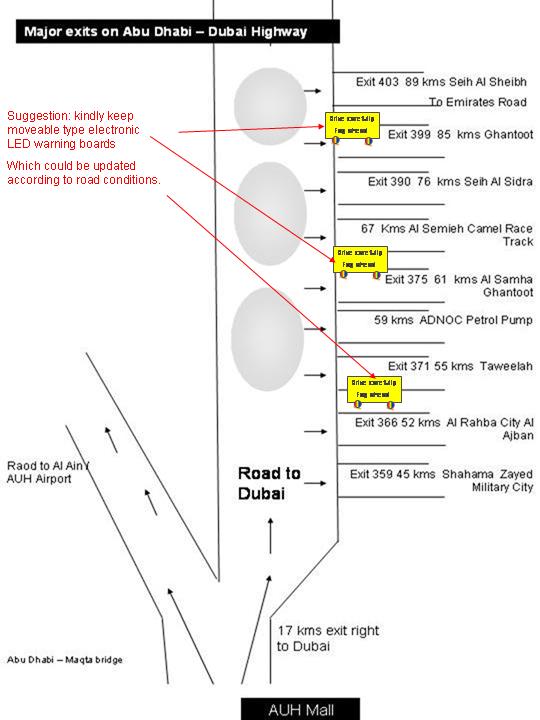
Along the route, there are major exits from the highway and all these have signboards placed on the right side of the road. During foggy days and when there is heavy vehicle traffic, these signboards are difficult to spot.
In order to avoid this dangerous situation, I suggest that the authorities:
– Introduce a new road signage system. Signboards near major exits can have luminescent paint, along with clear markings on roads. These should be present well in advance, so that drivers do not get worried and are not misguided, even in case of extreme foggy or dusty conditions.
– An increase in the installation of electronic road signs so that drivers are cautioned if there is danger ahead.
– An increase in police patrols on foggy days, especially on the Dubai-Abu Dhabi highway and Emirates Road.
I am optimistic that this system will be very effective, specifically on Emirates Road, Shaikh Zayed Road towards Abu Dhabi and Shaikh Rashid Road towards Dubai.
— The reader is a technical officer, based in Abu Dhabi
To read it in original, please visit GULF NEWS Online.


My Letters – GULF NEWS – Dt 14.09.2010 – Parents tighten their purse strings as schools reopen
My Letters – GULF NEWS – Dt 16.09.2010 – Parents tighten their purse strings as schools reopen
- By Anjana Sankar, Senior Reporter
Dubai: As children in the UAE start the school year today, parents will be tightening their purse strings to meet the escalating cost of education.
Many parents said that from increased tuition fees to the cost of uniforms, stationery and extra curricular activities, the year ahead would strain their monthly budgets.
Most Asian schools start their new term today, after their academic year started in April. All public school pupils, from kindergarten through to high school, will start the first day of their school year tomorrow. Some of the international schools commenced classes yesterday.
Patrick Gonsalviz said his family would have no more weekend outings due to the strain of education costs. The marketing manager from Sri Lanka said he had to pay Dh24,000 in term fees for his two children, going into grades three and four.
“This is in addition to the expenses of buying their school uniforms, books and stationery,” he said.
“The school shopping itself cost me around Dh3,000 this year,” Gonsalviz said.
He said he managed the back-to-school expenses using his credit card. “I had no other [option] but plastic money so that I don’t end up borrowing from friends or colleagues,” he said.
“My monthly payments on credit card will increase substantially, and I will have to cut down on my monthly budget.”
Tuition fees for his children had gone up by 20 per cent this year, Gonsalviz said.
“My salary has not increased in the last two years. But the cost of education for my kids is always on an upward swing,” he said.
Many parents said they were forced to do a tightrope walk between a quality education and an affordable one.
This year, many schools have increased their tuition fee up to 20 and 25 per cent. At least five GEMS schools and two of Taaleem’s schools in Dubai have been granted permission to increase the fees for the new academic year.
Fee increases
In the American Academy for Girls in Al Mizhar, run by Taaleem, the second largest private education provider in the UAE, fees have gone up from Dh28,580 to Dh34,000 for KG1. For grades six and above, the fees have jumped from Dh38,980 to Dh47,000.
M.E., a parent with a student in Uptown Mirdiff school, said the increase in school expenses meant his two children had to discontinue their piano classes. The school raised its fees by 20 per cent.
“I had to explain to my kids that I can no longer afford it to keep them in the same school,” said M.E., who works for a construction company in Abu Dhabi.
Are you cutting down on costs? How? Do you find the cost of raising a child high?
My Comments as follows:
Added 15:21 September 14, 2010
I believe, Ministry of Education should consider special concession to schools, for daily operating items, such as, Telephone, Electricity, Water, followed by discounts on school bus registration fees, staff immigration and naturalisation costs etc. This, if given by the authorities, will naturally bring down the operating costs of the school and allow them to opt for enhancing the existing facilities with a portion of the extra earnings. This will also stop their cry for raising the school fees. MoE can then give guidelines for them to opt for reduced fees structure for students than they charge currently.
It has to be noted that a country’s future lies in the youth and their development and these discounts will result in more parents opting for education and higher education of their children in UAE than sending him or her to abroad or to their home countries. It will definitely bear fruits in the long run to produce excellent citizen for tomorrows future, whether he is a resident or expat. The gratitude of a satisfactory school education is by itself a lifelong commitment. Thus, If school fees are structured within the affordable means of parents, definitely more children will join school and college in UAE.
School fee increase approval should therefore be the last thing in the wish list of items for consideration by respective Ministry.
I also do not understand why people are not coming out in open to discuss their opinion on this matter. It gives more leverage to those who act with business interest and inconsiderate manner ignoring the standard of education and service quality they claim to provide to their students.
Ramesh Menon, Abu Dhabi, United Arab Emirates
To read it in original, please visit, GULF NEWS online.
My Letters – GULF NEWS – Air India cancels flights to Gulf sector
My Letters – GULF NEWS – Air India cancels flights to Gulf sector
Services to Abu Dhabi, Dubai, Sharjah, Muscat and Kuwait are affected by the decision.
By Anjana Sankar, Senior Reporter Published: 20:14 September 4, 2010 Reader comments (1)
Flights to some of the sectors are curtailed, and not cancelled. It is mainly due to commercial reasons as Air India is already operating flights to all these sectors, said Abhay Pathak, the regional head of Air India. Image Credit: Gulf News Dubai: Passengers have been left high and dry after India’s budget airline Air India Express announced plans to cut down more than 200 services to destinations including the Gulf Sector.
Services to Abu Dhabi, Dubai, Sharjah, Muscat and Kuwait are affected by the decision.
Abhay Pathak, the regional head of Air India told Gulf News the decision has been taken considering both operational and commercial reasons.
“Flights to some of the sectors have been curtailed, and not cancelled. It is mainly due to commercial reasons as Air India is already operating flights to all these sectors,” said Pathak.
He added that the decision was also taken because the unavailability of pilots. “The licensing of expat pilots is a long procedure and the needed numbers are not available now. Moreover we need to curtail the flying hours in order to continue the services,” he said.
According to him, only the daily flight to Cochin-Sharjah has been knocked off. “From Sharjah to to Thiruvananthapuram sector, four-day week service is cut down to two days. Likewise, for the flights in the Calicut sector, the daily service is reduced to three days a week,” said Pathak, adding that the number of cancellations quoted in the media is exaggerated.
For Air India Express operating from Dubai, flights to Thiruvananthapuram will operate six days a week and not daily. Flights to Lucknow have been reduced to three days a week from the current four days.
Pathak said all the passengers who are booked to these sectors “will be taken care of and will not be affected by the cancellations.”
According to reports quoting airline officials from India, the decision will come into effect from next week. “Around 203 flights (73 from Kozhikode, 74 from Thiruvananthapuram and 56 from Kochi) stand cancelled
My comments as follows:
As a NRI, the news that Air India cancels flights to Gulf Sector is a great relief. In fact, they should entirely stop the operations to GULF region rather than knocking down a selected sector and reducing frequency of others as announced by regional head of the national carrier of India. This step will surely reduce confusion in the minds of thousands of Indian expats from this region before they plan there holiday or emergency travel as to whether they opt for Air India as their preferred travel partner. Not any more in two minds and will never be too, if this attitude of Air India continues towards one of it’s maximum revenue generating sector. Whatever be the reason explained for this sudden reduction of flights just before the expat families return, this will definitely cause severe difficulties to the planning and scheduling of their return before the school starts after Eid holidays. Surprisingly, all representatives of the political parties show a harmonious honeymoon in keeping their silence towards these acts of Air India. Indeed for several of them, travel by Air India has never been an automatic choice whenever they travel out off the state even to other states or abroad destination. It is high time that regional organisations should raise their voice collectively and from, now on completely refrain from using Air India to protest against this step motherly treatment towards southern sector of India.
Ramesh Menon, Abu Dhabi, United Arab Emirates
To read it in original, please visit GULF NEWS Online.
Gulf News Community reports published in July 2010: Winning entry – Spilt fuel can have dire consequences
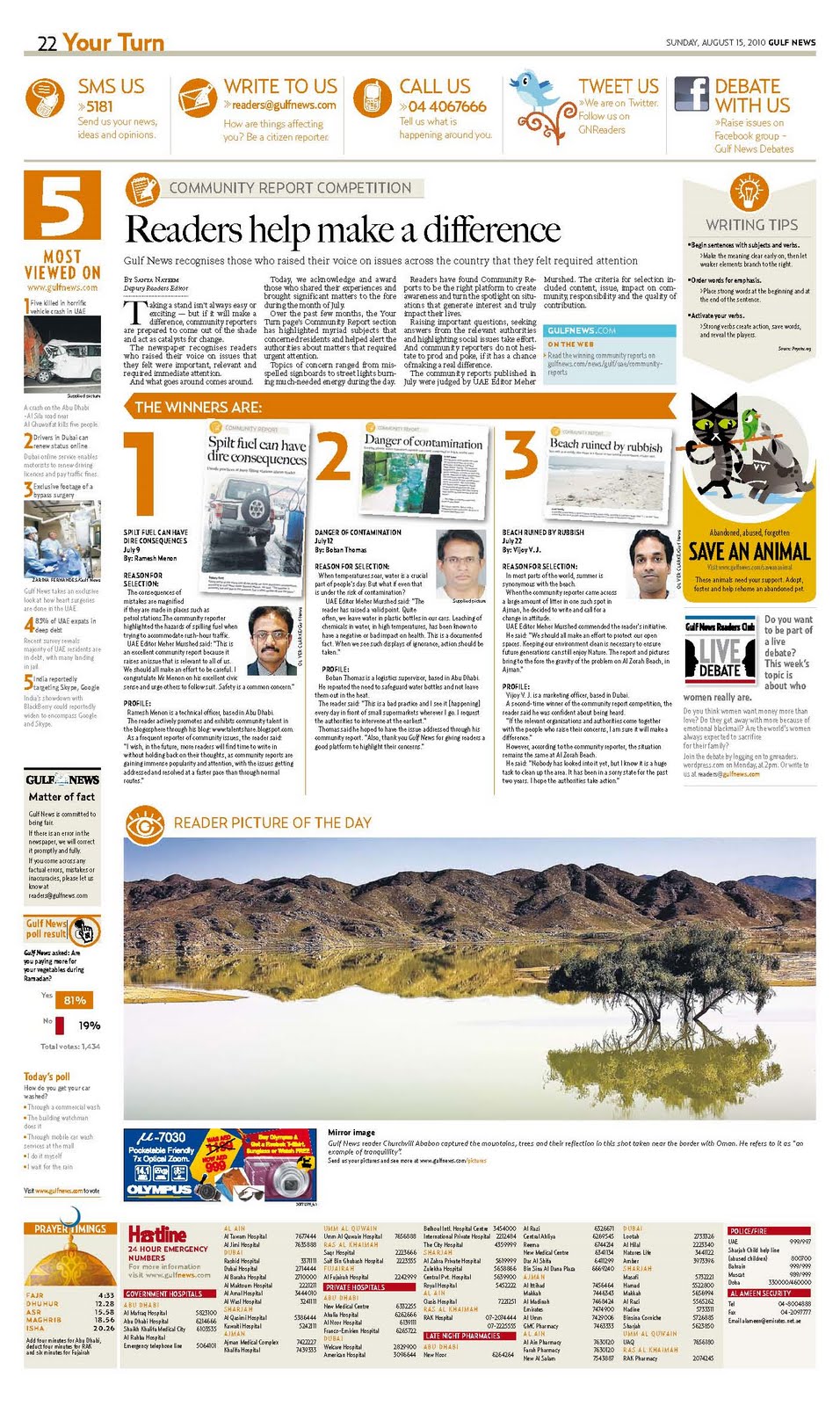
The newspaper recognises readers who raised their voice on issues that they felt were important, relevant and required immediate attention.
And what goes around comes around.
Today, we acknowledge and award those who shared their experiences and brought significant matters to the fore during the month of July.
Over the past few months, the Your Turn page’s Community Report section has highlighted myriad subjects that concerned residents and helped alert the authorities about matters that required urgent attention.
Topics of concern ranged from misspelled signboards to street lights burning much-needed energy during the day.
Readers have found Community Reports to be the right platform to create awareness and turn the spotlight on situations that generate interest and truly impact their lives.
Raising important questions, seeking answers from the relevant authorities and highlighting social issues take effort. And community reporters do not hesitate to prod and poke, if it has a chance of making a real difference.
The community reports published in July were judged by UAE Editor Meher Murshed. The criteria for selection included content, issue, impact on community, responsibility and the quality of contribution.
FIRST PRIZE
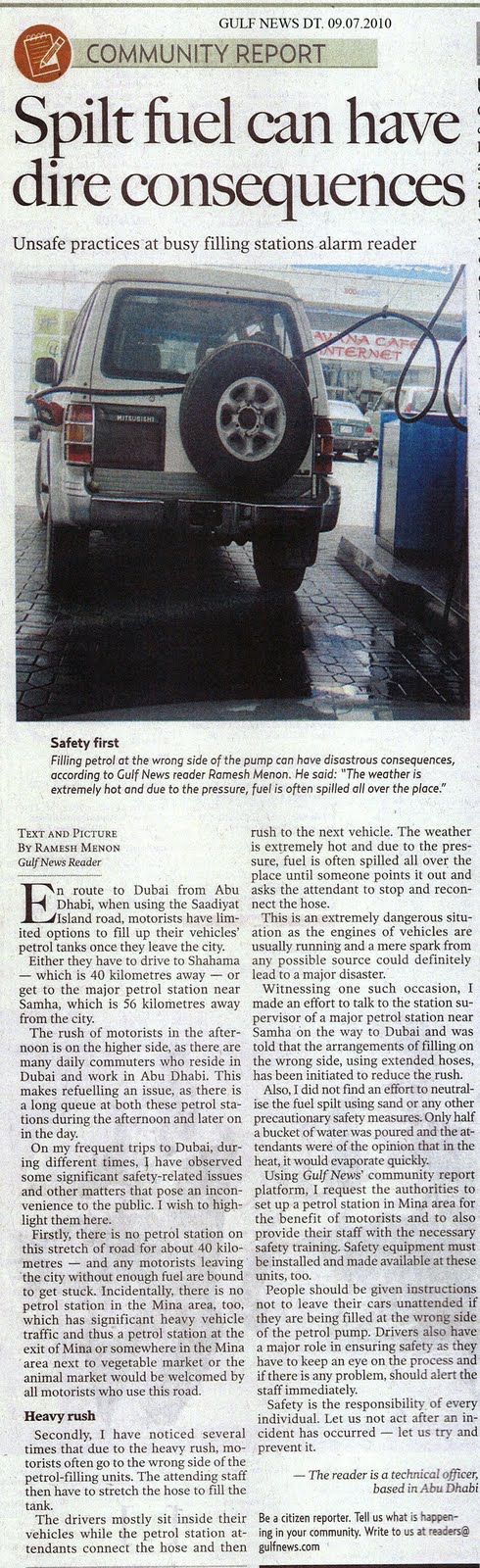
Spilt fuel can have dire consequences
July 9
By: Ramesh Menon
Reason for selection:
The consequences of mistakes are magnified if they are made in places such as petrol stations.The community reporter highlighted the hazards of spilling fuel when trying to accommodate rush-hour traffic.
UAE Editor Meher Murshed said: “This is an excellent community report because it raises an issue that is relevant to all of us. We should all make an effort to be careful. I congratulate Mr Menon on his excellent civic sense and urge others to follow suit. Safety is a common concern.”
Profile:
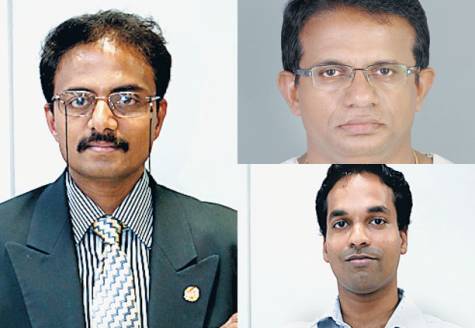
Ramesh Menon is a technical officer, based in Abu Dhabi.
The reader actively promotes and exhibits community talent in the blogosphere through his blog: http://www.talentshare.blogspot.com/.
As a frequent reporter of community issues, the reader said: “I wish, in the future, more readers will find time to write in without holding back on their thoughts, as community reports are gaining immense popularity and attention, with the issues getting addressed and resolved at a faster pace than through normal routes.”
SECOND PRIZE
Danger of contamination
July 12
By: Boban Thomas
Reason for selection:
When temperatures soar, water is a crucial part of people’s day. But what if even that is under the risk of contamination?
UAE Editor Meher Murshed said: “The reader has raised a valid point. Quite often, we leave water in plastic bottles in our cars. Leaching of chemicals in water, in high temperatures, has been known to have a negative or bad impact on health. This is a documented fact. When we see such displays of ignorance, action should be taken.”
Profile:
Boban Thomas is a logistics supervisor, based in Abu Dhabi.
He repeated the need to safeguard water bottles and not leave them out in the heat.
The reader said: “This is a bad practice and I see it [happening] every day in front of small supermarkets wherever I go. I request the authorities to intervene at the earliest.”
Thomas said he hoped to have the issue addressed through his community report. “Also, thank you Gulf News for giving readers a good platform to highlight their concerns.”
THIRD PRIZE
Beach ruined by rubbish
July 22
By: Vijoy V.J
Reason for selection:
In most parts of the world, summer is synonymous with the beach.
When the community reporter came across a large amount of litter in one such spot in Ajman, he decided to write and call for a change in attitude.
UAE Editor Meher Murshed commended the reader’s initiative.
He said: “We should all make an effort to protect our open spaces. Keeping our environment clean is necessary to ensure future generations can still enjoy Nature. The report and pictures bring to the fore the gravity of the problem on Al Zorah Beach, in Ajman.”
Profile:
Vijoy V. J. is a marketing officer, based in Dubai.
A second-time winner of the community report competition, the reader said he was confident about being heard.
“If the relevant organisations and authorities come together with the people who raise their concerns, I am sure it will make a difference.”
However, according to the community reporter, the situation remains the same at Al Zorah Beach.
He said: “Nobody has looked into it yet, but I know it is a huge task to clean up the area. It has been in a sorry state for the past two years. I hope the authorities take action.”
To read this in original, please visit GULF NEWS Online.

 ClicksandWrites

You must be logged in to post a comment.