Digging for gold in waste bins — what’s our role to change this?
Community Service
My Opinion : Gulf News – Dt 25.04.2010 – Recycling should replace scavenging
My Opinion : Gulf News – Dt 25.04.2010 – Recycling should replace scavenging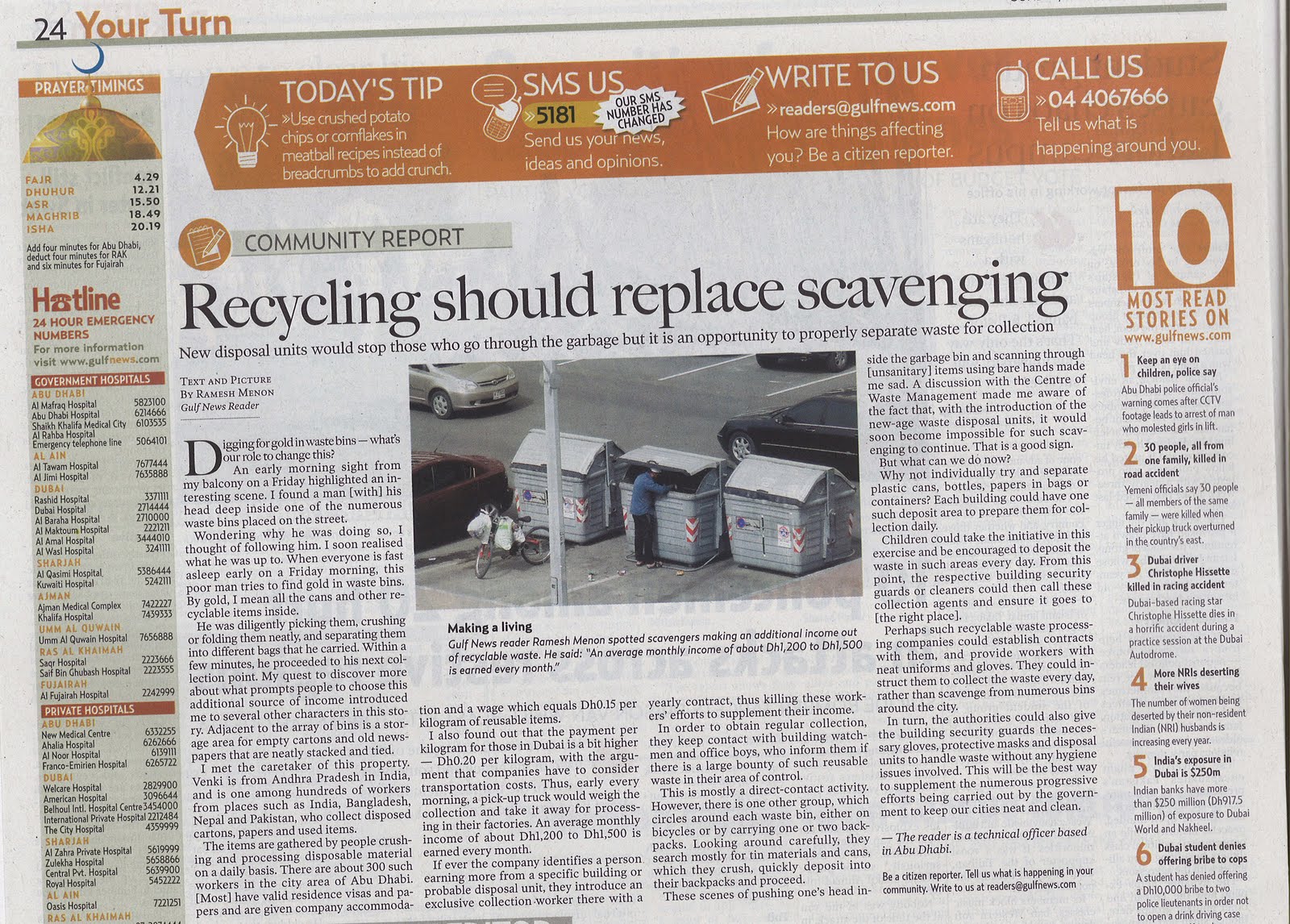
To read my letters to the news, please bookmark and visit Letters to the Editor
An early morning sight from my balcony on a Friday highlighted an interesting scene. I found a man [with] his head deep inside one of the numerous waste bins placed on the street.
Wondering why he was doing so, I thought of following him. I soon realised what he was up to. When everyone is fast asleep early on a Friday morning, this poor man tries to find gold in waste bins. By gold, I mean all the cans and other recyclable items inside.
He was diligently picking them, crushing or folding them neatly, and separating them into different bags that he carried. Within a few minutes, he proceeded to his next collection point. My quest to discover more about what prompts people to choose this additional source of income introduced me to several other characters in this story. Adjacent to the array of bins is a storage area for empty cartons and old newspapers that are neatly stacked and tied.
I met the caretaker of this property. Venki is from Andhra Pradesh in India, and is one among hundreds of workers from places such as India, Bangladesh, Nepal and Pakistan, who collect disposed cartons, papers and used items.
The items are gathered by people crushing and processing disposable material on a daily basis. There are about 300 such workers in the city area of Abu Dhabi. [Most] have valid residence visas and papers and are given company accommodation and a wage which equals Dh0.15 per kilogram of reusable items.
I also found out that the payment per kilogram for those in Dubai is a bit higher — Dh0.20 per kilogram, with the argument that companies have to consider transportation costs. Thus, early every morning, a pick-up truck would weigh the collection and take it away for processing in their factories. An average monthly income of about Dh1,200 to Dh1,500 is earned every month.
If ever the company identifies a person earning more from a specific building or probable disposal unit, they introduce an exclusive collection worker there with a yearly contract, thus killing these workers’ efforts to supplement their income.
In order to obtain regular collection, they keep contact with building watchmen and office boys, who inform them if there is a large bounty of such reusable waste in their area of control.
This is mostly a direct-contact activity. However, there is one other group, which circles around each waste bin, either on bicycles or by carrying one or two backpacks. Looking around carefully, they search mostly for tin materials and cans, which they crush, quickly deposit into their backpacks and proceed.
These scenes of pushing one’s head inside the garbage bin and scanning through [unsanitary] items using bare hands made me sad. A discussion with the Centre of Waste Management made me aware of the fact that, with the introduction of the new-age waste disposal units, it would soon become impossible for such scavenging to continue. That is a good sign.
But what can we do now?
Why not individually try and separate plastic cans, bottles, papers in bags or containers? Each building could have one such deposit area to prepare them for collection daily.
Children could take the initiative in this exercise and be encouraged to deposit the waste in such areas every day. From this point, the respective building security guards or cleaners could then call these collection agents and ensure it goes to [the right place].
Perhaps such recyclable waste processing companies could establish contracts with them, and provide workers with neat uniforms and gloves. They could instruct them to collect the waste every day, rather than scavenge from numerous bins around the city.
In turn, the authorities could also give the building security guards the necessary gloves, protective masks and disposal units to handle waste without any hygiene issues involved. This will be the best way to supplement the numerous progressive efforts being carried out by the government to keep our cities neat and clean.
— The reader is a technical officer based in Abu Dhabi.
Be a citizen reporter. Tell us what is happening in your community. Write to us at :readers@gulfnews.com
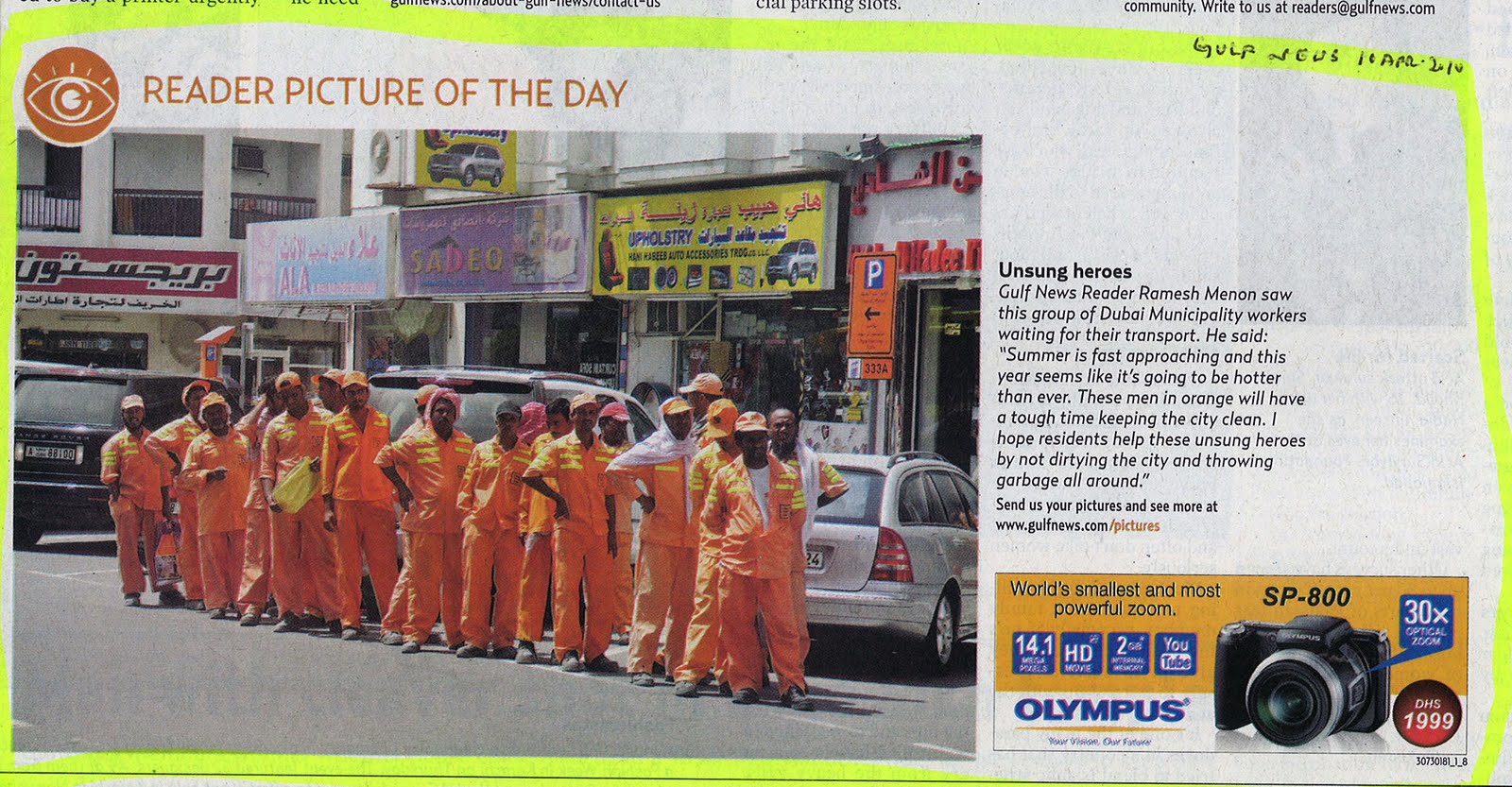
My Letters & Photo Speaks – Gulf News – Dt. 10.04.2010 – Unsung heroes
My Letters & Photo Speaks – Gulf News – Dt. 10.04.2010 – Unsung heroes
 To read my letters to the news, please bookmark and visit Letters to the Editor
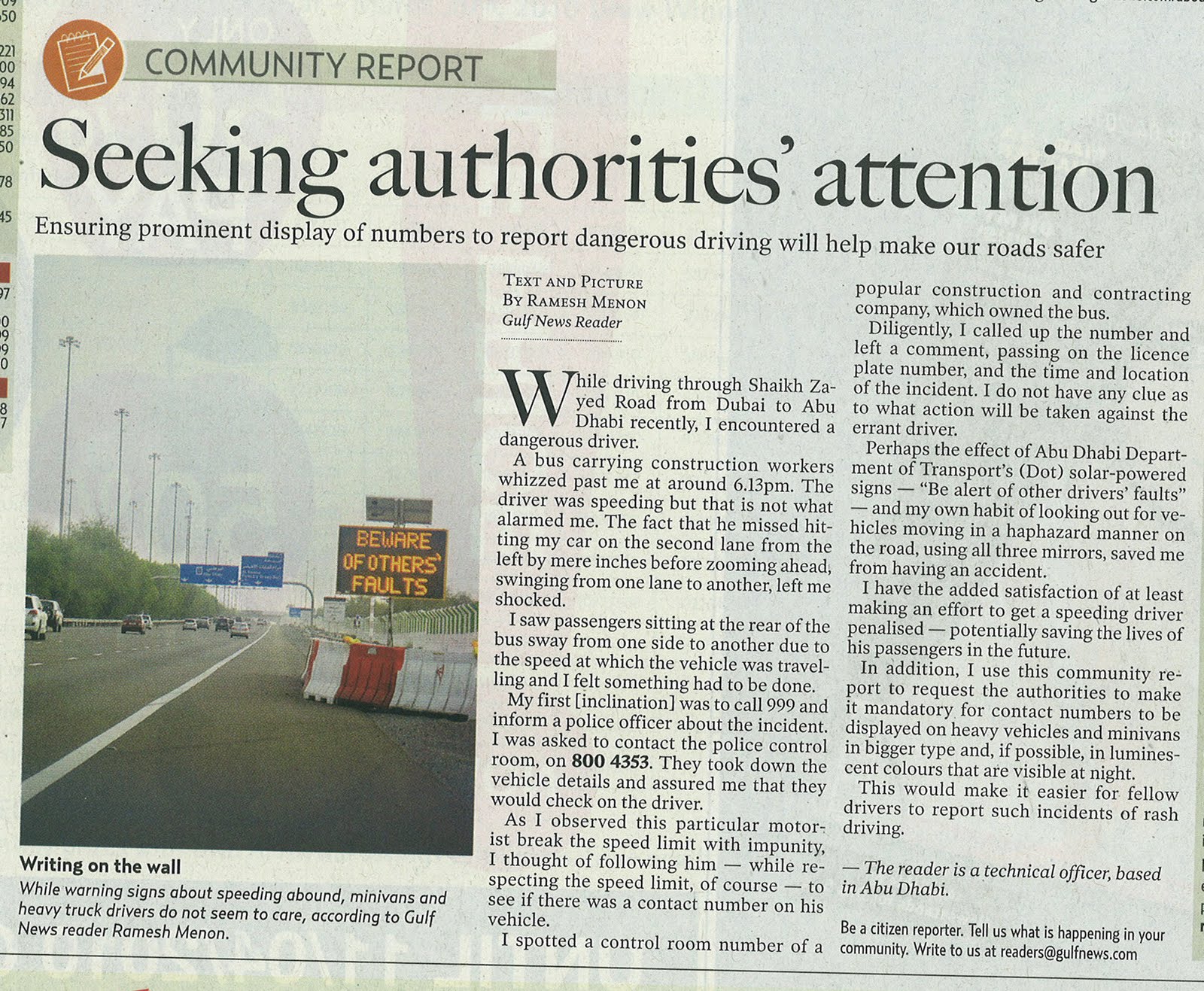
My Lettes – GULF NEWS – Dt. 08.04.2010 – Seeking authorities’ attention
My Lettes – GULF NEWS – Dt. 08.04.2010 – Seeking authorities’ attention
 To read my letters to the news, please bookmark and visit Letters to the Editor
My Letters – Gulf News – Dt. 07.04.2010 – Move smokers away from UAE mall entrances
My Letters – Gulf News – Dt. 07.04.2010 – Move smokers away from UAE mall entrances
Shoppers are being forced to inhale second-hand smoke at malls and near designated smoking areas causing health fears
By Bashir Mohammad Hijas, Gulf News Reader
I have been noticing a problem which I think should be highlighted in a community report.
My issue is with the “designated smoking area” in shopping malls. The entrance from the parking lots to the malls is often dotted with smokers, who fill up the air with exhaled smoke and endanger passers-by.
The designated area is in a place where [it affects everyone], including women and children. Often, this location is either not adequately ventilated or not ventilated at all, and the low roofs of the parking areas prevent the exhaled smoke from rising up in the air.
Passive smoking
Thus, the exhaled smoke and its smell lingers in the area for a long period of time.
Most importantly, this smoke endangers the health of passers-by due to the passive smoking effect.
There are several suggested remedial actions:
• Relocate the designated smoking area to a secluded place, away from the exit and entrance gates, so that it does not affect non-smokers.
• Build a glass wall around the smoking area to contain the smoke.
• Install heavy-duty smoke suckers, to trap the exhaled smoke. This would prevent others from inhaling exhaled smoke.
— The reader is a business analyst, in Dubai.
Be a citizen reporter. Tell us what is happening in your community. Write to us at readers@gulfnews.com
My Comments as follows:
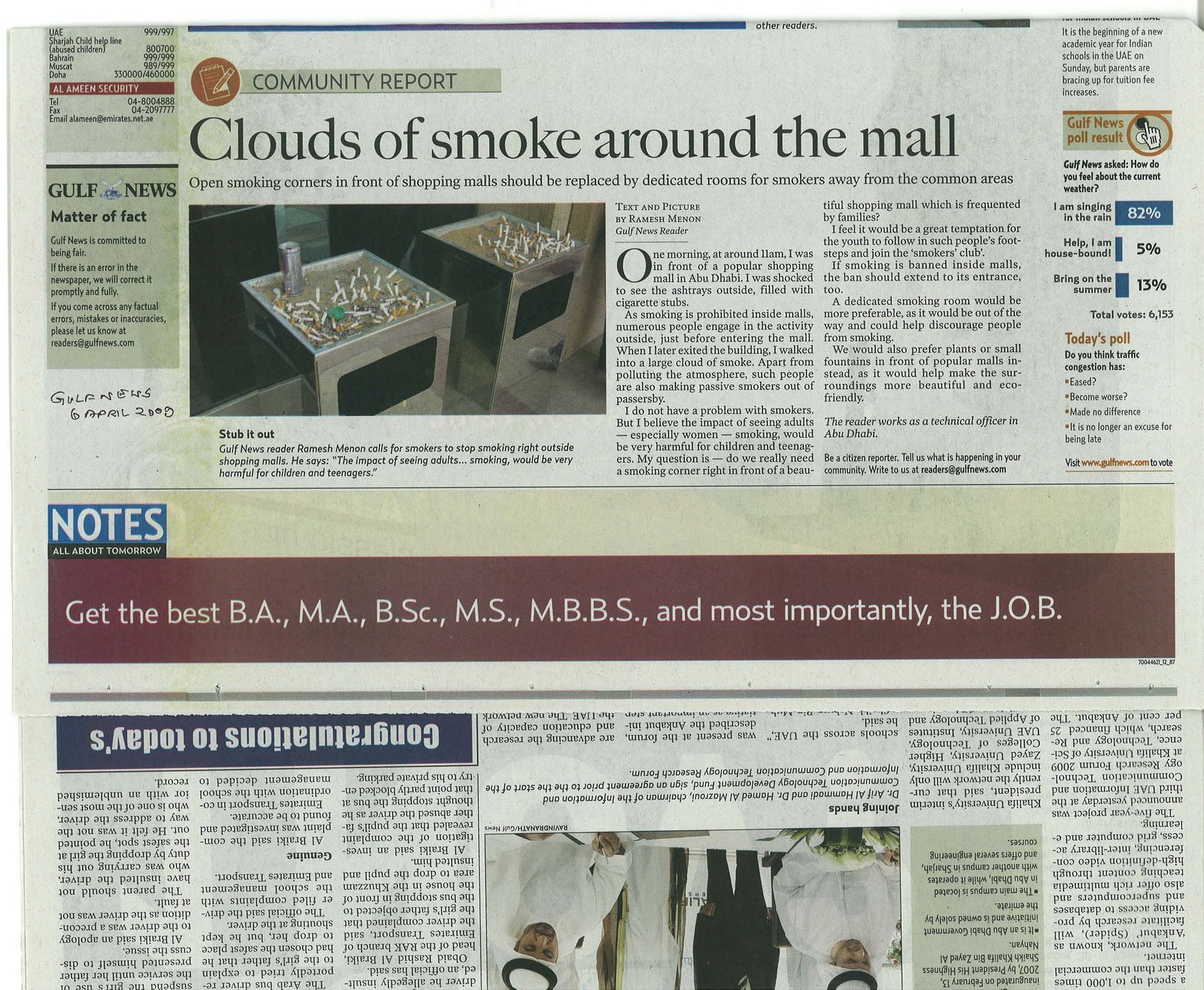
I thank Mr. Bashi Mohammed Hijas for highlighting this issue of smokers crowding the entrance of the malls. It is a common scene, not only for malls, but other office buildings, whether you are in Dubai or Abu Dhabi. I had highlighted a similar situation happening in Abu Dhabi through one of Community report dated 06 April 2009 (strange!!). I followed it up vigorously with the authorities including mall managements and replies received were not promising as they had to find solution for a separate smoking area, rooms etc, which are costly. Rather than the amount of smoke inhaled while one pass by, I was concerned about the temptation, the younger generation gets by watching grown up men and women smoking away fumes waiting in front of the malls. It is a dangerous precedence and it will create an instinctive attraction to try for a cigarette in young minds. Authorities have to find solutions to these exhibitionism outside the premises as and when they introduce control measures to stop smoking inside malls and building.
Ramesh Menon, Abu Dhabi, United Arab Emirates
To read this letter in original, please visit GULF NEWS online
My Letters – GULF NEWS – Dt 09 March 2010 – Energy efficiency for a better tomorrow
My Letters – GULF NEWS – Dt 09 March 2010 – Energy efficiency for a better tomorrow
 To read my letters to the news, please bookmark and visit Letters to the Editor
My Letters – GULF NEWS – Dt 22 Jan 2010 – Exemplary case of Safety Measures
My Letters – GULF NEWS – Dt 22 Jan 2010 – Exemplary case of Safety Measures

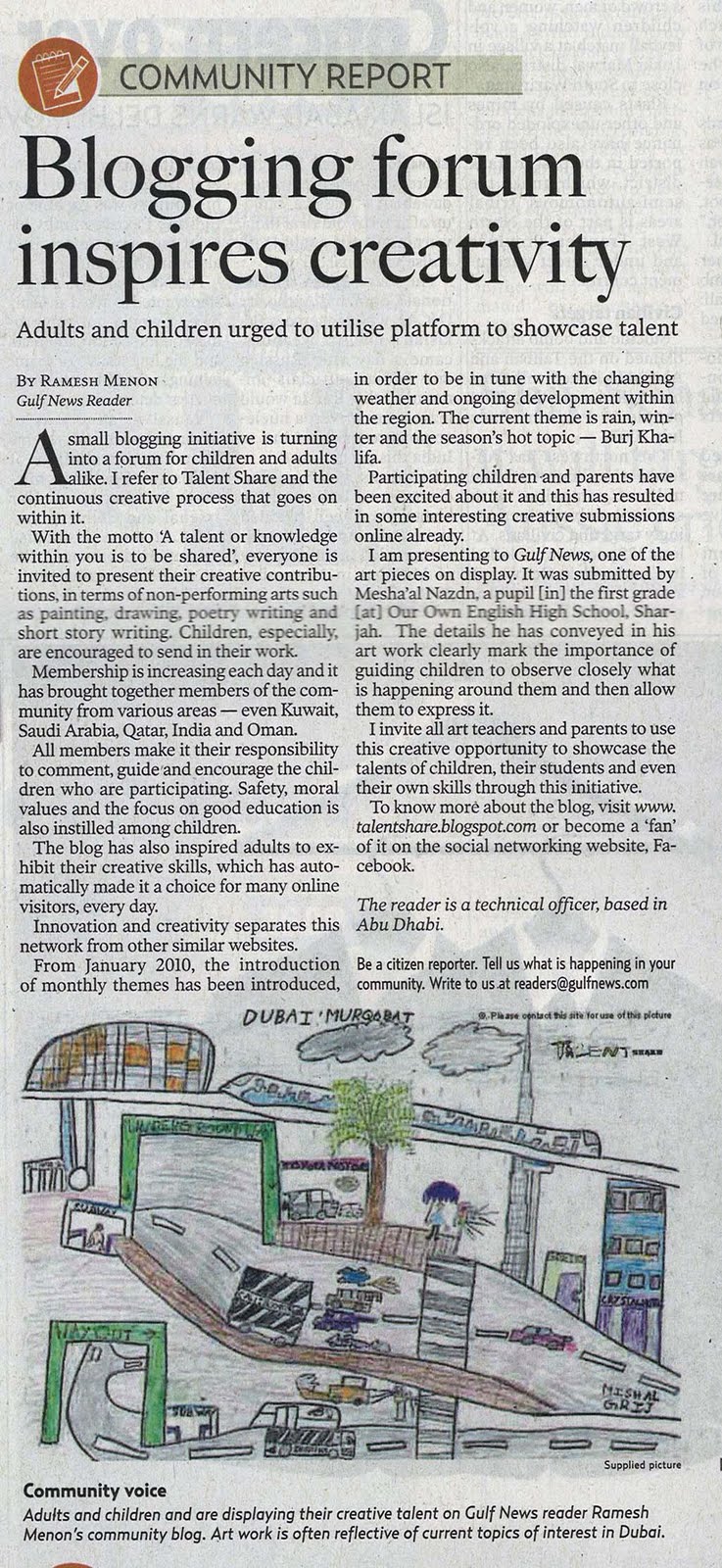
My Letters – GULF NEWS – 14 Jan 2010 – Blogging forum inspires creativity
My Letters – GULF NEWS – 14 Jan 2010 – Blogging forum inspires creativity
To read my letters to the news, please bookmark and visit Letters to the Editor
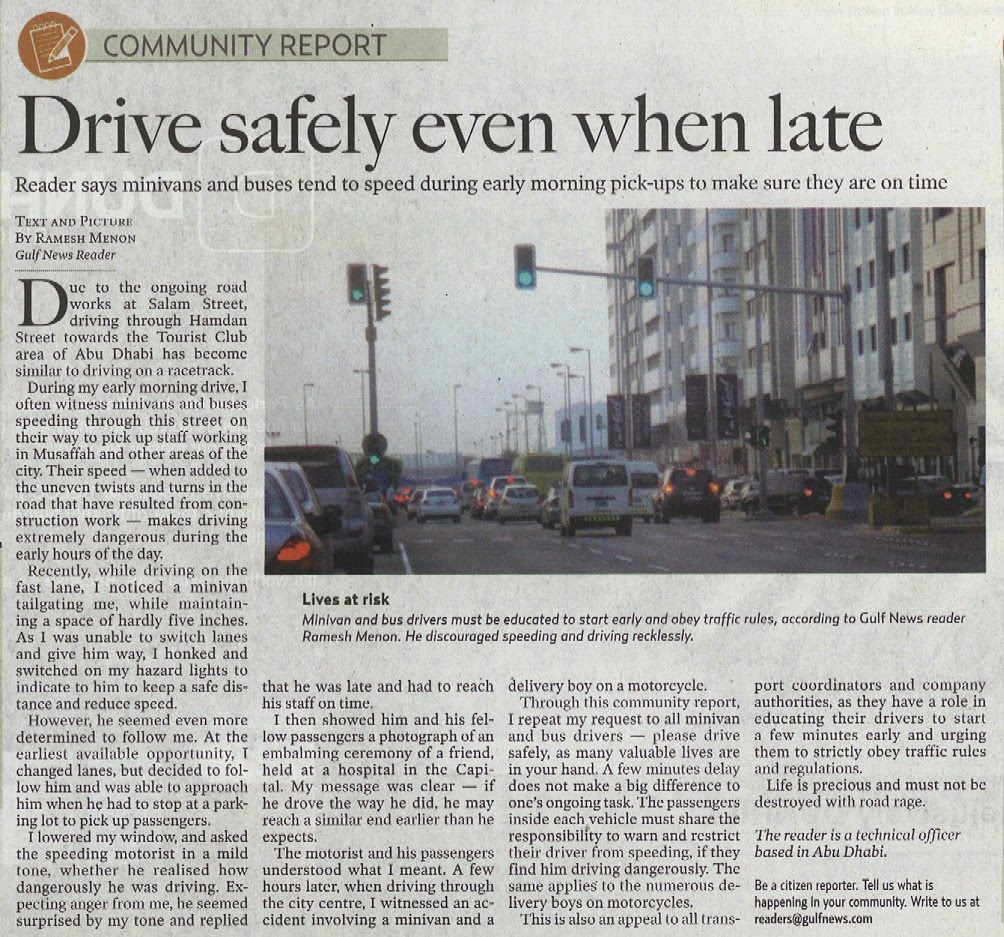
My Letters – GULF NEWS dt 03 Jan 2009 – Drive Safely even when late
My Letters – GULF NEWS dt 03 Jan 2009 – Drive Safely even when late
To read my letters to the news, please bookmark and visit Letters to the Editor
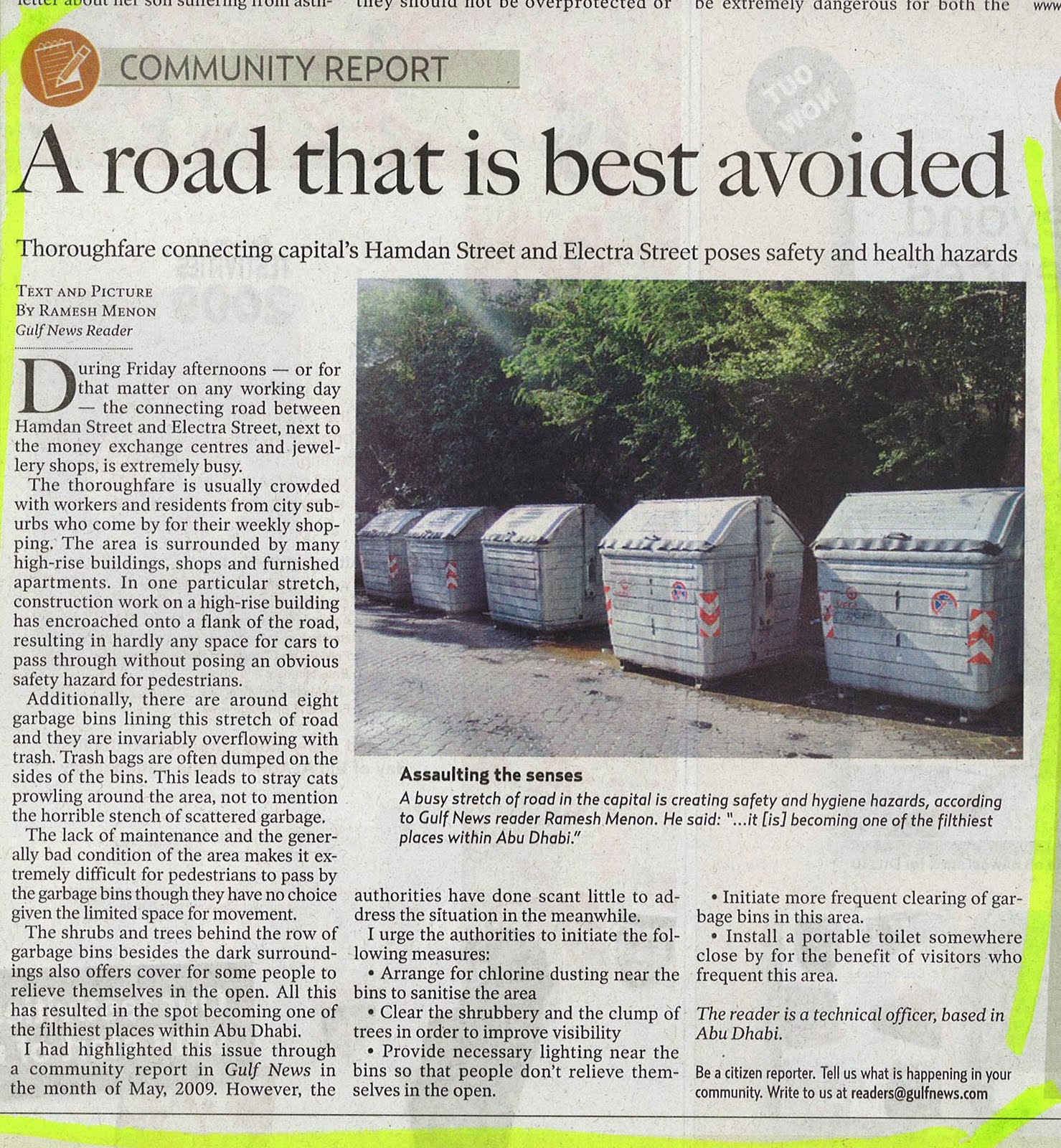
A road that is best avoided – My Letters – GULF NEWS
My Letters – GULF NEWS – A road that is best avoided
To read this report in original, please click here to visit GULF NEWS online section.
To read my letters to the news, please bookmark and visit Letters to the Editor
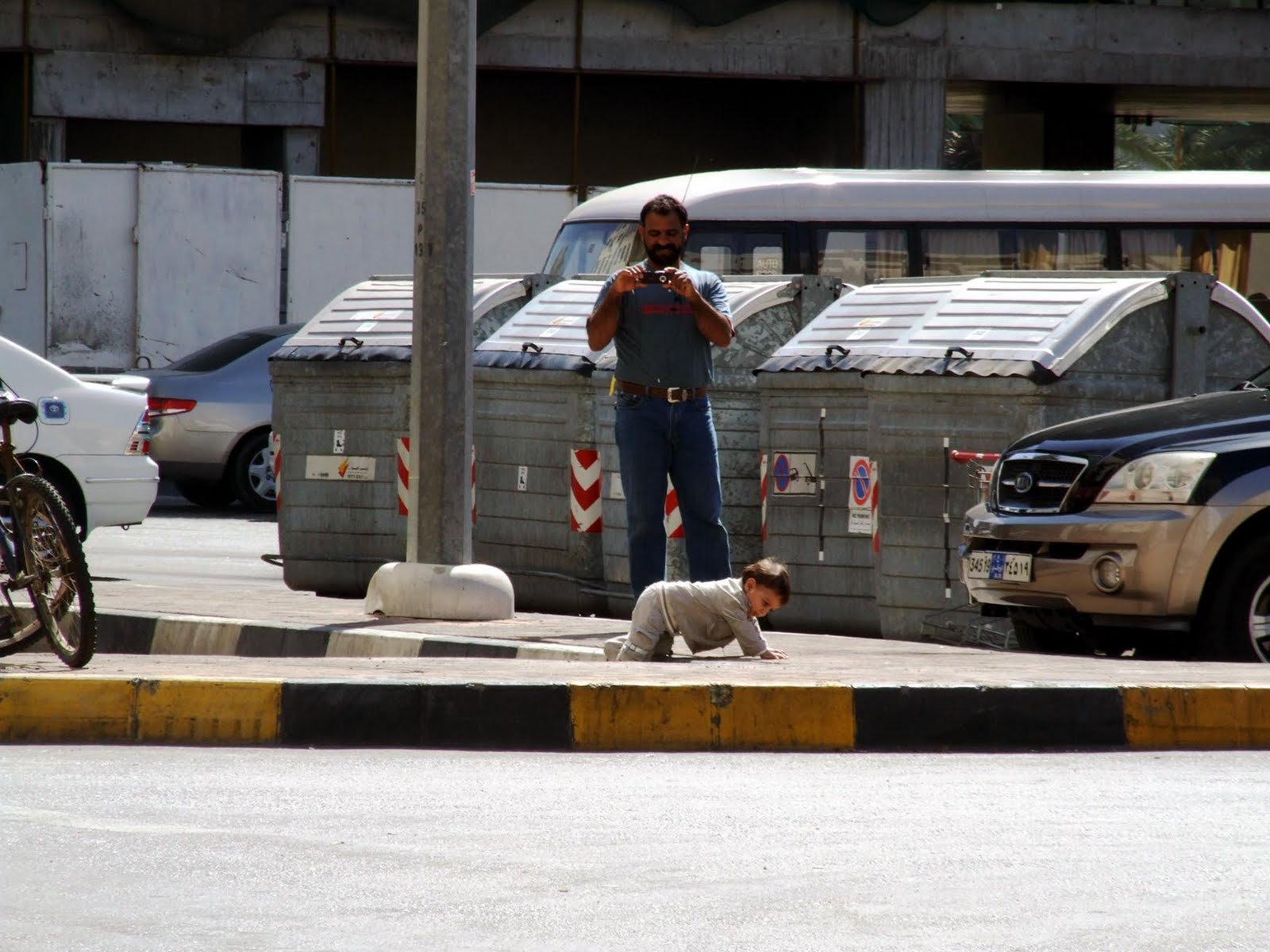
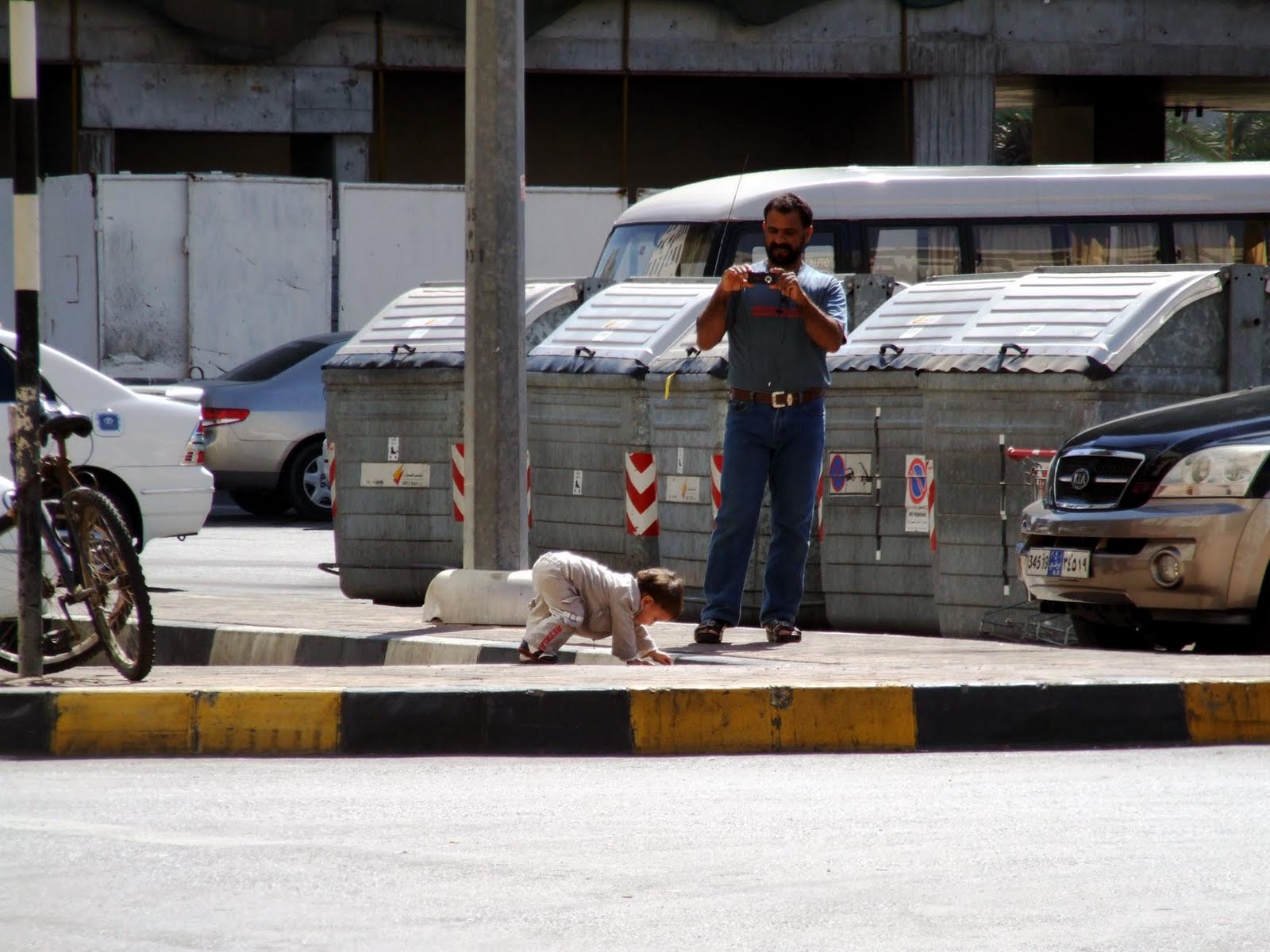
My Letters – GULF NEWS – First steps
My Letters – GULF NEWS – First steps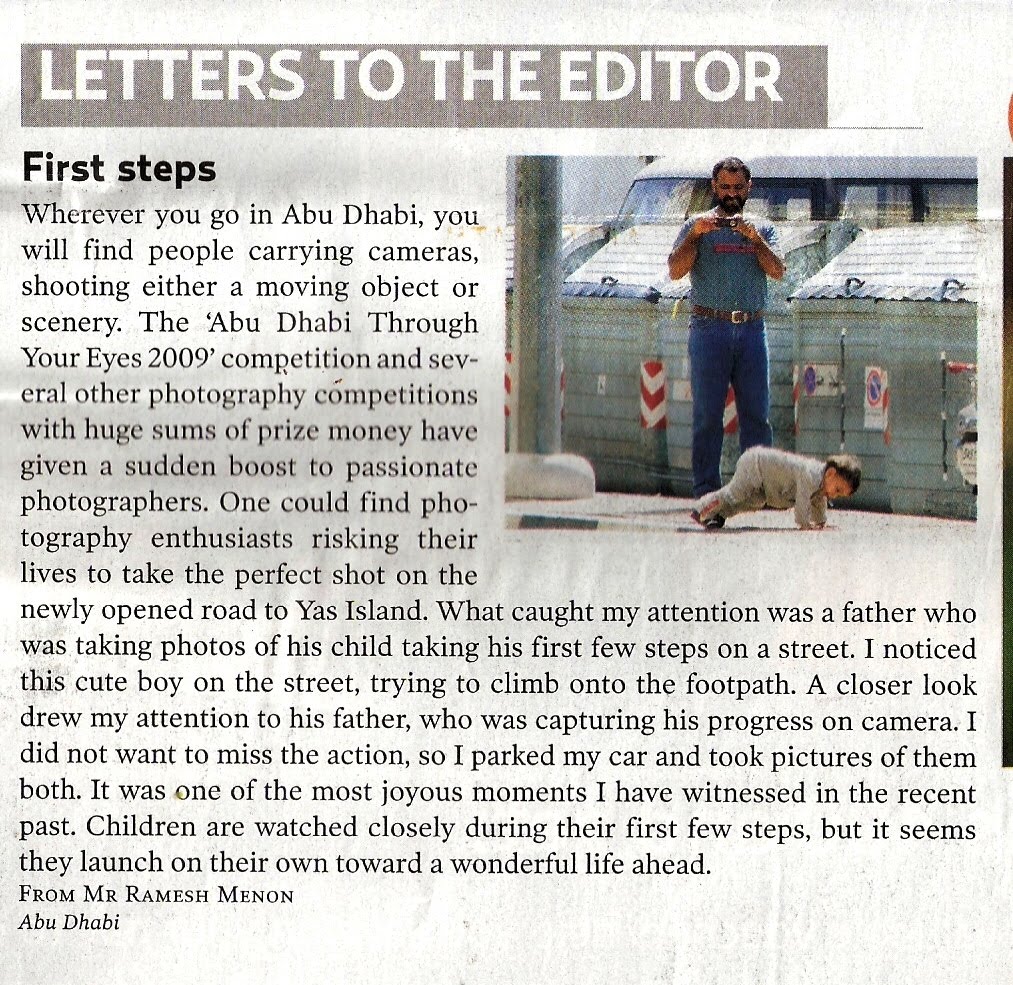
To read my letters to the news, please bookmark and visit Letters to the Editor
You may also watch a short video of this precious interaction:
http://www.youtube.com/get_player
- ← Previous
- 1
- …
- 12
- 13
- 14
- Next →
 ClicksandWrites

You must be logged in to post a comment.