Carnatic Raga Reviews
Am I Singing Right?
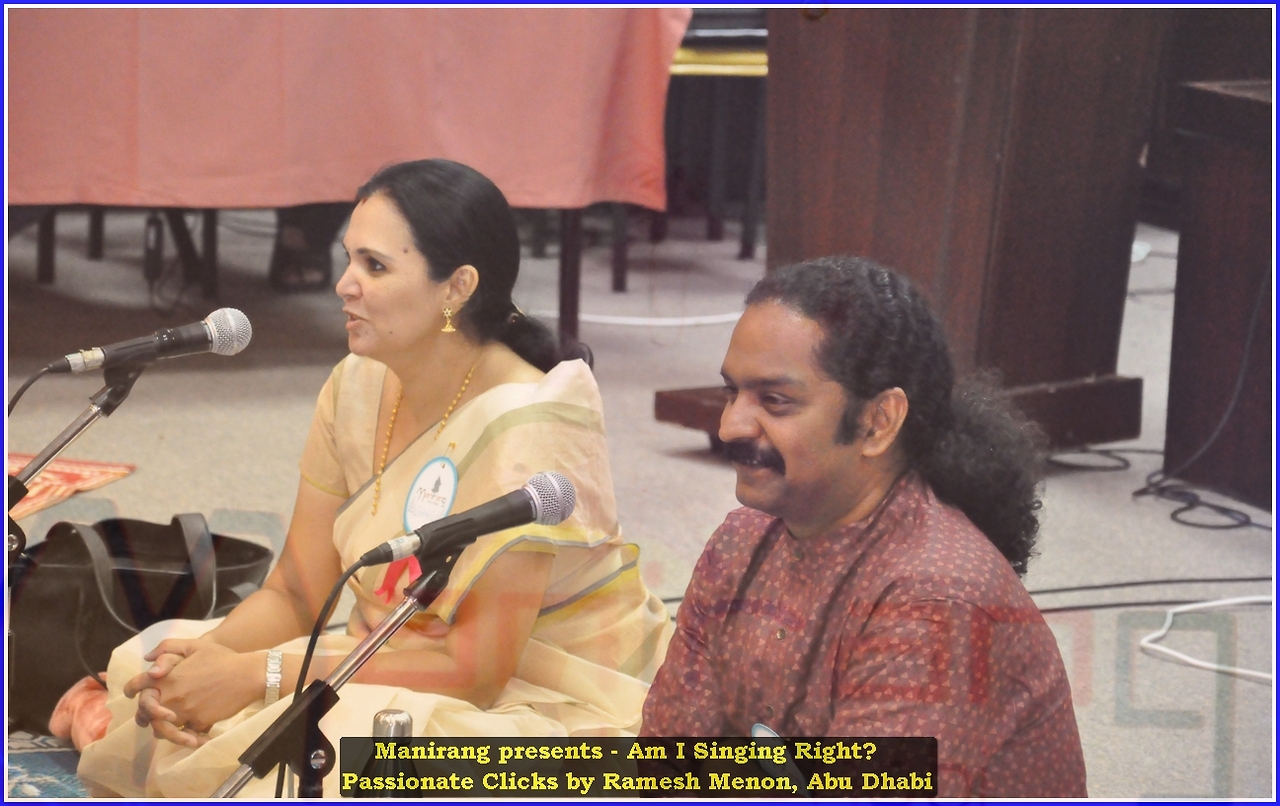
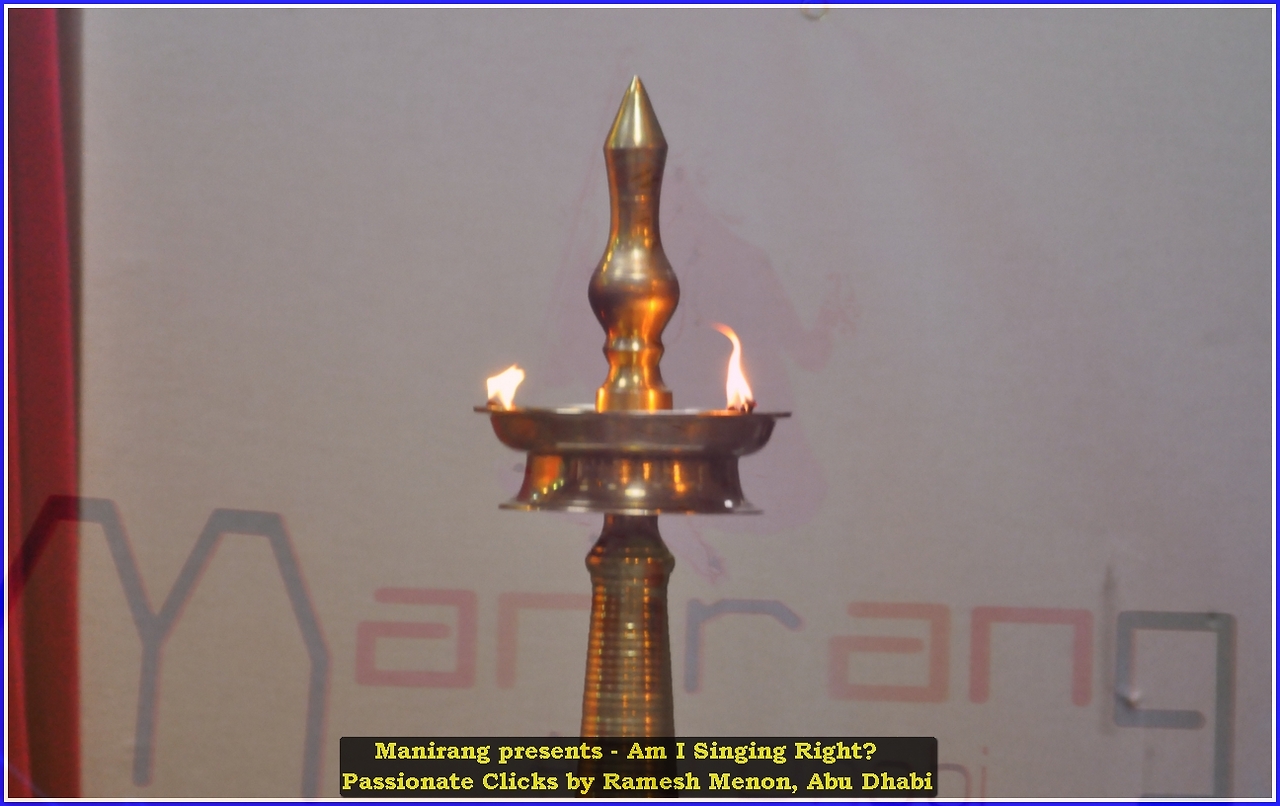
Manirang presents – Am I Singing Right? an extremely interesting and first of its kind in the history of Abu Dhabi programme by eminent musician Dr. Sreevalsan J Menon along with Dr. Preetha Menon, renowned Psychotherapist and academician on 12-13 April 2013. Open forum for rasikas tomorrow at ISC Mini hall from 1:30 to 3:00 pm. Closing ceremony follows with distribution of score cards and certificates.
For more information, please visit www.manirang.com
Sri Neyyattinkara Vasudevan
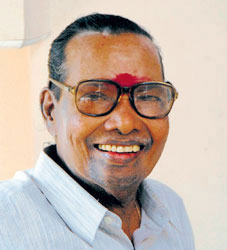
Sri Neyyattinkara Vasudevan
Neyyattinkara Vasudevan (1940-2008) was a leading Carnatic vocalist from Kerala. He belongs to Neyyattinkara , a township south of Thiruvananthapuram.
Vasudevan born in humble surroundings and after finishing his high school studies, his ardent love towards Carnatic music prompted him to join the Swathi Thirunal Music College at Thiruvananthapuram. He passed Ganabhushanam in 1960 and Sangeetha Vidwan in 1962 with colours. His skills were honed in the College by a bunch of reputed musicians under the leadership of the illustrious Semmangudi Sreenivasa Iyer. Later Vasudevan imbibed the esoteric subtleties from a rigorous training meted out by Ramnad Krishnan in Chennai. Vasudevan’s career graph soared upwards with his arrival to Tripunithura to serve as Assistant Professor in RLV College of music there. This hoary royal town has ever provided a fecund soil for any aspiring musician to bloom and Vasudevan was no exception. With his charming disposition and a positive approach to his chosen vocation, he became immensely popular. In 1974, he joined the All India Radio, Trivandrum as ‘A Grade’ Staff artist in Vocal Music from where he retired in 2000. The AIR honoured him with ‘A Top Rank’ – the highest rank in Carnatic Classical Music. He has been to American countries and Canada in 1983, 1984 and 1994 respectively for giving public performances and for imparting music to music lovers. He has also given public performances in Abudhabi, Dubai, and Muscat during his tour in 1992.
Sri Vasudevan died on May 13, 2008.
Albums and Recordings
The A.V.M Studios has released a cassette of Swathi Thirunal Krithis sung by Vasudevan. The C.B.S has produced two cassette volumes, sung by him, containing Krithis of different composers. The HMV & Manorama Music have also produced a volume of krithis rendered by him. For the film “Swathi Thirunal”, Sri.Vasudevan served as consultant for music aspects. He has also sung in films (Classical Music only) such as “ENIPADIKAL (1968)”, “SWATHI THIRUNAL (1987)”, “CHITHRAM (1988)”, “VACHANAM (1990)” & “MAZHA (2000)”.
He has recorded a music album Classical Encounters with his diciple Sreevalsan J Menon
Rendition Style
His strict adherence to tradition and yet innovating within it, unique style of raga elaboration, inimitable style of rendering rakthi ragas, rendering of compositions in appropriate tempo, compact swaraprasthara and above all his capacity to build up a rapport with the accompanying artists as well as his listeners brought him encomiums even in a place like Chennai where the audiences are fastidious by nature. When he secured the prize for the best sub-junior vocalist in 1971, at the Music Academy, roaring reviews had appeared in the leading newspapers. Vasudevan’s gift for voice modulations and flourishes are always enviable. He comes out always with a clean diction and his format during a concert is evenly distributed among our Sahajavaggeyakaras. He has taken a lot of pains in popularising, Swathi Thirunal compositions throughout the country and abroad.
Disciples
Vasudevan is blessed with a number of disciples in South India and U.S.A. Some of the performing musicians who are his disciples include M.G.Sreekumar, Sreevalsan J.Menon, Late Thripunithura Lalitha, Mukhathala Sivaji, Alleppey Sreekumar, Suresh.K.Nair, Vellayani Ashok Kumar, Narayanan Nair etc.
Honours and Awards
Vasudevan has been given the Indian President’s Award in the A.I.R. Music competition in 1960. He has been given music concerts regularly in Madras Music Academy ever since 1972. He has been given awards for Best Vocalist in the years 1972, 1978, 1982 and 1988 by the same institution. In 1993 he was given award for Best Musician in Raga rendering.
He has been giving public performances throughout India and abroad. Almost all top ranking violinists and mridangists have accompanied him in his concerts. He has also been featured in the National Programme of Music and Radio Sangeetha Sammelan concerts. The Kerala Sangeetha Nataka Academy Award was given to him in the year 1982 and the prestigious Sangeetha Nataka Academy Fellowship in 1989. He received the Tulasivanam Award of Kerala in 1992. The title “Asthana Vidwan” was conferred on him in 1984 by the Sri. Venkateswara Temple Trust, Pittsburgh, U.S.A. The Govt. of India’s Sangeeth Natak Academy, National Academy of Music, Dance and Drama honoured him with the Academy award for Carnatic Music in 2000. The prestigious Padmasree came in search of him in 2004 and the Swathi Puraskaram in 2006/7 by Kerala State Government.
More news on late Sri Neyyattinkara Vasudevan
He studied at the Swathi Thirunal Music collage and served as a professor of music there. His music is a combination of tradition and innovation. He has contributed in a big way to popularize Swathi compositions both as a teacher and a performer.
Hailing from Neyyattinkara, to the south of Thiruvananthapuram district, he studied in the Swati Tirunal College of Music here. The Carnatic music world realised his immense potential during his initial days of performance itself. Here was a singer in the truly classical mould who was not afraid of innovations. This twin quality made him acceptable to both the traditionalists and the innovators. To the delight of both, he soon took the Carnatic music world by storm. His concerts were eagerly awaited in the music circuits of Kerala. The sheer brilliance of his rendering made him acceptable to even the most exclusive institutions engaged in the promotion of exquisite music and brilliant singers.
He has succeeded in grooming up a group of talented young singers who are expected to do him proud in the coming days.
A jury headed by Sangeetha Nataka Akademi chairman Murali selected Mr. Vasudevan for the Swathipurasakaram award.
Musicians Remesh Narayanan and B. Arundhati and Sree Swathi Tirunal College of Music Principal Rajalakshmi were the members of the jury.
Semmangudi Sreenivasa Iyer, Ustad Bismilla Khan, D.K. Pattammal, K.V. Narayanswami, T.N. Krishnan, Pandit Bhimsen Joshi, Kalamandalam Sankaran Embranthiri, Mavelikara R. Prabhakara Varma and Umayalpuram Sivaraman are the past winners of the award.
He was 68 and is survived by wife and two sons, according to his family sources. Contributing in a big way to popularise Swathi compositions, his music is a combination of tradition and innovation. Neyyattinkara Vasudevan was so popular for his charming disposition.
Vasudevan was born in 1940 in humble surroundings at Neyyattinkara near here. After finishing his high school studies, he joined the Swathi Thirunal Music College at Thiruvananthapuram because of his ardent love for Carnatic music.
He was recognised as ”Ganabhushanam” in 1960 and ”Sangeetha Vidwan” in 1962. Vasudevan had served as Assistant Professor in RLV College of music at Tripunithura. In 1974, he joined All India Radio (AIR), Thiruvananthapuram as an ‘A Grade’ artist. He retired in the year 2000.
Vasudevan was honoured with many awards, including the Padmasree in 2004 and the Swathi Puraskaram in 2007.
He was also awarded the Sangeeth Natak Academy for Carnatic Music in 2000 and the Kerala Sangeetha Nataka Academy Award in 1982. He was also awarded the Sangeetha Nataka Academy Fellowship in 1989.
From The Hindu when he was selected for the Swati Puraskaram
Extraordinary musician and teacher: Neyyattinkara Vasudevan.
Neyyattinkara Vasudevan, who has been selected for the Swati Puraskaram, has renewed, refined and enriched the musical tradition he inherited from the great masters of Carnatic music.
His unlimited generosity as a guru has enhanced the lives of his disciples.
Ask mridangam maestro Umayalpuram Sivaraman about his favourite Carnatic musician from Kerala, and he would reply quickly: “Neyyattinkara Vasudevan.”
The master percussionist once told the audience at a concert in Mumbai: “If you want to be treated to the music of Semmangudi Srinivasa Iyer, Ramnad Krishnan and M. D. Ramanathan simultaneously, listen to Neyyattinkara Vasudevan.”
The maestro from Neyyattinkara, near Thiruvananthapuram, has renewed, refined and enriched the musical tradition he inherited from the great masters of Carnatic music. He has spiritedly preserved this tradition through his concerts and lessons to two or three generations of students, becoming its most important icon in post-Independence Kerala.
He likens a brilliant concert to a dynamic painting by an artist who has a definite idea about how to set out the elements, choose a light source and what to include or exclude in the composition.
Early 1990s. Being his disciple, I was with him as he proceeded to present a concert at the Ramaseva Mandali in Bangalore. Sometime ago, he had taught me ‘Sukhiyavaro’ in raga Kanada. When he was freshening up before the concert, I practised the raga with different swara combinations.
He stepped out of the shower, and said: “The sangathis (phrases) are good, but too many of them will make the presentation stale. Brevity is the soul of wit.”
Economy of expression
Economy of expression is the hallmark of his concert. He has proved that brevity in raga delineation, in swara prasthara and neraval is a worthy counterpoint to elaboration.
Nevertheless, each time you listen to him singing a raga, it would sound different. Concert to concert, he would change the manner of elaboration, pushing the boundaries of creativity. Sometimes, the raga presentation is guided by ‘lakshya.’ Here, the singer himself does not know which phrase comes next. There is a flow of spontaneous ideas.
On other occasions, he is guided by lakshana, where the plan is premeditated. In his concerts, there is a fine and majestic balance between the magical and the planned. He builds his musical edifice upon the foundations of brevity and balance.
Musicians of the younger generation have much to imbibe from the manner in which he interacts with fellow-beings. His simplicity, humility and, above all, unconditional love for others are exemplary. His unlimited generosity as a guru has enhanced the lives of his disciples. He would spend long hours teaching, making his disciples listen to stalwarts and discussing music.
If things went above their heads, he would say: “You will grasp this over time.”
He loves all forms of music, though he practises only the Carnatic style. He has made me listen to Pakistani brothers as much as G. N. Balasubramanian or M. D. Ramnathan. While we were travelling once, the background score of the film, ‘Salam Bombay’, composed by L. Subramaniam, was played in the car stereo. He exulted: “This is brilliant.”
He worked as assistant professor in the RLV College of Music, Thripunithura, for nearly a decade before joining All India Radio as an A-grade staff vocalist in 1974. He retired in 2000 and was later ranked A Top, the highest honour given by AIR to classical musicians. He never chased awards, but they came his way. He is a recipient of the Madras Music Academy Award, Kerala Sangeeta Nataka Akademi Award (1982), Kerala Sangeeta Nataka Akademi Fellowship (1989), Kendra Sangeet Natak Akademi Award (1999-2000) and Padma Sri (2004).
Apt award
The conferment of the Swati Puraskaram on him is apt as he has been one of the greatest ambassadors of the compositions of Swati Tirunals. The core of his music is embedded in the Semmangudi-Ramnad bani. He generally employs a madhyamakala tempo. His style of rendition is deceptively simple. He draws from D. K. Jayaraman’s adherence to kriti structure, M. D. Ramanathan’s brevity of presentation and G. N. Balasubramaniam’s raga elaboration. He pays close attention to diction.
I remember him having demonstrating the pronunciation of ‘Ra’ in ‘Rama Nannu Brova Ra.’ ‘Ra’ in ‘Rama’ is different from ‘Ra’ in Ratish or ‘Ra’ in ‘Rava.’ “Rama’s ‘Ra’ is somewhere in between,” he explained.
His ability to feel the pulse of the audience is much talked-about. Be it a Sangeetha Sabha in Chennai packed with connoisseurs or a cutcheri in a Kerala temple with lay listeners, he relates instantly to the audience and takes them to heights of aesthetic pleasure.
As mridangam maestro Mavelikkara Velukutty Nair says: “Neyyattinkara Vasudevan is an extraordinary musician and teacher – absolutely one of a kind.”
Links of songs sung by Sri Neyyattinkara Vasudevan
http://www.devaragam.com/vbscript/MusicNew.aspx?ArtistID=206
http://www.raaga.com/channels/malayalam/artist/Neyyattinkara_Vasudevan.html
http://www.hummaa.com/albumpage.php?pg=ja&lg=&lc=&md=27334&ps=
http://www.devaragam.com/vbscript/MusicNew.aspx?MovieId=57
http://www.thehindu.com/fr/2007/08/24/stories/2007082450320200.htm
Hope this collection of information on late Sri Neyyattinkara Vasudevan was useful to all of you and let us all join together collectively offering our regards and pranams to the departed soul of this musical maestro and offer our condolences to his family members. Music is immortal and he will continue to remain with us forever through his songs.
Madhyamavati – continued
Before that let us try to work out a way how we can listen to a song, here movie song and analyse the raga which the song is based on. A tough objective, isn’t ? . The way we look at it, some people have it easy, and can directly see the patterns and recognize a raga very easily. Some others learn by going to a guru, but for a casual listener, it might take some practice and some intuitive thinking. For those with no formal education of music, then there is a really fun, good and easy way to try and learn ragas. Listen to a song and get someone to identify the raga initially for you. Learn this raga, by listening to the song and try humming along with it. Then turn off the song, and try humming along the same tune, but with variations. Some songs are already listed above. Giving it a try?
Today, let us take a look at the popular pentatonic raagams (of which the discussion now is on Madhyamavathi) that have been handled in Carnatic music and inspired several movie song sequences over the years.
As the name indicates, pentatonic ragams have a scale consisting of 5 notes in the ascent (aarohanam ) and 5 notes in the descent (avarohanam ) of the scale. These are also called AuDava – AuDava raagams, meaning 5 note – 5 note raagams. In other words, out of the usual seven possible notes, S, R, G, M, P, D and N, two notes are left out to form the scale of the raagam. Mohanam, Madhyamavati, Hindolam, Shuddha Saveri and Shuddha Dhanyasi form a family of pentatonic ragams. They are part of one pentatonic family because, each of these raagams are similar in their structure and can be derived from the other by shifting the reference of the sa note. This kind of tonic shift is called Shruti ( Pitch ) Bedam or Graha( Location ) Bedam.
The inter-relationship between these ragams can best be summarized by the following table:
Raagam Scales ( Aarohanam or Ascent )
Mohanam S R2 G3 P D2 S+ R2+ G3+ P+ D2+
Madhyamavati S R2 M1 P N2 S+ R2+ M1+ P+
Hindholam S G2 M1 D1 N2 S+ G2+ M1+
Shuddha Saveri S R2 M1 P D2 S+ R2+
Shuddha Dhanyasi S G2 M1 P N2 S+
Note that S, R, G, M, P, D, N, denotes the commonly known Sa, Ri, Ga, Ma, Pa, Dha, Ni and the number suffix is the type of that particular note. The suffix “+” represents the note in the next octave.
The blank cell in the table after the S in each row represents the note in that position is not being used for that particular raagam. (However, due to space constraints – I was unable to project the note spacing correctly here).
For example, the scale ( Aarohanam ) for Madhyamavati is attained by shifting the Sa of Mohanam to its R2 position and playing the other notes in the scale successively. Similarly, when you shift the reference Sa along G3, P, D2 of Mohanam, you get the other raagams in the family, namely Hindholam, Shuddha Saveri and Shuddha Dhanyasi respectively. There are also many other raagams based on the pentatonic scale other than the ones mentioned above.
As we slide one step over from Mohanam’s AarohaNam (ascent ) by performing a tonic shift ( Graha Bedam or Shruti Bedam ), we land on the second raagam in our pentatonic family, Madhyamavati. This implies that the R2 of Mohanam is taken as the Sa of Madhyamavati. Being an Audava – Audava raagam, Madhyamavati’s AarohaNam is Sa Ri2 Ma1 Pa Ni2 Sa and the AvarohaNam (descent ) is Sa Ni2 Pa Ma1 Ri2 Sa. This raagam is unique in that it is the only raagam in this pentatonc family that is very gamakam (oscillation) oriented and it requires to be performed by accurately oscillating the Ri2 and the Ni2 notes above their respective base frequencies.
Sruti/Graha Bedham is the technique in which a new raga can be derived from the original raga, by changing the sruti (shadjam) . For example, if a singer is singing the raga mohanam (aro: S R2 G3 P D2) and he/she makes the rishabam (R2) of mohanam as the shadjam, then we get the madhyamavati raga (aro : S R2 M1 P N2 ). This is because (R2 G3 P D2 S) is equivalent to (S R2 M P N2) when R2 is assumed to be s. This is the essence of graha bedham.
There is also another theory involved. If raga B can be derived from A and raga C can be derived from B then raga C can be derived from A. That is, A*I–>B and B*J–> C implies A*K–>C for some swara K. For example, madhyamavati can be derived from mohanam (by letting R of mohanam be the S) and hindolam can be derived from madhyamavati (by letting the R of madhyamavati be the S). This implies that hindolam can be derived from mohanam — this is true. (by letting G of mohanam be the S).
As I wrote earlier yesterday, Madhyamavati is the janya (child) raagam of the 22nd Melakartha (parent) raagam Karaharapriya. It is said to be a Suraagam – an auspicious raagam or Shubhakaram – that which brings goodness. Performing the raagam is said to ward off sins (doshams) caused by singing other raagams at inappropriate times. It is well suited to be rendered in virutthams, raagamaalikaas and shlokams usually performed close to the end of the concert. Arunachala Kavi has employed this raagam for many songs in his RamanaTakam. This raagam is capable of portraying Bhakti and KaruNa rasam. Madhyamavati aalaapanai is traditionally performed after the concluding number called the Mangalam (auspicious) number – Pavamaana Sudutu Pattu in Saurashtram raagam. Hindustani raagams Madhyamaadi or Madhyamaditi Sarang of the Kafi thaat have the same scale as Madhyamavati and hence form able counterparts. Madhyamavati is suitable to be performed in the late evenings.Carnatic music composers have zestfully fancied utilizing Madhyamavati in their compositions probably due to its natural ability to lend a propitious aura to their devotional lyrics.
Popular Carnatic compositions include:
Palinthsu kamakshi pavani (Shyama Shastri),
Venkatesha Ninnu, Alakalalla lADaga, Nadupai Balikeru, Ramakatha Sudha (Thyagaraja),
Dharmasamvardhini, Pannaga Shayana Padmanabha (Muthuswami Dikshitar),
Karpagame KaN Paaraai, SharavaNabhava Guhane (Papanasam Sivan),
Shankari Shri Rajarajeshwari, AaDaadu Asangaadu Vaa (Ootthukadu Venkata Subbaiyer),
Parthasarathi Nannu (Ramanathapuram Shrinivasa Iyengar ),
Vandaan Vandaan Bharatan (Arunachala Kavi),
Saarasamukha Sarasijanaabha, Shri Padmanabha Kalayitum (Swati Tirunal),
Nannu brova raada, Raamabhiraama (Mysore Vasudevachar),
Shri Parameshwara, Shrimad Tripura Sundari (Mutthaiah Bhagavatar),
the ever popular Bhagyada Lakshmi Baaramma (Purandaradasar) to name a few.
The aesthetic elegance of Madhyamavati has apparently fascinated film music directors from all over India, especially the ones in the south. Particularly in the 60s and 70s the popular tamil movie songs tuned in Madhyamavati :-
Pon Ondru Kanden (Paditthaal mattum podhuma, 1962, Viswanathan-Ramamurthy), Aagaaya Pandalile (Pon Oonjal, 70s), MutthukkaLo KaNgaL (Nenjirukkum Varai, 1967, MSV) are still unforgettable.
Ilayaraja seems to have been so mesmerized by this raagam that he has atleast a couple of dozen songs tuned in Madhyamavati. Significant ones in his compositions are En Kalyana Vaibhogam (Azhage Unnai Aaraadhikkiren, 1979), Nee Daane Endan Pon Vasantham (Ninaivellam Nithya, 1982), Aagaaya Gangai (Dharma yuddham, 1979), Thaazham Poove (Kai Kodukkum Kai, mid 80s), Aananda Ten Sindum (MaN Vaasanai, 80s), Malargalil aadum (Kalyana Raman 1979) , Thulli Thulli (Chippikkul Muthu, 80s), Solai Kuyile (Ponnu Oorukku Pudusu, 80s), Kavidai Paadu Kuyile (Thendrale Ennai thodu, 1985, partially Brindavana Saaranga) and Nila Kayudu (Sakalakalaa vallavan, 1982, partially SriRaagam).
There are indeed several compositions influenced by Madhyamavati, in Kannada, Telugu, Malayalam films and even Punjabi Bhangda. Perhaps the auspicious, joyous and peaceful nature of Madhyamavati makes it such a sought-after raagam in the field of music.
Let us also try to discuss Madhyamavati (of 22 Mela Kartha) and it’s equivalent Hindustani Ragas:
Hindustani Raga That
Chanchaldas Malhar 10
Madhumad Sarang 10
Madhyamadi Sarang 10
There are some more interesting information on this auspicious raga:
Madhyamavati is one of the select twenty eight Ragas in which there is at least one composition by each member of the Trinity. The distribution of the total twenty two is as follows:
Tyagaraja – 15, Dikshitar – 4, Shyama Shastri – 3
The composition suited for rendition at the conduct of “Nalangu” (Nalangu is a tradition that dates back to times when marriages used to occur at a younger age) is: “Nagumomu Galavari” by Tyagaraja.
The composition that link Devi, Madhyamavati and Tyagaraja is “Vinayakuni Valenu”.
The Mangala-Kriti in Raga Madhyamavati, specifically composed as a Mangala Kriti is “Kamakshi Lokasakshini” by Shyama Shastri.
Too much of theory and history, so let us enjoy some great Madhyamavati songs.
More on Madhyamavati Raga:
More on Madhyamavati Raga:
—————————
I believe a lot in nimitham and the raga which came to me to begin this thread happened to be Madhyamavathi. This is a very auspicious raga. Even though it can be sung at all times ,morning 9-12 is considered to be the most appropriate time for singing this raga. Being a mangala raga mostly concerts are concluded with a piece in this raga. There is a belief that all the ill efects of any mistakes made in the concert is nullfied by singing this raga.
More on the theory part of this Raga:
Madhyamavati is a janya raga derived from 22nd melakartha kharaharapriya. Audava raga (5swaras in arohana and avarohana). The swaras taken are shadjam, chatusruti rishabham, sudha madhyamam, panchamam and kaisiki nishadam. ri ma and ni are the raga chaya swaras. This is a sampurna murchanakaraka ragam. The swaras ri, ma, pa and ni when taken as tonic note give the ragas hindolam, sudha saveri, sudhadhanyasi and mohanam.
Some compositions in this raga are:
Ramakadha suta- adi- Tyagaraja
Naadupai- khanda chapu- Tyagaraja
Kosalenda- adi- Swati thirunal
Palimsu kamakshi- adi- Syamasyastri
Sharavanabhava-adi- Papanasam sivan
More later and would definitely include a summary each time so that anyone interested can keep it as a reference.
Madhyamavathi – basics
Raga : Madhyamavathi
Mela: Kharaharapriya, 22
Arohana : S R 2 M 2 P N 1 S S Ri Ma Pa Ni S
Avarohana : S N 1 P M 2 R 2 S S Ni Pa Ma Ri S
Rasa : devotion
Jeeva Swaras : R, N
Special Considerations: Allows janta swaras and dattu swaras. Can be sung in madhyamakala.
Usually sung at the end of kutcheries. Srutibhedam of this raga results in Hindolam, Sudha dhanyasi, Mohanam, Udayaravichandrika etc..
Famous Kriths and compositions: sadaram ha bhajare – varnam, Vinayakuni, Rama Kadhasuta etc.
Sancharas: ni..pa.. pa.ma.ni.pa….pa.ma.ri….sa.ri.ma.pa.ni…ma.pa.ni.SA. RI. SA.
You may find more about this raga by visiting these links:
http://www.esnips.com/_t_/madhyamavathi
Another, more interesting fact is this is the raga in which the famous ayyappa slokam Harivarasanam is set:
 ClicksandWrites